Executive Summary
This was compounded by the fact that it was difficult for members of the public to judge the competence of legal professionals, and they often had a lot to lose when faced with legal problems. As a result, people felt vulnerable whenever they encountered a legal problem or had to use legal services. This sense of vulnerability became apparent as participants reflected on the potential compromises in the regulation of legal services.
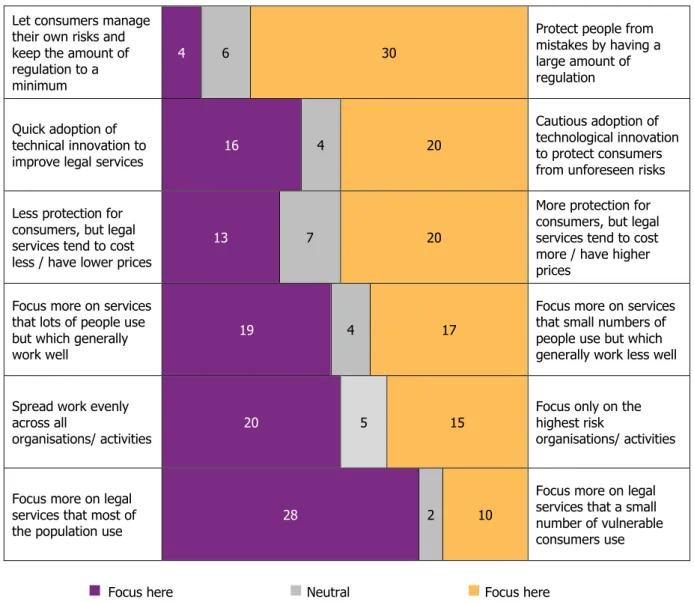
They also preferred to see regulation focused on protecting the majority of the population instead of the minority (even though that was the greatest need). Participants were pleased to see these themes reflected in the ten LSB 'hot topics', and their prioritization of the themes re-emphasized the importance of the themes. Nevertheless, most participants felt that all ten "hot topics" were important and found it difficult to prioritize.
Most felt that they had a vested interest, given that they had used legal services themselves or were likely to need them in the future.
Background & Objectives
Methodology
- Approach
- Recruitment and participant profile
- Process
- Notes on reporting
Ranking exercise, where the participants individually ranked the five consumer-facing 'hot topics' in priority order. Additional information on each of these topics with discussions of participants' reactions to this information. Ranking exercise, where the participants individually ranked the five profession-oriented 'hot-topics' in priority order.
Final ranking exercises to re-rank the consumer-oriented topics and then the vocational topics to gauge whether the information had influenced participants' views on prioritization. All figures presented in the report are raw numbers, not percentages, and only apply to this cohort of participants. Nevertheless, the findings provide insight into some of the logic and reasoning behind participants' decisions and opinions, and the approach made it possible to understand the influences on individuals' thinking, and how this changed over time.
The report includes differences by subgroups of participants, where these are strongly indicated in the raw data.
Main findings
The public’s prioritisation of ‘hot topics’ for the LSB to focus on
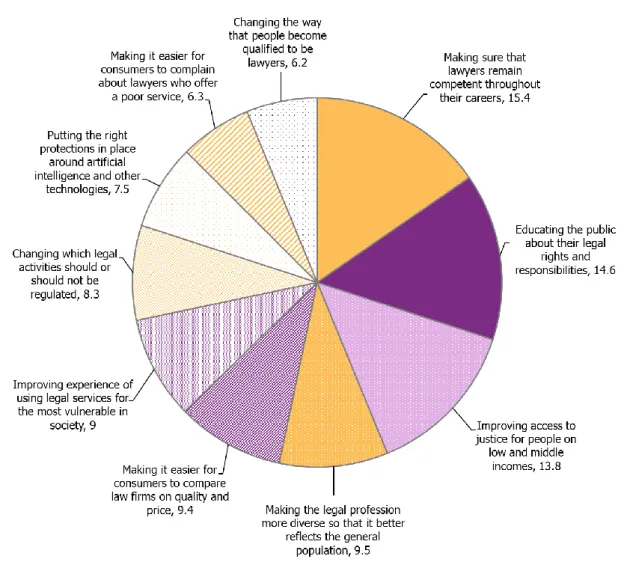
Greater focus on lawyers' competency, public legal education and access to justice for those with low and middle income;. Some focus on the diversity of the profession, allowing comparisons between law firms, improving experiences for the most vulnerable, and revising the list of regulated activities;. In the run-up to this final award exercise, the research explored the factors influencing participants' priorities, including their personal experience of legal issues and the legal profession and their expectations of a legal services regulator.
They also considered each of the 'hot topics' in greater depth and talked about their reasons for prioritizing them as they did.
Driving factors: what influences participants’ priorities?
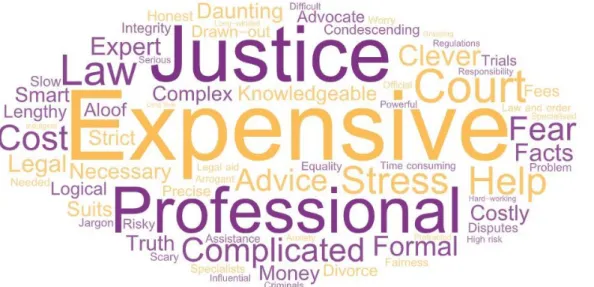
During the week-long online forum, and regardless of experience level, three themes emerged repeatedly in participants' perceptions of lawyers and legal services: cost, quality/competence, and understanding. For some, the cost prevented them from using legal services when they had a problem of a legal nature. For all, the high cost of legal services meant that they saw it as a high-risk investment.
There have been countless times I could have gotten legal help to help with layoffs and issues with my mortgage payments while I was unemployed, but due to resource constraints I felt I couldn't afford [it]. Female, 55-74, Wales. Probably only friends who are in law school and willing to help me cheaply since I couldn't afford legal services. Female, 18-24, Southern England. Participants discussed their lack of understanding regarding legal issues, the law, their rights and access to legal services.
The issues of cost, competence and understanding led to an undercurrent of fear (and - for some - mistrust) in using legal services. The cost element is also difficult, since legal services are initially very expensive.” Female, 55-74, Northern England. Participants' knowledge of the regulation of legal services was low and no one said they knew about the LSB prior to the survey.
Several spoke about the scope of regulation of legal services, expressing concern when they learned that some legal activities were not covered. As some participants had previously discussed will writing issues, there was concern that this in particular would not fall within the scope of legal services regulations. In part, it includes inequality in access to funds, legal services, and justice (either in the form of due process where one side is better represented than the other, or outcomes).
Participants acknowledged that their lack of knowledge and understanding of the law, legal services and the justice system was a problem. Some also felt that the LSB should raise its own profile and that this would increase people's confidence in using legal services. However, it also reflects a concern that there are lawyers taking advantage of people and that some people are not getting a fair deal in legal services at the moment.
One of] the key issues I see that LSB could focus on solving would be.
In detail: Consumer power and protection
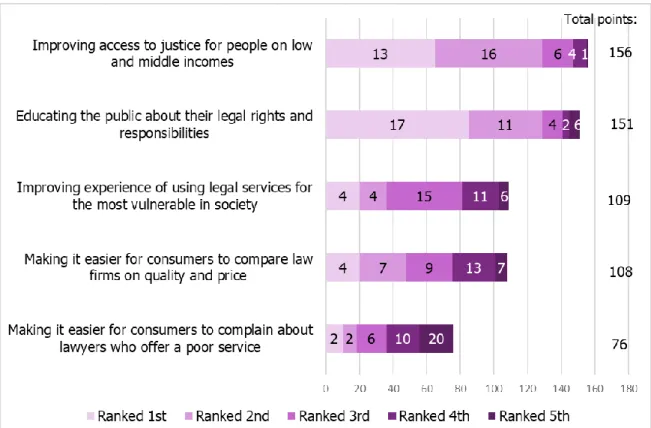
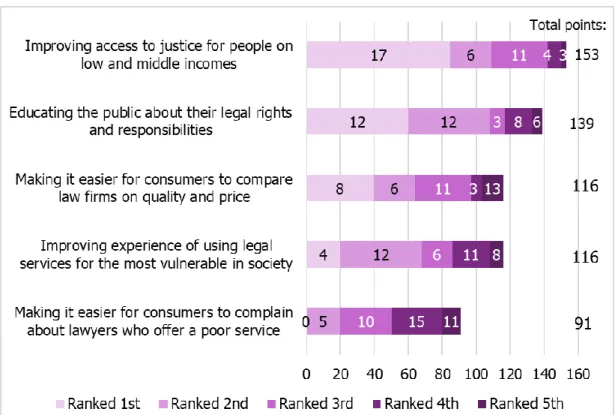
After spontaneously ranking the five themes, participants watched an explanatory video and received further written information about each theme, including why it was important and the risks of not prioritizing it. The size of the columns represents the points awarded, calculated as explained in Note 2. Throughout the survey, participants spoke of cost and personal finances as barriers to accessing legal services.
That was my priority in the sense that people on low and middle incomes are not going to get a fair justice system because they just can't afford it.” Male, 35-54, Wales. A minority of participants ranked this topic as the lowest priority of the five, mainly because they felt that there were other support systems for people on low incomes (such as legal aid and support from charities). Participants prioritized education because they felt that law, rights and legal services were confusing and poorly understood.
Some suggested that a better understanding of the issues would improve consumers' access to justice - if they better understand their rights and know how to enforce them, they are more likely to use legal services. Unless people understand what lawyers can and cannot do, they cannot get the best out of their services.” Female, 55-74, Southern England. This was one of the more polarizing topics – some participants were passionate about it, while others felt there was less of a need for it.
Overall, it came sixth out of ten subjects in terms of the number of 'points' assigned to it by the participants at the final allocation. As a socially responsible nation, we must ensure that the vulnerable and socially disadvantaged have access to legal services.” This topic was initially ranked fourth in the prioritization of the five consumer-focused topics, rising by a small margin to third after further reflection by participants.
Out of all ten subjects, it came fifth in terms of the number of 'points'. This was one of the topics that drew the most comments after participants considered the hot topics in more depth. However, the overall score for this edition dropped more than any other, after deliberating on the topics (from 91 to 76 points).
Improving the complaints process came in ninth out of ten topics in the final allocation exercise, suggesting that participants preferred to see the LSB focus on most of the other issues they discussed.
In detail: Maintaining high standards in the legal profession
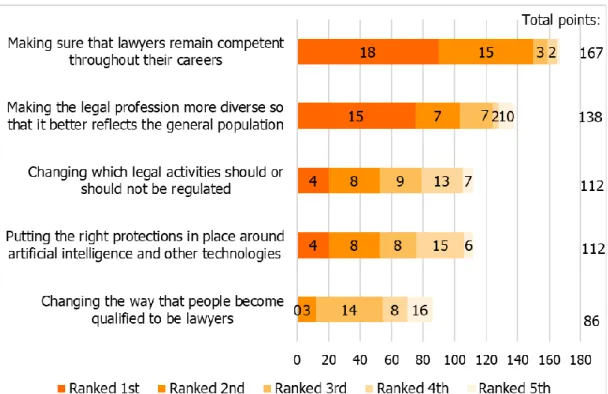
In detail: Maintaining high standards in the legal profession Following the procedure described above, participants were asked to consider five. Ensuring the competence of lawyers throughout their careers At the start of the survey, participants spoke spontaneously about the issue of competence among legal professionals: some were faced with errors in wills, missed instructions and slow transfer processes. It is therefore perhaps not surprising that 18 participants chose this topic as their top priority in the initial prioritization task.
It also received the largest distribution of 'points' of all ten topics in the final division exercise, suggesting that this was the area where participants wanted to see the greatest regulatory focus. Participants were concerned that the lack of ongoing competency checks could result in bad advice and affect people's confidence in the legal profession and legal advice. I think this definitely needs to be addressed to protect us all in the future.
It should be borne in mind that some participants had mistakenly assumed that lawyers are not required to have any ongoing training or development, despite this being explained in the video. In the initial prioritization, 15 participants ranked this as their top priority and 10 ranked it as their bottom priority. In the final awarding exercise, this number received the fourth highest award of 'points' on average.
Among those who ranked this topic among their top priorities, participants felt that there are currently problems with diversity and nepotism in the legal profession. Some participants felt that this was an issue of fairness – that all ethnic groups should be well represented and feel welcome in the legal profession. In the final allocation, this topic was eighth out of 10 topics in terms of 'points' allocation, indicating that on average participants thought it should have a lower priority for LSB.
A few participants were concerned about the potential for risk in the development of AI and new technology, and therefore considered it their top priority. The qualification process received the lowest score of all topics related to regulation of the profession in the initial prioritization. They accepted the process was quite robust and sufficiently challenging to maintain high standards in the legal profession.
Overall, however, this theme received the fewest "points" in the final award.
Conclusions
Appendix A: Participant profile