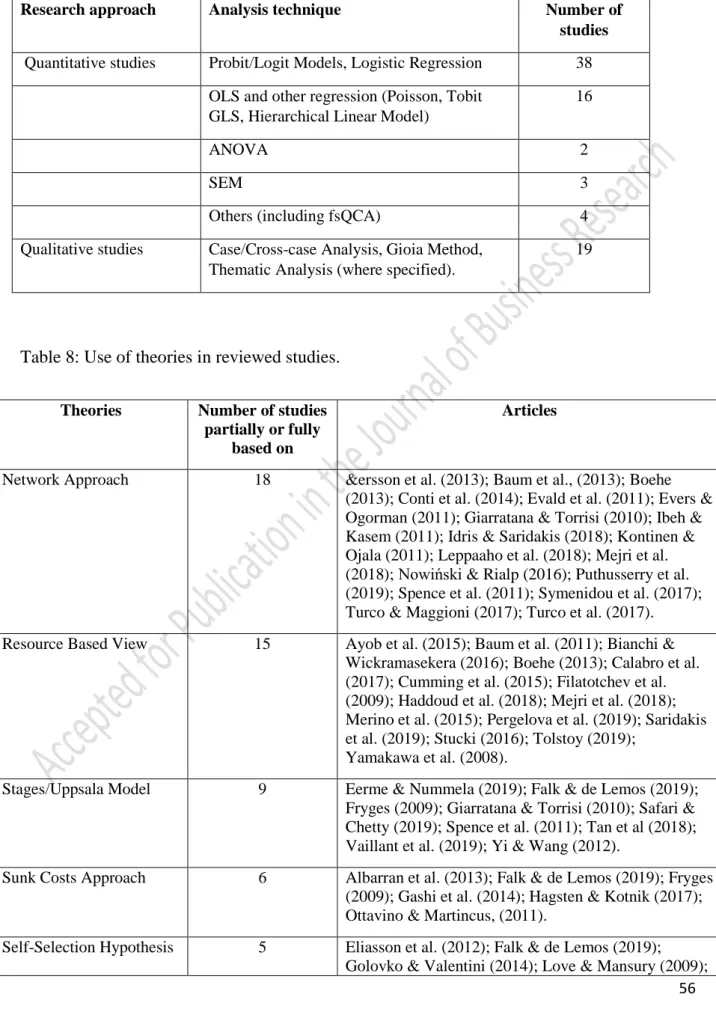
As a result, public intervention is often relied upon to promote the export activity of SMEs (Haddoud et al., 2017). In the current state of the literature, the drivers of SME exports remain poorly understood (Martineau & Pastoriza 2016; Mansion & Bausch, 2020). Nevertheless, there were notable and recurring theories in the 68 studies that support SME export investigations.
Focusing on financial resources, Ayob et al. 2015) examined the importance of finance as an enabler of SMEs' export entry, while acknowledging the role of tangible (physical) and intangible (human and intellectual) assets (Wernerfelt, 1984). In the review, six studies examined the export entry of SMEs through the sunk cost approach developed by Baldwin (1988), Baldwin and Krugman (1989) and Dixit (1989). In this review, five studies were anchored on self-selection in their examination of SMEs' export entry.
In addition, Ricard et al (2016) adopted a theory of representations to explain SMEs' export entry decision.
Owner/Manager Characteristics
Here, the opinion of potential buyers about the exporter's potential products can cause (or hinder) the internationalization of firms. To explain further, Fryges (2009) reported that managers' previous international experience or foreign education facilitates UK and German firms' entry into foreign markets. This is echoed by Ciravegna et al. 2014) who found that entrepreneurs' international experience would increase firms' export initiation as they are more likely to proactively seek foreign business opportunities.
In transition economies, Gashi et al. 2014) confirms that the manager's education has a positive influence on firms' export behavior, as Robson and Freel (2008) note, in a developing country context, that Ghanaian exporters and non-exporters differ by the presence of educated entrepreneurs. In relation to human and social capital, Evald et al. 2011) confirmed that this characteristic has an impact on SMEs' export intention.
Firms’ Resources
In a similar vein, in a Canadian sample, Spence et al. 2011) found that international firms were more likely to be owned by immigrants. Regarding the influence of gender, Orser et al. 2012) concluded that differences between female-owned and male-owned firms in terms of size, growth orientation and R&D are likely to affect the exporting activities of SMEs. In the last owner/operator trait, Tan et al. 2018) revealed the influence of decision-makers' lateral rigidity as defined by export onset.
Still in Spain, Esteves-Perez and Rodriguez (2013) claimed that export and R&D activities are interrelated as Monreal-Perez et al. 2012) explain how innovation encourages firms' export behavior. In China, the evidence shows that SMEs' export orientation depends on R&D and technology transfer capabilities (Filatotchev et al., 2009). In transition countries, Gashi et al. 2014) noted the important role of technology-related factors in SMEs' export behavior. 2017) recognized that intellectual property (IP) and product-based commercialization increase firms' likelihood to internationalize.
At the same time, Pergelova et al. 2019) reported that digital technologies increase the propensity of SMEs to internationalize through international market intelligence. 22 trends and technologies, Eliasson et al. 2012) show that pre-entry labor productivity differentiates prospective exporters from non-exporters. In the context of family firms, Eddleston et al. 2019) showed that firms with high-quality specialty products will have a higher propensity to internationalize, especially if they operate in developed markets.
Then, for proactivity, Dai et al. 2001) that a high level of this dimension is needed for the identification, assembly and exploitation of foreign resources. Likewise, in Canada, Riding et al. 2012) confirmed that firms seeking external financing (capital and trade loans) are associated with export activities. In Malaysia, Ayob et al. 2015) found that exporters possess greater internal financial resources and fewer restrictions on accessing external capital compared to non-exporters.
Environmental Factors
25 However, in the Netherlands, van Beers et al. 2011) show that technical clusters are not efficient as a source of knowledge alone, which may not be sufficient to stimulate exports. Da Rocha et al. 2009) argued that in Brazil external actors, such as private and public support institutions, were found to have a conflicting influence on the initiation of exports (particularly the federal government). Subsequently, Cumming et al. 2015) have proven that professional advisors enhance companies' ability to develop knowledge and skills.
Regarding international networks, Andersson et al. 2013) reported that foreign (other than local) contacts drive the internationalization of French firms as they use scientific and university connections to promote products in international markets. Similarly, international connections (Giarratan & Torrisi, 2010; Baum et al., 2013) especially with international customers (Conti et al., 2014) enhance firms' entry and export status. In China, Filatotchev et al. 2009) have shown that the global network of founders boosts SMEs. 2014) provide evidence that Italian firms that access export services provided by international banks exhibit greater export prospects.
In this regard, Chen et al. 2016) suggest that strict regulations have the counterintuitive effect of encouraging export behavior. For example, in assessing financial services, Bartoli et al. 2014) showed that the support offered by international banks affects the export probability of SMEs. 29 New Firms Entering Developed Markets Yamakawa et al. 2008) argue that none of these three perspectives in isolation [industry, institution and resource] can explain firms'.
Haddoud et al., 2020] have called for a more complex approach that would clarify the interplay between these factors in influencing SME export entry. What drives SMEs to enter international markets is therefore still a question that requires further evidence (Gashi et al., 2014; Wood et al., 2015; Turco &. Moreover, among the assessments cited in this paper , Dichtl et al. 1984) focused exclusively on export imports.
Theory (T)
Therefore, factors affecting SMEs' internationalization in developing countries remain unclear (Matanda et al., 2016), especially in Africa (Haddoud et al., 2020) and the Middle East (Ibeh. & Kasem, 2011). This is another empirical weakness, as the applicability of results generated from developed contexts may not be applicable to developing contexts (Ayob et al., 2015). Indeed, institutional differences across the two contexts warrant the need for more evidence from developing and emerging countries (Chen et al., 2016).
This is even more telling as the importance of country conditions for SMEs' internationalization has been widely proven (Ibeh & Kasem, 2011). Furthermore, due to volatile environments, SMEs in developing countries are less likely to export than SMEs in developed contexts. Therefore, new studies using evidence from less developed and emerging African, Middle Eastern and Asian contexts are needed.
We also echo Paul and Singh's (2017) call for more comparative studies to allow for greater generalizability and theoretical validity as only 11% of the papers examined more than one country. Such designs will enrich the quality of studies where environmental and institutional factors serve not only as independent variables but also as moderators in the link between the owner/manager characteristics, firm resources and entry decision.
Characteristics (C)
34 argued that decision-making processes in international business are shaped by the characteristics of top management teams (Canabal & White, 2008). Factors such as self-efficacy of decision makers, entrepreneurial orientation, risk appetite, lateral rigidity, commitment, personal values, expectation and valence were found to be important drivers of SME entry into exporting. We consider this a promising finding, as in an SME context, internationalization decisions largely depend on the decision maker's perceptions, attitudes and intentions towards foreign markets and activities (Acedo & Galan state that decision makers' beliefs and values play an important role). pillar in the internationalization of companies.
We echo this concern and invite more exhaustive and theoretically supported studies to capture the characteristics of decision makers that are likely to improve SMEs' export entry. Despite their utility in shedding light on some of the key psychological drivers of export entry, existing works have failed to provide an empirically proven and integrative model linking such functions.
Methodology (M)
2007: 295) asserts that 'the sequential nature of the internationalization process makes it a critical phase to examine as subsequent international development is based on the foundations laid at pre-internationalisation' and acknowledges that the pre-export phase has received limited scholarly attention has. This view is consistent with the resource orchestration theory which is a more dynamic variant of the RBV. The resource orchestration theory explains the interplay of firm- and management-level resources and capabilities to drive performance (Chadwick et al., 2015).
We therefore call for further studies to complement regression-based techniques with alternative tools that are qualified to detect the interplay of SME export determinants. The synthesis of works published in the period 2008-2019 enabled the development of an integrative framework that covers the key factors of SMEs' entry into export. This issue has already been raised in reviews by Dichtl et al. (1984), Leonidou and Katsikeas (2010) and Martineau and Pastoriza (2016), who called for more attention to the initial stages of the export decision-making process.
Regarding the research design, we noted that approximately 24% of the papers included in this review were of a qualitative nature. Second, especially in qualitative studies, it has often been challenging to determine the importance of the factors being studied. Therefore, in such cases it was difficult to decide on the relevance of the article.
Export Incentives Revisited: Impact. characteristics of managerial decision makers on international behavior. how small and medium-sized companies make decisions. 1991). An exploratory analysis of the impact of market orientation on new product performance: a contingency approach. The effect of human capital, social capital and perceived values on export intentions of nascent entrepreneurs.
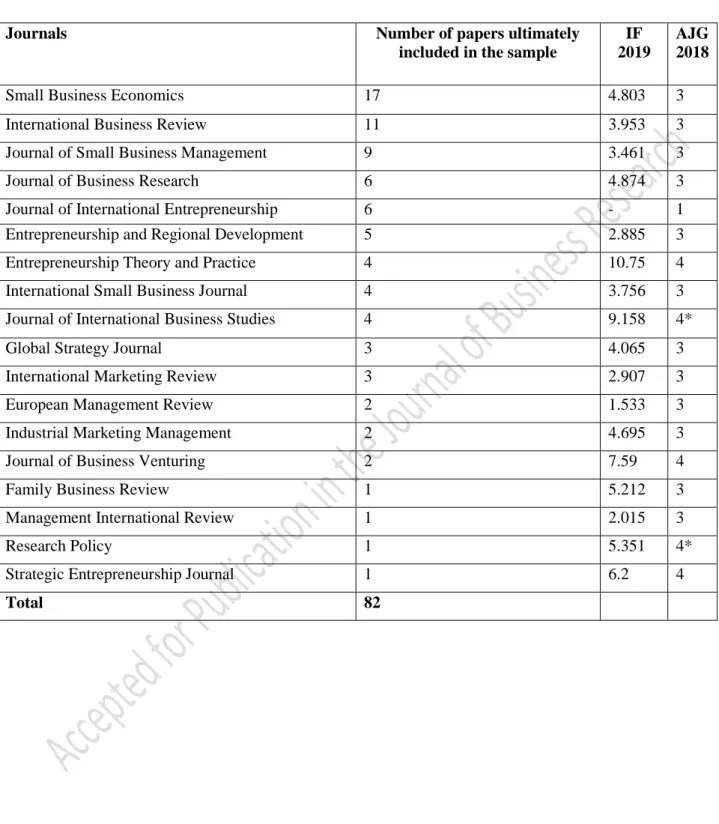
The company's internationalization process - a model of knowledge development and increasing obligations in the foreign market. 3 In the following journals included in the initial list, no articles were found that meet the criteria: Journal of International Marketing; Magazine for Management; magazine for world affairs; Marketing Science; magazine for international management; British management magazine; Asia-Pacific Journal of Management; magazine for marketing; magazine for marketing research; Journal of the Academy of Marketing Science; International Marketing Research Journal; Journal for Strategic Management; Long range planning.