Disability and
universal credit
Photograph posed by models | © Shutterstock
1
Disability and the universal credit
Contents
Foreword 2 Summary of changesto disability support
within the universal credit 3
Family studies– examples of family incomes
under universal credit 7–21
Scenario 1:The impact of universal credit on a lone parent with a disabled child – disabled child additions
Scenario 2:The impact of universal credit on a disabled lone parent and young carers – loss of the severe disability premium
Scenario 3:The impact of universal credit on couples who are both disabled – both losing severe disability premium
Scenario 4:The impact of universal credit on people who have a disability which restricts their earning power but who are found ‘fit for work’ –
loss of any equivalent of the disability element of working tax credit
Scenario 5:The impact of universal credit on couples in their 50s and 60s where one is under pension age but seriously ill and the other is over pension age – lack of a pensioner premium
Conclusion and next steps 22
2
Disability and the universal credit
Foreword
From October 2013 the Government will begin the process of transforming the welfare system, combining a number of different key benefits into ‘universal credit.’ This process will mean big changes in the structure of financial support for lower income families, both in and out of work.
No group will be more affected than disabled people. This is because not only will key benefits for disabled people (including income based employment and support allowance, disability elements of child and working tax credit, and other crucial disability additions) all be incorporated into the support provided through the new benefit, but in addition, changes will affect the rates at which some key benefits are paid, and mean that others aren’t mirrored in the universal credit at all.
Under the new system, financial support for some groups of disabled people will be much lower than current support available for people in the same circumstances. Cuts such as those to support for most disabled children and disabled adults living alone are going to make the future considerably bleaker for many of the most vulnerable households in Britain.
The Government argues that the reforms proposed are designed to improve the system in a way which protects the most
disadvantaged, and redirects support to those who need it most. That’s why I have launched this inquiry into support available for disabled people under universal credit. I want to find out how disabled people will be affected by the changes.
This initial briefing note provides a background to the changes that are being introduced.
It also outlines a set of five ‘scenarios’ showing how financial support for the families of
children and adults affected by a disability is likely to change following the introduction of universal credit. These scenarios are chosen to reflect the range of key changes affecting households. They are just a guide to the sort of likely changes and the groups most affected – final amounts for additions and disregards haven’t yet been announced but it is essential that people understand the sort of changes that are likely before the consultation on the regulations ends on 27 July 2012.
But this doesn’t tell me about how disabled people use the financial support available to them currently to help meet the additional costs of daily life. It doesn’t tell me how any changes to support would affect people’s day-to-day lives, the impact it would have on their family and their ability to fully participate in society.
That’s why I will be taking evidence in person from families who understand, from their own personal experience of living with a disability, the likely practical impact of these changes.
It is why I am also taking evidence through a survey of households with disabled adults or children.
If you are disabled or you have a disabled child, or care for someone who is disabled, please complete the online questionnaire at
www.citizensadvice.org.uk/universalcredit.
The questionnaire will close at the end of July and I will be working with Citizens Advice, The Children’s Society and Disability Rights UK to draw together the evidence received in order to write my review of support for disabled people in the universal credit, to be published in September, with
recommendations to ensure that the universal credit really does work for all disabled people.
Baroness Tanni Grey-Thompson
3
Disability and the universal credit Universal credit impact assessment, October 2010;
http://www.dwp.gov.uk/docs/universal-credit-wr2011-ia.pdf
Summary of key changes to support for disabled people with the introduction of universal credit
Background to universal credit
The plans for universal credit (UC) were laid out in the Department for Work and Pensions’ Welfare That WorksWhite Paper, published in November 2010, and the legislation to enable its introduction was created in the Welfare Reform Act 2012. The new system has two key aims. Firstly, to improve work incentives for families who can currently find it extremely difficult to make work pay and, secondly, to radically simplify the complex welfare system, by combining a number of key means tested benefits (including income support, income based jobseeker’s allowance and employment and support allowance, housing benefit and tax credits) into one single entitlement.
The Government estimates that about 2.8 million households will gain financially from the changes, and about two million households will lose out.1 Whilst some disabled people will gain from the new system, many disabled people will get very significantly less help because some of the additional support in the current system will not be provided to the same degree in universal credit. We are very concerned that the scale of the cuts in support for some groups of disabled people has not yet been properly understood, because the changes have been viewed in isolation.
This briefing looks at four particular financial changes for disabled children, adults and their families, and considers how they will interact with the broader universal credit changes. Whilst three of the changes are cuts and one is an increase, not all the people affected by the specific losses and gains will lose or gain overall in the way that might be expected. This briefing will unpick some of that complexity.
Change one: reduced disabled child additions
At present, families with a disabled child may be entitled to receive support through the disability element of child tax credit, currently worth £57 a week.
Under universal credit, this support is to be provided through ‘disability additions’
within household benefit entitlements but the proposal is to cut the help in half to just £28 a week.
This change will affect all families with a disabled child unless the child is receiving the higher rate of the care component of disability living allowance (DLA) or is registered blind. This is equivalent to a loss of around £1,500 per year for most families with a disabled child, which could push families below the poverty line.
The change will cost families with a child born with a disability up to £24,000 by the time the child reaches 16 years old. The rate is paid per child, so a family with two disabled children could lose double these amounts. The Government estimates that this change will affect around 100,000 disabled children.
1.
4
Disability and the universal credit http://www.theyworkforyou.com/wrans/?id=2011-06-
10c.57981.h&s=%22severe+disability+premium%22+section%
3Awrans+section%3Awms#g57981.q0
Scenario one below shows that many families with disabled children will, in fact, lose more than this £28 a week. For some, high childcare costs mean that the more paid work they do, the more they will lose. However some families with disabled children, who can work without incurring childcare costs, will be better off under universal credit, despite the £28 a week cut.
Abolition of the severe disability premium
The severe disability premium (SDP) currently gives additional support to disabled adults who receive the middle rate or higher rate of the care
component of DLA and live on their own (or just with children) and no one is paid carer’s allowance for assisting them. This additional support helps to cover the additional costs of both living alone with a disability and having no carer.
For disabled parents, receiving the premium can help reduce the pressure on their children, often of school age, to care for them.
The Government is abolishing the SDP with the introduction of universal credit.
This will cost disabled adults with no one to care for them, or with only a young carer, about £58 per week (over £3,000 per year).
Around 230,000 people on income support or jobseeker’s allowance (JSA) receive the SDP (with the numbers on employment and support allowance (ESA) in receipt of the premium not centrally collated.)2The DWP reports that 25,000 lone parents are currently in receipt of the severe disability premium.
Scenarios two and three, below, show that disabled people who have a low earning power and are affected by this cut will lose significantly overall with the introduction of universal credit.
Additional support for disabled adults in the support group for employment and support allowance
ESA is paid to people with a health condition or impairment who are not
‘fully fit for work’. It was introduced for new claimants in October 2008 and all claimants of the benefits it replaced are currently being reassessed for ESA.
The assessment process has three possible outcomes: claimants may be found fully fit for work (so they do not get ESA); awarded ESA and placed in the work related activity group (WRAG); or awarded ESA and placed in the support group (the group for people with the highest support needs and no work obligations).
The Government has said that financial support for disabled people
is to be restructured and that any savings from the reductions in the disability addition for children and the SDP will be used to increase the means tested addition for those in the support group from the current £49 up to an eventual
£80. Couples with someone in the support group will gain from this change but those in the support group who live on their own and don’t have a carer will still be worse off under universal credit.
Cuts to support for working disabled people
Tax credits currently provide in-work support for people on low incomes.
The disability element of working tax credit (WTC) is worth £54 a week and recognises that many disabled people have a reduced earning potential and are
2.
Disability and the universal credit 5
http://statistics.dwp.gov.uk/asd/asd5/WP21.pdf
http://www.hmrc.gov.uk/stats/personal-tax-credits/cwtc-main-apr12.pdf
70 per cent through WTC and 25 per cent through increased housing and council tax benefit
unable to work full-time as a result of their health condition or impairment.
They also frequently face extra costs3which can’t be met by schemes such as Access to Work. This support will not, however, be replicated in universal credit apart from for those who would qualify as not fit for work.
The disability element of working tax credits is payable to those who are working at least 16 hours each week, are receiving or have recently received a qualifying sickness or disability related benefit and have a disability that puts them at a disadvantage of getting a job. One hundred and sixteen thousand families had the disability element of WTC included in their tax credit award in April 2012.4
There will, however, be no extra financial help within universal credit for anyone found ‘fit for work’ under the ESA work capability assessment. This means for example, that someone who relies on a wheelchair to move around, but can self propel their (non motorised) chair 50 metres, would be found fit for work under the assessment process and so will receive no more financial support than someone with no disability. Under the current system because they receive DLA they would be entitled to the disability element of WTC.
Scenario four below, explains how disabled people in this position and with a low earning capacity will lose most.
Other welfare changes likely to affect disabled people
In addition to these measures, other welfare reforms will also have an effect on the level of financial support disabled people receive.
• Contribution based ESA, for those in the WRAG, will be time limited and only be payable for one year.
• Pensioners with a working age partner could lose nearly £100 a week as they will not be eligible for pension credit. If they need extra support from means tested benefits, they will have to claim universal credit. No extra allowance will be payable for the person over pension age. The pensioner would get more money when living alone than the total income when living with their partner. This will lead to particularly difficult cases where the person under pension age is seriously ill and unable to work and the person over pension age is the carer.
• The current system pays 95 per cent of childcare costs to those on a low income who live in rented accommodation5– universal credit will only pay 70 per cent. This is likely to have a particular impact on parents of disabled children. Disabled children frequently need childcare until they are much older, they are more likely to need formal childcare than non-disabled children and the childcare is likely to be more expensive.
• Reduction in amount of housing costs paid – there are a number of measures to restrict the amount of housing benefit paid. These include:
• » caps on the maximum amount of benefit which can be paid
• » reduction in the maximum entitlement based on the lowest 30 per cent of rents in the area instead of the lowest 50 per cent
3.
4.
5.
6
Disability and the universal credit http://www.dwp.gov.uk/docs/s10-2011.pdf
• » a cap on household benefit entitlements for out-of-work families
• » the under-occupancy rule for those in social housing
• » the extension of the shared room rate to those between 25 and 35.
There has been an increase in the amount of discretionary housing payments from £20 million a year to £60 million this year and £90 million for the following two years.6There is also a separate discretionary pot of money of £75 million next year and £45 million the following year to assist people affected by the benefit cap. This increase is welcome, but it cannot compensate for large scale housing benefit cuts and payments are often only made on a temporary basis.
• Personal independence payment (PIP) – will replace DLA for people aged 16 to 64. There will be a 20 per cent reduction in projected expenditure; so many people, and DWP estimates 500,000 less disabled people, currently entitled to DLA will be entitled to PIP.
• Carers will be able to keep the carer premium in universal credit, even when they earn more than the earnings limit for carer’s allowance.
This will help couples where one is unable to work and the other is working and acting as carer.
Losses from PIP and from cuts in housing support are not included in the scenarios because we do not yet know the fixed amounts. However, in addition to the losses shown in the scenario, many disabled people will see drops in income from both PIP and a reduction in housing costs.
Transitional protection
The Government announced that existing benefit claimants will be provided with ‘transitional protection’ to ensure that they will not face cash losses in their benefit entitlement at the point at which they are transferred on to universal credit, as long as their circumstances remain the same. However, there are key weaknesses with this protection:
• Firstly, the protection will not be up-rated with inflation, meaning that their cash protection will be ‘eroded away’ as prices increase.
• Secondly, claimants will lose their cash protection as a result of a significant change in household circumstances – yet it is currently unclear what these circumstances will be. It could be as simple as having another child.
In addition, by its very nature transitional protection will only apply to existing benefit claimants. New claimants will receive no protection if they are worse off under universal credit compared with what their entitlement would have been under the current benefit system. Increasingly claimants within the system won’t be supported by transitional protection, either because they have lost it as a result of erosion with inflation, or a change in circumstances, or they received no cash protection because they are new claimants within the universal credit system.
6.
7
Disability and the universal credit The calculations for the scenarios are based on the briefings published by DWP in autumn 2011
http://www.dwp.gov.uk/policy/welfare-reform/legislation-and-key-documents/welfare-reform-bill- 2011/universal-credit-briefing/
As each council will devise its own scheme, this will not be true for all, but as central government funding for council tax support for households of working age is being cut in effect by 20 per cent it is likely to give a reasonable approximation in most cases
7.
8.
Scenarios – how particular families will be affected by proposed changes
The key individual changes to welfare support within universal credit (as highlighted above) do not give a complete picture of the impact on welfare reform for families. Changes to the overall structure of welfare benefits need to be considered in combination, particularly following the introduction of universal credit, in order to understand the overall impact on family income.
To give an idea of how some households could be affected by the particular changes described above, we have modelled the position for particular types of households with a disabled person. We must emphasise that these figures are only meant as a guide to the sort of gains and losses which are likely for different groups – the final amounts of additions and disregards have not yet been published.7We recognise that some disabled people will gain from universal credit and have highlighted these groups in the scenarios.
These illustrative scenarios (rather than real families) show the differences between household disposable income for people claiming in the current system and for those making a fresh claim in the new system. People moving from the current system to the new one, without a change of circumstances, will not be subject to these changes as there will be transitional arrangements to protect them from many of the adverse effects. However, as mentioned earlier, the transitional arrangements present some problems of their own.
The scenarios assume that everyone of working age will have to pay the first 20 per cent of their council tax bill and that assistance with paying the rest of their council tax will follow the current principles of council tax benefit8. The income shown in the scenarios is the disposable income after rent, council tax and, where appropriate, childcare costs have been paid. It does not show the income from DLA or PIP, nor any shortfall in income from housing costs. For this reason it is likely that in many of the scenarios where there is a drop in income under the new system, this will actually be greater than shown.
8
Disability and the universal credit
Scenario 1
The impact of universal credit on a lone parent with a disabled child
• Families with disabled children in which someone can work full-time without incurring childcare costs are likely to be better off under universal credit, despite the reduction in the child disability addition.
• Families with no one who can work or where the earner has high childcare costs compared to their income are likely to be worse off under universal credit, whether in or out of work. Families in this position, who are not entitled to the carer addition, are likely to experience even greater losses in work compared to the
present system.
• Lone parents with a disabled child are likely to be particularly affected adversely by the change.
Photograph posed by models | © Shutterstock
9
Disability and the universal credit
Current system
• In the current system Janet has a disposable income if not working of £243 a week. She only sees a gradual gain until she works for 16 hours earning
£100 when she has a disposable income of £277.
• Because she is a carer she receives an allowance and also has a carer’s addition of £33 added to any means tested benefits. However under the current system she loses these if she earns more than £100.
• Working more than 16 hours she is likely to need expensive childcare so gains almost nothing from working more hours.
New system
• She will have £212 if not working, £31 worse off than under the current system – mainly due to the reduction in the disability addition for children.
She will see a gradual gain for increased earnings which will gradually reduce the difference between the current system and universal credit. She continues to be eligible for the carer premium in universal credit when she earns above
£100 unlike in the current system so the gap continues to reduce until she has childcare costs.
• However once she needs childcare, the gap widens again as she is likely to lose income the more work she does.
‘Janet’ is a lone parent – she lives with her son Jack who is 13 and was diagnosed about 10 years ago as being on the autistic spectrum. He receives the middle rate of the care component of DLA and low rate mobility.
Janet’s partner left about eight years ago – he found it very difficult to cope with Jack. Jack also has learning difficulties. He has very demanding routines which mean that he needs a lot of support to get out of the house in the morning and get to school. Despite his age, Janet is unable to leave him alone for even short periods of time because of the risk he might endanger himself.
He is particularly fascinated by anything electrical and has destroyed a number of electrical appliances by experimenting. Janet must be there when he gets home from school and needs to get any jobs such as shopping done while he is at school as it is very difficult to take him with her.
They live in a three bedroom housing association flat which she has lived in for the past 10 years.
She pays rent of £100 and council tax of £20 a week. Janet also has an older child Anne aged 20 who lives and works about 200 miles away but who visits when she can. The help she gets when Anne comes to stay is the only respite care she gets so she is very reluctant to move to a smaller property as it will be much more difficult for Anne and her partner to stay.
10
Disability and the universal credit This is disposable income after paying rent or mortgage and council tax and any childcare costs
and excludes any DLA
We have assumed that support for help with council tax will use approximately the same scheme but that everyone of working age will have to pay the first 20 per cent of their council tax regardless of their financial circumstances
In addition to this income drop, if she lives in a three bedroom property owned by a housing association, then she will lose a further £14 from her universal credit as she will have a deduction from the amount allowed for housing as she only is entitled to help with the cost of a two bedroom property.
Not working Working Gross weekly
earnings £30 £100 £150 £200 £250
Childcare costs £30 £80 £120 £160
Disposable income –
current system8 £243 £263 £277 £280 £283 £283
Disposable income –
new system £212 £240 £263 £262 £259 £258
Difference Loss of £31 Loss of
£23
Loss of
£14
Loss of
£18
Loss of
£24
Loss of
£25 Difference due to: £27 drop in child
disability element, £4 reduction in support for council tax9
If she goes into work, the drop in income is less especially as she continues to be entitled to the addition because she is a carer. However once she needs help with childcare costs the gap widens – if childcare costs are high, her income will actually drop as she works more hours
• Lone parents not entitled to the carer addition but who have a disabled child will be much worse off.
If Janet’s son Jack had a condition such as a serious heart condition and was entitled to high rate mobility and low rate care, Janet would not be entitled to receive the carer addition because the person you care for has to be receiving middle rate or higher rate of the care component of DLA – that would mean that the gap between the current system and universal credit would be £33 wider once the earnings limit in the current system is passed.
In other words, when earning £150 with childcare costs of £80 Janet would have a disposable income of £229, £51 less than in the current system.
• Many couples with a disabled child where one of the couple is earning will be better off under universal credit
If Janet’s partner had stayed and one of them was working whilst the other was a carer for Jack, so they didn’t have childcare costs then the drop in income between universal credit and the current system will continue to reduce as the earnings increase. If the person who worked earned more than £300 gross income a week then the couple will be better off under universal credit despite the reduction in the disability addition.
8.
9.
11
Disability and the universal credit
Scenario 2
Impact of universal credit on a disabled lone parent and young carers
• Loss of the severe disability premium (£58) means that lone parents with young carers will be much worse off in the new system, even if they are placed in the support group. They will have less to spend on care so will have to rely even more on their children.
• Couples, where one is both the carer and working, will be better off as the partner who is the carer will be able to claim the carer premium even if they work full-time – they will be able to afford more help with care.
Photograph modelled for The Children’s Society | © Nick David
12
Disability and the universal credit WRAG is work related activity group – there are three possible
outcomes for the ESA assessment depending on the person’s functional ability: fit for work, WRAG, support group. The WRAG implies a substantial level of functional impairment
Current system
• As a couple they have a disposable income of £324 a week after paying their housing costs when her partner earns £400 and she is unable to work and receiving mid rate of the care component of DLA.
• When Kathy becomes a lone parent her disposable income is £239 – this includes the SDP of £58 which allows her to pay for some care to relieve the pressure on her daughter. When she is placed in the support group her income rises to £260.
New system
• As a couple they will have a disposable income of £376, that is £52 more than in the current system as her partner keeps the carer premium even though working full-time.
• When Kathy becomes a lone parent she will have a disposable income of
£177 a week. She will be £62 worse off under universal credit than under the current system as there is no equivalent of the SDP in universal credit.
When placed in the support group she is likely to receive between £198 and
£228 (the Government has said it will raise it to this level when savings from other cuts allow) – a drop in income of between £32 and £62.
She could potentially be even worse off under universal credit if she has the amount of her housing costs reduced.
‘Kathy’ and her partner have one child. Kathy is diagnosed with MS and a couple of years later her partner leaves. There are no other adults in the household and no one receives carer’s allowance for looking after Kathy.
Kathy has one child, Sophie, aged nine. Kathy was first diagnosed with MS five years ago.
At the time she was working as a teaching assistant in her local school and her partner was also working full-time. She managed to carry on working but about three years after her condition was diagnosed she was struggling to cope and the head agreed to her working part-time.
She was awarded DLA low rate care at that point. However a year later her condition had deteriorated to the extent that she had to take increasing amounts of sick leave. With the advice of her doctors, she decided that she couldn’t carry on working. She claimed ESA (the new sickness benefit) and was placed in the WRAG10. She also had her DLA award
increased to middle rate care. Her partner was finding it very difficult to cope with her condition and six months after she stopped work he left her. Her daughter Sophie now acts as her carer.
Kathy is concerned that Sophie should not have to take on too much responsibility. She and her daughter continue to live in the two bedroom house they are privately renting. The rent is £130 a week and they pay council tax of £20 a week.
10.
13
Disability and the universal credit
Kathy leaves work and is awarded DLA MR care and ESA (WRAG)
Partner leaves and Kathy becomes a lone parent – still in WRAG for ESA
Kathy placed in SA support group
Gross weekly
earnings £400 £0 £0
Disposable income –
current system £324 £239 £260
Disposable income –
universal credit £377 £177 £198 at first rising to £228 when
savings from other cuts allow
Difference Gain of £53 Loss of £62 Loss of between
£62 and £32 Reason for the
difference
Couple will be £53 better off under UC – partner working full- time: still can qualify for carer premium
Loss of SDP Extra money for those in support group doesn’t compensate for loss of SDP
Photograph posed by models | © John Birdsall photo library
14
Disability and the universal credit
Scenario 3
Impact of universal credit on couples who are both disabled and entitled to the severe disability premium (SDP)
• Couples, where both partners are disabled people and both are in receipt of at least the middle rate of the care component of DLA, are currently both entitled to an SDP addition so will lose considerably more than £100 a week under the new system.
• They are more than £100 worse off on universal credit than in the present system even when one is in work and earning anywhere up to about £300 a week.
Photograph posed by models | © John Birdsall photo library
15
Disability and the universal credit WRAG is work related activity group – there are three possible outcomes for the ESA
assessment depending on the person’s functional ability:Fit for work, WRAG, Support group.
The WRAG implies a substantial level of functional impairment
Current system
• They will have a disposable income of £337 a week when not working – their disposable income will gradually rise from this when they work so, when John is earning £150, they will have a disposable income of £408.
New system
• Under universal credit, when not working, they will have a disposable income of £216 – the huge drop of £121 is mainly due to the lack of any equivalent of the SDP in universal credit. The SDP takes account of the fact that couples in this position are likely to have considerable extra costs compared to those who have a carer.
The gap between the current system and universal credit continues to be over
£100, even when one is earning £300 a week.
‘Pat’ and ‘John’ both have cerebral palsy and both receive DLA middle rate care –
they both qualify for the WRAG11for ESA. They have no one receiving carer’s allowance for looking after either of them. They have one child, Jonathan, aged two.
Pat and John live in an accessible adapted bungalow owned by a housing association.
They pay rent of £75 and council tax of £25 a week. They both have cerebral palsy and were both awarded ESA in youth when they left school. They are in the WRAG. Pat is the main carer for Jonathan. John is keen to find work.
Both not working
John working
Both working
Gross weekly
income £50 £100 £150 £300 £100+
£100
£150+
£150
£200+
£200 Disposable weekly
income – current system
£337 £387 £378 £408 £417 £415 £424 £436
Disposable weekly income –
new system
£216 £258 £272 £286 £314 £300 £332 £356
Difference Loss of
£121
Loss of
£129
Loss of
£106
Loss of
£121
Loss of
£103
Loss of
£114
Loss of
£92
Loss of
£80
Difference due to:
The main reason for the very large drops in income in the new system compared to the current system is that there is no equivalent of the severe disability premium in UC – both are entitled to the SDP under the current system whether in or out of work – an extra £116 a week
11.
16
Disability and the universal credit
Scenario 4
Impact of universal credit on people who have a disability which restricts their earning potential but who are found fit for work
• In the new system many of those with a health condition or
impairment which has a substantial impact on the number of hours they can work and the support they need are likely to end up with no more support than someone without a disability.
• If they can only work part-time they will lose about £40 a week, about a third of their disposable income. If this is combined with a loss of about £40 in help with housing costs, the effect is likely to be devastating.
Posed by model © Alex Sturrock/Citizens Advice
17
Disability and the universal credit WRAG is work related activity group – there are three possible
outcomes for the ESA assessment depending on the person’s functional ability: Fit for work, WRAG, Support group. The WRAG implies a substantial level of functional impairment
Current system
• Under the current system, during the period when he is unable to work his disposable income will drop to £99 a week.
• However when he returns to work part-time he will be eligible for the disability element of WTC – this will give him a disposable income of £146 a week. This enables him to cope with the extra costs of working part-time, such as the extra travel costs incurred in only working a few hours each day.
New system
• Single people who do not have a disability are likely to be better off on universal credit, but for disabled people found fit for work, the loss of any extra in-work support is likely to leave them about £40 worse off under universal credit.
Housing costs
• Steve would only be allowed help with his housing costs at the rate available to those who live in a bedsit and share a kitchen and bathroom. This is about
£40 less on average than the amount allowed for a one bedroom flat. Even if he could find a room in a shared flat, Steve believes his condition would make sharing a kitchen and bathroom impossible. Whilst he might qualify for help through the increased discretionary funds this is not guaranteed, and may well be very short term just to allow him time to find somewhere cheaper.
He may also be unaware of the availability of discretionary support. There is a real danger that people in this position will end up homeless.
(See table 2 overleaf).
‘Steve’ lives on his own and has been diagnosed with clinical depression and OCD;
has just returned to work having been found fit for work, having spent a period in the WRAG12of ESA.
Steve is 30 – he has a history of anxiety and depression and has struggled repeatedly to stay in work. He now works as a sales assistant at a supermarket in the town-centre, working 35 hours a week. The manager is very supportive and Steve has been employed there for about two years – the longest he has managed to stay in work since he left school. He lives in a privately rented one bedroom flat. He has a family bereavement which leads to him becoming increasingly depressed and anxious again and he has to take sick leave. He is diagnosed with clinical
depression and OCD. When he claims ESA, he is placed in the WRAG. A couple of months later he is keen to try a phased return to work and over the next few months he gradually builds up to four hours a day. Just before this he is called for another medical and at this he is found fit for work, but he is able to claim the disability element of WTC as he is working four hours a day.
He tries to increase his hours further but finds that his anxiety and depression rise. He fears if he increases beyond 20 hours a week that he would not be able to cope – his condition would worsen and he would be unable to work at all.
12.
18
Disability and the universal credit
Working full-time earning £450
On ESA in WRAG
On ESA and earning £50
Working 16 hours and earning £100
Working 24 hours and earning £150
Disposable weekly income – current system
£205 £99 £149 £146 £154
Disposable weekly income – new system
£205 £95 £134 £103 £116
Difference No difference Loss of £4 Loss of £15 Loss of £43 Loss of £35
Reasons for the difference
Not entitled to benefit under either system – earning slightly less he would be better off under UC
He is slightly better off doing permitted work in the current system but this has to be offset against the fact that he can only do this for a year
The lack of any equivalent of the disability element of WTC means a loss of about £40 at this level of earnings
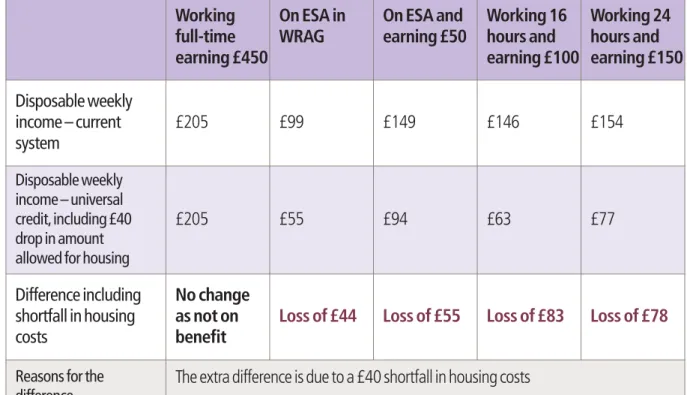
Working full-time earning £450
On ESA in WRAG
On ESA and earning £50
Working 16 hours and earning £100
Working 24 hours and earning £150
Disposable weekly income – current system
£205 £99 £149 £146 £154
Disposable weekly income – universal credit, including £40 drop in amount allowed for housing
£205 £55 £94 £63 £77
Difference including shortfall in housing costs
No change as not on benefit
Loss of £44 Loss of £55 Loss of £83 Loss of £78
Reasons for the difference
The extra difference is due to a £40 shortfall in housing costs
Table 1:Disposable income assuming no shortfall in support for housing costs
Table 2:Disposable income if there is a shortfall in support for housing costs
19
Disability and the universal credit
Scenario 5
The impact of universal credit on couples in their 50s and 60s where one is under pension age and seriously ill and the other is over pension age
• Under the current system, if one person in a couple has reached pension age, then the couple can claim pension credit. However, under the new system, they will have to claim universal credit – the assumption being that the one under pension age can work.
• Universal credit is much less generous than pension credit to those who can’t work, especially as there will be no pensioner addition.
Couples in this situation will be considerably worse off if the person of working age is unable to work.
Photograph posed by models | © 2012 Social Stock
20
Disability and the universal credit There are three possible outcomes for the ESA assessment depending
on the person’s functional ability: fit for work, work related activity group (WRAG), support group. The WRAG implies a substantial level of functional impairment
Current system (if they have no savings)
• They will have a disposable income of £251 a week from pension credit New system (if they have no savings)
• Under universal credit they will have a disposable income of £168 when Peter is in the WRAG making them £83 worse off than under the current system.
• His ESA starts again when he qualifies for the support group and they will have £219 (when finances allow the Government to increase the addition for those in the support group). When universal credit is first introduced it is likely to be considerably less than this.
• Even when the Government is able to increase the support addition to its maximum, Peter and Sarah will still be £32 worse off than under the current system.
New system (if they have savings)
• Any savings above £6,000 will widen the gap – a couple with £12,000 of savings will have £4 subtracted from their entitlement to pension credit to take account of the possible interest but £24 will be taken from their entitlement to universal credit – meaning they will receive £103 less under universal credit than the current system when Peter is in the WRAG.
• If a couple in this situation had savings of more than £16,000 towards their retirement, then the difference between their entitlement under the current system and that under universal credit would be about £170 a week when in the WRAG and about £70 a week when in the support group.
‘Peter’ and ‘Sarah’ have been married for 40 years. Peter is 60 years old and Sarah is 68.
Peter has been diagnosed with Parkinson’s Disease and is receiving DLA mid rate care, Sarah had to give up the small part-time job she was doing as she found it too
exhausting to cope with that and being a carer for Peter.
Peter has worked ever since he left school – as a lorry driver for many years and then in the last eight or nine years as a school caretaker. About a year ago he noticed that he was becoming increasingly clumsy and getting very tired. After a referral to his local hospital he was diagnosed with Parkinson’s. He carried on working for a few months but was unable to continue. He was paid statutory sick pay (SSP) for six months and has now claimed ESA (the new sickness benefit) and been placed in the WRAG13. He has been awarded the middle rate of the care component and his wife is his carer.
Sarah has a retirement pension of £100 a week. They own their own flat and pay council tax of £20 a week.
13.
21
Disability and the universal credit .
Peter is in the WRAG for a year
Peter qualifies for the support group
Disposable weekly
income – current system £251 £251
Disposable weekly
income – new system £168 When savings allow it will rise to £219
Difference Loss of £83 Loss of £62 at first dropping to £32
as government finances allow
Difference due to: Pensioner personal amounts much higher in PC than in UC
Even when the support element rises they will still be worse off than under the current system because they can’t claim pension credit
Photograph posed by models | © 2012 Social Stock
22
Disability and the universal credit
Conclusion and next steps
The scenarios above reveal the combined impact of some of the upcoming welfare changes on the incomes of households including a disabled person.
In some cases, a loss in one area is counteracted by an increase in support in other areas. For example, couples with a disabled child will have less support from the child disability addition but, if one of them is in full-time work, then other gains from universal credit are likely to mean that overall they will be better off. However, others will find that they lose in several different ways.
For example, a lone parent with a disabled child is likely to lose whether they stay at home with their child or they go out into low paid work and they need childcare. Compound losses, such as in this case, where the loss of the child disability element combines with the reduction in support for childcare (especially if it is combined with a cut in help with housing costs), can result in an enormous drop in income.
In addition to the losses shown in these scenarios, many disabled people will also lose more money through reductions in housing costs and because PIP is replacing DLA.
The examples in this report highlight some of the changes in income that different groups of disabled people will face following the introduction of universal credit. It is the combined impact of changes that will really make a difference to families. Additional scenarios of how households with disabilities will be affected by the introduction of the universal credit can be found at www.citizensadvice.org.uk/universalcredit
To take us beyond these scenarios, we need to know more about people’s personal experiences of the additional costs of living with a disability. Building on existing research, this will help us to better understand the practical impact that the introduction of universal credit will have on the daily life of disabled people.
If you, your child, or someone else you care for, has a long term health condition or disability, please complete the online questionnaire at www.citizensadvice.org.uk/universalcreditto let us know how the changes in financial support are likely to impact on you.
Results from this questionnaire, combined with other evidence collected by Tanni in coordination with Citizens Advice, The Children’s Society and Disability Rights UK, will be reported in her review of the impact of universal credit on households which include disabled people, which is to be published in September 2012. On the basis of the evidence received, the review will make recommendations for the future of support for disabled people under universal credit, to ensure the future of welfare provides the support that is needed for those who need it most.
Citizens Advice Myddelton House
115–123 Pentonville Road London N1 9LZ
Telephone: 020 7833 2181 www.citizensadvice.org.uk www.adviceguide.org.uk
Citizens Advice is an operating name of The National Association of Citizens Advice Bureaux.
Registered charity number 279057.
Written by
Sue Royston, Citizens Advice
Sam Royston, The Children’s Society Published July 2012