
The Ministry of Justice should raise awareness of the different types of mediation and alternative dispute resolution (ADR) processes that are available. The Ministry of Justice should allow couples to file a no-fault divorce petition and then obtain a divorce if they still wish to do so after 6 months. In April 2014, the MoJ introduced the requirement for couples to attend a Mediation and Information Assessment Meeting (MIAM) before starting court proceedings.
The Ministry of Justice is currently developing an 'out-of-court pathway' to help people solve their problems in this new context. The MoJ's 'Transforming Our Justice System' initiative also plans to simplify processes and information to enable couples to make the right arrangements themselves, as well as introducing new and less adversarial forms of dispute resolution.
Recommendation 2: The MoJ should develop tools that signpost people to wider support as well as relevant divorce services
It's faster, but you're probably going to run into heavy traffic because it's Sunday night and the traffic is terrible getting home. The scenic route, it's slightly longer, but you'll get there and there's no traffic. I think with something like this it's better to be personalized, so you know you're getting the right advice.
Recommendation 3: The MoJ should develop these online tools to support victims of domestic abuse
Enable people to make informed decisions about services
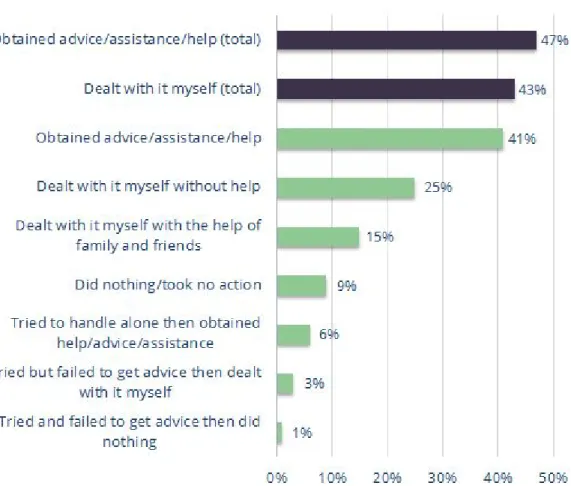
However, people are increasingly resolving the separation themselves, without relying on the courts or using legal services, or simply using them for specific parts of the process.20 Between 2011 and 2015, the number of divorce cases with at least one court session has decreased from 11% to 6% of all cases started. In the same period, 21 of those couples going to court, the number of cases where neither party had legal representation rose from 25% to 40%. 20 The Ministry of Justice, Survey of Legal Problems and Resolution of Persons with Family Problems used self-help solution strategies.
There is more to alternative dispute resolution than people think
Recommendation 4: The MoJ should raise awareness of the different types of mediation and alternative dispute resolution processes available
Currently, government pages (and the site to which the government links) do not display information about the various services offered by service providers. They should make it clear that separating couples do not have to attend mediation sessions together and clearly explain the differences between mediation and other forms of alternative dispute resolution.
Recommendation 5: Mediation and Information Assessment Meetings (MIAMs) and online information should help people understand the
Divorcing couples should also be able to search for service providers based on the type of approach they take and the service they provide. The search tool available on the British Association for Counseling and Psychotherapy website is a good example of what this might look like, as it allows people to search for a therapist by reason for therapy, type of client and session format. This type of search function is needed to ensure that 28 new online tools and information on different forms of mediation and ADR are able to feed into the rest of couples' journeys.
Recommendation 6: People who are eligible for legal aid should be able to use it for a range of family law services, including other types of mediation
People relying on solicitors struggle to shop around to ensure quality and value
Recommendation 7: The Solicitors Regulation Authority (SRA) should require all family solicitors to display core information on their websites
- Encourage constructive relationships
The Competition and Markets Authority's (CMA) recent call for regulators to improve the quality, usability and prominence of information on providers' websites can start to improve people's experiences. Our interviewees described various moments when professionals and processes derailed agreements or caused friction between partners. The damage caused by the debt requirement is felt by many of the clients we see with breakup problems.
A number of our interviewees were frustrated by the demand to blame divorce, as it was felt this was a waste of time and unnecessarily aggravated relationships. Half of our interviewees said they would have chosen a no-fault option if it had been available. 4 in 5 (83%) of our advisors say a no-fault divorce option would have at least some positive impact on people's experiences, while 1 in 3 (33%) say it would have a significant positive impact.
So, he wasn't very impressed at all, he actually got really angry, and then said he wasn't going to sign anything, and that he would have to consult his lawyer." It would have gotten very messy and probably would have dragged out the process by making it much more difficult for me. Common complaints about lawyers 45 relate to slow and impractical communication and poor explanation of the reasons behind decisions.
In addition, many of our respondents felt that lawyers create unnecessary stress in the family by derailing existing agreements or pushing for conflict.
Recommendation 8: Introduce a no fault divorce option, allowing couples to submit a divorce petition and then obtain a divorce if they still want to
It should be simplified, because we don't love each other anymore, it's time to move on, and a. Then it will give everyone time to cool off, think about it, because in six months you will get back together or you won't. I started my life over, with someone else, but it was still on hold, and it was a pressure on us because, you know, we wanted to move on with our lives."
On average, it currently takes 11 months for a couple to file for divorce until that divorce is finalized. For those couples who wish to divorce 53 without blaming each other, this 11-month wait is added to the 2 years they have waited to file their claim. An enhanced no-fault option would allow couples to begin the divorce process without this delay.
To ensure that people are able to check their decisions after a period of time.
Recommendation 9: Regulators should issue guidance, training and tools for family law professionals aimed at promoting positive relationships
- Simplify language and processes
Two points of complexity in the divorce process emerged from our research: forms and the decree absolute. Only a small minority (8%) of our frontline counselors who have supported people with divorce and separation problems believe that people understand the forms and paperwork they need to fill out. Some of our respondents found forms quite straightforward and quicker to get through than expected.
One of our interviewees worked in the consultancy sector, so thought she was too. When errors were made, even minor, forms were returned to some of our interviewees without any indication of what the error was and how to complete the form correctly. After the lawyer has checked that all the details are correct, he is authorized to print the forms and submit them to the court.
The current delay of 6 weeks 60 is intended to allow the Queen's Protector to lodge objections to the divorce. In practice, this would involve the Government Legal Department taking the matter to court to file a divorce petition. 60 Decree nisi is the document that states that the court sees no reason not to proceed with the divorce.
I mean, I've heard the words decree nisi, decree absolutely before, but even now I don't really know what they are.
Recommendation 10: The MoJ and HMCTS should create smart online forms for in-court and out-of-court divorce processes
Recommendation 11: Make the decree absolute an opt-out, rather than opt-in, removing the need for people to submit an additional form
- Design legal processes that reflect life changes
More than half (55%) of the people who came to Citizen Advice in 2016 with issues surrounding divorce or separation also received advice on another topic. More than half of Citizen Advice advisors (62%) believe that having a clear route to advice, information and support for issues that arise at the same time as a divorce would significantly reduce the harm our clients suffer. 7% of clients who received advice about divorce, separation or annulment also had problems with child support, and 6% had problems with contact with the other parent and other family members.
Of the clients who came to Citizens Advice with child support issues, 23% also received advice on Working and Child Tax Credit, 16% on debt and 10%. Some of our respondents explained that their divorce was the first time they needed access to benefits. Evidence requirements can ignore the complexities of divorce, leaving people who are entitled to support unable to access it.
Many found the process of moving from the family home and finding another place to live extremely stressful. One of our respondents became homeless as a result of his separation and was frustrated by his inability to provide his children with a suitable place to live. For some of our interviewees, it was necessary to start a new job because of new housing and childcare arrangements.
In one of our case studies, the employment effect was a combination of the two.
Recommendation 12: People going through divorce should be better signposted to available support
- Create a system that works for everyone
Well, of course from the beginning, when I had just started a new job, and it is very difficult to learn a new job and keep your head together about the breakup of a relationship. I didn't, you know, I've never been fired before, but they politely asked me if I wanted to leave because it wasn't working. I could no longer work on weekends because I would have to see my children on weekends.
However, we know that those with low digital capacity need practical help to complete the digital tasks required to access services. Victims of domestic violence must not be neglected in wider changes to family justice. We also found that some victims of domestic abuse faced 76 barriers to accessing legal support and struggled to deal with the practical aspects of ending a relationship.
An interviewee who had experienced coercive and controlling behavior was unable to prove it, and therefore could not apply for legal aid. Another respondent could not claim legal aid because she had not reported the assault to the police at the time. Apparently the way they work it out because I actually owned part of the house meant I wasn't entitled to anything even though I was only on - well, I'm only on part-time pay…”.
At the time everything was under dispute, and as I was not working at the time I had legal aid for mediation, but I was told by the mediator that, for the representation bit, the lawyer bit, I would not be eligible because they had different rules.”.
Recommendation 13: The MoJ should ensure online services are simple and intuitive, and have a plan in place for those who need extra support with
Recommendation 14: the MoJ should review evidence requirements and financial contributions for legal aid
Conclusion
Appendix A - the people we spoke to
At the time of her divorce in 2014, she owned her family home with her ex-husband and earned less than £1,000 a month. At the time of her divorce she had no children living at home and earned between £2,001 and £3,000 a month. She told us that she had a pretty amicable divorce and that she gets along well with her ex-husband.
In his case, the divorce proceedings were concluded without addressing issues of financial support and child contact.
Appendix B - age at divorce
We help people


