Drawing a pension
A consumer perspective on the first year of pension
freedoms
Contents
Executive summary 2
Introduction: what we know 4
Methodology 6
Chapter 1: Triggers and motivations 7
Types of consumers 7
Triggers and life events 8
Motivations 11
Chapter 2: Guidance, advice & informal support 15
Why consumers are likely to need help 15
Formal guidance 17
Formal advice 19
Informal support 20
No support 21
Chapter 3: Choosing a pension and provider 22
Choosing a provider 22
How to access savings 28
Chapter 4: Withdrawing a pension 33
Charges and fees 33
Delays 38
Risk warnings 39
Conclusion 41
Executive Summary
This is the second report of a three part series exploring how consumers think about and experience pension freedoms in the context of their broader lives.1 We evaluate use of the freedoms so far, adding for the first time a consumer perspective to the existing high level data on activity in the first year. We find that freedoms are working well for many, but identify a number of important problems which need to be
addressed to make freedoms work for all consumers.
Of particular concern, we find that some consumers are facing:
● Complex and high fees: Exit fees and other charges are not being levied consistently and are confusing consumers, and we estimate that 160,000 people have paid to access their pensions since April 2015. Those facing fees have reported an average cost of £1,577 in total. Most worryingly, this includes average fees of almost £2,000 for consumers with pots below £20,000.
● Long delays: More than half of consumers received their first payment within a month their request, but almost one in six (16%) have had to wait over two months.
● Limited product choice: Not all providers are offering the full range of
freedoms to customers. Approaching half (44%) of those switching are doing so to access the product that meets their needs.
● Ineffective risk warnings: Fewer than one 1 in 50 (1.6%) consumers say risk warnings had an effect on their choices. In contrast, 20% said their choice was affected by their first conversation with their provider.
● Patchy levels of support: While two thirds of consumers are getting help with their choices, almost half (45%) of those with household incomes below
£20,000 are not getting any support.
Chapter 1 provides a new typology of consumers using pension freedoms, featuring their different triggers and motivations. Triggers to engage with pensions such as key life events influence choices: those prompted by retiring, for example, are far more likely to buy an annuity whereas those responding to debt are more likely to take cash. We also find that while many consumers are motivated to make the most of their good retirement years, just 3% considered potential care costs as a key factor when accessing their pensions.
In Chapter 2 we examine what support consumers are using before accessing their pensions. We find that two thirds of consumers are getting formal or informal help
1 The first report in this series, Approaching Retirement, was published in December 2015.
with their choices, with free guidance the most popular single option (used by 29% of all consumers), followed by paid advice (24%). However, around a third (32%) are not seeking any help, particularly those with lower household incomes.
Chapter 3 explores how consumers go on to access their pensions in terms of which provider and freedoms they use. It shows that consumers face significant barriers to comparing providers, particularly for new products. While 57% of consumers who bought an annuity shopped around, just 39% of those who took a drawdown product did so. Many consumers have limited patience or time to compare offers, commonly because they have a pressing need to access their savings or because they experience research fatigue. Our qualitative research showed that trust is crucial here, and
perceptions of charges, delays or risk can be as important as the reality.
Consumers with similar priorities can opt to access their pensions in very different ways. For example, some see annuities as offering the most security through a guaranteed income, whereas others think drawdown offers more security for their family if they die suddenly. Different solutions like these are in keeping with the principles behind the freedoms. But they also underline the need for consumers to understand their options, such as being aware of other products including joint life annuities and drawdowns with guarantees.
In Chapter 4, we present consumers’ experiences between formally requesting access to their pensions and receiving their first payment. It identifies a number of early teething problems that should be addressed.
Based on our findings, we make the following recommendations:
● Regulators and the government should set a £50 cap on exit charges and tackle transfer delays such as by aligning transfer time limits with ISAs. These would improve consumer confidence both in switching and in pensions more generally.
● The government should support the creation of an independent
drawdown comparison tool reviewing the whole market to help consumers compare products in one place.
● Government and providers should review how information about support can be better targeted at those not currently accessing guidance or
advice. Almost half of consumers with the lowest household incomes are getting no help.
● Providers should ensure that any advice requirements are communicated clearly. A third (35%) of consumers with advice requirements do not
understand why they are having to pay. Better explanation will reduce consumer frustration.
● The FCA should review what more can be done to provide risk warnings to all consumers earlier, particularly to protect consumers who have not had any support.
Citizens Advice delivers Pension Wise guidance on behalf of the DWP. This report reflects the views of Citizens Advice as a consumer champion in the financial services market, and not those of DWP or Pension Wise.
Introduction: Existing research
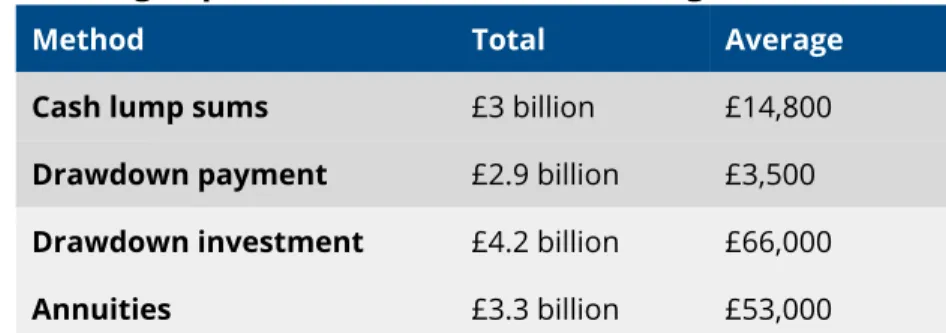
This chapter summarises existing research on pension freedoms. Initial data shows that consumers have been using the freedoms, with Association of British Insurers (ABI) data showing that £5.9 billion of DC pension savings were withdrawn and £7.5 billion was invested in pension products during the first nine months following pension freedoms. 2
Figure 1: Use of savings April to December 2015 - ABI figures
Method Total Average
Cash lump sums £3 billion £14,800 Drawdown payment £2.9 billion £3,500 Drawdown investment £4.2 billion £66,000
Annuities £3.3 billion £53,000
This initial demand is likely to be atypical: a large ‘stock’ of consumers aged over 55 became eligible for pension freedoms in April 2015, having had a year to prepare. A significant proportion of the initial stock has already acted in this first wave. The Pensions and Lifetime Savings Association (PLSA) estimates that approximately one in seven (14%) of the 2.8 million eligible consumers took action to access their pots in the first six months. PLSA research also suggests that this period is atypical in terms 3 of which consumers are accessing their savings: early adopters have 50% more DC pension wealth on average than the overall eligible cohort.
Figure 2: FCA data on number of pension pots being accessed for the first time 4
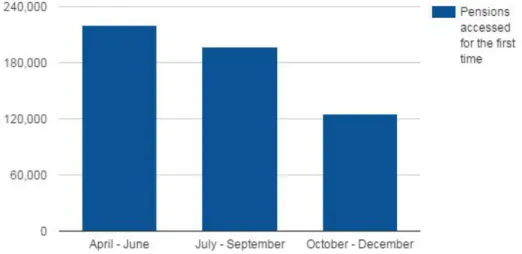
The initial demand has already abated as shown in Figure 2, although it is not yet clear whether we have reached a new steady state. The Financial Conduct Authority (FCA)
2 ABI, Pension freedom statistics - one year on factsheet, March 2016.
3 PLSA, Pension freedoms: no more normal, January 2016.
4 FCA, Data Bulletin supplement: Retirement Income Market Data, April 2016.
observed a significant decline in new access to pensions in the third quarter (October to December 2015) following the introduction of freedoms. A key driver of this fall was the reduction in the number of pots being fully withdrawn as cash.
Pension freedoms require consumers to understand more about their pensions than ever before. As Figure 3 shows, local Citizens Advice have seen a significant increase in demand for private pension support following the announcement of pension
freedoms. The government recognised this need when it introduced Pension Wise to deliver the guidance guarantee, and we explore this in Chapter 2.
Figure 3: private pension queries to Citizens Advice (excluding Pension Wise)
Many consumers benefit from the tailored personal recommendations from regulated financial advice. Last year Citizens Advice identified Four Advice Gaps which are
preventing consumers getting the support they need. These include issues around 5 affordability as well as awareness and referral. Through the Financial Advice Market Review (FAMR), the government is taking important steps to help more consumers access financial advice including supporting the creation of simplified advice and greater use of so-called robo advice.
Pension scams have posed a serious threat to consumers for decades and Citizens Advice research suggests that they could pose a key emerging risk. Up to 11 million people have received unsolicited contact about their pensions in the past year, including 2.4 million consumers aged 55-64. Most of these have been offered free pension ‘advice’ or reviews, and pension scams appear to be evolving from ‘liberation’
scams for under 55s to new tactics aimed at over 55s. This trend is particularly 6 concerning given that the same research found that 9 in 10 consumers cannot spot key scam warning signs.
For the freedoms to be a long term success consumers must have faith in the
pensions system. Some early teething problems have emerged, linked to issues such
5 Citizens Advice, The Four Advice Gaps, September 2015.
6 Citizens Advice, Too Good to be true: Understanding consumer experience of pension scams a year on from pension freedoms, April 2016.
as exit charges and delays. Citizens Advice analysis of FCA data, for example, found that more than two million consumers could face a pension exit fee of over £50, including almost 40,000 people who could face a charge of more than £5,000. The 7 FCA is now consulting on proposals for a 1% cap on exit charges. We explore these 8 issues in Chapter 4.
Making pension freedoms work is in everyone’s interests - for the government to deliver the spirit of its reforms; for the pensions industry to maintain confidence; and most importantly for consumers to achieve good outcomes. Pension freedoms will become more important as existing annuitants gain access to a secondary annuity market and, over time, automatic enrolment extends pension freedoms to more consumers. So it is important to take steps now to ensure the market functions well.
Methodology
This report draws primarily on two key pieces of research. All data in this report is from these two sources unless otherwise referenced. The first is a series of qualitative depth interviews with twenty consumers who accessed their Defined Contribution (DC) pensions for the first time after April 2015. These were conducted by Citizens Advice research staff in February and March 2016.
The second is a survey by ComRes of 501 British adults aged 55+ who accessed their DC pensions after April 2015. Fieldwork for this was carried out online between 17th March and 1st April 2016. ComRes is a member of the British Polling Council and all figures used in this report are available on the ComRes website.
There is limited demographic information about which consumers have used pension freedoms since April 2015. As a result, our sample frame sought to ensure that the household incomes and working status of respondents were consistent with research conducted into this by organisations including the Financial Conduct Authority and the Pensions and Lifetime Savings Association through the use of target quotas on
variables including household income and retirement status. In our survey, 61% of our sample had household incomes below £40,000, while 52% were retired, which are both in line with other evidence. Beyond this, the survey reached a good mix of respondents by variables including age, gender, working
status and household income. 9
7 Citizens Advice, Cap on pension exit fees ‘good news’ for consumers, January 2016.
8 FCA, CP16/15: Capping early exit pension charges, May 2016.
9 PLSA finds that early actioners in the first six months were more likely to be retired and to have lower incomes than the overall eligible group: two thirds have household incomes below £35,000, and 61% are already retired. Our results are for the first year, so we would expect them to be slightly different to the wave from the first six months.
Chapter 1: Consumer motivations and triggers
This chapter shows the range of consumers with different approaches to pension freedoms. It emphasises the importance of different triggers that engage
consumers, with a majority not prompted by retiring but by other factors such as wanting to take advantage of freedoms and paying off debt. Motivations influence consumers’ actions. For example, those prompted by retirement are much more likely to buy annuities, whereas those seeking to pay off debts are more likely to take cash lump sums. The range of motivations shows the freedoms at their best, but it is vital that consumers are equipped to make pensions work for them.
Types of consumers
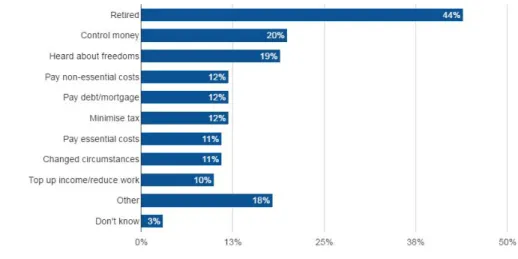
The cohort of consumers in this study - those who have accessed DC pensions since April 2015 - are, on average, wealthier and likely to have larger DC pension pots. 10 While some in this group can be seen as early adopters, it is important to remember that many different types of consumers have accessed their pensions. We found that two thirds of consumers do not see their DC pensions as their most important source of income in retirement, while three fifths don’t expect to need them for basic living costs. For many though, DC savings will make the difference between a comfortable and uncomfortable retirement. More than two in five (43%) say their DC pots will support their basic living costs, and one in three (32%) say it will be their most important source of income in retirement. As Figure 1.1 below shows, consumers have different things on their minds as they consider their pension options.
Figure 1.1: Why consumers access their pensions
10 Median DC pensions savings are £17,000 for 55-64 year olds and £10,700 for 65+ year olds. ONS, Private pension wealth, Wealth in Great Britain, 2012 to 2014. This compares to median DC savings of £50,001-£75,000 in our survey and reflects PLSA research which showed that the early adopters have 50% more DC wealth than the overall cohort eligible for pension freedoms. PLSA, Pension freedoms: no more normal, January 2016.
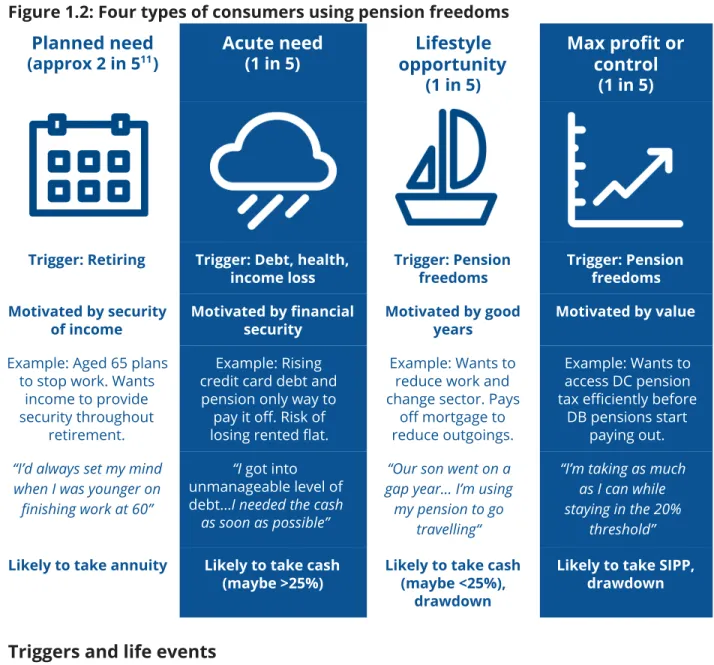
To illustrate the different consumers approaches to accessing their pensions, we have identified four broad groups, presented in Figure 1.2 below. These show the links between triggers and motivations, as well as eventual outcomes.
Figure 1.2: Four types of consumers using pension freedoms Planned need
(approx 2 in 5 ) 11 Acute need
(1 in 5) Lifestyle opportunity
(1 in 5)
Max profit or control
(1 in 5)
Trigger: Retiring Trigger: Debt, health,
income loss Trigger: Pension
freedoms Trigger: Pension freedoms Motivated by security
of income Motivated by financial
security Motivated by good
years Motivated by value Example: Aged 65 plans
to stop work. Wants income to provide security throughout
retirement.
Example: Rising credit card debt and pension only way to pay it off. Risk of losing rented flat.
Example: Wants to reduce work and change sector. Pays
off mortgage to reduce outgoings.
Example: Wants to access DC pension tax efficiently before
DB pensions start paying out.
“I’d always set my mind when I was younger on finishing work at 60”
“I got into unmanageable level of debt…I needed the cash as soon as possible”
“Our son went on a gap year… I’m using
my pension to go travelling“
“I’m taking as much as I can while staying in the 20%
threshold”
Likely to take annuity Likely to take cash
(maybe >25%) Likely to take cash (maybe <25%),
drawdown
Likely to take SIPP, drawdown
Triggers and life events
Consumers consider accessing their DC pensions for a variety of reasons. Our
research suggests that the two most common prompts are retiring and hearing about the freedoms themselves. The influence of the latter is likely to mean that the
experiences of the first cohort are atypical - in future, the new nature of pension freedoms is less likely to be an active trigger itself. Other triggers match our previous research on how consumers engage with their finances at key life events such as changes to income, family circumstances or health. 12
11 These are illustrative figures based on survey responses.
12 Citizens Advice, The Four Advice Gaps, September 2015.
Our research shows that the majority of consumers have not been prompted to engage with their pension by actually retiring, but this is still the single most common trigger for engaging with pension choices (44% of people). As Figure 1.3 shows below, households with incomes below £40,000 are considerably more likely to consider their options because they are retiring than those with higher incomes. This trigger is
clearly linked to outcomes - as we show in Chapter 3, 68% of consumers buying an annuity were engaging because they’d retired, compared to just 40% for drawdown and 25% for cash lump sums.
Figure 1.3: Retiring from work as a trigger, by household income
The announcement of pension freedoms in May 2014 and the subsequent media attention was the key trigger for many consumers across the income spectrum. One in five (19%) explicitly cite hearing about the freedoms as a trigger, whereas others cite outcomes linked directly to freedoms such as taking control of their money (20%).
Some of these had pre-existing plans that the freedoms enabled them to enact by offering new access to their savings, whereas others reacted to the news and looked at what they could access before making a plan.
“The media was saying ‘you can take your money out at 55 and do what you want with it’, and I suddenly realised I was coming up to 55. When the announcement came out I thought ‘that is the trigger to let me do what I’ve wanted’.”
“I heard about the pension changes, there was a big hoo haa, and I suddenly realised I could use my pension, which I hadn’t even considered. And I thought that would enable me to go a bit part time at work.”
Financial circumstances such as troublesome debt or loss of income can also prompt consumers to engage. Almost one in eight (12%) have debt as a trigger, including credit card debts, mortgages, unsecured loans and informal borrowing from family and friends. In our experience at Citizens Advice, people often only start looking at
debt when they hit a crisis point and it seems likely that pensions may be seen increasingly as a debt solution in future. This affects outcomes - consumers who engaged because of debt are twice as likely to take cash from their pensions as to take drawdown.
Case study: Debt as a trigger
Sandra, 56, works full time. She was widowed in 2013 and now lives in a rented flat. Following her husband’s death, she had to borrow money to cover legal fees and her drop in household income. She said “I got into quite an
unmanageable level of debt, it was a very quick process, it caves in on you. I owed over thirty grand on my credit cards and I was paying hundreds of pounds a month in interest payments alone. It took me very much to the brink of being bankrupt”. She stuck with her provider and accessed most of her pot through drawdown “I was never going to transfer because I needed the cash as soon as possible.” She is still paying into her pension and expects to work for at least another decade. If she hadn’t been able to access her pension, she said she would have gone bankrupt and believes she would have lost her rented property. “For me it was miraculous that I had a pot in the first place and then that I was allowed to access it.”
Loss of income can result from a change in work or welfare support, and more than one in ten (10%) engage to top up their income. This can be beyond the control of some people (such as being made redundant or having benefits changed) or slightly more voluntary for others (such as not liking a new manager or facing different conditions). Sudden health problems can also jolt people into considering their pension choices to top up their income, reduce work to support their mental or physical health, or to use their savings before they die.
“On the DLA to PIP [disability benefits] switch they gave me nothing, the mandatory reconsideration gave me nothing, the tribunal gave me back two thirds of what I’d had. Because my income’s been cut I’m having to take money out of my pension to top it up.”
“My older brother had worked all his life for a pension but died suddenly, so I thought ‘why should I wait until I’m 70, or whenever the government chooses to grant your pension?’ I thought ‘take your money and run’. That was one of the main triggers, stop doing the day job and do something we’ve always wanted to.”
Some consumers start thinking about their pension pots and future plans simply because they reach a significant age: the ages 60, 65 and now 55 are triggers for many to consider their pensions and other finances. We also encountered other triggers such as divorce or a change in family circumstances and receiving an annual
statement. So just as the range of consumers using pension freedoms is diverse, so are the triggers prompting their engagement.
“I’d always set my mind when I was younger on finishing work at 60. And even though everything had changed, that was still in my mind as the time I would go even though I knew it wasn’t 60. But in my mind that was the time I would finish.”
Motivations
After an initial prompt to engage with pensions, consumers’ underlying motivations have a strong effect on how and whether they decide to access their pensions. We observe three broad forms of motivation: security, good years and best value. Some issues can span all three categories. For example, property can motivate some to pay off their mortgage (for security), others to do up their home (to enjoy their good years) and others to invest in buy-to-let (to seek maximum return on their savings).
Security
Security underpins many people’s choices across the income spectrum. Our interviews highlighted the importance of risk aversion: consumers considering
retirement are aware that their ability to earn extra income will be limited. Memories of past financial scandals or problems are also important here. Many consumers still look to their pension to provide a steady income and a third (34%) plan to use their DC pensions for the rest of their lives, rising to two in five for those with larger pots above £50,000.
“Having established that we could be secure for life, my investment strategy was to minimise risk.”
Debt motivates people to seek financial security. In our survey, 16% of consumers said they have used pension savings to pay off a debt or mortgage. As discussed above, debt is also a trigger and clearing debts is the overwhelming motivation for many.
Mortgages are an important - but often less urgent - subset. Other consumers have sought security by adapting and futureproofing their homes, and some have sought security for their families by helping them buy properties.
“My mortgage had been on my mind before the pension changes. It was a worry because the original term would have been up til I’m 67 and there was no guarantee that I could work until then. Now I’ve got the security that if I am made redundant, the house would be paid for and I’m not at risk of losing it.”
“We’re starting to age-proof our house, we’ve decided we want to stay here. So we’ve spent a bit of money age-proofing the kitchen. With my arthritis and things like that I find drawers and cupboards a bit difficult. We’re doing the downstairs.”
Other consumers are motivated to gain security against potential future economic or political changes. Some feel that recent policy changes, and speculation about
future changes to tax relief, mean that they should take their money even if they don’t have a specific plan of how to spend it. Some wealthier consumers, with property and other savings, feel that their pension is their riskiest asset, particularly in relation to the impact of the global economy on their savings while invested in pensions. Some consumers are aware that divesting may not be the most rational, profit maximising course of action but prioritise their peace of mind.
“I took the 25% tax free. Not because I needed it , but because I wasn’t sure what future rules might do. I thought they might tamper with the tax free 25%.”
“I could have made more money if put into stock ISAs but they'd be showing a loss at the minute because stock market fallen recently. You only need another 2008. To leave your food and house to the market seems very risky.”
Good years
The second key driver is a desire to make the most of good, healthy years in retirement. We identified this concept in Approaching Retirement, and our new 13
research shows that while a third of consumers plan to use their pensions for the rest of their lives, one in five explicitly plan to use up their pensions pots earlier in
retirement while they have good health. While making the most of good years is an important opportunity created by pension freedoms, it is also important to consider in future the long term effects: just 3% of consumers say they considered care costs as a key issue when accessing their savings.
Some consumers simply want to ensure they use up their pension during their lifetime. This is closely linked to getting value as discussed below. Some see this as simple investments such as improving their home which, with retirement in mind, they are expecting to spend more time in.
“You walk around a graveyard and they’re 59, 62 or 87, 88. There is not much in between. I wanted to access my pension while I could and make sure I
benefitted from it fully.”
Work and health are important to consumers, with 10% accessing their savings to cut down their hours or top up their income. Some see their pension as a way to change their working hours, stop completely, to work in a different type of job or, often, a combination of these. This can be motivated by a desire to address health concerns, either to reduce the risk or to make them more manageable.
“I’m mentally and physically tired. I’ve got various health problems, none of them are life threatening but enough to be life affecting.”
13 Citizens Advice, Approaching Retirement, December 2015.
Case study: using pension to enjoy good years
Paul, 57, is married and owned his home with a mortgage. He wanted to leave his stressful job working in the motor industry. “The motor industry at 56 years of age was killing me. They want their two pounds of flesh six days a week, 65, 70 hours a week”. To achieve this, he took a 25% tax free lump sum and some more cash through drawdown to pay off his mortgage. He did this to reduce his monthly outgoings (he was spending half of his income on the mortgage) so he could look for part time work. “When I heard about the government's new rules I thought
‘whoopee’, that’s great for me because it gives me an opportunity to realise part of my pension, pay off my mortgage and take early semi-retirement.” He now works one and a half days a week in his local village hall and 2 days a week as a retained on call fireman. He feels relaxed and is enjoying spending “quality time” with his family and in his garden. He says pension freedoms have “changed my life”.
Some people have particular reasons to use up their money, such as known health conditions. This can include a specific desire to access their pension early, even if it means paying more tax or risking running out of private savings.
“My condition is almost guaranteed to render me bed-bound at some point. It’s got worse so I might as well while make use of my pension money while I’ve still got mobility. I won’t be able to make use of it much when I’m 70 because I’ll be in bed most of the time.”
Family is a key factor for people thinking about their good years. This can involve reducing their working hours to spend more time with partners or grandchildren. We also observed another effect during our interviews: parents being inspired by their children to go travelling or take a gap year.
“Our son went on a gap year and I just thought ‘you know what, I’ve not had any freedom since I left school at 16’. I didn’t want to work nine to five any more so I’m using my pension to go travelling.“
Best value
The third key motivation is to simply achieve the best value from pension savings. This can be linked to issues such as tax, welfare, charges or investment growth. A small minority (5%) access their pensions because they have seen a good investment opportunity, which shows a desire to get the best value, but also underlines the importance of efforts to raise consumer awareness of scams.
Most consumers want to take their pension in a way that will allow them to minimise income tax. One in eight (12%) consumers cite this as an explicit key motivation, which doubles to one in four of those with pots over £100,000. The tax free lump sum is hugely popular in this regard. Consumers also seek to take pensions in a way that
will keep them on a 0% or 20% rate of income tax. This approach can involve making tradeoffs between other savings income which is not liable for income tax (such as ISAs). In particular, consumers who expect to have another income coming later (such as Defined Benefit (DB) schemes) may choose to draw their DC pot deliberately to run out by then.
“I put them together in terms of financial thinking and I only wanted to pay 20%
tax so that’s why I went for the freedom route. Part taken out and part invested.
So I’m taking as much as I can while staying in the 20% threshold. So what I was doing was really driven by the tax liability.”
“When George [Osborne] came out with his announcement on pension tax I thought ‘ooh that’s interesting’ as I wasn’t using up my annual tax free allowance.”
Inheritance tax is also a consideration that leads some to access money to pass on to their children. This can also be linked to security and life events discussed above.
While this may represent effective tax planning, it can also be risky if people do not understand tax treatment of DC pension pots.
At the other end of the spectrum, some consumers perceive value in relation to welfare rather than taxation. We spoke to some consumers who plan to use up their savings to avoid falling foul of means testing later. One raised the importance of passported benefits allowing them to access a wider range of support.
“My plan’s to have used up my private pension by the time I retire - that’s the common sense thing to do. Because whatever I have in private pension will come straight out of whatever else I get, which will close doorways to other things.”
Property is also a feature for some consumers. We have observed consumers who see investing in buy-to-let as the most lucrative way to get value (and security) from their pension. For some this means taking a lump sum to pay for a deposit on an interest only mortgage, whereas for others it means taking their whole pot (despite tax) to buy a property.
Chapter 2: Guidance, advice and informal support
This chapter explores whether, why and how consumers get support with their choices, both formally and informally. The majority of consumers are getting help, including half using formal guidance or advice services. Consumers value access to multichannel, independent guidance services and are using them both as an introduction to their options and as a way to sense check plans they have already made. Consumers are also paying for advice, and appreciate the tailored
recommendations it offers. However, there is a group of consumers who are not getting any formal or informal support with their choices, including almost half of those with the lowest household incomes. It is important that more is done to promote support to them, and this should include better referral from pension providers to guidance and advice services.
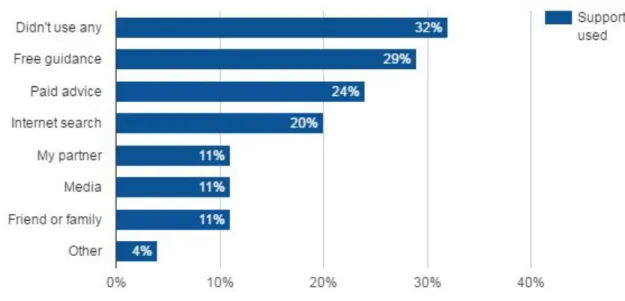
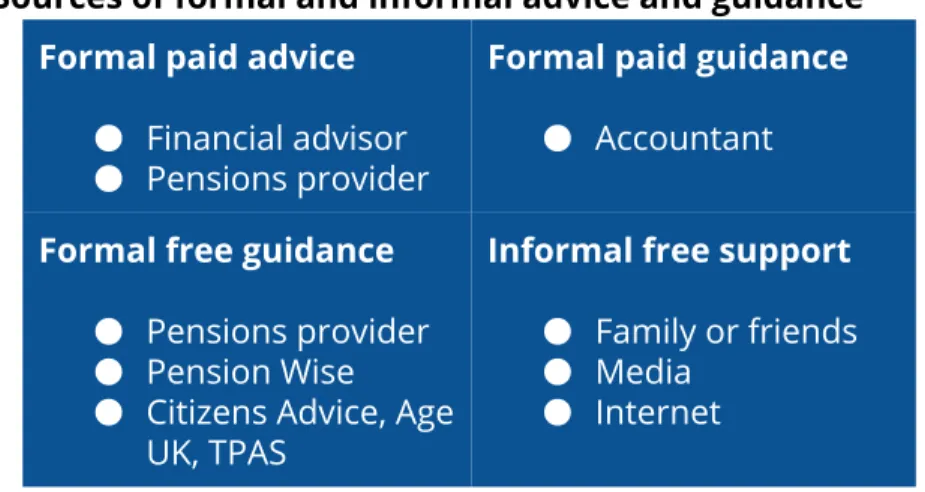
Most consumers seek support with their choices but almost a third (32%) don’t take any help. In fact, as Figure 2.1 shows, consumers are more likely to get no help than to seek support from any single source. Consumers in this group did not seek help either formally (such as from a financial advisor or Pension Wise) or informally (such as the internet, family and friends, and the media). For those who did seek help, free
guidance (used by 29%) and paid advice (used by 24%) were the most popular sources.
Figure 2.1: where consumers seek support understanding pension choices
Why consumers are likely to need help
Consumers taking their pensions generally find themselves in an unfamiliar environment. In Approaching Retirement, we found that only around one in five
consumers actively engage with their pension savings during their working lives, with
the remainder passively accumulating (56%) or actively avoiding their pension (22%). 14 We also found that consumers are more likely to want help accessing DC pensions than other key financial choices such as buying a house or investing in shares, as supported by other research. We also know from our previous research 15 The Four Advice Gaps that consumers are likely to consider their pension and other finances at key life events such as changing jobs or getting divorced. As Figure 2.2 shows, most 16 Citizens Advice clients who seek help with a private pension also want support on at least one other issue.
Figure 2.2: Citizens Advice clients with private pensions issues who also want support in other areas 17
Additional issue Percent of private pension clients with this additional issue
Financial services & capability 39%
Benefits & tax credits 37%
Debt 9%
Employment 8%
Housing 5%
Tax 5%
Relationships and family 4%
Other 18 16%
All 69%
Pension choices, even in isolation from people’s broader lives, are complex.
Consumers need to understand a wide variety of issues such as: tax liability, welfare entitlement, pension products, longer term retirement income and potential future care costs. The government recognised that consumers need support when it
introduced the guidance guarantee to provide free, independent guidance on pension choices. 19
In Approaching Retirement we found that over half (53%) of consumers who had not yet assessed their pensions would want professional support when taking their pensions.
14 Citizens Advice, Approaching Retirement, December 2015.
15 See, for example, Pensions Policy Institute, ‘Difficulty of making informed financial decisions’ in Submission to the Financial Advice Market Review, December 2015.
16 Citizens Advice, The Four Advice Gaps, September 2015.
17 These figures are from Citizens Advice management information for 2015/16. They do not include Pension Wise appointments. Consumers can be counted under more than one issue.
18 This includes issues such as consumer goods and services, legal, utilities and communications, and health and community care.
19 HMT, Millions guaranteed the right to free and impartial guidance, July 2014.
This is borne out in behaviour - our new research shows that half (49%) have taken
20
formal support through guidance or advice (or both). The support options in Figure 2.3 are not mutually exclusive - for example, our research shows that around 14% of those who took free guidance also paid for pensions advice.
Figure 2.3: Sources of formal and informal advice and guidance Formal paid advice
● Financial advisor
● Pensions provider
Formal paid guidance
● Accountant
Formal free guidance
● Pensions provider
● Pension Wise
● Citizens Advice, Age UK, TPAS
Informal free support
● Family or friends
● Media
● Internet
Formal financial guidance
Financial guidance offers an overview and generic information about the available options. For example, it sets out the six options for pension access and provides information about pension scams and financial advice. Consumers can access financial guidance about their pensions in a number of ways. These include
personalised Pension Wise guidance sessions, face to face with Citizens Advice or on the phone with the Pensions Advisory Service (TPAS), as well as guidance from pension providers themselves. Our research shows that three in ten (29%) of
consumers report having taken guidance before accessing their pension pots. The FCA estimates that 20% of consumers are using Pension Wise before accessing their
pensions. 21
Guidance services are widely used by consumers with different pot sizes, although they are slightly more likely to be used by those with smaller pensions. The FCA 22 found a similar pattern, with 22% of those with smaller pensions using Pension Wise compared to 17% of those with larger pots. But it is too simplistic to say that 23 guidance is just being used by those with small pots or low incomes.
Pension Wise is a multichannel service, offering consumers face to face, phone and online services. Our previous research found that consumers has a strong preference for face to face guidance when making pension choices, with 79% selecting this as a first or second preference . This has been borne out in the service: in the last six months, over 75% of completed Pension Wise appointments have been delivered face
20 Citizens Advice, Approaching retirement, December 2015.
21 FCA, Data Bulletin supplement: April 2016 - Retirement Income Market Data, April 2016.
22 In our survey over a third (35%) of those with pots below £30,000 told us they had used these, while three in ten (29%) of those with larger pensions also used guidance.
23 FCA, Retirement income market data: July – September 2015, January 2016.
to face. The government should ensure that consumer needs are recognised and 24 that the multichannel offering is protected in the new pensions guidance body being designed by the Public FInancial Guidance consultation. 25
Some consumers use Pension Wise as a first port of call to understand their options (potentially before taking advice), while others use it for a later check of their plans. In both cases the independence of the service is highly valued, as well as the fact that it is free.
“Pension Wise was very helpful. The person I spoke to was quite informative and able to outline our options. You want to bounce these ideas off someone and check for any potential pitfalls. And it was nice to talk without worrying what they were going to charge me.”
“I’m fairly confident now, but there was quite a lot of learning to do. I took
advantage of the Pension Wise appointment on the principle of never turn down a free lunch, and it was structured and helpful.”
Formal paid for advice
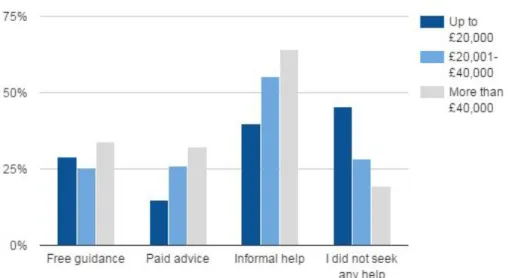
Paid for advice has many benefits for consumers, such as offering personalised recommendations and accepting liability for these. Perhaps not surprisingly we found that those with larger pension pots are more likely to pay for financial advice than those with smaller amounts. Consumers with large pensions or large household incomes are significantly more likely to take financial advice (the income effect is shows in Figure 2.4 below). The pot size effect is intuitive based on both supply and demand: our previous research showed that some advisors will not take consumers with small pots and consumers with small pots are less likely to feel that advice offers enough value to justify the costs. 26
“I got some advice – it’s been a complicated couple of years with pension freedoms and seeing the advisor made us think about it in more detail than we would have done. It really helped us understand everything in a lot more detail.”
The complexity of a consumer’s situation and preferences also affects their propensity to seek advice. This applies to both the complexity of the product(s) they want as well as the complexity of their overall finances. During our qualitative interviews
consumers were particularly keen on support if they were taking drawdown as they wanted to understand the options, establish withdrawal projections and understand risks. Our survey shows that almost half (46%) of consumers taking drawdown are
24 24,617 consumers have used the face to face service and 8,060 used the phone service between 1 October 2015 and 31 March 2016, from the gov.uk Pension Wise dashboard.
25 HM Treasury,Public financial guidance review: proposal for consultation, March 2016. The Citizens Advice response to this is here.
26 Citizens Advice, The affordable advice gap: how affordable and clear pricing can help more consumers access paid-for financial advice, October 2015.
using paid for advice compared to a quarter (26%) of those taking lump sums. Data 27 from the FCA suggests a similar relationship, with consumers accessing drawdown twice as likely to take financial advice than those taking cash through uncrystallised lump sums (UFPLS). 28
Figure 2.4: How household incomes affect support used
Some consumers take advice because they are compelled to do so. In some cases regulations dictate that advice is necessary, while in others providers impose their 29 own advice requirements both to protect the consumer and to protect themselves against future ombudsman claims. Some consumers find this frustrating, particularly if their pot is close to an advice threshold or they have considered risks and have a clear plan of what they want to do. This presents a delicate tradeoff between ensuring consumers understand what they are doing and the risks associated with their chosen course of action on one hand, and allowing a smooth journey on the other. It is
important that where advice requirements are applied consumers are told why, and we return to this in Chapter 4.
“Finding out we had these guaranteed annuities, because we were thinking of doing a drawdown, made us reassess it because they were better rates than I would have got if I tried to invest it myself.”
We have looked before at the barriers consumers face to taking financial advice. As 30 discussed above, price is an important factor, particularly relative to pension size. The government has worked to address this through the FAMR, and we welcome this work to support more advice offers at lower price levels. However, consumers face other barriers, most importantly around trust and reputation. Many consumers have low trust in financial advisors and are not aware of the changes to the industry following
27Data says paid advice taken by 26% of lump sum people, 27% annuities, 46% drawdown.
28FCA, Data Bulletin supplement: April 2016 - Retirement Income Market Data, April 2016.
29 These include for pensions with valuable Guaranteed Annuity Rates (GARs) or Guaranteed Minimum Payments (GMPs) worth over £30,000
30 Citizens Advice, The affordable advice gap: how affordable and clear pricing can help more consumers access paid-for financial advice, October 2015.
the Retail Distribution Review. Charges are key here, both how they are structured and how transparent they are. To help give more consumers confidence to take financial advice clearer, more transparent pricing should be used combined with TripAdvisor style feedback on directories.
“Financial advisors are hugely expensive and like to find out how much you’re worth and charge a percentage no matter what advice they give, which I find hard to stomach.”
Informal support
Many consumers use informal channels for help with their decisions. These include research on the internet (20%), speaking to a partner (11%) or friends and family (11%) and using the media (11%). Informal routes have been used alongside more formal support through guidance or advice by one in five (20%) consumers.
Confident consumers - who may have experience of working in the financial services sector or have actively managed investments in the past - often do a lot of research themselves. Some who aren’t confident ask friends or family for help, especially when these people have worked in financial services or accessed their pensions. So just as Pension Wise is a first port of call for many, informal support is also an important introduction for others.
“I did a lot of research really. I contacted some companies, and I did a lot of research on the internet. I was retired, so I had the time.”
“I looked in the paper and I got some general advice from that , I’ve been
following the change in retirement age for women so I’ve also kept on top of the freedoms at the same time.”
“I discussed it with my son who works as an economist.”
Consumers told us that informal approaches had a number of benefits. These include having greater trust in people they know and being able to fit research into their daily routines rather than going out of their way (and comfort zone) to speak to pension experts. As with guidance above, some are motivated to avoid the costs of advice.
Retired consumers are considerably less likely to use the internet for help with their choices (17% compared to 27% in work). This may indicate that they are less willing or able to go online or have less access to computers or another digital device. It should be seen in the context of low basic online skills amongst eligible consumers: almost a quarter (23%) of 55-64 year olds lack basic online skills, rising to 50% amongst over 60s. This underlines the importance of ensuring that consumers can access Pension 31 Wise through multiple channels and not just online.
31 Dot Everyone, Basic Digital Skills, UK report 2015.
No help
A third of consumers sought no support at all with their choices, and this is more common both when they have smaller pots and lower household incomes. As Figure 2.5 shows, of those earning £20,000 or less, almost half (45%) did not ask anyone for help. This proportion falls sharply to less than one fifth (19%) amongst those earning incomes of more than £40,000. This makes it particularly important that lower income groups are made aware that free pensions guidance services are available to them.
Citizens Advice has been looking at how this can be addressed at both local and national levels, such as through targeted advertising, by promoting better referrals from employers, providers and other services, and by improving the booking process for consumers.
Figure 2.5: Consumers not getting any help by household income 32
There is a high risk that some of these consumers will encounter significant detriment by not getting support. For example, while some are taking their money relatively simply, they may be unaware of implications for tax or welfare payments. The only protections they will receive are risk warnings which, as we show in Chapter 4, do not seem to be having a widespread effect.
“The advantage that I had was that I had a little bit of knowledge. I didn’t want to use an advisor because it would have taken longer and cost more.”
“I wasn’t going to do anything risky or complicated so I didn’t need a financial advisor. I just went with what seemed best for me”
In our qualitative research some consumers said they would take more help if they had more time. However, for others, taking formal help was useful precisely because they didn’t have much time - it was seen to save them the hassle of doing their own research. Our survey suggests the latter attitude is more common, with those in work significantly more likely to take guidance than those who are retired.
32 Citizens Advice data. Our figures show an increase in the number of those who did not ask for help at income levels around £70,000. However the sample size at this income level was small and was thought not to be representative of the wider population
Chapter 3: Choosing a pension and provider
This chapter considers how consumers approach their choices. Only a minority shop around, and those who do are almost as likely to shop around because they can’t get the product they want as because they are seeking best value. Even those who do want to shop around face a number of barriers, including trust in the new provider, effort to compare offers - especially for new drawdown products - as well as real and perceived issues around charges and delays which we discuss in the next chapter.
We find that tax free lump sums have been popular amongst all consumers as they offer flexibility and tax efficiency. Meanwhile, drawdown and annuity products are both equally popular, although drawdown is most commonly used by consumers with large pots whereas are annuities are most commonly used by those with medium-sized pots.
This chapter explores consumer experiences both of choosing which company to access their pension with and which access options they use. These two choices are linked: nearly half (44%) of consumers who switched provider did so to get the product they wanted, while one in five (20%) changed how they planned to access their savings after a first conversation with their provider.
Many consumers distrust the financial services industry in general, which means they are less likely to shop around - the benefit of moving to a better value product is outweighed by the perceived risks of transferring savings to a new (often unknown) provider. This is confounded by the fact that some who distrust financial services in general do have confidence in specific pension firms, particularly those that they have direct personal experience of using.
“If I can save money then I will, but If I tell you I got stung by Equitable Life and now I’m a bit weary about swapping and chopping and changing things. I got burned and it makes you a little more wary.”
Choosing a provider
Our research shows that just three in ten of all consumers shopped around and of these, half went on to change providers. Our qualitative research suggests that those shopping around just to find better value represent a small minority of consumers, which matches the roughly one in five we identified as engaged in Approaching
Retirement. This varies considerably by product. Whereas 57% of those buying an 33 annuity shopped around, just 14% of those who took their whole pot did so. The lack of shopping around for annuities has been an ongoing concern in the pensions market, so the lower levels for drawdown products (39%) shopping around is
concerning. Recent data from the FCA suggests that fewer than half of consumers are switching provider for either annuities or drawdown. 34
Figure 3.1: Shopping around by product
Shopped around
Our polling suggests that the key reasons that consumers are shopping around are either to access the product they want (47%) or to get the best value (44%), as shown in Figure 3.1. Although many consumers are aware that shopping around may deliver the best value, in practice they may not do this because of the risks or effort required to compare offers.
Figure 3.2: Why consumers switched
33 Citizens Advice, Approaching Retirement, December 2015.
34 FCA, Data Bulletin supplement: April 2016 - Retirement Income Market Data, April 2016.
Shopping around for value was the most common reason for consumers who went on to switch providers. But, as the case study below shows, even those who are shopping around for value face a number of barriers. These include conceptual barriers (such as trust) or practical ones (such as time to compare).
Case study: Trust as a barrier to shopping around
Jane, 60, lives with her husband and has just paid off her mortgage. She had two pensions worth around £70,000 and wanted to retire early with an
annuity: “I don’t take risk and at least you know where you stand.” But she felt that her provider was “telling me I could take it as drawdown now as annuities weren’t good.” She was sure she wanted the security of an annuity, and the provider said they could arrange this. But after some delays with her provider, she looked elsewhere.
“It was really hard to get them to send figures out, when they were becoming so difficult to work with I looked online got some quotes for the amount of money they were going to be giving me, and that came up with a company I hadn’t heard of before. Although I wanted value I called the second best offer because we’d had insurance with them before and I didn’t know the company offering the top one. They said they would buy me a product through the first company, and even though they recommended it and I checked they had all the FSA things, I was still worried I’d never heard of them. But obviously I’ve never looked at the market for annuities before. For all I knew at that point about them they could have been fly by nights.”
Jane’s case shows the importance of trust, and how shopping around can be daunting for many consumers.
The next most common reason for leaving a provider is linked to dissatisfaction with their range of access options. We found that 44% of consumers who switched did so to access a product that met their needs. This suggests that consumers could not access their savings as they wished from their original provider, meaning they either had to access their pension differently or move to another provider. Our survey shows this is most common for consumers wanting drawdown products, which suggests that providers are taking time to offer new products. Many consumers who weren’t able 35 to use the full flexibilities with their original provider were very unhappy, and felt confused that the government had announced freedoms that they couldn’t use.
“My provider said I said couldn’t just leave the small pot [with a GMP] and it was attached in some way financially to the other pots. It was tied up some way. I was a bit annoyed really, it meant I had to move all three rather than leave the little one with the guarantee, but overall it was a better deal for me.”
35 We found that 38% of consumers switched to access drawdown, compared to an average of 15%
of all consumers.
“My provider did not offer a [drawdown] platform. They also sold my pension onto another firm, which I hadn’t heard of, so I wasn’t particularly happy about that. When I contacted the new firm I said ‘do you have a platform so I can use the new freedoms and access my money in the way I would like to’ and they said no.”
In other cases consumers shopped around after receiving unsatisfactory support from their provider, such as delays or bad service. This can be because they have lost trust in their provider (10%) or because think they can access their money faster by switching (10%).
“It was really hard to get them [original provider] to send figures out, when they were becoming so difficult to work with I looked on Money Saving Expert and got some quotes for the amount of money they were going to be giving me.”
Our research shows that half of those who looked at other providers eventually opted to stick with their existing provider. In some cases consumers compared offers and realised that their current provider was offering the best value. In others, consumers would get better value from switching but were put off by other factors as they shopped around such as: fear of risk of transferring to a new provider, concerns around transfer charges, effort and delays.
“I looked at other charges and I thought ‘actually my provider’s charges are not bad’. There may be someone who’s a bit cheaper but really and truly does it seem extortionate or unreasonable? No, so I was happy to go with them.”
“I had the three offers in front of me, because I thought, ‘I can’t cope with more than three’. I was comparing their charges, the kind of funds they had, the returns they’d had on the funds. It was all incredibly boring, I was completely sick of it.”
We observed a tendency for consumers who shopped around to suffer research fatigue. Having made the effort to compare products, some consumers do not want to add additional delay so opt to stick with their provider. A key theme from our
qualitative research is that many consumers find the process stressful or face specific time pressures so are only willing to commit a limited amount of time or energy to the process. So it is important that they get clear support early on when they engage.
“I got other quotes, but ultimately decided rather than the hassle of moving it, which could apparently take 6 weeks, I just wanted to crack on with it and forget about the whole thing as it was so boring by then, so I stayed. That's partially inertia, but a lot of the times it’s better the devil you know with these things.”
“I was never going to transfer [into a drawdown] because I wanted the cash as soon as possible. Maybe I acted hastily, I don’t think I gave that too much
thought as the debt was a priority. I don’t think I had the luxury to understand everything.”
Didn’t shop around
The majority of consumers did not shop around and Figure 3.2 shows the reasons cited by those who stuck with their providers. Trust is the most common reason for consumers staying (36%), followed by best value (32%). As above, consumers often have a broad conception of value and once trust is established, they often follow a path of least resistance. Being able to get the product they want (30%) and most easily (29%) means that many see no need to shop around.
Figure 3.3: Why consumers stuck with their providers
Trusting an existing provider was the most important reason for not shopping around. This trust can stem from having had savings with a provider for many years or decades, and is particularly strong if consumers have seen good growth in their savings. Conversely, some remain loyal to their provider despite negative past experiences, often taking a ‘better the devil you know’ approach as described above.
While a minority of consumers we spoke to (and 9% in our survey) were not even aware they could switch, many others were aware but simply didn't see a compelling reason to switch. This can be a positive choice, such as they have been pleased with a provider or their service, or it can be a passive route.
“I’ve had the plan with them for over 15 years, it’s well performing and they’re easy to talk to. They did cock up my change of beneficiary form but they paid me
£50 compensation. So I’m quite happy to leave it there.”
“I just went with my existing provider because they were so efficient. They sent out written copies of what we’d discussed.”
Value is the second most common reason for sticking with a provider. There is some degree of cognitive dissonance here given that some consumers cite value as a reason for staying despite not having shopped around for other offers. Our qualitative
research suggests that consumers have a wider conception of value than simple product prices, and factor in perceived costs such as transfer charges or commission, time and effort as well as brands. Some consumers do genuinely get best value from their existing provider, particularly where they have guarantees with their pension. In other cases though, the perception that there will be charges deters them from even looking, with a sense that any extra value will be undermined by charges to switch.
Some consumers are also confused around advice requirements, and feel it may be cheaper and easier to avoid switching. We discuss the perceptions of advice and charges further in Chapter 4.
“I thought ‘I’m quite happy to leave it there’. There are costs involved every time you transfer, there seem to be commission every time. I got a recorded message saying you can change but there may be costs.”
In other cases consumers have a vague perception that the value of a product is reasonable. While this is fine when consumers are making informed choices, it is concerning if they have not actually compared prices or engaged closely with their product. In our interviews we found, for example, that some consumers with
drawdown products were not aware of the compound effect of annual charges and how these would influence their savings over time.
“I had no reason to shop around when the management charge seemed very reasonable. I was asking for something quite simple.”
“The [annual] charge didn’t seem that high, I will have a look at what it’s done when I get my statement.”
Case study: Perceptions of switching and fees
Margot, 68, recently retired and remarried, after divorcing six years ago. When she got divorced she checked her pension and other finances to understand how she would cope on her own. She found that her pension had dropped in value: “I didn’t think my provider was very good. They didn’t inform me I should go from stocks and shares into money [when approaching 60], so I lost quite a lot of money in 2008 when the crash happened. The charges were also too high and a whole year’s contributions were lost”.
At the time, and despite this negative experience, she chose to stay with her provider but move her investment into a lower risk profile. When she came to access her pension in 2015, she again stayed with her provider because she thought switching would incur additional costs, although she didn’t actually research this.
“Because you lose money if you change, it’s a lose lose game. I know from last time
that there are always fees involved and I didn’t want to have to deal with a whole other set of charges having lost money in the past.”
How to access savings
In general, the motivations and triggers discussed in Chapter 1 drive consumers’
decisions. They generally know what they want as an outcome (such as having money by a certain time or achieving security for their partner) and find the easiest way to achieve this. As Figure 3.3 shows, consumers are taking advantage of the freedoms and accessing their savings in a wide variety of ways.
Figure 3.4: How consumers have accessed their pension savings
Tax free lump sums
The tax free lump sum is a popular option for consumers with both long term and short term needs. In total, two thirds (67%) have taken some or all of their tax free allowance. This includes 17% who took some of their allowance and a 33% who took exactly a quarter. Some of these consumers have a pressing trigger for the money (as discussed in Chapter 2) so see cash as the best way to access their pensions, whereas others are motivated by desire for value through tax efficiency or the ability to take control. Consumers can take the TFLS alongside any other other option, although the most common approaches from our interviews were with drawdown or UFPLS.