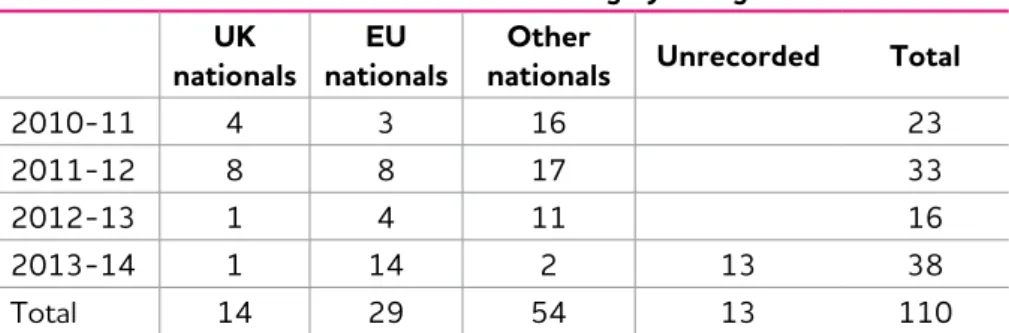
There is a growing awareness of the problem of forced labor and other forms of exploitation that have been collectively described as. The figures show that victims of forced labor (including domestic servitude) account for 21 percent (29 out of 135 total cases) of potential victims of human trafficking.

Summary
Cross border: A further factor considered to complicate the investigation into the shellfish harvesting case above was that the workers in Dundalk were based in the Republic of Ireland but worked in Northern Ireland. The issue of any cross-border dimension to forced labor was raised in the 2011 report and a small number of examples were cited where workers were moved between jurisdictions in Ireland. This current review found a number of other examples where people complained of being trafficked and moved between jurisdictions or, as in the periwinkle case, where there was clearly a cross-border dimension.
These included cases of people being trafficked across the border from south to north to pick fruit, and also some evidence of people being moved in the other direction to work in cannabis cultivation. Some interviewees noted that some of those working in forms of exploitation did not consider themselves to be so. Some were simply too afraid of the consequences for themselves or their families to file a complaint.
4 TRaFFicKinG OF childRen FOR
In a follow-up telephone interview in January 2014, Barnardo's noted that it had some evidence that a very small number of children who were British nationals from Northern Ireland were trafficked, and that all were trafficked for sexual exploitation in Northern Ireland. To date there is little evidence that children are used for forced labor in Northern Ireland. However, an increasing number of children are being identified as potential victims of trafficking and in a number of these cases the type of exploitation they may be subjected to is not identified and therefore there is the possibility that these young people may have been potential victims of forced labor.
5 ReSPOndinG TO FORced labOuR
The DoJ's current proposals aim to incorporate some of the proposals from the UK government's bill into the Private Member's Bill to have a single statute regulating all aspects of human trafficking and modern slavery, and that the revised and amended Private Member's Bill will pass in December 2014. A limiting factor in both the current Private Member's Bill and the proposals being discussed by the DoJ is that they separate the process of human trafficking from the practice of detaining people in modern forms of slavery. The two issues are considered interrelated but separate, but the experience of being a victim of human trafficking is considered more serious than the experience of being subjected to forced labor and other forms of modern day slavery.
This is illustrated by the fact that victims of human trafficking are given greater support and assistance than persons who have been exposed to forms of forced labor but who have not been trafficked. It begins by stating that 'modern slavery includes human trafficking, slavery, forced labor and domestic servitude'14. The Ministry of Justice should follow the lead of the Home Office and develop a legal and policy framework designed to tackle all modern forms of slavery.
Such an approach would ensure that the focus of law, policy and practice is more oriented towards victims of modern forms of slavery, rather than the trafficking process, and that victims of all forms of modern slavery (forced labour, sex industry work, domestic servitude) would be treated similarly.
Policy developments
The second action plan is more comprehensive and wide-ranging in that there are numerous references to initiatives to challenge forced labor and modern slavery. Some inconsistencies remain in the use of the terms 'slavery', 'modern slavery', 'forced labour' and. It is also worth noting that the section outlining proposed actions to protect and support victims refers only to victims of human trafficking and thus potentially distinguishes between those victims of forced labor and other acts of modern slavery who have been subject to trafficking and those who may not.
This document explicitly includes forced labor as one of the fundamental forms of exploitation that could be linked to human trafficking and provides a clear overview of the constituent elements of forced labor20. However, it should be noted that specific legislation prohibiting forced labor in the United Kingdom. Thus, the policy implicitly distinguishes between cases of forced labor that involve human trafficking and those that may not.
The Strategic Migration Partnership should review the impact and application of the 2009 Migrant Worker Strategy to produce an updated version to suit the current socio-economic environment and which includes measures to respond to forced labor and all modern forms of slavery. .
Since 2011, work in the field of migration has been carried out within the framework of the Northern Ireland Strategic Migration Partnership (NISMP); however, there does not appear to have been a formal update of the migrant worker strategy since 2009. A recent NISMP survey highlighted the ongoing challenges to the effective enforcement of employment rights21 and points to the continued need for a strategic framework that focuses on all issues related to migrant workers. It is also worth noting that interviewees cited a small number of cases of exploitation that spanned the border between Northern Ireland and the Republic, pointing to limitations and restrictions that hinder the development of effective cross-border responses.
It is therefore significant that the DOJ Action Plan on Trafficking and Exploitation 2014-15 includes a commitment to convene a cross-border forum on forced labor in autumn 2014, which will help build networks across Ireland for this matter.
A number of interviewees cited the positive work of the Gangmasters Licensing Authority (GLA) to reduce the exploitative practices of gangmasters and poor employment practices in those areas within their remit (agriculture, horticulture, forestry, shellfish gathering and food and beverage processing and packaging ) ). They also noted that there appears to be no political will within the government to extend the remit of the GLA at this time; the British government actually cut back on the resources available to the GLA. It also means that there is less likelihood that the various agencies will discover cases of more serious forms of exploitation.
A current initiative to raise awareness of forms of labor exploitation and how to identify signs of possible exploitation is the Stronger Together project28, run by the Association of Employers, GLA and Migrant Help, and funded by a number of the major supermarkets. This is a training program and toolkit aimed at employers and labor providers to make them aware of the potential for forms of labor exploitation and control in otherwise compliant and regulated workplaces. However, some interviewees believed that there was no political appetite for further employment regulation and that the best option would instead be to explore ways to make the current system more user-friendly for those who are subject to forms of labor exploitation and to increase the awareness of signs of possible cases involving forced labour.
Although there appears to be little possibility of any extension of the remit of the AVO or the creation of a new body to formally co-ordinate employment regulation, the work of bodies such as the NISMP may provide a platform for consideration of a more co-ordinating order response to labor exploitation and forms of forced labour.
Recommendations
The Department of Justice must ensure that all future legal and policy developments are designed to address all modern forms of slavery. The Action Plan of the Department of Justice must ensure that there is a consistency of language and approach to all modern forms of slavery. The Department of Justice must annually publish fully disaggregated figures for all cases of forced labor and modern forms of slavery in Northern Ireland.
The Department for Employment and Learning should review its current capacity for employment regulation and investigation to ensure that it can better address the issue of forced labor and modern forms of slavery. The Department of Justice and the Department for Employment and Learning should develop a more coordinated response to issues of forced labor and modern forms of slavery to maximize an effective response to the issue. The Public Prosecution Service should revise its policy on trafficking so that it covers all modern forms of slavery, including forced labour.
The Northern Ireland Strategic Migration Partnership should review and update the 2009 Migrant Worker Strategy and Action Plan, and this should include references to the issue of forced labor and modern forms of slavery.
Evaluation of the Effectiveness of the Implementation Mechanism in the Protection of the Employment Rights of Migrant Workers in NI. Press release December 13, "The Ministry of Justice hosts the first meeting of the NGO Engagement Group on human trafficking". At www.dojni.gov.uk/index/media-centre/justice-ministeri-hosts-first-meeting-of-ngo-engagement-group-on-human-trafficking.htm [accessed 8.5.14].
At www.dojni.gov.uk/index/media-centre/ford-highlights-role-of-young- people-in-tackling-human-trafficking.htm [accessed 8.5.14]. Assessing the Effectiveness of the Enforcement Mechanism in Upholding the Labor Rights of Migrant Workers in NI, pp. 17-18.