The Environment Agency is the leading public body protecting and improving the environment in England and Wales. This report is the result of research commissioned and funded by the Environment Agency's Science Programme. The Environment Agency's national customer contact center by emailing [email protected] or by
The work of the Environment Agency's Science Group is an important part of the collaboration between research, policy and operations that enables the Environment Agency to protect and restore our environment.
Introduction 1
Scientific Report: Microbial Origins Tracing Project 2 Previous work done through ICReW and also through another environment. Microbial source tracing techniques have been developed to help identify the source of such contamination. Scientific Report: Project Microbial Source-Tracking project 3 Combined with the count data, it will eventually be possible to classify the sources.
Provides a simple routine microbial source tracking service for human and ruminant markers for the 2007 swimming water season.
Experimental approach 4
Other possible indicators have been suggested that would suit routine service requirements (Devane et al., 2007). The limitations of the above approaches suggested that the only reliable approach to detect birds (such as the Aves class) would be to develop an assay for the host animal's DNA directly. The alternative would be to assess a range of potential indicator bird and bacterial species for each region of the UK.
Mitochondria – the cell organelles associated with energy metabolism in eukaryotes – possess an independent genome that encodes proteins and functions not produced by the host cell. Science Report: Microbial Source Tracking Project 11 to DNA, which allows quantification of the amount of DNA as it is synthesized during PCR, as well as monitoring a decrease in fluorescence when labeled double-stranded DNA melts (becoming single-stranded and released) the dye). The use of the probe allows further confidence in the specificity of the reaction, as it is determined by probe sequence (which must match the target sequence).
Detection limits were shown to be comparable to those of Bacteroidetes tests used for routine service. The presence of an avian marker in these faecal samples was likely due to diet. The level of the bird marker was lower than that of the host animal.
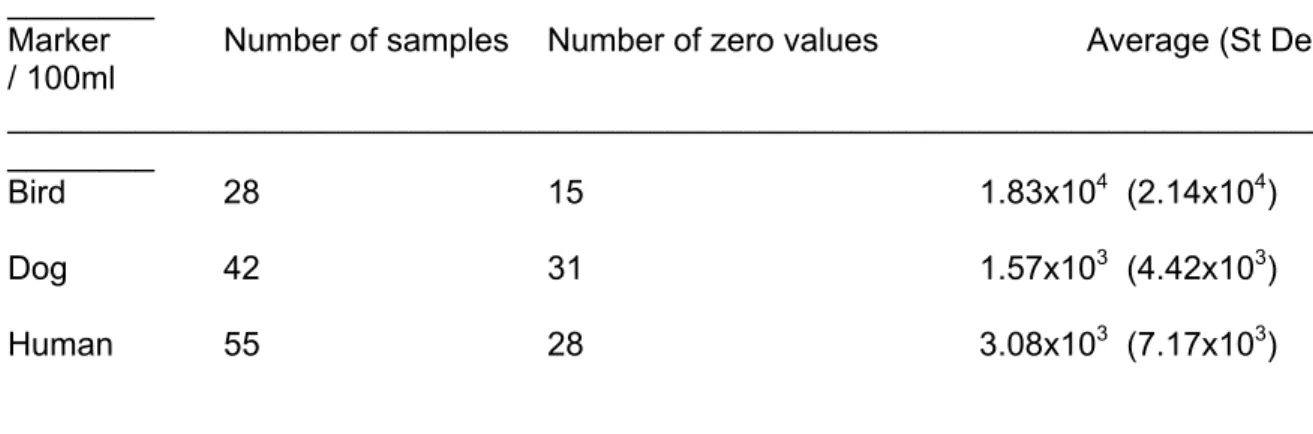
All three mitochondrial assays (bird, dog, human) were tested using water samples from the Environment Agency's North West and South West regions collected during the 2007 bathing season. Both standards (2.2B) and spiked control (2.2A) are used to determine the number of molecules of the target sequence in the current sample (Figure 2.2A). Sequencing of avian markers in human and canine faeces will require that when avian contamination is suspected, the samples will probably also require analysis for the human marker.
DNA repair is the best of the perforated discs, which can be inconvenient.
Discussion 18
Scientific Report: The Microbial Origins Tracing Project 19 the number of gene copies of these sequences in environmental samples will increase and. Extracting the maximum amount of information from these samples thus makes sense, and the ability to store DNA in a stable state for many years opens up the possibility of realizing this potential. An archive of DNA from selected sites (such as those known to have frequent contamination problems) will allow retrospective testing of these samples as new technologies are introduced.
Such an archive could serve as an excellent reference point for determining changes over time (eg quantifying the results of improvement measures or determining causes of gradual deterioration of water quality). The formal establishment of a DNA archive could also fulfill some monitoring requirements in the Water Framework Directive. These results represent significant progress toward the adoption and use of routine molecular biology tools in environmental testing.
The data generated by this project have provided the sponsors with information to critically evaluate the original bacterial markers used for source tracing (bathing water season 2007) and a framework within which the newly developed mitochondrial markers can be applied (bathing water season 2008). This project has thus established a solid foundation for source tracing for the UK regulatory authorities.
Recommendations 20
Likewise, absolute copy numbers of mitochondrial genes are not assessed, but the presence, absence, or relative abundance (such as avian to human) is used to suggest whether a sample contains such sequences, and if so, from the human diet or directly from birds. . The association between mitochondrial gene copies and both Bacteroidetes gene copies and FIO numbers should be further investigated, especially in relation to enterococci (which often do not show clear associations with other actual regulatory parameters). A further aspect, raised during one of the dissemination workshops, is the effects of UV treatment on effluent organisms.
When working properly, such treatment clearly reduces the culturable number of FIOs, but has little effect on Bacteroidetes gene copy number, when assessed by Q-PCR. The persistence of Bacteroidetes, mitochondrial DNA, and faecal regulatory indicator organisms in natural environments warrants further examination. There are several (relatively small) data sets suggesting that DNA from Bacteroidetes cells degrades rapidly within the environment, as growth of these anaerobes is unlikely to occur.
Likewise, once secreted from the host, the specific mitochondrial genes are unlikely to replicate in the environment. The role of free-living and particle-attached organisms, together with diversity assessment of the FIOs, needs to be further investigated to provide clarity. Research into MST techniques and applications is a rapidly changing field and although approaches such as those using Bacteroidetes and mitochondrial DNA currently have clear advantages over some other methods, new approaches need to be assessed and, if.
Using a single approach for all resources may be the clearest way of allocating resources (sorting inputs from all possible sources). Mitochondrial DNA is probably the most promising approach to this at present, although factors such as poorer detection limits, a less direct link between the measured parameter and the regulatory organism, and potential problems with a "universal" detection system that includes all participating organisms without cross-reacting with non-contributing organisms (such as plants) can.
Abundance and characteristics of the recreational water quality indicator bacteria Escherichia coli and enterococci in seagull faeces. Validation of host-specific Bacteroidetes 16S rRNA genes as markers to determine the origin of faecal pollution in the Atlantic rim of the EU. Evaluation of two library-independent microbial source tracking methods to identify sources of faecal pollution in French estuaries.
Development of goose- and duck-specific DNA markers to determine sources of Escherichia coli in waterways. Presence of Enterococcus faecalis in wild bird litter and wild bird droppings for bacterial source tracing. High-throughput, quantitative procedure for determining sources of Escherichia coli in waterways using host-specific DNA marker genes.
25
In short – the DNA extraction process is robust, but has some problems with inhibitor carryover and sensitivity when large amounts of non-target DNA are present. The enzyme copies single-stranded DNA, but requires a short section of double-stranded DNA to start from (primed). The enzyme used to copy the DNA is clearly a protein and can be prevented from working if it interacts with other molecules.
Thus, we now detect the production of specific products during the copying process as they are made, rather than at the end. In short - the standard DNA copying process is useful, but has the major limitation of only providing presence/absence data. DNA copying requires PCR primers to direct the specificity and direction of the enzyme as it works.
When this happens inside a living cell, the enzyme has a "check" feature, which ensures that the copying process works properly. However, if the enzyme recognizes the presence of the probe, and thus cuts it, the two fluorescent dyes are separated and the excitation light would result in a. Fluorescence from the reaction mixture can be monitored while the replication process occurs, that is, each time the process goes through cycles of heat (to melt the DNA) and cooling (to allow primers to bind and the enzyme to function).
We use about 40 such cycles, where the copying process can double the amount of DNA each time. In summary - the Q-PCR replication process is currently the most useful, with the main advantages of quantification and suitability for an acceptable laboratory process time.
30
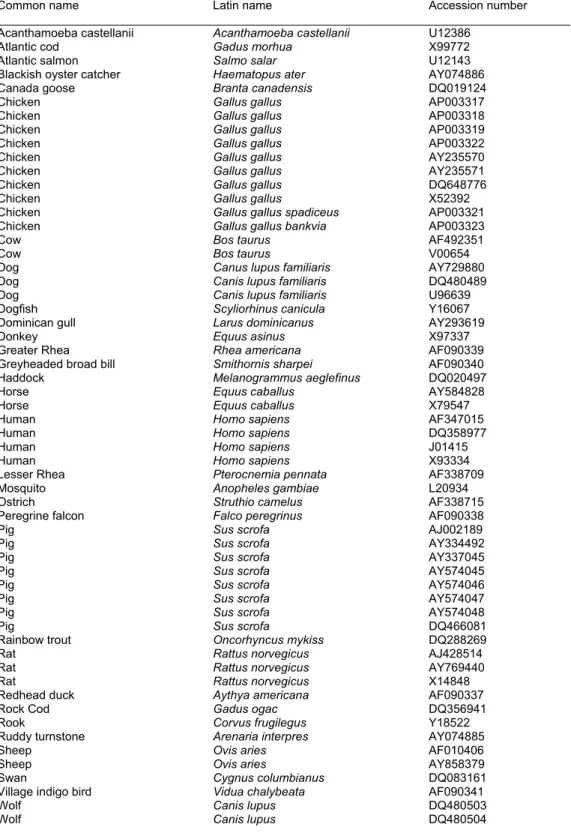
Ribosomal RNA gene sequences were also obtained from the Ribosomal Data Base Project (release 9; http://rdp.cme.msu.edu/). Target sequences were aligned using the Clustal-W software. http://www.ebi.ac.uk/Tools/clustalw2/), with the default settings. Consensus sequences were produced using the Boxshade software. http://www.ch.embnet.org/software/BOX_form.html) with >50% agreement required to determine a consensus position.
The mitochondrial genome sequence alignment was produced in-house using CLC Workbench Sequence Viewer 4.6 (CLC Bio, Aarhus, Denmark; http://www.clcbio.com/ ). Consensus sequences were obtained from the CLC Sequence Viewer and exported to FASTA format where required. Primers and probes were checked for suitability using a variety of parameters, including the DNA calculator software from Sigma Genosys (http://www.sigma-.
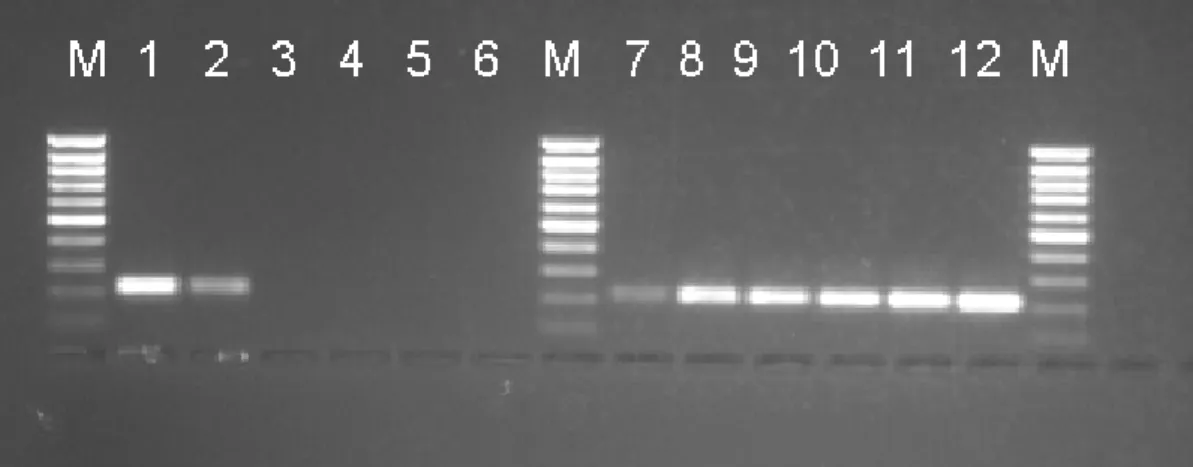
Secondary structures were also investigated using the MFold software from Michael Zuker, available on the web at. http://www.bioinfo.rpi.edu/applications/hybrid/quikfold.php). Standard PCR was performed using the KOD Hot Start DNA polymerase (Novagen, Merck Biosciences, Germany). Specific detection and discrimination of Ent. columbae using the rpoB genes or 16S rRNA genes was not achieved.
TaqMan probes with small groove binder non-fluorescent quenchers were obtained from Applied Biosystems, as were Q-PCR primers. Duplicate well mean values were corrected for enzyme inhibition using the spiked samples before comparing gene copy numbers.