Modernising
consumer markets
Citizens Advice formal consultation response
Contents
Introductory remarks 2
Measuring loyalty: response to Question 4 7 The need for telecoms advocacy: response to Question 5 19 Extending ADR: response Questions 12-15 34 Minimum standards in essential markets:
response to Question 17 48
Response to other selected questions 50
Dear colleague,
Citizens Advice provides free, independent and impartial advice to anyone who needs it.
We are the statutory advocate for energy and post consumers and run the national consumer helpline. Last year we helped 2.7 million people with 6.3 million problems.
We are pleased to respond to the Government’s consultation on Modernising consumer markets and look forward to working with it in the coming months and years to fix the market failures it identifies.
We welcome the ambitious analysis the Government has put forward and its
acknowledgement that markets have too often tilted towards companies’ benefit and away from consumers’. We also support its understanding of the ways in which markets fail consumers, its proposals to rank firms on how they treat loyal customers and its new strategic steer for the Competition and Markets Authority.
Having set the Government’s ambitions appropriately high, bold action will be expected to fix the problems it sets out. In summary, our principal recommendations are that
Government should:
● Fund a statutory, independent consumer advocate in the telecoms market
● Make firms publish how much they are overcharging loyal consumers and take further, evidenced action to reduce price differentials in essential markets
● Enshrine minimum standards for people with mental health conditions in essential markets
● Extend mandatory dispute resolution to every market, but particularly the used car and home improvement markets
We offer brief commentaries on each issue, which are addressed in more detail in subsequent answers to your questions. We also make further recommendations in our answers to selected questions below.
We recognise that time for parliamentary business is at a premium and that much action can be taken to help consumers without primary legislation. However, issues like giving the CMA proper civil fining powers, creating statutory advocacy for telecoms consumers and enhancing consumers’ data portability rights might best be addressed by a short, targeted Consumer Bill. In thinking about the next steps for the Green Paper, we urge the Government to give legislative options due consideration.
The need for telecoms advocacy
Broadband and mobile phone services are essential services and consumers have more problems with their telecoms provider than any other essential service: 27.6 million problems each year . Yet unlike other essential services such as water, energy and post, 1 there is no independent consumer advocate. As we know from other sectors, a small
1 Citizens Advice/Oxford Economics, ‘Consumer detriment: counting the cost of consumer problems’ (2016).
investment in consumer advocacy could make a serious dent in reducing consumer detriment and improve the functioning of the market. In water, for example, consumer advocacy has helped 250,000 low income consumers reduce their bills by up to 80% . In 2 energy, we helped reduce consumers’ energy bills by £300m , by shining a spotlight on 3 the profits of energy network companies and encouraging them to return money to consumers.
But a consumer advocate can do more than just expose and help fix existing detriment. In the big conversations about the future of these markets - from the rollout of full-fibre broadband to mobile spectrum allocation and the relationship between BT and
Openreach - the conversation is one between regulators and industry. Given how pivotal telecoms is to the wider economy, it’s critical that the voices of consumers and small businesses are also heard.
Our detailed views on telecoms advocacy are set out in response to Question 5.
Measuring the loyalty penalty in essential markets
We welcome the Government’s proposals to produce scorecards for providers in essential markets across a range of metrics. We think each of the metrics that the Government sets out in the Green Paper are important.
However, we have focussed in particular on its proposals for price differentials. This is partly because our research on the loyalty penalty suggests fruitful ways in which they can be measured. However, principally it is because we think excessive price differentials are the biggest way in which markets fail consumers at present. To fix this problem, we need better estimates of which firms are overcharging their consumers most. When properly measured, regulators can also use these scorecards to set companies targets to reduce the loyalty penalty.
We set out our detailed views on how to measure loyalty in response to Question 4.
Ensuring there are minimum standards for people with mental health conditions in essential markets
Our recent research (appended as Appendix A: Beyond good practice guides) finds that people are unaware they can get support with their essential services, that they struggle to access it without help and - critically - that the support is patchy, inconsistent and unreliable.
Mental health has rightly been a priority for this Government and we welcome the Green Paper’s focus on minimum standards for people with mental health problems in essential markets. As we argue in our response to Question 17, we believe this should be the first priority for the Government’s Consumer Forum. This is an area where quick and concrete action is required, driven at the highest governmental and regulatory level.
2 Annual Report and Accounts 2016-17, CC Water
3 The postcode lottery in energy profits, Citizens Advice, 2018
Extending alternative dispute resolution
Last year, three million people experienced a severe financial impact as a result of a consumer problem, and over two million suffer damage to their home or property.
Simple, non-court based resolutions to these problems are essential for well-functioning markets.
We still believe that the best solution to this is the simplest: mandate alternative dispute resolution (ADR) in all markets, irrespective of type or size of transaction. However, we recognise that mandatory ADR would require a significant change in regulatory approach and the potential cost impacts on business need to be considered.
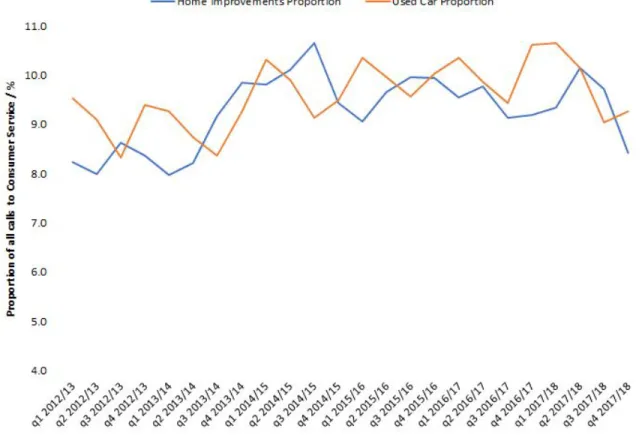
We therefore agree that in the immediate term, sectors where the size of the detriment is high should be prioritised. We welcome the Government’s intent to address this in the housing market and believe it should also be extended to used cars and home 4
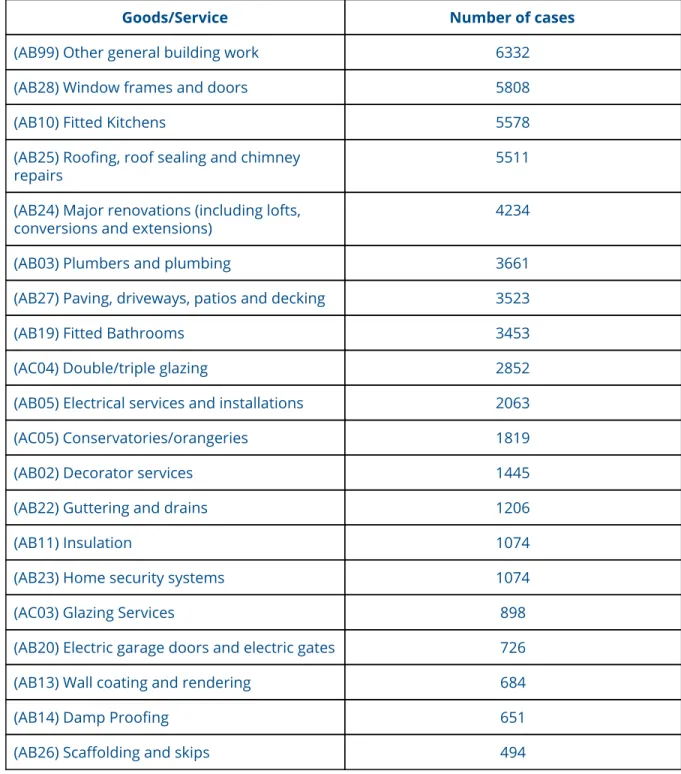
improvements (areas where our Consumer Service currently sees the highest volume of problems).
In response to Questions 12-15, we set out the scale of the problems in these markets, as well as proportionate ways in which mandatory ADR could be implemented.
——————
If significant progress is made on the preceding four key issues, then the Government will have taken important steps to help fix many consumer markets.
But it would still leave problems unresolved - particularly insofar as they relate to the loyalty penalty. Measuring the extent of the loyalty penalty is welcome and will provide firms with some reputational incentives to avoid it. But further action is likely needed to meet the Government’s ambition ‘to safeguard consumers who, for whatever reason, remain loyal to their existing providers so that they are not materially disadvantaged.’ 5
These problems are complex and do not elicit easy answers. But given that loyal
customers can pay nearly £1,000 per year for essential services, they need to be tackled nonetheless.
What works best depends on the market in question. An evidence based approach to understanding the advantages and limits of each approach is also necessary.
On the one hand, we know that demand-side interventions to help people switch are essential. In our own experience, we help 72,000 people in or at risk of fuel poverty engage with the energy market and provided information to a further 600,000 people through our Energy Best Deal programme . This is why we welcome the Government’s use 6 of competition, to help consumers use technology get on to better deals. We’d also
4 For more detail on how this should be implemented, please see our report Redressing the balance
5 Modernising consumer markets, Department for Business, Energy & Industrial Strategy
6 Energy Best Deal 2017, Citizens Advice
welcome the opportunity to work with the Government and regulators on using
technology to help more people: in particular, as we note in response to your questions on data portability, the problems with connecting low-income and vulnerable consumers with automatic switching services only partly stem from technological immaturity. More often, companies offering these services lack the trust and access to reach the consumers who need help most.
But we also know that, at least for the foreseeable future, this is unlikely to be a total solution. Well targeted interventions to encourage switching are low cost and make a difference at the margins. But they are not a panacea: millions of households still do not switch. Robust investigations into the efficacy of these interventions find real but limited impacts - for example, Ofgem’s letter to disengaged customers increased switching, but 7 only from 1% to 2.9% in the trial period. A similar picture is painted by Professor Amelia Fletcher in her review of the efficacy of demand-side remedies , who finds that ‘a number 8 of demand-side remedies, of various sorts, have had beneficial effects. However, many have not been as effective as intended, and a few may even have had unintended negative
consequences’.
So we are both convinced of the need for demand-side remedies but recognise the evidence that suggests their impact is important but limited. When loyal consumers are overpaying by almost £1,000 in six essential markets - a penalty particularly paid by low-income consumers - the Government should not be satisfied with remedies that only 9 solve a small proportion of this detriment.
Appropriate regulation of companies’ pricing structures - as the Government has done in the energy market - is proportionate to the size of the problem. And when 96% of
consumers think the loyalty penalty is unfair, these interventions are likely to be popular.
But they also carries significant risks to competitive dynamics in the market, so must be carefully considered. In certain circumstances, price discrimination can intensify
competition and there are certainly examples of well-intentioned attempts to regulate 10 price differentials in the UK that failed . 11
The Government has ably avoided the possible pitfalls of pricing interventions in energy, by targeting a price cap to a problem: incumbents setting significantly higher prices for a large, unengaged consumer base. However, this particular tool is unlikely to apply to
7 One letter that triples energy switching, The Behavioural Insights Team, February 2018
8 The Role of Demand-Side Remedies in Driving Effective Competition: A Review for Which, Professor Amelia Fletcher, November 2016
9 For example, low-income consumers are 29% more likely to have had the same energy contract for at least four years and 22% more likely to have had the same insurance contract for at least four years (Source: Citizens Advice, The cost of loyalty’, 2018)
10 Tariff diversity may have led to greater broadband adoption in the EU, for example (Source: Tariff Diversity and Competition Policy — Drivers for broadband adoption in the European Union, July 2017)
11 For example, limits on how much energy companies could charge their pre-privatisation region’s customers led to many suppliers increasing prices for acquisition deals, rather than lowering everyone’s prices. (Source: Consumer Choice and Competition Policy: a Study of UK Energy Markets, Waddams, Price and Waterson)
markets where there is greater product diversity and different competitive dynamics - but where the loyalty penalty is just as prevalent.
We believe that more robust interventions are nonetheless likely to be necessary in other markets - applying the same spirit of regulatory radicalism to the specific nature of the problem in other markets. That is the key question for us: how do regulators and Government best intervene to protect loyal consumers, without adversely affecting
competition and average prices in the market. This will be a major research focus for us in the coming months, as fixing the loyalty penalty remains the most important challenge for consumer markets.
——————
We also offer comment on other questions insofar as we have informed views or evidence on them. This response is not confidential and may be published in full on your website.
Kind regards, Morgan Wild
Senior Policy Researcher, Citizens Advice
Measuring loyalty: response to Question 4
What is the best way to publish performance data so that it incentivises firms to improve and can be used by consumers when taking decisions? Should firms also offer discounts or compensation for poor performance?
Summary
The Government and regulators should develop performance metrics for companies and digital comparison tools in their sectors, including data on price differentials, consumer engagement, service quality and complaints across these sectors.
There is an opportunity for trusted consumer advocates to publish much of this
information. Consumer organisations like Citizens Advice are better placed to produce many of these materials, because we have more day to day interaction with consumers than regulators. This makes us well suited to test, iterate and promulgate these tools. We currently produce a ‘star rating’ tool that compares domestic energy providers’ customer service on five objective metrics, including complaints data . We think this provides an 12 excellent template for how scorecards on customer service could be developed in other markets.
We have also developed specific proposals on how scorecards could measure price differentials in the regulated markets where we have identified a loyalty penalty
(excluding energy): broadband, mobile, savings, insurance and mortgages. We’ve focused on this issue both because of our prior expertise in this area, but also because of the sheer scale of detriment experienced by (often vulnerable, low-income) consumers. The Government should move to get regulators in a position to publish these scorecards as soon as possible.
There is scope for discounts or compensation for poor performance, similar to that delivered in some sectors (particularly energy) through Guaranteed Standards. The Government and regulators should also give consideration to forcing companies to waive exit fees when services fail - as we have asked for in relation to broadband exit fees where service quality is substandard.
12 Compare domestic energy suppliers’ customer service, Citizens Advice
Detailed proposals for measuring the loyalty penalty in essential markets
The Government’s Green Paper, Modernising consumer markets , sets out an ambition for 13 reducing the loyalty penalty in regulated markets. Our research has shown that people face a loyalty penalty of as much as £987 across six essential markets - more than 4 months’ worth of food for the average household. And it’s often vulnerable consumers who pay the most.
We think that reducing the loyalty penalty should be the focus for improving many consumer markets. If the Government and regulators can reduce it, then they’ll
substantially increase the disposable income of many households - particularly for those who are on low incomes or vulnerable . 14
One of the Green Paper’s proposals is to direct regulators to produce scorecards to
provide ‘a set of comparable data on consumer outcomes such as price differentials, consumer engagement, service quality, and complaints across these sectors.’ 15
We agree with this proposal and the scope of the metrics. These scorecards will have broadly three purposes:
1) As an input to digital comparison tools, adding to the information that consumers have available when making switching decisions
2) As a reputational incentive for firms, by naming and shaming those who engage in unfair pricing strategies or offer poor services
3) As an analytical tool for regulators, Government and consumer advocates, allowing interested parties to analyse the breadth and depth of consumer detriment
The metrics which the Government proposes are appropriate. This paper focuses on price differentials, both because of our prior work on identifying the problem and the urgency for tackling the loyalty penalty. Already, highlighting this problem has focussed industry &
regulators’ minds to tackle it: most notably, public disquiet at overcharging loyal
customers precipitated the Government’s action to end the loyalty penalty in the energy market, due to the scale of the exploitation identified.
If the Government is going to meet its ambition to end unfair price differentials in other markets, it will need to be able to measure them accurately - both in terms of how many people are overpaying and for how long.
13 Modernising consumer markets: green paper, Department for Business, Energy & Industrial Strategy, April 2018
14 We found that low-income consumers are 22% more likely to be paying a loyalty penalty in insurance, for example.
15 Modernising consumer markets: green paper, Department for Business, Energy & Industrial Strategy, April 2018
We outline three approaches for estimating price differentials between new and loyal consumers, based on our data and previous research. But there will also be other markets where there’s a loyalty penalty but a lack of available data to estimate it. We think this could include pensions and current accounts, for example. This underscores the need for effective information, since if we cannot work out how much consumers are punished for their loyalty in these markets, it’s highly unlikely consumers themselves can.
In measuring price differentials, and other elements regarding scorecards, it’s important that Government doesn’t let perfection be the enemy of the good. Prompt action is required and we do not expect the first attempt to get everything right. The Government should be directing regulators to publish this information as quickly as possible, iterating and improving the process along the way.
We set out:
1) The way the loyalty penalty is measured in the energy market 2) Why this is unlikely to work in other markets
3) Three options for estimating the loyalty penalty in other markets:
a) Measuring the loyalty penalty for basic products
b) Measuring the loyalty penalty for representative products c) Measuring the loyalty penalty at the firm level
We think each option will be able to capture interesting data for each market. But only the third option will establish market wide data for every market where the loyalty penalty exists and give the depth of knowledge about how long different consumer cohorts are overpaying for. We therefore think, while any increase in information would be useful, looking to firms to produce this information themselves is likely to be the best approach.
The approach in energy
Among regulators, Ofgem has made the most progress in measuring the loyalty penalty in the electricity and gas markets. They estimate it for customers on standard variable tariffs (the default tariff for non prepayment customers after a fixed deal has expired) with the 10 largest suppliers in the market. This gives excellent coverage of the scale of the problem. They use the following data:
● The proportion and number of customers on a standard variable tariff (SVT) (data requested from suppliers)
● Average weekly prices for a) standard variable tariff, b) the supplier’s cheapest tariff and c) the market’s cheapest tariff (data from Energyhelpline)
Consumers have different rates of consumption, so there is considerable variability in what they in fact pay. To adjust for this, Ofgem assumed a particular customer type - a dual fuel direct debit customer with a typical consumption pattern.
This simple approach yields the data shown in Figure 1. The fifth column shows ‘within company’ price differentials; the final column shows price differentials compared to the best deal available on the market.
Figure 1: Price differentials in the energy market 16 Supplier Proportion of
non-PPM customer accounts on SVT
Total non-PPM customer accounts
Average SVT price and relative ranking bracketed in ascending order
£differenc e to supplier's cheapest tariff
£ difference relative to market cheapest tariff
First
Utility 23% 179,433 1,132 (5) 224 326
OVO Energy 28% 149,573 1,097 (2) 127 291
Co-opera tive Energy
35% 128,081 1,158 (9) 192 352
Scottish
Power 41% 1,030,523 1,147 (8) 161 341
Npower 48% 1,186,081 1,166 (10) 158 360
EDF 52% 1,503,954 1,142 (7) 125 336
Utility Warehou se
53% 247,959 1,123 (4) 99 317
E.ON 61% 2,046,015 1,133 (6) 222 327
British
Gas 67% 4,477,308 1,090 (1) 62 284
SSE 71% 2,408,529 1,121 (3) 96 315
This approach has a number of advantages:
● It is simple to implement and understand. While it assumes away some complexity in the energy market, it does so in a way that gets to the heart of the matter - how much suppliers are punishing their customers for their loyalty.
● The burden on business is low. The data request to suppliers is simple and only made to the 10 largest suppliers, reducing the burden on new entrants to the market. Given the loyalty penalty is more pronounced among incumbents in the
16 Ofgem publishes supplier standard variable tariff league table, December 2017
market, this captures the vast majority of the problem. The remaining data is captured from commercial data sources.
● It provides an adequate benchmark. This exercise can be repeated regularly to measure how successful companies are in reducing how much they charge loyal consumers or, alternatively, whether more robust interventions are required.
However, there are reasons for thinking that this simple approach will not transfer cleanly to other markets. That’s because, despite significant tariff diversity, energy is a relatively simple product. This in turn makes the price differentials for comparison straightforward:
each supplier has a single tariff that loyal consumers default to and a comparable best available deal . 17
All the markets we consider below also have defaults that consumer roll on to. But that’s where the similarities end.
Product diversity and measuring loyalty
Measuring the loyalty penalty in energy is simple because product diversity is low: energy is energy. However, in other markets where the loyalty penalty exists, this isn’t the case.
We estimated the loyalty penalty in five other markets : 18
● Mortgages
● Insurance
● Savings accounts
● Mobile phones
● Broadband
Each of them has considerably higher product diversity than energy - for example, there are over 4,600 different mortgage products available . 19
This makes the approach outlined for energy infeasible. To take broadband as possibly the closest comparison to energy, tariffs and products differ by broadband speed, amount of data, contract length, setup and exit fees, and connection type. Any combination of differences on these variables can lead to a dizzying quantity of possible tariff types.
Telecommunications are also often bundled with other services, like pay-for TV or phone lines, adding to the potential complexity.
17 Some energy suppliers - who do not charge a loyalty penalty - only offer a single tariff so the difference between these two is in practice zero.
18 The cost of loyalty: exploring how long-standing customers pay more for essential services, Citizens Advice, February 2018
19 15th month of mortgage product growth, Moneyfacts, 07/08/2017
Products only get more complex from there. In financial services like mortgages and insurance, one way to think about what consumers are purchasing is a bespoke tariff:
based on the amount that people wish to borrow/insure and a wide variety of information about their personal circumstances to assess risk.
However, this complexity shouldn’t dissuade from attempts to measure the loyalty penalty. In fact, the greater difficulty for consumers in knowing they are paying a loyalty penalty in these markets makes it all the more urgent a problem to understand and fix.
The basic prerequisite of a well functioning market is information: if consumers can’t work out whether they’re getting a fair deal from their provider, markets won’t work in their favour.
We propose three ways in which this problem can be measured by regulators in different contexts. In brief these are:
1) Measuring the loyalty penalty for a sub-set of products in these markets. This would not necessarily be a representative sample of products, but might be the products that we know vulnerable or low-income consumers are particularly likely to purchase.
2) Measuring the loyalty penalty for a representative sample of products in these markets. Some markets will have great tariff diversity, but it will be possible to choose a selection of products which provide sufficient coverage to be indicative of the cost of loyalty for the whole market.
3) Measuring the total loyalty penalty for each firm in each market. This is the strongest version of the the scorecards, and would require businesses to estimate the costs of loyalty themselves. It is feasible in every market.
This response explains each option in turn and how it could be implemented for each market we have considered. It is not intended as the final word on measuring the loyalty penalty and we look forward to further conversations with regulators about how best it should be implemented.
Measuring the loyalty penalty for basic products
One of the reasons we care about the loyalty penalty is because of its impacts on low income and vulnerable consumers. As multiple studies have concluded,2021 the loyalty penalty is a significant driver of ‘a poverty premium’ - the additional amount that lower income consumers pay for essential goods and services. One therefore might wish to identify the loyalty penalty for the cheapest available products.
20 Measuring the Poverty Premium, Social Market Foundation
21 The Poverty Premium - When low-incomes households pay more for essential goods and services, University of Bristol
We used a similar approach to measure the loyalty penalty in the broadband market, by 22 looking at:
● The cheapest basic broadband contracts offered by providers online for BT, Sky, EE Virgin Media & TalkTalk
● The out-of-contract price for each provider This revealed the costs summarised in Figure 3 below.
Figure 3: Price differentials for cheapest basic broadband contracts 23
This shows the majority of information provided by the Ofgem SVT comparison. We
supplemented this information with polling on the number of people paying this penalty (by asking people about contract length) by provider (by asking people who provided their broadband) to estimate the market-wide scale of this problem. However, regulators can and should simply request this information directly from companies, getting the actual market wide data. In the example of broadband, this request would be for every company to provide information on the number and proportion of their customers on
out-of-contract basic broadband deals. It should also be supplemented with information about the market’s cheapest offer.
This is the simplest implementation and would provide illuminating information regarding the broadband market. It may also provide indicative inferences regarding the size of the loyalty penalty for other broadband products (e.g. higher speed products or bundled products). Given the growing number of consumers using triple play bundles (landline, broadband + pay-for TV), this model could indicate the size of the loyalty penalty for this bundle as well.
22 Exploring the loyalty penalty in the broadband market, Citizens Advice, April 2017
23 Used here for illustrative purposes; figures are from 2017
However, it does not provide a full picture of the problem. Relatively small proportions of the market are on these products . If scorecards for price differentials formed a powerful 24 reputational incentive, it could also encourage gaming from companies. We’ve seen this in the broadband market previously - Virgin Media already don’t have an in-and-out of contract price for their basic broadband deal, but do for many other more initially
attractive promotional deals. Whatever tariffs one selected for this type of measurement, it runs the risk that provider behaviour will adapt and offer different tariffs that escape the confines of what is being measured.
Implementing this approach in other markets
This approach is feasible for the broadband market. Figure 4 provides our high level analysis of whether it would be feasible in other markets.
Figure 4: Measuring loyalty for ‘basic’ products in other markets Market Are there
‘basic’
products?
How would it be measured? Limitations
Mobile
phones In principle - but difficult to estimate because there are different combinations of handset &
tariffs. In practice, therefore, unlikely to be tractable.
If tractable, select the most common low-cost handsets and tariffs and compare the in and out of contract price for each provider. Data request of companies for number of customers on each deal.
The most common low-cost handsets changes over time so longitudinal comparisons would be limited. Only three suppliers offer full bundled contracts anymore.
Savings The most common product is the easy access savings product
.
25
Calculate the difference in interest earned on an easy access savings product in in year 1 and the interest earned when moved to a variable rate in year 2.
Data requests of companies with number of customers on each deal.
Does not provide whole of market data - otherwise tractable.
Mortgages No - but archetypical fixed rate prices for below median income consumers could be
Regulators could work with companies directly to identify quotes for fixed rate prices.
This would be compared with a) typical SVR rate for transfer customers and b) their actual SVR rate.
Isolating the price differential for lower income families could be difficult (if, for example and as would be expected, they have systematically different interest rates to other income profiles).
24 Ofcom, Pricing trends for communications services in the UK, May 2018
25 Worth roughly £354bn, or 50%, of the personal savings market: Cash Savings Market Study, FCA 2016
calculated from providers’
online mortgage calculators.
Data requests to companies would estimate the number of customers on each deal.
Insurance No. It seems unlikely that this method is possible for insurance.
N/A N/A
Measuring the loyalty penalty for representative products
The loyalty penalty is unfair for all consumers, so regulators should also try to estimate the loyalty penalty for the average consumer. We’ve calculated that it costs loyal
consumers almost £1,000 across 6 markets . Regulators should therefore identify the 26 loyalty penalty for the average product, or a subset of products that make up the majority of that market.
This requires judgement about what a representative product or set of products is in each market. We used this approach to measure the loyalty penalty in the mortgages market , 27 by looking at the standard variable rate & first-time buyer 2-year and 5-year fixes, treating the latter fixed products as representative of the whole market. We identified the best prices for the six leading mortgage companies which represent 69% of the market.
We supplemented this with data from the Bank of England survey of mortgage users to estimate the size of the loyalty penalty. In practice, regulators would be able supplement this with market-wide data by making requests of companies directly.
Similarly, one could make assumptions about the representative products in broadband.
For example, Ofcom could base their analysis on median broadband speed, or selected a weighted average of different speed broadband products to identify the right bundle to estimate a firm’s loyalty penalty . 28
This leaves open the question of whether it is appropriate to treat these products as representative for the market as whole. We are not in a position to answer these
questions definitively, but regulators should be able to. In any case, measures for some products that are likely to be representative of the wider market would be a better position than we find ourselves in now.
26 The cost of loyalty, Citizens Advice, January 2018
27 Exploring the loyalty penalty in the mortgages market, Citizens Advice, July 2017
28 Perhaps drawing on survey data in the Communications Market Report 2017
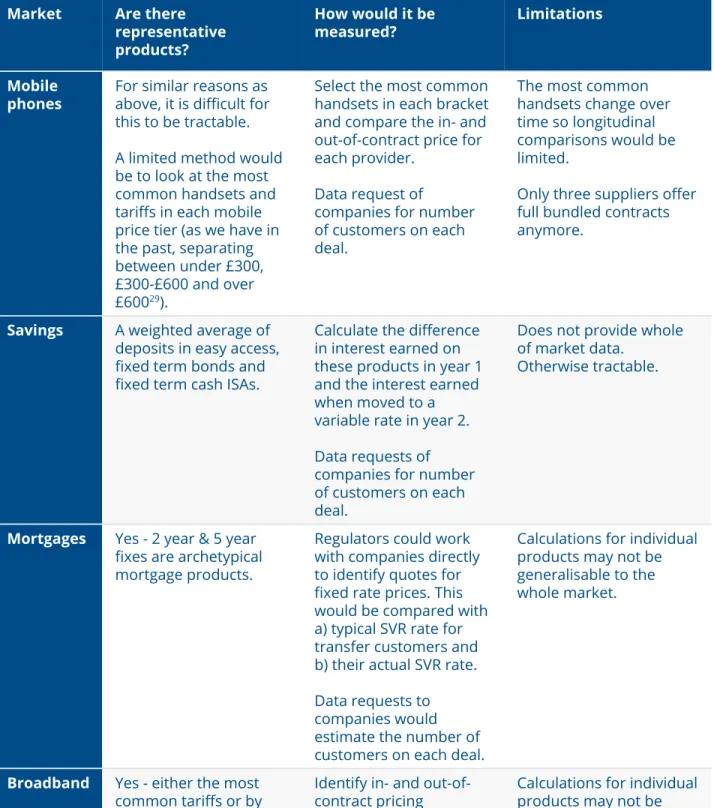
Measuring the loyalty penalty for representative products in other markets This approach is feasible for the broadband market. Figure 4 provides our high level analysis of whether it would be feasible in other markets.
Figure 4: Measuring loyalty for ‘basic’ products in other markets Market Are there
representative products?
How would it be
measured? Limitations
Mobile
phones For similar reasons as above, it is difficult for this to be tractable.
A limited method would be to look at the most common handsets and tariffs in each mobile price tier (as we have in the past, separating between under £300,
£300-£600 and over
£600 ). 29
Select the most common handsets in each bracket and compare the in- and out-of-contract price for each provider.
Data request of
companies for number of customers on each deal.
The most common handsets change over time so longitudinal comparisons would be limited.
Only three suppliers offer full bundled contracts anymore.
Savings A weighted average of deposits in easy access, fixed term bonds and fixed term cash ISAs.
Calculate the difference in interest earned on these products in year 1 and the interest earned when moved to a variable rate in year 2.
Data requests of companies for number of customers on each deal.
Does not provide whole of market data.
Otherwise tractable.
Mortgages Yes - 2 year & 5 year fixes are archetypical mortgage products.
Regulators could work with companies directly to identify quotes for fixed rate prices. This would be compared with a) typical SVR rate for transfer customers and b) their actual SVR rate.
Data requests to companies would estimate the number of customers on each deal.
Calculations for individual products may not be generalisable to the whole market.
Broadband Yes - either the most common tariffs or by some critical variable (e.g. speed).
Identify in- and out-of- contract pricing
information for chosen
Calculations for individual products may not be generalisable to the whole market.
29 Mobile phone networks overcharging loyal customers by up to £38 a month, Citizens Advice, October 2017
representative tariffs for each firm.
Request data from firms on number of customers on each tariff.
Insurance No. It seems unlikely that this method is possible for insurance.
N/A N/A
Measuring the loyalty penalty at the firm level
For the markets in which they’re feasible, the preceding proposals are implementable with relative ease. They will provide valuable information about the extent of the problem for regulators, Government and consumers. Yet they have certain drawbacks:
1) Neither option provides a total answer to the questions: how much are companies overcharging loyal consumers? And for how long? Each provides a snapshot for certain consumers which does not provide a full analysis of the problem.
2) For some markets - namely insurance, though we imagine smaller difficulties in other markets - the approaches proposed will not be tractable at all.
A third approach is needed if these questions are to be answered. It’s instructive to consider how the Financial Conduct Authority estimated the increase in costs for loyal consumers in the insurance industry . 30
Insurance case study
There are reasons you would expect the loyalty penalty to be difficult to estimate in the insurance industry. The first is that there are so many risk variables for each individual consumer that change over time, that it is difficult to meaningfully compare costs across consumers and for consumers at one time and then at a later time. The second is that the cost of insurance is only ever determined ex post: insurers themselves only ever know the cost to serve a consumer when the claim comes in. Both these factors make it difficult to analyse the cost of loyalty from outside the industry.
However, it remains possible in aggregate. The FCA worked with three home insurance providers to compare the cost of insurance premiums in each renewal period - comparing the total revenue for each of these customers groups identifies a raw figure for how much more loyal customers are being charged. You can then divide the difference between each customer cohort by the number of customers in each year to arrive at a per-policy loyalty penalty.
30 Occasional Paper No.12: Encouraging consumers to act at renewal, Financial Conduct Authority, December 2015
To determine whether loyal customers had a higher claim cost than new consumers, the FCA also checked average claim costs for each cohort with one firm, and concluded there was no difference. For the three firms, they concluded an average annual percentage loyalty penalty.
Putting the onus on companies
This is somewhat of a burden for regulators to do themselves, but one would expect that companies themselves would be able to do it with relatively trivial ease. They will know how long each customer has been with them. They will know how much they are charging them. Subtracting one from the other gives a raw figure for the loyalty penalty in each annual cohort of customers.
Market or firm specific adjustments may well be necessary - some tariffs or products may only have been available in certain years, for example. Certain controls on the data may need to be put in place. But overall, this approach has merit: companies are the ones charging consumers the loyalty penalty, so the onus should be on them to measure and to fix it. If companies wish to make arguments about systematic differences in
cost-to-serve for loyal customers (as has been common in the energy market) they are free to do so. Regulators should have responsibility for ensuring this happens and making sure companies measure it in an appropriate way.
This provides the best answer to how much companies are overcharging loyal customers, though it doesn’t offer a hugely granular answer. It won’t answer an individual’s question about how much they themselves are being overcharged for loyalty, for example. But such questions are difficult to answer except in the aggregate. It is therefore the most useful way of both identifying the companies that overcharge their loyal customers the most and avoiding longitudinal comparison problems that will be present in both of the preceding methods.
Response to Question 5
Is there a need to change the current consumer advocacy arrangements in the telecommunications sector? If so, what arrangements would be most effective in delivering consumer benefits, including for those who are most vulnerable?
Summary
Consumer advocacy arrangements in the telecoms sector need to be updated and strengthened. Telecoms has evolved rapidly since our current regulatory arrangements were first set up in 2003 and have now become an essential service.
Consumers face more problems with telecoms services than any other essential service.
And these impact on their ability to communicate, work, study, bank or shop. Small businesses and self employed people also rely heavily on telecoms services to run their businesses, so when they experience unreliable service this has a negative impact on productivity.
These issues are only likely to grow as the telecoms market rapidly evolves and more services move online. There are a large number of current and upcoming policy debates that will significantly impact the structure of the telecoms market and consumers’
experience of it. Up to now, the main voice in these debates has been a well resourced industry lobby. Unlike other essential service sectors, such as energy, post, water and transport, telecoms consumers do not have a fully independent, statutory consumer advocate to represent them in key decisions that affect the service they receive.
Organisations such as Which?, uSwitch and Citizens Advice are doing a good job, with limited resources, of highlighting some telecoms consumer issues. But we cannot engage consistently across all of the largest and most complex questions facing the sector. So, as it stands, Ofcom has to act both as the judge and the advocate. We, therefore, believe the most effective way to strengthen consumer advocacy and improve outcomes for the millions of consumers in the telecoms market is to establish a statutory consumer advocate.
Is there a need to change the current consumer advocacy arrangements in the
telecommunications sector?
Telecoms is an essential service
Broadband and mobile phone services are essential for today’s consumers, sitting alongside established services like energy and water. Nearly all of us (96% of UK adults) have a mobile phone, and more than 8 in 10 (82% of UK adults) have access to broadband services. 31
The current regulatory and consumer landscape for telecoms was created in 2003, when the use of communications technology was very different. Today 88% of adults own a smartphone - a product that didn’t exist in 2003. 32
The way we interact with Government services, utilities and retail has also changed significantly. The migration of these services online, and the dominance of mobile and broadband as our primary form of communications technology, contributes to telecoms becoming an essential service. For example:
● Almost 2 in 3 people (64% of UK adults) now use online banking services, and this is likely to increase as major banks continue closing branches . 33
● By the time Universal Credit is fully rolled out, over 7 million households will be applying for and maintaining their claim online. 34
● UK shoppers spent an average of £1.2 billion online each week in 2017, an increase of 10% on the previous year . 35
Mobile and broadband services are also vital to the success of the digital economy. New technology allows us to work more flexibly than ever before. Many people now just need a smart phone, laptop or tablet and an internet connection to work wherever they want.
Telecoms problems affect more people than any other essential service
There is widespread evidence that consumers have more problems than most other sectors. The Institute for Customer Service, for example, ranks customer service in
telecoms and media as second worst of out 13 sectors. And the European Commission’s 36
31 Citizens Advice, ‘Access denied: The case for stronger action to protect telecoms consumers’
(2018)
32 Polling commissioned by Citizens Advice for Access Denied: The case for stronger action to protect telecoms consumers
33 Ofcom, ‘Internet uses and attitudes’, 2017; The number of branches provided by the big six banks has fallen by over 30% since 2000. See House of Commons Library, ‘Bank Branch closures’, 2017
34 Citizens Advice, ‘Delivering on Universal Credit’, 2017
35 Office for National Statistics, ‘Retail sales, Great Britain’, November 2017
36 Institute for Customer Service, UKCSI: The state of customer satisfaction in the UK - January 2018.
Consumer Markets Scoreboard ranked consumer detriment (defined as financial loss, time wasted or stress) in telecoms markets higher than any other market surveyed. 37
Citizens Advice research shows that UK consumers have more issues with telecoms services (mobile, broadband, landline and TV) than any other essential service - 27.6 million problems per year. 38
Among the many issues we see across the sector are:
● Broadband customers paying an average ‘loyalty penalty’ of £113 per year for not switching, with low-income households and older people disproportionately affected. 39
● Millions of mobile customers being charged unnecessary excess amounts of up to
£38 per month for phones they already own if they don’t switch or upgrade at the end of their contract. 40
● Disproportionate and unreasonable exit fees for broadband customers who receive poor service or move to an area where the same service is not offered. 41
● Poor speeds and persistent connection failures in broadband services, where 6 in 10 customers have experienced an issue in the last year. 1 in 5 suffered very slow speeds, and 17% had frequent connection drop outs.42
Telecoms problems impact on small businesses and productivity
Problems with telecoms services can have a significant impact on individuals and the wider economy. 1 in 4 people who had a problem with their broadband service reported a fair or great amount of impact on their work or study, rising to 1 in 3 for 25-34 year olds . 43
Research by the Federation of Small Businesses found that nearly all (94%) of small business owners rate a reliable broadband connection as critical to the success of their business . 44
The vast majority of small businesses and self employed people use the internet for a range of activities such as to access the web, send and receive emails, order goods and
37 European Commission, ‘Consumer Markets Scoreboard: Making markets work for consumers.
2016 edition’
38 Citizens Advice/Oxford Economics, ‘Consumer detriment: counting the cost of consumer problems’ (2016).
39 Citizens Advice, ‘Exploring the loyalty penalty in the broadband market’, 18 April 2017.
40 Citizens Advice, ‘Mobile phone networks overcharging loyal customers by up to £38 a month’, 20 October 2017.
41 Citizens Advice, ‘Exit Fees’, 2018.
42 Which?, ‘Best and worst broadband providers of 2017’, 20 April 2017; Which?, ‘Update: bad broadband? You’re not alone…’, 3 July 2017.
43 Citizens Advice, ‘Access denied: The case for stronger action to protect telecoms consumers’
(2018)
44 Federation of Small Businesses, The fourth utility: Delivering universal broadband connectivity for small businesses across the UK, July 2014
services, bank and access HMRC services . So when small businesses and self employed people experience problems with telecoms services it impacts on productivity.
Almost half of small businesses experienced a problem (e.g. poor service reliability, total loss of service, slow download speeds) with their fixed internet over a 12 month period in 2016. Of those, 84% said it had an impact on their business12.
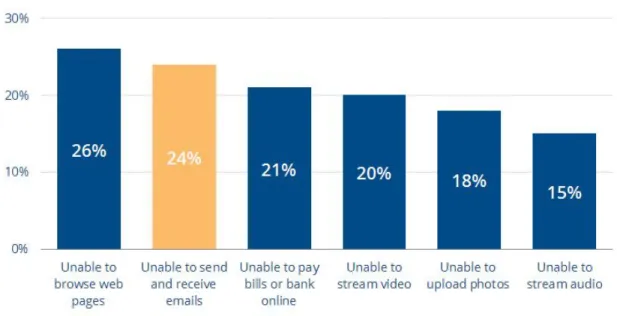
A quarter of people are regularly unable to send emails due to the speed or reliability of their broadband46
Fig 2: Consumers ‘always’/’regularly’ unable to perform tasks due to quality of broadband connection
International evidence of detriment in telecoms markets
The European Commission’s Consumer Markets Scoreboard compares 29 services markets across the EU. In 2016 it found ‘persistent issues’ in telecoms markets. Total consumer detriment (defined as financial loss, time wasted or stress) in telecoms markets was higher than any other market surveyed. Overall, telecoms has lagged 47
45 Ofcom SME experience of communications services - 2016 - data for businesses with fewer than 10 employees
46 Citizens Advice, ‘Access denied: The case for stronger action to protect telecoms consumers’
(2018)
47 European Commission, ‘Consumer Markets Scoreboard: Making markets work for consumers.
2016 edition’
behind the improvements seen in other markets since 2013. The UK score for mobile and landline services was in line with the EU28 average, but internet services scored 2 points lower. 48
The research shows telecoms consumers are the most likely to have experienced a problem, and in mobile and landline services the proportion of consumers who have experienced problems has increased since 2013.
The European Commission also found that, across the EU28, consumers who have problems with mobile telephone services recover only 14% of their losses on average. 49 This is the lowest amount recovered through redress across all markets surveyed. The 50 total post-redress financial detriment of telecoms consumers estimated to be between
€2-6.8 billion per year. It also takes telecoms consumers between 5.7 and 6.6 hours to resolve each problem. This is twice as long as it takes to resolve problems with train services.
BEUC, the European Consumer Organisation, state that “the current regulatory rules of the telecoms sector have not delivered a vibrant broadband market across the EU.
Consumers still face limited choice, barriers to switching, restrictions and unfair conditions in their contracts. Roaming charges remain high and competition does not deliver in consumers’ interests.”51
Telecoms consumers should have an independent voice in decisions that affect their future.
The issues above are simply a snapshot of those facing consumers and small businesses today. Telecoms is unique in being subject to rapid technological change while performing an essential service - which means consumers are likely to face new challenges over time.
Innovation brings benefits for consumers in the form of new products, faster speeds, and often relatively lower prices. However, it also presents challenges. Rising consumer
expectations may not always be met. There is a risk that some people will be left behind if they cannot access new services. And because we increasingly rely on telecoms for work, study and keeping in touch, the potential detriment when things go wrong is growing.
New services can also create new consumer problems, such as complex pricing or an increased risk of consumers being misled when they buy unfamiliar products. Research by Doteveryone also highlights the increasing security and privacy issues that have emerged
48 Ibid., page 185
49 European Commission, ‘Study on measuring consumer detriment in the European Union.
Executive Summary’, February 2017
50 Markets surveyed: Household appliances; Loans, credit and credit card; Mobile telephone services;
Electricity services; Train services; Clothing, footwear and bags.
51 BEUC, Digital Rights: Telecoms Single Market.
from developing technology - these questions are generally likely to be beyond the scope of this consultation but highlight the importance of consumer protections keeping up with technological change. Policymakers face a difficult challenge in promoting innovation 52 and competition, whilst also ensuring consumers are adequately protected.
There are already a large number of technical debates about issues that will significantly impact the telecoms market for years to come. These include:
● The rollout of full-fibre broadband
● The design of the broadband Universal Service Obligation
● The relationship between BT and Openreach
● Wholesale broadband pricing
● Retirement of BT’s public switched telephone network
● Mobile spectrum allocation and 5G infrastructure
These technical debates will have an enormous impact on the services consumers receive and the prices they pay. To be constructive, participants in these debates require a deep and technical understanding of the sector, and the resources to remain engaged over the long-term. Currently, industry has a strong presence in these discussions, and it is
sufficiently resourced to continue contributing. However, there is no independent, dedicated and well-resourced voice for consumers and small businesses to provide a balance to the strong industry lobby. This means that the regulator is often the only body providing robust consumer evidence and advocacy on the largest questions. However, it is having to do this whilst also adjudicating on the relative merits of the industry’s case.
By representing the needs of consumers and small businesses, an advocacy body could deliver dual benefits of both reducing the detriment and contributing overall to a better functioning telecoms market.
Advocacy reduces detriment and empowers consumers
Consumer issues can go unaddressed in part because of a lack of policy and regulatory focus, or because of structural power imbalances that enable well-resourced industry participants to shape debates and outcomes in a way that advantage firms over consumers.
A well-resourced consumer advocate could shine a spotlight on established and emerging problems and ensure the consumer interest is taken into account as decisions are made.
Creating a dedicated telecoms consumer advocate, independent from but working alongside the regulator, could deliver benefits for consumers:
● A strong, independent voice on telecoms policy, providing balance to a well-resourced industry.
52 Doteveryone: Accountability in the digital age: Imagining an internet regulator, 2018
● Advocacy on pro-consumer issues unencumbered by the institutional constraints that are inherent in any regulator’s mandate. An independent advocate can be a catalyst for changes in industry practice, avoiding the need for regulation; can spotlight issues for policy-makers’ attention; or can create space for the regulator to act.
● Front-line, trusted and specialised advice for consumers experiencing issues, backed up by a more in-depth case-handling service for people in need of extra help (akin to the Extra Help Unit for energy consumers).
● Effective, targeted consumer education and awareness campaigns.
● A dedicated voice for vulnerable consumers (such as rural, low-income, older, linguistically diverse and disabled people).
Case study: Advocacy results in millions being returned to energy consumers
53Network costs account for a quarter of UK domestic energy bills - £280 a year on average. They have grown as a proportion of bills over time.
Energy networks costs are decided, not by competition with other companies, but through complex regulatory price controls. Given the amount of consumer money at stake, around £71bn across all price controls, it is vital that these are scrutinised carefully.
We found that consumers are overpaying for energy infrastructure by £7.5 billion over the course of the current 8-year price control. As a direct result of our advocacy, so far SSEN has agreed to return £65 million and SGN has agreed to return £145 million to consumers. Ofgem has also committed publicly to make the next price control much tougher. 54
See appendix 1 for further case studies of successful consumer advocacy across sectors and internationally.
There is an advocacy gap in the telecoms market
A powerful, well resourced industry lobby is not unique to telecoms. Indeed, there is nothing inherently wrong with a powerful industry lobby: businesses can provide expertise to promote investment and competition. However, unlike in other essential markets, the voice of industry is not counterbalanced by a strong, independent consumer
53 Citizens Advice, Energy Consumers’ Missing Billions, 2017
54Ofgem, ‘Tougher price controls for energy networks’, March 2018.
advocate.
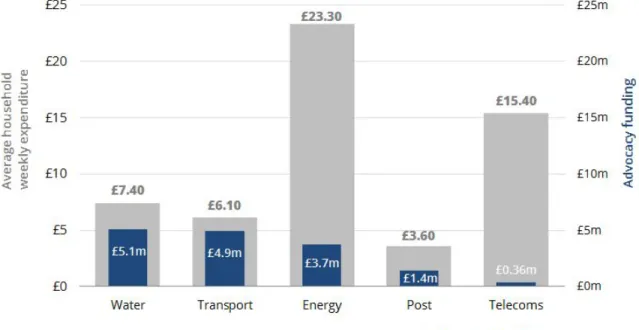
In energy, water, post and transport, the interests of consumers are represented by dedicated, independent consumer advocates funded by a levy or Government grant. As the chart below shows, consumer advocacy in the telecoms market receives considerably less funding than in other essential markets.
Telecoms consumer advocacy receives the least funding of all essential services.
Fig 3: Average weekly expenditure and advocacy funding for essential services
Source: Figures for telecoms and transport are from publicly available reports for 2015-16. Figures for water are from publicly available reports for 2016-17. Figures for energy and post are from 2017-18 Citizens Advice grant agreement, including, an estimate (based on 2016-17 figures) for the costs of Citizens Advice Scotland to ensure geographic comparability. Household spend from ONS: Components of household expenditure, UK (2015/16)
Both the scale of funding and function is different in telecoms. Water, for example,
receives over 14 times more funding than telecoms. The role of consumer representation in telecoms is fulfilled partially by the Communications Consumer Panel (CCP), a panel of 8 part time experts that is charged with giving advice to Ofcom and others on the interests of domestic and small business consumers. The Panel can provide input early in the 55 regulatory process, offering strategic advice on how to represent consumer interests in decision making. It was established and is maintained by Ofcom.
55 Section 16, Communications Act 2007.
There are also other organisations such as Which?, uSwitch and Citizens Advice
highlighting areas of consumer detriment and making valuable contributions to debates. 56 However, up to now, these organisations have not had the resources to engage on the full range of issues that affect consumers in the telecoms market.
Consumer advocacy must be sufficiently well resourced to allow for thorough, evidence-based representation and engagement in the most important debates.
However, as the table below highlights, with limited resources Citizens Advice has only been able to engage with smaller scale issues.
Citizens Advice policy
engagement
Issue Scale of
consumer impact Live issues we
have been actively engaged with
Auto-compensation M
Loyalty penalty - broadband, mobile handset separation M
Mobile debt collection S
Exit fees S
Unregulated aspects of mobile handsets S
Misselling in mobiles S
Vulnerable consumers M
Live issues we have been re-actively engaged with
Mobile switching M
Voice-line price regulation S
Live issues we are not engaged with
Small businesses M
Universal broadband and rural access L
BT/Openreach, industry structure XL
Wholesale access and pricing XL
Mobile spectrum, coverage, rural access, and roaming L Consumer engagement, bundling, quadplay M Broadband fibre infrastructure, speeds, reliability XL
56 See, for example, Which?, Best and Worst Broadband Providers 2018, and uSwitch, Connectivity without complexity.
Advertising fibre and broadband speeds M PSTN to VoIP (copper network switch-off) M
EU telecoms regulation L
What arrangements would be most effective in delivering consumer benefits, including for those who are most vulnerable?
Options for extending telecoms consumer advocacy include:
1. An independent consumer advocate with a statutory mandate
This arrangement could closely resemble the overall setup of the statutory consumer advocates for energy, water, post and transport. The consumer advocate would be run by an organisation separate to, and independent of, the regulator.
Benefits of this model:
● Improve outcomes for consumers by providing independent advocacy on the policy debates, including expert input into large, technical issues
● Could provide direct consumer advice, individual casehandling support for vulnerable consumers, and consumer education
● Independence would allow it to both work collaboratively with industry to improve practice without need for regulation but also encourage regulator to act when it identifies detriment
Limitations of this model:
● Could cost up to 4p per broadband/mobile connection per year
● May be unable to draw on confidential regulator information at early stages, but this could be addressed through formalised arrangements between the regulator and the advocate
● Could require some form of legislation dependent on funding mechanism
2. Increased funding for the Communications Consumer Panel
An alternative option is to increase the funding for the Communications Consumer Panel.
The panel has experience and expertise in the telecoms sector and provides valuable advice to Ofcom.
Benefits of this model:
● Advisory body receives early sight and exclusive access to regulator
● Panel could increase research capacity for new exploratory work and leverage its existing industry expertise
● No new infrastructure or legislation necessary - simply increase funding
Limitations of this model:
● The CCP describes itself as 'a “critical friend” to Ofcom, rather than a campaigning organisation'. The lack of a public facing profile potentially constrains the panel
model’s capacity to lead or influence wider debates and act as a catalyst for change where appropriate.
● An institutional link to Ofcom potentially makes it more challenging to raise shortcomings in the regulator's own performance - publicly, with other stakeholders such as Government, or in private with the regulator itself - if necessary
● Consumer panels are not set up to engage directly with consumers or provide advice, and do not have a widely recognised brand.
We believe if an independent consumer advocacy body were set up, the CCP could continue to perform a valuable role for the regulator.
3. Increasing funding for Ofcom
Another option for addressing the consumer advocacy gap could be to increase funding for Ofcom.
Benefits of this model:
● Regulator acts as consumer champion with legal powers and expertise to to change industry behaviour
● Regulator could increase size of consumer team working on telecoms
● No new infrastructure or legislation necessary - simply increase funding
Limitations of this model:
● The burden and inherent conflict of acting as judge and advocate in complex policy decisions with a mandate to represent consumers and competition
● Regulators can lack brand resonance with consumers and rich direct engagement with them
● Would still leave the regulator as the only authoritative consumer voice in most policy debates
Our view is that an independent consumer advocate with a statutory mandate would be the most effective way of delivering consumer benefits. It could perform 3 key functions:
1. A core policy advocacy function, resourced to effectively represent
consumers in important debates and to undertake independent research into key consumer issues.
An effective advocate would work in private, feeding insights into policy debates and consultations to balance the voice of industry. It would also operate in public, working to highlight issues with consumers and decision-makers, generate
consumer awareness of their rights and issues in the sector, apply public scrutiny on industry where appropriate, and create space for the regulator to act.
With greater resource, an advocate could move beyond the existing limited focus of independent advocacy to work on large technical issues set out above such as the rollout of full-fibre broadband. It would also be able to input into the design of technical codes and guidelines.
While industry can, and must, be part of these debates, consumers should also have robust representation beyond the regulator. As in energy, a statutory consumer advocate could shed light on the problems consumers experience and work closely with the regulator to secure better outcomes (and like in energy this could involve a tripartite agreement with the regulator and ombudsmen ). It 57 would particularly focus on issues which disproportionately impact on vulnerable consumers. An advocate could also engage with other authorities in its work, such as The Body of European Regulators for Electronic Communications (BEREC), BEUC, the Advertising Standards Authority, and the Information Commissioner’s Office.
2. A consumer advice function
This could comprise of two parts: a consumer helpline and a specialist
casehandling function for assisting vulnerable consumers, similar to the Extra Help Unit that exists for energy consumers, currently run by Citizens Advice Scotland. A well resourced consumer helpline could serve telecoms consumers directly with problems that can be solved over the phone. A specialist casehandling function would help solve more complex individual consumer issues, particularly where they affect more vulnerable consumers.
Both services would generate more data for Ofcom and provide valuable insights into how telecoms problems interact with other problems in people’s lives.