Due to the impact of Coronavirus COVID-19, the Trust Board will meet virtually but is unable to invite people to attend the public session. Trust Board papers will be published on the website, and interested members of the public are invited to submit questions to [email protected] in line with the Trust’s normal processes.
A recording of the meeting will be made available on the Trust’s website for two weeks following the meeting.
Trust Board Meeting – Public
Thursday 28 January 2021 10.00 – 12.00
A G E N D A
No. Item Purpose Lead Paper Time
OPENING BUSINESS
1. Welcome and Apologies for Absence: Information Chair Verbal 10.00
2. Declarations of Interest Information Chair Verbal 10.02
3. Minutes of the Public Trust Board Meeting Held on 26 November 2020
Approval Chair Enc. 10.05
4. Action Chart from Previous Meetings Discussion Trust Secretary Enc. 10.08 5. Matters Arising from Previous Meeting Information Chair Verbal 10.12 6. Chair’s Business
- Board Committee meetings 2021/22 Q1
Information Approval
Chair Verbal 10.15
7. Chief Executive’s Report Information Chief Executive Verbal 10.20 KEY DISCUSSION TOPIC
8. Staff Story
Juliette Hughes, Div. Dir. Nursing for Medicine attending
Discussion Director of Nursing
& Quality
Enc. 10.30
9. Green Plan (2019/20) Approval Director of Estate and Facilities
Enc. 10.55 10. Annual EPRR Report/ EPRR assurance
report
Discussion Chief Operating Officer
Enc. 11.05 PERFORMANCE AND FINANCE
11. Integrated Performance Report Discussion Chief Executive Enc. 11.20 GOVERNANCE & ASSURANCE
12. Quality & Risk Management Committee Upward Report
12.1. CQC Gynaecology inspection letter
12.2. QRMC Terms of Reference
Information
Approval
NED Chair Enc. 11.50
CLOSING BUSINESS
Any Other Business Information Chair Verbal 12.00
Questions from the Public in Relation to Agenda Items
Information Chair Verbal 12.00
Date of Next Meeting: Thursday 25 March 2021, 10.00 a.m. Virtual
Resolution: Exclusion of the Press and Public. It is recommended that, pursuant to the Public Bodies (Admission to Meetings) Act 1960, Section 1(2), the press and members of the public be excluded from further items of business, having regard to the confidential nature of the business to be transacted, publicity on which would be prejudicial to the public interest.
TRUST BOARD DECLARATIONS OF INTEREST
Name Role Interest Declared
Ms Michele Romaine Chair Nothing to declare.
Mr Kelvin Blake Non-Executive Director
Non-Executive Director of BRISDOC who provide GP services to North Bristol NHS Trust.
Trustee, Second Step. Provide mental health services for the Bristol North Somerset and South Gloucestershire area.
Trustee, West of England Centre for Integrated Living. Provide a range of services to disabled people living in the Bristol, North Somerset and South Gloucestershire area.
Lay Member of the Avon & Somerset Advisory Committee. The Committee is responsible for forming interview panels for the appointment of magistrates.
Director, Bristol Chamber of Commerce and Initiative.
Member of the Labour Party.
Mr John Everitt Non-Executive Director
Councillor, Newton St Loe Parish Council.
Member of Bath Abbey Appeal Committee.
Daughter works for NBT.
Trustee, Wellsway Multi Academy Trust – an education trust that manages approx. 20 schools.
Professor John Iredale
Non-Executive Director
Pro-Vice Chancellor of University of Bristol.
Member of Medical Research Council.
Trustee of:
o British Heart Foundation o Foundation for Liver Research
Chair of the governing board, CRUK Beatson Institute.
Mr Tim Gregory Non-Executive Director
Employed by Derbyshire County Council – Director of Environment, Economy and Transport, commencing 03/08/2020. Likely to be until January 2021.
2
Mr Richard Gaunt Non-Executive Director
College.
Local Board Governor of Colston’s Girls’
School.
Non-Executive Director of Alliance Homes, social housing and domiciliary care provider
Ms Kelly Macfarlane Non-Executive Director
Managing Director of Thames Water Utilities Ltd.
Vice President of The Institute of Customer Service.
Sister is Centre Leader of Genesiscare Bristol – Private Oncology.
Sister works for Pioneer Medical Group, Bristol.
Mr Ade Williams Associate Non- Executive Director
Superintendent Pharmacist and Director of M J Williams Pharmacy Group – NHS
community pharmacy contractor and private vaccination services provider.
Practice Pharmacist, Broadmead Medical Centre.
Pharmacy Ambassador and Clinical Advisor, Pancreatic Cancer Action Charity.
Non-Executive Director Southern Health NHS Foundation Trust.
Trustee of the Self Care Forum Charity.
Ms LaToyah McAllister-Jones
Associate Non- Executive Director
Board member of Bristol Festivals
Executive Director St Pauls Carnival CIC
Board Trustee of United Communities
Ms Evelyn Barker Chief Executive Nothing to declare.
Ms Karen Brown Chief Operating Officer
Nothing to declare.
Dr Chris Burton
Medical Director and Deputy Chief Executive
Wife works for NBT.
Ms Helen Blanchard
Director of Nursing
and Quality Nothing to declare.
Name Role Interest Declared
Mr Neil Darvill
Director of Information Management and Technology (non- voting position)
Wife works as a senior manager for Avon and Wiltshire Partnership Mental Health Trust.
Ms Jacqui Marshall
Director of People and Transformation (non-voting position)
Nothing to declare.
Ms Catherine
Phillips Director of Finance Nothing to declare.
Mr Simon Wood
Director of Estates, Facilities and Capital Planning
(non-voting position)
Member of Bristol City Council’s Bristol One City Environmental Sustainability Board.
2
1 Held Virtually via Microsoft Teams
Present:
Michele Romaine Chair Andrea Young Chief Executive
Tim Gregory Non-Executive Director Evelyn Barker Chief Operating Officer Kelvin Blake Non-Executive Director Helen Blanchard Director of Nursing & Quality John Everitt Non-Executive Director
(present up to an including minute item 10)
Chris Burton Medical Director
Kelly MacFarlane Non-Executive Director Neil Darvill Director of Informatics Richard Gaunt Non-Executive Director Catherine Phillips Director of Finance Ade Williams Associate Non-Executive
Director
Jacqui Marshall Director of People &
Transformation LaToyah McAllister-
Jones
Associate Non-Executive Director
Simon Wood Director of Estates, Facilities
& Capital Planning In Attendance:
Xavier Bell Director of Corporate Governance & Trust Secretary
Pete Bramwell Acting Director of Communications Karen Brown Interim Chief Operating
Officer
Isobel Clements Corporate Governance Officer
Observer:
Georgina Angel Public Health Registrar (ST4), Strategy & Research Team Presenters:
Charlie Molden Patient Experience &
Involvement Lead, Medicine (present up to and including minute item 7)
Joydeep Grover Clinical Governance Lead, Medicine (present up to and including minute item 7) David Wynick Research Director, NBT and
UHBW (present for minute item 10)
Rebecca Smith Deputy Director of Research, NBT (present for minute item 10)
Observers: Due to the impact of Covid-19, the Trust Board met virtually via MS Teams, but was unable to invite people to attend the public session. Trust Board papers were published on the website, and interested members of the public were invited to submit questions in line with the Trust’s normal processes. A
recording of the meeting was published on the website for two weeks following the meeting.
TB/20/11/01 Welcome and Apologies for Absence Action
Michele Romaine, Trust Chair, welcomed everyone to NBT’s Trust Board meeting in public. No apologies had been received.
TB/20/11/02 Declarations of Interest
There were no declarations of interest, nor updates to the Trust Board register of interests as currently published on the NBT website and
2 annexed to the Board papers.
Ade Williams, Associate Non-Executive Director (NED), was congratulated on his appointment as NED for Southern Health NHS Foundation Trust. It was noted that the Trust’s footprint of care did not overlap with NBT’s.
TB/20/11/03 Minutes of the previous Public Trust Board Meeting
RESOLVED that the minutes of the public meeting held on 29 September 2020 be approved as a true and correct record.
TB/20/11/04 Action Log and Matters Arising from the Previous Meeting
It was noted that NED walk-around discussions would be delayed until after the pandemic due to Infection Prevention Control requirements.
A patient story was on the agenda in the form of Family and Friends Test feedback and Helen Blanchard, Director of Nursing and Quality was in the process of creating a forward plan for patient stories at Board.
No matters arising were raised.
RESOLVED that updates on the Action Log were noted.
TB/20/11/05 Chair’s Business
Michele Romaine, NBT Chair, noted that she continued to reach out to thank teams in the hospital through attendance of virtual team huddles.
RESOLVED that the Chair’s briefing be noted.
TB/20/11/06 Chief Executive’s Report
Andrea Young, Chief Executive, provided an update on the following:
Trust staff who had reached the Parliamentary Award Nominations’
final round were congratulated: Care Connect implementation team;
Mental Health Liaison Team; and Dr Scott Grier, lead consultant responsible for the rapid development and launch of Retrieve, a new Adult Critical Care Transfer Service. It was noted that this was the second year Darren Jones - NBT's local MP – had nominated NBT staff for Parliamentary Awards;
£6bn Health and Social Care funding had been announced by the Government. However, it was reported that £3bn of this was committed as part of the Long Term Plan and the remaining £3bn was non-recurrent. It was likely some funding would be used to reduce the elective backlog and some be given to social care and community services. The Board would be updated on details of funding when received;
NHSE/I had published their plans and consultation for Integrated Care Systems (ICS). BNSSG was on-track to become a shadow ICS in January 2021.
3
3 of insight from improved qualitative Family & Friends Test data
Charlie Molden, Patient Experience & Involvement Lead for Medicine Division, and Joydeep Grover, Clinical Governance Lead for Medicine Division, presented ways in which the Division and Trust was using and sharing the Family and Friend Test (FFT) improved qualitative feedback for learning; how the Division was increasing and improving
engagement; and what the next steps for further improvement and use were, including roll-out to ward level feedback. The Board also heard examples of FFT voice note feedback.
During the ensuing discussion the following points were noted:
o Kelvin Blake, NED, queried how themes from feedback and complaints were used to improve services. Charlie Molden responded that thematic reviews of data had been completed and the most prominent Trust-wide theme was regarding the discharge process. The theme was also triangulated with data from Picker survey feedback and formal complaints. Collation of evidence had been fed-back to Helen Mee, Integrated Discharge Service Manager, who was leading on NBT’s discharge improvement projects;
o Kelly MacFarlane, NED, queried how feedback was categorised into being within a team’s control or outside of a team’s control i.e. due to system issues. It was confirmed that the ‘You Said, We Did’
evidenced what the Trust could control but that the next steps to roll-out to ward level would further facilitate real-time feedback and improvements and allow clearer categorisation;
o Michele Romaine noted that there should be a Trust-Wide feedback process from FFT for all divisions to ensure a consistent approach across the Trust. For example, regular reports to Patient & Carer Experience Committee and groups;
o Latoyah McAllister-Jones, Associate NED, queried if there was a process for tracking interventions stemming from FFT feedback in the short, medium and long-term. Charlie Molden responded that he was tracking all interventions and ensuring standards were kept high. The continued aim was to ensure FFT was embedded in the culture of NBT and that the Trust could evidence it was listening to patients.
RESOLVED that the Board:
Congratulated Medicine for leading the way with FFT insight and commended their improvement work;
Requested that the FFT feedback and engagement process be standardised across the Trust;
4
Agreed on the importance of listening to patients and responding aptly to feedback.
TB/20/11/08 Freedom to Speak-Up report
Xavier Bell, Director of Corporate Governance and Trust Secretary, presented the Freedom To Speak Up (FTSU) Report. It was reported that Hilary Sawyer - currently a Healthcare Scientist and Quality Assurance Lead at NBT - would undertake the new FTSU lead role.
Visibility, accessibility and inclusion would be prioritised in the coming year and plans would be reported to Board in an interim FTSU update at February Board after Hilary’s appointment in January.
Kelly MacFarlane, NED and FTSU NED lead, highlighted four areas for the Board to note: that there had been a drop in FTSU reports in
2020/21; that the Trust was a significant outlier in the number of bullying and harassment reports (though this was a small concrete number);
that engagement was varied across areas (for example no reports were received from Maternity Healthcare Assistants but other areas were active such as Catering); and finally, that no reports had been received regarding concern for patient safety in the last period. Kelly encouraged the Executive and Senior Team to continue walk-arounds in a safe way and reinforce speaking up, and promotion of Just Culture and
psychological safety at NBT.
An error was noted regarding paragraph 3.12: the reported ‘suffering detriment’ figure had been followed up and was a data submission error. The figure for ‘suffering detriment’ was corrected to 0.
During the ensuing discussion the following points were noted:
o Jacqui Marshall, Director of People & Transformation, noted that the FTSU report had been triangulated with Just Culture work and NBT was ensuring all line managers received training on these elements.
The importance of informal feedback was also highlighted for increasing staff engagement;
o After a query from Kelvin Blake, it was confirmed that FTSU was included in staff inductions, and linked to Trade Union feedback through Trade Union representatives at quarterly FTSU catch-ups.
Xavier Bell also attended JCNC subgroup meetings regularly to ensure Unions were aware of FTSU feedback;
o National comparison data had not yet been received due to the pandemic and changes in data submission requirements. The Medical Director and Director of Corporate Governance would ensure the correct, most useful comparator data for national comparison would be investigated and provided to Board in future.
RESOLVED that the Board:
Commended the FTSU bi-annual report and the continued improvement of the FTSU process;
Expected an interim report to February Board;
3
5 the plans to update the document.
TB/20/11/09 Integrated Performance Report
Evelyn Barker, Chief Operating Officer, presented the Integrated Performance Report (IPR) for discussion. Key elements were highlighted to the Board including:
Unusually high numbers of ambulance delays and 12 hour trolley waits. This was due to national challenges and issues with ability to discharge medically fit patients into the community. The Trust had been in Internal Critical Incident for 11 days in October;
Elective care long-wait P4 patient numbers had grown to over 1000 though this figure was lower than trajectories had predicted and improvements were seen in a number of diagnostic modalities;
Concern had been raised regarding cancer performance in September due to capacity constraints and patients choosing to delay. More referrals were being received for breast pain at NBT as GPs had reduced face to face appointments. This would be closely tracked and reported to Finance & Performance Committee (FPC);
Pressure Injury numbers in October were disappointing with no clear determining reason but it was reported that numbers of PIs had reduced in November;
The Trust had managed a number of Covid-19 outbreaks (defined as two positive Covid-19 cases that were linked) mainly due to asymptomatic staff infected in the community. Actions to control outbreaks had been effective and Covid-19 self-tests had just been received for distribution to staff which would continue to reduce outbreaks. A report had been submitted to the regional NHS team and no issues had been raised;
Funding for the second half of 2020/21 would be considerably different to the first half and the Trust would likely finish the financial year with a £24m deficit largely due to low non-NHS income. Other specific issues would be worked through with local, regional and national colleagues and oversight given by FPC;
Jacqui Marshall noted that the Trust’s vacancy level was at its lowest rate for many years (3.8%) and work continued to ensure retention of staff during the pandemic. After a positive first half of the financial year, spend on agency staff was beginning to increase due to Covid-19 sickness rates.
During the ensuing discussion the following points and queries were noted:
6 o Michele Romaine queried the community position. Karen Brown,
incoming Interim Chief Operating Officer, highlighted twice weekly BNSSG silver meetings focused on key actions to improve flow.
More community beds had opened and NBT physiotherapists were assisting Sirona which meant flow was starting to improve.
However, 170 medically fit patients were in NBT which was hindering the Trust’s ability to keep up with elective demand;
o John Everitt raised concern regarding increasing numbers of stranded patients. He queried if there was any further actions the Trust could take to reduce the numbers and what the future plan was. Andrea Young confirmed that the system now recognised BNSSG had a gap of 200 beds and Local Authority and Healthcare leaders were aligned in their efforts to increase community capacity.
50 beds had come on stream in the preceding week however care homes continued to close due to staffing shortages and outbreaks;
o In addition, a Pulse Auxiliary Service had been set-up with Sirona to identify patients at risk of deteriorating and an IV Hospital At Home facilitated by NBT and Sirona combined resources to keep people at home wherever possible. However, it was noted that non-recurrent government funding hindered the system’s ability to grow the care home workforce especially as BNSSG region relied heavily on the care home sector due to its small NHS community bed base;
o Ade Williams, Associate NED, queried how NBT and the system managed inappropriate presentations at ED. Ade noted initiatives to increase Primary Care capacity but was unsure how this reflected in attendance figures and if a process was available for NBT to report inappropriate attendances to the system. Evelyn Barker responded that a new 111-First scheme was being launched in Bristol and would hopefully affect attendances soon. In addition, November minors attendances had reduced from 300 to 220 per day;
o John Everitt requested assurance regarding mitigation of harm for delayed ambulance hand-over and trolley breaches. It was highlighted that a new, secure ambulance lobby had been created to manage handovers and the clinical modular unit installed would decompress ED to avoid overcrowding. Furthermore, each trolley breach was reviewed to ensure patients had not come to harm and it was noted NBT had significantly less delays than comparators;
o Tim Gregory, NED, queried if the Trust was maximising pressure on the Government to continue use of the Independent Sector (IS) for 52 week waits and diagnostic pressures to reduce long-term impact.
It was confirmed that the Trust continued to use Emerson’s Green and negotiations were ongoing to continue use past the national IS contract end on 25 December 2020. In addition, PRIME in Central Bristol was running endoscopy services for NBT under a separate contract which would continue;
o Richard Gaunt, NED, requested assurance regarding mandatory training. Jacqui Marshall confirmed that the majority of training was
3
7 RESOLVED that the Board:
Approved the Provider Licence Compliance Statements;
Noted the IPR report and that the content evidenced that the Trust was challenged in a number of areas but was performing comparatively well. Staff were thanked for their continued hard work.
TB/20/11/10 Research & Innovation Update
David Wynick, Research Director, NBT and UHBW, and Becca Smith, Deputy Director of Research, NBT, presented the Research and Innovation update which covered a highly successful year despite difficulties of the pandemic. Priorities for the upcoming year were also outlined. Key points to note included the following:
The Trust’s research portfolio reached £22m and combined with UHBW, Bristol was fifth nationally;
Bristol was the largest recruiter for the Oxford Covid-19 Vaccine trials, was running 29 separate Covid-19 trials and was leading on long-Covid-19 studies;
Cross-partnership working had dramatically increased; and
Bristol had become an Academic Health Sciences Centre which meant increased chances of achieving funding and becoming a player on the international research stage.
It was noted that during the upcoming year, the Research and
Innovation Department would focus on restarting all portfolios that had been paused due to the pandemic. An issue was also highlighted to the Board that upcoming trials on alternative new covid-19 vaccines may have difficulties with recruitment once the majority of population have received a validated vaccine.
Key points from the Board were as follows:
o John Iredale, NED, reiterated the importance of prioritising non- Covid-19 studies. David Wynick agreed and reassured the Board that NBT and UHBW’s focus was on restarting all non-Covid-19 research as soon as possible;
o The Board commended the outstanding Research team and its leadership that had enabled rapid change to the Trust’s research portfolio. In particular, Becca Smith was thanked for leading
Research in addition to leading the PPE Bronze cell in the first wave of the pandemic;
o Kelvin Blake queried potential areas for improvement. David Wynick responded that there were always opportunities for improvement
8 and the Academic Health Sciences Centre would focus particularly
on reducing health inequalities through targeted interventions based on population health management data.
RESOLVED that the Research and Innovation annual update was noted and the team were thanked and commended for their continued inspiring, flexible and interdisciplinary work.
John Everitt left the meeting
TB/20/11/11 Patient & Carer Experience Committee (P&CE) Upward Report Kelvin Blake, NED and P&CE Committee Chair, presented the P&CE Upward Report including the Trust’s annual Learning Disability report. It was also noted that two projects to facilitate communication between patients and loved ones during the pandemic were ongoing.
RESOLVED that:
The P&CE upward report and LD report were noted and the importance of LD work was reiterated;
The amended P&CE Terms of Reference were approved.
TB/20/11/12 Quality & Risk Management Committee Upward Report
John Iredale, NED and QRMC Chair, presented the Quality & Risk Management Committee Report for assurance on a number of areas as detailed in the report.
RESOLVED that the Quality & Risk Management Committee Upward Report was noted and the Board assured.
TB/20/11/13 Audit Committee Upward Report
Richard Gaunt, NED and Chair of Audit Committee, presented the Audit Committee Upward Report for assurance. It was noted that a number of internal audit reviews had been paused during the pandemic with work ongoing to assess which reviews could be postponed until 2021/22.
RESOLVED that:
The Audit Committee Upward Report was noted;
The Standing Orders and SFIs and Covid-19 appendix were approved for publication to the Trust’s website and intranet. IC TB/20/11/14 Any Other Business
Michele Romaine described the Trust’s heartfelt thankyou to Andrea Young who was due to retire before the next Board meeting.
Andrea’s extensive contribution to the Trust and the BNSSG system was commended. Andrea was noted as a powerful voice for NBT and the wider population and was thanked for staying on longer than planned to support throughout the pandemic;
In response, Andrea thanked the Board and the Chair for working so
3
9 the Trust and its abilities.
TB/20/11/15 Questions from the public – None received TB/20/11/16 Date of Next Meeting
The next public meeting of the Board is scheduled to take place on Thursday 28 January 2020, 10.00 a.m. The Board will meet virtually and recording of the meeting will be available for two weeks following the meeting. Trust Board papers will be published on the website, and interested members of the public are invited to submit questions in line with the Trust’s normal processes.
The meeting concluded at 12.10pm
Meeting Date
Agenda Item Minute Ref
Action No.
Agreed Action Owner Deadline for
completion of action
Item for Future Board Meeting?
Status/
RAG
Info/ Update Date action
was closed/
updated
30/01/2020 Patient Story / Staff Story
TBC/20/0 1/04
19 Patient story advance six month plan to be created for patient and staff stories with sufficient secondary options to ensure a staff/patient story is brought to the Board
Helen Blanchard Director of Nursing &
Quality
Nov-20 Yes, regular item
Open Patient story received at Nov Trust Board. Forward work-plan TBC, in progress (focus to be on W&CH, Outpatients and ICU as CQC focus areas)
26/11/2020
30/01/2020 Board member’s walk-arounds
TBC/20/0 1/09
22 A Board workshop/ seminar to reach a shared decision on NED and Exec walk- arounds, including staff perspectives, to be organised
Xavier Bell, Director of Corporate Governance
TBD Yes Delayed Delayed until hospital restoration plan phase 2 & 3 complete
28/05/2020
26/11/2020 Audit Committee Upward Report
TB/20/1 1/13
41 Approved revised SFIs, SOs and Covid appendix to be uploaded to NBT website and intranet
Isobel Clements, Corporate Governance
Officer
Dec-20 No Closed SO&SFIs uploaded to website, SO&SFIs and Covid appendix uploaded to intranet (LINK).
30/11/2020
Trust Board - Public ACTION LOG
10.00am, (Public) Virtual via Microsoft Teams-28/01/21
Report To: Trust Board Date of Meeting: 28 January 2021
Report Title: Green Plan (ex-Sustainable Development Management Plan) 2019-20 Report Author & Job
Title
Esther Coffin-Smith, Sustainable Development Manager Executive/Non-executive
Sponsor (presenting)
Simon Wood, Director of Estates, Facilities and Capital Planning Purpose: Approval Discussion To Receive for Information
x
Recommendation: Trust Board is asked to approve the draft annual Green Plan Report History: NBT Sustainable Development Steering Group
Trust Management Team January 2021 – Approved with minor
amendments to dates and executive summary to include national work, this has been completed
Next Steps: The Green Plan will be published online
Executive Summary
The newly named ‘Green Plan’ reports progress on NBT’s aspiration to be a leader in the field of sustainable healthcare and sets out plans for the year ahead. This plan replaces the Sustainable Development Management Plan 2018/19.
NBT is assessed on progress towards sustainable development by;
The Care Quality Commission within the “Use of Resources” and “Well Led” reviews
The Clinical Commissioning Group within the requirements of the NHS Standard Contract
NHS England within the new requirements of the NHS Long Term Plan which focus on carbon reduction and emissions from NHS fleet vehicles.
National Sustainable Development Assessment Tool (SDAT) for which NBT has achieved 63% (increased from 58% last year)
Highlights from 2019/20 include; Embedded Sustainable Development within the Trust Strategy, declared and Ecological Emergency with our Civic partners, established a Business Assurance Framework risk for our Carbon 2030 Goal, launched the Southmead Explorer Map, Green Gym and Allotment and ran our successful staff engagement scheme, Green Impact for the 5th year.
Plans for 2020/21 include; commissioning the production of a Carbon Routemap to set out the path to being carbon neutral by 2030, adopting the BNSSG Climate Change Adaptation Plan and completing a climate change risk assessment for the Trust, delivering year two of the NBT Travel Plan and delivering year two of the Biodiversity Management Plan.
TMT have agreed to support the request for Sustainability Advocates from each Division/Directorate to
9
be nominated to act as a point of contact for progressing Carbon 2030 efforts throughout the organisation.
New national guidance for the production of Green Plans will be introduced in March 2021 and future NBT Plans will be drawn up in line with this. A new summary of proposed action for the year ahead will now be brought to TMT & Trust Board in March each year for approval.
The Green Plan report will next be brought to TMT and Trust Board in September 2021 (setting out progress from 2020/21, half year progress for 2021/22 and any objective modifications driven by the part- year progress). A change to the current arrangement.
Strategic Theme/Corporate Objective Links
Change how we deliver services to generate affordable capacity to meet the demands of the future
Play our part in delivering a successful health and care system
Create an exceptional workforce for the future
Be one of the safest trusts in the UK Board Assurance
Framework/Trust Risk Register Links
Risk of non-compliance with the NHS Standard Contract which requires a Trust Board approved Green Plan
Other Standard Reference Compliance with NHS Long Term Plan (2019-2029)
Compliance with the National Sustainability Strategy (2014-2020)
Compliance with the National Climate Change Adaptation Programme (2018-2023)
Compliance with Health Technical Memoranda 00-07
Compliance with NHSI guidance on Green Plan reporting (2020) Financial implications Costs associated with the delivery of the Green Plan will be
addressed within separate business cases going forward.
Potential penalties for noncompliance with NHS Standard Contract Other Resource
Implications
The Sustainable Development Unit is resourced to manage the delivery of the Green Plan
Additional resources required for specific work programmes within the Plan will be addressed within separate business cases going forward Legal Implications
including Equality, Diversity and Inclusion Assessment
Compliance with legal obligations which include but are not limited to;
Climate Change Act (2008), Environmental Protection Act (1990), Civil Contingencies Act (2004) and Public Services (Social value) Act 2012.
The Green Plan has been prepared in consultation with the Sustainable Development Steering Group which includes a wide range of stakeholders (staff, contractors, specialist advisors, stakeholders, trade unions and local community interest groups).
The Green Plan supports better health outcomes (for patients and staff) and improved patient access and experience through various work streams and individual projects outlined within the Plan.
Appendices: Green Plan 2019-20 report
9
1
Green Plan
2020-2021
9
2
Foreword
The last year has been significant for North Bristol NHS Trust as we continue to pursue our ambition to be a leader in the field of sustainable healthcare. We were the one of the first NHS organisations in the country to declare a Climate Emergency and we joined our civic partners in setting an ambitious and stretching goal of being carbon neutral by 2030.
We recognise that we urgently need to take action to halt the decline in biodiversity, so we also declared an Ecological Emergency, the first NHS Trust to do this. This builds on our existing efforts to protect and enhance biodiversity on our sites.
We have further embedded our commitment to sustainable development with a clear strategic focus on being an anchor in the community which is outlined in the Trust Strategy 2019-24.
We know that delivering sustainable healthcare involves working across the health system and with partners to deliver a health system that is h financially sound, supports social and
environmental ambitions and ensures value for money.
We are immensely proud of the part our staff play in supporting our push towards
sustainability. It has been our most successful Green Impact cycle to date with 38 teams celebrating this award and the Staff Travel Survey this year showed the highest numbers of staff walking, cycling and catching the bus to work.
Finally, as we begin the 2020-21 financial year the Trust is responding to a new healthcare challenge in the form of the Covid-19 pandemic.
This is already having an impact from a
sustainability perspective, in terms of additional waste being generated and air quality
improvements as fewer people travel. We will continue to monitor these and other impacts as they arise and develop approaches to manage them sustainably.
Evelyn Barker Michele Romaine Interim Chief Executive Trust Chair
9
3
Contents
1 Introduction 4
1.1 The year at a glance 5
2 Drivers for change 6
3 Our Vision 7
3.1 Climate Emergency Declaration 7
3.2 Trust Strategy 7
4 Governance 8
5 Communications and Engagement
6 Sustainable Development Assessment Tool (SDAT) 9
7 Corporate Objectives 10
7.1 Corporate Approach 12
7.2 Our People 13
7.3 Climate Change Adaptation 15
7.4 Sustainable Models of Care 16
7.5 Sustainable Use of Resources 17
- Energy Consumption 18
- Waste and Recycling 19
- Anaesthetic Gases, Pharmaceuticals and Medical Devices 20
- Water Consumption 21
- Fuel Consumption 22
- Paper Consumption 22
7.6 Carbon Emissions 23
7.7 Travel and Logistics 25
7.8 Green Space and Biodiversity 27
7.9 Capital Projects 28
7.10 Asset Management and Utilities 29
8.0 Finance 30
9.0 Reporting 31
10.0 Risks and Opportunities 31
11.0 Sustainable Development Indicators 32
9
4
1. Introduction
The NHS has a responsibility to provide high quality health care whilst protecting human health and minimising negative impacts on the environment. A Green Plan (previously named the Sustainable Development Management Plan) is a mechanism for organisations to take a coordinated, strategic and action-orientated approach to sustainability. Green Plans form a key part of sustainable healthcare delivery to ensure services remain fit for purpose today and for the future.
The North Bristol NHS Trust (NBT) Green Plan will help us to:
Deliver on the NHS Long-Term plan
Improve the health of the local community
Achieve our financial goals
Meet our legislative requirements We are in the process of creating a
Sustainable Development Strategy and Our Green Plan annual report in the future will be a summary of progress against this strategy and plans for the year ahead. Future Green Plans will also report on progress against the
upcoming Net Zero Plan for the NHS.
Sustainable development is based on 3 core factors:
Environmental impact; the impact NBT activities have on the environment – this means focusing on activities which reduce or eliminate any negative impact.
Social impact; the impact NBT activities have on our local communities, and society or more broadly, how we can positively utilise our influence to address health and social inequalities.
Financial impact; the impact NBT has on how it controls and spends its money; from the contribution sustainable development activities have on our short, medium and long term financial position, to the impact we have on actively improving the local socio-economics of our communities through the way you direct our expenditure.
This document represents a transition from our previous reporting style to a new format in 2021 that will more clearly link our longer term Sustainable Development Strategy and Carbon 2030 goals through to in-year progress.
9
5
2019/2020 at a glance…
of solar power generated
117,883 tonnes of carbon
60% of staff commute by active or sustainable modes of travel
6,831kg of wasted furniture
diverted from landfill through
using Warp It 674 actions taken
by our Green Impact Teams
28 trees planted
…..
kWh
28 patients referred to
Warmer Homes Advice and
Money service
Climate and Sustainability YouTube videos
8
9
6
2. Drivers for change
Sustainable healthcare in the NHS is predominantly driven through local and national policy, legislative and mandated requirements and healthcare specific
specifications from the Department of Health and NHS England.
The NHS Long Term Plan requirements
introduced in 2019 have been incorporated into the contractual obligations of the NHS
Standard Contract, substantially increasing the obligations on the NHS for the year ahead (2020-21.)
These include:
By March 2021:
o take action to reduce air pollution from fleet vehicles, use of coal/oil, through promotion of more sustainable travel choices and restricting lease vehicle choices to ultra-low emission vehicles o take action on climate change by
reducing greenhouse gas emissions, reducing the use of fluorinated gases used in anaesthetic gases and inhaler propellants and adapting services and premises to mitigate risks associated with climate change and severe weather
Reduce waste and water usage through best practice and innovation, reduce the use of single-use plastics and maximize the rate of return of walking aids for reuse/recycling.
Give due regard to the potential to secure wider social, economic and environmental benefits for the local community and population through purchase and specification of products and services.
The NHS Operational Planning and
Contracting Guidance echoes the Standard Contract obligations but with additional recommendations that all NHS organisations:
Purchase 100% renewable energy
Replace lighting with LED alternatives during routine maintenance
Ensure all new builds and refurbishment projects are delivered to net zero carbon standards
Implement the Estates and Facilities Management Stretch programme (key activity’s organisations can take to reduce the environmental impact of their estates.)
Other requirements on the NHS include:
The National Adaptation Programme (2018) outlines key requirements and associated actions for the NHS to ensure climate change adaptation and mitigation measures are addressed.
In June 2019 the UK Government committed to reduce its greenhouse gas emissions to net Zero by 2050 under the terms of a new government plan to tackle climate change, stating that cutting emissions would benefit public health and cut NHS costs.
The Bristol One City Plan (2019-2050) plan aspires to deliver a sustainable city, with a low impact on our planet and a healthy environment for all by 2050.
The plan sets out a series of objectives across the backdrop of the United Nations Global Goals for Sustainable Development with key commitments for Bristol which include carbon neutral status by 2030.
9
7
3. Our Vision
Our Sustainable Development Policy sets out our aspiration to be a leader in the field of sustainable healthcare through committed leadership, innovation, culture change and system wide engagement and development.
We are committed to embedding sustainable development across our sites and services and will deliver our Policy commitments through our Green Plan by;
Maximising the environmental, financial and health opportunities associated with sustainable development and the co- benefits to our staff, patients and the local community.
Valuing the importance of protecting our natural environment for the benefit of the physical and mental health and well- being of our community, now and in the future.
Striving to improve staff and patient experience by moving towards more sustainable models of care and workplace practices.
3.1 Climate Emergency Declaration
In October 2019, North Bristol NHS Trust joined University Hospitals Bristol and Weston NHS Foundation Trust, alongside our civic partners, Bristol City Council, North Somerset Council, South Gloucestershire Council and the West of England Combined Authority to declare a Climate Emergency. By making such a declaration, we hope to lead the healthcare sector in collective action to ensure the future health and wellbeing of our city. As part of the declaration we committed to the ambitious Bristol One City Plan goal of Carbon Net Zero by 2030.
3.2 Trust Strategy 2019-2024
This year the Trust updated its strategy. One of the 4 areas of focus is Being an Anchor in Our Community. This element of the strategy includes developing in a sustainable way. The strategy also includes a commitment to:
Working with our civic partners to reduce carbon emissions as part of Bristol’s One City Plan.
9
8
4. Governance
Our Green Plan is approved by Trust Board on an annual basis, with a six monthly progress report submitted half way through the year.
Sustainable development is championed by the Trust's Chair Michele Romaine and the Director of Estates, Facilities and Capital Planning, Simon Wood.
Simon Wood chairs the Sustainable Development Steering Group which meets quarterly. The steering group consists of our Trust Chair, specialist Public Health Advisers, Senior Management, our PFI partner and representatives from the local community and Trade Unions.
The group drives forward the sustainable development agenda at the Trust by setting objectives, reviewing progress and delivering assurance on a regular basis. The group promotes collaborative working with external partners to bring external benefits to the trust and support the local community.
The Sustainable Development Unit (SDU) is a small team of specialists providing advice and support across the Trust to assist in the delivery of sustainable development.
To further support the delivery of the policy commitments, the Trust has an active network of Environmental Awareness Reps (EARs) and Green Impact teams spread throughout the organisation to raise awareness, engage and enthuse the wider workforce.
In 2020-21 we will establish a new group, comprising staff representation from across the Trust, to drive action and increase engagement on our Carbon 2030 goal.
NBT is also a member of the Bristol, North Somerset and South Gloucestershire Sustainability Transformation Partnership (STP) “Healthier Together,” along with other major health and care providers in the region.
The STP has developed a Climate Change and Sustainability work stream into which all organisations are expected to contribute.
9
9
5. Communications and Engagement
Our vision to be a leader in the field of sustainable healthcare requires system-wide engagement and development through simple and effective communication.
In 2019/20, we published our Communication and Engagement Plan which sets out how the Trust engages with its audience to raise awareness, understanding and bring about behaviour change to promote sustainable healthcare now and for generations to come.
We communicate with our stakeholders using various channels and means to get our messages out to our staff, patients and wider community, notably through our website and social media outlets, annual reports and numerous, innovative engagement events and opportunities throughout the year.
Engagement Activities 2019-20
Gardens for Health Week (May)
Staff insect hotel building (Jun 2019)
NHS Sustainable Health and Care Week (June 2019)
Clean Air Day (June 2019)
30 Days Wild (June 2019)
Southmead Festival (July 2019)
Cycle to Work day (Aug 2019)
Southmead Hospital Lavender Project events (June – Dec 2019)
Apple pressing in partnership with The National Trust (Oct 2019)
Green Impact Awards (Dec 2019)
Community Hedge & Tree-Planting (Dec 2019)
Junior Doctor Wellbeing Wednesday (February 2020)
Travel to Work Survey (Mar 2020)
NHS Sustainability Day (Mar 2020)
The Community Farm weekly fruit and veg stall
Attended 24 Corporate Inductions
12 monthly SDUpdate e-newsletters
248 Tweets
2,170 visits to our Twitter profile
9
10
6. Sustainable Development Assessment Tool (SDAT)
The Sustainable Development Assessment Tool (SDAT) is the national bench mark used by Public Health England and NHS England to measure improvement across the health and care system.
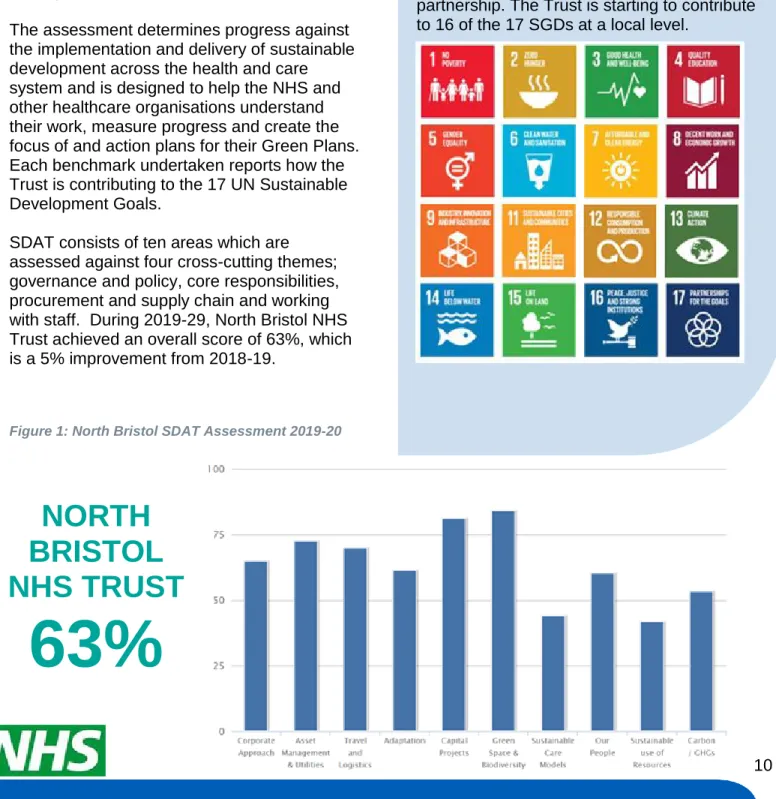
The assessment determines progress against the implementation and delivery of sustainable development across the health and care system and is designed to help the NHS and other healthcare organisations understand their work, measure progress and create the focus of and action plans for their Green Plans.
Each benchmark undertaken reports how the Trust is contributing to the 17 UN Sustainable Development Goals.
SDAT consists of ten areas which are assessed against four cross-cutting themes;
governance and policy, core responsibilities, procurement and supply chain and working with staff. During 2019-29, North Bristol NHS Trust achieved an overall score of 63%, which is a 5% improvement from 2018-19.
Figure 1: North Bristol SDAT Assessment 2019-20
United Nations Sustainable Development Goals
The 17 Sustainable Development Goals (SDGs) were adopted by all United Nations Members States in 2015 and represent an urgent call for action by all countries in a global partnership. The Trust is starting to contribute to 16 of the 17 SGDs at a local level.
NORTH BRISTOL NHS TRUST
63%
%9
11
7. Corporate Objectives
North Bristol NHS Trust has developed ten key objectives in line with the SDAT themes laid out in the diagram below.
Each objective has a set of actions set for the year ahead to drive forward sustainable development at NBT.
The following pages outline the Trust's progress against each theme undertaken in 2019-20 and our plans for the year ahead.
At the top of each page, we have reported our SDAT progress score against each theme.
2019-20 SDAT score Further action required
Arrow indicates
increase/decrease since 2018-19 and colour indicates positive or negative trend
%
9
12
7.1 Corporate Approach
The best health and care is not the work of an individual, a single team or even one
organisation. Partnership and collaboration is fundamental. The Trust strategy recognises the opportunity we have to make the best use of NHS resources for patient care and to develop sustainable services for the long term.
Through our position as a large and
established organisation acting as an anchor in our local community we accept our
responsibilities for sustainable development, local product sourcing, and population health and illness prevention.
Our Sustainable Development Policy
underpins our decision making process, which now includes Sustainability Impact
Assessments for all key decisions and a Carbon Assessment Tool for use during the completion of annual business plans.
We continue to work with local community organisations and wider civic partners via our Sustainable Development Steering Group, through engagement events and by
collaborating at neighbourhood, city-wide and regional levels. North Bristol NHS Trust represents health on the Bristol One City Environmental Strategy Board and has contributed to the Bristol One City Climate Strategy in recognition of the many ways in which healthcare both contributes to and can provide solutions to mitigate and adapt to the impacts of climate change.
OBJECTIVE 1
The Trust aspires to be a leader in sustainable healthcare
We have:
Declared a Climate Emergency
Set a goal of Carbon Net Zero by 2030
Included the climate change emergency on our Business Assurance Framework
Embedded sustainable development within the Trust’s updated Strategy.
Introduced a Carbon Assessment Tool to the business planning process
Declared an Ecological Emergency with Bristol partners
We will:
Develop a Carbon 2030 Routemap
Continue to work collaboratively to deliver the Bristol One City obligations
Introduce sustainability considerations for business cases under £100K.
Engage with our suppliers, contractors and commissioned services to reduce the impacts of the goods and services we buy
65%
9
13
7.2 Our People
The Trust recognises that a healthy, happy and resilient workforce is key to ensuring we
operate sustainably, and as such, every single member of staff has an important role to play in helping us achieve this.
The updated Trust Strategy recognises the importance of providing staff with a means of engaging on sustainability whilst at work. This is achieved through the provision of a
sustainability programme and our travel to work offer which supports our staff to make sustainable and active travel choices.
The Trust's Sustainable Development Policy outlines individual staff responsibilities to ensure efficient resource use through simple, everyday actions.
The Sustainable Development Unit encourages staff to get involved through regular events and the Green Impact Engagement scheme. During 2019/20 we completed our fourth year of taking part in Green Impact, with 38 teams achieving an award. The scheme provides innovative ways for staff to get involved in sustainability in the workplace and celebrates those that did, with an awards ceremony hosted in the Brunel Atrium in December.
OBJECTIVE 2
Engage our staff, patients, visitors,
stakeholders and our wider community on sustainable development
We have
Launched our staff Green Impact engagement scheme for the fifth consecutive year
Jointly with the Fresh Arts team launched the Pathway to Well-being programme and produced the Southmead Explorer map for the Southmead Hospital site
Delivered the Green Gym and Allotment
Completed Lime Walk Park We will
Continue to run a staff engagement scheme
Hold at least 6 sustainable healthcare engagement events
Ensure greater engagement with the local community on sustainability activities at the Trust and the use of our green spaces for health and wellbeing
9
14 Our People Case Studies
Southmead Explorer Map
Working with Fresh Arts and Wellbeing teams, The Site Lines Explorer Map was launched to support and encourage staff and patients to spend time outdoors.
The map identifies various walking routes, bench locations, the Sculpture Trail and biodiversity points of interest such as our bug hotels and the new Allotment site. Part of the walking routes are known as Routes to Recovery; to be used by patients in their rehabilitation and help them get active again.
Green Gym Equipment Launched
To further encourage health and wellbeing through being active and spending time outside, the Green Gym equipment installed in December provides a perfect opportunity for staff, patients and the local community to enjoy our green spaces whilst doing physical exercise.
It is conveniently located adjacent to the new staff and patient allotment, together with new seating, so that multiple forms of exercise and relaxation can take place in the same space.
Green Impact – Respiratory Medicine
The respiratory green impact team live and ‘breathe’
sustainability and have worked hard (despite ward moves!) to ensure lights are turned off in unused rooms, paper waste is reduced, faulty electricals changed and more of the respiratory team travel in a sustainable way.
Their enthusiasm for sustainability is infectious – they have used the Green Impact programme to encourage behaviour change throughout the team and are set to achieve the silver award this year.
9
15
7.3 Climate Change Adaptation
The Trust is committed to adapting to the impacts of climate change by working to deliver a healthy, resilient and sustainable healthcare system ready for changing times and climates.
The Trust has been working across the region with Sustainability and Transformation
Partnership (STP) partners to finalise the Bristol, North Somerset and South
Gloucestershire (BNSSG) Climate Change Adaptation Plan. The plan identifies the shared risks and opportunities in our region, including the anticipated health impacts and serves to prioritise actions and deliver shared
opportunities to achieve regional benefits going forward. The plan sits within the wider Bristol, South Gloucestershire and North Somerset STP Estates Group and aims to reduce our combined impact on the environment, reduce our organisational running costs, ensure our business continuity plans are in place and reduce health inequalities.
North Bristol NHS Trust has already
implemented a number of schemes on site to promote adaptation through sustainable design and infrastructure, notably through the
development of the Brunel Building which includes sustainable urban drainage and energy efficient design.
The Trust has also been working to promote patient and staff resilience through health and wellbeing via the provision of access to high quality green space and the natural
environment. Consideration is also given to the secondary impacts of climate change, such as the effects of severe weather on our
infrastructure, supply chain and vital resources such as medical equipment, water, energy, fuel and food to ensure continuity of service in times of scarcity.
OBJECTIVE 3
We will adapt our sites and services ready for a changing climate
We have
Added a Carbon Assessment Tool (which includes consideration of adaptation to climate change) within the corporate business
planning process
Included the risk from failing to meet our Carbon 2030 goal to our Board Assurance Framework
Submitted the Healthier Together Climate Change Adaptation Plan to the Partnership Executive group for ratification and
subsequently made amendments
Contributed to the Sustainability chapter of the Healthier Together Five Year Plan
We will
Seek adoption of the Healthier Together Climate Change Adaptation Plan across the BNSSG region together with recruiting climate change leads for each member
We will create a Board Assurance Framework entry for Climate Change Adaptation to ensure that risks to NBT are identified and sufficiently mitigated.
9
16
7.4 Sustainable Models of Care
The Trust seeks to make the best use of NHS resources for patient care and develop
sustainable services for the long term.
During 2019-20 the Trust has been identifying good examples of where care pathways, care models and the delivery of healthcare in general have been and can be made more sustainable. One such project involved the switch to pre-filled saline syringes. This project involved replacing several items (individually purchased saline ampoules, syringes,
chlorhexidine wipes) with one pre-filled saline syringe. This saved on staff time and cost and avoided emissions from multiple deliveries, packaging waste and also contributed to reduced infection risk.
OBJECTIVE 4
We will adopt sustainable models of care across our services
We have
Worked with citywide partners and successfully bid to appoint a hospital-based Fuel Poverty Advisor to help identify patients being
discharged to a cold home and to provide the support they need to ensure their homes are warm and to prevent readmission.
Continued to reduce the use of volatile anaesthetic gases used in theatres.
We will
Co-ordinate the delivery of a SusQI workshop with the Academic Health Science Network for the Bristol, South Gloucestershire and North Somerset Sustainability Transformation Partnership.
Use the Carbon Assessment Tool in our business planning to help identify opportunities for more sustainable care pathways.
44%
9
17
7.5 Sustainable Use of Resources
We will seek to make the best use of NHS resources for patient care and develop sustainable services for the long term.
A more sustainable use can include:
Using a product with a smaller carbon footprint (e.g. less waste generated, energy/water used, fewer transport emissions, less packaging etc.)
Using less of a product
Choosing products with fewer or no hazardous chemicals
Using locally-sourced, fresh, organic and Fair Trade ingredients
Reducing waste
Maximising repair and reuse
Influencing our supply chains and partners to play their part
Over the last year we have made significant steps in improving the sustainability of our catering operations through both replacing all takeaway containers with an alternative product with a smaller carbon footprint and through signing up to the NHS Plastic Pledge and further committing to reduce single-use plastic consumables.
OBJECTIVE 5
We will manage our resources sustainably,
reducing our direct environmental impacts across our healthcare services in energy, waste, water, food and anaesthetic gases
We have
Signed up to a project with Healthcare Without Harm Europe which will look at the plastics used in healthcare and how to reduce them, find more sustainable alternatives and increase recycled content where plastics are the only option.
We have employed an external consultant to undertake a comprehensive waste review to identify further opportunities to reduce our carbon emissions
Launched a clinical waste campaign to raise awareness and enable staff to make informed decisions when disposing of their waste, including the production of a new suite of posters.
Successfully reduced contamination of our dry mixed recycling stream resulting in its
diversion from energy-to-waste disposal back to recycling.
Launched Vegware as a replacement for plastic-based take-away containers.
Signed up to the NHS Plastic Pledge We will
Measure the carbon emission reduction potential of waste disposal methods as part of the commissioning of the Carbon Routemap .
Create a Sustainable Use of Resources action plan
Investigate more sustainable alternatives to metered dose inhalers
9
18 7.5.1 Energy Consumption
Total energy consumption has increased slightly since last year, by 568,966 kWh. Both electricity and gas demand have increased whilst oil usage has decreased.
Despite a rise in emissions, the carbon
footprint associated with this consumption has reduced due to decarbonisation of the national electricity grid (meaning a greater percentage of renewal energy is being generated
nationally and fed into the supply that NBT then uses.)
The Trust will appoint an Energy and Carbon Manager in 2020 to drive forward progress on improving our energy efficiency. The Carbon Routemap which we plan to commission will also highlight the key priorities to help us reach our Carbon 2030 net zero goal.
The generation of renewable energy from the solar panel arrays onsite has reduced by 11,263 kWh over the past year due to a technical problem which is being addressed.
9
19 7.5.2 Waste and Recycling
This year we are pleased to report that the contamination issues experienced in 2018-19 have been resolved and all our dry mixed recycling has been diverted back to this route instead of being disposed via the energy-to- waste route.
All waste streams are showing positive trends with recycling increasing and recovery streams (incineration with energy recovery and
autoclaving) decreasing. Waste which had been going to landfill (offensive hygiene waste) is now being incinerated with energy recovery so NBT is no longer sending any waste to landfill. Our carbon footprint is reduced as a result of this and greater levels of recycling.
Overall the Trust generated 23 more tonnes of waste than last year so more effort is required to identify areas where waste can be reduced.
The Trust saved £58K over the past year through our internal reuse scheme Warp-It.
Through avoiding disposal of usable furniture and the purchase of new, we have also saved 30 tonnes of CO2. The table below shows the most common items our staff seek to reuse.
9
20 7.5.3 Anaesthetic Gases, Pharmaceuticals
and Medical Devices
The consumption of anaesthetic gases,
pharmaceuticals and medical devices varies in line with patient contact, the more patients we treat the more products we use.
During 2019-20 the good practice started in the previous year has continued with ongoing movement away from using volatile anaesthetic gas such as sevoflurane and desflurane to using intravenous anaesthesia as an alternative for some patients. Intravenous anaesthetic has a considerably lower carbon footprint.
As a result of the work undertaken by staff, we have seen a continued reduction in the use of these gases. Future work includes awareness- raising with patients in certain areas so
informed decisions about the optional use of gases such as nitrous oxide can be made.
The Trust can only influence these areas as the decision rests with the patient.
The Trust’s spend on both pharmaceutical and medical devices have increased by 2.6% and 3.4% respectively. The greenhouse gases (measured as carbon dioxide equivalent or CO2e) associated with the production and distribution of both these product areas are one of the most intensive in the NHS. At NBT the footprint of pharmaceuticals last year was 6,095 tonnes CO2e with medical equipment and instrumentation contributing 18,801 tonnes CO2e. Anaesthetic gases contribute 3,151 tonnes CO2e as seen in the table below.
Much of the work to reduce the impact in these areas lies with the manufacturers and suppliers whom we will seek to influence however our biggest opportunity to reduce the carbon footprint lies in reducing use and wastage within the Trust.
9
21 7.5.4 Water consumption
During 2019-20 our water use has decreased.
Some of this reduction will be due to having had no major water leaks (e.g. burst pipes) over the past year. Work has also taken place to identify continually flushing toilets within our main building Brunel which is believed to have successfully reduced consumption.
9
22 7.5.5 Fuel Consumption
Data for 2019-20 shows a decrease in grey fleet mileage (staff using their own vehicles for business use). Efforts have been made over the last year to encourage greater use of public transport, our pool cars or the Trust’s pool bicycles to reach business destinations.
Bicycle mileage has increased by 793 miles in the last year. Mileage undertaken by Trust fleet vehicles has also decreased however the overall ‘business travel and fleet’ miles have increased due to a significant increase in business miles undertaken by rail and air. This is likely due to a lift on travel restrictions
following the Trust no longer being in special financial measures.
We have also seen decreases in staff
commuting mileage and those undertaken by patients and visitors. We discovered an error in calculating the mileage associated with staff commuting in previous years and have been able to rectify this for last years’ data but not earlier years, which explains the sudden increase in mileage between 2017-18 and 2018-19.
7.5.6. Paper Consumption
Following the further roll-out of digital solutions the Trust’s spend on paper reduced by £27k in 2019-20.
9
23
7.6 Carbon and Greenhouse Gases
The Trust is committed to reducing our carbon emissions.
During 2019, NBT declared a Climate Emergency with University Hospitals