Networks’ Good Intentions
A report on how energy networks’ social
obligations are delivered
Contents
Executive summary 2
I. What are a network’s social obligations? 5
II. Social obligations under RIIO so far 14
III. Social obligations and future networks 25
Executive summary
Energy networks - the wires and pipes that connect electricity and gas supplies to homes and businesses - are among the most important infrastructure in the country. They have a significant impact on consumers across the country. They keep our lights and heating on, are a key part of shaping our future energy system and are rare - but crucial - sources of direct customer support in the event of power cuts or gas leaks. They are also a
significant consumer cost: at an average household cost of £265 a year, they’re roughly one and half times the average cost of a mobile phone contract.
This report considers what networks spend on social
obligations. Because energy networks are monopolies, Ofgem (the energy regulator) sets a price control for how much they’re allowed to charge consumers. In the RIIO price control for energy networks, Ofgem introduced a category of regulated outputs called ‘social obligations’, recognising that:
1. These infrastructure providers impact almost every consumer in the country 2. Networks have particular obligations and opportunities with consumers who are
vulnerable or disadvantaged.
“We want to encourage DNOs to maximise their role in understanding, identifying and dealing with consumers in vulnerable situations...for DNOs to fulfil this role they will need to undertake a major cultural and behavioural shift.”
Ofgem, RIIO-ED1 Strategy Decision, 2013
With the three RIIO price controls (for gas distribution, electricity distribution and transmission) now established, questions still remain around how ‘social obligations’
actually work in practice. If these are not answered, commitments to social obligations could end up being seen as a statement of good intent, but never fully realised as a practical way of improving consumer outcomes.
But if the process of development and implementation, already underway, is continued by the network companies and by Ofgem, they can set an example of how intelligent infrastructure can play a key part in supporting social policy goals.
This report reviews what has been said and done so far, and what remains to do.
Section I outlines the thinking behind the introduction of the ‘social obligations’
category, and also includes a short comparative case study of how the water industry is currently tackling vulnerability. Section II examines what practical mechanisms have been put into place so far to incentivise ‘social obligations’, how well these are working, and how they can be improved. Section III looks forwards to how social impacts can be accounted for in network innovation in future.
“In many instances, a more strategic approach to upgrading our networks could deliver large savings to future consumers, or bring wider economic and social benefits to a local community.”
First report of the National Infrastructure Commission, Smart Power, 2016
In this report, we make three types of recommendation: what networks should do now, what they should do in the future, and how they should be funded and assessed.
What social obligations should networks deliver now?
1. Networks should explore collaborative and innovative approaches to deliver social obligations. However, networks should undertake social obligations only when they are best-placed to deliver cost-effective outcomes for energy consumers.
2. Networks should commit to disseminating evidence of innovation and ‘what works’ across the industry. Incentives should be designed to encourage dissemination.
3. Ofgem should continue monitoring the extent to which incentives are driving GDNs to work with partners in identifying whole-house solutions for off-gas properties. A specific whole-house condition in the Stakeholder Engagement Incentive should be introduced if the correct behaviours are not being driven.
4. Networks should exploit opportunities to improve energy efficiency for their consumers. Ofgem should investigate whether the right drivers are in place, particularly when value may be split between consumers and networks (for
example, when energy efficiency can be an alternative to network reinforcement).
What should networks do in the future?
1. Social obligation incentives should be flexible enough to recognise additional areas when networks can demonstrate they are best placed to address them.
Networks should proactively spot opportunities, and incentives should reward breaking new ground.
2. Social obligations should extend to networks’ long-term strategic decisions.
Networks should routinely consider the distributional impacts of their long-term decisions and demonstrate how the needs of vulnerable consumers are taken into account.
How should networks be funded and assessed?
1. Ofgem should consider increasing the ambition and scope of social obligations funding, if networks prove effective at addressing consumer vulnerability.
2. Ofgem should investigate whether it is feasible and desirable to update the Stakeholder Engagement Incentive in GD1 to include consumer vulnerability.
3. Networks need to evaluate their interventions effectively. Wherever possible, benefits and costs should be quantified. The value of non-quantifiable benefits should be clearly stated and justified.
4. The assessment benchmark for the Stakeholder Engagement and Consumer Vulnerability (SECV) incentive should not be set too low. The average score should not be significantly above the midpoint of the scoring mechanism. If Ofgem finds that certain networks persistently lag behind, they should consider introducing penalties in future price controls.
I. What are a network’s social obligations?
Energy networks - the wires and pipes that connect electricity and gas supplies to homes and businesses - are among the most important infrastructure in the country. The
companies that own and operate them collect an average of around £265 from each household’s energy bill each year to maintain this vital service. They are responsible for regular upkeep and upgrades of the system, for connecting new sources of energy generation, for reconnecting the supply in a power cut and for certain other occasional customer interactions such as moving the gas or electricity meter when a consumer requests it.
These responsibilities mean networks companies have a significant impact on consumers around the country. This can be seen in five broad areas:
1. Keeping the lights/heating on: the networks have a vital responsibility for providing a constant, reliable supply of electricity and gas. Any interruptions to this, though sometimes outside the network’s control, have a serious negative impact on consumers’ wellbeing. Networks are also responsible for connecting new properties and, where appropriate, those in remote areas that have not previously had a gas supply.
2. Cost: consumers might not realise it, but the average household now spends more on energy networks than one and a half times the average cost of a mobile phone contract. Network charges are subject to change, and rose substantially 1 from 2005 to 2015, having previously decreased since privatisation in 1986 (gas) and 1990 (electricity). Any decision the network companies make that affects this 2 cost now or in future will have an important knock-on effect on household
accounts.
3. Customer service: networks do not often interact directly with household consumers, but the occasions when they do - during power cuts, or when connecting new generation above a certain size, for example - are likely to be complex and crucial. Making these interactions as straightforward as possible, and ensuring that they are accessible and fair to all consumers, is a key part of the network’s impact.
1 The latest available data from Ofcom states that in 2014 the average monthly cost of a mobile phone contract, taking both prepay and postpay options into account, was £15.63
(http://stakeholders.ofcom.org.uk/binaries/research/cmr/cmr15/UK_4.pdf p.293). The latest available data from Ofgem estimates that the average household network charge for 12 months from April 2015 will be £265, or £22 per month
(https://www.ofgem.gov.uk/system/files/docs/2016/08/retail_energy_markets_in_2016.pdf).
2https://www.ofgem.gov.uk/network-regulation-riio-model/energy-network-how-it-works-you
4. Shaping the future energy system: to meet the challenge of decarbonisation, Great Britain’s energy system is undergoing radical change. Networks are a key part of this. They need to provide the capacity and flexibility to accommodate renewable energy sources, more localised distributed generation and changing patterns of demand. Decisions networks take now will affect what the energy system as a whole looks like in five, ten or thirty years. This might
include shifts in
the remit and/or consumer relationship of the network, adding new aspects to their consumer impact.
5. Networks as responsible businesses: as well as the consumer impacts which are specific to the network companies, there are also a number of other
considerations which may apply to the networks as they would to any other large businesses. These include their role as employers and procurers, their
environmental impact (though this has special importance beyond other companies due to the networks’ vital function in the energy system) and their engagement with the communities they serve.
At least the first four of these responsibilities are regulated by Ofgem, via licence
conditions and the recently established RIIO price controls. These took effect in 2013 for transmission networks and gas distribution networks, and in 2015 for electricity
distribution networks. The RIIO model continues Ofgem’s previous approach to network regulation, but adds a renewed emphasis on incentivising specific desired outputs.
In RIIO, outputs are organised into six categories:
● Customer satisfaction
● Reliability and availability
● Safety
● Connection services
● Environmental impact
● Social obligations
All of these bring new considerations. But it is the focus on social obligations that are most novel. The other categories broadly build on existing work that took place under previous price controls, but there has previously been no equivalent to ‘social
obligations’.
Social obligations is an ambiguous phrase. Ofgem typically use the term to refer to consumers in vulnerable situations, as in the ED1 Strategy Decision:
‘We want to encourage DNOs to maximise their role in understanding, identifying and dealing with consumers in vulnerable situations. We recognise that for DNOs to fulfil this role they will need to undertake a major cultural and behavioural shift.’ 3
However, it is sometimes used in a wider sense, such as the responsibility of gas networks to raise awareness of carbon monoxide, which applies to all consumers equally. This flexibility is likely an asset, but should be borne in mind when considering and assessing social obligations under RIIO.
3https://www.ofgem.gov.uk/sites/default/files/docs/2013/02/riioed1decoutputsincentives_0.pdf p.72.
Delivering social obligations: from tactics to strategy?
‘Social obligations’ can be interpreted in different ways. At a minimum, the introduction of this new outputs category allows networks to be brought into the wider policy
approach to fuel poverty and vulnerability, where they are best placed to do so. Without rigidly defining their role, it provides a reminder that they have a part to play there.
Ofgem has recently made progress in starting to implement the incentives and guidance that will shape networks’ activity in this area, and a wide range of initiatives by networks are well underway. In section II of this report, we review the current state of play and discuss possible next steps to make social obligations even more efficient and effective in the near future.
Section III looks further ahead. The energy system is going through a period of great technological change, with networks at the heart of it. This will have important consequences for network social obligations. As the role of networks develops and potentially becomes more dynamic and differentiated, it may
be beneficial to start to
consider social obligations more broadly. It may become beneficial to consider social obligations more not only on the level of networks’ day-to-day activity but also the levels of planning and innovation.
Network social obligations are already part of Ofgem’s Consumer Vulnerability Strategy.
In 2013, Ofgem included a target for ‘network companies to maximise their role in addressing vulnerability and establishing partnerships with a range of different stakeholders to deliver successful outcomes.’ Their progress report stressed the 4 advances made since 2013, and particularly highlighted the link between network innovation and vulnerability. The need now is to start to produce tangible results and 5 experience that can be fed back in to refine incentives, share findings and grow network capabilities.
We recommend that networks should only deliver social obligations where they are best placed to cost effectively improve outcomes for energy consumers. This is essential to
4 https://www.ofgem.gov.uk/sites/default/files/docs/2013/07/consumer-vulnerability-strategy_0.pdf p.30.
5
https://www.ofgem.gov.uk/sites/default/files/docs/2015/09/cvs_progress_report_for_website_final.pdf p.60.
maintaining consumers’ trust and their willingness to fund these services. A network is clearly best placed to support vulnerable consumers in a power cut, but not to take responsibility for clearer billing, for instance.
There may often be value in partnership working, but this should be linked to networks’
position and strength. It should also be cost-effective - networks should not be just
‘passing through’ funding to other parties; if this were a sensible use of consumers’
money, it would be more efficient to simply fund these parties directly. Networks’
involvement must be additive.
Several factors suggest that networks often are best placed to deliver quality outcomes.
Networks may be best-placed when social obligations need delivering to all consumers within a particular geographic area. Only networks have that comprehensive reach.
Networks also have a wealth of experience on energy issues, huge technical and data resources, and control some of the largest and most nationally significant infrastructures in the country. There is a large opportunity for them to contribute to broader strategies on fuel poverty and consumer vulnerability: but always with the litmus test that they do not stray into services that another party would be better placed to provide. Therefore:
Recommendation:
Networks should explore collaborative and innovative approaches to
deliver social obligations. However, networks should undertake social obligations only when they are best-placed to deliver cost-effective outcomes for energy consumers.
Opportunities and capabilities for social obligations
Network social obligations can be seen from two perspectives: opportunity-spotting and capability-building. There is no point in discussing social obligations unless networks can show they have an opportunity to contribute. Networks’ capacity for social obligations have been demonstrated up to a point. New approaches networks are taking to
customer service, information networks and partnerships are already starting to make a difference for consumers. The ‘proof of concept’ is not complete, but it is well underway.
The outlines of this capability were set out in the networks’ RIIO business plans, which each company submitted to Ofgem. In the case of gas and electricity distribution
networks, these included a set of detailed proposals under the social obligations output category. As well as detailed forecasts and targets, many of these business plans
included or were accompanied by broader statements of vision and values. Northern Gas Networks’ ‘Our Community Promises’, published in 2013 at the time RIIO-GD1 started, is a good example of the latter, connecting social obligations targets to other areas such as environment and stakeholder engagement without blurring them. The 6 challenge is now to make these proposals a reality, or improve on them.
To go from plans to reality, the RIIO system uses a mixture of rules-based and
incentive-based regulation. Each of the six output categories is controlled by a different combination of these factors. For example, there are no incentives available in the safety category, since this is almost wholly controlled by the networks’ legal obligations, while customer satisfaction is mainly based on financial incentives.
6 Northern Gas Networks, Our Community Promises (2013)
http://www.northerngasnetworks.co.uk/wp-content/uploads/2016/05/Community-Promises-FINAL.pdf
Social obligations are currently controlled by a mixture of rules and incentives. For example, Distribution Network Operators are required
to keep a Priority Services Register
of their vulnerable consumers, but incentivised
to find ways to use and improve it. At
present these incentives are awarded on the basis of discretionary assessment rather than quantitative measurement (with the exception of the Fuel Poor Network Extension Scheme in GD1). In future it may be possible to devise more direct ways of measuring what currently requires discretionary judgement, as it becomes clearer what type of behaviours Ofgem are trying to drive from networks. While not essential, a gradual transition towards quantitative incentives may provide some welcome certainty.
Case study: social obligations in the water sector
Energy networks are not the only regulated infrastructure companies currently assessing their social responsibilities. Water companies - likewise regulated monopolies that provide an essential service and collect a similar level of revenue per household - are 7 currently working with their regulator and the Consumer Council for Water to try to make progress on social obligations.
In a speech on vulnerability last year, Cathryn Ross, chief executive of Ofwat, said that affordability ‘has been a bigger issue over the last 5 years than at any point since the privatization of the water and wastewater services’. In February 2016, Ofwat published 8 their Vulnerability Focus Report. As part of this, Ofwat is encouraging water companies 9 to collaborate and share opportunities with other sectors such as energy. Energy
companies should also be paying attention the other way.
Ofwat’s Vulnerability Focus Report sets out three principles for addressing consumer vulnerability in the water sector:
1. Excellent and inclusive customer care for all customers.
2. Using data to understand customers, and identify and support customers whose circumstances make them vulnerable.
3. Creating further partnerships between water companies, with other utilities and third party organisations such as CCWater, Water UK, debt management and health charities.’
These principles are strikingly similar to the core areas for social obligations - better accessible customer service, better use of data, and better development of partnerships - that Ofgem and the networks have focussed on in RIIO, as discussed in section II.
However, there are also important differences in the challenges the sectors face. Three are particularly important.
7 Water UK forecasts that the average household water bill for 2015/16 will be £387, comparable to the
£265 costs of networks forecast by Ofgem (the network charge being approximately 24% of the total energy bill)
http://www.ccwater.org.uk/blog/2016/02/03/water-companies-must-do-more-to-support-customers-st ruggling-to-pay-their-bills-says-water-watchdog/.
8 http://www.ofwat.gov.uk/wp-content/uploads/2015/12/prs_spe20151112vulnerability.pdf
9
http://9208a6bdb79020ec0337-99614e491dc8efff25f017339872a32a.r86.cf3.rackcdn.com/wp-content/
uploads/2016/02/prs_web20160218vulnerabilityfocus.pdf p.5.
● Because there is currently no division between networks and suppliers in water, the companies have a wider range of responsibilities and opportunities for customer contact, including billing. Historically, for this reason, much of Ofwat’s work on vulnerability has focussed on debt repayment.
● The water industry is not going through as great a period of technological change and innovation as energy (see section III), so the range of considerations is in some ways simpler, focussed on current circumstances more than future trends and their unpredictable consequences.
● The regulatory approach taken by Ofwat is somewhat less directive than Ofgem’s.
Water companies set their own outcomes and incentives for the current price review (2014-19) subject to engagement with a Customer Challenge Group and approval from the regulator.
In other ways, the sectors have much in common. Comparing expenditure is difficult, due to the differences in regulatory regimes and company responsibilities (with a much greater overlap between social and environmental outputs for water companies, for example). But levels of resourcing for social obligations seem to be broadly similar, with perhaps a little more being spent by the water companies. South West Water committed to spend £99m in their ‘Benefitting the Community’ category, out of a whole-period totex of £1,011m, i.e. c.1%. Anglian Water will spend £60m out of £4,746m on ‘Caring for
Communities’, i.e. c.1.25%. Taking the Stakeholder Engagement/Stakeholder Engagement and Consumer Vulnerability incentive as the nearest point of comparison in RIIO, these allow an incentive payment of up to 0.5% revenue annually. This suggests that,
proportionately, slightly more resources are being devoted to community initiatives in the water sector, but in the same range.
Ofgem and energy networks are making valuable strides in understanding and delivering on social obligations. They may be areas where both can learn from the work Ofwat and the water companies are engaged in. In particular, we highlight:
● The role for Customer Challenge Groups: the approach of encouraging each company to set their own targets in collaboration with a Customer Challenge Group has given rise to a more diverse range of social commitments than in the energy networks sector, with more regional variations. On the one hand, this might give rise to a patchy overall effect, and restrict compatibility between companies even where they are undertaking similar initiatives. On the other, it allows water companies to tailor their social impact to the needs of the
communities they serve. For example United Utilities, which serves the North West region with the country’s highest concentration of deprived areas, is focussing its outputs more on debt and affordability, whereas other companies are more engaged in education and community engagement. This might make it harder to compare company performance directly, but at least as long as
incentives are awarded on a discretionary basis there are likely to be discrepancy between networks’ approaches that make comparison difficult in any case.
● Identifying vulnerability: Considerable progress is being made in energy in identifying vulnerability, transitioning from a Priority Services Register which characterised vulnerability in terms of fixed characteristics, to one which recognises consumers in vulnerable (and often transitory) situations. Valuable
work is also being undertaken in the water industry. In particular, as an annex to their recent report on vulnerability, Ofwat has published a ‘practitioner's pack’.
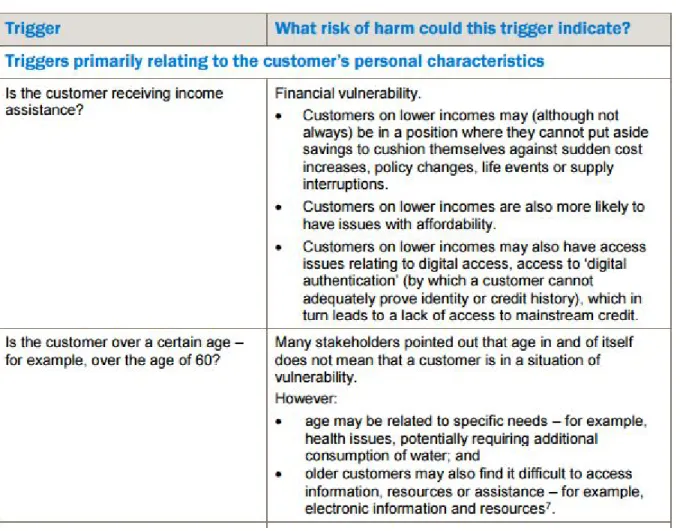
Particularly useful might be the detailed guide to a ‘trigger-point’ approach to identifying vulnerability. It is a positive step that water and energy companies 10 are already taking steps to coordinate the support they provide to their vulnerable customers, improving signposting between their information resources. 11
Figure 1: Extract from Ofwat’s ‘trigger-point’ approach to identifying vulnerability, from
‘Practitioners’ Pack for Water Companies’ (p.13-15), February 2016
● Social tariffs: As of 2012, one of the key elements of addressing financial vulnerability in the water sector has been the introduction of social tariffs for those who are struggling to pay. As of July 2016, 19 out of the 21 large water companies operated a social tariff, and the remaining two were seeking 12
customer agreement to introduce one. While following this example in the energy network sector would be a significant innovation from past policy, which has seen responsibility for fuel poverty mostly placed with the energy retail sector, the
10
http://9208a6bdb79020ec0337-99614e491dc8efff25f017339872a32a.r86.cf3.rackcdn.com/wp-content/
uploads/2016/02/pap_tec20160218vulnerabilitypract.pdf
11
http://www.energy-uk.org.uk/press-releases/338-2016/5749-water-and-energy-companies-join-forces-t o-help-vulnerable-customers.html
12http://www.publications.parliament.uk/pa/cm201516/cmselect/cmpubacc/505/505.pdf p.6.
potential impact of social tariffs could be huge. Social tariffs for energy networks already exist in other European countries such as Portugal and Italy. 13
● Willingness-to-pay: one regulatory tool that is common in the water sector but that has played a less important part in the regulatory framework to date in energy is willingness-to-pay analysis. By working with surveys and focus groups, this allows the regulator to build a picture of how consumers value non-monetary benefits and disbenefits, ranging from service reliability to visual amenity. This can then be used when setting incentives, and could therefore be useful in designing social obligations. However, willingness-to-pay needs to be used with caution.
Ofwat has recently highlighted that the results are not always robust, and Cathryn Ross has indicated there may be less reliance on it in PR19, the next price control.
Furthermore, willingness-to-pay assessments can only measure the interests of
14
a given sample of consumers and may therefore not be well-suited to decisions about social outcomes which inevitably involve distributional effects and
tradeoffs. All the same, willingness-to-pay analysis may be a useful tool in judging networks’ new social initiatives, where calibrating outcomes against traditional spending or saving will be a challenge.
These aspects of the approach to vulnerability in the water industry may not be directly translatable to the energy regulatory system. But it is important to maintain a wider focus and awareness of what other tools may be available, at the same time as working out the detail of the current systems in place under RIIO, as discussed in the next section.
13
https://ec.europa.eu/energy/sites/ener/files/documents/20150313%20Tariff%20report%20fina_revREF- E.PDF
14http://www.ofwat.gov.uk/wp-content/uploads/2015/12/prs_spe20151112vulnerability.pdf p.6.
II. Social obligations under RIIO so far
Social obligations have been the subject of much discussion under RIIO, over the long period when the new price controls were being planned and now over the first few years of their implementation. But there is still a sense, coming up for three years into RIIO-T1 and RIIO-GD1 and one year into RIIO-ED1, that the real activity under social obligations is only now starting to gain momentum. In some areas, it has still to get underway. In this section we look at the initiatives so far underway for each network type, the issues currently being discussed, and the opportunities for possible future development.
RIIO-ED1
RIIO-ED1, the price control for Great Britain’s six electricity Distribution Network
Operators (DNOs), has so far been a primary focus for delivering social obligations. This is because DNOs are responsible for responding to power cuts and therefore have more frequent direct customer contact than the other network types.
Social obligations pre-ED1
DNOs’ responsibility to consider the needs of vulnerable consumers is not new in ED1.
DNOs were already obliged to maintain a Priority Services Register (PSR) among their customer base. This shows households whose members, for reasons of age, disability status or a broad range of other factors may benefit from alternative services and communication channels. Measures available for PSR consumers range from large-print documentation to advance warning of outages. At the time of writing Ofgem is in the later stages of a review of the PSR, and has made a set of proposals aimed at raising awareness and take-up, facilitating data gathering and sharing, and improving the targeting of the services on offer. 15
As well as the PSR, there are a range of other requirements and incentivesthat affect DNOs’ social impact directly or indirectly. Financial incentives exist for customer
satisfaction, complaints and stakeholder engagement (the last of these has recently been expanded also to cover ‘customer vulnerability’, as discussed below). The Quality of Service Guaranteed Standards on availability and reliability are also relevant, as they set levels of service which network companies are obliged to give consumers direct
compensation if they break. More broadly, it is worth restating that providing a reliable, value-for-money service is a DNO’s core purpose. While not bracketed off as a social obligation, this is the most important impact a network can have on its vulnerable customers.
An important grey area to note between reliability and social obligations is the
‘worst-served customer’ mechanism that exists under ED1, as it has done under previous price controls. Through this, £76.5m is available over the course of the price control on a use-it-or-lose-it basis for DNOs to undertake projects improving service to any customers
15https://www.ofgem.gov.uk/publications-and-updates/priority-services-register-review-statutory-cons ultation-and-notices
who have previously met a defined qualification for ‘worst served’. This is a similar level 16 of funding to what was available, on a year by year basis, in the last price control. In that period, 2010-15, less than 20% of the available funding pot was taken up. Ofgem have addressed this by removing the requirement to meet a target level of improvement from these projects, opting instead for an ex post judgement on whether the spending was reasonable.
The new worst-served-customer arrangements will require a high degree of
transparency and proactive scrutiny. This is particularly important given one in five of such projects from the last price control that have reported so far missed the then
target. The relevance to social obligations is first, because chronically poor service from 17 the network might be a cause of consumer vulnerability in itself, and second, because worst-served customers may correlate with those who are vulnerable for other reasons.
In future, it may even be advantageous to target worst-served improvements in areas of deprivation where the benefit might be most felt, as is the case with the gas networks’
Fuel Poor Connections incentive.
New in ED1: planned spending on social obligations
When the DNOs submitted their business plans for ED1, each included a section on their outputs in the six categories, and a separate section on their projected expenditure.
Some of the DNOs went further, however, and tried to show how expenditure would map onto the outputs. The discrepancies between the results this produced shows how hard it is to draw the edges of social obligations. Northern Powergrid stated that only 0.2% of their spending would be on social obligations. But UK Power Networks 18
allocated £0.6bn of their requested £7.3bn revenue for the price control to this category, equal to 8% - proportionally, 40 times as much as Northern Powergrid.
This large difference is presumably a result of the ambiguity of what to count as a social output. It acts as a reminder that social obligations cannot be seen in isolation. But taking the higher proportion as a maximum estimate, this gives an indication of the amounts of money at stake. Through incentive payments, a maximum of only £30m or so is available for social obligations over the eight years of ED1 (the £24.6bn revenue allowed to all six companies times a quarter of the 0.5% available from the the SECV, see below). But if all the companies considered social obligations as broadly as UK Power Networks do in their business plan, the total spent on them would be approximately
£2bn.
New in ED1: the SECV
The main mechanism driving outputs in the social obligations category under ED1 is the Stakeholder Engagement and Consumer Vulnerability (SECV) incentive. At the time of writing, this is awaiting its first iteration since its development from the former
Stakeholder Engagement incentive. The DNOs’ first submissions will be assessed and the
16 https://www.ofgem.gov.uk/sites/default/files/docs/2013/02/riioed1decreliabilitysafety.pdf p.61.
17
https://www.ofgem.gov.uk/sites/default/files/docs/electricity_distribution_company_performance_201 0-2015.pdf p.47.
18https://www.yourpowergridplan.com/#!social_obligations
first award made in summer 2016. Ofgem have consulted on the new incentive, and the full response from Citizens Advice is available on Ofgem’s website. 19
The new SECV provides a discretionary, non-prescriptive incentive for networks to take innovative action on fuel poverty and consumer vulnerability. As a framework, a set of scoring criteria is defined by Ofgem. The SECV potentially adds a new dimension to the DNOs’ activities, despite its relatively small scale. It also raises a new set of questions. In particular, as the new regime take shape, it will be necessary to consider:
1. Is the scale of ambition and the associated financial reward available appropriately set?
2. Is the incentive design fit for purpose, to deliver tangible, cumulative benefits at value-for-money for consumers?
3. Is the scope of what is eligible for the SECV correctly set to maximise benefits without encouraging networks to stray from their core remit?
4. Will the measurement of outcomes give consumers confidence and drive improvements in future?
These questions are in the first instance specific to the SECV, but they will also apply to other incentives for network social obligations, whether for gas networks or in electricity in future.
1. Within the 0.5% revenue governed by the SECV, only 25% of this is directly linked to ‘the DNO’s strategy to address consumer vulnerability’ (0.125% of total
revenue). The other 75% remains allocated to stakeholder engagement. Although the guidance suggests good performance on consumer vulnerability might be taken into account when assessing the other criteria, this possibility is unlikely to be enough to stimulate new and innovative approaches.
Under this arrangement, only 0.125% of DNOs’ revenue, or slightly under
£4m/year across all six companies, is available specifically for their new consumer vulnerability strategies. This yearly amount is less than half what the DNOs
collectively spend on an average day. It is therefore likely to be outweighed by other considerations for the DNOs.
Citizens Advice believe that the funding available under the SECV is a positive step and it is important that evidence is allowed to accumulate regarding the
effectiveness of the social obligations revenue networks are permitted to recover.
It is therefore appropriate that the funding is limited at this stage, and directs funding previously allocated to the Stakeholder Engagement incentive. 20
However, in the future - subject to evidence demonstrating that social obligations investment produces effective results - the incentive available for ‘consumer vulnerability’ should be given formal parity within the SECV, so that the incentive is evenly split between stakeholder engagement and consumer vulnerability, with 0.25% of annual revenue ring-fenced for each. One way of evidencing this would
19 https://www.ofgem.gov.uk/system/files/docs/2016/04/citizens_advice_response.pdf
20
https://www.ofgem.gov.uk/system/files/docs/2016/03/electricity_distribution_secv_guidance_documen t.pdf
be networks are consistently excellent in the balanced scorecard mechanism by which electricity distribution are currently assessed. A positive commitment to formal parity from Ofgem could also succeed in driving networks’ current performance for vulnerable consumers, by providing the possibility of further rewards in the future.
If the scheme is successful, in future price controls it may be appropriate to increase the incentive’s scope, and perhaps to separate the vulnerability and engagement elements. As there are already concerns about network companies earning high returns across the board, it may be preferable to do this by making the incentive two-sided, adding a downside rather than simply increasing the upside. In the consultation decision on the guidance for the SECV, Ofgem notes these questions regarding the scale of the incentive, and confirms its willingness to ‘revisit this in later years’. 21
Recommendation:
Ofgem should consider increasing the ambition and scope of social
obligations funding, if networks prove effective at addressing consumer vulnerability.
2. The second outstanding question on the SECV is whether the incentive design is in line with best regulatory practice. In 2015 Citizens Advice published a report on the consumer impacts of price controls in regulated networks, including the principles that should underpin good incentive design. 22
It is not clear that the SECV is fully consistent with these, in particular with the principle that a regulatory incentive must be ‘bankable’ for consumers. That is, advances made under an incentive should translate into lasting, cumulative effects across all companies. In return for the extra contribution from bill payers, the benchmark should gradually advance over time. In response to submissions made by Citizens Advice, the SECV guidance now asks the companies to highlight year-on-year progress. But there may still be room for a further mechanism to consolidate progress and disseminate what works.
In some ways this is analogous to the situation with network innovation seen previously in the Low Carbon Network Fund (LCNF) and now with the Network Innovation Competition (NIC). Here, the challenge in recent years has been to turn pathbreaking individual projects into industry-wide progress, by sharing and generalising successes. In Citizens Advice’s review of the LCNF, we called for Ofgem to publish a yearly round-up of findings and implementation. 23
A similar approach could be beneficial for social obligations. There is scope to share the channels of dissemination in place for network innovation: the Energy
21
https://www.ofgem.gov.uk/system/files/docs/2016/04/direction_to_issue_the_secv_guidance_documen t.pdf
22 Citizens Advice, Many Happy Returns?: The Consumer Impact of Price Controls in Regulated Networks
https://www.citizensadvice.org.uk/Global/Public/Corporate%20content/Publications/ManyHappyRetur ns-NewBrandEdition%20(2).pdf p.7.
23
https://www.citizensadvice.org.uk/Global/CitizensAdvice/essential%20services%20publications/LCNFpo licypaper.pdf
Networks Association’s Smarter Networks Portal website, and the annual Low 24 Carbon Networks & Innovation (LCNI) conference. As this is the only 25
cross-network conference in Great Britain, a good first step to ensuring that benefits from the SECV are bankable for consumers would be simply to include social obligations and SECV initiatives on the LCNI agenda from 2016.
Networks should also proactively seek innovative ways of disseminating results, as they will be well placed to identify key forums and audience whose social obligations practise will benefit from what they have learned.
Recommendation:
Networks should commit to disseminating evidence of innovation and
‘what works’ across the industry. Incentives should be designed to encourage dissemination.
A second question relating to incentive design of the SECV is the risk that expectations of performance will be set too low, so that all participants are consistently over-rewarded. In the dry-run SECV assessment carried out by consultants commissioned by Ofgem, the average score awarded was 7.6 out of 10. This was based on first-attempt, preliminary submissions, so we hope that standards will be more demanding in the first real assessment. Starting with a benchmark that puts average performance substantially above the midpoint strongly suggests that the assessment is not sufficiently demanding. Consumers stand to pay more than they should if incentives are made too easy to earn, and the DNOs, having less to gain, will be less motivated to improve their
performance.
On the evidence available so far, it is unclear whether some networks will
consistently outperform or underperform others. We therefore also recommend that Ofgem consider how it will deal with consistent underperformance, especially given the limited funding available is not guaranteed to drive behaviour.
Recommendation:
The assessment benchmark for the SECV incentive should not be set too
low. The average score should not be significantly above the midpoint of the scoring
mechanism. If Ofgem finds that certain networks persistently lag behind, they should consider introducing penalties in future price controls.
3. The third question raised by the SECV relates to its scope. Ofgem have set out five Consumer Vulnerability Criteria against which the relevant part of DNOs’
submissions will be assessed. Broadly these cover management of the Priority Services Register, constructive engagement with partners and other stakeholders, and embedding consideration of consumer vulnerability into day-to-day service provision. 26
This represents a good set of starting points for social obligations, but there are several areas of potential work it does not appear to cover. Notably, this would
24 http://www.smarternetworks.org/
25 http://www.lcniconference.org/
26
https://www.ofgem.gov.uk/system/files/docs/2016/04/electricity_distribution_secv_guidance_documen t.pdf p.12.
exclude certain projects that DNOs have either previously undertaken as social obligations, or proposed under this category in their RIIO-ED1 business plans:
● Direct provision of funds for charitable purposes or community schemes.
Several networks have favoured this approach in the past, with Western Power Distribution for example for a number of years accepting
applications to a £50k ‘Community Chest’ fund. In the case of some funding initiatives, this has been a requirement imposed on networks as a part of a penalty from the regulator.
● Corporate social responsibility (CSR) extending beyond the network’s specific involvement in energy. Several of the DNOs included proposals of this kind under social obligations in their business plans. For example, Electricity North West proposed to aim for a gold certification in Business in the Community’s Corporate Responsibility Index by 2018. 27
● Social impact of planning, building and reinforcement decisions. While this might be in part included in Ofgem’s Consumer Vulnerability Criteria, it is not explicit. The range of other pressures on building and reinforcement mean that social obligations are unlikely to be considered unless
specifically mandated for. This means that a plan such as Northern
Powergrid’s, to upgrade electrical connections in high-rise blocks that need to have their gas connections removed for safety reasons, might lack direct encouragement. 28
● Community energy projects. The social benefits of community energy are well recognised, and at least one DNO, SSEPD, included the plan to work in particular with community energy projects as part of their social
obligations proposal in their business plan. Again, it is hard to see how 29 this initiative would be recognised under Ofgem’s criteria.
All of these are grey areas. Charitable donations would likely fail the test of being a function the network is best placed to provide. The second, CSR, should be undertaken voluntarily as by other companies, not for a regulatory reward.
The third and fourth areas, on the other hand - demonstrable consideration of social issues in the network’s large-scale planning decisions, and engagement with community energy projects - should at least be considered for incentivisation, where they can play a part in addressing vulnerability. These are discussed further in section III, but the key point for the SECV is the need for the criteria, which initially are drawn quite conservatively, to adapt and expand as new opportunities arise.
Recommendation:
Social obligation incentives should be flexible enough to recognise
additional areas when networks can demonstrate they are best placed to address them.
Networks should proactively spot opportunities, and incentives should reward breaking new ground.
27 http://www.enwl.co.uk/docs/default-source/enwl-wjbp-2014/section4-outputs.pdf?sfvrsn=2
28http://www.yourpowergridplan.com/#!social_obligations
29http://www.yourfutureenergynetwork.co.uk/07_csr2014.pdf
4. The fourth and final point is how measurable the outcomes of the SECV are, and whether they can be shown to be proportional to its costs. One DNO, Western Power Distribution, included a useful cost-benefit analysis in its dry-run
assessment which provided details of the monetary benefits. However, many of the benefits produced by social obligations, including those from Western Power Distribution’s own projects, may not be directly monetised. These benefits, in areas such as accessibility, fairness and consumer experience, should not be discounted or taken for granted just because they are hard to pin down.
Developed frameworks for capturing non-monetary benefits exist. DNOs might refer to the techniques being developed in impact investing and the ‘Green Book’
published by the Treasury in 2013, as well as approaches from other sectors 30 such as the water industry’s use of ‘willingness-to-pay’ analysis. We welcome that Ofgem is already taking steps to encourage networks to evaluate their
programmes effectively.
As well as being clear about the benefits of social obligations, it is important to be clear about the costs. Each DNO has been allocated a certain budget for social obligations initiatives, which is to be collected from consumers over the course of the price control. In addition to this, the vulnerability component of the SECV reward will effectively ‘buy’ a certain further level of commitment and results.
Consumers should be able to clearly see how much of their money is being spent on network social obligations and what benefit they are receiving for it. The important point is to clearly explain and evaluate how these initiatives are costing the consumer (through allowed spending on social obligations, plus any extra incentive reward) and how they are beneficial (financial and non-financial
benefits). Consumers will want to know that the latter is greater than the former.
That is, all networks should be able to assure their consumers that:
social obligation spending + incentive reward financial consumer savings + non-financial social benefits
(A caveat to this is that where financial consumer savings are involved, it is important to be clear which consumers these are going to. Enabling high-income early adapters to save on low carbon technologies, for example, may have
environmental benefits but should not be counted under social obligations.) There may be an initial period where costs are high and benefits are low. This is fully understandable, but again, it needs to be be clearly communicated, and accountable targets must be set for moving out of this phase. It may be that some real and important benefits cannot be measured with any degree of accuracy, or that it too expensive to do so, but likewise this should be explained to consumers and other stakeholders.
30
https://www.gov.uk/government/uploads/system/uploads/attachment_data/file/220541/green_book_c omplete.pdf
Recommendation:
Networks need to evaluate their interventions effectively . Wherever
possible, benefits and costs should be quantified. The value of non-quantifiable benefits should be clearly stated and justified.
RIIO-GD1
Ofgem has given the GDNs two specific roles in the social obligations output category of GD1: connecting off-gas consumers in more deprived areas of the country, and raising awareness of carbon monoxide (CO) poisoning. Alongside these two clear-cut social obligations, there is also a broader third category in GD1, roughly covering all ED1-type activity discussed above, that covers ‘providing non-network solutions to fuel poor households’. 31
To motivate these social obligations, Ofgem has included two incentive structures in GD1: the Fuel Poor Network Extension Scheme (FPNES), and the Discretionary Reward Scheme (DRS). At an earlier stage of planning, the intention expressed was to expand the Stakeholder Engagement incentive also to cover social obligations as in ED1, but this has yet to be acted on. The position of the Stakeholder Engagement incentive therefore 32 remains slightly ambiguous.
The Fuel Poor Network Extension Scheme
The FPNES, continuing a similar mechanism in the previous price control, puts an incentive on GDNs to connect a target of c.90k properties that are currently off-gas in areas with a statistically high level of deprivation. This was the subject of a review in 2015. Each GDN has a target number of connections, and besides the basic uplift in 33 their allowed spend, they will be rewarded or penalised by 2.5% of any spending (at an efficient rate decided ex post
by Ofgem) that either takes them past this target or by
which they fall short of it.
The FPNES has seen many households in deprived areas connected to the gas grid and is an important part of Ofgem’s fuel poverty strategy. In the long term, if heating becomes increasingly electrified, simply extending the gas network further and further may at some point cease to be a sustainable solution (see section III).
The targeted home visits involved in fuel poor connections offers a chance to promote the installation of more efficient heating equipment and home insulation improvements.
Gas distribution networks are not funded to undertake this work through the FPNES and do not have the expertise to do so. Ofgem instead requires them to work with partners through the FPNES and to use the Stakeholder Engagement Incentive and DRS ‘to demonstrate how they have worked in partnership with others to deliver the best whole-house solution for households eligible for the Scheme.’ 34
31 https://www.ofgem.gov.uk/sites/default/files/docs/2011/03/gd1decision_0.pdf p.23.
32
https://www.ofgem.gov.uk/sites/default/files/docs/2012/12/2_riiogd1_fp_outputsincentives_dec12_0.p df p.30.
33
https://www.ofgem.gov.uk/sites/default/files/docs/2015/03/the_findings_of_our_review_of_fuel_poor_n etwork_extension_scheme_26_march_2015_0.pdf
34
https://www.ofgem.gov.uk/sites/default/files/docs/2014/11/citizens_advice_response_to_fuel_poor_con
From the GDN stakeholder incentive submissions so far under GD1, only Wales & West Utilities has pursued the possibility of delivering whole-house solutions, and it is unclear from their submission how effectively this was synchronised with their fuel poor
connections. We support Ofgem’s attempt so far to encourage GDNs to work in 35 partnership with other organisations to deliver whole-house solutions, such as through local authorities in receipt of the Central Heating Fund . 36
Recommendation:
Ofgem should continue monitoring the extent to which incentives are
driving GDNs to work with partners in identifying whole-house solutions for off-gas properties.
A specific whole-house condition in the Stakeholder Engagement Incentive should be introduced if the correct behaviours are not being driven.
The Discretionary Reward Scheme
The Discretionary Reward Scheme (DRS) in GD1 makes available up to £12m in three tranches of up to £4m awarded on the basis of submissions to a panel. £3.05m of the first tranche was awarded between 2013 and 2015, with the others to follow in 2018 and 2021. This reward is meant to incentivise not only ‘social initiatives’ but also 37
environmental outputs and work on carbon monoxide safety. Indeed, it is the only financial reward in either of those areas. 38
£800,000 has been awarded regarding GDNs’ efforts to raise awareness of carbon
monoxide poisoning. Rewarded activities have included partnerships between Wales and West Utilities and the Royal Welsh College of Music and Drama to develop outreach programmes that deliver gas and carbon monoxide safety messaging to 13,000 people annually, as well as collaborative work among all GDNs to deliver the carbon monoxide Gas Safety School Poster Competition.
Specific social outputs under the DRS are divided along similar lines to the SECV in ED1:
● ‘Development of energy solutions for the fuel poor.
● Initiatives that facilitate sustainable energy solutions to the fuel poor by building partnerships with other parties in the sector (eg electricity distributors, suppliers, technology providers, local councils, agencies).
● Initiatives that improve the knowledge that the company has regarding vulnerable and fuel poor customers in their service area.’
Across these areas of social outputs, the total award under the first tranche of the DRS to all GDNs for 2013-15 was £750k.
sultation_0.pdf;
https://www.ofgem.gov.uk/sites/default/files/docs/2015/03/the_findings_of_our_review_of_fuel_poor_n etwork_extension_scheme_26_march_2015_0.pdf p.17.
35 https://www.ofgem.gov.uk/sites/default/files/docs/2015/09/drs_wwu_submission_0.pdf
36
https://www.gov.uk/government/publications/central-heating-fund-local-authority-guidance/central-he ating-fund-faqs
37
https://www.ofgem.gov.uk/sites/default/files/docs/2015/09/gas_drs_decision_document_2013-2015.pd f 38https://www.ofgem.gov.uk/sites/default/files/docs/2014/12/gas_drs_15_decision_letter.pdf
Most of the projects put forwards in the GDNs’ submissions fall into the second and third categories above - partnerships and improving information - or else staff training, rather than direct ‘development of energy solutions for the fuel poor’. An exception to this is SGN’s trial of fitting locking valves on gas cookers, after having ‘realised [their] engineers have the necessary skills, are already working in the community and would be able to fit locking cooker valves to avoid explosion and fire’. This is a great example of a network 39 discovering innovative ways to meet its social obligations efficiently within the scope its existing activity, albeit on a small scale.
In other cases, though, the scale of initiatives included in DRS submissions seems strikingly small. Northern Gas Networks, for example, mention a partnership to set up
‘pop-up energy hubs’, despite the fact that apparently only one had so far taken place, and the submission describes a positive outcome for ‘two attendees’. More sessions were planned, and clearly this was not solely responsible for the £200,000 reward for social outputs that Northern Gas Networks was allocated (for example, the DRS decision praises their work in setting up the Infrastructure North partnership and a larger
programme of workshops in Bradford). Nonetheless, the scale of the benefits delivered seems incongruous. It is welcome that networks can describe their initiatives that have been less successful or not reached a large scale (and in this case, Northern Gas
Networks was able to expand the scheme subsequently), but where this is the case, it should be made clearer and more explicit.
Ofgem publishes brief feedback on the submissions, including a few general points of criticism from the assessment panel. Notably this includes that there is too little evidence of the scale of results, too little detail about the specific role played by the GDN in each partnership, and too little clarity on where initiatives actually went beyond regulatory requirements. 40
All are certainly valid points, but there is also a more fundamental question about whether it will ever be reasonable to expect meaningful and sustained results when the overall scale of the incentive is so small. A pot of £12m over eight years would be unlikely to be be enough to significantly impact the behaviour of organisations the size of the GDNs even in one area, and the DRS tries to use it as a driver in three: social,
environmental and carbon monoxide awareness.
Two possibilities are feasible for social obligations under GD1. Either it should be made explicit that social obligations should be limited to carbon monoxide awareness and fuel-poor connections, or - if it is felt that gas networks potentially have more of a contribution to make - incentive funding for social initiatives should be increased to meaningful levels. The most obvious way of doing this, as per ED1, would be to update the Stakeholder Engagement incentive.
Stakeholder Engagement incentive for GD1
39
https://www.ofgem.gov.uk/sites/default/files/docs/2015/09/drs-submission-_sgn_individual_-final_reda cted_0.pdf
40
https://www.ofgem.gov.uk/sites/default/files/docs/2015/09/gas_drs_decision_document_2013-2015.pd f
The Stakeholder Engagement incentive element of the Broad Measure of Customer Satisfaction is worth up to 0.5% of revenue. When Ofgem designed RIIO, it had intended links with social obligations. For example, Ofgem’s final proposals for GD1 suggest a reward equal to up to 25% of the stakeholder engagement funding . It is unclear 41 whether the Stakeholder Engagement incentive is always promoting new activity or risking double-counting. Networks often replicate content from DRS or FPNES submissions in their Stakeholder Engagement incentive submissions in relation to
consumer vulnerability. However, neither of Ofgem’s panel decisions for the Stakeholder Engagement incentive mention vulnerability or social obligations.
So far, however, Ofgem has relied on the smaller DRS to drive both carbon monoxide awareness and consumer vulnerability work. It is possible that the DRS is too small and irregular a source of reward to effect any significant change. Despite their different remit, GDNs can contribute to social policy objectives in most of the ways DNOs do - through use of data, referrals, partnerships and existing points of customer contact - and have additional expertise on key issues related to heating and cooking. Ofgem should explore updating the Stakeholder Engagement incentive to include consumer vulnerability requirements, in a similar manner to ED1. This would allow the Discretionary Reward Scheme to focus more narrowly on carbon monoxide awareness and environmental obligations.
Recommendation:
Ofgem should investigate updating the Stakeholder Engagement Incentive
in GD1 to include consumer vulnerability.
RIIO-T1
At present there are no social obligations outputs for transmission networks under T1.
Although the six RIIO outputs categories are the same across the different price controls, Ofgem’s decision following consultation in 2011 was:
‘We do not intend to place any social obligations on the TOs. This was because there are not currently any specific social obligations on the companies in transmission and we do not see any rationale for introducing new obligations.’ 42 This is largely due to the fact that transmission networks seldom have contact with individual consumers or connect directly to particular homes, leaving little room for specific social interventions. At present this is a sensible approach, but in future it may be beneficial for the potential social role of the transmission operators to be revisited. In particular, National Grid, which also holds the remit of system operator, will have key input into how smart grid developments will affect consumers.
41https://www.ofgem.gov.uk/sites/default/files/docs/2012/12/1_riiogd1_fp_overview_dec12.pdf
42https://www.ofgem.gov.uk/sites/default/files/docs/2011/03/t1decisionoutput_0.pdf p.6.
III. Social obligations and future networks
Networks’ social obligations will look very different in ten years, or twenty. The energy system is going through its biggest transformation for several generations. The need to accommodate new renewable energy sources, distributed generation and the potential electrification of heat and transport, together with the opportunities created by smart grid technologies, international interconnection and increasing levels of system flexibility, have already had a major impact on all parts of the sector. They will continue to do so well into the foreseeable future. Networks are at the heart of this, with major changes possible to how they are planned, built and operated, as well as potential changes in remit and regulation.
Alongside other impacts of these changes, it is essential now to consider how these will affect the networks’ social obligations - both by creating new challenges and offering new opportunities. Measures so far put into place in the RIIO price controls should provide a good basis for a broader integrated approach as the system develops. According to the National Infrastructure Commission’s 2016 report ‘Smart Power’: ‘in many instances, a more strategic approach to upgrading our networks could deliver large savings to future consumers, or bring wider economic and social benefits to a local community.’ 43
At present, networks by and large provide a one-size-fits-all service, with customers primarily modelled as interchangeable units of demand. This has historically been an efficient approach, and can be made more flexible where necessary in defined areas - such as social obligations - as and when tactically useful to support other policy goals. In this way of seeing it, social obligations are relevant only to the minority of consumers whose special circumstances require additional support.
Looking forwards, however, there may
be a case for considering social obligations more
widely. Developments such as a more active local network operator role or a more dynamic demand side response for electricity may make the social impact of networks broader and more complex, and the one-size-fits-all model less applicable. A wider, more strategic definition of social obligations might include the overall distributional impact of a network’s long-term decisions, not just its services to a minority of vulnerable
consumers (this can be seen in particular when considering possible adaptations to the structure of network tariffs: see box on p.31). Networks may also increasingly shape consumers’ future energy experience, for example by enabling the growth of community energy projects or the uptake of low-carbon technologies.
On the other hand, even in a future scenario where networks’ remits are broader and more differentiated, expanding the emphasis on network social obligations will not
43
https://www.gov.uk/government/uploads/system/uploads/attachment_data/file/505218/IC_Energy_Re port_web.pdf p.71.
automatically be the right thing to do. Increases in incentive funding should only be considered where this provides consumers with greater value for money.
Double-counting must also be avoided and networks should not be rewarded for activities, or levels of service, they would already deliver because of other incentives.
The question of the future social impact of networks is broad and complex. It is one that all parties should be considering. In this section, we look in particular how changing network roles will create new threats and opportunities social obligations, and how this links to planning and innovation for the future.
Changing network roles
There is a spectrum of possible future developments of the role of energy networks, between incremental change and paradigm shift. The former has already been visible over the development of RIIO. Towards the latter end could be a programme similar to the one considered by New York state’s Reforming the Energy Vision (REV), with
electricity networks becoming not just a physical infrastructure provider but a platform for a range of energy and data services. While it is unlikely that the shift in Great Britain 44 will go as far as this, it is still true that networks are likely to start undertaking new kinds of activities as new challenges and opportunities open up.
Foremost among these challenges for electricity networks is the ongoing need for reinforcement, often exacerbated by growing distributed generation, and potentially, in the future, even more so by the electrification of heat and transport. Solutions based on smart grid technology are starting to challenge the traditional approach of maintaining a wide buffer of redundant assets to mitigate the risk of overloading the network. Many of these solutions will be invisible to consumers, except in the indirect sense that they should lead to cheaper bills (relative to a counterfactual - network costs overall are likely to rise) and more reliable service. However, it is possible that some might affect the consumer experience, or even involve consumers directly.
Networks and demand-side response
The most immediate possibility is that DNOs may become interested in the flexibility offered by domestic Demand Side Response (DSR) - that is, using a financial or
non-financial incentive to encourage consumers to adapt their energy-using behaviour in response to a signal. This could be used in network fault management or to reduce usage at peak times. While it may be the case that domestic customer flexibility is of more short-term value to suppliers, and that DNOs are likely to access it via third-party aggregators, in highly geographically-specific instances if at all, it is still important to note that this could create a new type of DNO-consumer relation. It may also have an 45
important impact on the design of distribution tariffs (see box below).
44 http://www3.dps.ny.gov/W/PSCWeb.nsf/All/CC4F2EFA3A23551585257DEA007DCFE2?OpenDocument
45 See the consumer annex to the report by work stream 6 of the Smart Grid forum on these DSR issues: https://www.ofgem.gov.uk/sites/default/files/docs/ws6_annex1_sgchapters.pdf