Parcel delivery
Delivery services in the online shopping market
Cara Jones & Tess Lanning
Contents
Summary 2
1. Parcel delivery services are increasingly important to
how we shop and live 3
2. Most online shoppers have experienced a problem with
parcel delivery in the last year 4 3. Access to redress is limited by low uptake and
enforcement of consumer rights 7 4. Consumers who do take action often experience
further problems 11
Consumers are not clear on their rights 11 Consumer rights information isn’t always easily available 13 Company complaints processes can be frustrating 16 Conclusions and implications 19 Appendix 1: Consumer rights 21
Summary
The boom in e-retail in recent years has driven a surge in parcel delivery
services. People of all ages and in all parts of the UK are increasingly reliant on being able to receive goods direct to their door. It is important that retailers and parcel operators work together to meet their interests through fair pricing, fast, convenient and flexible delivery, and ease of redress when things go wrong.
Drawing on two major new studies and analysis of calls to the Citizens Advice helpline, this report explores consumer experiences of parcel delivery services in the online shopping market. We set out the scale and type of problems online shoppers experience with parcel delivery, their rights to redress, and the extent to which these rights are taken up and upheld in practice.
The findings show that nearly seven in ten online shoppers have experienced a problem with parcel delivery services in the last year, including delayed, lost and damaged parcels. Problems with failed delivery are also common, partly due to a lack of safe spaces and pick-up points for people who cannot wait in for a parcel.
Access to redress is limited by low awareness and take up among consumers.
This is exacerbated by a lack of clear information from many online retailers and parcel delivery companies about how to seek redress and a sometimes poor quality service when consumers do take action.
The research points to three areas for further investigation:
● How to reduce the number of consumer problems: Failed deliveries could be reduced by investing in community pick-up points and requiring every new-build home to have a parcel locker.
● How to improve consumer awareness and uptake of their rights: A voluntary certification scheme could encourage retailers and parcel companies to adopt HM Government guidance on information provision for online shoppers about their rights.
● How to ensure consumers’ rights to redress are upheld: If best practice is not adhered to voluntarily there may be a case for stronger regulatory intervention.
1. Parcel delivery services are
increasingly important to how we shop and live
The volume of parcel deliveries has grown significantly in recent years. Over two billion items were delivered to households across the UK in 2015-16 - an
increase of 12% on the previous year and in marked contrast to the shrinking letters market. UK adults now receive an average of just over a parcel a week , 1 2 and forecasters expect volumes to continue to grow in the next few years, albeit at a slower pace. 3
The main driver for the growth of parcel traffic is round the clock internet
shopping. People are increasingly seeking the convenience of being able to shop at a time and place that suits them and to receive goods direct to their front door. While the largest parcel volumes are driven by major retailers sending out packages to their customers, the popularity of digital sales platforms such as eBay, Gumtree, Etsy and Preloved have also led to an increase in deliveries despatched by consumers and small businesses. 4
As parcel delivery services become increasingly important to individuals and the wider economy it is vital that they provide a decent standard of service, including fair pricing, fast, convenient and flexible delivery, and a smooth system for
resolving any problems that arise.
This report examines these issues. We draw on two major studies commissioned by Citizens Advice: a literature review and survey of 2,005 online shoppers
conducted by Europe Economics, and an independent audit of online shopping websites and analysis of the diaries of 524 online shoppers conducted by Verve.
We also draw on our own analysis of the issues faced by people who contact Citizens Advice. Together these provide new evidence about the problems consumers face, the action they take, and how easy it is to gain redress.
1 Ofcom, Annual Monitoring Update on the Postal Market, 2016
2 Ofcom, The Communication Market Report, 2016
3 See for example, Barclays, The last mile: exploring the online purchasing and delivery journey, 2014; Apex Insight, UK Parcels: Market Insight Report 2017, 2017
4 Apex Insight, UK Parcels Market Insight Report 2017, 2017
2. Most online shoppers have
experienced a problem with parcel delivery in the last year
When asked about the quality of parcel delivery services in general, consumers appear to be largely satisfied - 94% report a satisfactory or high quality of service. Nearly two-thirds (63%) of online shoppers buy something online at least once a month, and every year millions of these parcels are delivered without incident.
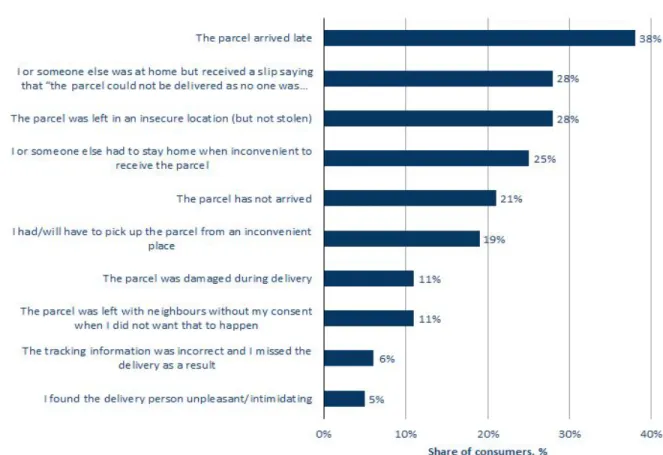
Yet our research also reveals that nearly seven in ten (69%) online shoppers have experienced at least one problem in the last year. Key issues include delayed, lost and damaged parcels, and problems with the flexibility and convenience of delivery options.
Figure 1. Problems with parcel delivery
Source: Europe Economics, 2017 5
5 Base: 2,005. The numbers do not add up to 100 as consumers could choose multiple options.
Delays are by far the biggest issue affecting consumers. In total, 38% of online shoppers report having experienced late delivery of parcels in the last year, including people who had paid for premium delivery services. Over a fifth (21%) said the parcel had not arrived (at the time of survey), and more than one in ten people had received a package damaged in delivery. Over a quarter (28%) of online shoppers also complained about parcels being left in insecure locations, potentially leaving them vulnerable to theft or damage.
Other issues focused on the inconvenience of collecting or receiving parcels. A particular issue emerged around unnecessary delivery failures, with a significant group of people (28%) having received notes saying that a parcel could not be delivered despite the fact that someone was at home to receive it, and a smaller group (6%) missing deliveries due to incorrect tracking information. These issues highlight the scope for more preventative action to reduce the number of failed deliveries, which can be a source of stress and inconvenience for consumers and can take a significant amount of time to resolve.
Amanda contacted the Citizens Advice consumer helpline when she was not able to resolve her problem. After missing the original delivery and receiving a slip Amanda arranged for the parcel to be redelivered as she couldn’t get to the depot office. She was home for the scheduled re-delivery date but nobody turned up. Amanda does not know what to do and how she can get her package.
Making multiple delivery attempts and handling consumer complaints can also be costly and time consuming for retailers and delivery companies. The industry has innovated to meet the so-called ‘last mile challenge’ of getting packages to people with different needs in an area efficiently. Media reports have focused on the use of drones, driverless cars, and the tendency to simply outsource the challenge to a network of local couriers, which has led to allegations of exploitative working conditions and bogus self-employment. The most 6
successful solutions, however, have included investments in new technology to enable consumers to track and manage their delivery times, and the
establishment of parcel shops and locker networks to provide convenient pick-up points for consumers who cannot be at home. 7
6 See, for example, BBC, Courier firm Hermes may face HMRC investigation over low pay, 2016;
GMB, GMB launches legal action against DX, 2017; GMB, GMB Launches ‘Uber-Style’ Case Against UK Express, 2017
7 Apex Insight, UK Parcels Market Insight Report 2017, 2017
Encouraging the parcel industry to invest in a wider range of delivery options, alongside more sophisticated tracking systems, could help to better meet the needs of people in different areas. Analysis of diaries kept by online shoppers 8 suggests that less than half (47%) of online retailers offer consumers the option to pick up their parcel from a convenient central collection point such as a store or parcel locker. Those in remote areas appear to be particularly disadvantaged, as they are both less likely to have someone at home or a neighbour who can receive the delivery and less likely to use pick-up points. People living in urban areas meanwhile are less likely to have a safe space for their parcel to be left than those in rural and remote areas. Addressing these disparities could help to minimise the problems associated with failed delivery.
8 Verve, Transparency and ease of online delivery, 2017
3. Access to redress is limited by low uptake and enforcement of
consumer rights
Retailers are legally required to ensure a certain standard of service in the parcel delivery market, and consumers have a right to redress if these standards are not met. Online shoppers should expect to receive packages within 30 days, for example, and have the right to claim damages as well as a refund, repair, price reduction or replacement if a parcel is late, lost, damaged or left in a place other than agreed. Consumers can also ask for delivery charges to be refunded when they experience one of these issues. 9
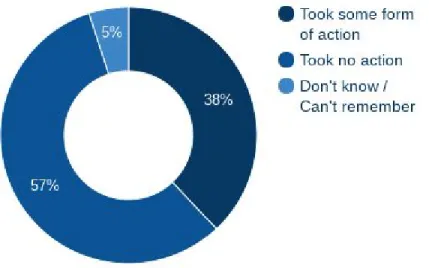
While the Competition and Markets Authority and local trading standards have powers to seek court orders in cases of repeat breaches of legislation, in most cases enforcement of these rights is dependent on individuals taking action through company complaints procedures. In theory, consumer action - 10 whether by complaining to the retailer or avoiding shopping with those who provide a poor service - can also help drive industry priorities, and so lead to improvements in service standards. However, data from the survey of online shoppers shows that less than two-fifths (38%) of consumers who experience problems with parcel delivery take any action. 11
9 See Appendix 1 for a full list of consumer rights and the associated regulation.
10 The independent regulator and competition authority for communications Ofcom regulates the postal industry. However, Ofcom does not investigate individual complaints about postal operators.
11 Europe Economics, Consumer rights for parcels delivery, 2017
Figure 2. Consumer action
Source: Europe Economics, 2017 12
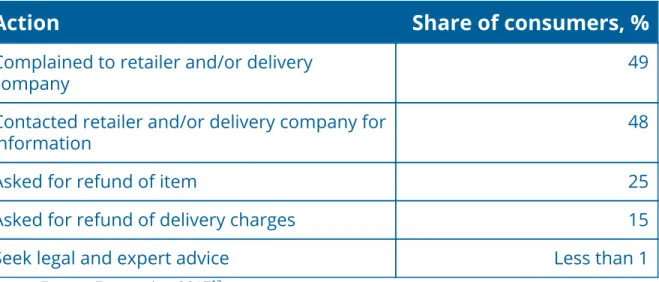
Of those who do take action, most either contact or complain to the retailer and/or the delivery company. Only a quarter of people who take action ask for a refund, and less than 1% seek legal and expert advice when they experience a problem. The research suggests that older people take action more frequently than younger people and that disabled people are more likely to take action than non-disabled people.
12 Base: 1383 consumers who experienced a problem with parcel delivery in the last 12 months.
Figure 3. Type of action taken
Action Share of consumers, %
Complained to retailer and/or delivery
company 49
Contacted retailer and/or delivery company for
information 48
Asked for refund of item 25
Asked for refund of delivery charges 15
Seek legal and expert advice Less than 1
Source: Europe Economics, 201713
People who have experienced a financial loss are more likely to ask for a refund of delivery charges, the purchased item and/or other costs. Those consumers who paid for a premium service such as next- or named-day delivery that was delayed, for example, are more likely to take action than consumers who experience delays with standard delivery services. Yet the levels of consumer action even for those who lost money is relatively low. Less than half (49%) of people who paid for a premium delivery service that did not arrive on time took action. About a quarter of people who have been inconvenienced by having to arrange for someone else to be at home or had to pick up their items from inconvenient locations took any action. 14
13 Base: 531 consumers who took action after experiencing a problem. The numbers do not add up to 100 as consumers could choose multiple options.
14 Europe Economics, Consumer rights for parcels delivery, 2017
Another potential course of action for people that experience problems with parcel delivery is to take their business elsewhere. People rarely have a choice about which parcel delivery company is used - our diary evidence suggests that less than one in five online shops offer this option at checkout - but they can 15 choose to no longer to shop with the retailer responsible. Data from our survey shows that most people do not switch retailer as a result of delivery problems, but a third say that they would either shop less often or never shop again with the retailer in the future. This suggests that there may be a hidden cost for 16 retailers in failing to address problems with parcel delivery.
15 Verve, Transparency and ease of online delivery, 2017
16 Europe Economics, Consumer rights for parcels delivery, 2017
4. Consumers who do take action often experience further problems
Relatively low rates of consumer action mean that a majority of consumers are not getting the redress they are legally entitled to. Underreporting also means that both retailers and regulators may be unaware of the extent and type of issues consumers regularly experience, limiting the opportunities to use the feedback to improve service delivery.
Our research also suggests that when people do take action they can experience further problems accessing redress. This is due to low levels of awareness
among online shoppers about their rights, the clarity and quality of the information provided by online retailers, and difficulties navigating company complaints procedures.
Consumers are not clear on their rights
Promoting strong consumer awareness of their rights when it comes to parcel delivery services is important so that people know who to contact and what they are entitled to should something go wrong. However, our research suggests that knowledge of rights varies considerably.
Evidence from the survey of online shoppers suggests that little more than half 17 (55%) of online shoppers think they know their rights well. When asked to
identify specific rights in true or false questions:
● The vast majority (around 90%) could correctly identify that the retailer must provide information on delivery charges and arrangements prior to purchase.
● 70% could identify that delivery charges and arrangements must be quoted before payment and cannot be changed once fixed.
However, the survey also found that:
● Only 4 in 10 (38%) consumers could identify that if the retailer does not mention delivery or return charges, the retailer must pay for delivery.
17 Europe Economics, Consumer rights for parcels delivery, 2017
● Just 25% of consumers could identify the correct cooling off period of 14 days.
● Only a third of consumers (33%) correctly identified that if they decide to return their package within the cooling off period they are also entitled to a refund of the standard delivery charge.
In practice, there may be even more confusion than some of this data suggests.
Research by Verve for Citizens Advice found that, when asked who to contact if they had questions or issues with delivery, 50% of online shoppers were either incorrect or unsure. Similarly, when presented with a simple case study, only 17% of consumers correctly said that the retailer should refund the cost of the item and the standard delivery charge . This indicates that although consumers 18 may be able to identify legal responsibility in the abstract, in practice they may not have the knowledge necessary to understand when or how to take action.
18 Verve, Transparency and ease of online delivery, 2017
Consumer rights information isn’t always easily available
Limited consumer awareness may be exacerbated by a lack of clear information about what they should expect when ordering a parcel. Retailers are legally required to provide consumers with information about the cost of delivery, the time for standard delivery, areas where they do not deliver, and how to
re-arrange delivery, return goods, and seek refunds should something go wrong.
It is up to online retailers, however, to decide how and when this information
19
is displayed, and our research suggests that the clarity and accessibility of information varies considerably.
An independent audit of the websites of top online retailers commissioned by 20 Citizens Advice suggests that although most retailers do provide the legally required information about delivery, complaints and returns, it can be difficult to find and/or difficult to understand. Information is difficult to find in around a quarter of websites tested. For example, consumers have to click away from home or product pages, search through several pages or click multiple times to find regulated information. A third of retailers do not explain consumer rights information in clear terms or split up the information and spread it across different pages on their website.
19 The Consumer Contracts (Information, Cancellation and Additional Charges) Regulations 2013 set out the information retailers are required to provide. More detail on this legislation can be found in Appendix 1: Consumer rights
20 25 online retailers selected from the Top 50 IMRG E-Retailer Index, September 2016
Figure 5. Presence of regulated information on retailer websites 21
Product
Page Delivery Contact /
Complaints Returns Policy Found on
most retailer websites (80%)
Full
description of the product Total price (including delivery costs)
Standard delivery estimate Option to choose type of delivery
Legal address
Contact details for retailer / courier
Deadline to return items
How and where to return items
Found on some retailer websites (40%)
Areas
excluded from standard delivery
Call charges for consumer telephone enquiry
Liability for return costs (i.e. retailer or consumer) Conditions to return item Free returns for faulty items
Length of time to get a
refund
Found on a minority of retailer websites (20%)
(20%
Retailer is
responsible for condition of the item until it reaches consumer
Refund include standard delivery
Source: Verve, 2017
21 When information is reported as found or not found, it is the view of the consumer and does not mean we can conclude the information is definitely present or not.
In 2016, Citizens Advice worked with government, industry representatives and other consumer bodies to produce a set of practical suggestions for online retailers. The guidance was designed to help businesses that sell online to 22 understand their legal obligations and how they could comply with the law in a consumer friendly manner. Adopting these suggestions would help address delivery problems experienced by consumers and ensure services meet current and future consumer needs by building on the minimum requirements of
retailers’ legal obligations. The advice is that retailers should:
● Provide information on delivery charges, returns policy and services (especially exceptions and surcharges) on the homepage, on every
product page, and at the checkout stage before the consumer is asked to pay.
● If there are any geographical restrictions to delivery this should be made clear on the homepage, in FAQs, and once the consumer’s postcode is known.
● Increase the success of first-time delivery by offering a range of delivery options and times, allowing consumers to provide specific delivery
instructions, allow consumers to select a safe-place or specific neighbour delivery, offer options to collect from a store, third party outlet, a Post Office or a secure locker, and tell consumers when delivery can be expected.
● Confirm dispatch and delivery information when the order is complete and dispatched.
● Consider giving consumers opportunities to provide feedback about their delivery experience.
The website audit suggests that only a minority of online retailers follow these suggestions in full. Around 4 in 10 retailers examined provide information on what happens if the consumer is out when their item is delivered. Only a fifth inform the consumer which courier is being used and provide information on delivery prices to rural and remote areas when these are not covered by standard delivery.
Evidence from the diaries of online shoppers suggests that in general 23
consumers are satisfied with the information provided by retailers, but become frustrated when key information is not readily accessible. The research suggests
22 HM Government, Online Delivery Leaflet, 2016
23 Verve, Transparency and ease of online delivery, 2017
that the following changes would make online shopping easier for consumers and should help to avoid confusion:
● Fewer clicks to access required information.
● Key information repeated in a simple, clear format at each stage of the shop.
● A range of delivery options.
● The option of selecting delivery company (where possible).
● A clear statement that the retailer is responsible for delivery, with contact details and clarity on any call costs in the event of an enquiry.
● Details of the delivery company once order is confirmed or once item is ready for dispatch if delivery company is not known before. 24
● Transparent information on what will be refunded with regards to delivery costs.
● Confirmation (where possible) that delivery has been made, and where to.
A key question is how to encourage more online retailers to adopt the suggestions on provision of information in the Online Delivery Leaflet. The research also suggests that there may be a case for extending the current guidance to ensure retailers highlight that they are responsible for delivery, provide more straightforward information around refunds, and provide consumers with a confirmation once delivery has taken place.
Company complaints processes can be frustrating
When consumer markets work well they deliver innovation and efficiency, keeping prices fair and providing products and services that meet people’s needs. When they misfire, however, consumers end up wasting time and money trying to resolve problems. Our research suggests that the lack of clear and easily available information about delivery in online retailer communications can make seeking redress a frustrating experience for consumers.
The survey of online shoppers found that of the people who take action when they have a problem with parcel delivery, 44% experience further issues when trying to resolve it. The most common issue is having to contact the retailer 25 and/or delivery company multiple times with consumers also reporting slow
24 Retailers may not always know who the delivery company will be until items are ready to dispatch meaning delivery company name on order confirmation is not always possible.
25 Europe Economics, Consumer rights for parcels delivery, 2017
response times to queries or complaints. Consumers also reported finding it hard to find contact details and found information on how to submit a complaint or ask for a refund was difficult to understand.
Citizens Advice receives around 2,600 calls enquiries about parcel issues each year. Many of the calls we receive to the consumer helpline are from people who have been unable to resolve their problem and are unsure about the legal
protections that apply to their situation. Clients tell us that parcel operators can be difficult to get in touch with over a problem with delivery, and they can find themselves passed between the retailer and the parcel operator, with neither willing to take responsibility for resolving the issue.
Alan contacted Citizens Advice about a parcel that had been damaged during delivery. He had spent time and money for call charges contacting both the parcel operator by phone and email as well as the retailer. He had found the responses unsatisfactory and was still unclear about his rights to a refund.
Sandra was on holiday when her parcel was left in her bin. While she was away the bin had been emptied and the parcel was gone when she returned. Sandra complained to the retailer who said that it was not their responsibility. After a complaint to the parcel
operator she was given a third of the value as a refund.
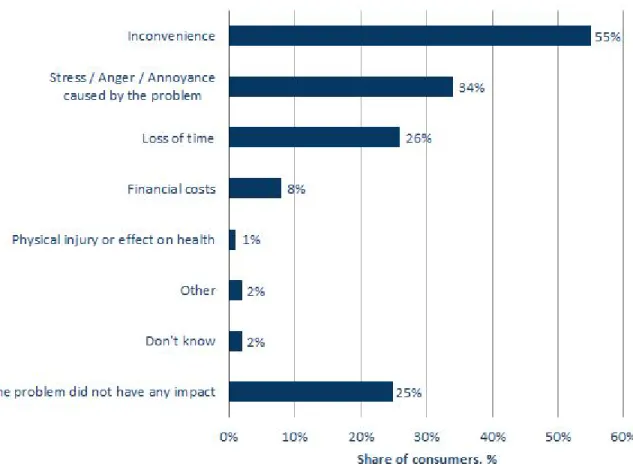
Resolving these problems can take up considerable time and be a cause of stress. Three quarters of people who experience problems with parcel delivery experience a negative impact, the most common of these being inconvenience, stress and anger. More than a quarter (26%) lost time trying to sort out the problem and nearly 1 in 10 (8%) suffered some kind of financial loss. Consumers who lost time (42%) typically spent between 1 and 5 hours resolving the
problem. This is in line with previous research by Citizens Advice suggesting 26 that consumers spend an average of 2.5 hours sorting out problems with parcel deliveries. 27
26 Europe Economics, Consumer rights for parcels delivery, 2017
27 Citizens Advice, Shoppers will spend two and a half hours sorting out a delivery problem this Christmas, 2016
Figure 6. The impact of parcel delivery problems
Source: Europe Economics, 201728
The sheer hassle of registering a complaint may put some people off seeking redress. This highlights the need to ensure that consumer rights are upheld by retailers and parcel operators, and that the process is simple and easy to navigate.
28 Base: 1,383 consumers who reported at least one problem with parcel delivery in the past 12 months. The numbers do not add up to 100% as consumers could choose multiple options.
Conclusions and implications
This report has shown that although there is high general satisfaction with parcel delivery services, a large proportion of consumers have experienced problems receiving items they have purchased online. These range from
problems arranging delivery and failed attempts at delivery to delayed, lost and damaged goods.
The key tests of whether the market is fair are that consumers understand and take up their rights when such problems occur, and that these rights are
subsequently upheld by retailers. People have limited time, so the system needs to work around their needs to make resolving problems straightforward.
Yet the research presented in this report suggests that many consumers do not take action when a problem occurs. Consumer confidence and understanding of their statutory rights is patchy - a situation exacerbated by a lack of clear
information and a sometimes protracted complaints process.
We asked Verve and Europe Economics to review potential recommendations for policymakers, parcel operators and retailers to reduce the number of consumer problems and improve access to redress.
Overall, the research points to three areas for further investigation:
1. How to reduce the number of consumer problems
Encouraging the use of tracking technology, safe spaces within private
properties, and community pick-up points could help to reduce the volume of failed deliveries and prevent lost and delayed packages. Currently, people in rural areas are less likely to benefit from community collection points, while people in cities are more likely to lack safe spaces to leave packages and may benefit from action to increase parcel lockers in houses and apartment blocks.
In our view, these and other technological innovations should be encouraged as an alternative to increasing the pressure on the parcel workforce.
Areas to explore include:
● Encouraging investment in shared delivery infrastructure which can be used by all parcel operators, such as community collection points in train stations, shops, libraries and churches.
● Ways to increase the provision of delivery lockers in new-build homes.
● Expanding the HM Government guidance for retailers to give consumers greater choice over how and where their parcels are delivered.
2. How to improve consumer awareness and uptake of their rights
Incentivising retailers and parcel companies to adopt HM Government guidance would help to improve the clarity and availability of information for online
shoppers about their rights. This, in turn, is likely to improve consumer awareness and could encourage more people to take action when they experience a problem.
Areas to explore include:
● A voluntary certification scheme for parcel delivery companies, with those that adhere to best practice standards able to seek certified status -
working with retailers to ensure this is encouraged and taken into account when choosing which parcel companies to work with.
● A consumer awareness campaign to increase knowledge of consumer rights, subject to financial constraints.
3. How to ensure consumers’ rights to redress are upheld
The current legal framework underpinning consumer rights in the parcels
market relies mostly on the willingness and ability of consumers to navigate the system if they wish to seek redress. This inevitably favours the most confident and best informed consumers. If best practice is not adhered to voluntarily, therefore, there may be a case for stronger action, with more regulation to monitor the quality of parcel services and improve ease of redress.
Areas to explore include:
● Investigating whether incentivising or mandating e-retailers to provide important information, for example about delivery charges and their consumer rights, at particular stages of the transaction would lead to better consumer outcomes.
● Ensuring that complaints and redress processes are simple and easy to navigate, and do not act as a barrier to consumers accessing the redress they are legally entitled to.
Appendix 1: Consumer rights
There is a range of legislation which protects consumers when shopping online.
Different rights come into play at different stages of the online shopping process and can be broadly categorised around the themes of: information, delivery, returns, and dealing with problems.
Information
The Consumer Contracts (Information, Cancellation and Additional Charges) Regulations 2013 provide consumers the right to the following information:
● A full description of the product
● Retailer information including address and contact details
● The total price
● Delivery cost and/or other charges
● The payment schedule
● Details of any deposit
● Delivery time
● Details of who pays for the cost of returning items
● Details of any complaints procedure
● The nature of any guarantees
● Cancellation rights
● A standard cancellation form
● Details of access to Alternative Dispute Resolution (if applicable)
Delivery
The Consumer Rights Act 2015 states the retailer is responsible for goods until they have been delivered. It’s the retailer, not the delivery firm who is liable for the service provided.
The act also specifies a default delivery period of 30 days unless agreed otherwise. If goods are not received within 30 days, or the agreed timeframe, consumers have the right to cancel the purchase and get a full refund.
The contract consumers agree with the retailer spell out certain terms such as length of delivery. This means that if a premium delivery service has been paid for and goods have not been received within the agreed timeframe consumers can cancel the purchase for a full refund or keep the goods and claim a refund on the basic cost of delivery.
Returns
The Consumer Contracts (Information, Cancellation and Additional Charges) Regulations 2013 provides consumers the right to return items they no longer want (for any reason) up to 14 days from when the goods were received.
Retailers have 14 days to process refunds from either the day after the retailer receives the goods back, or earlier if the consumer can provide evidence that the goods have been returned.
The regulations also state that refunds must include the basic cost of delivery of delivering to the consumer. If consumers have paid for a more expensive
delivery option retailers only need to refund the cost of the least expensive option.
The Consumer Rights Act 2015 states that if goods are of an unsatisfactory quality, unfit for purpose or not as described by the retailer consumers have the right to reject the goods for a full refund within 30 days or require that the retailer repairs or replaces the goods.
Dealing with problems
The Consumer Contracts (Information, Cancellation and Additional Charges) Regulations 2013 prevent retailers from charging more than the basic rate for post-contract telephone calls. If consumers do have to call a retailer on a
surcharged number they have the right to claim this cost back from the retailer.
The Consumer Protection from Unfair Trading Regulations 2008 provides consumer the right to damages, refunds and discounts when they have been subjected to misleading or aggressive practices causing them to enter contracts or make payments.
The Enterprise Act 2002 and The Consumer Protection from Unfair Trading Regulations 2008 provide enforcement bodies powers to seek orders to prevent repeat breaches of consumer protection laws and the right to seek court orders including to prevent the continued use of misleading and aggressive practices.
We help people
find a way forward
Citizens Advice provides free,
confidential and independent advice to help people overcome their problems.
We advocate for our clients and consumers on the issues that matter to them.
We value diversity, champion equality and challenge discrimination.
We're here for everyone.
citizensadvice.org.uk
Published June 2017
Citizens Advice is an operating name of The National Association of Citizens Advice Bureaux.
Registered charity number 279057.