Report of the Leader to the Executive Committee to be held on 5 March 2019 AZ. If the Government cannot secure amendments to the Act that require both a majority in the Commons and the agreement of the EU, and.

The following work is already being undertaken
While EU citizens in the Council's workforce have a legal right to live and work in the UK by securing settled status, we need to ensure they are aware of this right and support them through this process ;. EU citizens living and working in the Bradford district are aware of and can access the Settlement Scheme.
As noted above, we are currently gathering data on how many employees are eligible for settlement status in order to identify support and guidance needs
Key sectors such as the health and social work force are preparing for potential workforce shortages to ensure continuity of service delivery.
Wider Workforce
The consensus amongst economic forecasters is that a no deal Brexit will lead to a sharp down turn in the economy. The impact on the business community is
Eastern European nationals have become an increasingly important part of the local labour force in Bradford since the mid 2000s. Employment is in a range of
The Health and Social Care workforce is the largest employment sector in
The latest Government guidance for the health and social care sector is that the current expectation is that there will not be a significant degree of health and care
Workforce Sectors Most Likely to be Affected by Brexit and the Implications for Bradford
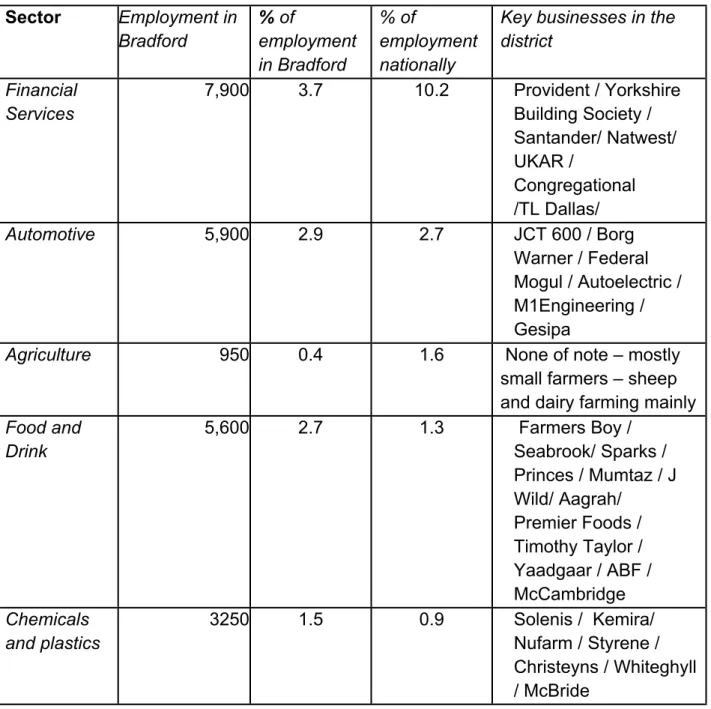
A report in 2018 by Oliver Wyman found that over three quarters of the impact of Brexit will be shouldered by only five sectors (Financial Services, Automotive,
The implications for Bradford businesses may not be the same as national trends (for example, our local financial services sector tends to serve a domestic market
UKAR /
- As our Economic Strategy points out, Bradford is home to enterprising and creative people and strong and productive businesses and we are one of the
- More specifically, as part of Bradford Council’s work in preparation for Brexit, we are engaging with partners such as the Chamber of Commerce to gain a better
- The Chambers of Commerce have developed a Brexit preparedness toolkit and we are raising awareness of this and the Home Office toolkit on the settlement
- The Local Economic Partnership has put in place a range of support to help businesses and the regional economy adapt to the economic conditions post
- We are working with NHS partners, and others on the health and social care workforce, as there are already labour shortages in this sector (regardless of
- In the short term, the Department of Health and Wellbeing and Children’s Services are planning to work with NHS and other partners to ensure that the
- It was agreed at the Integration and Change Board Meeting, on the 15 th
- Supporting Bradford Residents Directly Affected by The EU Settlement Scheme
- The demographic profile of Bradford means that there are large numbers of people within our community who are directly affected by the Settlement
- A Settlement Scheme Working Group has been established. Colleagues from across the Council are working through our commissioned services, as well as in
- As a Corporate Parent, the Council is responsible for securing the settled status of any eligible Looked After Children (LAC). We have begun to identify how many
- The feedback from the Community Engagement Event, together with discussions in the Council’s Brexit Steering Group and consultation with partners in the health
- As recommended by Corporate Overview and Scrutiny Committee, this funding should be focused on supporting vulnerable residents through the process of
The purpose of this county-wide message will be to encourage EU residents in the county to apply. Community hubs and outreach support are vital in ensuring that groups can access information and get support.
Amount
Purpose of money and rationale OCX £30,000 Supporting on-going corporate work co-
- Funding and Public Finances What are the potential issues?
- If these forecasts are correct, the contraction in the UK economy will lead to a reduction in tax receipts and potentially the funding available for Local
- Any short or long term supply constraints in the event of a no deal Brexit may also increase the cost of delivering Council services
- Preparations for Brexit are delaying decisions on national policies which will impact on Local Authorities. This includes finalising the financial settlement for
- Financial risks also arise from the cost of planning for Brexit and from the impact on specific services. This is difficult to model both because the type of Brexit the
- As part of the Local Government Finance Act, the Section 151 officer is required to determine the robustness of the budget and the adequacy of the level of the
- As noted earlier, the Government announced, on the 28 th January, that they would make additional funds available to help Local Authorities prepare for
- Supply Chain Disruption What are the potential issues?
- Whilst the risk is currently low, there have been some suggestions that some supply chain issues might occur in a no deal Brexit. The most immediate issues
- The Civil Contingencies Act 2004 requires local authorities to make assessments and plans for possible civil emergencies and provide contingency advice to the
- There has already been some activity in parts of the council to identify supply chain risks around a no deal Brexit and appropriate mitigations. This includes
- To ensure that we are considering the impact of Brexit on all areas of business, all Assistant Directors in the authority have been commissioned to assess risks
- As the uncertainty around Brexit continues, the Council is preparing for an increase in demands for guidance, advice and reassurance, and for media
- We are working to develop how we can use ward networks, provide briefing and support to members in responding to questions on Brexit, and provide scripts for
The impact of a general economic slowdown due to a number of potential effects: labor market shortages, company relocations, supply chain difficulties, price increases leading to lower sales and profitability for companies. This will ensure that the municipality can continue to operate key services in the event of an interruption of the fuel supply.
2. 68 Procurement Processes, Regulation and Inspection Systems
This includes the work of facilities management on school meals and other food services, such as community meals; work at the Waste, Fleet and Transport Department.
What are the potential issues?
What are we doing?
- Work with national government is on-going to develop understanding of what will replace the OJEU procurement framework. The government position is that a
- The Council is undertaking a review of existing contracts with EU providers
- As noted above, existing contracts that cover critical supplies essential to continuing service delivery are being reviewed to assess resilience to supply
- Communications and Community Leadership What are the potential issues?
- If the current levels of uncertainty continue, we are expecting an increase in demand for advice and guidance services and leadership, as business,
- The Council is preparing for an increase in demands for guidance, advice and signposting services. This will cover all the key issues identified earlier and
- The communications strategy will change and develop as government advice and guidance changes and develops. To date, we have
- As noted in paragraph 2.43, it was agreed at the Integration and Change Board Meeting on the 15 th February, that a common Bradford message needs to be
- As recommended by Corporate Overview and Scrutiny Committee on the 14 th February, a separate report will be written on social cohesion issues raised by
Established weekly reporting to the Cities and Local Growth Unit –YHNE identifying Brexit issues raised by local businesses. This includes signage for guidance and advice pages for EU citizens, local businesses, residents and volunteers and community groups.
3 OTHER CONSIDERATIONS
- Brexit clearly has implications for many of our partners and we are working with them. This includes the following activity
- FINANCIAL & RESOURCE APPRAISAL
- The overall financial and resource implications will depend on which Brexit scenario unfolds
- RISK MANAGEMENT AND GOVERNANCE ISSUES
- Brexit affects all the service provision and governance functions of the Council
- LEGAL APPRAISAL
- OTHER IMPLICATIONS 1 EQUALITY & DIVERSITY
- The full impact of Brexit on protected groups is unknown and will, in part, depend on the type of Brexit
- SUSTAINABILITY IMPLICATIONS 1 These are unknown, as yet
- GREENHOUSE GAS EMISSIONS IMPACTS 1 None directly arising from this report
- COMMUNITY SAFETY IMPLICATIONS
- We are working with the Police and the Local Resilience Forum to understand and mitigate for any potential threats that might arise
- HUMAN RIGHTS ACT 1 None directly arising
- TRADE UNION
- Will be consulted, where necessary, in relation to workforce issues
- WARD IMPLICATIONS
- Unknown, as yet, but neighbourhood teams will play a role in monitoring area impacts and offering guidance and advice where necessary
- AREA COMMITTEE ACTION PLAN IMPLICATIONS (for reports to Area Committees only)
- None directly arising from this report
- IMPLICATIONS FOR CORPORATE PARENTING
- Identified in section 2 in relation to Looked After Children
- ISSUES ARISING FROM PRIVACY IMPACT ASSESMENT 7.11 None arising
- NOT FOR PUBLICATION DOCUMENTS 1 Not applicable
- OPTIONS 1 Not applicable
- RECOMMENDATIONS
- That the engagement with regional and national partners emphasises the specific support needs of our citizens, given our socio demographic profile
- That the Committee approve the proposed allocation of the additional £210, 000, as outlined in Table 2, below
CVS sector - we attended a CNet event on Brexit and are working with the VCS alliance on issues related to Brexit. Bradford University – we regularly consult with the university on the implications of Brexit for the labor market and research;
Amount Purpose of money and rationale OCX £30,000 Supporting on-going corporate work co-
- That a clear message that Bradford is a place of welcome, proud of its diversity and that this will not change, whatever happens to our relations with other
- That further community engagement events are held to monitor the impact of Brexit, identify emerging issues and plan and implement actions
- That the Council continue to support its staff through settled status
- That the Council continues to ensure that Looked After Children, and EU foster carers, are supported through settled status
Report of the Interim Strategic Director of Children's Services to the Executive Committee meeting.
Report of the Interim Strategic Director of Children’s Services to the meeting of Executive Committee to be
Subject
DETERMINATION OF PRIMARY AND SECONDARY ADMISSION ARRANGEMENTS
Summary statement
This report asks the Executive to determine the admission arrangements for September 2020 including
Portfolio
Education, Employment and Skills Report Contact: Marium Haque
Overview & Scrutiny Area
Children’s Services
SUMMARY
BACKGROUND
Admission Arrangements
- All schools must have admission arrangements that clearly set out how children will be admitted, including the criteria that will be applied if there are more applications
- The Local Authority is the admission authority for community and voluntary
- When changes are proposed to admission arrangements, all admission authorities must consult on the admission arrangements that will apply for admission
- The only proposed change to admission arrangements for community and voluntary controlled schools, is to extend the priority of previously looked after children to
- The admission arrangements for community and voluntary controlled primary schools for 2020/21 are shown in Appendix B. Appendix C shows the admission
- Published Admission Numbers (PANs) for Primary and Secondary Schools for entry in September 2020 are shown in Appendix G
OTHER CONSIDERATIONS
- Own admission authority schools
Primary Schools and Academies
Academies
- Schools receive funding through the Fair Funding Formula which allocates funding to schools based on the number of pupils attending the school
- The Local Authority is the admission authority for community and voluntary
- The School Standards and Framework Act 1998, and associated regulations, required admission authorities to determine the admission arrangements on an
- In accordance with the School Admissions Code 2014, when changes are proposed to admission arrangements for entry in September 2020, the admissions authority
- All admission authorities must determine their admission arrangements even if there have been no changes and no consultation has taken place. Admission
- Admission Authorities must set a PAN for each ‘relevant age group’ when determining their admission arrangements
- Own admission authorities are not required to consult on their Published Admission Numbers (PAN) where they propose to either increase or keep the same PAN. For
- Each year all local authorities must formulate and publish on their website a scheme by 1 January in the relevant determination year to co-ordinate admission
- Under section 14 of the Education Act 1996, the Local Authority has a statutory duty to provide sufficient school places for all pupils in its area
- SUSTAINABILITY IMPLICATIONS There are no sustainability implications
- GREENHOUSE GAS EMISSIONS IMPACTS
- HUMAN RIGHTS ACT
- ISSUES ARISING FROM PRIVACY IMPACT ASSESMENT
- NOT FOR PUBLICATION DOCUMENTS None
- OPTIONS
- Extend Priority of previously looked after children
- That the Executive approve the extension of the category of previously looked after children in the oversubscription criteria to include previously looked after children
- That the Executive approve the Primary and Secondary Admission Arrangements
- That the Executive approve the Primary and Secondary Co-ordinated Admissions Scheme
- That the Executive approve the In-Year Co-ordinated Admissions Scheme
- That the Executive note the proposed changes to admission oversubscription criteria for own admission authority schools listed in section 3.2
- That the Executive note the Published Admission Numbers contained in Appendix
- APPENDICES
- BACKGROUND DOCUMENTS School Admissions Code 2014
Voluntary aided, foundations, trust schools and academies are responsible for determining their own admissions arrangements. Annex C: Admission schemes for primary schools Annex D: Coordinated admission scheme for primary schools 2020/21 Annex E: Coordinated admission scheme for upper secondary schools 2020/21 Annex F: Yearly coordinated admission scheme for 2020/21.
Admission Arrangements for
Community and Voluntary-Controlled Primary Schools 2020/2021
ENTITLEMENT
PUPILS WITH AN EDUCATION, HEALTH AND CARE PLAN
TIE BREAK
MULTIPLE BIRTHS
ADMISSION POLICIES
Schools with Priority Admission Areas
Addingham, Ben Rhydding, Cottingley Village, Eldwick, Long Lee primary schools
- Children who have exceptional social or medical needs, supported by a written recommendation from the child’s paediatrician/consultant or professional from
- Children whose home address is outside the school’s priority admission area
- All other community schools and All Saints CE (Bradford)
- Bowling Park Primary School (Community School) Application Procedure
4 Siblings of children living at the same address who are currently enrolled in school and will still be attending school at the time of admission (see note 3). C) Bowling Park Elementary School (Community School) ) Application Process Application Process. Bowling Park Primary School operates from two sites: 60 places at the New Cross Street site and 30 places at the Usher Street site. Parents must indicate which site they are applying for by naming the site on the common online application form using
Where the number of preferences for any site exceeds the number of available places on that site, the oversubscription criteria below will first be applied in relation to that site to determine which applicants for that site will be offered places.
Oversubscription Criteria
Late and refused applications and in-year admissions
Appeals
Voluntary-controlled Church of England schools The admission criteria below apply for the following schools
- Looked after children or children who were previously looked after but ceased to be so because they were adopted or became subject to a residence or special
- Children who were Previously Looked After Children outside of England and Wales who were adopted (see Note 2)
- Sisters and brothers of children living at the same address who are at present on roll at the school and will still be attending the school at the time of admission (see
- Children of parents who are members* of the Church of England or other Christian denominations for whom the preferred school is the nearest Church of England
- Other children
All Saints CE Primary School (Ilkley) - voluntary-controlled
- Looked after children or children who were previously looked after but ceased to be so because they were adopted or became subject to a residence or special
- Children who were Previously Looked After Children outside of England and Wales who were adopted (see Note 2)
- Siblings of children resident at the same address who are at present on roll at the school and who will still be attending the school at the time of admission
- Up to 50% of the remaining places will be allocated to the children of parents who are practicing members of the Church of England or other Christian
- Remaining places will be allocated to other applicants
Siblings of children residing at the same address who are currently attending school and who will continue to attend school at the time of admission. the school and who will continue to attend the school at the time of admission. Up to 50% of the remaining places will be allocated to children of parents who are practicing members of the Church of England or other Christians who are practicing members of the Church of England or other Christian faiths for which All Saints C of Primary Ilkley School is the nearest Church of England school to the home address in the following order of priority. refer to the notes below for additional information*) a. Where demand exceeds places for any of the above criteria, the shortest distance between home and school, measured in a straight line from the main entrance of the home to the main entrance of the school building, will be used to decide who is given to a place.
The supplementary information form is available from the school or the Local Authority and must be returned to the school by the closing date.
NOTES
- A ‘looked after child’ is a child who is in the care of the local authority, or being provided with accommodation by a local authority in the exercise of their social
- A ‘previously looked after child’ is a child who has been in ‘state care’ outside of England and Wales, accommodated by a public authority, a religious organisation
- In order to meet this criterion, parents will be required to complete a Supplementary Information Form (SIF) (attached), signed by their Vicar or Church Leader,
- Proximity to school is used as a tie-breaker, those living closest being given priority
- Multiple Births – where the parents of children of multiple births (twins, triplets etc) request admission and only one of the siblings can be offered a place, the
To meet this criterion, parents must complete a Supplemental Information Form (SIF) (attached) signed by their pastor or church leader, and an Information Form (SIF) (attached) signed by their pastor or church leader. This requires the personal involvement of the family, including the child for whom the application is made, in the worship and life of a Church of the Church of England, or that of any member of the Churches Together in Great Britain and Ireland, or any other recognized Trinitarian church. Church. Nearest Church of England School” is measured as the distance in a straight line from the main entrance of the house to the main entrance of the nearest Church of England primary school, including those of other local authorities.
Multiple births - when parents of multiple children (twins, triplets, etc.) apply for admission and only one of the siblings can be offered a place, they apply for admission and only one of the siblings can be offered a place.
Admission Arrangements for Community Secondary Schools
A 'looked after child' is a child who is in the care of a local authority, or who is provided with accommodation by a local authority in the exercise of their social services functions. A previously 'looked after child' who is no longer looked after in England and Wales because he/she is the subject of an adoption, special care or child arrangement order, which includes arrangements about who will long live the child. A 'previously looked after child' who has been in 'state care' outside England and Wales, accommodated by a public authority, a religious organization or any other organization whose sole or main purpose is to benefit society and legally adopted.
Year 11 students currently at the school can continue to Year 12 where entry requirements are met.
Co-ordinated Admission
Scheme for the Bradford Metropolitan District Area
- INTRODUCTION
- APPLYING FOR A SCHOOL PLACE
- PROCEDURE Stage 1
- LATE APPLICATIONS AND CHANGES OF PREFERENCE
- WHERE PREFERENCES CANNOT BE MET
- WAITING LISTS Community schools
- RIGHT OF APPEAL
- IN-YEAR APPLICATIONS AND TRANSFERS
- FAIR ACCESS PROTOCOL
Parents must apply online, except in exceptional circumstances where a paper form will be available through the admissions team. By Friday, February 14, 2020, the Admissions team will forward the preferences (including those of unauthorized students) to their own schools with admissions authority for them to apply. Any form received by primary schools after the deadline must be date stamped and returned to the admissions team as soon as possible.
The Admissions Team will maintain waiting lists for all community and voluntary controlled schools until the end of the 2020-2020 academic year.
PRIMARY SCHOOL ADMISSIONS TIMETABLE 2020-2021
WAITING LISTS
Waiting lists must be maintained for all schools until 31 December 2020 in accordance with the Code of Practice. The Admissions Team will manage waiting lists for all community controlled and voluntary schools until the end of the 2020-2021 academic year. Parents can request that their child be placed on a waiting list for any school they are registered for.
By agreement, the Admissions Team will maintain waiting lists for voluntary aided, foundation, trust schools or academies, if requested to do so.
FAIR ACCESS PROTOCOL
SECONDARY SCHOOL ADMISSIONS TIMETABLE 2020-2021 Application process opens
September 2019
In-year Co-ordinated
Admissions Scheme & Mid Term Transfer Policy For applications and mid-term transfers during
APPLICATION FORMS
- Applications for community and voluntary-controlled schools
- Applications for own admission authority schools for whom the LA co-ordinates admissions
- Applications for Catholic schools and other own admission authority schools dealing with their own in year admissions
If there is only one place available or there is a waiting list, the school must contact the Admissions Team to find out if there are other applicants waiting to be processed. This will happen within 7 school days of receiving the application and where the school is ranked higher than a community or voluntary run school that could be offered. Parents will be informed of the outcome of their application either by the relevant authority or the applied school.
The Admissions Team maintains waiting lists for all year groups for community and voluntary controlled schools until the end of the school year in which the application is received (for primary schools) and the end of the school year (for secondary schools).
BRADFORD LA IN-YEAR CO-ORDINATED ADMISSIONS SCHEME
Pupil Mid-Term Transfer Policy
- Introduction
- Background
- Legal Framework
- School Transfer Process
- Exceptions
- Information for parents
For all applications, parents should ask the Head of Year or a member of the Senior Leadership Team at the child's current school to complete part two of the application form. If the preferred school has places in the correct year group and the school does not refer the application through the Fair Access process, the admissions team will inform parents that a place has been allocated and arrangements can be made for admission to take place on the beginning of the next school year. For pupils with an Education, Health and Care (EHCP) plan, any change of school must be made through an assessment of the EHCP by the school/SEN team.
Guidelines accompanying the 'in-year general application form' inform parents of the adverse effects that changing schools has on their child's progress and that such decisions should not be made without careful consideration.
Secondary School Published Admission Numbers (PANs)
2 Section 1: What is being assessed?
Name of proposal to be assessed
Describe the proposal under assessment and what change it would result in if implemented
3 Section 2: What the impact of the proposal is likely to be
- Will this proposal advance equality of opportunity for people who share a protected characteristic and/or foster good relations between people who
- Will this proposal have a positive impact and help to eliminate discrimination and harassment against, or the victimisation of people who share a protected
- Will this proposal potentially have a negative or disproportionate impact on people who share a protected characteristic? If yes, please explain further
- Please indicate the level of negative impact on each of the protected characteristics?
- How could the disproportionate negative impacts be mitigated or eliminated?
The Equality Act 2010 requires the Council to take due account of the need to. to eliminate unlawful discrimination, harassment and victimization;. promote equality of opportunity between different groups; and. to cultivate good relations between different groups.
4 Section 3: Dependencies from other proposals
Please consider which other services would need to know about your proposal and the impacts you have identified. Identify below which services you
5 Section 4: What evidence you have used?
What evidence do you hold to back up this assessment?
Do you need further evidence?
6 Section 5: Consultation Feedback
Results from any previous consultations prior to the proposal development
Feedback from current consultation following the proposal development (e.g
Report of the Interim Strategic Director of Children's Services to the Executive Committee meeting to be Services to the Executive Committee meeting to be held on 5 March 2019.
PROPOSED REDUCTION OF PUBLISHED ADMISSION NUMBER AT PRINCEVILLE PRIMARY SCHOOL
This report asks the Executive to
- Proposal to reduce the Published Admission Number at Princeville Primary School
- When planning primary school places in Bradford, the District is split into 26 primary school planning areas. Princeville Primary School is situated in the South West 4
- Funding received by schools is directly related to the number of pupils attending the school. Too many vacancies mean that schools do not receive the maximum
- Data received from the NHS shows that the number of younger children living in this area who will require a school place in the coming years is lower than the
- There are a number of housing developments in the South West 4 planning area that had received planning permission but have not materialised. One is now a
- Consultation to reduce PAN at Princeville Primary School
- In line with the School Admissions Code, consultation to reduce the PAN at Princeville Primary School from 90 to 60 from 1 September 2020 was carried out
- A total of 2 responses were received, see comments and summary in Appendix C
- Schools receive funding through the Fair Funding Formula which allocates funding to schools based on the number of pupils attending the school. Bradford Council
- All Admission Authorities must consult in accordance with paragraph 1.42 of the School Admissions Code where they propose to lower a school’s PAN
- Under section 14 of the Education Act 1996, the Local Authority has a statutory duty to provide sufficient school places for all pupils in its area. Page 65
- Princeville Primary School
- That the Executive approve the proposal to reduce the Published Admission
Approve the reduction in the published admission numbers at Princeville Primary School from 90 to 60 from 1 September 2020. Unions have been informed of the proposal to reduce the PAN at Princeville Primary School. Ward councilors have been consulted on the proposed change to the PAN at Princeville Primary School.
Appendix A: Sample consultation letter for reduction of PAN at Princeville Primary School Appendix B: List of consultees.
Department of Place Education Client Services
Statutory consultation on the proposed reduction in Published Admission Number for Princeville Primary School for the 2020/21 academic year
Bradford Council, as the Admissions Authority, is therefore seeking comments on the proposed change to the PAN for Princeville Primary School in South West Planning Area 4. Bradford Council is proposing to reduce the PAN at Princeville Primary School from 90 to 60 from September 2020. Consultation on reducing the published primary name acceptance number Princeville Schools (optional).
I agree with the proposal to reduce the number of admissions at Princeville Primary School from 90 to 60.
List of Consultees Director/ADs Children's Services
School
Responses agreeing with the proposal to reduce the PAN
In response to this comment
Consultation has been held to gauge views on the proposal to reduce the published admission number (PAN) at Princeville Primary School from 90 to 60 from 1 September 2020. Note: Legislation and best practice require mitigations to be taken into account, but only need to be considered. places if possible). Please indicate below which services you have accessed, and any resulting additional equality impacts that have been identified.