QUEST Project Progress Report 2 Issue: V0.1
Submission Date: 8 th December 2022
VERSION HISTORY
Version Date Author Status Comments
V0.1 15/11/21
Maurice Lynch Programme
Manager
First Draft
V1.0 08/12/2022
Maurice Lynch Programme
Manager
Final
Amendments based on feedback back from internal
review.
REVIEW
Name Role Date
Elizabeth Pattison Discretionary Funding
Manager 01/12/2022
APPROVAL
Name Role Signature & date
Maurice Lynch Innovation Programme
Manager
Victoria Turnham Head of Network Innovation
08.12.22
08.12.22
CONTENTS
1 EXECUTIVE SUMMARY 4
1.1 The Project 4
1.2 Project progress 4
1.3 Risks 5
1.4 Learning and dissemination 6
2 PROJECT MANAGER’S REPORT 6
2.1 Project background 6
2.2 General 7
2.3 QUEST deliverables competed in this reporting period 8
2.4 Customer workstream 9
2.5 Learning and dissemination workstream 9
2.6 Project trial and test area 10
3 BUSINESS CASE UPDATE 11
4 PROGRESS AGAINST PLAN 11
5 PROGRESS AGAINST BUDGET 12
6 BANK ACCOUNT 12
7 PROJECT DELIVERABLES 12
8 LEARNING OUTCOMES 14
9 INTELLECTUAL PROPERTY RIGHTS (IPR) 15
10 RISK MANAGEMENT 15
11 CONSISTENCY WITH FULL SUBMISSION 15
12 ACCURACY ASSURANCE STATEMENT 15
13 APPENDICES 16
Appendix A: Status of current project risks 16
Appendix B: Project deliverables 21
Appendix C: Project direction budget 23
Appendix D: Detailed project expenditure 25
Appendix E: Project bank account 26
Appendix F: QUEST communications register 27
Appendix G: Glossary of terms 30
Appendix H: Whitegate GSP geographical network area 31
1 EXECUTIVE SUMMARY
1.1 The Project
For the purposes of this report, “the project” refers to the Network Innovation Competition (NIC) funded project, “QUEST” refers to the overarching system, and the “optimisation software” refers to the software used to enable QUEST.
The project officially started in April 2021 and is due to finish in April 2025. It will identify and trial novel methods to holistically integrate multiple, concurrent system voltage control and optimisation techniques across the whole distribution system. The method will be integrated into the NMS (Network Management System), thus providing the full co-ordination needed to unlock the available benefits.
In addition, the new holistic voltage control methodology will:
Ensure the network operates as efficiently as possible, optimising the system voltage to connected customers and minimising losses.
Further boost the benefits available from existing voltage management techniques.
Facilitate the increased connection and use of LCTs.
Maximise benefits to all customers through demand reduction at High Voltage (HV) and Low Voltage (LV).
Explore the potential of reactive power absorb in supporting NG flexible services.
By providing a means of command arbitration, the optimisation software will ensure that potential clashes are avoided, and overall benefits are maximised through co-ordination of previously discrete techniques. Furthermore, the project will provide a solid foundation upon which issues associated with conflict resolution, i.e. independent activation of Distributed Energy Resources (DERs), can be addressed.
The project will explore the co-ordinated operation of voltage management techniques to enable a reduction of the built-in operating margins, creating capacity for our customers. The project will also develop and introduce a distribution network-wide, fully co-ordinated,
overarching system to manage voltages, with an appropriate balance between centralised and decentralised control hierarchy. It will also allow for network forecasting for the different voltage control techniques by implementing an operational digital twin of the trial network to ensure network objectives are for filled for example compliance within settlement services.
1.2 Project progress
This is the second annual project progress report (PPR). This report covers the period from 9th December 2021 to 9th December 2022.
The project is currently on track to meet its aims, objectives and successful delivery of all deliverables as per the project plan.
Figure 1.2.1: Project milestones delivered in this reporting period
Date Milestone
31/12/21 Submission of the QUEST second deliverable
“QUEST System Design and Architecture Lessons Learned”
10/05/22 Delivery of the QUEST Industry Steering Group (ISG) 03 with other DNO organisations
30/06/22 Submission of the QUEST third deliverable
“QUEST Trials, Design and Specification Report”
13/07/22 Delivery of the second annual face-to-face project partners meeting 15/08/22 Enhancement of QUEST website in March 2021
19/09/2022 Commencement of on-site works in QUEST trial and test area, due for completion in March 2023
29/09/22 QUEST presentation at Energy Innovation Summit, Glasgow
28/10/22 Approval of the QUEST HLD (High Level Design) for integration into live NMS system by ENWL design authority
30/11/22 Delivery of the QUEST ISG 04 with other DNO organisations
The second and third project deliverables were due in this reporting period.
The second project deliverable, “QUEST System Design and Architecture Lessons Learned”, is a report detailing the review of architecture options based on the QUEST use cases
developed within the first deliverable. It also specifies the network models and modelling regime for the voltage control methodology described in the QUEST use cases. This report was successfully submitted to Ofgem on 31 December 2021 and published on Electricity North West’s (ENWL’s) QUEST project website.
The third project deliverable, “QUEST Trials, Design and Specification Report”, details the chosen architecture and voltage control methodology for the project and also outlines the trial design and detailed site design selected for the QUEST trials and tests. This report was successfully submitted to Ofgem on 30 June 2022 and published on ENWL’s QUEST project website.
The project team has also started work on the fourth deliverable, “QUEST Interim Report - System Design and Technology Build Lessons Learned”, due for submission on the 30 June 2023. This is progressing well and will be delivered within the specified time scales.
The project actual costs to date (end-Nov) are £2,955,022 and the estimated at completion cost is now £9,098,093 which is to project budget (including contingency).
1.3 Risks
There have been a number of changes to the risk log since the last reporting period, the most significant is the addition of two new risks, described below.
R030 - Cloud ANM Integration (new risk) – raised 18/03/22
It has been identified that there could be issues implementing Cloud ANM with the trials due to ENWL’s security platforms. This came to light after an increase in cyber security attacks on ENWL’s network. Energy operators across the UK have seen an increase in this type of attack due to current events within Ukraine and Russia.
Mitigation
The ENWL enterprise architects have worked closely with our Cloud ANM project partner to come up with a secure IT HLD (High Level Design) that allows the successful integration of Cloud ANM into the QUEST optimization software. This proposal was put before the ENWL design approval panel and was signed off; hence this risk rating has now been lowered.
R031 - Project Partner Recourse Issues – (new risk) – raised 05/09/22
Two project partners have lost key technical personnel. This presents a real challenge as new members of the partners’ teams will require training and an overview of the work done and project learning established to date.
Mitigation
ENWL will conduct additional learning and dissemination sessions to support all new team members in getting up to speed with the project. In addition, all key decisions and project learning will be documented in an internal log that will be shared with all partners, thus allowing new team members an up-to-date overview of the project.
An up-to-date log showing the status of all current project risks is included in Appendix A.
1.4 Learning and dissemination
The QUEST project team has participated in a number of learning and dissemination events in this reporting period, the key events are:
Third ISG meeting held in May with other DNO organisations
Post about QUEST project progress on LinkedIn in June
Second annual QUEST project partners away day in July
Updates to QUEST website launched in August
Presentation on QUEST at ENA’s Energy Innovation Summit in Glasgow in September
Fourth ISG meeting held in November with other DNO organisations
2 PROJECT MANAGER’S REPORT
2.1 Project background
To cater for the subsequent increase in electricity demand and generation caused by decarbonisation targets, DNOs have investigated and deployed techniques such as Customer Load Active System Services (CLASS), Smart Street and Active Network Management (ANM). Whilst these systems have proven successful in helping DNOs to manage the network, they do have limitations. For example:
They are often applied in isolation of one another and do not operate in a co-ordinated manner.
It is possible that one technique could counteract another, resulting in reduced effectiveness and potentially failing to maintain operation within acceptable limits.
They use worst-case planning assumptions, which build in large safety margins, resulting in operation below the theoretical maximum.
They require a resilient communications infrastructure at all times and are set up to fail safe. Therefore, if there is a communications failure any voltage optimisation or ANM benefit is significantly reduced or removed.
The QUEST project will aim to integrate the above voltage optimisation systems into one overarching, co-ordinated and optimised system, with appropriate balance between centralised (global) and decentralised (zone) control hierarchy. This will enable voltage optimisation for the whole distribution network. By viewing and controlling the whole network, QUEST will co-ordinate the often-competing objectives of these existing systems to ensure optimised operation whilst maximising benefits for customers. In addition, the QUEST software will allow demand and generation to automatically self-adjust in response to changing voltage requirements, creating an innovative, self-regulating distribution network.
QUEST optimisation software is the overarching software system that has the ability to control other individual systems on the network, i.e. Enhanced AVC including CLASS, Smart Street and ANM. These systems provide voltage control, thermal constraint management and demand control. Where appropriate, the QUEST Voltage Optimiser will optimise system voltages to provide additional benefits, for example, through reduction of system losses.
2.2 General
This is the second reporting period and progress is currently in line with the project plan.
ENWL has completed three of the nine project deliverables. The QUEST architecture and voltage control methodology requirements have been finalised and the project is now in its development phase, which is on track for completion in March 2023.
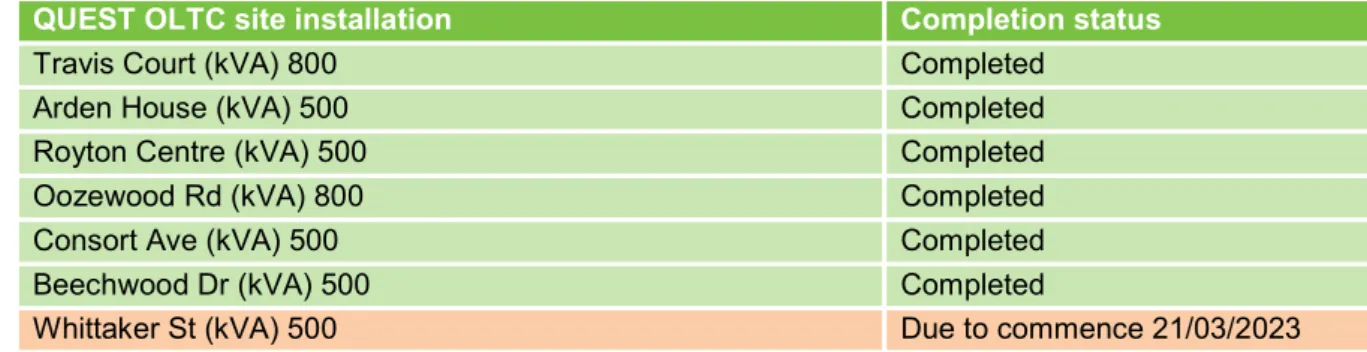
The on-site work activities are progressing well, with six out of the seven Smart Street On- Load Tap Changers (OLTCs) installed on the single distribution circuit out from Royton primary. The remaining OLTC is due for installation in March 2023. The Automatic Voltage Control (AVC) installation at the non-CLASS primaries and BSPs are progressing to plan. At present, 10 of the 20 transformer AVC upgrades have been completed, with the remaining 10 due for completion in March 2023.
The key project management activities undertaken during this reporting period are summarised below:
Finalising the architecture and voltage control requirements: The first three project deliverables have focussed on the architecture and voltage control requirements for the QUEST control software. Now that this is completed, the team are focusing on
developing control application based on these requirements.
Commencement of on-site works for QUEST trials and tests: Two separate streams of site activity have commenced. The first, the installation of the Smart Street OLTCs on the single distribution feeder out from Royton primary, is progressing well, with only one site to be completed. The second, the upgrade of AVC functionality at nine non-CLASS primaries and BSPs, is also well underway, with nearly half of all sites completed. Once these works, work will commence on the feeder monitoring upgrades at the three primary sites with connected generation.
Project monitoring and control: Processes for the monitoring and control of project delivery have been followed throughout this reporting period. These processes build on those developed during previous NIC projects to ensure that the project progresses in a controlled manner and that outputs are of the highest quality.
Regular engagement with project partners: The ENWL project team held weekly progress update meetings with the project partners. Additionally, bi-annual project steering groups including key stakeholders from other DNO organisations have taken place.
2.3 QUEST deliverables competed in this reporting period
As mentioned in section 1, there were two QUEST deliverables completed within this reporting period: “QUEST System Design and Architecture Lessons Learned” and “QUEST Trials, Design and Specification Report”.
These reports were delivered using the same approach. Individual workstreams were broken up into separate elements, each led by individual project partners who were also responsible for leading weekly update meetings for their workstream. This approach worked well as it provided accountability for each partner and ensured all project partners had visibility of progress and outstanding works. ENWL provided governance for all workstreams to ensure they remained in line with objectives and project direction.
2.3.1 QUEST System Design and Architecture Lessons Learned This deliverable consisted of two separate workstreams.
Review of architecture options: This work was led and delivered by Schneider Electric (SE) and was based on review of the different use cases developed in the first deliverable, with the aim of proposing a range of different architecture options that could fulfil the functionality and requirements outlined in the use cases. The output of this report was the Architecture Options report, with a recommended proposed architecture that could for fill the scenarios outlined in the use cases.
Specification for the network models and modelling regime: This work was led by Smarter Grid Solutions (SGS), which was tasked with reviewing ENWL’s power system network models of where trials will be carried out and also developing these models based on the scenarios outlined within the use cases.
2.3.2 QUEST Trials, Design and Specification This deliverable consisted of four individual workstreams.
Functional specification for chosen architecture: This work was led by SE and follows on from deliverable two, further defining the chosen architecture to be developed for the trials and test phase of the project. It also details the QUEST
software requirements to allow the enterprise architects to begin development work on the chosen architecture.
Functional specification for voltage control methodology: This work was led by SGS and follows on from the previous deliverable 2. This work was critical to the development of the architecture as it proves that the scenarios outlined within the use cases, and which dictate the design, were achievable and the chosen architecture would work correctly from a modelling perspective.
Trial design: This work was led by SE and its purpose was to provide a detailed overview of the testing strategy that will be applied during the QUEST trials. It
produced a document that provides a high-level description of the use cases and will be used to assess QUEST functionality during the trials.
Detailed site design: This was the final workstream of this deliverable and was led by Fundamentals. It details the site surveys carried out and works required to prepare sites for the QUEST trials and tests. In total, there were nine BSPs and primaries that required AVC upgrades, and some also required enhanced feeder monitoring. This report provides an overview of the work to be carried out and details why these upgrades are required.
2.4 Customer workstream
The customer workstream has not advanced since the last PPR1, as the customer element of the project is not scheduled to commence until March 2023.
The Customer Engagement Plan (CEP) was completed during the last reporting period, on 26 July 2021, and was uploaded on the QUEST website shorty after. This plan sets out the research strategy within the project to support, explore and understand the answers to the following questions:
Do customers notice when project trials and tests are applied, and, if so, how?
Are the operating characteristics of various generators and sensitive customers affected by the optimisation software and, if so, how and in what circumstances?
Are there any special requirements in respect of the supply voltage for certain customer types?
What are the impacts of voltage profiling on generator customers?
What is the appetite amongst customers for voltage-driven, self-managed connections, particularly for generators and/or large demand customers?
This document will outline to customers what existing and future systems are doing to further optimise the running arrangement of the network, and what customers need to do to ensure they are not affected if they have voltage sensitive equipment.
2.5 Learning and dissemination workstream
The QUEST project team has participated in a number of learning and dissemination events in this reporting period, the key events are:
Third ISG meeting held in May with other DNO organisations
Post about QUEST project progress on LinkedIn in June
Second annual QUEST project partners away day in July
Updates to QUEST website launched in August
Presentation on QUEST at ENA’s Energy Innovation Summit in Glasgow in September
Fourth ISG meeting held in November with other DNO organisations
The QUEST communications register that details all communications during this reporting period is available in Appendix F.
One key learning point from this reporting period comes out of the introduction of the Yield Summary within the QUEST dashboard as seen in section 4. When discussing future user operability with project partners and industry stakeholders a strategic overview of the QUEST system outputs was highlighted as essential. The Yield Summary dashboard will present the output of QUEST coordination and demonstrate in real time the benefits of QUEST. The Yield Summary dashboard will present the benefits of QUEST using a simplified dashboard;
including on customer energy saving, carbon reduction, and demand management. This
dashboard will enhance the operator and stakeholder understanding of the QUEST impact on the network allowing for greater focus in real time on key metric areas outlined above.
There has been additional unforeseen complexity in developing the dashboard and has required additional time and resource by the architecture development partner SE. This is a risk that was highlighted within the QUEST risk register in Appendix A, which means that additional funding may be required from the contingency budget to ensure successful delivery of the QUEST control system and dashboard. The extent of the additional cost and time of this risk is not yet known but will be outlined and detailed in the next project progress report.
In the next reporting period, the learning and dissemination workstream will undertake the following activities:
Publicise QUEST project in an engineering industry magazine
Submit a paper on QUEST to CIRED 2023 in the Planning of Power Distribution Systems category
Submit a paper on QUEST to CIRED 2023 in the Protection, Control & Automation category
2.6 Project trial and test area
As confirmed in the last reporting period, Whitegate GSP was identified as the site to be used for the QUEST trials and tests. Whitegate GSP was selected because it provides a range of demand types: from highly commercial to dense urban, suburban and semi-rural areas. In addition to the usual domestic and commercial customers, there are a number of larger HV-connected customers, such as hospitals and a large semiconductor factory. A map of the geographical network area of Whitegate BSP is available in Appendix H.
Within this reporting period, significant development has been carried out in the Whitegate trial area. This includes upgrading the AVC controls at nine non-CLASS BSPs and primaries and installing six of seven Smart Street OLTCs on single circuit that feeds out from Royton primary, in addition to also upgrading the feeder monitoring at three primaries where there is HV generation connected. Tables 2.6.1 and 2.6.2 provide an overview of the work completed to date and still outstanding.
Table 2.6.1 BSP and primary substation AVC upgrades
QUEST on site works Completion status
Chadderton BSP GT1 & GT2 Completed
Greenhill BSP GT2 & GT3 Completed
Greenhill Primary T11, T12 & T13 Completed
Newton Heath T11 Completed
Werneth T11 & T12 Completed
Redbank BSP GT2 & GT3 Due to commence 16/12/2022 Ancoats North T11, T12 & T14 Due to commence 03/02/2023 Cannon Street T11, T12 & T13 Due to commence 24/02/2023 Royton BSP GT1 & GT2 Due to commence 17/03/2023 Feeder Monitoring Site Upgrades
Failsworth Primary S/S (Feeder Monitoring Upgrades) Due to commence 21/03/2023 Chadderton Primary S/S (Feeder Monitoring Upgrades) Due to commence 24/03/2023
Langley Primary S/S (Feeder Monitoring Upgrades) Due to commence 29/03/2023
Table 2.6.2 Smart Street OLTC installation
QUEST OLTC site installation Completion status
Travis Court (kVA) 800 Completed
Arden House (kVA) 500 Completed
Royton Centre (kVA) 500 Completed
Oozewood Rd (kVA) 800 Completed
Consort Ave (kVA) 500 Completed
Beechwood Dr (kVA) 500 Completed
Whittaker St (kVA) 500 Due to commence 21/03/2023
As shown in tables 2.6.1 and 2.6.2, more than 70% of the onsite work has been completed and the project is scheduled to deliver the remaining work by end of March 2023.
3 BUSINESS CASE UPDATE
The project team is not aware of any developments that have taken place since the issue of the QUEST project direction that affect the business case for this project.
4 PROGRESS AGAINST PLAN
The project plan is monitored, reviewed and updated on a continuous basis. This process takes into consideration potential risks that were documented in the full submission and any change to these risks. The process also considers newly identified risks and issues that are highlighted during the project lifecycle.
As outlined above, all project deliverables and activities are on track as per the project plan.
However, there are some points worth noting:
The voltage demand research study was not due for submission until December 2024.
However, this work commenced earlier than planned because it is tied in with
deliverables two and three, and therefore it suited the project to bring it forward. This work was undertaken by SGS, which completed the initial “Present and Future Voltage Demand Load Model” reports. The final stage of this analysis is to feed the QUEST trials and test data into the report so this modelling data can be compared to outputs from the trials and tests.
As referenced in section 2.5, whilst deliverable three was in progress additional time and resource was required for the functionality development within the QUEST architecture build – specifically around the Yield Summary dashboard. This additional work was needed to ensure the that the user would see clearly the impact of QUEST coordination on the network and allow for long term benchmarking of the QUEST approach. The scope of this work sat within SE’s remit as they are responsible for the overall architecture development. Due to the increased complexity, additional time and resource for front-end design and development was required., As this work area is still in progress the overall balance of development time is still not complete but there may be a need for additional funding to complete this task. Any additional requirements will be detailed in the next project progress report.
5 PROGRESS AGAINST BUDGET
The project budget as defined in the project direction is shown in Appendix C.
Actual spend to date compared to project budget is summarised in Table 5.1 below. This report includes expenditure up to and including 30 November 2022.
It will be noted that the project is currently performing favourably, relative to budget. Project expenditure as at the end of November 2022 was £2,955,022 compared to a cost baseline of
£4,620,849.
This variance in project expenditure to baseline cost is due to delayed invoices for onsite works and IT equipment, and due is to hit project budget early next year. Another contributor to the variance is phasing of project contracts, which were set at the beginning of the project and estimated the expected project cost. Taking the above into account, the project is performing well in terms of cost, which is due to a strong commercial and project management governance in place within the project.
Table 5.1: Summary of project expenditure
Detailed expenditure is shown in Appendix D at project activity level.
6 BANK ACCOUNT
The project bank statement is shown in Appendix E. This statement contains all receipts and payments associated with the project up to the end of November 2022.
7 PROJECT DELIVERABLES
There were two deliverables due for submission in this reporting period, “QUEST System Design and Architecture Lessons Learned Report” and “QUEST Trials, Design and
Specification Report”. These reports were submitted to Ofgem on 31 December 2021 and 30 June 2022 and uploaded to the QUEST website.
All deliverables are shown in Table 7.1 below, and deliverables four and five are due in the next reporting period.
Table 7.1: QUEST project deliverables
Reference Project deliverable Deadline Evidence Delivery status
1 QUEST Initial Report -
Use Cases 31/07/2021
Document introducing the Project and detailing the use cases and scenarios.
Submitted to Ofgem on the 30th of July 2021 and also uploaded on to the QUEST website the same day.
2
QUEST System Design and
Architecture Lessons Learned
31/12/2021
Document explaining Project progress including the following outputs:
• Review of architecture options
• Specification for the network models and modelling regime.
Submitted to Ofgem on the 31st of December 2021 and also uploaded on to the QUEST website the same day.
3
QUEST Trials, Design and Specification Report
30/06/2022
Document explaining Project progress including the following outputs:
• Functional specification for chosen architecture.
• Functional specification for voltage control methodology.
• Trial design.
• Detailed site design.
Submitted to Ofgem on the 30th of June 2022 and also uploaded on to the QUEST website the same day.
4
QUEST Interim Report - System Design and Technology Build Lessons Learned
30/06/2023
Document detailing Project progress to date including lessons learned from:
• QUEST software.
development and testing.
• Power system model
development.
• Site installation for the voltage control and ANM equipment.
On track for submission deadline
5
QUEST System Integration Lessons Learned Report
30/12/2023
Document detailing the lessons learned from the installation and commissioning of the QUEST system including system integration and the results of site acceptance testing.
On track for submission deadline.
6 Customer Research
Findings Report 31/10/2024 Document detailing the outputs from the customer research.
On track for submission deadline.
Reference Project deliverable Deadline Evidence Delivery status
7 QUEST Trials and
Analysis Report 30/12/2024
Document detailing:
• Final results from network trials.
• Final results from modelling trials.
• Output from the voltage demand relationship research.
• Any adaptation required to voltage control methodology.
On track for submission deadline.
8 QUEST Final Report 30/04/2025
Report on the conclusion of the QUEST Project including all the lessons learned and detailing the next steps, including BAU transition.
On track for submission deadline.
9
Comply with knowledge transfer requirements of the Governance Document.
End of Project
Annual Project Progress Reports which comply with the requirements of the
Governance Document.
Completed Close Down Report which complies with the requirements of the
Governance Document.
Evidence of attendance and participation in the Annual Conference as described in the Governance Document.
On track for submission deadline.
The current status of the evidence for all project deliverables is shown in Appendix B.
Progress against project deliverables and the project plan will continue to be monitored, and if the current forecast for any project deliverable changes, this will be detailed in future project progress reports.
8 LEARNING OUTCOMES
As this is ENWL’s sixth large-scale innovation project, the project team has been able to review and apply lessons learnt from previous projects. During this reporting period, much of the work has revolved around the second and third project deliverables as per table 7.1, which clarified the architecture design and voltage control modelling regime to take forward for the QUEST trials and tests.
In the next reporting period, it is expected that further learning will be generated after the submission of the next two project deliverables, “QUEST Interim Report - System Design and Technology Build Lessons Learned” due in June 2023 and “QUEST System Integration Lessons Learned Report” due in December 2023.
9 INTELLECTUAL PROPERTY RIGHTS (IPR)
ENWL is following the default IPR arrangements. No IPR has been generated or registered during this reporting period. The IPR implications of forthcoming project deliverables are currently being considered and will be reported in the next project progress report.
10 RISK MANAGEMENT
There are currently no uncontrolled risks that could impede the achievement of any of the project deliverables outlined in the project direction, or that could cause the project to deviate from the full submission.
The project risks identified in the QUEST full submission have been migrated into the QUEST delivery risk register, reviewed, and confirmed as still valid. Risks will be monitored on a continuous basis, including the potential risks that were documented in the full
submission. Project risks are described in detail in Appendix A.
11 CONSISTENCY WITH FULL SUBMISSION
At the end of this reporting period, it can be confirmed that the QUEST project is being undertaken in accordance with the full submission.
12 ACCURACY ASSURANCE STATEMENT
This document has been reviewed by a number of key business stakeholders. The project team and select members of the QUEST project steering group, including a member of the bid development team, have reviewed this report to ensure its accuracy. The narrative has also been peer-reviewed by ENWL’s Head of Network Innovation.
The financial information has been produced by the QUEST project manager and the project’s finance representative, who review all financial postings to the project each month to ensure they are correctly allocated to the appropriate project activity. The financial information has also been peer reviewed by ENWL’s risk, control, and assurance (finance) manager.
Issue of the document has been approved by the Head of Network Innovation.
13 APPENDICES
Appendix A: Status of current project risks
Project Phase /Workstream Description Probability Impact Mitigating Action Revised Revised
Impact Score
Score Score Probability
Project work groups Not being able to set up SharePoint access where external partners can access is hindering development of the project work with partners
1 2 This risk has now been
mitigated due to the use of another SharePoint planform.
Which all project partners have access to and work off collectively
1 2
Customer There is a risk that
customers could be adversely affected by implementation of the holistic voltage control methodology. This risk might result in a breakdown in customer relationship and reputation.
2 3 We will engage with a variety
of customers to understand how optimising voltage may affect their operations and identify any special
requirements. We will adapt the Method to incorporate the needs of these specific users.
To ensure that there is no public or reputational damage to ENWL, QUEST will embed a process to quickly and appropriately manage any customer impacts.
1 3
Trials and Analysis There is a risk that implementation of the holistic voltage control methodology may have an impact on the network which leads to disruption or outage.
1 5 The holistic voltage control
methodology uses a combination of proven techniques. We will run the methodology in open loop to understand the actions it would take before allowing operation on the live network.
1 5
Trials and Analysis There is a risk that the QUEST software does not perform as intended leading to a requirement for additional resource to carry out debugging/
development.
3 4 We have selected a Project
Partner who is familiar with our existing systems and software and whom has appropriate experience and technical expertise to perform this task.
2 4
Technology There is a risk of increased cost for installation of BSP and Primary AVC schemes due to unforeseen issues such as increased cabling, etc.
3 5 Preliminary site surveys to be
conducted.
1 5
Technology Due to the Covid Pandemic there has been a 20%
increase on materials
2 ENWL to monitor this price
inflation and perhaps reduce the number of OLTC we use in trial.
1 4
Technology There is a risk of delay in procurement/ delivery of OLTC transformers leading to a delay in
implementation.
2 4 The plan is to order the
transformers this year and keep them in storage for when required for installation next year
1 4
Delivery There is a risk that COVID- 19 restrictions will impact Project delivery. This is especially true should we experience a second wave or a regional lockdown.
This could have a
significant effect due to the location of one of our Partners, potentially causing delays to Project completion.
3 4 Suitable partnership
agreements that ensure collaborative working, value for customers’ money and achievement of learning objectives in a timely manner have been identified for all Partners. A project initiation document will be issued to the Project Partners to ensure that all parties are ready.
2 3
Mobilisation There is a risk that the Project Partners are not able to mobilise their resources in time because of other commitments leading to a delay in achieving potential milestones which could have a Project reputational and financial repercussion.
3 4 Suitable partnership
agreements that ensure collaborative working, value for customers’ money and achievement of learning objectives in a timely manner have been identified for all Partners. A project initiation document will be issued to the Project Partners to ensure that all parties are ready.
2 4
Technology There is a risk of delay in development/ integration of the overarching software, which leads to an overall Project delay.
3 4 We have selected an
appropriate Project Partner with relevant experience to deliver this element of the Project and have ensured that the scope of work is clear and deliverable. Regular
development meetings will be held to track progress against the plan.
1 4
Technology There is a risk that the final architecture design may be more complex than originally anticipated leading to an increase in cost and delivery timescales.
3 5 Proposed architecture in bid
has been developed using experience of Project Partners.
1 5
Technology There is a risk that customers may experience an outage during
installation of the distribution substation equipment.
2 2 Pre-site surveys to identify
suitable means of installation which avoid customer outages whether via backfeeds or generators.
1 2
Technology There is a risk that there is a need for unforeseen additional work during commissioning, leading to a requirement for additional resource to attend site to fix or replace.
2 4 Pre-installation surveys to
identify commissioning requirements.
1 4
Learning dissemination There is a risk that attendance at events may be low due to other dissemination events/
current restrictions preventing attendance.
Learning may be inhibited due to stakeholders having different interests and learning styles.
2 3 ENWL will choose
dissemination channels optimised to achieve maximum reach and coverage.
1 2
Close Down There is a risk that new obligations and guidance will be released on key deliverables, such as the Close Down Report leading to a longer preparation and review period required.
3 3 Communication from Ofgem
will be monitored and any updates to such requirements identified as early as possible.
1 3
Cyber Security Integration of SGS ANM within ENWL NMS system may have issues to cyber due to security
requirements
2 5 SGS and SE to have
discussions with ENWL IT team to understand if what cyber security issues may cause issue with system implementation.
2 5
Cloud ANM Integration It has been identified that there may be issues implementing Cloud ANM with the trials due to ENWL security platforms
2 5 The ENWL enterprise
architects have worked closely with Cloud ANM project partner to come up secure IT HLD (High Level Design) to allow the successful
2 5
integration of Cloud ANM into QUEST control system.
Project Partner Recourse Issues Two project partners have lost key technical personal as they have left their respective organizations.
This presents a real challenge as new members of the partners team will require training to get overview of the work done to date and learning that has been established so far within the project
2 5 ENWL will conduct additional
learning and dissemination sessions to support new partner team members get up to speed with project.
2 5
Appendix B: Project deliverables
Ref Project Deliverable Deadline Evidence Delivery Status
1 QUEST Initial Report -
Use Cases 31/07/2021 Document introducing the Project and detailing the use cases and scenarios.
Submitted to Ofgem on 30 July 2021 and uploaded to QUEST website.
2
QUEST System Design and Architecture Lessons
Learned
31/12/2021
Document explaining Project progress including
the following outputs:
• Review of architecture options
• Specification for the network models and modelling regime.
On track for
submission deadline.
3 QUEST Trials, Design and Specification
Report
30/06/2022
Document explaining Project progress including
the following outputs:
• Functional specification
for chosen architecture.
• Functional specification for voltage control methodology.
• Trial design.
• Detailed site design.
On track for
submission deadline.
4
QUEST Interim Report - System
Design and Technology Build Lessons Learned
30/06/2023
Document detailing Project progress to date including lessons learned from:
• QUEST software.
development and testing.
• Power system model
development.
• Site installation for the voltage control and ANM equipment.
On track for
submission deadline.
5
QUEST System Integration Lessons
Learned Report 30/12/2023
Document detailing the lessons learned from the installation and
commissioning of the QUEST system including system integration and the results of site acceptance testing.
On track for
submission deadline.
6 Customer Research
Findings Report 31/10/2024 Document detailing the outputs from the customer research.
On track for
submission deadline.
7 QUEST Trials and
Analysis Report 30/12/2024
Document detailing:
• Final results from
network trials.
• Final results from
modelling trials.
• Output from the voltage demand relationship research. • Any adaptation required to voltage control methodology.
On track for
submission deadline.
8 QUEST Final Report 30/04/2025
Report on the conclusion of the QUEST Project including all the lessons learned and detailing the next steps, including BaU transition.
On track for
submission deadline.
9
Comply with knowledge transfer requirements of the
Governance Document.
End of Project
Annual Project Progress Reports which comply with the requirements of the Governance
Document.
Completed Close Down Report which complies with the requirements of the Governance
Document.
Evidence of attendance and participation in the Annual Conference as described in the
Governance Document.
On track for
submission deadline.
Appendix C: Project direction budget
Project direction ref: ENWL / QUEST / 9 December 2022, Annex 1: Project budget
Appendix D: Detailed project expenditure
Appendix E: Project bank account
The bank statement below details all transactions relevant to the project. This includes all receipts and payments associated with the project up to the November 2021 month end reporting period.
Note:
ENWL’s contribution of £891,696 was made into QUEST bank account on 29 April 2021.
Appendix F: QUEST communications register
Date Activity Audience Evidence
May 2022
Industry Steering Group No:3
All project partners and other DNO’s
Presentation
June 2022
Post about QUEST project progress.
Industry connections on LinkedIn
Date Activity Audience Evidence
July 2022
Second annual project face to face meeting
All project parnters and key
stakeholders
Annual Project Meeting
Aug 2022
Update of QUEST website with library of documents and literature
Everyone
Website
Sept 2022
Presentation of QUEST at the Innovation Summit, Glasgow
All Attendees at the Summit
Summit Agenda
Date Activity Audience Evidence
Nov 2022
Industry Steering Group No:4
All project partners and other DNO’s
Presentation
Appendix G: Glossary of terms
Cable An underground conductor used to distribute electrical power, typically buried directly in the ground or installed in ducts or troughs
Capacity The amount of power that can be delivered by an asset
Current The movement of electrons through a conductor, measured in amperes, milliamperes and microamperes
Demand The amount of electrical energy that is being consumed at any given time
Distribution substation A substation which contains high voltage (HV) switchgear, an HV/LV transformer, LV switchgear and short length of LV cable(s) and can be either pole- or ground-mounted
Distribution network operator (DNO)
The owner and/or operator of an electricity distribution system and associated assets
Energy Networks Association (ENA)
The industry body funded by GB electricity transmission and distribution licence holders and gas transporter licence holders. It lobbies on common issues in the operating environment, at domestic and European levels, and provides technical services for the benefit of members
High voltage (HV) Voltages over 1kV up to, but not including, 22kV
NIC Network Innovation Competition
Low carbon technology
(LCT) A type of technology which operates with substantially fewer carbon emissions than traditional equivalents
Low voltage (LV) This refers to voltages of 1kV and below
Reinforcement Network development to relieve an existing network constraint or facilitate new load growth
Deliverable Successful delivery reward criteria
Substation A point on the network where voltage transformation occurs Switchgear Device for opening and closing electrical circuits
Transformer Device that changes the network voltage without changing the frequency
NMS Network Management System
Appendix H: Whitegate GSP geographical network area