We welcome the DWP's commitment to continue the 'test and learn' approach throughout the process of managed migration. Recommendation 2: DWP must transparently assess the clarity of UC systems before significantly increasing the number of claimants.
Communication and support
Further evidence from our local Citizens Advice network suggests that the support provided through Universal Support can be patchy and lack a coherent local strategy. For example, one local Citizens Advice reported that Assisted Digital Support for Universal Credit in their rural area consisted of sessions in local libraries.
DWP should amend the regulations to include the requirement to have a published minimum standard of Universal
As this support is needed to help people make their UC claim, coverage and availability is essential as this can leave some people waiting a week without being entitled to UC. 30% of local Citizens Advice told us they think systems are not currently effective in ensuring that complainants are referred to the right services. Finally, our research suggests that the current scope of Universal Support is too narrow as it does not provide adequate support for all stages of claims.
For example, help with evidence requirements is not currently available under Universal Support, despite the difficulty many claimants have with providing adequate evidence in order to successfully complete their claim and receive the first full payment on time (see part 1). Outside of Universal Support, UC claimants who are unable to complete a claim without help or leave their home to visit a jobcentre can request a home visit or make their claim via the UC Helpline . Clear and distinct offers to help people make and complete their claims and empower people with the skills they need to manage the new benefit.
Making a new claim and ending legacy benefits
A significant number of people are not receiving their full UC award on time as claimants struggle to provide evidence as part of their claim. It is vital that people's income stability is maintained through managed migration, particularly as claimants already face a wait of up to 5 weeks for their first payment. Our evidence shows that existing UC claimants are struggling to cope with the initial wait for payment - particularly those who are not paid in full and on time.
Half (49%) of customers we surveyed who had their UC award paid on time had to borrow from friends or family during the initial wait - rising to 62% among those who were not paid on time. Unless delays to payment are improved before managed migration begins, the requirement to make a new claim means thousands more people will have to manage a long period without sufficient income. The nursery threatened that her son would lose his place if the debt was not paid.
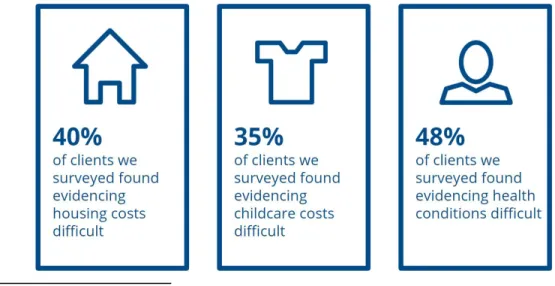
Claimants should not have to complete a full UC claim at the point at which they migrate to UC. The DWP could reduce the
After the visit, all documents were lost resulting in a long wait for the claim to be resolved." to make their claim if it is not readily available at first instance Case study Advice for citizens - difficulties in claiming by phone Polina has learning difficulties which can make some tasks difficult for her.
Although she tried to make an online claim for Universal Credit, she found it difficult to do so and encountered several problems. Polina didn't feel like she was being listened to, so the phone call hit her hard - and she still hasn't managed to submit her application for Universal Credit. When Polina visited Citizens Advice, the adviser called the helpline on Polina's behalf and asked to speak to a manager, who then allowed Polina to make a claim over the phone.
Throughout the managed migration process the government should further advertise the availability of telephone
This risk is particularly acute for more vulnerable claimants, or those who have been on an existing legacy benefit claim for many years with little interaction with DWP services. We believe that claims for legacy benefits should not be terminated even if claimants have not made a new UC claim by the specified date. Instead, at the time a migration deadline is exceeded, the government should proactively provide support to claimants to continue with the managed migration process.
Legacy benefit payments must continue until it is confirmed that a UC claim has been successfully settled. Consideration should also be given to additional measures that can be taken to help avoid gaps in income or negative financial impact during the migration process. This can significantly help existing legacy benefit claimants better manage their finances during the initial wait for their first UC payment, as well as helping them adjust to a monthly payment cycle.
People must not have their benefits stopped or reduced as a result of problems with the migration process. To prevent
She said her mental health was deteriorating due to the initial time limit on new UC claims and the lack of support, making it more difficult to complete her claim. However, these payments are not always balanced with people's need to cover essential running costs, putting them at risk of further debt accumulation. However, deductions 28 are not mentioned in the managed migration regulations, which makes it unclear how they will be transferred to the new benefit and how they will be treated in the calculation of transitional protection.
Citizens Advice customer case study - impact of high discount rates Georgina is a single parent with a 4 month old baby. It is unclear whether the deductions set in the legacy system will automatically transfer to UC and if so, whether these will be at the legacy benefit rate a claimant is used to paying or whether these will automatically increase to the UC amount. Applying the discounts at a higher level means that claimants with these debts risk losing income on switching to UC, even with transitional protection for their overall award.
Regulations need to ensure that claimants are not worse off following managed migration because of deductions
Calculation and impact of transitional protection
To prevent the loss of transitional protection, a gateway condition should be added to allow claimants who move local
Regulation 56(2) means transitional protection can also end entirely if a claimant's income falls below their earnings threshold for three or more. Claimants may turn down opportunities to temporarily increase their earnings (perhaps through seasonal work) because the subsequent withdrawal of transitional protection will make them worse off overall. Claimants may also not want to risk trying a new higher paying role if they will lose transition protection if they leave the job after more than three months.
Recommendation 15: The government should assess which elements will contribute to the erosion of transitional protection measures, for example those intended to cover the additional costs of disability or long-term illness. Recommendation 16: Regulation 56(2) should be deleted or amended so that claimants who experience a drop in income for three months do not lose their transitional protection. Recommendation 17: The government should consider extending the period in which claimants can resume their previous UC claim with transitional protection beyond three months.
Fluctuation of Incomes
The current managed migration proposals reflect the current process, where the date of claim is the start of the assessment period. In addition, the rules should be expanded to allow people to choose the dates of their assessment period to suit their payrolls and budgeting. Initial communications should make clear that the timing of a UC claim is important, and support should be available to claimants to help determine the best assessment period dates for the stability of their claims.
Claimants should be given the opportunity to align their assessment period with their pay cycles
Another cause for concern is the introduction of the Minimum Income Floor (MIF) for self-employed claimants. The theory behind the policy is that by setting a minimum amount self-employed claimants are expected to earn, and not making up the difference in UC payments if they fall below this amount. The regulations include a six-month 'grace period' during which self-employed claimants who have migrated to UC will not have the MIF applied to their claim.
This means that self-employed claimants, many of whom may have viable businesses, will not have the same level of protection as conventionally employed claimants with the same earning pattern. This may incentivize self-employed claimants to increase their earnings, but it may also lead them to abandon otherwise viable businesses that simply need more time to become established or experience significant financial hardship. The regulations would greatly expand the number of claimants subject to this, still experimental, policy and reduce the transitional protection afforded to many self-employed people.
The Minimum Income Floor should not be implemented for managed migration claimants until it is has been
Severe Disability Premium
The government should offer full transitional protection to those who have already naturally migrated from a legacy that includes SDP. Recommendation 22: DWP should establish and communicate a clear process to ensure SDP recipients understand what to do if circumstances change. A verification question should be added to the start of a UC claim to ensure that those who receive an SDP do not mistakenly start a UC claim.
Recommendation 23: DWP should consider extending gate conditions that prevent natural migration for SDP recipients to all groups facing high losses. Work permitted in ESA. They will not help people claiming a new UC benefit or those who are newly eligible for SDP. Recommendation 24: The DWP should consider using these regulations to introduce a self-care element of at least £156 per month for disabled people.
List of Recommendations
A clear schedule for rollout must be set out in regulations. Details should be provided on
Ahead of managed migration starting, build features currently in development should be sped up and completed
The Regulations should set out break points within the process of managed migration at which the DWP must review
Strengthened referral routes, including the introduction of a 'no wrong door' policy to ensure UC claimants can access the help they need without a direct referral. Recommendation 8: Claimants should not complete a full UC claim at the point they migrate to UC. Determine where there is an immediate need to complete an aspect of the UC claim, and where aspects can be done at a later stage. To ensure it makes best use of existing claimant data to reduce the need to re-submit information and evidence.
Throughout the managed migration process DWP should further advertise the availability of telephone application and
The Regulations need to ensure that claimants are not worse off following managed migration because of deductions
This must be done in a way that ensures claimants do not face a drop in income to cover their ongoing essential costs. The regulations should be expanded to allow people to choose their assessment period dates to suit their budget. Recommendation 20: The DWP should quickly and proactively identify those claimants who had already naturally migrated to UC and were entitled to the SDP.
If this is not possible, the proposed transitional payments should be increased to more accurately reflect the losses people face. Singles in the UC LCWRA group who were eligible for SDP should receive top-up and repayments of approximately £180 per month. Information about the process for SDP recipients reporting a change of circumstances must be communicated through the UC Helpline, Work Coaches, support staff and counselors.