Our research last year revealed that the total cost of consumer problems is in the billions. Citizens Advice is the statutory consumer representative for the energy and postal markets in Great Britain. The cost of consumer problems that followed in 2015 from markets failing consumers due to issues such as faulty goods, poor customer service or lack of compensation is in the billions.
The changing landscape
Measuring impact
This report
Consultation
Energy
Context
Over the coming year we will develop this working arrangement to ensure more effective knowledge sharing and clearer division of responsibilities as organizations seek to deal with challenges such as the transition to principles-based regulation and the continued rollout of smart meters in the coming year . . In this chapter we explain how we will tackle damage in the energy market based on four themes for our work. It covers our ongoing work and specific projects planned to meet the challenges of the coming year.
Cutting energy bills
Identify consumer overpayments in energy networks and regulated
The pipes and wires that bring gas and electricity to our homes account for about a quarter of the final household bill. In previous studies, we have uncovered hundreds of millions of potentially unwarranted profits of energy networks. We will re-examine this in light of the newly published data and break it down regionally, looking at whether consumers in Wales, Scotland and England are getting comparably different value for money.
We will also seek to extend this work to consumer markets, by creating a model to determine whether regulated monopolies extract unreasonable revenues from consumers and comparing network price controls to these regulated monopolies.
Assess the framework for controlling policy levies on bills. Consumer-funded social and environmental policies accounted for £132 (13%) of the average household
Empowering and protecting vulnerable energy consumers
- Ensuring heightened scrutiny of the smart meter rollout and monitoring specific consumer problems. The next year is critical for the successful delivery of
- Monitoring wider consumer experience of smart meters. Our previous research into early consumer experiences of smart meters identified serious
- Create a smart meter monitoring tool. As the smart meter rollout programme progresses, there will be increased consumer demand for information, which we are
- Establishing a benchmark for energy efficiency. Following the Bonfield Review , we’ll establish an annual benchmark for measuring improvements in consumer
We will strengthen our oversight of the success of the rollout for consumers through our tripartite work and through our advocacy with bodies such as the Smart Energy Code and the Smart Meter Delivery Group. We will work with industry to share our data insights across England, Scotland and Wales and ensure these issues are addressed. We will also monitor the market to keep up with the types of innovations and services that are emerging.
We will replicate this research to provide a longitudinal overview of how and whether the industry has improved its delivery of the smart meter rollout, and examine (for example) whether consumers are being informed about the limitations of SMETS1 meters, which. We will also review and highlight positive experiences of smart meters, such as increased billing accuracy and near-real-time access to information about energy consumption and costs. As the Energy Company Obligation (ECO) transitions to the fuel-poverty-focused 'Help to Heat' scheme, we will monitor its effectiveness in reaching fuel-poor homes, and assess the use and effectiveness of the new local.
In Wales, we will seek to influence the development of the Welsh Government's Warm Homes program and compare the experiences of the two schemes. Looking to the long-term future of the commitment, we will also explore the best ways to deliver ECO funding to meet our medium to long-term fuel scarcity targets, help vulnerable consumers and deliver value for money. We will assess the relative strengths and weaknesses of the market-driven ECO model, local delivery models and other delivery models.
The pilot phase ends in April 2017 and the evaluation of the program will be completed in October 2017.
Giving energy consumers a voice in decisions that affect them
Facilitate regional representation on energy networks’ customer and stakeholder panels. Local Citizens Advice offices have a deep understanding of the
We will provide these employees with more national support to represent energy consumers in their region. Following on from the Department for Business, Energy and Industrial Strategy (BEIS) Spring 2017 survey of heat consumers, we will assess current and future consumer harm in the district heating sector and develop the case for better protecting these consumers and implementing a regulatory policy. framework that meets their needs.
Creating a simpler and fairer energy market
- Publish data to encourage customer service improvements and further develop our star ratings supplier tool. We will publish two quarterly supplier
- Examine Guaranteed Standards of Service for energy networks and
- Analyse data from the Citizens Advice Consumer Service and Extra Help Unit to identify harmful supplier practices and performance. Where appropriate,
- Post
We will also test whether the principles proposed by Ofgem will make sense for emerging and smartly enabled offers. We will also examine compensation arrangements for issues such as power outages to see if there are consistent and fair approaches. If this fails and there is evidence of a license or other breach, we will refer the matter to Ofgem's enforcement team.
We will also extend our monitoring to third party intermediaries (TPIs) in the foreign market, allowing us to refer potentially consistently bad TPIs to Ofgem. We will use our deep market knowledge and consumer expertise to help them develop excellent consumer processes, particularly around vulnerable consumers. More than 1,500 post offices will be converted to the new models, along with the continued franchising of flagship Crown branches.
We will carry out research to support strong recommendations on how to make pricing simpler and fairer. We will carefully review all 20 changes to post offices in 2017/18 to ensure they do not harm consumers. Recent research has calculated that the total societal value of the Post Office network is up to £9.7 billion.
We will look closely at potential future threats to the needs of postal consumers, as well as the potential.
Tackling postal scams
Convene a task force to share intelligence and develop practical ways to tackle scams at source and reduce the risk of the consumers who come into contact with
Ensuring that consumers are represented in debates about the future of postal services is central to the role of a consumer advocate.
Standing up for rural areas and older people
- Improving the experience of rural consumers of postal services now and in the future across Scotland, Wales and England. Research conducted by Citizens
- Continuing a rolling programme of Post Office mystery shopping across England and Wales to ensure consumers are getting a fair service. We will
- Measuring and protecting consumer access to core services by developing our Geographic Information System (GIS) project, modelling Post Office viability
- Developing a strategic understanding of how to protect future consumer access by researching what consumers want from Post Offices and the viability
- Ensuring that all Post Office branch changes receive robust consumer scrutiny and that access is maintained for all consumers. The Network
- Ensuring that all Crown Post Office branch changes receive consumer scrutiny to maintain access for all consumers. Crowns are flagship branches in
- Preventing consumers from paying more than they need for postal services due to a lack of transparency in pricing structures. Clear, easy to navigate pricing
- Ensuring that key mail services are affordable and meet the needs of
We will conduct new mystery shopping research to enhance our unique longitudinal data on the effects of the network transformation program. We will model future scenarios to determine if there are threats to the future viability of different branches. In addition to this, we will conduct qualitative research to understand exactly what consumers want from Post Offices, building on our findings from consumer surveys this year.
Funding permitting, we will extend this research to include the views and experiences of Scottish consumers. We will also return to branches that we have previously examined to understand if any changes have occurred. We will commission research to test consumer understanding of existing pricing structures and quantify the harm consumers are experiencing.
We will extend the scope of this research to a representative sample of Scottish consumers. If we find that the needs of people with disabilities are not being met, we will develop workable, proportionate proposals to improve access to these services. Funds permitting, we will extend the scope of this survey from England and Wales to the entire GB sample only.
We will commission research to more fully understand the reasons why so many consumers do not use this important service, for example due to lack of awareness or affordability, and identify ways to reduce these barriers.
Measuring consumer detriment
Measuring the scale of consumer detriment across postal services. We will commission a study to quantify the total value of consumer detriment consumers in
Promoting consumer interests in a changing world
Understanding the likely impact of future market developments on
We will also work to ensure that postal service consumers are not forgotten in debates about the need to preserve key consumer protections when we leave the EU.
Representing postal consumers
Cross sector
Our network of local Citizens Advice offices gives us a unique reach in every community across England and Wales. Our website, face-to-face and over-the-phone advisory services provide us with data that we use to understand the problems consumers face in markets in real time. In 2015-16 we had 13.4 million visits to our consumer pages online, 1.05 million contacts to our Consumer Service and delivered 31.2 million minutes (531,000 hours) of online digital consumer advice.
Although each market is individual, many of the problems we see in one market apply equally to another. Our ability to look across different sectors is second to none, and to identify solutions we draw on insights and examples of good practice across markets. These cross-market comparisons allow us to push for better consumer protection when one industry falls behind others.
We know that people's problems tend to be complex and interconnected - our approach also identifies how problems in different markets interact with each other and finds cross-sectoral solutions. The government faces a number of challenges over the coming year; developing an industrial strategy, publishing a Green Paper for consumers and considering a vision for consumers after Brexit. We will continue to use our understanding of consumer harm and the problems people experience across different markets to get the best deal for consumers.
Except where regulation or legislation is devolved, we will use a GB-wide approach and use nationally representative samples of consumers across England, Wales and Scotland.
Understanding the cost of consumer detriment
- Explore areas of detriment across sectors by problem type and
- Apply our understanding of behavioural insights to particular demographic groups across markets across Great Britain. Evidence suggests older people may
- Understand consumer detriment across communities. A solely national approach to consumer issues can miss sharp detriment experienced by small
- Identify the detriment to consumers of the misuse of personal and
- Further develop and engage stakeholders on our work on the ‘loyalty penalty’ which exists across a range of markets. Consumers overpay by £1.3
We will continue to respond flexibly to the changing needs of consumers by identifying necessary projects. We will explore the experiences of this 30 growing group of consumers and identify steps that can be taken to undo the damage. Explore the indirect effects of failing markets on consumers' lives. We'll find out whether certain groups are vulnerable to wider harm.
To do this, we will conduct a group analysis of data from Consumer Services and Citizens Advice and undertake in-depth research. We will focus specifically on the indirect effects of fraud and use this insight to identify ways to protect vulnerable people from fraud. We will work with departments and regulators including BEIS, the CMA and the Advertising Standards Authority (ASA) to highlight existing and emerging areas of harm.
Next year we will build on this insight to improve regulation, share best practice, test our recommendations and apply our findings within the Citizen Advice service. We will investigate 31 which cognitive biases particularly affect older people and where consumer markets benefit from these biases to the detriment of consumers. With this insight, we will develop practical solutions that ensure a fairer deal for the elderly.
We will 34 examine how behavioral biases are exploited to reduce the redress paid to consumers and how they can be overcome.
Getting consumers the best deal in a changing world
Influence decisions made as a result of leaving the European Union. We will monitor and influence changes that affect consumers to identify areas of detriment
We will be flexible in this area, holding round tables or preparing briefings on the effects on England, Wales and Scotland as most appropriate as the formal process develops. We will work in partnership with organizations specializing in innovation and social finance to develop our recommendations for. We will contribute to the all-Slovenian study of the Office for Competition and Markets on price comparison websites. We will also work closely with partners and use our cross-sector approach to combat mail, telephone and online fraud: one in ten people were affected by scams and mail and phone fraud 39 cost British consumers £5 billion every year.
Build on our research exploring the potential of Next Generation
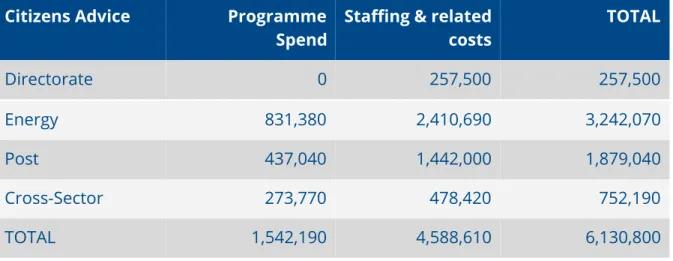
Provisional expenditure 2017/18
Summary Budget for 2017/18
We help people