inclusive policy, social development
Strengthening and streamlining energy advice and redress
An independent review of the adequacy of energy advice and redress – full report
Georgia Klein 07939 541 807 [email protected]
Page 2 of 88
Section Page
1. Introduction 3
2. Key policy developments 7
3. Consumer needs – current and future 16
4. Definition of adequate energy advice and redress provision 29 5. An assessment of the adequacy of current advice provision 37 6. An assessment of the adequacy of current redress provision 58
7. Proposals for improving provision 75
Appendices and a standalone executive summary are also available at www.citizensadvice.org.uk/knowing-who-can-help
Page 3 of 88 Chapter 1
Introduction
This chapter sets out the review objectives, the approach taken and the key limitations on the review.
The review’s primary objective was to identify the changes needed to the existing regulatory and delivery framework in order to deliver optimal energy advice and redress to domestic consumers (particularly vulnerable consumers) and micro-business consumers in Great Britain.
Because the commissioning organisation – the Citizens Advice Service – is itself an advice provider, a number of measures were put in place to ensure the review was robust, objective and independent. Of key importance was the development of an assessment framework, along with the collection of data to evidence performance against this.
The review was limited by the non-disclosure of key information to the reviewer and weaknesses in publicly available information, in spite of these services being funded by taxpayers and consumers. Nonetheless, the review:
provides a robust evaluation framework that can be applied to help drive future improvements in advice and redress provision in energy as well as other sectors
provides a comprehensive, aggregate view of the performance of both energy advice and energy redress in Great Britain; and
secures sufficient evidence to indicate the improvements needed to the regulatory and delivery framework to secure adequate energy advice and redress.
Page 4 of 88
1.1 Objectives
The Consumer Futures team at Citizens Advice and Citizens Advice Scotland wish to work with stakeholders to achieve optimal advice and redress provision for energy consumers in Great Britain. To support them in this goal, they commissioned GK Consulting to:
describe all relevant organisations involved in energy advice and redress provision, including details such as: the type of advice/redress provided; use of cross-referrals;
volumes of consumers using the services; how consumers’ experiences are captured and reported
conduct an independent review of the adequacy of this energy advice and redress provision in the light of current and forecasted future consumer needs, with particular regard to:
- potential overlaps, gaps and coordination in provision, capturing differences between England, Scotland and Wales
- the needs of domestic, micro-enterprise and vulnerable consumers; and
make recommendations regarding the changes needed to the regulatory and delivery framework to deliver improved support for energy consumers.
The review exclusively considers provision that is funded by:
taxpayers; or
consumers as a result of a Government mandate.
1.2 Approach
Consumer Futures has previously commissioned other reviews of energy advice and redress provision, the latest being in 2011.1 In order to deliver maximum value for money, this review focuses on key developments since these reviews were completed, taking a different evaluation approach with a greater emphasis on recommended changes.
Since previous reviews were completed, Consumer Futures has become part of Citizens Advice and Citizens Advice Scotland (hereafter referred to together as ‘the Citizens Advice Service’) – a policy-influencing organisation and advice provider with commercial interests in the advice environment. Given this context, in order for this work to have credibility with external stakeholders and to obtain the necessary data, it was important to develop an approach that was robust, objective and independent. This entailed the following:
1Centre for Consumers and Essential Services, University of Leicester (2011), Making the Connection:
strengthening the advice, complaint handling and redress framework; Centre for Utility Consumer Law, University of Leicester (2007), Consumer vulnerability and the energy sector: vulnerable consumers and complex complaints.
Page 5 of 88
A combination of literature research and asking key providers and stakeholders in the sector to identify the full array of advice and redress organisations in scope for this work.
Developing a robust assessment framework from a review of best practice in advice and redress provision. This was used to evaluate current provision and test recommended changes.
Relevant organisations were requested to complete a standardised information request; the data requested would serve to objectively determine the performance of individual organisations and also the sector against the assessment framework.
Key stakeholders in the sector were interviewed to capture their views on the effectiveness of current sector provision, its fitness for the future and any changes they would recommend (see Appendix 5 for organisations interviewed).
Participants’ detailed responses were not shared with the Citizens Advice Service – it only has access to published data.
Contributors were asked to verify the accuracy of information about their organisation as it appears in the final report.
Contributors also had the opportunity to comment on the conclusions and recommendations in the report.
The views expressed are those of GK Consulting based on the evidence acquired, not of Citizens Advice or Citizens Advice Scotland.
The research for this report was completed in early March 2015.
1.3 Definitions
For the purposes of this project, advice includes first-tier and second-tier advice. First-tier advice often points the way towards further information or answers practical and frequently asked questions. Second-tier is detailed advice for individual consumers about their specific problems. Information and education, including via web channels, are out of scope.
Relevant organisations were those that have a primary responsibility for energy. The Financial Services Ombudsman and the three Public Services Ombudsmen serving England, Scotland and Wales will all touch on energy issues. For example, the Financial Services Ombudsman tackles some financial aspects of energy transactions. The Public Service Ombudsmen may capture energy issues if a local authority manages the installation of energy measures. However, because they do not have a primary role in energy, we have not reviewed their work in detail but do acknowledge that they add to the array of organisations that consumers may feasibly need to engage with.
Micro-business has a particular legal definition of pertinence to Citizens Advice.2 Consumer Futures also operated with a definition of vulnerable consumers as ‘people who cannot
2 The definition of micro-business is taken from section 12 of the Consumers, Estate Agents and Redress Act 2007 (https://www.ofgem.gov.uk/ofgem-publications/57726/cd-cf-non-dom-discon-vulcon-referral-
pathway.pdf) and updates in the The Gas and Electricity Regulated Providers (Redress Scheme) (Amendment) Order 2014. A business with: (a) an annual consumption of (i) electricity of up to 100,000 kwh or (ii) gas of up to 293,000 kwh; or (b) (i) fewer than 10 employees (or their full time equivalent); and (ii) an annual turnover or annual balance sheet total not exceeding €2 million.
Page 6 of 88
choose or access essential products and services which are suitable for their needs or cannot do so without disproportionate effort/cost/time’. However, for this project, organisations self-defined these consumer groups as this revealed more about the regulatory and delivery framework’s responses to such groups.
1.4 Limitations
In spite of the Citizens Advice Service using its powers under the Consumers, Estate Agents and Redress (CEAR) Act 2007 to request the data for this project, a significant number of organisations were unable to respond as a result of commercial and political sensitivities or time pressures. Protection of commercially sensitive data was offered. It was also not possible to secure interviews with Ofgem or the Scottish or Welsh Governments. The proximity of the work to the general election is likely to have been a contributing factor.
The reviewer was required to draw on publicly available information for non-responding providers. As the later sections reveal, the data available in the public domain is, on the whole, quite lean and led to challenges in aggregating or comparing organisations. However, these deficits in publicly available information are themselves an important finding.
The requirement for advice or redress provision to be funded by Government or mandated also excludes advice from organisations that sell further goods and services, such as energy efficiency or micro-generation measures. This includes, but goes beyond, Green Deal provision. To achieve a full picture of the adequacy of provision, such types of advice need to be taken into consideration.
In spite of these limitations, the review has succeeded in:
developing a robust evaluation framework that can be applied to help drive future improvements in advice and redress provision in energy as well as other sectors
providing a comprehensive, aggregate view of the performance of both energy advice and energy redress separately in England, Scotland and Wales, as well as an aggregated view of performance across Great Britain
securing sufficient evidence to indicate the improvements needed to the regulatory and delivery framework to deliver adequate energy advice and redress.
Page 7 of 88 Chapter 2
Key policy developments
This chapter sets the context for the evaluation of current provision by considering the policy drivers behind key recent developments in advice and redress provision. It considers both consumer affairs and energy sector-specific policy drivers of the British, Scottish and Welsh Governments.
In all countries, over the last four years, we have witnessed a recognition of the importance of advice as a means of improving markets, driving economic growth and achieving climate change objectives. Governments have responded by seeking to consolidate and better coordinate the provision of advice to consumers, to enhance both its quality and cost- effectiveness.
In Scotland and Wales, recent changes in the advice delivery framework have focused primarily on energy efficiency advice, with provision split between domestic and non- domestic consumers although using similar delivery frameworks. The delivery of advice to vulnerable energy consumers has remained unchanged, either because this has been deemed effective, has yet to be subject to review or because some elements are overseen by the British Government.
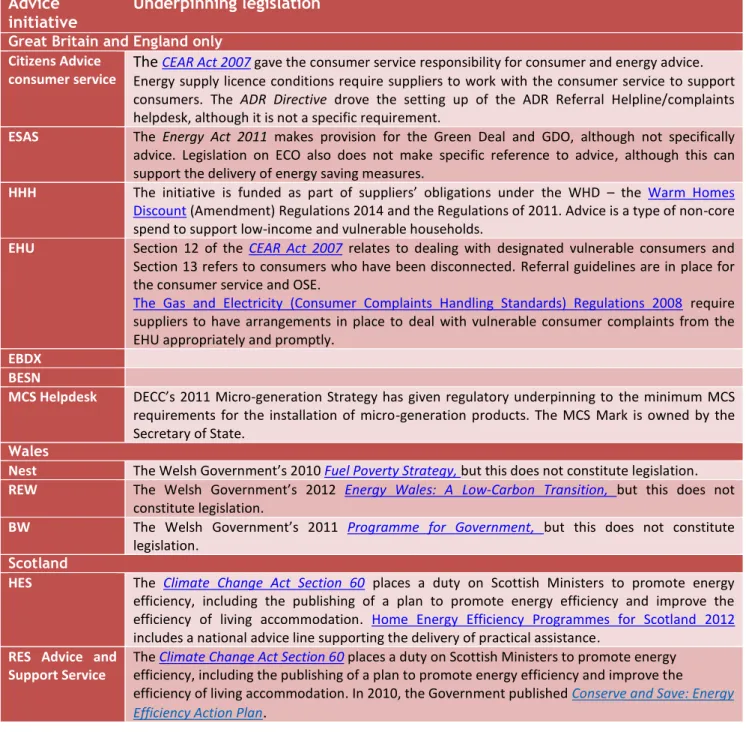
In Great Britain, the dual policy drivers from consumer affairs and energy have led to simplification efforts being focused on general advice provision, and so the impact on energy advice is less marked. Simplification of general consumer advice has been achieved and a new cross-sector complaints referral helpdesk is under development, which will be part of this service. Energy advice has a more tangled path. Some provision has been integrated within a general consumer advice line, a more specialised advice service has been set up for vulnerable energy consumers, and a specialist energy advice service has been launched that advises on energy efficiency and signposts to financial support. A coordinated network of face-to-face energy advisors has also been set up. In Scotland and Wales, clear attempts to streamline energy advice provision have been made.
Redress provision has also changed, with the Energy Ombudsman being placed on a statutory footing, a new Green Deal Ombudsman (GDO) being set up and Government becoming more formally involved in what was the voluntary complaints scheme of the Micro-generation Certification Scheme (MCS). This is in spite of the Cabinet Office and BIS stating a preference for a single ombudsman. Driven by a European Directive, there were also plans to set up a residual alternative dispute resolution (ADR) scheme to plug the gaps in the existing provision for this. This was proposed to operate as an umbrella model
Page 8 of 88
encompassing existing providers, but BIS are no longer procuring this as the market has responded.
Page 9 of 88
2.1 The roles of British, Scottish and Welsh Governments
Consumer affairs policy is currently a reserved function of the British Government, meaning that many of the structural changes in advice and redress provision are driven by the Department for Business, Innovation and Skills (BIS). Similarly, much of energy policy is also reserved and so the policies of the Department of Energy and Climate Change (DECC) are also pertinent to Scotland and Wales, although policies relating to the environment are devolved to both nations. However, both countries have additional initiatives, and discussions about the devolution of relevant powers are underway. These are considered separately.
2.2 Consumer affairs policies across Great Britain
The CEAR Act 2007 came into effect on 1 October 2008 and changed the landscape of energy advice and complaints handling. The new arrangements consisted of four key elements:
1. New complaint handling standards were introduced for energy companies.
2. The Energy Ombudsman became the only approved statutory ADR scheme, with the ability to settle disputes between consumers and their energy suppliers.
3. Consumer Direct (a national generic consumer helpline run by the Office of Fair Trading) took over Energywatch's responsibility for providing first-tier advice, as well as referring and signposting cases to other organisations.
4. Consumer Focus, created by the CEAR Act, had responsibility for handling cases from vulnerable energy consumers within itsExtra Help Unit (EHU). This has now moved to Citizens Advice Scotland, which manages the unit on behalf of the Citizens Advice Service.
In April 2011, the British Government published its consumer strategy document, ‘Better Choices: Better Deals – Consumers Powering Growth’. This set out how Government can help to support and empower consumers to help drive competition and growth, and send signals via the market mechanism to businesses that best serve their needs. Ensuring consumers have the necessary information, advice and confidence to exercise their rights is a key part of this strategy.
Shortly after, BIS published a consultation on the institutional arrangements for the provision of consumer information, education, advocacy and enforcement. This review of the consumer landscape sought to contribute to the delivery on the Government’s 2010 Queen’s speech commitment, that ‘the cost of bureaucracy and the number of public bodies will be reduced’. The proposed rationalisation of the consumer landscape was also designed to help deliver the consumer strategy by:
reducing the complexity of the consumer landscape and associated public confusion about advice, advocacy and enforcement bodies
Page 10 of 88
strengthening the frontline of consumer empowerment and protection so that enforcement was more consistent
delivering consumer services more cost effectively and consistently.
The reforms, announced in April 2012, included:
streamlining public funding by focusing current resources allocated to consumer information, advice and education on the Citizens Advice Service
ceasing funding of the Office of Fair Trading’s consumer code approval scheme
transferring most of the powers and functions of Consumer Focus to the Citizens Advice service.
Of particular note was that the stated intention that:
‘Over time almost all relevant central government resources for advocacy, information and advice and enforcement will transfer to Trading Standards and the Citizens Advice service, which have high recognition and trust among the public.’
In April 2012, the Citizens Advice consumer service (hereafter referred to as ‘the consumer service’) took over responsibility for providing consumer advice and information from Consumer Direct. In April 2014, Citizen’s Advice and Citizen’s Advice Scotland took on the role formerly undertaken by Consumer Focus to provide a statutory consumer watchdog function for energy consumers.
Another key development is the European ADR Directive, which came into force in July 2013. It obliges the UK to ensure that, by July 2015, ADR is available for all disputes concerning contractual obligations between a consumer and a business, and that certain operational rules are adopted by ADR schemes. Following a recent consultation, BIS decided to leave the existing landscape, as it already operates well, and initially proposed setting up a residual ADR scheme to plug the gaps where coverage is limited, in order to meet the UK's obligation. This residual scheme would have operated as an umbrella model, providing clear access to consumers and helping to raise levels of awareness and uptake. Energy and the Green Deal were specifically cited as being outside of the scope of this scheme and would continue to co-exist under the umbrella system, although current energy redress providers will need to demonstrate that they follow the operational rules set by Europe and BIS.
However, since the BIS proposals were set out, the Retail Ombudsman and Ombudsman Services have set up schemes offering this service and therefore BIS has decided not to tender for a provider as it considers the market response to be sufficient. It will, however, continue to monitor the market to ensure comprehensive availability of ADR services.
Further changes being implemented as part of the ADR Directive will be to:
create and fund a consumer complaints ‘helpdesk’, to be provided by Citizens Advice alongside their existing consumer service, where consumers can go for assistance and advice when attempting to resolve a dispute with a trader
Page 11 of 88
legislate to allow regulators (in this case Ofgem) to act as competent authorities, overseeing compliance in their sectors and building on their existing relationships with statutory ADR providers.
Further changes are also anticipated. Even though there was little evidence provided in support of a single ombudsman model, most respondents to the consultation supported the idea of the simplification of ADR. This simplified approach is already endorsed in theCabinet Office April 2010 guidance on Ombudsman Schemes, which advocates a single ADR scheme within a sector. BIS has proposed to further investigate whether the number of ADR bodies operating in each sector should be limited, how far to harmonise the type of ADR on offer to consumers, and to explore whether it should be compulsory for businesses to use a residual scheme. BIS therefore plans to continue to consult with stakeholders and to carry out further work to assess the costs, benefits and impacts to inform its decision on any future simplification However, this plan may be amended, given the change in direction on residual scheme provision.
Currently under way is the consolidation and simplification of consumer law. The Consumer Rights Act is designed to set out a framework that consolidates in one place the key consumer rights covering contracts for goods, services, digital content and the law relating to unfair terms in consumer contracts. The Act also introduces easier routes for consumers and small and medium-sized businesses (SMEs) to challenge anti-competitive behaviour through the Competition Appeal Tribunal (CAT). The Federation of Small Businesses is lobbying for small businesses to be treated in a similar way to consumers and so given similar status in energy markets. It wants general consumer protection extended to micro- businesses in line with the Consumer Rights Directive and Consumer Rights Act.
2.3 Energy policies across Great Britain
BIS policy has secured a statutory Energy Ombudsman but other developments in UK energy policy have led to further changes in redress needs and provision in the sector, namely micro-generation strategy and the Green Deal.
The industry-led MCS primarily oversees the certification of installers and technologies used to produce electricity and heat from renewable sources, but also provides information on micro-generation installers and a complaints process. DECC’s June 2011 Micro-generation Strategy seeks to expand the use of micro-generation schemes and makes MCS a key delivery partner in improving advice and information provision to consumers, communities and businesses on micro-generation. This is under-pinned by a tripartite agreement between DECC, the MCS administrator and the MCS service company. This in effect turns a self-regulatory redress scheme into one that has Government oversight (a co-regulatory scheme).
The Energy Act 2011 includes provision for the Green Deal – the British Government's flagship energy saving plan to transform the country's homes to make them warmer and cheaper to run. It enables homeowners to arrange energy efficiency measures, which are paid for through savings in their energy bills. The ombudsman landscape for the Green Deal needs to cover financial aspects (in the remit of the existing Financial Ombudsman Service),
Page 12 of 88
aspects relating to the collection of the Green Deal charge (covered by the existing Energy Ombudsman Service as part of its role dealing with energy billing and collection) and where complaints have not been resolved by Green Deal Providers. DECC consulted on extending the remit of the Energy Ombudsman to incorporate Green Deal Provider complaints.
However, this would have entailed an amendment to primary legislation, changing Ofgem’s role. Because of timing and other considerations, DECC created a dedicated GDO. Following a competitive tender, DECC appointed Ombudsman Services in June 2012 as the ombudsman and investigation service for the Green Deal.
The Energy Act 2013 gave Ofgem power to make a ‘consumer redress order’ to breaches by gas or electricity companies. These can be used where Ofgem considers a company has breached its licence and one or more consumers have suffered loss or damage, or been caused inconvenience. The order may require a regulated person to pay compensation to affected consumers and to terminate or vary any contract with the affected consumers. This new power has the potential to resolve cases that otherwise may have reached the ombudsman.
Following Ofgem’s Retail Market Review, in December 2012, the Energy and Climate Change Select Committee conducted an Inquiry into Consumer Engagement in the Energy Markets.
The Committee stated:
‘We are concerned by the evidence we have received that consumers do not know who to trust to give them reliable, independent advice and information about energy matters. Given the need we have outlined to help consumers to reduce their energy consumption and costs, we conclude that there is a case for a single, dedicated organisation to advise consumers on energy matters. We recommend that DECC should consult with relevant stakeholders about the possibility of establishing an independent organisation tasked with providing consumers with independent energy advice. The ultimate aim should be to have a single, impartial, dedicated service that consumers can trust as their first port of call with any query about energy matters. Ideally there should be a single helpline and a single website so that there is no confusion among consumers about where they should go for advice.’
The Government's response agreed on the need for trusted consumer advice in energy saving matters. They cited two advice services as delivering this – the Energy Saving Advice Service (ESAS), covering England and Wales, and the Citizens Advice consumer service.
ESAS – a telephone and email advice service – went live in April 2012, tasked with delivering information around Government energy saving schemes and incentives, and most importantly, the Green Deal and Energy Company Obligation (ECO) in England and Wales.
While principally providing advice on the installation of energy efficiency and low-carbon measures, it refers or signposts consumers to financial support (such as the Affordable Warmth element of the ECO, the Warm Homes Discount (WHD) or Cold Weather Payments – all Government-backed schemes to lower energy bills). A Government campaign on the Green Deal has sought to promote awareness of ESAS.
Prior to the establishment of ESAS, DECC funded energy saving advice in England and Wales through grant arrangements with the Energy Saving Trust (EST) and the Carbon Trust (CT).
The service was delivered through a network of local advice centres. Following the
Page 13 of 88
announcement of the DECC Delivery Review in May 2011, grant funding to EST and CT to deliver these advice services ceased at the end of the 2011/2012 financial year and further delivery was opened up to competitive tender.
In May 2013, DECC published the response to its consultation on Ensuring a Better Deal for Energy Consumers. This also considered advice provision but, unlike the Select Committee inquiry, only for vulnerable consumers. DECC is of the view that vulnerable consumers need extra help and advice to engage with the energy market and to give them the confidence to take decisions that will reduce their bills. It has therefore funded the creation of the Big Energy Saving Network (BESN), a coordinated network of third-sector organisations dedicated to provide face-to-face outreach advice for vulnerable consumers with the support of trained energy advisors. DECC has committed to evaluate the effectiveness of this network and develop options for future advice provision, taking into account the impact of Ofgem’s Retail Market Review tariffs and information reforms.
The Gas and Electricity Regulated Providers (Redress scheme) (Amendment) Order 2014 changed the definition of micro-business with the intention of increasing the numbers of micro-business consumers able to utilise a redress scheme.
In March 2015, Ombudsman Services were appointed to manage Heat Trust as the ADR scheme for district heating schemes, building capacity for responding to associated problems.
2.4 Welsh policies
The Government of Wales Act 2006 resulted in the devolution of energy advice and support to Wales.
The Welsh Government’s July 2010 Fuel Poverty Strategy cites financial and energy advice as being key to the eradication of household fuel poverty. Proposals were made to ensure that the advice available going forward would be better coordinated, more easily accessible and provided in a format best suited to those needing advice. The delivery model would be a two-way referral network that ensured whichever organisation or service a householder accesses first, they can be referred to the full range of advice and support services the householder requires to reduce their fuel bills, maximise their income, improve the energy performance of their homes and reduce their risk of becoming fuel poor. A central coordination point for referrals would work with existing frontline services and offer priority support to households in crisis. This advice service is integral to what is now known as Nest, Wales’ demand-led fuel poverty scheme. While British Gas has overall responsibility for Nest, the EST is a material sub-contractor delivering the advice part of the scheme.
In 2011, the Welsh Government published its Programme for Government, setting out its ambition to create a sustainable, low-carbon economy for Wales and committing to reviewing the arrangements for providing advice on energy efficiency. The review concluded that the grant-funded services should be replaced by competitively procured services. It also recommended that the landscape of provision could be simplified for service users, with the newly procured services being better integrated with other Welsh Government services.
Page 14 of 88
In response to this, in January 2013, Business Wales (BW) was set up with European Union and Welsh Government funding to provide an all-encompassing advice service to Welsh businesses. This includes specialist energy efficiency advice.
Energy Wales: A Low-Carbon Transition, published in March 2012, details the route to realising a low-carbon economy through the Welsh Government’s devolved powers on economic development, housing, planning, environmental regulation, pollution and transport policies. Energy Wales committed to putting in place a single point of contact for businesses and households for advice on resource efficiency, in particular energy efficiency, and the options available. Picking up on the need to improve the quality of efficiency advice, the Welsh Government then launched Resource Efficient Wales (REW) in October 2014. Its design is intended to support the development of a thriving market for advice and support in resource efficiency, and deliver continuous improvement. It incorporates advice provision as part of Nest.
2.5 Scottish policies
The Scottish Government plans to move towards a low-carbon economy with a focus on energy efficiency and micro-generation. It considers raising awareness and offering advice and support as an effective method for effecting long-term reductions in energy consumption across Scotland. To facilitate this, one of the key actions committed to in its 2010 Conserve and Save: Energy Efficiency Action Plan was the simplification and streamlining of the energy and resource efficiency advice and support delivery landscape for business and domestic consumers.
The Scottish Government considered that access to advice and support for businesses on energy and resource efficiency could appear unclear and disjointed. It identified a need for a more effective, joined-up approach between agencies, including the need for better integration of services, better signposting between agencies and a more customer-focused approach. Additionally, it identified a need for action to remove some of the barriers that impede effective delivery, including inconsistencies between agencies.
The Scottish Government’s plans included the following:
Streamlining the delivery of its energy efficiency and fuel poverty programmes through the setting up of Home Energy Scotland (HES), effectively a re-brand of Energy Saving Scotland’s advice centres. This is the main contact for domestic energy consumers in Scotland and is managed by the EST.
Actively promoting the provision of energy efficiency advice to businesses in Scotland, including through the establishment of a single energy and resource efficiency service that integrates non-domestic energy, water and material resource efficiency services previously provided by Zero Waste Scotland, CT and EST. The Resource Efficient Scotland (RES) Advice and Support Service was launched in April 2013.
Following the referendum vote, the November 2014 Smith Commission Report sets out agreed devolution of additional powers to the Scottish Government. The following agreements are of particular relevance:
Page 15 of 88
There will be a formal consultative role for the Scottish Government and the Scottish Parliament in designing renewables incentives and the strategic priorities set out in the Energy Strategy and Policy Statement, to which Ofgem must have due regard.
Powers to determine how supplier obligations in relation to energy efficiency and fuel poverty, such as the ECO and WHD, are designed and implemented in Scotland will be devolved. Responsibility for setting the way the money is raised (the scale, costs and apportionment of the obligations as well as the obligated parties) will remain reserved.
Consumer advocacy and advice will be devolved to the Scottish Parliament.
The Westminster legislation was based on the recommendations of the Smith Commission and will not be enacted until after the UK election in May.
Page 16 of 88 Chapter 3
Consumer needs – current and future
This chapter sets out the scope of consumer advice and redress needs, both current and likely to emerge in the future. Intransigent consumer service problems such as billing and transfers, coupled with rapidly evolving and complex policies, drive consumers’ advice and redress needs.
Consumers need help to:
secure the best deal (including bill management, identifying the best deal, securing subsidies, and negotiating a better deal)
reduce energy use
generate energy.
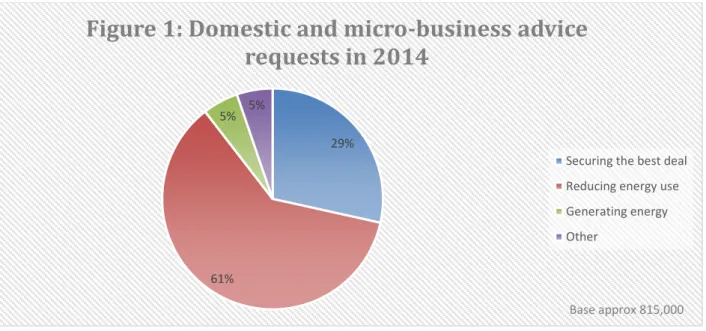
According to the data collated for this research, in 2014, nearly 815,000 requests for energy advice were made by domestic consumers and over 2,000 by micro-businesses, increasing significantly since 2012 but still below targets:
Saving energy was the primary reason for consumers seeking advice, followed by securing the best deal – no surprise given levels of fuel poverty and the measures used to address it.
Securing financial assistance (e.g. subsidised tariffs) was far more important than identifying the best tariff but new smart meter tariffs, service bundling and collective switching may increase demand for this type of advice.
The increasingly technical nature of energy efficiency measures will also drive future advice needs.
Generating energy concerned considerably fewer clients but its importance is likely to grow – particularly for off-grid consumers – as the costs fall, if the impacts of supply shortages are felt and as Governments seek to further incentivise its use.
According to the data collated for this research, in 2014, around 42,000 consumers requested independent assistance with resolving an energy complaint, of which only a tiny proportion were micro-businesses. In spite of a quadrupling of complaints over the last three years, there is evidence that far fewer people are making using of independent redress than are eligible.
Basic consumer service issues of billing and transfers currently dominate.
There is a conspicuous absence of complaints relating to energy efficiency sales, products and installations – all of which stakeholders anticipate will grow with the Green Deal and smart meter roll out.
Page 17 of 88
The Government’s encouragement of micro-generation schemes is also likely to increase demand for redress.
Consumers want advice to be:
of different styles and formats
comprehensive and accurate
proactively supporting those most in need
offering practical support to those who need it
independent from energy providers
free.
Consumers want redress providers to be:
well-known and understood
trusted to be fair and effective;
hassle-free.
Page 18 of 88
3.1 Introduction
One of the most fundamental needs of consumers is to be able to understand the options available to them in the market and select those of greatest benefit to them. Advice may be needed to achieve this. And if things go wrong, consumers need to know what their rights are and that if the company does not put things right, that someone else will protect them and make sure they secure the redress deserved.
While these consumer needs are widely accepted, there is little direct research into consumers’ energy advice and redress needs (or at least published data). This research has:
collated data on the issues for which consumers contact advice and redress providers (bearing in mind that the needs of those not using the service will not be captured)
referred to other sources of direct consumer research about the nature of support desired where available.
To develop a fuller picture, we must supplement this information by deducing consumer needs from:
what is happening to the energy market and what is forecasted to happen
what policy-makers are seeking to achieve.
The chapter below sets out this evidence, gleaned from the information request, document reviews and discussions with the providers interviewed. It begins by looking at the issues consumers need support with, and follows this with evidence on how they would like this support to be provided.
3.2 What do consumers need support with?
3.2.1 Overview
Evidence from consumers on their current needs
In spite of caveats regarding the quality of the data available, the responses to the information request provides a unique indication of the scale and nature of advice and redress use across all major energy advice and redress providers in England, Scotland and Wales. This in turn gives us valuable insights into current consumer needs.
Page 19 of 88
The information request revealed a high number of consumers using advice and redress services, indicating that this support is needed. In 2014, nearly 815,000 requests for energy advice were made by domestic consumers and fewer than 2,000 by micro-businesses.3 Data limitations are likely to have suppressed the figures for business, but even with allowances for this, they would remain very much a minority client group in spite of their representation in the population. This may indicate that they either have fewer advice needs than domestic consumers or their needs are inadequately addressed.
The total number of advice requests has increased significantly – by about one-fifth – since 2012. That this remains significantly below some major providers’ targets may indicate that either the support is not needed at this level or improvements are needed to deliver on these targets.
Based on the data available, saving energy was the primary reason for consumers seeking advice, followed by securing the best deal. However, the latter issue is likely to be under- represented.4 Generating energy and other issues concerned considerably fewer clients.
As Figure 1 below reveals, domestic consumers’ requests were largely about how to reduce energy use, followed by securing the best deal, with considerably fewer seeking advice on generating their own energy. Micro-businesses seemed mostly concerned with securing the best deal, reducing energy use and generating energy following very much as a minority.
However, energy saving issues are likely to be under-represented because of data limitations. These key areas of consumer need are explored in more detail below.
3Data used was from Energy Best Deal Extra, EHU, Citizens Advice consumer service, Home Heat Helpline, ESAS, Nest, HES, RES, BESN and MCS. The figures used to calculate this vary in their presentation. Most were presented by client but some organisations counted the number of contacts. Most data was for 2014 but some was for 2013. ESAS does not make publicly available data separating enquires from business from domestic consumers and this will inflate the domestic figures presented here, as will figures from the consumer service.
4BESN did not split out the types of advice it provided and so was not included in this analysis.
29%
61%
5% 5%
Figure 1: Domestic and micro-business advice requests in 2014
Securing the best deal Reducing energy use Generating energy Other
Base approx 815,000
Page 20 of 88
In 2014, over 42,000 consumers requested independent assistance with resolving an energy complaint. This represents a quadrupling of complaints over the last three years,5 indicating a growing need for support and/or that providers are delivering a more effective service.
There is clear evidence for the former position, since satisfaction with suppliers’ complaint handling has decreased from 40 per cent in 2012 to 30 per cent in 2014, and over half of those who had complained were not satisfied with the way their complaint had been handled by their energy supplier. The latter position is also supported because we know that the vast majority of complaints that are eligible for consideration by a redress provider are never taken to them. In 2013, Ofgem research into use of the Energy Ombudsman found that only 5 per cent of eligible domestic and micro-business customers had escalated their complaint to the ombudsman. The vast majority of complaints are about billing problems, followed by switching suppliers; this is illustrated in Figure 2 below.
While service usage indicates advice and redress providers are responding to consumer needs, a clear test is whether a) consumers are suffering harm, and b) whether advice and redress providers reduce this harm. The BIS 2014 consumer detriment survey reveals that gas and electricity services account for 5 per cent of issues within those sectors that cause the highest proportion of consumer problems – surpassed by only home maintenance/improvements/installation services (9 per cent) and telecommunications (10 per cent). Regrettably BIS does not assign a monetary value to the detriment caused as a result in this survey. However, we do know that poor consumer choices and improper supplier actions can, and have, led to significant health problems and even death.
In Chapter 5, the reviewer evaluates in more detail the benefits delivered by current provision based on providers’ performance data. However, Ofgem’s 2014 evaluation of the benefits of eight energy advice services does show that, in consumers’ opinions, advice providers are reducing harm. Ofgem found that the energy efficiency, finance and tariff
5This is based on data from MCS, Ombudsman Services: Energy, GDO and the Renewable Energy Consumer Code.
85%
12%
2% 1%
Figure 2: Domestic and micro-business' requests for complaints assistance in 2014
Billing Transfer Sales Feed-in-tariff
Base over 42,00000
Page 21 of 88
advice, as well as hands-on support with equipment provided, has a range of benefits for the fuel poor, including:
warmer homes (with additional health benefits)
financial benefits
greater peace of mind
confidence in controlling usage.
Evidence from policy and market developments
The energy market provides one of the most essential services but it is also one of the most complicated markets for consumers. Energy consumers face a triple challenge – rising energy prices, potential future supply shortages and suppliers that are unresponsive to their needs. The high level of financial and technical literacy skills required by consumers, and the time needed for them to address these sector challenges, means that independent, high- quality advice is a necessity for many and redress a crucial backstop.
The Government and Ofgem take steps to manage energy consumer challenges; they seek to help consumers use less energy and to get the best deal, encourage the use of micro- generation and provide support to those most in need. But these actions in themselves can create new challenges for consumers. With every new policy comes a new service or way of doing business, which needs consumer understanding, choice and action. As one of the interviewees stated: ‘Complicated policies lead to complicated advice.’ And with a change of Government, these policies could change again.
Every new policy also risks causing new types of detriment that need resolving. Because suppliers do not always deliver on their commitments and the potential for detriment is so high, robust forms of redress that are responsive to the changing nature of consumer detriment are needed to maintain service standards. Redress providers also need to continue to tackle intransigent and basic customer service problems such as billing.
Providers are reporting an upswing in these issues as more small suppliers enter the market;
they can struggle to cope with their rapid growth and tend to lack the sophistication of response needed.
The section below examines these issues in more detail across the key areas of consumer advice needs.
3.2.2
Help to secure the best dealIn 2014, there were nearly 137,000 requests for advice on how to lower energy bills by securing the best deal.6 The dominance of billing and transfer complaints reinforces the importance – and challenges – that consumers face in securing lower bills.
6This analysis, and equivalent ones in subsequent sections, draws on data supplied in relation to the top five issues for each organisation. They therefore do not total the number of requests cited earlier.
Page 22 of 88
While the British Government has actively sought to support consumers to identify and switch to the best deal, consumers are more likely to seek advice in order to secure financial assistance than to explore different tariffs. This may well be a result of rising energy prices, coupled with a decrease in average household incomes, resulting in an increase in fuel poverty. For some advice providers it is consumers’ need for help to address a general poverty issue that enables them to give advice on energy. Micro-businesses have also felt the impact of the economic downturn and Ofgem research has shown them to be similarly concerned with cost reduction, albeit through sourcing a cheaper tariff. Rising fuel prices will drive advice needs in this area.
We can further explore consumers’ current and future need for advice and support in reducing their energy bills through:
bill management
identifying and switching to a better deal (either with the same or a different supplier)
securing subsidies
negotiating a better deal (through collective switching).
Bill management
Many advice issues currently relate to help needed in understanding bills and resolving inaccurate bills. Incomprehensible and inaccurate bills both lead to unnecessarily high costs as consumers may be unable to spot over-billing or be charged too much. Other common problems include back-billing and managing debt (for example, agreeing repayment plans, money advice, disconnection). Meters also create a number of common concerns, including problems topping up meters and emergency wind-ons for prepayment meter customers.
Smart meters will impact upon these issues but generate concerns of their own.
8%
5%
69%
18%
Figure 3: Best deal advice requests from domestic and micro-business consumers in
2014
Bill queries & errors
Debt, back-billing & disconnection
Financial assistance (e.g. Warm Homes Discount and supplier initiatives)
Pricing information & tariffs
Base nearly 137,000
Page 23 of 88 Identifying the best deal
To switch to a better deal, consumers need to be clear about their energy needs and what different tariffs will cost them. Ofgem’s Retail Market Review provided evidence that domestic consumers are confused about energy tariffs, and this was a major obstacle to switching to a better deal. The more confused consumers are about the options available, the greater the need for independent advice. However, Ofgem research indicates that this needs to be free of charge. They found that micro-businesses are less likely than a larger business to use a broker for finding a supplier, partly because they do not think there are sufficient savings to be made, and partly because they perceive an additional layer of cost.
The independence of price comparison sites accredited by Ofgem has recently come under criticism, leading one interviewee to suggest that organisations without a profit motive and so independent of the energy industry should be involved in providing this service.
The simplification of both the offers and switching process should reduce the need for independent advice provision. However, tariff/payment complexity is being driven by other Government policies aimed at reducing energy consumption – smart meters, micro- generation, and the Green Deal (see Section 3.2.3). This brings into sharper relief the reliability and cost of price comparison services, and how well these serve consumer needs.7 The roll out of smart meters to all homes and small businesses (that want them) by 2020, and the increasing take-up of electric vehicles, are likely to lead to the proliferation of time- of-use tariffs. Unless the industry proactively matches consumers to their optimal tariff, consumers will need to develop a sophisticated understanding of their energy needs or seek independent advice and support. The potential for these services to be provided by increasingly sophisticated, regulated intermediaries could add a further layer of complexity to these transactions.
The current trend towards bundled multi-utility offers and the bundling of power with energy efficiency measures adds a further layer of complexity to securing a better deal. It also expands the opportunities for detrimental and complex redress procedures if the switching process is problematic, or if there are problems with the products, their installation or performance.
A further complication to tariff choice is the emergence of green and renewable tariffs.
These offer another reason for tariff choice beyond price but Ofgem 2014 research found consumer awareness and understanding of green tariffs to be very low, again driving the need for advice. The current availability of such tariffs are, however, very low.
Securing subsidies
In addition to these changes, to get the best deal consumers need to identify what social tariffs are available, understand which one suits their needs, whether they are eligible, how to apply, and to reapply every year. Because the financial support schemes are targeted at vulnerable consumers, it is likely that many consumers in need of such schemes are likely to require advice and support to benefit from them. The schemes are in near-perpetual flux,
7Citizens Advice deemed price comparison websites out of scope for this evaluation.
Page 24 of 88
further adding to the advice and support needs of vulnerable consumers, and indeed the training needs of advisors. To illustrate this complexity, DECC have tasked the ESAS with developing and maintaining a database of companies’ ECO offers and local authority schemes so that they can correctly advise callers on offers that may be available to them according to their supplier, property and area.
Negotiating a better deal
On top of these developments, DECC is seeking to stimulate collective switching and ensure that vulnerable consumers can benefit. The idea is that through combining their buying power, consumers will be able to secure a better deal. Consumers will increasingly need to consider whether they want to choose from a tariff on the market or join a collective that then negotiates a better tariff from providers. However, new ways of engaging with the market bring new demands for advice, support and redress.
3.2.3 Help to reduce energy use
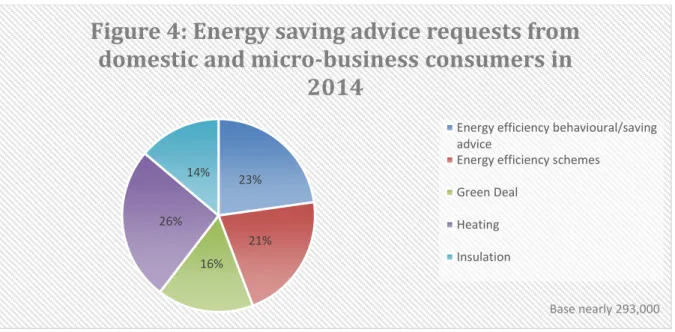
In order to keep warm, save money and/or benefit the environment, consumers may want to invest in energy efficiency measures. The information request revealed that in 2014, there were nearly 293,000 requests for advice about reducing energy usage. These are fairly evenly distributed between heating, energy efficiency behavioural/saving advice and energy efficiency schemes that help consumers take advantage of subsidised measures and installations. The Green Deal and insulation were also advice topics of note. Energy savings complaints did not arise in the data made available.
Ofgem research has shown micro-businesses to be keen to reduce their expenditure through using less energy, although they consider that they have too little time or money to invest in this. Consumers also have little experience of efficiency measures – what they can offer, how they work, and what their benefits and disadvantages are. This is problematic as increasingly energy efficiency advice is moving on from simple, easy-to-install measures
23%
21%
16%
26%
14%
Figure 4: Energy saving advice requests from domestic and micro-business consumers in
2014
Energy efficiency behavioural/saving advice
Energy efficiency schemes Green Deal
Heating Insulation
Base nearly 293,000
Page 25 of 88
such as light bulbs and insulation (such as cavities and lofts) to more complex measures that require tailored, on-site advice.
To engage in the energy efficiency market, having decided what measures to purchase or install, consumers will then need to work through the complex options and subsidies available to pay for these products. Problems with product and installation quality, performance and mis-selling will also create a demand for redress. Together, this means that advice and redress needs are already complex. If prices and supply shortages increase, it is possible that there will be increasing activity in the energy efficiency market, especially with further Government incentives. The emergence of new, more complex and costly technologies, particularly those to address hard-to-treat homes, will further add to advice needs.
Currently, through the Green Deal and ECO, the British Government is seeking to stimulate an energy efficiency market and increase the energy efficiency of homes and non-domestic premises. The Green Deal lets domestic and non-domestic consumers make energy efficiency improvements with some or all of the cost paid for from the savings on their energy bills. The financial, technical and administration skills are significant, especially since those responsible for calculating likely cost savings from different measures have not always agreed on the level of savings that will be feasible.
Investing in energy efficiency requires decisions about who is to provide in-home advice on the measures needed; the type of measures preferred; who is to supply and install (accredited or not?); how to use them and what to do if things don’t work as well as they should – either because of poor initial advice on the measures needed, poor workmanship or faulty products, or because the anticipated savings are not being achieved and/or mis- selling has occurred.
On top of these decisions, consumers need to decide how to pay – through Green Deal financing (that is, signing up to a Green Deal plan), self-financing, whether it is possible to access subsidised installation schemes such as ECO, the Green Deal Home Improvement Fund and those run by the Scottish or Welsh Governments, or some combination of these.
Collective purchasing of energy efficiency measures is a further alternative. Green Deal repayments will be collected through energy bills, with the risk of disconnection if consumers default on these charges, but advice will be necessary if alternative financial arrangements are needed due to a change in personal circumstances, or there are suspected or actual billing errors. Support to seek redress will be needed if the original advice on payments or forecasted savings was poor or misleading.
Consumers, especially vulnerable consumers, will need support through this complex series of decisions and to hold to account the parties responsible if problems arise. They will need to know where responsibility for the problem lies and who to contact. The rights and obligations of leaseholders, tenants, vendors and homebuyers when a Green Deal plan exists will also vary and need targeted advice.
ECO is a subsidy from energy suppliers that will work alongside the Green Deal to provide energy-saving home improvements. As with social tariffs and discounts, vulnerable consumers need support in obtaining secure access to ECO funds as information and pro- active recruitment by companies is insufficient to reach all those who could potentially
Page 26 of 88
benefit. It also opens up opportunities for misleading offers of support. Consumers may be misled to pay for a Green Deal assessment in order to ‘find out if they are eligible for ECO’, even though surveys are free under ECO. While some of the decision-making on choice of efficiency measures may be outside of consumers’ control, installation and performance issues may still arise and so create a demand for advice and redress provision.
The smart meter roll out programme is another Government initiative to encourage reduced energy usage. The business case for this is predicated on consumer use of the information these meters will provide on energy use in the home. To maximise the gains from these, many consumers may need support to interpret and act on the extra information on energy usage being made available to them. Again, consumer support is needed to tackle issues relating to usability (of both the meter and in-home display), installation, faulty products and switching energy providers, as well as protecting vulnerable consumers from opportunists and pressurised doorstep sales occurring opportunistically alongside the roll out. Consumer needs may also arise in relation to remote disconnection and remote switching to prepayment meters and data privacy. These issues add to the common current meter concerns of installation and operation. As with the Green Deal, any consumer resistance to the initiative jeopardises its success but also reduces the need for consumer-led advice and redress provision.
The increasing focus on the energy efficiency of the private rented sector will lead to increasing need for support amongst landlords and tenants.
3.2.4 Help to generate energy
The information request revealed that, in 2014, there were nearly 27,000 requests for advice about micro-generation and around 1,500 complaints. This volume is relatively small but this market is already substantial, with around 4,000 certified installers. Consumers may increasingly want (or in the future, need) to generate their own power through the use of renewable and low-carbon methods (for example, solar panels, wind turbines, heat pumps) in order to secure energy supplies, lower their bills and possibly earn money through selling back excess supplies to the grid. This may be especially valuable for homes that are off the gas network.
The British Government is seeking to move micro-generation into the energy mainstream and stoke demand with initiatives such as Feed-in-Tariffs (FITs) for small-scale electricity generation and the Renewable Heat Incentive (RHI) for commercial and domestic heat generation. The Welsh Government also wants to ensure communities have access to advice to help them co-operatively harness appropriate and proven renewable technology – such as hydro, solar, wind and biomass – for local electricity generation. The Scottish Government is similarly interested in supporting communities to develop energy projects and supports individual householders to use renewable energy systems.
The market has proven to be responsive to Government subsidies in the past and redress needs have reflected these changes. For example, 78 per cent of the Renewable Energy Consumer Code’s (RECC) complaints were accounted for by solar photovoltaics, and FITs are one of the top four consumer complaints (albeit only 1 per cent of all complaints). As the
Page 27 of 88
RHI further beds in, heating advice and redress needs are likely to increase, although the latter will be moderated by the effectiveness of consumer protection measures that the Government builds into the scheme.
Micro-generation products are technically complex and expensive. Already, interviewees felt there to be a shortage of independent, technically competent advice available on suitable renewable options that were specifically suited to the building and inhabitants’
needs. Moreover, these products and services are becoming widely promoted and there are instances of mis-selling (particularly to vulnerable consumers), and of contractual problems.
Consumers need reliable and independent advice about this increasingly important part of the energy sector, including interconnections with the Green Deal and smart metering.
Consumers also need reliable, independent advice on financing. Most of the complaints to RECC are concerned with issues around deposits and advance payments. The administration of Government financial incentives is also another area requiring consumer support.
As with energy savings options, advice on accreditation of advisors, products and installers, and responsibilities and consumer protections for problems at any point in the transaction, are needed. Consumers will require advice and support to ensure the benefits of new heating systems are delivered in practice. They will also need support if technical or workmanship issues arise. This is the third most frequent complaint to RECC.
Advice and redress providers have reported that these initiatives have indeed stoked increased use of their services in this area. One might also assume that, with energy supply shortages forecast, the EU’s 2020 renewables target and the focus of the British, Scottish and Welsh Governments on micro-generation and energy storage technologies, it is likely that its use will grow.
3.3 Preferences for how this support is provided
There is very little research with consumers about how they want advice and redress providers to operate. DECC commissioned research into high-level potential advice needs throughout Great Britain, but this is unpublished. However, there are a few useful studies, which indicate that energy consumers need advice that is as follows:
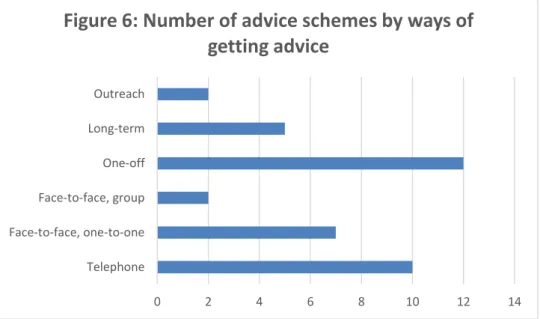
Takes different styles and formats. Ofgem’s 2014 evaluation of the benefits of eight energy advice services recommended a mixed economy of provision in advice services (that is, telephone or face-to-face, group or one-on-one, one-off or long-term) in order to better match advice with consumer needs.
Comprehensive and accurate. The advice provided needs to be up-to-date and reflect the breadth of issues consumers need to engage with in this complex, fast-moving sector. As part of their evaluation, Ofgem recommended greater co-operation and use of referrals between providers to better match consumers to the advice they needed.
Proactively supports those most in need. BIS reports that certain types of consumers have particularly low awareness of their rights and difficulties accessing advice (for example, low-income groups) so advice needs to reach out to those consumers least informed and at greatest risk of detriment.
Page 28 of 88
Offers practical support to those who need it. Consumers who have the additional challenge of personal drivers for change in their relationship with their energy provider, such as a change to their health, finances and home or business, are also likely to need more practical support from advice providers to help them secure the goods and services that are most beneficial to them. Ofgem found that practical support could be key for those more vulnerable consumers adopting advice, so this should be a priority when designing advice schemes. This is especially the case where the cost-benefit appraisal conducted by consumers when considering whether or not to change behaviour is more marginal.
Independent from energy providers. A 2013 EST survey found that 60 per cent of
domestic consumers were unwilling to take advice from energy firms on energy efficiency as a direct consequence of their distrust. Similarly, Ofgem found that some micro-
businesses would like more advice on energy efficiency measures but this needs to come from an impartial, and ideally a Government, source.
Free. Ofgem’s advice services evaluation and behavioural economics establishes that consumers will make cost-benefit analyses before taking action. Costs will act as a barrier to seeking advice and this may be why some consumer groups are less likely to seek support. Ofgem research supports this, with the finding that micro-businesses are less likely than larger businesses to use a broker for finding a supplier, partly because they do not think there are sufficient savings to be made, and partly because they perceive an additional layer of cost.
Ofgem research into use of the Energy Ombudsman identifies barriers to use of the redress scheme, indicating that consumers need redress provision that is as follows:
Well-known and understood. Low levels of awareness of redress provision and understanding of a redress provider’s role hinders usage. Advice about making a complaint and redress provision is therefore important. The Cabinet Office favours the use of a single ombudsman for each regulated sector (that is, only one for all energy matters) in order to maximise awareness and understanding.
Trusted to be fair and effective. As with advice provision, independence is important to consumers.
Hassle-free. Ofgem found that expectations of difficult exchanges with energy providers, followed by a drawn-out and complicated process, was a barrier to take- up. Although not explored, this may extend to offering practical support to consumers and being clear that the benefits of engaging in the process are worth the cost (that is, worth the hassle).
Page 29 of 88 Chapter 4
Definition of adequate energy advice and redress provision
The definition of adequate advice and redress provision is captured within a bespoke evidence-based assessment tool developed for this evaluation, but which also has equal relevance to other sectors. Unlike previous evaluations, this not only sets expectations of how advice or redress should be provided but prescribes what outcomes are desired, and sets out objective indicators to c