Trust Board Meeting in Public
Thursday 30 January 2020 10.00 – 12:40
Seminar Room 5, Learning and Research Centre, Southmead Hospital A G E N D A
No. Item Purpose Lead Paper Time
OPENING BUSINESS
1. Welcome and Apologies for Absence:
Tim Gregory
Information Chair Verbal 10:00
2. Declarations of Interest Information Chair Verbal 10:02
3. Patient Story Information Director of Nursing
& Quality
Verbal 10:05 4. Minutes of the Public Trust Board Meeting
Held on 28 November 2019
Approval Chair Enc. 10:25
5. Action Chart from Previous Meetings Discussion Trust Secretary Enc. 10:27 6. Matters Arising from Previous Meeting Information Chair Verbal 10:30
7. Chair’s Business Information Chair Verbal 10:35
8. Chief Executive’s Report Information Chief Executive Enc. 10:45 QUALITY
9. Board director walk-arounds Discussion Director of Nursing
& Quality
Enc. 10.55 10. Quality & Risk Management Committee
upward report
10.1. Safety Culture Survey pilot results
Information NED Chair Enc. 11:05
11. Patient & Carer Experience Committee upward report
Information NED Chair Enc. 11:15 PERFORMANCE AND FINANCE
12. North Bristol Trust Five Year Strategy 2019- 2024
Approval Medical Director Enc. 11.25 13. Integrated performance report Discussion Chief Executive Enc. 11.40 14. Audit Committee Upward report
14.1. Standing Orders & Standing Financial Instructions
Information Approval
NED Chair Enc 12:05
PEOPLE & IMT
15. People & Digital Committee Upward Report
Discussion NED Chair Verbal 12.25 CLOSING BUSINESS
16. Any Other Business Information Chair Verbal 12:35
17. Questions from the Public in Relation to Agenda Items
Information Chair Verbal -
No. Item Purpose Lead Paper Time
& Research Building, Southmead Hospital
Resolution: Exclusion of the Press and Public. It is recommended that, pursuant to the Public Bodies (Admission to Meetings) Act 1960, Section 1(2), the press and members of the public be excluded from further items of business, having regard to the
confidential nature of the business to be transacted, publicity on which would be
prejudicial to the public interest.
Trust Board Declarations of Interest
Name Role Interest Declared
Ms Michele Romaine Chair (from 1 July
2018) Nothing to declare.
Mr Kelvin Blake
Non-Executive Director (from 1 February 2019)
Non-Executive Director of Weston Area Health Trust.
Non-Executive Director of BRISDOC who provide GP services to North Bristol NHS Trust.
Trustee, Second Step. Provide mental health services for the Bristol North Somerset and South
Gloucestershire area.
Trustee, West of England Centre for Integrated Living. Provide a range of services to disabled people living in the Bristol, North Somerset and South
Gloucestershire area.
Lay Member of the Avon & Somerset Advisory Committee. The Committee is responsible for forming interview panels for the appointment of magistrates.
Director, Bristol Chamber of Commerce and Initiative.
Member of the Labour Party.
Ms Jaki Davis Non-Executive Director
Trustee of the Cheltenham Trust.
Trustees of the Friends of the Wilson Museum and Art Gallery in Cheltenham.
Mr John Everitt Non-Executive Director
Councillor, Newton St Loe Parish Council.
Member of Bath Abbey Appeal Committee.
Daughter works for NBT.
Professor John Iredale
Non-Executive Director
Pro-Vice Chancellor of University of Bristol.
Advisor to Novartis on liver disease.
Member of Medical Research Council.
Trustee of:
o British Heart Foundation
o Children's Liver Disease Foundation o Foundation for Liver Research
Chair of the governing board, CRUK Beatson Institute.
Mr Tim Gregory Non-Executive Director
Son-in-law works for NBT.
Name Role Interest Declared
Mr Robert Mould Non-Executive Director
Non-Executive Director of Weston Area Health Trust.
Member of Bristol Mediation.
Daughter works for NBT.
Ms Andrea Young Chief Executive Nothing to declare.
Ms Evelyn Barker
Chief Operating Officer & Deputy Chief Executive
Nothing to declare.
Ms Helen Blanchard
Interim Director of Nursing and Quality (from 2 July 2018 to 7 November 2019) Director of Nursing and Quality (from 8 November 2019)
Nothing to declare.
Dr Chris Burton Medical Director Wife works for NBT.
Mr Neil Darvill
Director of Information Management and Technology (non- voting position)
Wife works as a senior manager for Avon and Wiltshire Partnership Mental Health Trust.
Ms Jacqui Marshall
Director of People and Transformation (non-voting position)
Nothing to declare.
Mrs Catherine
Phillips Director of Finance Nothing to declare.
Mr Simon Wood
Director of Estates, Facilities and Capital Planning
(non-voting position)
Nothing to declare.
DRAFT Minutes of the Public Trust Board Meeting held on Thursday 28 November 2019 at 10.00am
Seminar Room 5, Learning & Research Building, Southmead Hospital Present:
Michele Romaine Kelvin Blake John Everitt Tim Gregory Jaki Meekings- Davis
Prof John Iredale Rob Mould
Chair
Non-Executive Director Non-Executive Director Non-Executive Director Non-Executive Director
Non-Executive Director Non-Executive Director
Helen Blanchard
Evelyn Barker
Dr Chris Burton Neil Darvill Catherine Phillips Jacqui Marshall
Interim Director of Nursing &
Quality
Chief Operating Officer Medical Director
Director of Informatics Director of Finance Director of People &
Transformation In Attendance:
Xavier Bell
Isobel Clements
Director of Corporate
Governance & Trust Secretary Corporate Governance Officer
Stephen Lightbown Andrew Jeanes
Director of Communications Director of Operational Facilities
Presenters:
Kacie Gibson*
Brenda Dowie*
Dr Jane Mears*
Lauren Cole*
Deputy Antenatal and new- born Screening Coordinator/
Foetal Medicine Midwife Lead Chaplain, Department of Spiritual Care
Consultant Gynaecologist &
Obstetrician
Bereavement Midwife
Dr Hadi Waheed*
Sarah Chalkey**
Sarah Lidgett**
Sue Mallett**
Dr Kathryn Holder***
Registrar
Deputy Head of Nursing/
Lead Nurse ASCR Clinical matron, Medicine Clinical matron, NMSK Consultant Anaesthetist, Guardian of Safe Junior Doctor Working
*Attended for up to and during minute no.04, **Attended for up to and during minute no.09, *** Attended for minute no.19 only.
Observers: Ten members of staff / public attended.
Apologies:
Andrea Young Simon Wood
Chief Executive
Director of Estates, Facilities & Capital Planning
TBC/19/11/01 Welcome Action
The Chair welcomed everyone to the public meeting of the Board and noted the high number of public and staff in attendance.
TBC/19/11/02 Apologies For Absence and Welcome
The Board noted that apologies for absence had been received from Andrea Young, Chief Executive and Simon Wood, Director of Estate &
Facilities.
TBC/19/11/03 Declarations of Interest
There were no declarations of interest declared nor updates to the Trust Board register of interests as currently published on the NBT website and annexed to the papers.
TBC/19/11/04 Patient Story / Staff Story
Dr Jane Mears read out a letter of thanks received by Andrea Young, Chief Executive, from parents, Sam and Dan, describing their
experience after learning that their baby boy’s heart had stopped
4
2 beating at 18 weeks gestation.
They praised NBT for its carefully planned process, care, compassion and the respect the staff gave to them and their baby Harry. This included services provided by NBT which were not provided by all Trusts such as funeral and burial for babies who die between 13 and 40weeks gestation and a memory box to take home.
Those mentioned in the letter had been thanked personally by Andrea Young and the Board also added their thanks.
Key observations and questions from the Trust Board and staff involved who were in attendance were as follows:
o The bereavement midwife role and the multi-disciplinary team was invaluable to provide the best care and support for patients, family and fellow staff;
o It was noted second trimester pregnancy loss was not uncommon on the Cotswold Ward, a gynaecology ward, and therefore co- location with maternity was key;
o It was noted that 20-weeks’ gestation elicited one to one midwife care, whereas at 20-weeks and below, patients are cared for on Cotswold ward which has a higher staff to patient;
o It was noted that a large amount of staff time and effort was required to provide a service that helps reduce negative impact on patient’s long-term mental health;
o Staff present confirmed that although the work was emotionally challenging, staff felt positive that they are able to provide individualised care for patients and families;
o The importance of treating the whole family/couple was noted.
RESOLVED thanked on behalf of the Trust Board for sharing the story and staff thanked for all they did and continue to do.
TBC/19/11/05 Minutes of the previous Public Trust Board Meeting
RESOLVED that the minutes of the public meeting held on 26 September 2019 be approved as a true and correct record.
TBC/18/11/06 Action Log and Matters Arising from the Previous Meeting The below actions were clarified:
A proposal regarding the non-executive walk-arounds would be brought to December/ January Trust Board;
Risk Management Committee action to be brought to January’s Trust Board.
RESOLVED that the updates to the Action Log be received and approved.
TBC/19/11/07 Chair’s Business
The Chair provided an update on the following:
Andrea Young, Chief Executive, had received an Honorary
Doctorate awarded by the University of West England (UWE). The
4
3
Chair noted this was a fantastic achievement Helen Blanchard, Director of Nursing and Quality was congratulated on her
substantive appointment and formally welcomed as a member of Trust Board.
RESOLVED that the Chair’s verbal update be noted.
TBC/19/11/08 Chief Executive’s Report
The Board considered the Chief Executive’s report, presented by Evelyn Barker, Chief Operating Officer and Deputy Chief Executive in Andrea Young’s absence. The following points were highlighted:
NBT had received a visit from Health Education England which was successful;
NBT was recognised by UWE for its excellence especially regarding student approval ratings and Emergency Medicine at the Trust was recognised as outstanding by the General Medical Council. NBT was also recognised as the largest placement provider in the South West and had been asked for further placements to be made available. John Iredale, NED, stated NBT was a fantastic partner to University of Bristol as well as UWE;
NBT, University Hospitals Bristol (UHB) and Weston Area Heath Trust (WAHT) were aiming to become an Academic Health Science Network (AHSN) (interview process in February). It was noted this was positive cross-working in building the Bristol ‘brand’. John Iredale, noted the AHSN label would give the Trust leverage nationally and with key authorities such as Local Government;
New national pension guidance issued varied slight from the pension scheme Trust Board had previously approved.
NBT’s Chair and Chief Executive signed off BNSSG’s Long-Term Plan for submission to NHSI at the most recent STP Partnership Board in line with delegated authority from the Board.
RESOLVED that the Chief Executive’s report be noted and the pension issue to be discussed at People & Digital Committee in December.
TBC/19/11/09 Pressure injury improvement programme
Helen Blanchard, Director of Nursing & Quality introduced
Sarah Chalkey, Deputy Head of Nursing/ Lead Nurse ASCR, Sarah Lidgett, Clinical Matron (Medicine) and Sue Mallett, Clinical Matron (NMSK) who presented the achievements to date and the planned next steps of the pressure injury improvement programme (PIIP).
The PIIP stemmed from an action from the Board after presentation of a paper that evidenced a raised incidence of pressure injuries (PI) in the Trust. The PIIP focussed on three main areas to reduce incidents of PIs: (i) Documentation; (ii) education & training; and (iii) monitoring &
assurance.
Key comments and questions from the Board:
o John Everitt, NED, acknowledged the impressive dedication to the
4
4
PIIP but queried what targets would be used to monitor progress. It was confirmed that compliance targets and competency training would be detailed on Lorenzo with the overall target being a reduction in PI. Additionally, in future the PIIP hoped to encourage comparability across services within BNSSG;
o It was confirmed the Trust had had positive feedback on Trust-wide PI training and was also working with UWE pre-registered and in- training nurses to ensure PIs were at the forefront of clinical training;
o It was confirmed that a process was in place for ensuring patients had the correct PI care on discharge. This process included incorporating photos of PIs in the care summary for community teams;
o It was clarified that PI incidences were lower on patient-mobile wards such as Elgar and highest on high dependency wards;
o It was noted work was ongoing to gain comparator data of specific wards for example, ICU had a high incidence of PIs within the Trust but data from other Trusts had been requested for a benchmarking exercise;
o The Board were assured a PI risk assessment to identify PIs or risks of PI was completed within six hours of admission.
RESOLVED:
The Board were assured on the activity and progress of the Pressure Injury Incident group since July 2019;
Presenters were thanked for their attendance and for their clear view on how to tackle PI incidence across the Trust.
TBC/19/11/10 Patient & Carer Experience Committee upward report Rob Mould, NED, presented the Patient & Carers Experience Committee (P&CEC) upward report and described escalations to the Board as follows:
Assess the organisation’s disability confidence and accelerate work on information accessibility (prioritising Accessible Information Standards business cases);
Support a clear methodology for learning from complaints and PALS pilot;
Action P&CEC if further deep-dives into Quality Elements of the IPR need further investigation.
Key comments from the discussion were as follows:
o NBT was confirmed as compliant for accessibility standards and the CCG had acknowledged the Trust was furthering its work around this especially regarding learning difficulties and autism. However, it was noted assurance could be greater for other disabilities;
o P&CEC had useful insight from a visually impaired patient who attended November’s meeting;
o P&CEC would receive a further update on patient transport issues in
4
5 May 2020.
RESOLVED:
Received and noted the P&CEC upward report;
Agreed to increased reporting of accessibility standards work at NBT to Board in 2020/21;
Tasked P&CEC committee with overseeing the Disability Confident scheme’s NBT self-assessment after scoping of resource required.
XB XB
TBC/19/11/11 Complaints annual report
Helen Blanchard presented the Complaints Annual Report for
information. The report was described as predominately quantitative but a commitment had been made as part of the Quality Strategy that learning from complaints would be triangulated with feedback received from the Family & Friends Test (FFT) and local surveys.
Key comments from the discussion that ensued were as follows:
o Tim Gregory, NED, highlighted that moving to electronic feedback in day-care and the chemotherapy centre had elicited a drop in the number of patient responses received. Tim Gregory requested continuation of alternative and broader feedback opportunities.
Helen Blanchard advised that the Trust was looking at collecting feedback differently which complemented changes to the FFT due in April 2020. This process was confirmed to be owned by P&CEC.
o It was noted that the number of complaints to the Trust overall had risen. The Board noted the positive aspects of this as the following:
it suggested increased engagement with patients; it provided further learning opportunities and it allowed more opportunities for the Trust to ‘turn around’ a complaint into a positive interaction as the way in which complaints are dealt with was key to bettering the patient experience and perceptions of the Trust;
o It was further noted that compliments in general are not reported at the same rate as complaints;
o The Trust was commended on the improvement in timeliness of complaint responses;
o It was confirmed that all of the Trust’s responses to complaints were signed off by an Executive Director and most often by the Chief Executive;
o It was suggested that more could be done to follow-up responses to complaints i.e. a phone call to check if the complainant was satisfied with the response. The Chair noted support for this process which could be provided by PALS.
RESOLVED:
Noted the complaints annual report;
Requested that future complaints reports contained additional information about patient satisfaction with complaint responses.
4
6
TBC/19/11/12 Quality & Risk Management Committee Upward Report
Professor John Iredale, NED and chair of the QRMC commended the QRMC Upward report to the Board for assurance with no issues to escalate but key approvals requested.
RESOLVED:
Approved the revised wording for BAF SIR14;
Noted the positive 14 day turn-around time for cervical screening (99.28% compared to the national average 52%);
Approved the QRMC’s revised Terms of Reference;
Approved the revised 7day services audit for submission to regulators.
TBC/19/11/13 Six-monthly safer staffing report
Helen Blanchard presented the six-monthly safer staffing report which outlined the progress to date and further actions planned to ensure staffing levels were safe to meet the needs of patients, were effectively managed, and were being published in
accordance with the national quality standards. Key points were as follows:
All adult patient areas were assessed for staffing levels bar NICU and ICU which had their own, specific staffing standards.
Regarding maternity, the Trust was commissioning a separate Birth- rate Plus review (including Cossham) which would be brought back to Board for assurance when completed.
Overall, the report evidenced that staffing levels were appropriate to meet the requirements of patients;
Some areas were challenged by numbers of vacancies, sickness and mental health nurses to support patients;
Increases in staffing recruitment such as international nursing programme would improve staffing levels in the future;
The Board were assured that staffing levels were reviewed two to three times daily across all inpatient areas to ensure safety and identification of hotspots.
RESOLVED:
The six-monthly safer staffing report was noted;
It was agreed the safer staffing report would be deep-dived at a future People & Digital Committee;
It was agreed a reflection of the system context should be
included in future staffing reports; HB
TBC/19/11/14 Integrated Performance Report – October 2019
Evelyn Barker introduced the Integrated Performance Report (IPR) for October 2019 data. Key highlights of the IPR were as follows:
Third month in a row of strong urgent care performance especially in comparison to local Trusts;
Reduction in overall waiting list size which was positive especially
4
7
regarding the sustained pressure on the Trust;
The Trust had achieved the endoscopy target in a shorter timeline than expected due to outsourcing;
A large spike in demand for CT scanning was highlighted with the Trust investigating options for dealing with this.
Key comments from the Board were as follows:
o Professor John Iredale, NED and also pro-vice chancellor Health &
Life Sciences at the University of Bristol, highlighted that the Universities had an under-utilised CT scanner;
o Jaki-Meeking Davies, NED, noted the delay of transfers figures were high. Evelyn Barker confirmed the latest data showed times had improved but that numbers of stranded patients greater than 21 days continued to increase. The Board were assured regular system-wide conversations were taking place regarding this;
o John Everitt, NED, recognised that with the exception of diagnostics, the Trust was on track with revised trajectories;
o The Board were assured the four patients who had breached the 12-hour trolley target had access to an alarm and were cared for in a bed in ED with regular monitoring for hydration, pain and food.
Additionally, Datix reports were undertaken for each breach;
o Catherine Phillips, Director of Finance, highlighted the Trust was behind plan but predicting to meet its control total. John Everitt, NED and F&PC chair, confirmed the Trust was predicting to meet outturn but that there was a significant number of risks to achieving the difficult target.
RESOLVED that:
The IPR be noted;
Board concerns be acknowledged and fed into Urgent Care Oversight Board discussions;
Further discussions offline to be had regarding University of Bristol’s CT scanner;
Further peer comparison requested regarding meeting of targets.
EB/JI
TBC/19/11/15 Month 6 2019/20 corporate objectives update
Catherine Phillips presented the month six 2019/20 corporate objectives which had been updated from the IPR and the F&PC. It was noted that the Trust’s position was more positive than the red indicators within the report suggested.
RESOLVED:
Noted the Month 6 2019/20 corporate objectives update;
Requested F&PC to deep-dive the objectives and risk mitigations in February 2020;
Prioritisation of the Trust’s objectives to be completed and CP
4
8 denoted within future reports.
TBC/19/11/16 Freedom to speak up 6-monthly report
Xavier Bell, Director of Corporate Governance and Trust Secretary, presented the Freedom to speak up (FTSU) 6-monthly report and highlighted the following points to the Board:
The number of concerns reported to FTSU had increased to the national average in the last six months though it was noted Q1 and Q2 did not currently have comparative data;
It was noted that no staff who had raised a concern felt they had experience detriment. This was a reduction since the previous annual FTSU report;
Future reports would include triangulation of data such as happy app and staff survey results;
From CQC feedback, FTSU had further incorporated Staff Side Union colleagues into policy reviews and meetings;
It was noted NBT’s FTSU scheme had good involvement from junior doctors;
Guardian well-being was supported through training, well- attended quarterly FTSU meetings and Xavier Bell as lead.
There was discussion around how other Trusts created and ran FTSU within their Trusts. Xavier Bell described variance nationally as some Trusts employed a dedicated FTSU Guardian and others had multiple volunteer FTSU Guardians who meet regularly.
RESOLVED:
Agreed a self-review tool for FTSU be confirmed at a future Board seminar workshop;
Noted the FTSU report with agreement that visibility to Board was important;
Agreed to a FTSU internal audit in 2020/21;
FTSU Guardians were thanked for volunteering their time. XB TBC/19/11/17 Any Other Business (AOB)
No other business was raised.
TBC/19/11/18 Questions from the Public in Relation to Agenda Items
A member of the public raised three questions on the topic of refugees accessing healthcare:
‘1. How will North Bristol NHS Trust monitor cases of harm and distress resulting from the implementation of the charging regime - and make this information publicly available?
2. How are patients who are charged for or denied care supported so that the bills they receive do not do irreparable financial damage and drive them to avoid accessing further care?
3. How are the costs, charges and income generated being evaluated by the Trust on an on-going basis to ensure that the implementation of the policy can be justified?’
The Board thanked the member of public for their questions and confirmed a full, written response would be communicated in due course. Board members further provided assurance that the Trust
4
9
would always provide urgent treatment to someone who needed it. It was also noted that the Trust were acting in line with National Government policy.
RESOLVED to provide a full written response to the questions provided by the member of public.
XB TBC/19/11/19 Annual guardian of safe working (junior doctors) report
Chris Burton introduced Dr Kathryn Holder whose role as guardian of safe working was created as part of the junior doctors contract, 2016.
Dr Kathryn Holder noted the following:
At the Junior Doctor Forum, availability and choice of food during anti-social hours shifts was highlighted as a key concern;
A review of junior contract hours had stipulated a reduction of weekend working frequency from 1 in 2 to 1 in 3 and doctors should receive rotas with 6-8 weeks-notice;
Since writing the report, vacant appointments in Trust junior- doctors staffing had reduced to three;
The Board was assured that the Trust was on track to be compliant in February 2020 for the 1 in 3 weekend rotas in ITU and for 72-hour week maximums.
Rob Mould, NED, also highlighted the lack of hot food facilities for patients and visitors to Southmead Hospital. Andrew Jeanes, Director of Operational Facilities, confirmed the Trust was in conversations with The Hospital Company (PFI provider) and hoped provision of a new food outlet including hot food would be available in 2020.
RESOLVED
Noted the annual guardian of safe working report;
Requested a discussion/ workshop with shift staff to provide potential options for out-of-hours food;
Kathryn Holder to continue to attend People & Digital Committee quarterly.
AJ/KH
TBC/19/11/20 Date of Next Meeting
The next public meeting of the Board was scheduled to take place on 30 January 2020 at 10.00am, Southmead Hospital.
The meeting concluded at 12.15pm
4
Meeting Date
Agenda Item Minute Ref
Action No.
Agreed Action Owner Deadline for
completion of action
Item for Future Board Meeting?
Status/
RAG
Info/ Update Date action was closed/
updated
30/05/2019 Quality and Risk Management Committee Report
TBC/19/
5/11
2 Review format of Exec / Non-Exec Walkrounds
Helen Blanchard Director of Nursing
& Quality
Aug-19 Yes,
29/08/2019 A
On January public trust Board agenda
28/11/2019
28/11/2019 IPR – October 2019
TBC/19/1 1/14
14 Further discussions offline to be had regarding University of Bristol’s CT scanner
Evelyn Barker, COO & John Everitt, NED
TBC No Open Andrew Pearce is
facilities manager at the Universities
23/01/2020
28/11/2019 Questions from the Public in Relation to Agenda Items
TBC/19/1 1/18
18 Provide a full written response to the questions provided by the member of public
Xavier Bell, Director of Governance
Jan-20 No Compl
ete
A response was provided in December 2019
22/01/2020
Trust Board (Public) - 10.00am, Seminar Room 5, L&R-30/01/20
1
This document could be made public under the Freedom of Information Act 2000.Any person identifiable, corporate sensitive information will be exempt and must be discussed under a 'closed section' of any meeting.
Report To: Trust Board Meeting Agenda
Item:
8.0 Date of Meeting: 30 January 2020
Report Title: Chief Executive’s Briefing Report Author & Job
Title
Xavier Bell, Director of Corporate Governance & Trust Secretary Executive/Non-
executive Sponsor (presenting)
Andrea Young, Chief Executive
Purpose: Approval/Decision Review To Receive for
Assurance
To Receive for
Information X Recommendation: The Trust Board is asked to receive and note the content of the
briefing.
Report History: The Chief Executive’s briefing is a standing agenda item on all Board agenda.
Next Steps: Next steps in relation to any of the issues highlighted in the Report are shown in the body of the report.
Executive Summary
The report sets out information on recent updates from our regulators, changes in senior leadership within the Trust, and other items of importance to the Board.
8
2
This document could be made public under the Freedom of Information Act 2000.Any person identifiable, corporate sensitive information will be exempt and must be discussed under a 'closed section' of any meeting.
Strategic
Theme/Corporate Objective Links
Be one of the safest trusts in the UK
Play our part in delivering a successful health and care system
Board Assurance Framework/Trust Risk Register Links
Does not link to any specific risk.
Other Standard Reference N/A
Financial implications None identified.
Other Resource Implications
No other resource implications associated with this report.
Legal Implications including Equality, Diversity and Inclusion Assessment
None noted.
Appendices: Appendix 1 – Flu Vaccination Figures – 16 January 2020
Appendix 2 – Transforming health through innovation: Integrating the NHS and academia (Summary)
8
3
This document could be made public under the Freedom of Information Act 2000.Any person identifiable, corporate sensitive information will be exempt and must be discussed under a 'closed section' of any meeting.
1. Purpose
To present for information an update on local and national issues impacting on the Trust.
2. Background
The Trust Board should receive a report from the Chief Executive to each meeting detailing important changes or issues in the external environment. This includes guidance and policy actions which have been received from the wider regulatory and policy system, quality and financial risks in the health economy.
3. New clinical performance standards
Recent media reports have highlighted that there is likely to be a change to emergency department performance standards, including the current A&E 4 hour wait standard. A number of Trusts nationally have been piloting new clinical standards since they were first recommended in a review led by NHS England’s national medical director in March 2019.
At the time of writing this report, providers have not received any formal notification that standards will change in 2020/21; however annual planning guidance is expected to be released in late January 2020 which may provide further information on changes and a timeframe of implementation.
4. Local Members of Parliament
Trust Board will be aware that the recent national election (December 2019) did not result in any changes to local Members of Parliament in Bristol or South Gloucestershire.
The Right Honourable Chris Skidmore, MP for Kingswood, currently holds the Government post of Minister of State (Department for Business, Energy and Industrial Strategy) (Universities and Science) (Joint with the Department for Education).
Luke Hall, MP for Thornbury and Yate, currently holds the Government post of Parliamentary Under-Secretary (Housing, Communities and Local Government).
5. Academy of Medical Sciences new report
The Academy of Medical Sciences has published a new report “Transforming health through innovation: Integrating the NHS and Academia”. The report calls for better integration of academic and clinical activity and career pathways. Across the two Bristol Trusts there is a considerable volume of research activity, with NBT increasingly performing well in research income and activity. Executives from the two Trusts and the Universities will consider how we can build on the current platform.
A summary of the report is attached at Appendix 2.
8
4
This document could be made public under the Freedom of Information Act 2000.Any person identifiable, corporate sensitive information will be exempt and must be discussed under a 'closed section' of any meeting.
6. Out of hospital care
Changes to the GP contract in the context of establishing Primary Care Networks are currently out for consultation with NHS England due to respond before the start of the new financial year. Staffing shortages, similar to those experienced in the hospital sector are being highlighted as creating difficulties in meeting some of the contract standards, particularly those concerned with medication reviews in nursing homes, and the development of anticipatory care. We await the outcome of the consultation to determine pace of change in building primary care networks and localities.
More encouragingly Sirona as the new community provider have appointed Executive Directors to support integration in each of the six localities in Bristol, North Somerset and South Gloucestershire. A presentation on their vision and progress with implementation was shared with TMT this week.
7. Protecting NHS staff
We welcome the announcement by NHS England and Improvement that a new joint agreement has been signed with the Crown Prosecution service to ensure there is effective investigation and prosecution of cases where emergency workers are the victims of crime and physical violence. This puts strength behind the current legislation “Assaults on Emergency Workers (offences) Act”. The new agreement is effective from 6 January 2020.
Our most recent staff survey suggests a worsening picture for staff experiencing physical violence at work at NBT, so action in this area nationally and locally remains a top priority.
8. Thornbury outpatients facility
The new Thornbury outpatient unit opened its doors on 23 December 2019. This involved the relocation of various outpatient services from the Thornbury Hospital site to a precinct in the centre of Thornbury. This has allowed the old site to be closed, while still retaining a local service for the residents of Thornbury.
There are four outpatient rooms in the new unit which currently support gynaecology, colorectal, respiratory medicine and audiology outpatient appointments, as well as community midwifery activity. So far there has been positive user feedback and a good demand for the services offered at the new site.
9. System planning 2020/21
Following submission of the system long term plan in November 2019, focus has now shifted to developing an implementation plan for 2020/21. Regulators have now confirmed revenue support for the Weston transaction, and alongside this there is
8
5
This document could be made public under the Freedom of Information Act 2000.Any person identifiable, corporate sensitive information will be exempt and must be discussed under a 'closed section' of any meeting.
an expectation that the BNSSG system plan for 2020/21 will achieve a financial trajectory agreed with regulators.
Currently a number of system partners are reporting a variance from this trajectory which totals £29M. Work is underway at executive level to try and close this gap.
10. Consultant appointments
In quarter 3 of 2019/20 the Trust appointed eight new consultants across several key specialties:
Name: Specialty: Appointed from:
Anthony Cox Diagnostic/Interventional Neuroradiology October 2019 Fleur Talbot Diabetes & Endocrinology October 2019
Helen Johnston Anaesthetics November 2019
Thomas Mayes Medicine for Older People November 2019
Chih Wong Cardiology November 2019
Jay Nath Renal Transplant Surgery December 2019
Sananda Halder AbdominoPelvic Radiology December 2019
Zoe Jones Acute Medicine December 2019
Trust Board is invited to welcome these critical members of staff to the Trust – we wish them well in their career at NBT.
11. Flu vaccinations
The 2019/20 seasonal flu vaccination campaign continues and will run until the end of February 2020. The vaccination programme includes 84 peer vaccinators along with 45 hours per week bank shifts to ensure a wide coverage across the Southmead site and satellite units.
The national requirement, linked to the flu vaccine CQUIN is that 80% of frontline healthcare workers receive a vaccination. As at 16 January 2020 the Trust has achieved 80.7% of all frontline staff vaccinated. A further breakdown is provided in Appendix 1.
12. Use of the Trust Seal
Trust Board should note that the following contracts have been executed on behalf of the Trust under seal, in accordance with the Standing Orders and Scheme of Delegated Authority:
8
6
This document could be made public under the Freedom of Information Act 2000.Any person identifiable, corporate sensitive information will be exempt and must be discussed under a 'closed section' of any meeting.
Contract: Date sealed:
Cribbs Causeway (Lease) 19/09/2019
Construction contract - refurbishment of BCRM building to facilitate move outpatients & imaging
19/09/2019 Shirehampton Health Centre – Licence to underlet
(Community Midwifery)
19/09/2019 Residential accommodation for overseas nurses, Bristol
(Lease)
02/10/2019 Residential accommodation for overseas nurses, Bristol
(Lease)
21/10/2019 Licence for alterations, Beckspool Road, Frenchay (BIRU) 21/10/2019
East Trees Health Centre (Lease)
VWV Lease
Statutory Declaration
03/10/2019
JCT Intermediate Building Contract – Phase 2 Pathology Programme
12/11/2019
Residential Lease, Bristol 20/11/2019
Hope Farm, Thornbury – Overage Agreement (Deed of Covenant)
27/11/2019 Hope Farm, Thornbury, Deed of Priority 27/11/2019
Sale of Land (Frenchay) 18/12/2019
Retail Leases at Southmead Hospital (Licence for works) 19/12/2019 13. Recommendation
The Trust Board is recommended to receive the report for information.
8
This document could be made public under the Freedom of Information Act 2000.
1
Any person identifiable, corporate sensitive information will be exempt and must be discussed under a 'closed section' of any meeting.
Report To: Trust Board Meeting Agenda
Item:
8.0
Date of Meeting: 30 January 2020
Report Title: Board Director walk arounds Report Author & Job
Title Xavier Bell, Director of Corporate Governance & Trust Secretary Executive/Non-
executive Sponsor (presenting)
Xavier Bell, Director of Corporate Governance & Trust Secretary
Purpose: Approval/Decision Review To Receive for
Assurance
To Receive for
Information X
Recommendation: The Trust Board is asked to discuss and approve the proposed approach to Board Director walk-arounds.
Report History: This paper provides a response to an action arising from the May Trust Board meeting asking for a proposal for Board Director walk-arounds.
Next Steps: Next steps in relation to any of the issues highlighted in the Report are shown in the body of the report.
Executive Summary
The series of slides (Appendix 1) sets out a proposal for Board Director walk-arounds at North Bristol Trust. These slides will be presented at the Board meeting, and the Board is invited to consider and discuss the proposal. Approval is sought for the recommended option.
9
This document could be made public under the Freedom of Information Act 2000.
2
Any person identifiable, corporate sensitive information will be exempt and must be discussed under a 'closed section' of any meeting.
Strategic
Theme/Corporate Objective Links
Be one of the safest trusts in the UK
Board Assurance Framework/Trust Risk Register Links
N/A
Other Standard
Reference N/A
Financial implications None identified.
Other Resource
Implications No other resource implications associated with this report.
Legal Implications including Equality, Diversity and Inclusion Assessment
None noted.
Appendices: Appendix 1 – Board Director walk-around slides Appendix 2 – Board Director walk-around template
9
Board Director Walk- arounds
Purpose & Process – for discussion
Trust Board (Public) - 10.00am, Seminar Room 5, L&R-30/01/20
Purpose:
• Visibility of Board Members
• Engagement with front-line staff
• Insight and exposure for Non-Executives
• Coaching & conversations NOT:
• Recording actions / “rescuing”
• A safety audit (note that Ward Accreditation is planned for 2020)
Trust Board (Public) - 10.00am, Seminar Room 5, L&R-30/01/20
Process:
Annual Board seminar/discussion covering:
• Purpose & Process
• Senior front-line staff to be involved – sharing their experience of, and what they get out of the process
• Board discussion on priority areas for visits
• Culminates in a 12 month schedule of visits for Execs and NEDs
• “self-rostered” – option to step in to cover absence
Trust Board (Public) - 10.00am, Seminar Room 5, L&R-30/01/20
For discussion:
Option 1: (Recommended) NED &
Exec undertaking visits together
Option 2: Separate visits Opportunity for NEDs & Execs to
spend time together
Less “VIPs” descending on a location at once
Exec able to navigate and provide introductions if required
NED opportunity to have
discussions/triangulate without Execs present
• Proposed frequency is quarterly for Executives, and twice yearly for Non-Executive Directors
• Suggest that whatever conclusion is reached, new NEDs accompany an Exec for first few visits
Trust Board (Public) - 10.00am, Seminar Room 5, L&R-30/01/20
Process (continued):
Visits & Outcomes:
• Directors take their own notes
• Simplified template, consistent across both Execs and NEDs
• Opportunity for senior manager to accompany NED, but not a requirement
• PA/Admin to ensure ward manager meet’s Director on arrival
• Notes shared with Xavier Bell & Su Monk
• Visit numbers and themes reported to QRMC
Trust Board (Public) - 10.00am, Seminar Room 5, L&R-30/01/20
Board Director Walk-arounds
Ward / Clinical Area Date & Time Executive/Non- Executive
Individuals spoken to (please only use patient’s first name or initial, and staff member’s role):
e.g. ward housekeeper Patient M
Director’s Observations
Good practice I heard about: Concerns heard:
Director Impression (indicate):
Staff morale J K L **
Patient
experience J K L **
Physical
environment J K L **
Overall
impression J K L **
**HELP… - indicates serious safety concern, requires immediate feedback to relevant Director
9
Discussions with Staff Prompts…
∑ How’s it going today?
∑ Do you like working on this ward/in this team?
∑ Is it a supportive environment?
∑ Do you know about the staff wellbeing offerings?
∑ Did you feel enabled to provide the best care for your patients this week?
∑ What are you proud of this week?
∑ What are your top three concerns?
∑ How does communication between staff either help or hinder safe care on your ward?
∑ How can we help you to undertake activities that improve safety and patient experience?
∑ Did you discuss with your manager any incidents / complaints that have been reported?
∑ Do you know what happened following the reported incident(s) / complaints?
∑ Is there anything you want to ask me? Do you have any ideas or good practice to share?
Discussions with Patient and/or Relatives Prompts…
∑ How has your stay with us been?
∑ Do you know when you’re leaving hospital?
∑ (If yes) Are you confident the arrangements are in place?
∑ (If no) Do you know what you are waiting for?
∑ Is there anything the staff have been doing really well?
∑ Is there anything we could do better?
Please now:
∑ Complete this form and share it with Su Monk & Xavier Bell
9
This document could be made public under the Freedom of Information Act 2000.
Any person identifiable, corporate sensitive information will be exempt and must be discussed under a 'closed section' of any meeting.
1
Report To: Trust Board Agenda
Item: 10
Date of Meeting: 23 January 2020
Report Title: Quality & Risk Management Committee Report Report Author & Job
Title
Xavier Bell, Director of Corporate Governance & Trust Secretary
Executive/Non- executive Sponsor (presenting)
Professor John Iredale, Quality and Risk Management Committee Chair, Non-executive Director
Purpose: Approval/Decision Review To Receive for
Assurance
To Receive for
Information X
Recommendation: The Trust Board should receive the report for assurance and:
∑ Note in particular the Committee’s conclusion that the Trust continues to comply with the CNST maternity standards; and
∑ Consider the emerging NHS patient safety survey and the Trust’s patient safety culture work as possible future away- day topics.
Report History: The report is a standing item to the Trust Board following each Committee meeting.
Next Steps: The next report will be received at the Trust Board in March 2020.
Executive Summary
The report provides a summary of the assurances received and items discussed and debated at the Quality and Risk Management Committee Meeting held on 23 January 2020.
10
This document could be made public under the Freedom of Information Act 2000.
Any person identifiable, corporate sensitive information will be exempt and must be discussed under a 'closed section' of any meeting.
2 Strategic
Theme/Corporate Objective Links
∑ Be one of the safest trusts in the UK
∑ Treat patients as partners in their care
Board Assurance Framework/Trust Risk Register Links
Link to BAF risk SIR14 relating to clinical complexity.
Other Standard Reference CQC Standards.
Financial implications No financial implications identified in the report.
Other Resource Implications
No other resource implications identified.
Legal Implications including Equality, Diversity and Inclusion Assessment
None identified.
Appendices: Appendix 1: Safety Culture Survey Report – QRMC January 2020
10
This document could be made public under the Freedom of Information Act 2000.
Any person identifiable, corporate sensitive information will be exempt and must be discussed under a 'closed section' of any meeting.
3 1. Purpose
To provide a highlight of the key assurances received, items discussed, and items for the attention of Trust Board from the Quality and Risk Management Committee meeting held on 23 January 2020.
2. Background
The Quality and Risk Management Committee is a sub-committee of the Trust Board. It meets bi-monthly and reports to the Board after each meeting. The Committee was established to provide assurance to the Trust Board on the effective management of quality governance and risk management.
3. Key assurances received & items discussed
The Committee focused its discussions on the following items:
3.1 Safety culture survey
The Medical Director provided an update on actions being taken by the Trust arising from the Professor Durkin report. It was noted that these actions are progressing appropriately.
The Committee also received a report on the pilot of a safety culture survey in
Gynaecology and Pathology. This report included triangulation of safety culture information from a variety of sources, including:
∑ The Trust’s Quality Improvement Programme
∑ The Perform Academy
∑ The Trust’s staff wellbeing programme
∑ The Clinical Governance Improvement Programme
∑ Results from the Trust’s recent CQC inspection
∑ 2018 staff survey results
∑ 2019 SCOR safety culture survey results in maternity
∑ The Freedom to Speak Up programme
∑ The “Just Culture” transformation project, focusing on the management of disciplinary and grievance cases
The safety culture pilot in Gynaecology and Pathology used a version of the Safety
Attitudes Questionnaire (SAQ) adapted to be NHS context-specific. Trust Board should be assured that the interim results from the survey are positive; with the only area scoring below the “positive” cut-off were staff perceptions around staffing levels in Pathology.
The various sources set out in the report identified consistent themes of staffing levels and the danger of burnout and how this might impact on safety culture. It acknowledged that the safety culture across the organisation appears to be positive, but with areas that clearly need improvement. Work over coming months to implement the new NHS patient safety culture will help to progress the desired improvements.
A copy of the report received by the Committee is included as Appendix 1.
10
This document could be made public under the Freedom of Information Act 2000.
Any person identifiable, corporate sensitive information will be exempt and must be discussed under a 'closed section' of any meeting.
4 3.2 Cancer Diagnostics/52ww/A&E 12 hour performance – patient harm deep dive
A deep-dive was undertaken, led by the Chief Operating Officer. Assurance was provided that patients waiting for longer than the agreed standards are reviewed regularly, and that patients approaching treatment deadlines are also subject to a clinical review.
The Committee was also assured that patients on an RTT pathway who wait longer than 52 weeks are usually seen within 56-57 weeks, and that the harm reviews undertaken on each patient have not identified any worse outcomes resulting from the wait.
The Committee asked for additional work to ensure that the clinical review looking at patient harm is standardised and as effective as possible, and also looks at quality and patient experience as well as harm. The Committee will receive quarterly updates on this topic.
3.3 NHS Patient safety strategy overview
The Committee received an update on the new NHS patient safety strategy. The implementation of this strategy over the next three years will involve a focus on patient safety culture and developing a “just culture” in the NHS. The Committee were reassured based on feedback from regulators including the CQC that the Trust will start this work from a position of strength.
The Patient safety strategy will also involve significant changes to incident reporting and investigations, moving to a more thematic and risk-based approach with more board oversight. The Committee will receive further updates as regulators release additional implementation guidelines and the Trust’s patient safety strategy implementation plan progresses.
This item (together with the patient safety survey described above) is recommended to Trust Board as possible Trust Board away-day topics.
3.4 CNST maternity scheme update
The Committee received an update on the Trust’s compliance with the CNST maternity scheme, and was assured that that Trust is continuing to achieve the require standards, with appropriate actions being taken to ensure that this continues. The Committee also reviewed the perinatal morbidity quarterly report.
It was noted that some of the standards may require future investment and support from commissioners. This will continue to be monitored and exception reports will be raised to the Committee as required.
3.5 Other updates:
Updates were also received on the following topics:
∑ Risk management assurance programme;
∑ Quality performance report;
∑ Board Assurance Framework quality risks;
∑ Patient falls;
10
This document could be made public under the Freedom of Information Act 2000.
Any person identifiable, corporate sensitive information will be exempt and must be discussed under a 'closed section' of any meeting.
5
∑ Internal audit reports (Patient Safety Incident Reporting & Clinical Governance Improvement Programme);
∑ Serious incidents/Never events;
∑ Royal College of Surgeons colorectal surgery review (the full written report will be brought to the next Committee meeting);
∑ Liberty Protection Safeguards (LPS) regulations & Deprivation of Liberty Standards (DOLS) reporting;
∑ CQC inspection action plan; and
∑ Sub-committee upward reports.
The Committee did not identify any concerns requiring escalation to Trust Board.
3.6 Committee self-evaluation results
The results of the Committee’s self-evaluation questionnaire indicate that members feel that the group was focusing on the important issues and achieving the aims of the Committee as set out in its terms of reference. It was agreed that more clarity would be provided to authors when commissioning deep-dives.
4. Identification of new risk & items for escalation No new risks were identified in the meeting.
5. Recommendations
The Trust Board should receive the report for assurance and:
∑ Note in particular the Committee’s conclusion that the Trust continues to comply with the CNST maternity standards; and
∑ Consider the emerging NHS patient safety survey and the Trust’s patient safety culture work as possible future away-day topics.
10
Report To: Quality & Risk Management Committee Agenda
Item: 05.2.
Date of Meeting: 23/01/2020 Report Title: Safety Culture
Report Author & Job Title Dr Seema Srivastava, Associate Medical Director.
Lorraine Motuel Quality Improvement Patient Safety Lead.
Executive/Non-executive
Sponsor (presenting) Dr Chris Burton, Medical Director
Purpose: Approval/Decision Review To Receive for
Assurance To Receive for
Information
X X X
Recommendation: The committee is requested to:
∑ Note the interim findings of the current Safety Culture survey in Pathology and Gynaecology.
∑ Note the findings of the Staff Survey, CQC report and other relevant reviews.
∑ Note the approach QSIT has used to develop the survey, create specialty readiness and engagement ahead of survey launch and the collaboration with key corporate teams, Comms, HR, PMO, Clinical Risk, for the analysis and triangulation of information.
∑ Note the requirement for ongoing activities related to the results of this report to continuous to develop a Just Culture in NBT in line with the NHS Patient Safety strategy.
Next Steps: As set out in paper;
Executive Summary
This report provides QRMC with an overview of the work on measuring the safety culture in North Bristol Trust (NBT) and the on-going development of a Just Culture. This was one of the five recommendations from the Independent Inquiry carried out by Professor Michael Durkin into the Serious Incident Investigation on the missed diagnosis of cervical cancer in a patient.
Strategic
Theme/Corporate Objective Links
Strategic Themes:
∑ Be one of the safest trusts in the UK
∑ Patients as partners in their care Linked Corporate Objectives 19/20:
∑ Invest in clinical governance for learning and improvement
10
∑ Achieve ’Good’ CQC rating Other Resource
Implications To regularly measure the safety culture across the organisation there are resource implications.
∑ Divisions will be required to release staff from clinical and administrative duties to participate in engagement activities to develop their safety culture vision and strategy.
∑ Time will also be required for analysis and planning to improve safety culture.
The Quality and Safety Improvement Team (QSIT) will estimate the time it has taken in pilot areas to carry out the engagement activities and who needs to be involved (for example, PMO, Communications, divisional governance) The pilots in
Gynaecology and Pathology should inform the requirements for safety culture work in other specialties and clinical areas.
1. Purpose
In 2017 a Serious Incident was reported in which a diagnosis of cervical cancer was delayed resulting in the death of a patient. The subsequent investigation was criticised and the Trust commissioned Professor Mike Durkin to review the Trusts investigation process. A number of recommendations were made in the Durkin report and the actions against these will be reported to QRMC. One specific recommendation was made where the Trust Board asked for early indications of progress. That recommendation was:
In order to avoid future examples of poorly conducted safety investigations, the Board of the Trust must reaffirm its commitment to a compassionate and just leadership culture that champions innovation and eradicates fear and blame, whilst ensuring open, efficient and effective investigations when mistakes are identified. To this end strong consideration should be given to formally assessing the Trust’s safety culture at regular intervals and acting upon the results, alongside wider information such as that obtained from the Staff Survey.
Through its quality strategy (draft at QRMC Jan 2020) and response to the national patient safety strategy published in 2019 the Trust demonstrably affirms its commitment to developing a culture that continuously promotes the safety of patients. This report describes work already undertaken to develop that culture as well as additional steps being taken which include piloting a trust safety culture survey and initial feedback from the two pilot clinical areas – Pathology and Gynaecology.
To provide an overview of the insights into the safety culture from recent trust reports and reviews;
∑ Trustwide Safety Culture Survey Report 2016
∑ The Care Quality Commission reported finding in August 2019.
∑ Staff survey results of 2018 (2019 results due February).
10
∑ Results of a Score safety culture survey in maternity as part of a national maternity project (NHS Improvement).
∑ Freedom to speak up programme.
∑ Human Resources transformation project of a Just Culture approach in the management of disciplinary and grievance cases.
2. Introduction
There are many definitions of what organisational culture is.
Culture can be defined as our values (what is important?), behaviours (the way we do things around here) and beliefs (how things work).
The Southwest Patient Safety Collaborative use simple but clear language in their publication about Safety Culture (2015):
“What does it feel like to come to work?”
“Do I feel valued for my contribution in my team?”
It is widely accepted that good culture in the NHS is crucial to ensure that patients receive high quality care and better outcomes.
NHS Improvement has described in the NHS Patient Safety Strategy (2019) the key ingredients for healthcare organisations that want to be safe: staff who feel psychologically safe; valuing and respecting diversity; a compelling vision; good leadership at all levels; a sense of teamwork; openness and support for learning.
3. Trustwide Safety Culture Survey 2016
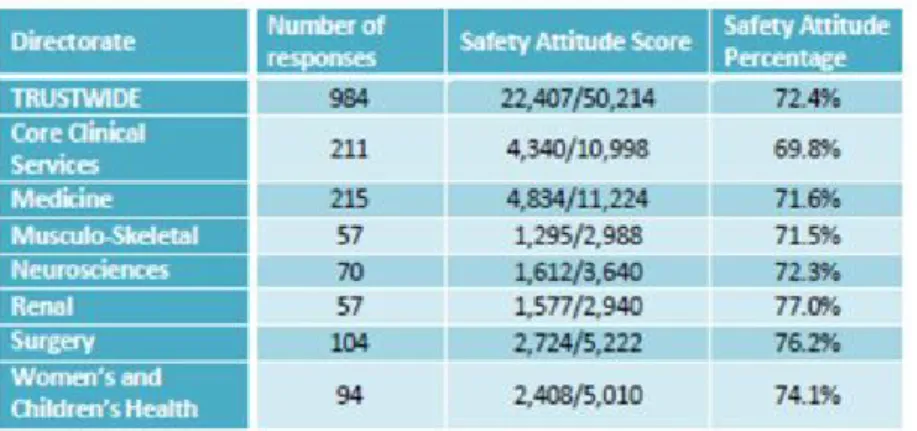
In 2016 a validated Safety Culture survey called the Safety Attitude Questionnaire (SAQ) was used to measure Safety Culture across the organisation. 984 questionnaires were completed from staff across all divisions (then directorates). The Safety Attitudes Questionnaire (SAQ), developed by the University of Texas is a validated questionnaire for use in healthcare.
The survey consists of 28 questions to determine staff perceptions towards Safety Culture in their local clinical service and teams. Participants used a Likert Scale to rate their perceptions towards safety related statements. The scale scores range from ‘Strongly Disagree’ to
‘Strongly Agree’.
The outputs of the survey include a total Safety Attitude Score described as a percentage, which if over 50%, indicates a positive finding in that domain. Scores less than 50% are considered negative.
In the 2016 survey the trust score was 74%. Positive findings included having regular briefings, encouraging reporting incidents and nursing input being well received.
Less positive domains included perceptions around staffing levels and speaking up if there was a problem in patient care.
A number of activities have taken place since this report to build on a positive Safety Culture.
10
4. Trust activities which have supported building a positive Safety Culture
There have been a number of ways which we have engaged our staff in positive Safety Culture. These include:
Quality Improvement (QI) Programme
∑ Creating a comprehensive Patient Safety Programme which engages all professions to be able to play their part in improving the care they deliver to patients, and the services they work within. The programme covers safety on wards, in theatres, emergency care and maternity care (Appendix 2).
∑ Holding a weekly Hub for anyone with an idea to make positive changes in their services to receive Quality Improvement coaching and technical support.
∑ Celebrating success with an annual Quality Improvement poster event and showcasing the great work that teams do at the first World Patient Safety day.
∑ Regular workshops which give staff training in how make positive change and improve their services.
∑ Supporting the well-established Foundation Year QI programme as well as extending the QI education to Clinical Fellows and other grades of doctors.
In 2019 there were 199 improvement projects registered with 40 of them now in final stages.
Examples of projects include:
∑ The Theatres Simulation Project which enables teams to train together and improve psychological safety.
∑ Reducing Anxiety for Burns Patients which developed a video to support patients when they are transferred to rehabilitation units.
∑ The ICU Infographic Project has improved the experience of relatives visiting ICU, and enables them to understand more about the care which is delivered to their family member.
∑ Positive Incident Management developed in ICU and spread to Medicine. This encourages teams to nominate staff members monthly who have made a positive contribution and celebrate their efforts to provide compassionate care to patients.
This demonstrates that we have a culture of improving, and that our teams feel empowered to take their ideas and develop them into deliverable improvements to help their patients and their own working environment.
Perform Academy
In April 2018 the Trust invested significantly in its teams to develop and deliver the Perform approach with a focus on coaching teams to work well together with structured communication and shared goals to enable patients to get home quicker and improving “flow”. To date 1750 members of NBT staff have attended Perform Bootcamps (over 20% of the organisation).
Perform coaches have supported all inpatient wards as well as ICU, Maternity and
10
MediRooms. In Mendip Ward (Part of Women’s and Children’s Division) they saw a 10%
reduction in length of stay. In ICU there has been a >50% increase in morning transfers out of the Unit.
The appreciative approach of Perform
∑ encourages teams to identify their vision for an excellent service for patients
∑ supports the strengthening of team accountability and empowerment and
∑ celebrates success within teams and more visibly in the organisation Has all contributed to positive team cultures.
Staff Wellbeing
There has been significant attention to staff health and wellbeing with initiatives such as Schwartz Rounds, Mindfulness, Reflective writing, Mental Health First Aid.
In 2018, 206 staff have accessed one-to-one psychology support, 37 teams have requested support with 6 active sessions currently running, 180 staff members have received training in Mental Health First Aid awareness, with an additional 50 staff who are existing Mental Health First Aiders.
Schwartz Rounds started at NBT in 2017 and take pl