ISSN 1684-1360 print/ISSN 1750-4686 online
© 2022 European Law Faculties Association
‘It makes me feel empowered and that we can make a difference’: Reverse mentoring between international
students and staff in legal education
Rachael O’Connor* Abstract
Inclusion of student voices in higher education (HE) policy is of increasing importance. However, inclusion of marginalised or under-represented voices is a continuing practical challenge. International students are one example of voices more often unheard, despite the last decade’s internationalisation drive.
Reverse mentoring use within business facilitates conversations between senior and junior colleagues, promoting cultural development. To date, its use in HE is comparatively limited. This work seeks to fill that gap through a small-scale study at a Russell Group law school between international undergraduate students (mentors) and staff (mentees) during 2019/20. The reverse mentoring focused on equality, diversity and inclusion (EDI) issues. This piece focuses on the impact of reverse mentoring on student mentors and views of their School community. The study’s design was informed by reverse mentoring in the legal profession, staff and student focus groups and international student and reverse mentoring literature. Mentor and mentee reflections were captured via interviews and reflective logs. Findings suggest reverse mentoring is an effective tool in HE to facilitate positive staff/student relationships and to hear authentic student voices. It has potential for transformational mentor impact which can catalyse wider community development, particularly in hierarchical disciplines like law. This work argues that reverse mentoring deserves a prominent place in ‘post-pandemic’ University strategies, with some cautionary notes and ideas for future development.
*University of Leeds. Thank you to all students and staff involved in this project for all you taught me. Special thanks to my research assistant, Megan Killerby for all your valuable work at the start of this project. Thank you to everyone who has given me comments and advice at conferences and more informally. The project was funded by Leeds Institute for Teaching Excellence and the Association of Law Teachers.
Keywords: reverse mentoring; international students; diversity and inclusion;
staff and student relationships; student voices.
Introduction
Most Universities have strategic goals relating to ‘equality, diversity and inclusion’ (EDI), often specifically relating to international and other marginalised student ‘groups’. This work contributes to better understanding of HE reverse mentoring as a practical intervention which may contribute towards achieving these ‘EDI’ goals.1 A 2019/20 reverse mentoring scheme with eight international undergraduate law student mentors and eight staff mentees from a Russell Group law school forms the focus.2 This piece explains the study, explores key benefits of reverse mentoring for student mentors from both an individual and law school community perspective and makes recommendations regarding development of reverse mentoring in HE and legal education, drawing on existing reverse mentoring and international student literature.
Reverse mentoring flips traditional mentoring roles and power dynamics, placing a typically more junior person as mentor and a more senior person as mentee. Reverse mentoring is:
‘… a reciprocal and temporally stable relationship between a less experienced mentor providing specific expert knowledge and a more experienced mentee who wants to gain this knowledge … characterised by mutual trust and courtesy, it aims at facilitating learning and development of both the mentor and the mentee.’3
This study saw student mentors (typically perceived as less experienced) sharing and exploring lived experiences as international students (their specific
1 See https://wonkhe.com/blogs/why-its-time-to-retire-equality-diversity-and- inclusion/?utm_medium=email&utm_campaign=Wonkhe%20Daily%20-
%20Thursday%2021%20October&utm_content=Wonkhe%20Daily%20-
%20Thursday%2021%20October+CID_26ca6d49a44c36bf1f36b3822a78129b&utm_sour ce=Email%20marketing%20software&utm_term=ditch%20equality%20diversity%20and
%20inclusion%20in%20favour%20of%20equity%20and%20belonging (accessed 21 February 2022) for criticism of the acronym ‘EDI’ in HE which the author acknowledges and is reflecting on for future work.
2 University of Leeds Faculty Research Ethics Committee granted ethical approval
3 Zauchner-Studnicka, ‘A Model for Reverse-Mentoring in Education’ (2017) International Journal of Educational and Pedagogical Sciences 11(3), 551.
expert knowledge) with staff mentees (perceived as more experienced) seeking to understand such experiences (gain expert knowledge to improve practice).
The focus here is on student mentor experiences in an attempt to shift the discourse surrounding interventions relying on student voices which may exploit students as research resource, without direct benefit for them. This project is a celebration of the mentors as experts in their lived experiences and their contribution to developing this field, as well as themselves and their school community. The lens through which this piece is written therefore highlights the benefits of reverse mentoring for mentors as a primary incentive to develop work in this area.
This is one of the first studies to analyse a HE staff and student reverse mentoring scheme. The few existing studies in the educational context demonstrate positive potential for reverse mentoring.4 However, no studies explore in detail what students think and feel about reverse mentoring. As the study unexpectedly crossed into the start of the COVID19 pandemic, this article is the first to consider reverse mentoring in the context of the ‘post- pandemic’ University and also some of the challenges of reverse mentoring, as well as the first study focused on international students. The project was inspired by reverse mentoring in the legal profession5 and is the first reported study in a law school context between students and teaching staff. The competitive and hierarchical nature of law educationally and professionally provides an interesting context for the study which unites two key gaps: studies exploring staff/student ‘EDI’ reverse mentoring schemes and studies exploring practical interventions to enhance international students’ experiences which
4 Gunduz and Aksit, ‘Student-President Reverse Mentoring at Universities: Maltepe University Case’ (2018) Yüksekö¤retim Dergisi, doi:10.2399/yod.18.019; Goossens, et al
‘The student-staff mentoring project at the University of Hertfordshire’ (2009) Procs of World Conf on Educational Multimedia, Hypermedia and Telecommunications; Petersen and Ramsay, ‘Reducing the gap! Reciprocal mentoring between Black, Asian and minority ethnic (BAME) students and senior leaders at the University of Gloucestershire’ (2021) Perspectives: Policy and Practice in Higher Education 25(1) 34-39; Raymond, et al,
‘Students, Please Teach Us! Implementing Student-Employee Reverse Mentoring to Increase Career Readiness’ (2021) Marketing Education Review DOI:
10.1080/10528008.2021.1907593.
5 For example: https://www.linklaters.com/en/about-us/news-and-
deals/news/2019/april/linklaters-launches-second-round-of-reverse-mentoring-following- successful-pilot (accessed 29 August 2021); female lawyers mentoring male partners in law firms was recently listed as an example of ‘good practice’ for supporting inclusion in law firms by the Solicitors Regulatory Authority: https://www.sra.org.uk/sra/research- report/workplace-culture-thematic-review/ (accessed 7 March 2022).
may also influence initiatives focused on other marginalised student groups or under-represented students more broadly.6
Given the lack of reported EDI reverse mentoring schemes in HE,7 this was largely a feasibility study. The key research questions explored in this piece are:
1. How does the role of mentor in a reverse mentoring scheme with staff mentees benefit students as individuals?
2. Does the reverse mentoring partnership impact students’ perceptions of their law school community?
Other research questions relating to belonging, identity and staff experience will be explored in further work. The discussion closes with a forward thinking consideration of how reverse mentoring may be used in the ‘post-pandemic’
University,8 as well as highlighting key areas for development.
Through an exploration of reverse mentoring at individual and community levels, via the lens of student mentors’ experiences, it is concluded that HE reverse mentoring can have multidimensional impact, particularly in hierarchical disciplines like law and for marginalised ‘groups’ like international students. Individually, it can create authentic one-to-one relationships in safe spaces where mentors can be heard and can lead, contributing to stronger self-worth and sense of influence. It encourages mentors to view themselves differently in the law school community through the catalytic impacts of humanisation, hierarchy dismantling and recognition of commonalities and connections. This can empower mentors to be change agents now and in future roles, a trickle effect which may in time contribute to cultural shifts across campus and in workplaces. A commitment to reverse mentoring puts EDI goals firmly on the agenda in the ‘post-pandemic’
University. However, it carries wellbeing risks and is not enough alone to overcome barriers in disciplines like law for marginalised students, including
6 See Mottershaw on the challenges of terminology in this area:
https://www.hepi.ac.uk/2021/12/17/why-we-need-to-stop-using-the-term-widening- participation/ (accessed 7March 2022). The author has opted to use marginalised, minoritised and under-represented interchangeably in this piece.
7 See (n.4), Petersen and Ramsay.
8 This is explored in more detail in: O’Connor ‘Supporting students to better support themselves through reverse mentoring: the power of positive staff/student relationships and authentic conversations in the law school’ in Guth and McCloy (Eds) Supporting law students: Exploring the why, what and how’ Routledge [forthcoming, 2022]
international students. The aim is for this frank exploration to encourage further interest and development in this area.
Literature review Reverse mentoring
There is an array of mentoring research, within and beyond HE.9 However, empirical research on HE reverse mentoring is limited.10 Few studies have explored EDI reverse mentoring and its impact on marginalised students.11 Existing studies have also been criticised for overly focussing on mentees and lacking qualitative data.12 Reverse mentoring has been described as ‘weakly conceptualized’13 although arguably its flexibility is one of its strengths. Much existing HE work focuses on sharing of ‘tech’ expertise by student mentors with staff/senior leader mentees, harking back to the more traditional origins of reverse mentoring.14 Existing work also tends to focus on mentors’
professional development, rather than personal development.15
The role reversal within reverse mentoring can break open hierarchies,16 foster intergenerational connections17 and benefit mentor and mentee in career development18 and prospects19 as well as feeling motivated, involved and respected.20 It may address negative stereotyping21 and contribute to continued professional development,22 important in HE as academics may become ‘out of touch’ with students for example, through managerial roles. It can help mentees overcome power-distance cultures which may stifle innovation and
9 For a summary, see Zauchner-Studnicka (n.3).
10 Ibid, 556.
11 See Petersen and Ramsay (n.4).
12 Clarke, at al ‘The role of reverse mentoring in medical education: current insights’
Advances in Medical Education and Practice (2019) 10, 694-695, 699.
13 Gunduz and Aksit (n.4), 2.
14 Raymond, et al (n.4), 2.
15 Clarke, et al (n.12), 698.
16 Zauchner-Studnicka (n.3); Clarke, et al (n.12), 698.
17 Murphy, ‘Reverse Mentoring at Work: Fostering cross-generational learning and developing millennial leaders’ (2012) HR Management 51(4).
18 Clarke, et al (n.12), 698.
19 Raymond, et al (n.4).
20 Gunduz and Aksit (n.4), 8.
21 Zauchner-Studnicka (n.3), 557.
22 Clarke, et al (n.12), 697.
development.23 However, to achieve these things, reverse mentoring requires careful planning and training.24
In the hierarchical legal profession, dominance of white males persists, particularly in senior roles, despite efforts to increase diversity.25 Reverse mentoring in the profession typically adopts an EDI focus to support those ‘at the top’ in better understanding perspectives of lawyers ‘lower down’ in the traditional workplace hierarchy. ‘Old boys’ networks’ noted in other reverse mentoring work in science are similarly prevalent in law. Reverse mentoring may help those ‘othered’ to break these exclusive circles.26
Existing work demonstrates that reverse mentoring facilitates positive professional development for mentors and mentees. What is less clear are its benefits as an EDI initiative, particularly for students, its downsides and risks and its community impact beyond the one-to-one relationship. Although this study is small-scale (n=16), it is the largest staff/student reverse mentoring EDI study to be reported in HE to date and seeks to contribute to better understanding of these issues.
International students
‘International student experience’, if such a thing exists,27 is well explored in existing work. Such ‘big culture labels’ can ‘other’ students, failing to recognise lived experiences, risking loss of individual identity.28 Existing work typically focuses on ‘integration challenges’29 for international students and identity crises when moving away to University due to the ‘diaspora
23 Gunduz and Aksit (n.4), 4.
24 Petersen and Ramsay (n.4), 38.
25 See Sommerlad, et al, ‘Diversity in the legal profession in England and Wales: A qualitative study of barriers and individual choices’ (2010) Legal Services Board, London, 6. See also: https://www.sra.org.uk/sra/equality-diversity/diversity-profession/diverse- legal-profession/ (accessed 21 February 2022).
26 Zauchner-Studnicka (n.3), 554.
27 Jones, ‘Problematising and reimagining the notion of ‘international student experience’
(2017) Studies in Higher Education 42(5).
28 Bond, ‘International students: language, culture and the ‘performance of identity’’
(2019) Teaching in Higher Education 24(5), 649-665; on lived experiences and identity formation, see Avraamidou, ‘“I am a young immigrant woman doing physics and on top of that I am Muslim”: Identities, intersections, and negotiations’ (2020) Journal of Research in Science Teaching 57, 319-320.
29 Thomas, et al, ‘Leveraging Common Ground: Improving International and Domestic Students’ Interaction Through Mutual Engagement’ (2018) Journal of International Students, 8(3), 1387.
consciousness’ associated with being neither one nor the other.30 In the US, lack of student voice in scholarship may be inadvertently silencing international students.31 Ethnocentric attitudes assume institutions have little to learn from international students – they come to us to learn and must adapt accordingly; it is a one-way transaction.32 In the UK, international students have been described as “a virtually invisible group” flowing through the country.33 However, there is a growing push towards increasing student voices and having conversations about international students with them, not just about them.34
The expectation is often that international students prefer learning how they learned at ‘home’, sometimes in very hierarchical structures with little independent participation.35 Although interactions with staff may be critical to international students’ sense of community and engagement at University,36 experiences of hierarchical approaches at home can impact staff/student relationships in new countries.37 Where staff get to know students personally, this can have profound impact on students’ identity, prospects and ability to
‘integrate’ or belong.38 Mutual engagement, rather than adaptation, is therefore key.39 However, many academic staff may not recognise challenges
30 Gu and Schweisfurth, ‘Transnational connections, competences and identities:
experiences of Chinese international students after their return ‘home’’ (2015) British Educational Research Journal 41(6), 950.
31 Heng, ‘Voices of Chinese international students in USA Colleges: ‘I want to tell them that …’ (2017) Studies in Higher Education 42(5), 845.
32 Ibid, 834.
33 Lillyman and Bennett, ‘Providing a positive learning experience for international students studying at UK universities: A literature review’ (2014) Journal of Research in International Education, 13(1), 64.
34 Heng (n.31), 847.
35 Andrade, ‘International students in English-speaking universities: Adjustment factors’
(2006) Journal of Research in International Education, 5(2), 137-138.
36 Glass, et al, ‘Faculty as bridges to co-curricular engagement and community for first- generation international students’ (2017) Studies in Higher Education 42(5).
37 Lillyman and Bennett (n.33), 69.
38 Glass, et al, ‘Uneven Experiences: The Impact of Student-Faculty Interactions on International Students’ Sense of Belonging’ (2015) Journal of International Students 5(4), 353.
39 Thomas, et al (n.28); See Marangell, et al, ‘Developing a host culture for international students: What does it take?’ (2018) Journal of International Students, 8(3), 1440–1458.
experienced by international students, leading to assumptions and stereotyping.40 Twenty plus years on, such assumptions often persist.
With Universities and particularly law schools becoming increasingly internationalised, recruitment efforts must be matched with campus developments.41 Focus on numbers, rather than quality of experience, is problematic for individual welfare42 and institutions viewing and treating international students as ‘cash cows do so at their peril’.43 There is little sign of internationalisation slowing as Universities seek to recover financially from the pandemic and the International Education Strategy is further implemented.44 This work therefore makes an important and timely contribution as it centres around ‘demuting’ international student voices45 through reverse mentoring. However, many challenges routinely faced by international students have been felt across the wider student body since March 2020 including loneliness, social isolation, inability to see family and adapting to new teaching styles. Ryan and Carroll suggested that ‘if we improve conditions for international students, we improve them for all ...’46 creating a halo effect. Consequently, the reflections in this piece may also be of wider application to improving experiences for other marginalised students.
40 Sarkodie-Mensah, ‘International Students in the U.S.: Trends, Cultural Adjustments, and Solutions for a Better Experience’ (1998) Journal of Education for Library and Information Science 39(3), 214-222.
41 Arthur, ‘Supporting international students through strengthening their social resources’
(2017) Studies in Higher Education, 42:5, 892.
42 Ibid.
43 Andrade (n.35), 133; Mittelmeier and Lomer, ‘The problem of positioning international students as cash cows’ https://www.hepi.ac.uk/2021/11/04/the-problem-of-positioning- international-students-as-cash-
cows/#:~:text=International%20students%20are%20often%20seen,to%20universities%20 and%20the%20country.&text=The%20report%20highlights%20they%20have,25.9%20bil lion%20to%20the%20UK' (accessed 25 November 2021).
44 See https://www.gov.uk/government/publications/international-education-strategy-2021- update (accessed 24 August 2021).
45 Page and Chahboun, ‘Emerging empowerment of international students: how international student literature has shifted to include the students’ voices’ (2019) Higher Education 78, 871.
46 Ryan and Carroll (eds), ‘Canaries in the coalmine’: international students in Western universities’ in ‘Teaching International Students: Improving Learning for All’ (2005) Routledge, 10.
Methods
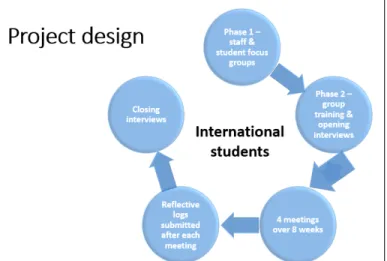
Project design took a dual phase, sequential approach (figure 1). Methodology aimed to capture deep reflections, using international students as a case study.
Qualitative insight provided feedback depth, generating knowledge grounded in human experience.47 International students were chosen because their experiences: (i) are important alone; and (ii) as noted, may facilitate understanding of other marginalised students.48 Noting the criticality of context,49 law was chosen based on its hierarchical nature and the growth of reverse mentoring in the legal profession. As Campbell’s work demonstrates, legal education provides ‘a rich site of interest from which illuminative questions about our socio-cultural life, constraints and desires can be raised’.50
Figure 1: Project design Phase 1
Phase 1 began with staff and student focus groups, discussing international student experience. Invitations were sent to staff and law international students
47 Sandelowski, ‘Using qualitative research’ (2004) Qualitative Health Research 14(10), 1366–1386.
48 See Ryan and Carroll (n.46); Webley, 'Stumbling Blocks in Empirical Legal Research:
Case Study Research' (2016) Law and Method, 20.
49 See Baxter and Jack, Qualitative Case Study Methodology: Study Design and Implementation for Novice Researchers (2008), The Qualitative Report, 13(4), 544-559.
50 Campbell, ‘Exploring Autoethnography as a Method and Methodology in Legal Education Research’ (2016) 3 Asian Journal of Legal Education, 98.
in second year and above via e-mail, virtual learning environments and teaching announcements. Purposive sampling excluded first year students, ensuring mentors had existing HE staff relationship experience in the UK or at
‘home’ to reflect on.
13 students, 14 academic and seven student services staff joined focus groups facilitated by the author. There were no staff incentives beyond refreshments.
Students were entered into a £50 voucher draw. Phase 1 data comprised nine focus group transcripts and two word clouds generated from an icebreaker exercise (see student word cloud figure 2). This data iteratively contributed to finalisation of meeting topics (figure 3)51 and Phase 2 interview questions.
Focus groups aimed to create interest in Phase 2 and community rapport amongst attendees and the author, increasing research trustworthiness52 and project ownership.53 Many attendees chose to take part in Phase 2. All provided written consent.
Mentors and mentees were recruited on a first come, first served based following the same Phase 1 advertisements, plus direct e-mails to focus group attendees. There were more mentors than mentees which regrettably resulted in rejections.54 Pairs were randomly selected then checked to ensure no existing significant relationship. Two pairs were switched as a result of cross-checking.
It was felt dynamics could be negatively impacted by existing knowledge if, for example, a student was paired with their personal tutor. Mentees were academic staff of differing seniority levels and one student support staff member. Altogether, there were eight pairs (16 individuals). Mentors came from five countries (Malaysia, India, Nigeria, Canada and the UAE).
Phase 2
An external EDI organisation led training, involving separate mentor and mentee group discussions and collaborative work. Mentor training focused on
51 Topic 4 (failure and resilience) was informed by Bleasdale and Humphreys,
‘Undergraduate Resilience Research Project’ https://teachingexcellence.leeds.ac.uk/wp- content/uploads/sites/89/2018/01/LITEbleasdalehumphreys_fullreport_online.pdf (accessed 29 August 2021).
52 See Avraamidou (n.28), 324.
53 Matthews and Ross, ‘Research Methods: A Practical Guide for the Social Sciences’
(2010) Pearson, 240-241.
54 See Petersen and Ramsay (n.4), 38 on recruitment challenges.
leading conversations via the ‘GROW’ model.55 Mentee training focused on active listening. Training was the first time mentors and mentees came together to ‘break the ice’. During training, pairs entered into ‘mentoring agreements’
and meeting topics were revealed.
Mentors and mentees embarked on their meetings, advised to meet fortnightly over eight weeks. Each attended an hour-long one-to-one semi-structured interview in person with the author following training, prior to meeting one.
Interviews were chosen as they provide insight into interviewees ‘worlds’,56 humanising research57 and are particularly useful for feasibility studies like this.58
Following each meeting, mentors and mentees submitted reflective logs (see Appendix). This encouraged recognition of learning as it was experienced.
Logs mimicked Gibbs’ reflective cycle so ‘actions’ could be worked on in the next meeting, enabling real time improvements.59 A further hour-long interview closed the project, conducted online due to national lockdown. With a mix of in person and online meetings also due to lockdown, all pairs successfully completed four meetings.
Mixed qualitative methods enabled time and method triangulation of pre and post mentoring interviews with reflective logs, permitting strong understanding of experiences.60 Phase 2 data comprising 32 interview transcripts and 64 logs was chronologically reviewed and thematically analysed.
The flexible nature of thematic analysis demands process clarity which this section explains,61 particularly important given the ‘alongsider’ nature of the
55 Whitmore, Coaching For Performance: The Principles and Practice of Coaching and Leadership (2017) Nicholas Brearley.
56 Fujii, ‘Interviewing in Social Science Research: A Relational Approach’, (2017) Routledge, 1.
57 Fontana and Frey, ‘The Interview: From Neutral Stance to Political Involvement’
(2005), 152 in Denzin and Lincoln (Eds), The Sage Handbook of Qualitative Research, 3rd Edn, Sage Publication, London, 695-727.
58 Matthews and Ross (n.53), 221-223.
59 Gibbs, ‘Learning by Doing: A guide to teaching and learning methods’ (1988) Further Education Unit. Oxford Polytechnic: Oxford.
60 Fontana and Frey (n.57).
61 Braun and Clarke, ‘Using thematic analysis in psychology’ (2006) Qualitative Research in Psychology, 3(2), 96.
author’s positionality as a fellow lecturer62 and someone who strives to eradicate unhealthy hierarchies in HE.63 As recommended by Braun and Clarke, all transcripts and logs were read to emerge the author in the data.64 Raw Phase 2 data was colour coded, manually rather than using software,65 based on connections across the dataset. Colour coded sections were moved from their original transcripts into individual documents named by connecting theme. Following a further review of these theme documents, themes were confirmed by the author and a draft thematic analysis written up, identifying sub-themes and scaffolding excerpts of raw data into analytic discussion. 66 Some sub-themes were merged after a draft review of this analysis by critical friends, as recommended by Nowell, et al.67 The themes and data relating to student and community benefits are explored in this piece, with the remainder to be explored in future work. Quotes used identify mentors by number to show the discussion includes a range of voices (M1 to M8).68 This piece includes quotes from student mentors only.
This level of data gathering and analysis has typically not been done in previous reverse mentoring studies, adding richness and credibility to the field.
Although sample size (n=16) limits generalisability, the findings have strong potential for instigating ‘bottom-up’ and ‘top-down’ change, empowering students individually and within their communities.
Results
How does the role of mentor in a reverse mentoring scheme benefit students as individuals?
‘it was really special. I learned that I had made not only a lasting impact on my mentee, but I realised how far I myself had come as well. This project was a chance for me to do some
62 See Lewthwaite and Nind, Methods that teach: developing pedagogic research methods, developing pedagogy (2018) International Journal of Research and Method in Education, 41(4), 401-403.
63 On positionality, see Avraamidou (n.28), 323-324.
64 Braun and Clarke (n.61), 87.
65 Ibid, 89.
66 Nowell et al, ‘Thematic Analysis: Striving to Meet the Trustworthiness Criteria’ (2017) International Journal of Qualitative Methods 16(1), 10.
67 Ibid.
68 Ibid, 11.
good while also having to learn how to come out of my shell
…’ (M3)
Reverse mentoring can amplify individual student voices often unheard institutionally. Students relished finally being heard and listened to. The ability to lead and maintain their mentor role gave mentors greater confidence in their current and future capabilities and self-worth. This challenged deficit narratives through which mentors talked about being an international student at the outset and encouraged students to recognise the importance of their internal values and the power of their voice, including in visions of themselves in future workplaces.
Being meaningfully heard
Creation of a safe space to be heard was valuable to mentors. M4 felt their
‘voice and experiences [were] important and valued’, finally having
‘permission to speak openly’, echoed by M2. M7 reflected that meetings were a unique and potentially first time opportunity to talk about ‘taboo’ subjects which she previously did not know where or how to share. M5 felt the meetings
‘added meaning to those statements … that we are there for you and … willing to support you’ – they gave heart to the institution and the opportunity to be meaningfully heard through the project encouraged students to feel cared about, echoing Petersen and Ramsay’s findings69 and Heron’s reflections on the power of less conventional methods of conversation in student research.70 Willingness to be open and honest from the mentor is vital,71 as is the way mentees respond to mentor vulnerability. Teacher behaviour can impact student emotions.72 This is arguably no different where roles are reversed. M2
‘felt good because … my words had been taken seriously’ whilst being shared in an informal setting. The reactions of M6’s mentee showed her opinion was
‘worthy enough to persuade [my mentee] to make … changes.’ Students feel empowered working with staff where their contribution is valued, not just
69 Petersen and Ramsay (n.4), 36.
70 Heron, ‘Friendship as method: reflections on a new approach to
understanding student experiences in higher education’ (2020) Journal of Further and Higher Education, 44(3), 395-397.
71 Clarke, et al (n.12) 698.
72 Mazar, et al, ‘The Dark Side of Emotion in the Classroom: Emotional Processes as Mediators of Teacher Communication Behaviors and Student Negative Emotions’ (2014) Communication Education 63, 149.
superficially listened to.73 Mentors reported attributes and actions including calmness, scribbling notes and bringing things up mentors had mentioned in prior meetings as demonstrating mentees’ active listening and care. This challenges the narrative that staff are often unable to give time to listen to students authentically.74 This is possible where positive conditions like non- hierarchical reverse mentoring meetings are facilitated and is of particular benefit for marginalised students who are often the least ‘heard’.75
Power dynamics and titles
The power dynamic reversal was a recurring topic during training which all mentors worried about and there were challenges once meetings began, particularly for one mentor. After the scheme, M4 regretted not being more assertive: ‘my mentee is quite vocal … the conversation is slightly imbalanced ...’ Reverse mentoring can put students into one of the most casual and non- hierarchical interactions they have had with an ‘authority figure’. M4’s deference to this authority and preconception that her mentee ‘knew best’ was hard to overcome, despite M4 being the international student and the focus of the project being international students’ experiences. M1 also noted initial hesitance in being honest and authentic - feeling ‘scared that [my mentee]
might judge my reactions’. However, mentee responses ‘made me more relaxed and able to express [myself] … remembering I have done this before at the focus group made it better.’ This demonstrates the importance of mentees being willing to actively cede power in order for mentors to feel confident in leading – this was perhaps lacking a little from M4’s mentee. It also emphasises the need for mentors to be able to practice or rehearse leadership before being thrown into reverse mentoring meetings, for example, within focus groups or training.
Some reflections by contrast suggest mentors were concerned they had taken over. M5 worried she had ‘dominated the discussion whereas I would’ve liked to encourage my partner to share more …’ Similarly, M1 felt she did most of the talking and wished she had proactively encouraged a more equal conversation. Reflections were more positive from those who talked of an equal partnership approach, for example, using phrases such as brainstorming,
73 Kaur, et al, ‘Students’ experiences of co-creating classroom instruction with faculty- a case study in eastern context’ (2019) Teaching in Higher Education 24(4), 461.
74 Mullen, ‘Telling Tales in School: Storytelling for Self-Reflection and Pedagogical Improvement in Clinical Legal Education’ (2011) 18 Clinical Law Review 283, 297.
75 Heron (n.70), 393-394.
providing constructive criticism, free flow of ideas and collaborative thinking.
These meetings were less mentor dictatorship and more mutual conversation, adding to the debate as to whether ‘reverse’ is the right term for this type of mentoring.76
Overall, however, reflections regarding power dynamics were positive – it was a significant source of mentor self-confidence. M3 recognised her competence in leadership and that she was not a ‘complete train wreck’ as a mentor, undoing some of the initial nervousness mentioned above. M6 described the role reversal as ‘surprisingly very comfortable … mutual and equal …’ M5 echoed feelings of equality between herself and her mentor and M8 similarly found it ‘very refreshing’ to not feel a constant need to defer to perceived authority and to recognise what she could offer her mentee in terms of new learning, undoing the assumption that student/teacher relationships are one- way transactions.77
The power dynamic reversal also permitted exploration of unusual topics, creating authenticity. M6 was
taken aback … nobody’s asked me why … that was a pivotal moment where I was like, okay [my mentee] is different, because [my mentee] chose and dared to ask a question that normally isn’t asked.
M3 was surprised by how much both mentor and mentee learnt about each other through discussing topics they may never have otherwise discussed. The authenticity of conversations contributed to the strong bonds built and a comfort in sharing personal issues. M5 felt as comfortable with her mentor as with friends by the end and this undertone of friendship was echoed by M6.78 Pairs had worked hard to ‘break the ice’ by throwing themselves into their new roles and in doing so, perceived and traditional power dynamics became much less of a barrier to authentic conversations over the course of the meetings.
The way individuals interpreted their ‘title’ of mentor or mentee within the project affected the power balance. There was a sense of a right and wrong way to ‘mentor’ amongst the students. Prior to the first meeting, M3 ‘was a bit
76 See below (n.106).
77 See above (n.32).
78 See Hierarchy and boundaries below.
worried that I would say or do something wrong.’ There was also some self- consciousness from M2: ‘what if I've said something that maybe [my mentee]
doesn’t agree with or [my mentee] feels … this is wrong …’ This may have been influenced by many factors, including mentee seniority, as well as topics discussed. It could also be owing to a lack of mentor understanding as to the value of sharing their experiences. Existing work on reverse mentoring suggests the mentor has to be a ‘specific expert’.79 However, students may not view themselves in this way and consequently, may not use their voices confidently where they could be impactful. This study suggests reverse mentoring should not just be about ‘specific technical or content expertise’ or improving specific knowledge80 but about listening to and learning from experiences more generally, particularly lived experiences of marginalised individuals.
The project was new for all and inevitably, all came to it with preconceptions about their roles. During training, alternative labels of ‘adviser’ (mentor) and
‘listener’ (mentee) were offered by the training provider. However, these alternatives still did not appear to strike the right balance. ‘Listener’ suggested mentees should not talk much, reducing vital reciprocity. M7 thought renaming the scheme would be beneficial as it sometimes got ‘tricky [in terms of] who does the questioning/talking’. Greater emphasis should be given in training to the idea that there is no ‘right and wrong’ in order for mentor and mentee to be their authentic selves. The direction of discussions should be partnership led.
This can help mentors stay in control of the power dynamic whilst also facilitating equal input and contribution.81
Self-worth and confidence
The opportunity to share experiences and explore them as a partnership appeared to challenge the ‘minoritised’ deficit mind-set mentors had, thinking they are not good enough or that nobody cares what they have to say. Mentors had mixed views at the start about the label ‘international student’. In opening interviews, mentors talked about racialised experiences, micro aggressions and feeling ‘othered’. As M4 put it: ‘being an international student is about having to fight stereotypes, overcoming your own fears of failing and the fear of building relationships ...’ Some of the stereotypes discussed in opening
79 Zauchner-Studnicka (n.3).
80 Clarke, et al (n.12), 694 and 696.
81 See Design and targeting below.
interviews included being rich, assumption of nationality (for example, Malaysian students assumed by others to be Chinese), being ‘cliquey’, ‘try- hards’ and shy or quiet and not wanting to speak in class or socialise outside ofnationality ‘bubbles’.
Mentors appeared to be overcoming a ‘self-fulfilling prophecy’ created by the
‘international student’ label as the project reminded them that they are individuals, with unique paths, although also part of a collective law school community. There was a shift from talking about themselves in deficit terminology to a stronger recognition of worth. M4 focused on the ‘positive, productive impact’ of being an international student and this rare opportunity to represent ‘friends whose stories may never hear the light of day.’ There was both a deepening individual connection with the ‘label’ and also a stronger connection with peers identifying within the same label.
Reverse mentoring may therefore reunite students with their sense of self and individuality.82 Some mentors, including M4, felt empowered because it was their international student ‘status’ which enabled them to be part of the project.
This is not to say that reverse mentoring solved challenges associated with being an international student. However, it gave space for mentors to reflect on those challenges and value their strengths. As M1 put it,
being an international student … does not change anything.
It's just who you are and everything is up to you to really make a difference … that's what the meetings have taught me.
The authentic discussions reverse mentoring permits, coupled with regular reflection, have potential to alter students’ views of their experiences at University, recognising the strengths of such experience, contributing to positive self-development.
Through leadership, mentors saw things in themselves they had not previously appreciated or had underestimated. Several mentors described themselves as more capable than they had anticipated being. M1 reflected on the need to move away from ‘mental discrimination of race’ which had previously prevented her from getting involved in her school. She felt more determined to increase her engagement, ‘never allowing any failure to be the stopping point ...’ M2 attached greater value to her communication skills: ‘I usually find it quite
82 See (n.28).
daunting to speak to … seniors, but I found that in my element, I am able to effectively communicate.’
M1 felt deep engagement with someone older or ‘scary’ enabled her to overcome initial misconceptions about authority figures. M4 saw her ‘mentee’s receptiveness and openness’ as the catalyst of her increased confidence to speak out. Similarly, M6 credited the mentor role as giving her ‘guts … to … speak out ...’ which she was previously hesitant to do. By focusing on students’
‘resources’, rather than ‘deficiencies’,83 reverse mentoring can have a significant impact on mentor perceptions of their capabilities. As M5 noted, it was powerful to know that her voice could contribute to change: ‘what I’m saying is not being ignored … you’re a child you don’t know what you’re talking about, it’s actually being considered …’ This may not only contribute to a more positive view of self in the present but may also influence future values and identity.
Personal and professional skills and values
Both legal education and the legal profession have norms and ‘unspoken rules’.84 These may be particularly inaccessible to marginalised individuals given the identity work typically required by ‘outsiders’ to fit such norms.85 The role of HE staff should not be to acclimatise students aspiring to become lawyers to those norms as if they are on a conveyor belt of academic moulds but to support them in recognising the value of their voices to create change and forge inclusive space for themselves and others in future workplaces.
Reverse mentoring impacted students’ perceptions about their future capabilities, particularly leadership skills and use of their voice, equipping them with a confidence to make change stretching beyond University.86 M7 reflected on becoming ‘a better listener’ and how this will benefit her in a legal career. Other skills mentors noted having developed or improved included communication, organisation and time management. Reverse mentoring has potential to permit reflection on a range of psychosocial factors suggested in
83 See Zauchner-Studnicka (n.3), 557.
84 Bleasdale and Francis, ‘Great expectations: millennial lawyers and the structures of contemporary legal practice’ (2020) Legal Studies 40(3), 376.
85 Francis and Sommerlad, ‘Access to legal work experience and its role in the (re)production of legal professional identity’ (2009) International Journal of the Legal Profession, 16(1), 63-86.
86 Raymond, et al (n.4).
previous work to be key engagement influencers which may result in improved academic and professional performance.87
Beyond these basic skills, engagement in a mutual dialogue and accompanying self-reflection may enable mentors to think about personal and professional values and how the two align. This could foreseeably impact future career decisions and workplace positionality. Some mentors felt they had acquired a
‘boldness to really voice up’ (M4) in the face of adversity. As M4 put it:
‘because I'm part of this project, I feel more free to express my point of view.’
M5 agreed with this increased confidence to share her thoughts and projected this into thinking about conversations with managers in future workplaces. M7 also felt that she would have a confidence from the project to raise issues in the workplace: ‘[my] feelings are valid and if [I] think that something’s wrong … I shouldn’t keep it to myself …’ Likewise, M6 saw how her new found ability to be more honest would help her maintain individuality at work – ‘it is important to not become a sheep in a herd ...’ Despite previous cultural barriers, M4 felt more comfortable to disagree and was ‘less burdened by the need to sugar-coat things, and more encouraged to think productively on what might be done’ developing an action mind-set, with M6 agreeing her understanding of the power of ‘expressing [her] thoughts’ could instigate change in her future actions. M1 felt discussions with her mentee ‘had an impact on who I am and how I react’ again suggesting learnings about self through being a mentor may influence future decisions and actions, developing identity.
Reverse mentoring seemed to help mentors understand what they are good at and what is important to them, stemming from having the space to share experiences and be heard. It also enhanced confidence, proving their capabilities to lead and influence. Consequently, reverse mentoring may broaden student horizons, developing both personal and professional identities at University and in future workplaces.
Does reverse mentoring impact mentor perceptions of the law school community?
I learned that the School actually does care and that policies are not merely policies … seeing that side of what the School is doing [around EDI] inspires me, as an international student,
87 Kahu, ‘Framing student engagement in higher education’ (2013) Studies in Higher Education, 38(5), 766 (see diagram).
to really do my best because I know the School is rooting for me ... (M4)
The humanisation of one staff member appeared to influence how mentors felt about other staff relationships, changing views about hierarchy. The more mentors learned about the University, the more they recognised connections with peers, demonstrating the potential for reverse mentoring to not just impact individual mentors and mentees but also for impact to trickle into wider community structures. Through acknowledging their lived experiences via this one-to-one partnership, as well as their future workplace ‘self’ discussed above, students may see the impact they can have within their student community, including similarities they have with others in it. As mentors become empowered as influencers in their community, they may consequently feel a stronger part of it. However, reverse mentoring does not have all the answers when it comes to peer-to-peer community, particularly in hyper- competitive disciplines like law.
Humanisation
Having honest discussions on issues that staff and students may not usually have and creating opportunity for mentees to share themselves, appeared to strongly humanise staff to mentors. M5 reflected how the novel insight of reverse mentoring contributed to seeing staff as ‘human beings’. It helped M6 remove ‘labels’ and stereotypes attached to staff through authentic conversations that would not otherwise have happened. M3 was previously held back by preconceptions that students cannot ask staff personal questions about things like their childhood experiences whereas reverse mentoring
‘opened up a chance to talk about these things’, enhancing the depth of connection built. Similarly, the opportunity for M8 to share their life more personally with someone within their school was enjoyable. Ability to discuss personal issues appeared particularly impactful. M2 reflected on the importance of being ‘able to talk to someone about [life and my family] … especially someone that you … look up to.’ A highlight for M2 of the final meeting held online was meeting her mentee’s pet. These honest conversations and happenstances of pets wandering across camera lens’ can contribute to destabilisation of unhealthy hierarchies in HE: hierarchies which exist purely due to power, labels or positions and unnecessary exploitation or performance of the same and create potentially harmful barriers to authentic relationships between staff and students.
The final topic (failure and resilience) appeared to most strongly humanise staff. The reciprocation and vulnerability shown through mentees sharing failures and revealing perceived weaknesses resulted in M2 finding it easier to be open about her own struggles, academically and otherwise. Failure was being normalised through authentic conversations. M4 reflected that through reverse mentoring, industrial action and the School’s COVID19 response, she
‘got to see how human [staff] really are.’
A trickle effect to this individual humanisation comes across in the reflections whereby building a closer relationship with one person increased desire to build connections with other staff. A recurring theme throughout opening interviews was being a small fish in a big pond: in other words, being one member of a huge cohort. This impacted confidence to make connections, placing barriers between students and staff and creating negative connotations with
‘community’. Due to cohort size, mentors felt staff ‘have no time …’ (M1) and
‘[t]here is no possible way that [staff] could get to know … every single person ...’ (M5). M2 described this absence of personal connection as ‘unavoidable’, resulting in the need to have a ‘good excuse’ to speak to staff and fuelling perceptions of inaccessibility, further ingraining unhealthy hierarchies.
However, individual connections facilitated through reverse mentoring challenged these perceptions. Reverse mentoring can encourage questioning by students and staff: does it actually have to be like this? This opportunity to question the status quo may influence relationships with others, helping students realise that building bonds with staff can be ‘key to one’s sense of belonging and community ...’ (M4).
Staff humanisation appeared to help mentors start moving on from past educational experiences, despite assumptions students prefer ‘home style’
learning environments.88 M5 developed a new confidence to speak with staff, despite being ‘previously highly hesitant to do [so] as it [is] something I never did in school or was encouraged to ...’ Similarly, M3’s relationship with her mentee ‘made me feel a little bit less intimidated by [other staff]’. M1 discovered how easy it was to create a meaningful relationship with an authority figure and this spurred her on to want to engage in more relationships like this with others. This confidence can serve as a springboard to build other authentic relationships. Reverse mentoring may thus extend mentors’ social
88 See (n.35).
capital, permitting access to the ‘resources’ of others including knowledge and support of other staff.89
Hierarchy and boundaries
All pairs shared themselves personally, for most more so than they had ever done with another student or staff member. Whilst role boundaries are important and should be explored in training, findings from this study suggest these humanised connections did not blur or damage professional boundaries.
It seems students’ respect and understanding increased not only for their mentee but also for their law school community. As M6 reflected:
knowing that we have developed this unusual friendship without compromising … professionalism, it’s going to be much easier to discuss difficult personal stories.
The development of these new relationships and re-negotiation of boundaries with staff members was facilitated through mutual and reciprocal learning.
Student mentors learnt as much about the staff community as themselves and their peer community. M7 reflected on better understanding ‘the struggle … [for staff]’. Similarly, M8 ‘learned that staff have the same issues [as us] …’
M2 echoed this and how it changed her opinions on staff and more generally, the way she understands and approaches others.
As well as staff, the process helped M2 ‘understand how I feel about the university a lot more.’ M4 was pleased to discover the work her school is doing to improve marginalised students’ experiences. M1 discovered a lot about support available which could have helped her in the past and reflected on a need to be more proactive in her school community going forward. M4’s powerful opening reflection reproduced at the start of this section also emphasises how the learning process through authentic conversations relating to EDI issues contributed to mentors obtaining a more informed and positive view of their school. Whilst this contributed to breaking down unhealthy hierarchies between mentor and mentee and potentially wider staff/student relationships, there was no evidence that it crossed boundaries or lessened respect. As noted, the findings and reflections suggest the opposite.
89 Clarke, et al (n.12), 698.
Commonalities and connections
The connections staff and students found appeared important to the trusting relationships built and ability to discuss challenging topics. Common interests included music, volunteering, social justice, countries visited or lived in and personality traits, for example, identifying as introverts. M6 described this relatability as one of ‘the most enjoyable aspects’ which surprised her, given
‘age and cultural gaps’. As students and staff get to know one another more deeply, it may become possible to replace assumptions and negative stereotyping connected to differences with recognition and appreciation of similarities.90 However, M3 noted frustration when her mentor compared their upbringing to hers after she discussed childhood challenges of identifying as ethnically minoritised, without acknowledging differences and inadvertently undermining M3’s experiences. Whilst this did not damage the relationship in the long term, it is important to recognise that active listening need not always involve personal comparison. Students and staff can still build connections across their differences by understanding and valuing their respective experiences – sometimes, listening may be enough.
As well as recognising commonalities with their mentor, students reflected on preconceptions about peers, particularly ‘home students’, and began to consider similarities, suggesting they began to feel less ‘other’ and more attuned to their community. M1 recognised ‘[my mentee] showed me … being an international student doesn't really change anything … everyone is going through the same [student journey].’ At the start, mentors had views about what it meant to be a ‘home student’ or an international student from a country different to their own. However, following the meetings, M8 ‘had a better [and unexpected] understanding of the community … [and] of … other international students … British students and professors ...’ Similarly, M5 discovered that many of her preconceptions and fears around interacting with home students were ‘nonsense’. Through this recognition of peer connections, mentors were arguably beginning to develop intercultural competence91 or the potential to demonstrate such competence. Whilst this is typically a key aim of initiatives
90 Murphy (n.17).
91 See Deardorff, ‘The Identification and Assessment of Intercultural Competence as a Student Outcome of Internationalization at Institutions of Higher Education in the United States’ (2006) Journal of Studies in International Education 10, 241-266.
like EDI reverse mentoring for mentees, this study suggests it is possible for mentors too.
However, that is not to suggest staff/student reverse mentoring can actually create peer-to-peer relationships in and of itself. M6 summarises this:
I do feel that similarity, that friendship, that sense of belongingness with my mentee … I had a role in contributing towards change. So on a professional level … I do feel much more connected to [the] law school. But socially I don’t think that has really impacted.
M7 reflected on the fact that she was a project volunteer i.e. she had put herself forward so this did not result in her feeling ‘automatically accepted ...’ by peers within her school community. Likewise, M8 valued feeling cared about and having built such a positive relationship with her mentee but felt ‘it would take a lot more for me to feel like I’m actually part of the community’. However, the experience did help M8 realise a personal responsibility to engage more with her school community, including with peers, moving away from blaming others or external influences for some of the ‘integration’92 or belonging challenges faced as an international student and taking some personal responsibility to facilitate change. M5 also felt ‘subconsciously because of this experience, I was able to interact with more people [in law] …’ Feelings were therefore mixed as to the impact on peer and social community although overall, the sense was that improving staff relationships did not necessarily translate to improved peer-to-peer relationships although it did prompt deeper consideration of those relationships.
Whilst the law school context appears to have significantly influenced how mentors viewed their peer community and their position within it, reverse mentoring seemed to have little impact on perceptions about the competitiveness of law. Prestige attached to the study and practice of law may result in notions of individual superiority. In Phase 1 focus groups, discussions explored the ‘elitism’ of school roles, for example, student law society positions and consequent negative effects on community. The school environment was described by M6 as ‘pure competition’. The pressures of seeking entry into the extremely competitive legal profession may contribute to this. M2 reflected on how intertwined the law degree and a future legal career
92 See (n.29).
are as inhibiting community strength and fuelling competition. As M5 put it:
‘there’s almost a race … people are trying to get to the finish line with the best possible degree, with the most internships…’ – this can inhibit ability to build authentic relationships by viewing peers as competitors rather than colleagues.
Reverse mentoring between staff and students is therefore not a panacea for all community challenges faced by marginalised students. Whilst it can change understanding and views about others in the community and increase desire to develop broader relationships, it cannot alone break down the hierarchy and competitiveness of environments like law schools. The tale of reverse mentoring’s impact on school level community is therefore two-fold with its impact on staff/student relationships seemingly more significant, influencing behaviours towards other staff relationships. By contrast, for peer relationships, the process appeared to facilitate stronger understanding of peers, beginning to chip away at barriers between ‘home’ and ‘international’ in particular but could not break down barriers between students, whether due to nationality, career aspirations or other perceived differences although it was able to empower mentors through recognition of a community dimension to their voice, as explored below.
Empowerment and influence
Mentors felt empowered by what they learned about themselves through reverse mentoring. They thought about how their experiences could help peers and future students, particularly those who also identify as marginalised and/or under-represented, playing a pioneering role in their community. M7 recognised ‘my voice matters’ and the power she has to help others by using that voice. There was also a sense of special status earnt through project participation. For example, it made M6 feel ‘really good seeing that I was able to contribute to … something completely different from what a law student would … participate in.’
Reverse mentoring is therefore not just about educating mentees to instigate change in the community because they are typically the ones with ‘power’
when the status quo is restored. It is also about inculcating power within mentors so that they can instigate community change through their own behaviours and actions and continue developing the transformational benefits acquired from mentoring after the scheme. As M2 put it, ‘I will … continue to reflect on my experiences … with the view of trying to improve the experiences
of students.’ The fact mentees wanted to hear about mentors’ lived experiences and mentors saw that they were learning from them made M8 ‘feel empowered
… we can make a difference so that future students do not deal with the same issues that [we] are currently facing.’ This desire to help others within the community may facilitate future cultural shifts across schools and campuses as mentors seek to use their learning experiences to create change for others.
Despite the one-to-one relationship, what mentors learned about themselves and other staff, their peers and the University from their mentee impacted their perspective of the law school community through humanisation and recognition of previously unknown connections, breaking down unhealthy hierarchies and empowering students as potential change agents. Whilst the one-to-one nature of reverse mentoring questions its scalability and wider impact, this study suggests a ‘trickle effect’ is possible when mentors and mentees internalise and have opportunity to reflect on their experiences (in this study, via regular reflective logs and interviews). The desire to take the experience further through relationships with others arguably intensified through reflection, potentially benefitting the wider community through subsequent actions or changes in approach. This may be less likely in schemes where there is no accountability or reflection after meetings.
Discussion
When Ryan and Carroll described international students as ‘canaries in the coalmine’ in 2005, they talked of being at a HE ‘coalface’ due to increasing internationalisation and diversity. Today, we are before a different ‘coalface’ – the ‘post-pandemic’ University. However, many issues arguably remain similar. We know a ‘one size fits all’ approach does not work in HE or within student groups or ‘silos’. What our diverse student body needs, wants and benefits from spans a huge spectrum. As one example of a positive student-led intervention, findings from this study suggest that to learn and grow institutionally, we should prioritise opportunities to amplify marginalised student voices and ask their opinions, putting our ethical and moral obligations to all students into action, with our students.93
As we attempt to build and rebuild connections with students during our return to campuses, we have an opportunity to create structures and cultures that work better for marginalised students. Reverse mentoring provides a useful
93 Bond (n.28), 650 (discussing international students specifically).