Storage at suboptimal temperature of puparia of Exorista larvarum (L.), a tachinid larval parasitoid of Lepidoptera
Master thesis
Franciska Tóth
International Master in Horticultural Sciences
Supervisor:
Ao.Prof. Dr. Elisabeth Helene Koschier Division of Plant Protection (BOKU)
Co-supervisor:
Assoc. Prof. Dr. Maria Luisa Dindo
Department of Agricultural and Food Sciences (UniBo)
Vienna, April 2018.
2
Acknowledgements
I am grateful to Maria Luisa Dindo (DISTAL, Bologna) for her support, her advices during my whole work that she made possible.
Maurizio Benelli for his assistance, support from the very beginning to the end of my workflow, also for his patience and advices. His enthusiasm was very inspiring.
Furthermore, I would like to thank:
Dr. Elisabeth Helene Koschier for her support and advices.
Santolo Francati for his support during my stay in Bologna.
3
Statuory declaration
I hereby declare on oath that I have created the present master thesis without any outside help and without the use of any sources and aids other than those specified, and that I have indicated as such passages taken from the sources I used either verbatim or in substance.
I have never submitted this work in its present or a similar form to any other examiner as a graded work.
I am aware that breaches of conduct will be sanctioned ("use of unauthorized aids") and may lead to further legal action.
In addition to the printed version, this paper has been submitted as a digital file to the examiner in charge for verification of the above statement.
Place, date Name Signature
4
Index
1. Abstract (3-5 key words) ... 5.
2. Introduction ... 6.
2.1. General remarks on Exorista larvarum ... 6.
2.1.1. Origin and distribution ... 6.
2.1.2. Hosts ... 6.
2.1.3. Biology and life cycle ... 7.
2.2. Importance of E. larvarum as an applied biological control agent ... 10.
2.3. General remarks on Galleria mellonella, a factitious host of E. larvarum ... 11.
2.3.1. Distribution and damage ... 12.
2.3.2. Biology and life cycle ... 12.
2.4. Production of parasitoids: general remarks with special references to E. larvarum ... 13.
2.4.1. In vivo and in vitro rearing techniques ... 14.
2.4.2. Storage procedures ... 15.
3. Research question ... 16.
4. Materials and methods ... 17.
4.1. Rearing of the parasitoid Exorista larvarum ... 17.
4.2. Rearing of the host Galleria mellonella ... 18.
4.3. Experiment description ... 19.
4.3.1. Treatments and procedure ... 20.
4.3.2. Female quality control ... 21.
4.3.3. Parameters evaluated ... 22.
4.3.4. Statistical analysis ... 22.
5. Results ... 23.
6. Discussion ... 26.
7. References cited ... 28.
8.Appendix ... 35.
8.1. List of Figures ... 35.
8.2. Table index ... 36.
8.3. List of abbreviations ... 37.
8.4. Original data tables ... 38.
5
1. Abstract
Exorista larvarum (L.) (Diptera: Tachinidae) is a parasitoid generally known as an antagonist of lepidopterous defoliators of forest and agricultural interest. This beneficial entomophagous insect can be easily reared in vivo and in vitro, on artificial media. The in vivo rearing technique is generally perfomed by adopting a factitious host, such as Galleria mellonella (L.) (Lepidoptera: Pyralidae). Storage at low temperatures is a useful technique to extend insects’ developmental time and thus elongate their shelf-life. Immobile stages, including puparia, are usually more tolerant to the cold exposure. In the present study, the effects of storage at 15 °C (for four weeks) on in vivo produced E. larvarum puparia were tested and compared with puparia stored at 26 °C. The results showed some decrease in adult quality parameters, namely longevity and fecundity, however, the storage treatment (15 °C) proved effective for extending the parasitoid development. According to the different purposes of insects’ mass-rearing, a certain reduction in quality can be accepted in favour of a more flexible rearing schedule.
Key words: tachinid, storage, parasitoid puparia, suboptimal temperature, Exorista larvarum
6
2. Introduction
2.1. General remarks on the parasitoid Exorista larvarum (L.):
Exorista larvarum (L.) is a dipteran polyphagous larval endoparasitoid particularly known as antagonist of Lepidoptera. This gregarious species is a member of the Tachinidae family, which includes about 8,500 parasitoid species described all over the world and is the largest group of non-hymenopteran parasitoids (Michalkova et al. 2009; O’Hara 2013). The greater numbers of the hosts of tachinid flies are herbivorous insects. In general, parasitoid activity has two favourable effects at the community level, namely a control of the populations of pest species and, as a consequence, an indirect decrease of their feeding damage on plants.
The effectiveness of the parasitoidism, however, depends on different factors, such as the size of the host population, also the size of the parasitoid population and the environmental circumstances (O’Hara 2008).
2.1.1. Origin
This Palaearctic tachinid fly is distributed from Europe, to northern Africa, and certain Asian regions (Cerretti and Tschorsnig 2010). It has also become established in North America during the 20th century, when it was introduced there to control Lymantria dispar (L.) (the gypsy moth), which is a lepidopterous defoliator species causing serious damages in the forests, introduced to North America from Europe in the XIX century (Kennis and Lopez Vaamonde 1998).
2.1.2. Hosts
Among the approximately 45 natural host species of E. larvarum (Hafez 1953; Herting 1960), many lepidopterans of forest interest have been recorded, such as L. dispar, Malacosoma neustria (L.), Tortrix viridana L., Hyphantria cunea (Drury), Dendrolimus pini L. (Herting, 1960;
Delrio et al., 1983; 1988). This tachinid is also an antagonist of some agricultural noctuid pest species such as Mamestra brassicae (L.) (Sannino and Espinosa, 1999), Autographa gamma (L.) and Lacanobia oleracea (L.) (Cerretti and Tschorsing 2010). Moreover, other lepidopterous species, not attacked in nature, may be suitable for the development of E.
larvarum; one of these is the wax moth Galleria mellonella (L.), which has been used as a
7 laboratory host for this tachinid in the laboratory of Entomology of the University of Bologna since 1993 (Mellini et al. 1993).
2.1.3. Biology and life cycle
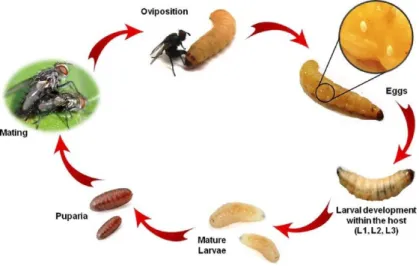
Exorista larvarum has a developmental life cycle which consists of an egg stage, three larval instars, a pupal stage (protected by a puparium, the hardened shell of the third instar larva) and an adult stage (O’Hara 2008; Mellini 1991) (Figure 1). Hafez (1953) and Michalkova et al.
(2009) described the biology of E. larvarum. Females lay macrotype eggs (the average size of which is ca. 0.6 mm in length) directly on the host cuticle with the help of their substitutional ovipositor (Mellini 1991). Eggs are oval shaped and white in colour. They turn to pale yellow during embryonic development (Hafez 1953).
Figure 1. Life cycle of E. larvarum Source: Dindo and Nakamura (2018) (drawn By M. Benelli)
The first instar larvae hatch after 2-3 days at 26 °C and have to penetrate the host integument with their strong and well-developed cephalopharyngeal skeleton and special body musculature (Valigurová et al. 2014). Soon after penetration, they form a primary integumental respiratory funnel, constructed from the modified host integument and host haemocyte action. This funnel leads to the surface of the host, and allows the parasitoid larva (which presents a pair of spiracles on the last abdominal segment) to stay in contact with atmospheric oxygen from the beginning of its development. The larval penetration is indicated by a visible dark brown or black spot on the host surface, where the cuticle melanisation has occurred (Figure 2). The larvae use their saliva to soften the host skin and penetrate it with their pointed hook-like labrum (Mellini 1991). Larvae continuously develop
8 within the body cavity of the host and, at the beginning they feed on the haemolymph with the avoidance of damaging any vital organs. Very soon, however, the larvae will attack the host fat body and vital organs. In parallel the host stops moving and feeding and it is killed in 1-2 days after the egg hatching (O’Hara 2008; Valigurová et al. 2014; Depalo et al. 2010).
Larvae develop independently of the host hormonal balance and physiology (Dindo 2011).
Second instars larvae stay attached to the respiratory funnel by a second hook, constantly increasing in size and expanding in space within the host body. After moulting to the third instar, the parasitoids can freely move in the body cavity, and thanks to that feature, progressively nourish on host’s interior tissue until it is available (Marchetti 2006; Valigurová et al. 2014). More than one parasitoid larva can successfully develop in one host (up to 5-6 in the factitious host G. mellonella) (Mellini and Campadelli 1997).
Figure 2. Melanisation of the host’s cuticle; Private picture
After crawling away from the host by the third instar larvae, pupation occurs and puparium forms as the hardened shell of the last instar (Figure 3). In some cases, this phenomenon can take place within the host (O’Hara 2008) (Figure 4). The size of the puparia can be different according to their number obtained per host. Sex and other factors can influence it too (Hafez 1953).
9 Figure 3-4. Examples for pupation, out of the host and within the host; Private pictures
Adult emergence usually takes place 8 days after the pupation at 26 °C (Marchetti 2006).
Previous studies carried out at the laboratory of Entomology of the University of Bologna demonstrated that the full development of E. larvarum (from egg stage to adult) takes 15-16 days at 26-27 °C (Marchetti 2006).
The newly-emerged adult sex can be easily distinguished according to pretarsi, which are firmly forked in case of the males and slightly divided in regard of the females (Hafez 1953) (Figure 5-6). Adults are mating immediately after emergence; the female pre-oviposition period can vary between 2-3 days in laboratory conditions at 26 °C, but in nature it can take 6 days when the temperature is lower, like in autumn (Hafez 1953; Dindo et al. 2007). Host location occurs by the identification of chemical signals, like host-induced plant volatiles.
Visual cues, however, play a crucial role in host detection: for that reason, the motion signals of the host insects have very important features (Depalo et al. 2010; 2012). Females oviposit directly on the host cuticle by extending their ovipositor and attach an egg to the host laterally or to the dorsal surface (Mellini et al. 1994). The average of the eggs laid is 7 eggs per day by females during 20-25 days; most of the eggs are laid during the first 10 days following the beginning of oviposition (Hafez 1953; Dindo et al. 1999).
10 Figure 5-6. E. larvarum male with his forked pretarsi; and a female adult with slightly divided pretarsi, Private pictures
Like in the majority of tachinids, in nature adults feed on sugar based materials (nectar, honeydew). The longevity of the adults depends on different factors such as the temperature, and the available food source. In general females stay alive approximately 18- 22 days under laboratory conditions, although they may live longer (Hafez 1953; Dindo et al.
2002, 2004). In the laboratory, the adults usually feed on honey and water solutions, lamp sugar or pollen (Dindo and Grenier 2014).
2.2. Importance of E. larvarum as an applied biological control agent
The members of Tachinidae can be applied in classical and augmentative biological control programs. Yet, the potential of these beneficial enemies as antagonist of target insect pests is still underestimated and misunderstood. Difficulties may arise from the scarcity of knowledge about the biology, behaviour and ecology of both the tachinids to be used as biological control agents and the target insect pests. Also, the rearing techniques and shipping methods of tachinids flies are relatively poorly known in comparison with hymenopteran parasitoids (Dindo and Grenier 2014).
Exorista larvarum is a good biocontrol candidate against forest lepidopterous defoliators.
One of the most important target pest is L. dispar (native in Eurasia), impairing deciduous and evergreen species. This defoliator damages more than 300 species of trees. The pest was introduced from Europe into the USA in the end of the 19th century (O’Hara 2008). To date, however, E. larvarum has been used as a biological control agent against L. dispar only
11 in inoculative releases in the northern United States, where it has become established (Sabrosky and Reardon 1976).
The potential of E. larvarum as an antagonist of forest and agricultural insect pests deserves to be better exploited. This parasitoid has positive features, among which, it can be efficiently reared in vivo and in vitro (on artificial media, without the host) too (Dindo and Grenier 2014). As emphasised by Greathead (1986) the success of biological control with entomophagous insects (classical and, especially, augmentative) is largely based on the availability of efficient techniques for producing the parasitoids or predators involved. Due to that, at the University of Bologna, extensive research is focusing on the mass production of this species (on artificial media as well) (Dindo and Grenier 2014; Dindo et al. 2016). Their results of laboratory studies are encouraging regarding the possible augmentative releases of E. larvarum against noctuid populations of agricultural interest, such as S. littoralis (Boisduval) (Depalo et al. 2010) or M. unipuncta (Haworth) (Depalo et al. 2012) and also including Agrotis segetum Schiffermüller, Prodenia litura F. (Hafez, 1953) and M. brassicae (L.) (Sannino and Espinosa 1999).
2.3. General remarks on Galleria mellonella, a factitious host of E. larvarum:
For laboratory rearing alternative hosts are frequently used, instead of natural hosts, because of the easier rearing requirements. Galleria mellonella (L.) (Lepidoptera, Pyralidae) (the greater wax moth) is a factitious host for several parasitoid insects and it is a more convenient host for E. larvarum as well (Mellini et al. 1993). In consideration of agricultural crop protection and forestry ecosystem management and also for biodiversity conservation, the possibility to mass rear parasitoids using G. mellonella as a laboratory host is very important. Therefore, the greater wax moth has a particular role for entomological application (Roversi et al. 2007). The greater wax moth larvae are less problematic (they do not show an active defence) compared to the natural hosts; some of them (e.g. L. dispar) have dangerous urticating hairs (Bonnot et al. 1984). This species is one of the most commonly used insects in the mass production of many biological control agents (not only parasitoids): for instance it has proven to be suitable for the rearing of at least 21 other tachind species and also for the production of entomopathogenic nematodes (Grenier 1986;
Hala et al. 2012). It has also been used in model studies to inquire into host-pathogen or
12 host-parasitoid interactions, and into invertebrate immune systems (Roversi et al. 2007). It has favourable properties such as the relatively simple nutritional needs, ecological adaptation and developmental characteristics (Miyata et al. 2003; Mylonakis et al. 2005).
2.3.1. Distribution and damage
In nature, G. mellonella is widely distributed from Asia to northern Africa, Great Britain, and some parts of Europe, northern America, and New Zealand; it can be found almost everywhere, where beekeeping is adopted (Kwadha et al. 2017). It seriously damages field- based honeybee hives and stored bee wax and other hive products (Metwally et al. 2012).
2.3.2. Biology and life cycle
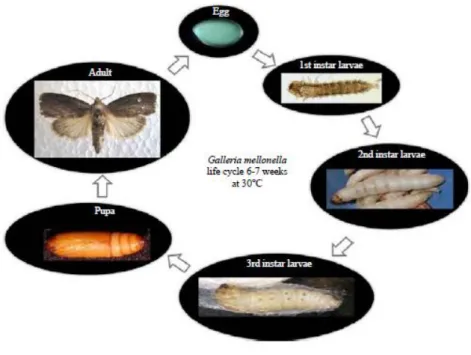
Galleria mellonella undergoes four different life stages of development, such as egg, larva, pupa, and adult, this insect has a typical holometabolic life cycle (Figure 7). The whole development from egg to adult may take weeks or months depending on the available food sources, competition in between the individuals, temperature and other biotic and abiotic factors (Nielsen et al. 1979).
Figure 7. Life cycle of G. mellonella Source: Abidalla (2018)
Adult females are capable of laying eggs in a relatively short time after emergence and mating. Female moths oviposit 50-150 eggs in clusters in less detectable places as cracks or crevices in the hive: this oviposition mode raises the survival of larvae. Larval hatching occurs
13 after some days (3-30 days depending on environmental conditions) after the eggs deposition, the newly-hatched larvae immediately looking for food source (Williams 1997;
Shimanuki et al. 1981; Charriere et al. 1999). Usually, the larvae feed on honey, pollen and even brood, (cannibalism may happen), but, under laboratory conditions, they can be reared also on different artificial diets, containing honey wax and some cereal compounds (Williams 1997). Younger larvae feed more intensively than last instars. They go through 7-10 moulting stages, which takes 28 day to 6 months (usually 7 stages in the lab, at 30 °C); the silk production is specific for all larval stages until pupation, but only the last instars form a cocoon (Nielsen et al. 1979). During the pupal stage the insect is immobile and not feeding;
this stage takes 1-9 weeks (Williams 1997; Paddock 1918).
2.4. Production of parasitoids: general remarks with special reference to E. larvarum The mass rearing of parasitoids can be traced back to the 1940s. The motivation was to make these biological control agents easily available and, in the end, more preferable as pest control agents in comparison with mechanical, chemical and other methods. For this purpose, an important aim was (and is) to establish more and more efficient and economic rearing techniques. The commercialisation of natural enemies started during the 20th century (van Lenteren and Tommasini 2003).
Nowadays, different mass production techniques are available. A procedure is to rear the natural enemy in vivo, on its natural target host species, which, in turn, needs food (either plant or an artificial diet). Otherwise, sometimes this is not possible, because of the high cost of the host rearing (especially labour costs) or undesirable risk of infections or diseases. For that fact alternative hosts, if they are available, can provide a solution, because their rearing (still an in vivo rearing technique) is generally easier and more economic (van Lenteren and Tommasini 2003; Dindo and Grenier 2014).
Another possibility is to culture the parasitoids directly on artificial media, without a host (in vitro rearing technique). This may be considered as a cheaper solution and also needs less space. It was especially regarded as a very promising solution a few decades ago, and some hymenopterous and tachinid species (including E. larvarum) were successfully reared to adult on artificial media (Thompson 1999; Dindo and Grenier 2014). However, this technique can cause quality limitations and problems. Rearing of parasitoids on artificial media may,
14 therefore, be considered useful as an emergency solution, in case of discontinuity problems (i.e. scarcity or even lack of hosts). The use of artificial diets is more common as a technique of pest (host) species production (van Lenteren and Tommasini 2003; Grenier et al. 1994).
2.4.1. In vivo and in vitro rearing techniques
For in vivo production we need to successfully rear the host insects, generally on artificial diets in replacement of their natural food, to make the rearing less expensive and safer from infections and diseases as well. In rearing of parasitoids (many of which are antagonist of Lepidoptera) lepidopterous larvae are used in many cases (King and Leppla 1984; Cohen 2004). It is important to have knowledge about the parasitoid and host biological, physiological and behavioural traits to rear the parasitoid successfully. For E. larvarum rearing at the laboratory of Entomology (DISTAL; University of Bologna, Italy) G. mellonella is applied as a factitious host. Larvae are less dangerous (without urticating hairs) than the natural hosts and it is also relatively easy to rear them on artificial diet (Bonnot et al. 1984).
Details on the in vivo rearing procedure of E. larvarum on G. mellonella applied at the Entomology area of DISTAL are given in the Material and Methods section.
Rearing conditions of natural enemies are considered as effective when they are similar to their natural environmental conditions (van Lenteren and Tommasini 2003). However, as stated above, in some cases in vitro techniques on artificial media can be also effective and may be helpful to overcome emergency situations, such as host shortage (Dindo and Grenier 2014). Exorista larvarum has been successfully reared on different artificial media composed of crude components; with yields of fecund adults approaching those usually obtained in vivo (Dindo and Grenier 2014). As an example, Dindo et al. (2006) compared of the results obtained on two artificial media composed of crude components with in vivo (host-reared) technique on G. mellonella. In that experiment, the pupal yield and the puparial weights of E. larvarum were even significantly higher on the media then on alternative host. The developmental time of both genders was, however, faster in the host than on media. Field tests showed that the overall quality of the in vitro reared parasitoid was lower compared with that of the in vivo reared ones (Dindo et al. 2002).
15 2.4.2. Storage procedures
Methods of natural enemies storage assists decision making of delivery time in mass- production programs, since demand for field releases can be unpredictable, also considering variable weather conditions at the time of release (van Lenteren and Tommasini 2003).
Leopold (2007) emphasised the importance of entomophagous insect storage at low temperatures in order to extend their shelf-life. According to the duration of the treatment, storage can be classified as short- or long-term, and can be applied to any developmental stage (both immature and adult stages). Cold storage tolerance can be influenced by a variety of factors, including diet (natural prey or host vs. artificial diet) (Coudron 2007).
Other factors affecting natural enemies’ mass-production and release to be considered are their life cycle diversity, their host or prey selection, and their physiological or developmental stage when released in the field (Leopold 1998). For these reasons, quality control of mass-reared insects is fundamental; the combination of quality traits has high impact on the parasitoids effectiveness under field conditions and must be taken into account also in the view of storage (Bigler 1994).
Cold storage protocols are not always available for mass-reared natural enemies. However, the possibility to store these beneficial insects in order to produce useful stockpiles, meet market requirements and increase the flexibility of the rearing schedule is highly desirable for production companies (van Lenteren and Tommasini 2003). Most natural enemies can be stored only for a short time. Commonly, they are stored as immatures at temperatures between 4 and 15 °C. Even if storage is applied for few weeks, negative impacts on fitness can be detected (van Lenteren and Tommasini 2003). To store beneficial insects in their diapausing stage is also a possibility and has been tested; this method requires really precise regulatory cues and preconditioning; the majority of these kinds of studies are not introduced to the daily practice, because of the insects’ high mortality rates (Tauber et al.
1993; Leopold 1998).
In the case of E. larvarum, a previous study performed at the Department of Agricultural and Food Sciences (DISTAL; University of Bologna, Italy), showed that suboptimal temperature storage at 15 or 20 °C of the parasitoid reared in vitro from the egg stage was possible for a short term (Benelli et al. 2017). However, some quality parameters (such as adult emergence) of the reared flies were negatively affected by the thermal treatments experienced during the rearing process.
16
3. Research question
The purpose of the present study is to improve the rearing technique and mass-production of E. larvarum, by testing suboptimal temperature storage at 15 °C for a longer period compared to previous studies performed at the Department of Agricultural and Food Sciences (DISTAL; University of Bologna, Italy). Specifically, the present thesis investigates the effects of storage for 4 weeks of E. larvarum puparia.
The questions to be answered are the following:
How many adults per treatment will emerge? What is their sex ratio?
How long does it take for completing pupal development?
What is the longevity of the resulting females?
Are emerged females capable of laying eggs?
How many F1 puparia will form?
How many adults will emerge from the F1 puparia?
According to the current knowledge, some hypothesis can be identified for this research:
Some quality parameters can be negatively affected by the storage at low temperature (Leopold 1998).
In the first two weeks no emergence will occur at 15 °C (Benelli 2017).
17
4. Materials and methods
4.1. Rearing of Exorista larvarum:
The maintenance of the stock colony of E. larvarum at the Department of Agricultural and Food Sciences (DISTAL; University of Bologna, Italy) started in 1992 and was renewed in 2004 with adults emerged from L. dispar and Hyphantria cunea (Drury) (Lepidoptera: Erebidae) larvae collected in the field near Bologna and Modena (Emilia Romagna, northern Italy) (Depalo et al. 2010). Exorista larvarum adults are kept in 40 x 30 x 30 cm plexiglas cages under “standard conditions”, namely at a temperature (T) set at average 26 ± 1 °C and relative humidity (RH) of (65 ± 5 % RH). The insects are kept in a controlled incubator room with provided photoperiod of 16:8 (L: D) hrs (Dindo et al. 1999). During the experiments the colony consisted of two adult cages. The parasitoids were continuously reared in vivo by using G. mellonella larvae as factitious hosts. The diet of adult flies consisted of sugar cubes, pollen, yeast extract and water provided in drinking cups with water-soaked cotton (Figure 8).
Figure 8. A cage from the standard colony with water cup, food, puparia and adults, Private picture
For the standard colony maintenance, up to 2-5 parasitization procedures were performed weekly, by exposing last instar larvae of G. mellonella to flies (however younger larvae can also be suitable for them) (Baronio et al. 2002). According to the number of flies 40-70 host larvae were inserted into the adults’ cage. Exposure occurred after about 5 days from the beginning of fly emergence: the females were, therefore, mated, since in E. larvarum mating
18 occurs soon after emergence (Mellini et al., 1994). Before exposure, the drinking troughs, pollen, yeast and sugar cubes, as well as the remaining puparia were removed from the cage (Figure 9). The alternative hosts were removed after 3-4 parasitoid eggs were visible on their cuticle: this is the optimal number per host, to avoid excessive superparasitism and enhance the survival of the new individuals (Mellini and Campadelli 1997; Baronio et al. 2002) (Figure 10). The following step was to collect the host larvae with eggs and to remove the silk from the cage of the fly colony. The larvae with eggs were placed together in a separate plastic box (24 x 13 x 8 cm) without food and left in the same rearing room until puparia formed.
The following days after parasitization the silk produced by the host had to be removed to facilitate the emergence of parasitoid third instars from the host remains and their pupation.
A new cage was established each week with the collected puparia from the previous parasitization procedures. Sometimes, the older flies were gathered together with younger in order to maintain about 50-70 individuals per cage.
Figure 9-10. Parasitisation for the stock colony, and collected larvae with eggs, Private pictures
4.2. Rearing of Galleria mellonella:
Galleria mellonella colony was reared on artificial diet developed by Sehnal (1966) and modified by Campadelli (1987) under controlled conditions in a cabinet set at 30-32 °C ± 1
°C, 65±5 % RH and in complete darkness. A number of 9-10 boxes (24 x 13x8 cm) of larvae of different, continuous ages were maintained. Three times a week the larvae were fed with grinded diet. The requirements of the amount of diet were different according to the developmental stages (younger larvae need more diet). Three boxes of fertile adult moths were kept for egg producing reasons; they laid the eggs on filter papers, which were collected each week. The eggs which were not used were stored at 4 °C in a refrigerator.
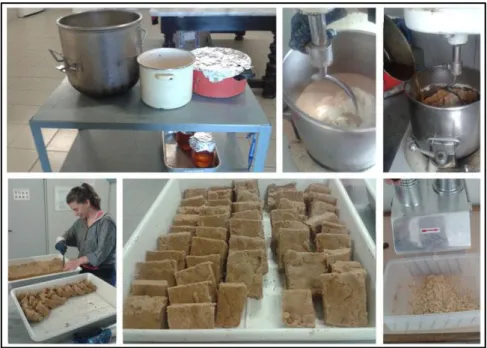
19 Artificial diet preparation was made monthly. The diet contained corn flour, white flour, and wholemeal flour, milk powder, lyophilised brewer’s yeast; the ingredients were mixed together in a big pot; solid wax and liquid glycerine were put in two other pots, and two bottles of honey were prepared in advance. All of the ingredients were placed in a special oven set at 100 °C for 3-4 hours. This is a method to disinfest the materials and to melt the solid ingredients. In a special mixing machine all components were mixed until they got mash texture; before the whole dollop became rigid it was mounted to a plastic tray and cut into smaller pieces (“cubes”) (Figure 11). When the diet cubes were cold they became solid and some of the cubes were grinded in a shredding machine. The grinded diet was placed for 24 h into a freezer (-24 °C), and the following day it was unfrozen and was used for larval feeding. The remaining diet was stored in a fridge set at 4-5 °C until further use.
Figure 11. Diet preparation, Private pictures
4.3. Experiment description:
The experiments included a preliminary test and a main experiment which consisted of two treatments (including the control treatment). To achieve data which could be compared with those collected in a previous study by Benelli (2017), we tested the survival rate and the capacity to complete the development of E. larvarum puparia stored ‘ad libitum’
(preliminary test) or for 4 weeks (main experiment) at 15 °C. This temperature previously showed to be suboptimal for the short term storage of E. larvarum eggs (Benelli et al., 2017)
20 and puparia - the latter up to 3 weeks, tested by Benelli (2017). In the main experiment some quality parameters of the adult E. larvarum females that had emerged from puparia stored at 15 °C for 4 weeks were compared with control puparia always maintained under the standard conditions (at 26 °C). These quality parameters could give an indication about the possibility to use the flies emerged from the stored puparia as biological control agents or even for making the colony maintenance more flexible.
4.3.1. Treatments and procedure
Exorista larvarum puparia to be stored at the experimental conditions were obtained from the stock colony available at the laboratory of Entomology and selected within a weight range of 35-55 mg (Dindo et al., 2006). Prior to storage at 15 °C, regardless of the storage period, puparia were kept under the standard rearing temperature of 26 °C for 24 hrs to allow completion of the first crucial developmental period.
A preliminary test was conducted to assess the possibility of 1-day old puparia to complete their development and lead to adult emergence when continuously (‘ad libitum’) stored at 15 °C. For this purpose, 10 puparia were maintained at this suboptimal temperature and 10 control puparia were kept at 26 °C. Shortly after the third week of storage (21 days), puparia stored at 15 °C began to give origin to adults. Puparia that did not produce adults within the fourth week were kept under observation at 15 °C for additional 2 weeks, but all of them resulted in being non-viable. For this reason, four weeks (28 days) were selected as a maximum storage period to be investigated in the main experiment.
Following the results of the preliminary test, our main experiment was designed to investigate the capacity of E. larvarum puparia to survive and complete development when stored at 15 °C for 28 days (= 4 weeks) (1) compared with puparia kept at the standard temperature of 26 °C from their formation (controls) (2). For each of the two tested treatments, four replicates were carried out, each consisting of 10 puparia placed in a plastic cup (6-cm diameter) with no lid. The plastic cups were transferred into small plexiglass cages (20x20x20 cm) and located either inside an incubator set at 15 ± 1 °C, 65 ± 5 % RH (1) or in the same rearing chamber of the laboratory stock colony (set at 26 ± 1 °C, 65 ± 5 % RH) (2).
Storage conditions were continuously monitored by data loggers (RHT10, Extech, USA).
Puparia were daily inspected for detecting adult emergence. At the end of the storage
21 period of 28 days, puparia stored at 15 °C which had not emerged as adults were brought back at 26 °C, for safe (i.e. to check a possible parasitoid adult emergence, which never occurred). Newly-formed adults were counted and sexed and female flies were selected for the quality control assessment. In treatment 1) emergence occurred before the storage period completion (within the incubator) and female flies were transferred under standard rearing conditions. Male flies were discarded.
4.3.2. Female quality control
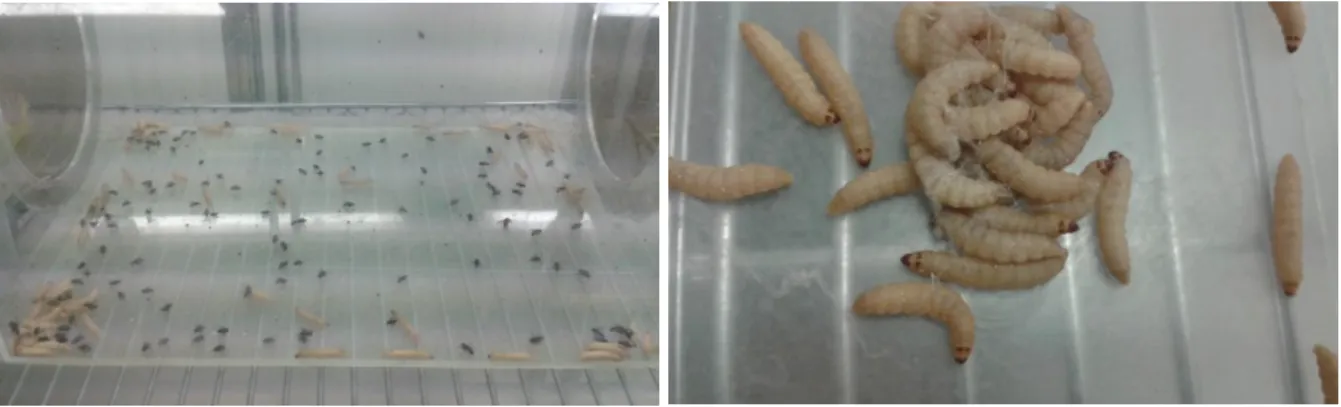
Immediately after emergence, female flies were individually placed in small plexiglass cages of the same type described above and provided a standard diet of water, sugar cubes and a cotton ball soaked in honey/water solution. Subsequently, they were paired with a male fly from the laboratory colony, which had emerged in the same timeframe (48 hrs). When more than one female emerged from the same replicate within 24 hrs, they were placed in the same cage and paired with an equal number of males (Figure 12).
After 3 days from pairing (preoviposition period, see Mellini et al. 1994 and Dindo et al.
2007), the first host larvae were exposed to the females. Specifically, after removing adult food from the cages, 3 mature G. mellonella larvae per female were inserted into the cages.
After allowing females to oviposit for 1 hr, host larvae were collected and the eggs on their integument counted. Host larvae with eggs were kept in small plastic cups (similar to those used during the storage period, but with a lid) under the standard rearing conditions (26 ± 1
°C) until parasitoid pupation (Figure 13). Newly-formed F1 puparia and F1 adults were counted. The parasitization procedure described above was repeated daily for 10 days (or until female death, if this occurred before the 10th day). In fact, E. larvarum females lay most eggs during this period of time (Dindo et al. 1999).
Figure 12-13. Paired experimental females in small cages (left); Plastic cups with parasitized larvae (right), Private pictures
22 4.3.3. Parameters evaluated
The observed parameters during the experiment were the following:
1. Adult emergence (%) calculated on the original puparium number (=10);
2. Pupal development (days), calculated separately for males and females, from the day on which puparia were obtained until adult emergence;
3. Sex ratio (% of females), calculated on the total number of adults obtained;
4. Female adult longevity (days), calculated from emergence until death;
5. Fecundity (F1 eggs/female), this parameter was calculated according to Dindo et al.
(1999; 2006). In detail, the number of F1 eggs per female laid on host larvae (e = number of F1 eggs/number of alive females) was calculated daily. The single e- values were then added to determine the mean number of F1 eggs laid on the larvae within the 10 days of exposure (= E10). The total F1 eggs laid within 10 days by all the females of each treatment were also calculated;
6. F1 puparium yield (%), calculated on the total number of eggs laid by females;
7. F1 adult emergence (%); calculated on the number of F1 puparia obtained.
4.3.4. Statistical analysis
Means and standard error were calculated. The statistical analysis was performed with STATISTICA software for Windows (StatSoft. Inc., Version 2010). The level of significance was set at 0.05 (P) for each statistical measure. For analysing the data variability first we used Levene’s Test for Homogenity of Variance. If the test justified it, One-Way ANOVA was applied and in case of not homogenous variances a non-parametric analysis we used (Kruskal-Wallis test). Before the analysis percentage values were transformed by using arcsine transformation (with ASN formula) (Zar, 1984).
23
5. Results
In the present study, we aimed at the improvement of the rearing technique of E. larvarum, also considering possible applications in mass-rearing. Specifically, we have selected the suboptimal temperature of 15 °C and a longer storage period (4 weeks) for E. larvarum puparia compared to those already tested in previous studies (Benelli 2017).
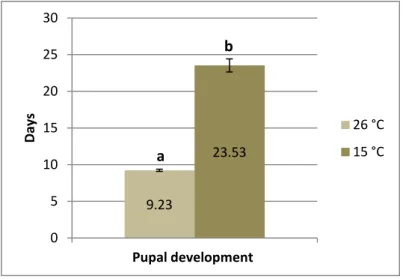
Figure 14. Effect of storage of puparia at 15 °C on the pupal development of E. larvarum. The development time was calculated from puparium formation to adult emergence. The mean values are indicated by the columns (± standard error). Different letters above the columns indicate significant results. See text for statistics.
In general, the obtained results showed that pupal development was significantly affected by the low temperature. Control flies (stored at 26 °C) completed pupal development in about 9 days, while flies stored at 15 °C needed up to 23.5 days (Kruskal-Wallis non parametric test; H = 5.398; P = 0.0202; Figure 14). The first adults emerged between the third and the fourth week of storage, and the remaining puparia died during the storage period. After restoring puparia at 26 °C when the storage period was completed, no adults emerged.
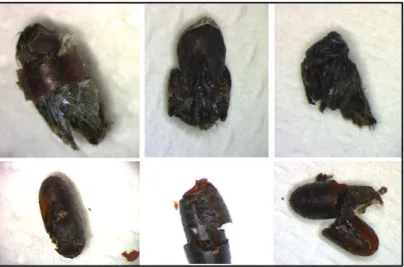
Based on the microscopic images, it is visible that some of the not emerged puparia contained underdevelopped individuals or adult dead shortly before emergence (Figure 15).
9.23
23.53
0 5 10 15 20 25 30
Pupal development
Days
26 °C 15 °C a
b
24 Figure 15. High resolution microscopic images on opened puparia without emergence. Private pictures.
Adult emergence rate and sex ratio were not significantly affected by storage temperature (Table 1). Female development took more days than in case of the males at both temperatures (this was consistent with the findings of previous work, as summaraized by Dindo and Grenier, 2015) . Under standard conditions male development took approximately 9 days and for females it took around 10 days. Otherwise, during the suboptimal storage males reached the adult stage in about 22-23 days, whereas females emerged after about 24-25 days. For both sexes, therefore, the pupal development was about two weeks longer at 15°C than at 26°C. The difference between the development of males and females under 26 °C was about one day, and at 15 °C that was two days.
TABLE 1. Effect of storage at suboptimal temperature (15 °C) of Exorista larvarum puparia for 4 weeks on adult emergence, pupal development and sex-ratio. Number of replicates = 4.
Within a column, means followed by the same letter are not significantly different (P<0.05;
Kruskal-Wallis non parametric test).
Treatment
Adult emergence
(%)1
Pupal development (males) (days) 2
Pupal development (females) (days) 2
Sex ratio (= % females) 3 26 °C (Control) 75±2.887 a 8.84±0.099 a 9.67±0.236 a 42.86±7.180 a 15 °C (4 weeks) 72.5±7.5 a 22.27±0.832 b 24.51±0.968 b 55.55±3.929 a
H (N=8) 0.089 5.398 5.398 2.108
P 0.7645 0.0202* 0.0202* 0.1465
1 percentages calculated on the puparium number
2 calculated from puparium formation to adult emergence
3 percentages calculated on the number of emerged adults
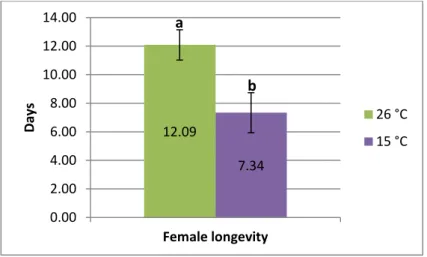
25 Storage at 15 °C negatively influenced the longevity of the emerged females, which was almost halved when compared with control flies (One-Way ANOVA; F (df1,6) =7.3203; P = 0.0353; Figure 16). Similarly, the number of eggs laid by the stored females and F1 puparium yield was significantly reduced, approximately a 50% reduction was found (Table 2). F1 adult emergence did not differ among puparia stored at the low temperature and control puparia kept at 26 °C.
Figure 16. Effect of storage of puparia at 15 °C on female longevity of E. larvarum. The mean values are indicated by the columns (± standard error). Different letters above the columns indicate significant result.
[Female number per replicate = 2 (1st), 3 (2nd), 5 (3rd), 3 (4th ) for the controls and 5 (1st),4(2nd), 4 (3rd), 3 (4th) for 15°C]. See text for statistics.
TABLE 2. Effect of storage at suboptimal temperature (15 °C) of E. larvarum puparia for 4 weeks on different quality parameters of the resulting females: female longevity, F1 eggs/female laid in 10 days from the beginning of oviposition, F1 puparium yield and F1 adult emergence. Host larvae were exposed to female flies from the 4th day from emergence. Number of replicates = 4. Within a column, means followed by the same letter are not significantly different (P<0.05; One-Way ANOVA).
Treatment F1 eggs/female in 10 days (E10)1
F1 puparium yield (%)
F1 adult emergence
26 °C (Control) 90.46±10.696 a 21.98±2.103 a 84.87±3.462 a 15 °C (4 weeks) 42.88±12.336 b 9.66±1.713 b 92.86±7.143 a
F (df1,6) 8.493 21.1879 2.848
P 0.0268* 0.0037* 0.1425
1Female number per replicate = 2 (1st), 3 (2nd), 5 (3rd), 3 (4th ) for the controls and 3 (1st),3(2nd), 3 (3rd), 2 (4th) for 15°C 12.09
7.34
0.00 2.00 4.00 6.00 8.00 10.00 12.00 14.00
Female longevity
Days
26 °C 15 °C b
a
26
6. Discussion
Effective production of biological control agents requires efficient mass-rearing techniques at competitive costs (van Lenteren 2012). The role of tachinid parasitoids in applied biological control programs has been sometimes underestimated; they receive less attention than hymenopteran parasitoids, on which more research has been carried out (Dindo and Grenier 2014). However, examples of successful classical and augmentative biocontrol programs wich involved fly release can be found in literature (Grenier 1988; Shendage and Sathe 2016). For example, lepidopterous sugarcane borers have been succesfully controlled by Lixophaga diatraea in the Southern USA, Central and South America. This tachinid has also potential to be introduced in new Regions producing sugarcane, such China and other Asian Regions (Dindo and Grenier 2014). Another example is our target species, E. larvarum, which was successfully introduced in North America against L. dispar in the 20th century along with other parasitoid species (Kennis and Lopez Vaamonde 1998). This fly has also shown potential to control other forest defoliators and agricultural lepidopterous pest species, like S. littoralis (Boisduval) (Depalo et al. 2010) or M. unipuncta (Haworth) (Depalo et al. 2012) and also other noctuid species, such as Xestia c-nigrum (L.), Peridroma saucia (Hübner), Pseudaletia unipuncta (Haworth) (Simões et al. 2004). This beneficial entomophagous parasitoid can be mass-produced both in vivo, in the presence of a host, and in vitro on artificial media, although, as already emphasised, the latter technique is not competitive with the in vivo one, but it may be useful in emergency cases (Benelli et al.
2017; Dindo et al. 1999).
Storing immature stages of insects at low temperatures provides the possibility to increase the shelf-life by delaying their development and proves also useful as a better tool to adapt at their delivery time according to the demand. In addition, storage increases the overall flexibility of the rearing and, at the same time, can reduce the rearing costs (Glenister and Hoffmann 1998). In his study, Benelli et al. (2017) stored E. larvarum eggs on artificial media under suboptimal temperatures for short periods. Even though some detrimental effects on quality were observed, suboptimal temperature storage proved effective in delaying the parasitoid development thus making its rearing more flexible. A quality reduction of the produced flies was noticed; however, quality is not an absolute concept.
27 According to the results obtained in the present study, we demonstrated that storage at 15
°C for 4 weeks can increase the shelf-life of E. larvarum puparia., However, the low temperature storage caused a reduction in the quality of the resulting females. As reported by Leopold (1998), these findings are generally observed in studies of this kind. Mills and Nealis (1992) also noticed similarities concerning their cold storage research on puparia of the tachinid Aphantorhaphopsis (= Ceranthia) samarensis (Villeneuve), which could be stored approximately at 8 °C until 8 months.
In conclusion, some quality reductions can be acceptable in favor of other requirements, such as the optimal timing schedule by elongation of the development.
Cold storage is a promising technology for insects’ mass-rearing, since it can assist the releases of biocontrol agents both in greenhouses and open field. As previously underlined, its benefits are numerous and include a more flexible schedule for releases and the facilitation of shipment procedures. In the view of better implementing the protocols already developed for E. larvarum, further research is needed to understand the mechanisms of cold storage tolerance of this parasitoid species. Furthermore, future studies will aim at reducing the impact that storage at suboptimal temperatures has shown on the quality of the stored parasitoid (for instance by modifying the parasitoid or host food).
28
7. References:
Abidalla, M. 2018. Morphogenesis of Early Embryonic Development in the Greater Wax Moth, Galleria mellonella (Lepidoptera: Pyralidae). Journal of Entomology, 15: 1-12.
Baronio, P., Dindo, M. L., Campadelli, G., and Sighinolfi, L. 2002. Intraspecific weight variability in tachinid flies: response of Pseudogonia rufifrons to two host species with different size and of Exorista larvarum to variations in vital space. Bulletin of Insectology, 55, 55-62.
Benelli, M. 2017. Effect of short-term suboptimal temperature storage to assist large-scale production of two dipterans: Exorista larvarum (L.) and Bactrocera tryoni (Froggatt). Phd thesis, Univ. of Bologna, IT.
Benelli, M., Marchetti, E., Dindo, M. L. 2017. Effects of storage at suboptimal temperatures on the in vitro-reared parasitoid E. larvarum (Diptera,Tachinidae). Journal of Economic Entomology, 110, 1476 – 1482.
Bigler, F. 1994. Quality control in Trichogramma production. In E. Wajnberg and S.A. Hassan eds. Biological control with egg parasitoids. Wallingford: CAB International 91-111.
Bonnot, G., Delobel, B., Grenier, S. 1984. Elevage, croissance et dévéloppement de Phryxe caudata (Diptera, Tachinidae) sur son hôte de substitution Galleria mellonella (Lepidoptera, Pyralidae) et sur milieu artificiel. Bulletin Société Linnéenne de Lyon 53, 313-320.
Campadelli, G. 1987. Effetti della bassa temperatura sulla coppia ospite-parassita Galleria mellonella L., Pseudogonia rufifrons Wied.pages 29-49 Bollettino dell'Istituto di Entomologia
"Guido Grandi" della Università degli Studi di Bologna 41
Cerretti, P., and Tschorsnig, H. P. 2010. Annotated host catalogue for the Tachinidae (Diptera) of Italy. Stuttgarter Beitrage Zur Naturkunde A, Neue Serie 3: 305–340.
Charriere, J. D., Imdorf, A. 1999. Protection of honey combs from wax moth damage. Am.
Bee Journal, 139, 627–630.
Cohen, A. C. 2004. Insect Diets: Scinece and technology. CRC Press, Boca Raton, USA.
29 Coudron, T. A. 2007. Improving cold storage of insects with dietary changes. In: van Lenteren, J.C., De Clercq, P., Johnson, M., (Eds.), Proceeding of the 11th Meeting of the Working Group Arthropods Mass Rearing and Quality Control – 28/10/2007-1/11/2007, Canada Bulletin IOBC Gloal, Montreal, 34-37 No.3.
Delrio, G., Luciano, P., Prota, R. 1983. I parassiti di Malacosoma neustria L. in Sardegna, pp.
237-244. In: Atti XIII Congresso Nazionale Italiano di Entomologia, Sestriere, Torino, Italy, 27 June-1 July 1983.
Delrio, G., Luciano, P., Flori, I. 1988. I parassiti di Tortix viridana L. in Sardegna, pp. 407-414.
In: Atti XV Congresso Nazionale Italiano di Entomologia, L’Aquila, Italy, 13-17 June 1988.
Depalo, L., Marchetti, E., Baronio, P., Martini, A., and Dindo, M. L. 2010. Location, acceptance and suitability of Spodoptera littoralis and Galleria mellonella as hosts for the parasitoid Exorista larvarum. Bulletin of Insectology, 63(1), 65-69.
Depalo, L., Dindo, M. L., and Eizaguirre, M. 2012. Host location and suitability of the armyworm larvae of Mythimna unipuncta for the tachinid parasitoid Exorista larvarum.
BioControl, 57(4), 471-479.
Dindo, M. L., Farneti, R., Scapolatempo, M., and Gardenghi, G. 1999. In vitro rearing of the parasitoid Exorista larvarum (L.) (Diptera: Tachinidae) on meat homogenate-based diets.
Biological Control, 16(3), 258-266.
Dindo M. L., Grenier S., Guillaud J., Sighinolfi L., Baronio P. 2002. Allevamento in Exorista larvarum (L.) (Diptera: Tachinidae): confronto tra parametri biologici e biochimici di parassitoidi ottenuti in vivo e in vitro. In: Atti XIX Congresso Nazionale Italiano di Entomologia, Catania 10-15 giugno 2002: 831-835.
Dindo, M. L., Verdinelli, M., Baronio, P., Serra, G. 2002. Laboratory and field performance of in vitro and in vivo-reared Exorista larvarum (L.), a natural enemy of cork-oak defoliators. In:
Villemant, C., Sousa, E. (Eds.), Integrated Protection in Oak Forests (Oeiras-Lisbonne- Portugal). 1–4 Ottobre 2001. IOBC Bull., 25, 147–150.
30 Dindo, M. L., Marchetti, E., and Baronio, P. 2007. In vitro rearing of the parasitoid Exorista larvarum (Diptera: Tachinidae) from eggs laid out of host. Journal of Economic Entomology, 100, 26-30.
Dindo, M. L., Grenier, S. 2014. Production of Dipteran Parasitoids. In: Morales-Ramos J.A., Rojas M.G., Shapiro-Ilan D.I, eds. Mass Production of Beneficial Organisms: Invertebrates and Entomopathogens. London, UK: Academic Press, 101–143.
Dindo, M. L. and Nakamura, S. 2018. Oviposition Strategies of Tachinid Parasitoids: Two Exorista Species as Case Studies, International Journal of Insect Science, 1-6.
Dindo, M. L., Vandicke, J., Marchetti, E., Spranghers, T., Bonte, J., and De Clercq, P. 2016.
Supplementation of an artificial medium for the parasitoid Exorista larvarum (Diptera:
Tachinidae) with hemolymph of Hermetia illucens (Diptera: Stratiomyidae) or Antheraea pernyi (Lepidoptera: Saturniidae). Journal of Economic Entomology, 109: 602–606.
Grenier, S. 1988. Applied biological control with tachinid flies (Diptera, Tachinidae): a review.
Anzeiger Für Schadlingskunde, Pflanzenschutz, Umweltschutz 61: 49–56.
Glenister, C. S., Hoffmann, M. P. 1998. Mass-reared natural enemies: Scientific, technological, and informational needs and considerations, 242–267. In R. L. Ridgway, M. P.
Hoffmann, M. N. Inscoe, and C. S. Glenister (eds.), Mass reared natural enemies: application, regulation, and needs. Entomological Society of America, Annapolis, MD.
Hafez, M. 1953. Studies on Tachina larvarum L. (Diptera, Tachinidae). Bulletin of the Entomological Society of Egypt, 37, 255-335.
Herting, B. 1960. Biologie der westpaläarktischen raupenfliegen Dipt. Tachinidae. Monogr. Z.
Angew. Entomology, 16, 188.
Kenis, M., and Lopez Vaamonde, C. 1998. Classical biological control of the gypsy moth, Lymantria dispar (L.) in North America: prospects and new strategies, pp. 213–221. In M. L.
MacManus and A. M. Liebhold (eds.), Proceedings, population dynamics, impact and integrated management of forest defoliating insects. USDA Forest Service General Technical Report NE-247.
31 King, E. G., Leppla, N. C. 1984. Advances and challenges in insect rearing, Government Printing Office, Washington, DC, USA.
Kwadha, C. A., Ong’amo, G. O., Ndegwa, P. N., Raina, S. K. and Fombong ,A. T. 2017. The Biology and Control of the Greater Wax Moth, Galleria mellonella. Insects. 8(2): 61.
Leopold, R. A. 1998. Cold storage of insects for integrated pest management. In: Hallman, G.
J., & Denlinger, D. L. (Eds.), Temperature sensitivity in insects and application in integrated pest management. Westview Press, Colorado, USA, 235-267.
Leopold, R. A. 2007. Colony maintenance and mass-rearing: using cold storage technology for extending the shelf-life of insects. In: Vreysen, M.J.B., Robinson, A.S., Hendrichs, J. (Eds.), Area-Wide Control of Insect Pests, from Research to Field Implementation, Springer, Dordrecht, The Netherlands, 149-162.
Marchetti, E. 2006. Possibili effetti secondari di batteri epifiti modificati con geni di Bacillus thuringiensis (Bt) su Exorista larvarum (L.) (Diptera Tachinidae). PhD thesis in Agricultural Entomology, XVIII Cycle, University of Bologna, IT.
Mellini, E. 1991. Sinossi di biologia dei ditteri larvevoridi (studi sui Ditteri larvevoridi L.
contributo). Bollettino dell'Istituto di Entomologia "Guido Grandi" dell'Università di Bologna, 45, 1-38.
Mellini, E., Campadelli, G., Dindo, M. L. 1993 Artificial culture of the parasitoid Exorista larvarum L. (Dipt. Tachinidae) on bovine serum-based diets. Bollettino dell’ Istituto di Entomologia “Guido Grandi” dell’ Univversità di Bologna. 1993; 47: 221–229.
Mellini, E., Gardenghi, G., and Coulibaly, A. K. 1994. Caratteristiche anatomiche ed istologiche dell’apparato genitale femminile di Exorista larvarum (L.), parassitoide deponente uova macrotipiche sull’ospite. Bollettino dell'Istituto di Entomologia "Guido Grandi" dell'Università di Bologna, 48, 45-58.
Mellini, E., and Campadelli, G. 1997. Analisi del superparassitoidismo di Exorista larvarum (L.) nell’ospite di sostituzione Galleria mellonella (L.). Bollettino dell'Istituto di Entomologia
"Guido Grandi" dell'Università di Bologna, 51, 1-11.
32 Metwally, Hala M. S., Hafez, A. G., Hussein, M. A., Salem, H. A. and Saleh, M. M. 2012. Low Cost Artificial Diet for Rearing the Greater Wax Moth, Galleria mellonella L. (Lepidoptera:
Pyralidea) as a Host for Entomopathogenic Nematodes. Egyiptian journal of pest control 22(1), 2012, 15-17
Michalkova, V. A., Valigurova, M., Dindo, M. L. and Vanhara. J. 2009. Larval morphology and anatomy of the parasitoid Exorista larvarum (Diptera Tachenidae), with an emphasis on cephalopharyngeal skeleton and digestive tract. Journal of Parasitology 95:544-554.
Mills, N. J. and Nealis, V. G. 1992. European field collections and Canadian releases of Ceranthia samarensis (Dipt.: Tachinidae), a parasitoid of the gypsy moth, Lymantria dispar (L.). Entomophaga 37: 181-191.
Miyata, S., Casey, M., Frank, D.W., Ausubel, F.M., Drenkard, E. 2003. Use of the Galleria mellonella caterpillar as a model host to study the role of the type III secretion system in Pseudomonas aeruginosa pathogenesis, Infection and Immunity 71; 2404-2413.
Mylonakis, E., Moreno, R., El Khoury, J.B., Idnurm, A., Heitman, J., Calderwood, S.B., Ausubel, F.M., Diener, A. 2005. Galleria mellonella as a model system to study Cryptococcus neoformans pathogenesis, Infection and Immunity, 73; 3842-3850.
Nielsen, R.A.; Brister, C. 1979. Greater wax moth: Behavior of larvae. Annals of the Entomological Society of America, 72, 811–815.
O’Hara, J. E. 2008. Tachinid flies. In: Capinera, J. L. (Eds.), Encyclopedia of Entomology, 2nd Edition. Springer, Dordrecht, The Netherlands, pp. 3675-3686.ú
O’Hara, JE. 2013 History of tachinid classification (Diptera, Tachinidae). ZooKeys. 2013; 316:
1–34.
Paddock, F.B. 1918. The Beemoth or Waxworm; Texas Agricultural Experiment Stations:
College Station, TX, USA
Roversi, P. F., Cosi, E., Irdani, T. 2007. Chill sensitivity and cryopreservation of eggs of the greater wax moth Galleria mellonella (Lepidoptera: Pyralidae); Cyrobiology 56 (2008) 1-7.
33 Sabrosky, C. W., and Reardon, R. C. 1976. Tachinid parasites of the gypsy moth, Lymantria dispar, with keys to adults and puparia. Miscellaneous publications of the Entomological Society of America 10, 1–126.
Sannino L., Espinosa B. 1999. Biology of Mamestra brassicae (Lepidoptera Noctuidae) in Campania (South Italy). Bollettino del Laboratorio di Entomologia agraria “Filippo Silvestri”, 55: 79-91.
Sehnal, F. 1966. Kritisches Studium der Bionomie und Biometrik der in verschiedenen Lebensbedingungen gezuchteten Wachsmotte, Galleria mellonella L. (Lepidoptera).- Zeitschrift für Wissenschaftliche Zoologie, 174: 53-82.
Shendage, N. and Sathe, T. V. 2016. Tachinids as good biocontrol agents of agricultural pests. Biolife, 4(1), 79-83.
Shimanuki, H. 1980. Diseases and pests of honey bees. In Bee Keeping in the United States;
Science and Education Administration, United States Department of Agriculture:
Washington, DC, USA, Volume 335, pp. 118–128.
Shimanuki, H. 1981. Controlling the Greater Wax Moth. A Pest of Honeycombs; Science and Education Administration, US: United States Department of Agriculture, Washington, DC, USA, Volume 2217, 1–13.
Simões, A. M. A., Dindo, M. L., and Grenier, S. 2004. Development and yields of the tachinid Exorista larvarum in three common Noctuidae of Azores Archipelago and in a laboratory host. Bulletin of Insectology, 57(2), 145-150.
Tauber, M.J., Tauber, C.A. and Gardescu, S. 1993. Prolonged storage of Chrysoperla carnea (Neuroptera: Chrysopidae). Environmental Entomology 22, 843-848.
Thompson, S.N., 1999. Nutrition and culture of entomophagous insects. Annu. Rev.
Entomology 44, 561–592.
Valigurová, A., Michalková, V., Koník, P., Dindo, M.L., Gelnar, M.and Vanhara, J. 2014.
Penetration and encapsulation of the larval endoparasitoid Exorista larvarum (Diptera:
Tachinidae) in the factitious host Galleria mellonella (Lepidoptera: Pyralidae) Bulletin of Entomological Research 104, 203–212, © Cambridge University Press 2013
34 van Lenteren, J. C., Tommasini, M. G. 2003. Mass production, storage, shipment and release of natural enemies. In: van Lenteren, J. C. (Eds.), Quality control and production of biological control agents, theory and testing procedures. CABI Publishing, Cambridge, Massachusetts, USA, 182-189.
van Lenteren, J. C. 2012. The state of commercial augmentative biological control: plenty of natural enemies, but a frustrating lack of update. BioControl 57: 1-20.
Williams, J.L. 1997. Insects: Lepidoptera (moths). In Honey Bee Pests, Predators, and Diseases; Morse, R., Flottum, K., Eds.; AI Root Company: Medina, OH, USA, 1997; 121–141.
Zar, J. H. 1984. Biostatistical analysis. Englewood Cliffs, NJ, USA: Prentice Hall.
35
8. Appendix
8.1 List of Figures:
Figure 1. Life cycle of E. larvarum Source: Dindo and Nakamura (2018)(drawn By M. Benelli)7.
Figure 2. Melanisation of the host’s cuticle; Private picture ... 8.
Figure 3-4. Examples for pupation, out of the host and within the host; Private pictures ... 9.
Figure 5-6. E. larvarum male with his forked pretarsi; and a female adult with slightly divided pretarsi, Private pictures ... 10.
Figure 7. Life cycle of G. mellonella Source: Abidalla 2018. ... 12.
Figure 8. A cage from the standard colony with water cup, food, puparia and adults, Private picture ... 17.
Figure 9-10. Parasitisation for the stock colony, and collected larvae with eggs, Private pictures ... 18.
Figure 11. Diet preparation, Private pictures ... 19.
Figure 12-13. Paired experimental females in small cages (left); Plastic cups with parasitized larvae (right), Private pictures ... 21.
Figure 14. Effect of storage of puparia at 15 °C on the pupal development of E. larvarum. The development time was calculated from puparium formation to adult emergence. The mean values are indicated by the columns (± standard error). Different letters above the columns indicate significant results. See text for statistics. ... 23.
Figure 15. High resolution microscopic images on opened puparia without emergence.
Private pictures. ... 24.
Figure 16. Effect of storage of puparia at 15 °C on female longevity of E. larvarum. The mean values are indicated by the columns (± standard error). Different letters above the columns indicate significant result. [Female number per replicate = 2 (1st), 3 (2nd), 5 (3rd), 3 (4th ) for the controls and 5 (1st),4(2nd), 4 (3rd), 3 (4th) for 15°C]. See text for statistics... ... 25.
36
8.2. Table index:
TABLE 1 Effect of storage at suboptimal temperature (15 °C) of Exorista larvarum puparia for 4 weeks on adult emergence, pupal development and sex-ratio. Number of replicates = 4.
Within a column, means followed by the same letter are not significantly different (P<0.05;
Kruskal-Wallis non parametric test). ... 24.
TABLE 2 Effect of storage at suboptimal temperature (15 °C) of E. larvarum puparia for 4 weeks on different quality parameters of the resulting females: female longevity, F1 eggs/female laid in 10 days from the beginning of oviposition, F1 puparium yield and F1 adult emergence. Host larvae were exposed to female flies from the 4th day from emergence. Number of replicates = 4. Within a column, means followed by the same letter are not significantly different (P<0.05; One-Way ANOVA). ... 25.
37
8.3. List of abbreviations
no. or nr. – number pup. – puparia
G. larvae – Galleria larvae (Galleria mellonella) EM – Emergence
Avr – Average