1 PART I: PROJECT INFORMATION
Project Title: Sixth Operational Phase of the GEF Small Grants Programme in Kazakhstan
Country: Kazakhstan GEF Project ID:
GEF Agency: UNDP GEF Agency Project ID: 5045
Other Executing Partner: UNOPS Submission Date: 27 Jul 2015
GEF Focal Area(s): Multifocal Areas Project Duration (Months) 48
Integrated Approach Pilot IAP-Cities IAP-Commodities IAP-Food Security Corporate Program: SGP X
Name of parent program: Agency Fee ($) 251,724
A. INDICATIVE FOCAL AREA STRATEGY FRAMEWORK AND OTHER PROGRAM STRATEGIES Objectives/Programs (Focal Areas, Integrated Approach Pilot, Corporate
Programs) Trust Fund
(in $) GEF Project
Financing Co- financing
BD-2 Program 4 GEF 883,242 1,000,000
LD-2 Program 3 GEF 883,242 1,000,000
CCM-2 Program 3 GEF 883,242 1,000,000
Total Project Cost 2,649,726 3,000,000 B. INDICATIVE PROJECT DESCRIPTION SUMMARY
Project Objective: To build the social-ecological resilience of steppe and desert landscapes of Kazakhstan by securing global environmental benefits from community-based management of biodiversity, ecosystem function, and land, water and biomass resources.
Project Component
Fi na nci ng Ty pe
Project Outcomes Project Outputs Trust Fund
(in $)
GEF Project Financing
Co- financing
1.0. Resilient rural
landscapes of steppe and desert ecosystems for sustainable development and global environmental protection
TA 1.1 Community organizations in multistakeholder partnerships formulate and implement adaptive management plans to strengthen socio-ecological resilience of steppe and desert landscapes based on conservation of biodiversity, sustainable
management of land and water resources, and adaptation to and mitigation of climate change.
1.2 Multistakeholder landscape
1.1.1 Formal multistakeholder groups organized for each landscape
1.1.2 Formal multistakeholder
agreements agreed and signed regarding long term outcomes for each landscape 1.1.3 Participatory research and planning processes instituted leading to comprehensive socio-ecological baseline assessments
1.1.4 Landscape strategies developed by multistakeholder groups with detailed typology of community level projects developed and agreed by multistakeholder groups together with elegibility criteria
1.2.1 Multisectoral policy dialogue
GEF 2,517,240 2,850,000
GEF-6 PROJECT IDENTIFICATION FORM (PIF)
PROJECT TYPE:FULL-SIZED PROJECT TYPE OF TRUST FUND:GEFTRUST FUND
2
management groups, local policy makers and
subnational/national advisors organized in landscape policy platforms discuss potential policy innovations based on analysis of project experience and lessons learned.
1.3 Community organizations in target ecosystems build their adaptive management and organizational capacities by designing and implementing community and/or landscape level projects to sustain and revitalize biodiversity and ecosystem function; improve productivity and sustainability of production systems;
develop viable livelihood alternatives;
and strengthen formal and non-formal landscape governance institutions and mechanisms.
1.4 Successful technologies, practices and systems from community based initiatives are upscaled by multistakeholder partnerships using knowledge and lessons learned from
identifying, testing and adapting community innovations for landscape and resource management.
platforms organized for each landscape and one dialogue platform organized nationally including potential financial partners and public sector institutions as viable in analysis and planning
1.2.2 Relevant project and portfolio experiences systematized and codified for dissemination to policy platform participants as well as community organizations and networks and second level organizations
1.3.1 Community level small grant projects in the selected landscapes that conserve biodiversity and enhance ecosystem services
1.3.2 Community level small grant projects in the selected landscapes that enhance productivity and sustainability of smallholder agroecosystems 1.3.3 Community level small grant projects in the selected landscapes that innovate alternative livelihood options and improve market access
1.4.1 Detailed analysis of successful grant project portfolios and lines of work (e.g. crop genetic resource conservation) to identify lessons learned/best practice and market opportunities and identification of upscaling requirements and opportunities and development of a strategy(ies) to enable and facilitate upscaling
1.4.4 Strategic projects (up to USD 150,000) to implement strategies enabling and facilitating upscaling of the identified portfolios and lines of work
3
Subtotal 2,517,240 2,850,000 Project Management Cost (PMC) GEF 132,486 150,000 Total Project Cost 2,649,726 3,000,000
C.INDICATIVE SOURCES OF CO-FINANCING FOR THE PROJECT BY NAME AND BY TYPE, IF AVAILABLE
Sources of Co-
financing Name of Co-financier Type of Co-
financing Amount ($)
CSO Community Grantee Organizations In-kind 750,000
CSO Community Grantee Organizations Cash 750,000
GEF Agency UNDP Cash 800.000
GEF Agency UNDP In-kind 300,000
TBD TBD 400,000
Total Co-financing 3,000,000
D.INDICATIVE TRUST FUND RESOURCES REQUESTED BY AGENCY, COUNTRY AND THE PROGRAMMING OF
FUNDS
GEF Agency
Trust Fund
Country/
Regional/ Global Focal Area Programming of Funds
(in $) GEF
Project Financing
(a)
Agency Fee (b)
Total (c)=a+b
UNDP GEF Kazakhstan Biodiversity 883,242 83,908 967,150
UNDP GEF Kazakhstan Land degradation 883,242 83,908 967,150
UNDP GEF Kazakhstan Climate change 883,242 83,908 967,150
Total GEF Resources 2,649,726 251,724 2,901,450
E. PROJECT PREPARATION GRANT (PPG)
Is Project Preparation Grant requested? Yes X No If no, skip item E.
PPG AMOUNT REQUESTED BY AGENCY,TRUST FUND, COUNTRY AND THE PROGRAMMING OF FUNDS Project Preparation Grant amount requested: $ 90,000 PPG Agency Fee: 8,550 GEF
Agency
Trust Fund
Country/
Regional/Global Focal Area Programming of Funds
(in $)
PPG (a)
Agency Fee (b)
Total c = a + b
UNDP GEF Kazakhstan Biodiversity 30,000 2,850 32,850
UNDP GEF Kazakhstan Land Degradation 30,000 2,850 32,850
UNDP GEF Kazakhstan Climate Change 30,000 2,850 32,850
Total PPG Amount 90,000 8,550 98,550
F. PROJECT’S TARGET CONTRIBUTIONS TO GLOBAL ENVIRONMENTAL BENEFITS
Corporate Results Replenishment Targets Project Targets
1. Maintain globally significant biodiversity and the ecosystem goods and services that
Improved management of landscapes and seascapes covering 300 million hectares
TBD
4
it provides to society
2. Sustainable land management in production systems (agriculture, rangelands, and forest landscapes)
120 million hectares under sustainable land management
TBD
3. Promotion of collective management of transboundary water systems and
implementation of the full range of policy, legal, and institutional reforms and investments contributing to sustainable use and maintenance of ecosystem services
Water-food-ecosystems security and conjunctive management of surface and groundwater in at least 10 freshwater basins;
Number of freshwater basins
20% of globally over-exploited fisheries (by volume) moved to more sustainable levels
Percent of fisheries, by volume 4. 4. Support to transformational shifts towards a
low-emission and resilient development path
750 million tons of CO2e mitigated (include both direct and indirect)
TBD
5. Increase in phase-out, disposal and reduction of releases of POPs, ODS, mercury and other chemicals of global concern
Disposal of 80,000 tons of POPs (PCB, obsolete pesticides)
metric tons Reduction of 1000 tons of Mercury metric tons Phase-out of 303.44 tons of ODP (HCFC) ODP tons 6. Enhance capacity of countries to
implement MEAs (multilateral environmental agreements) and
mainstream into national and sub-national policy, planning financial and legal frameworks
Development and sectoral planning frameworks integrate measurable targets drawn from the MEAs in at least 10 countries
Number of Countries:
Functional environmental information systems
are established to support decision-making in at least 10 countries
Number of Countries:
PART II: PROJECT JUSTIFICATION A.1. Project Description
A.1.1 The problem and barriers that need to be addressed The GEF SGP in Kazakhstan
The GEF Small Grants Programme (GEF-SGP) in Kazakhstan was established in 1997. Since that time, the Kazakhstan SGP has supported 329 projects for a total of US$ 6.6 million in GEF funding. The Kazakhstan SGP Country Programme has provided technical and financial support to community-based projects that conserve and restore biodiversity under threat; mitigate climate change impacts through use of alternative energy sources like wind and solar power, retrofitting of installations for energy efficient heating as well as use of energy efficient construction materials; protect trans-boundary water bodies; introduce sustainable land and water use practices to combat land degradation and desertification; and reduce the use of persistent agro-ecological pollutants. These projects include demonstration projects (e.g. water saving, sustainable rangeland management, zero tillage, energy efficient homes and furnaces, energy efficient lighting in schools, etc.), capacity building projects for community- based organizations through learning-by-doing, information and awareness campaigns, and advocacy projects to disseminate results of small-scale demonstration projects at regional and national levels and promote replication.
Initially, the GEF-SGP Programme took a geographic approach by identifying priority regions like the pre-Caspian and pre-Aral regions and the Tien Shan Mountains. In addition, GEF-SGP Kazakhstan accepted applications from other regions that met the GEF-SGP thematic criteria, though the number of applicants was limited during this time.
In 2003, however, this approach was adjusted to substantially expand the number of projects and their thematic focus, improve the quality of submitted project proposals and more actively engage public organizations from all over the country in addressing important environmental and socio-economic issues. In 2007, the Programme’s strategic approach was adapted to focus more on capturing knowledge from specific kinds of projects (lines of work) and generating best practices and lessons learned, with the aim of demonstrating tangible positive effects on environment and people’s livelihoods that could be replicated in other regions of the country. In this context, the Programme’s planning, implementation, monitoring and evaluation processes over time have been revised substantially to ensure that projects produce visible and measurable impacts on the ground, delivering global
5 environmental benefits within the GEF-SGP focal areas, as well as community organizational capacities and knowledge from community level innovations.
GEF-SGP Kazakhstan continues pursuing this approach to project development, implementation and promotion. To support the Country Programme and tap additional resources, the Programme established partnerships with relevant national and regional government programs and projects as well as networks of non-government and research organizations and experts in all regions of Kazakhstan.
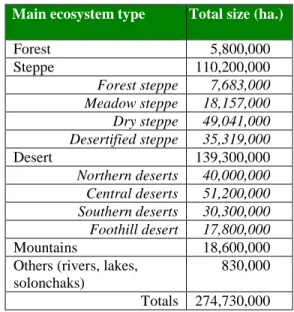
The global environmental significance of Kazakhstan is well-documented (See Annex 1 for brief descriptions of important target ecosystems and biodiversity). Nevertheless, structural and functional degradation of desert and steppe ecosystems is occurring across Kazakhstan with the loss of important biodiversity and ecosystem services.
Wind and water erosion primarily due to unsustainable farming practices (crop and rice production) and extensive resource use (grazing, wood and grass harvesting) affect over 67 % of rain-fed areas of steppe and desert ecosystems, resulting in the loss of agro-ecological matter in topsoil (20% in the past 30 years) and reduction of crop yields by 20-30%1. Widespread monoculture practices are by far the leading cause of the gradual degradation of habitats, and loss of flora and fauna, including floodplain communities and riparian forests. Inefficient irrigation coupled with inefficient and inappropriate farming methods have negatively affected soil structure, causing waterlogging, salinization, leaching of essential soil nutrients, and wind and water erosion.
The increasing annual harvest of riparian trees and reeds by local communities, local hunters, fishermen and farmers for use as fuel and for sale as well as for creating areas for fishing, grazing and harvesting has led to a dramatic reduction of the area and diversity of wooded zones. Tree and reed cutting puts at risk the survival of some bird, reptiles and mammal species, because their distribution is closely connected with these islets of wooded vegetation in surround treeless landscapes. Cutting of saksaul forest (Haloxylon sp.) near rural settlements causes sand drifts, soil erosion, and increased occurrence of windstorms in productive landscapes.
Overgrazing is the leading cause of degradation of Kazakhstan’s rangelands making this important agroecosystem susceptible to droughts, inadequate natural regeneration, widespread aerial transportation of sand and salt (affecting some 30 million ha) and formation of salinized or “solonchak” lands (more than 93 million ha).2 Today, over 62% of winter pastures and 71% of summer pastures are eroded and the quality of pastures has declined by 4-5 times compared to the 1980s levels3. Between 1951 and 2011, the stocking rate of livestock increased five times over the carrying capacity of pastures around rural settlements. Just in the past decade, sheep grazing in Kazakhstan has nearly tripled. The pressure on pastures (floodplain pastures and pastures around settlements) is intensified by the declining practice of moving livestock between summer and winter pastures, and increased livestock density, especially in areas around settlements, i.e. communal winter pastures4. The combined impact generates land erosion around settlements and under-grazing at distant pastures.
Unsustainable hunting and fishing is on the rise. Unsustainable fishing largely stems from the worsening economic situation in rural areas of the country and has become a source of income for low income populations. The uncontrolled poaching of goitered gazelle (Gazella subgutturosa) and koulan (Equus hemionus) has contributed to a significant drop in their populations since 1990s. Poaching not only threatens steppe and desert species directly, but also leads to broader, ecosystem-level impacts associated with sharply reduced levels of grazing. Unsustainable hunting and fishing destabilize population size, cause disturbance for birds during nesting times, and can jeopardize conservation efforts of protected areas in both zones.
Being a semiarid to arid country with a temperate climate, Kazakhstan faces significant desiccation in the face of climate change, and significant exacerbation of non-climate pressures. Kazakhstan’s national communications to the
1 The Fifth National Report of Kazakhstan on Implementation of the UN Convention on Combatting Desertification (with comments and additions). 2014. Astana, Republic of Kazakhstan
2 National Programming Framework of Kazakhstan under CACILM. 2009
3 According to the Committee of Land Resources of the Ministry of Regional Development of Kazakhstan
4 UNDP (2005)
6 UNFCCC indicate that climate change scenarios for Kazakhstan project an increase in average temperature (approximately +1.4 by 2030 to +4.6 by 2085), and northward migration of humidity zones by as much as 450 km.
This increasing aridity threatens to significantly decrease the resilience of Kazakhstan’s ecosystems to land degradation pressures, constituting both a considerable threat to the natural environment, as well as to national development and poverty alleviation targets. Climate change impacts are expected to exacerbate existing land degradation pressures, by reducing ecosystem resilience to non-climate drivers of land degradation, while also contributing to land degradation directly through desiccation and increased wind and water erosion. Land degradation has already had significant adverse impacts on rural communities, whose livelihoods are dependent on agriculture and livestock production. Climate change will increase the severity and geographic extent of land degradation pressures, threatening these livelihoods further (III-VI National Communication to the UNFCCC, 2013).
The unsustainable resource management and production practices driving widespread ecosystem degradation and increasing vulnerability to climate change must be addressed through the coordinated actions of individual smallholders and land users organized to pursue agreed objectives aimed at enhancing socio-ecological resilience across the landscape. Collective action by civil society is required to achieve and maintain resilience of socio- ecological systems in rural landscapes. This resilience is built primarily on climate change mitigation and adaptation and optimization of ecosystem services through biodiversity conservation and sustainable land management, including agro-ecosystem management and integrated water resources management, among other things, all of which are pursued in the context of local sustainable development. Community organizations need to act in synergy to achieve impacts at the scale of rural landscapes, progressively acquiring critical mass to reach a tipping point of adoption by rural constituencies of adaptive practice and innovation. To act effectively, community organizations need the motivation, capacities, knowledge, financing and enabling factors and opportunities to work individually and collectively. Using SGP funding, community organizations and NGOs build their capacities through learning by doing i.e. through analysis of their priorities and problems; identification of potential innovations to address them;
and project design, implementation, monitoring, and evaluation of results and performance. To date, while the Kazakhstan Country Program has supported community organizations individually, it has also organized them in informal networks for broader knowledge sharing and information exchange. SGP Kazakshtan experience with different successful lines of work has laid the foundation for upscaling of specific technologies, practices and systems. A significant enabling factor for the success of the SGP Country Programme over the years and a concrete basis for upscaling has been the establishment of long-lasting multistakeholder partnerships in specific regions and around specific themes. Partners include local governments, national agencies and Ministries, NGOs, the private sector and others, who provide support (technical assistance, strategic guidance, financing) to community level initiatives.
Nevertheless, community level organizations in Kazakhstan often lack essential adaptive management capabilities, such as technical know-how, planning skills, innovation and experimentation capacities and organizational abilities, and, as a result, often resort to ineffective and unsustainable land and biodiversity resource use practices that can put at risk the integrity and resilience of steppe and desert landscapes thus threatening long-term sustainability of rural livelihoods.
The essential problem to be addressed by this project is that the necessary collective action in Kazakhstan for adaptive management of resources and ecosystem processes for sustainable development and global environmental benefits is hindered by the organizational weaknesses of the communities living and working in affected landscapes to act strategically and collectively in building social and ecological resilience.
The preferred solution is the following: rural community level organizations develop and implement adaptive management strategies and projects for their landscapes that build social, economic, and ecological resilience based on and reinforced by global environmental and local sustainable development benefits.
The main barriers to achieving the preferred solution are described below.
Rural communities lack adequate skills and capacities for landscape-level resource planning and management:
Communities generally suffer from weak organizational capacities to efficiently and effectively plan, manage and implement initiatives and actions of their own design. They often lack a larger, more long-term vision and strategy
7 for ecosystem and resource management and suffer from weak adaptive management capacities i.e. to innovate, test alternatives, monitor and evaluate results, and adjust practices and techniques to meet emerging challenges and lessons learned. Community-based organizations such as joint pasture users associations or joint forest users do exist but are not conversant in sustainable resource management and receive limited extension support or training in long- term strategic planning for resilient ecosystem management. Motivation to maintain ecosystem services is often weak and innovation in incentive development is rarely systematic, for example, there is no experience with Payments for Ecosystem Services at community level in Kazakhstan. There is a need for structured innovation and the systematization of this experience with the aim of developing a critical mass of pilot projects relevant to the Kazakh context.
Community organizations often lack sufficient organizational capacities to effectively initiate and implement initiatives and actions that reduce threats to biodiversity and land degradation and preserve ecological functions of productive and non-productive landscapes. Community-based organizations implement initiatives and projects largely on an ad-hoc basis by using conventional non-efficient approaches and technologies that have little to do with biodiversity conservation and sustainable land management. Also, communities mostly react to emerging environmental problems and have few capacities and skills to address such problems proactively.
Community organizations lack sufficient financial resources to lower the risks associated with innovating land and resource management practices and sustaining or scaling up successful experiences. Financial support for sustainable use in the form of micro-credits has been gaining popularity in the country. This is especially the case in areas where income has been gradually rising and with it the borrowing capacity of people. In rural areas, however, the access of community-based organizations to micro-credit remains a problem. While for mainstream agriculture (crop farming, animal husbandry) more credit is available, alternatives that would at the same time generate biodiversity and SLM benefits lack credit availability.
Knowledge from project experience with innovation/experimentation in relation to biodiversity conservation, climate mitigation and sustainable land management is not systematically analyzed, recorded or disseminated for adaptive management and policy inputs: Kazakhstan has declared a transformation to a “green economy,” but in the area of community-based practices, the country has neither the know-how nor the professionals with relevant biological, climate, SLM and financial knowledge and skills. The existing extension services do not have this knowledge either, and as a result local communities are unable to acquire methods to raise productivity without negatively disrupting ecolosystem functions, in particular in regard to the role of pastures and forests in underground water recharge, erosion control, flood mitigation, etc. As well, a few communities realize the benefits of using distant pastures, but no easily accessible information is available on how to improve living conditions of herders in distant pastures (e.g.
the use of wind and solar power for electricity generation, energy efficient furnaces and materials for construction of herder houses, etc.), even though this knowledge is available in the country. Finally, there is a rather limited cooperation and co-ordination between conservation agencies, development sectors, land-use planning authorities and local communities. Conservation agencies, local communities, stakeholders within development sectors and land-use planning authorities have few interactions regarding conservation strategies and objectives. This absence of co-operation is particularly critical with respect to comprehensive policy making that stems from tested and workable solutions and approaches to sustainable landscape management.
A.1.2 The baseline scenario and associated baseline projects National level baseline programs and projects
Kazakhstan has adopted the Concept of transition of the Republic of Kazakhstan to a "green economy”, approved by the Decree of the President of the Republic of Kazakhstan № 577 on May 30, 2013 with the aim to harmonize relations between people and nature. The conceptual framework of the strategy includes the following documents:
the Strategy of Development of Kazakhstan until 2030; the Strategic Development Plan of the Republic of Kazakhstan until 2020; the Sectoral Programme "Zhasyl damu" for 2010-2014, the Strategy of Industrial and Innovation Development for 2003-2015 and other programs and documents.
The main priorities for the transition to a "green economy" are as follows: (i) more efficient use of resources (water,
8 land, biota, fuel, etc.) and their effective management; (ii) modernization of existing infrastructure and construction of new infrastructure; (iii) improved welfare of the population and the quality of the environment through cost- effective ways of mitigation of pressures on the environment; (iv) enhancing national security, including food and water security.
One of the priority areas, specified in the concept, is the "Conservation and efficient management of ecosystems".
Integrated management of natural ecosystems will be implemented in accordance with the principles of sustainable development to increase significance and the economic potential of natural ecosystems. A widespread use of alternative energy sources is also among the top government priorities and included in the government’s concept of transition to green economy.
With regard to the management of wildlife, the plan is to make it attractive for promotion of sustainable hunting and sport fishing, ecotourism, safari photography, reproduction of wild animals in captive and semi-free conditions—all there are considered as "green" investments. Ecological tourism was identified as one of the most promising tourist products and the essential condition for its development is conservation of landscapes suitable for ecotourism.
Among other government programs, the followings can be listed as relevant5:
Protected Area Expansion Program until 2030. The program provides financing for the inclusion of under- represented ecosystems in the national PA system. The program has no instruments for biodiversity conservation in landscapes adjacent to PAs as well as no mechanisms for community-based PA management.
State program “Agro-business 2020 (2013–2020, by Ministry of Agriculture, Oblast Akimats, Akimats of Almaty and Astana cities, about US $ 1.8 million annually). The program provides mainstream subsidies for key crops and supports large-scale farmers. While it is a main source of subsidies in agriculture, because of its focus on large-scale producers it has negative consequences for land.
Rational use of land resources (2013–2020; Ministry of Agriculture, about US$ 309 million annually). The program largely focuses on the increased use of mineral (chemical) fertilizers, and provision of specialized machinery to incentivize farmers. One particular item in the master plan, however, mentions the need to introduce changes to current rules on the rational use of croplands, pastures and hayfields.
State Program on Prevention of Desertification and Efficient Use of Summer-Winter Pastures (2004–2014;
Ministry of Agriculture; 2012 budget: US$ 387 million). The program supports production-oriented agriculture (e.g. seed production [$14.7 million], livestock breeding programs [$28.0 million], and improving quality of livestock [$87.4 million]) without considering the carrying capacity of ecosystems.
National Program for Restoration and Expansion of Pastures (2009–present, Ministry of Agriculture). This is a relatively small-scale program aiming to restore 32,000 hectares of the most degraded pasture lands and convert them to hayfields.
Local level baseline programs
There is a limited number of government and donor financed programs that empower community organizations, individually or collectively, to take a lead role as decision making agents in determining strategic landscape management priorities, which technologies or practices to adopt, how production systems should be designed, how they should be adapted to prevailing community conditions, etc. The following can be listed:
State social procurement program disburses public grant funding to NGOs at oblast and rayon levels but
5Implementation of these national programs is realized through action plans at the local level. No separate community-level programs exist in Kazakhstan.
9 largely focuses on projects that address social and educational needs at the local level.
Damu Fund, designed as a grant mechanism, largely targets small and medium-sized businesses with little reference to environmental issues.
Counterpart Consortium provided grant funding to NGOs and community-based organizations for capacity building (training and seminars). This entity no longer operates in Kazakhstan.
Coca Cola implements—through UNDP—a grant program “Every Drop Matters” that targets NGOs and community-based organizations covering hygiene, sanitation, access to drinking water, and water saving (to some extent) issues.
To sum up, there are currently no programs in Kazakhstan—other than the GEF SGP Country Programme—that aim at building the capacities of rural communities to plan and manage their landscapes for sustainable development.
A.1.3 The proposed alternative scenario
The GEF Kazakhstan Country Programme objective is to build the social-ecological resilience of steppe and desert landscapes of Kazakhstan by securing global environmental benefits from community-based management of biodiversity, ecosystem function, and land, water and biomass resources. The project will be designed to achieve this objective and generate the expected outcomes and related outputs.
Component 1 – Resilient rural landscapes of steppe and desert ecosystems for sustainable development and global environmental protection
Under this Component, GEF incremental support and co-financing will be applied to overcome the barriers mentioned above and to add value, where appropriate and possible, to existing government sectoral initiatives in rural Kazakhstan. In particular, GEF funding will provide small grants to NGOs and community organizations for the development and implementation of landscape-level planning frameworks (landscape management plans) that focus on the economic potentials (rather than the constraints) of safeguarding and maintaining ecosystem services in target ecosystems. The plan is to develop at least six landscape management plans that encompass the lands of several rural communities in target landscapes in pursuit of strategic landscape outcomes related to biodiversity conservation, sustainable land management, climate change adaptation and mitigation and integrated water resources management.
Community-managed plans will also be promoted for management of such areas as Important Bird Areas (IBAs).
This project component will be carried out in specific landscapes of up to seven administrative regions of Kazakhstan, covering steppe and desert ecosystems, to be defined with more precision during the project preparation phase. In terms of geographic coverage, target ecosystems include the following administrative regions (or oblasts):
(i) steppe ecosystems – Akmola, Pavlodar, Kostanai and Karaganda oblasts; (ii) desert ecosystems – Kzylorda, South Kazakhstan and Almaty oblasts.
The target steppe and desert areas include many lakes and rivers, of which the most significant are Lake Balkhash, and the Syr Darya and Ili Rivers. A significant portion of the world’s remaining natural Pontian steppe habitat in Kazakhstan supports approximately 2,000 species of flora; provides habitat for 9 of the 24 globally endangered mammal species occurring in the country6 and about 70% of bird species described for Kazakhstan including Sociable Lapwing, Great Bustard, Little Bustard, Pallid Harrier, and Black-winged Pratincole. The country’s important desert ecosystems, covering about 50% of the country’s territory, provide habitat for 151 threatened species out of 800 listed in the country (the second highest number after forests); 27 rare vegetation communities, out of 79 rare vegetation communities in need of protection, which is the highest number, followed by forest communities at 22; 51.4% of all bird species; and 65.2% of all reptile species. In particular, the area is home to two
6 These are Saiga Antelope (Saiga tatarica tatarica), Kulan (Equus hemionus), Przewalski Horse (Equus przewalskii), Goitered Gazelle (Gazella subgutturosa), Desert Dormouse (Selevinia betpakdalensis), Steppe Pika (Ochotona pulsilla), Kazakhstan Argali (Ovis ammon collium), Menzbier’s marmot (Marmota menzbieri) and Palla’s Cat (Felis manul).
10 Global 200 Ecoregions, a number of Important Bird Areas (IBAs), and the largest threatened mammals in this area such as goitered gazelle (Gazella subgutturosa), onager (Equus hemionus), Pallas's cat (Otocolobus manul or Felis manul), caracal (Caracal caracal), etc. Please refer to Annex 1 for details on biodiversity significance of target ecosystems.
The tentatively identified administrative regions cover about 53% of total population and about 30% of rural residents in Kazakhstan. Of the total population in the target regions, rural communities constitute about 52%.7
The economy of target steppe ecosystems located in northern and central parts of Kazakhstan focus on both agricultural and industrial production. Wheat production is widespread in Kostanai and Akmola oblasts with contribution to total grain production in the country of 15.8% and 13% respectively. Karaganda oblast is rich in mineral resources and raw materials (e.g. coal, ferrous, non-ferrous, precious metals) and is home to such sectors as coal production, mineral resources extraction, machinery engineering, pharmaceutical and chemical production, and production of construction materials. Pavlodar oblast is second after Karaganda oblast with a share of industrial production of 11.9% (intermediary goods mostly such as aluminum, coal, electricity). Rice, vegetable and fish production is present in desert ecosystems of Almaty, Kzyl Orda and South Kazakhstan oblasts (south and south- east of Kazakhstan), largely along the downstream areas of the Syr Darya and Ili Rivers. More than 80% of total rice production in Kazakhstan depends on the rice growing area in the Kzyl Orda oblast. Along with agricultural production, industries such as food processing, uranium extraction, construction materials production, and electricity generation equally contribute to economies of these regions.8 Cattle raising and pasturing are well developed in both steppe and desert ecosystems and continue to serve as the main source of subsistence for rural communities.
Target steppe and desert ecosystems represent mosaics of natural and productive landscapes including agricultural, industrial, urban and rural areas that shelter important migratory mammals and birds, whose status depends on a landscape-level approach to conservation along with sustainable livelihoods in productive areas. As such, criteria for more precise landscape selection will include biodiversity value, land use trends and patterns, opportunities for application of renewable energy technologies, poverty and inequality levels, disposition of communities and local authorities, potential partnerships with NGOs, the private sector and other stakeholders, and other factors.
Under this component, GEF funding will provide small grants to NGOs and community organizations to build their governance and organizational capacities through implementation of sustainable and replicable resource use practices in PA buffer zones, wildlife corridors, community managed areas such as IBAs and agroecosystems. Sustainable and adaptive practices include but are not limited to drip irrigation, zero tillage, crop rotation, sustainable pasture management, fodder production, agro-ecological farming, biodiversity-related products, and eco- and agrotourism.
Community-driven initiatives under this Component will demonstrate techniques for increasing the effectiveness of PAs by enhancing biodiversity conservation and ecosystem services of intervening landscape areas. Implementing SLM practices will not only improve biodiversity and ecosystem services within the demonstration sites but will have wider implications by reducing threats to biodiversity and ecosystem function within protected areas and maintaining landscape-scale ecological processes. The expected total landscape area (exact areas and geographic focus for piloting) to be brought under sustainable use and management will be determined during the PPG phase.
Community-based design and application of Payment for Ecosystem Services schemes relevant to the Kazakhstan context will be explored at both community and landscape levels. This line of work will set thresholds and create incentives for sustainable resource use in PA and non-PA productive landscapes by engaging landscape actors (community-based organizations together with public and private sector entities9) in voluntary agreements on rewards for ecosystem services. More detailed design of this line of work will be developed during the project preparation phase.
7 Committee of Statistics. Estimated population of Kazakhstan as of beginning of 2009-2015. 2015.
8 http://www.government.kz/ru/go-ministerstva.html
9 Private entities may include hunting & fishing reserves, tourism operators, production companies & industries
11 Jointly with two existing microcredit organizations - affiliates of the micro-finance programmes “Akbota” and “Fund for support of farmers and entrepreneurs” in the north and south of the country10 - the Upgrading Country Programme in Kazakhstan will expand the scope of existing micro-credit programs as long-term sustainable mechanisms to support community level biodiversity-friendly, sustainable and adaptive land and water management practices. The SGP Country Programme in Kazakhstan will expand the existing portfolio of microcredit products of the above mentioned public funds to include support for biodiversity conservation, sustainable land and water management, climate change adaptation and mitigation in and around PAs and in productive landscapes, with a particular focus on steppe and desert landscapes. No costs will be associated with the design and operationalization of these delivery mechanisms, as the SGP Country Programme will engage with existing institutional, financial and operational platforms of the above mentioned microcredit organizations. An estimated 500 recipients11 are expected to benefit from this program, though this will be definitively determined as a result of the PPG phase. This figure represents a conservative estimate deriving from past experience of the microcredit organizations and prospective demand of potential borrowers in target regions, potential ecological viability of the proposed credit activities, and experience of similar GEF Small Grants Programmes and full-size GEF projects in Kazakhstan. A detailed design of this line of work will be developed during the PPG phase.
Under this Component funding will be available for initiatives by specific community groups as well as landscape level organizations to plan and manage complex initiatives and test, evaluate and disseminate community level innovations. Supportive partner organizations will assist implementation of the Upgrading Country Programme by aiding in the collection and dissemination of best practices, capacity building of target communities, facilitating community access to the micro-credit program, and partnership-building among local authorities, local communities, PAs, private sectors and other landscape-level stakeholders to enhance replication potential of successfully piloted practices and policy mechanisms in target landscapes. These “hubs” or facilitating organizations will be selected from existing non-government organizations that have already proven their reliability and respect among communities and local authorities in target ecosystems. One hub will cover the northern areas of steppe and forest steppe ecosystems. Three others will cover the south and south-east areas of desert ecosystems12. These hub organizations will facilitate community learning through a system of peer-to-peer exchanges and will assist in monitoring community initiatives. Knowledge gained from M&E of community level actions will feed back into the Country Programme adaptive management cycle.
Resources will also be made available to upscale proven technologies, systems or practices based on knowledge gained from analysis of community innovations both as a result of this project as well as from past experience gained during previous phases of the SGP Kazakhstan Country Programme. Identification of specific initiatives for upscaling will take place during project preparation, based on experience over previous phases, but preliminary possibilities include expansion of programs for sustainable land management (e.g. drip irrigation, zero tillage, crop rotation, sustainable pasture management, fodder production, agro-ecological farming) and biodiversity conservation (biodiversity-related products, ecotourism).
It is expected that within the new Country Programme, on-going cooperation with schools and colleges will be expanded to include higher educational institutions. With these partnerships, rural communities will have access to scientific knowledge and practices to build resilient landscapes, while students will have opportunities for field work.
Finally, funding will be available to promote partnerships with key stakeholders in government agencies and parliament with the aim of contributing to national policy making that builds on successfully piloted approaches for resilient rural landscapes. This has proven to be a successful practice of the current Country Programme, and partners in government and on the ground have expressed their strong interest in continuing this practice.
10 The Akbota Public Fund that operates in the north (forest steppe and steppe zone) is expected to cover Akmola, Pavlodar, Kostanai and Karaganda oblasts. The public fund “Fund for support of farmers and entrepreneurs” will cover Kzylorda, Shymkent and Almaty oblasts that encompass desert ecosystems.
11 This figure may include recurring borrowers.
12Such distribution is proposed based on population density. Southern zones of Kazakhstan are more densely populated.
12 A.1.4. Incremental Cost Reasoning and global environmental benefits
Global environmental benefits (GEB) generated by the SGP Upgrading Country Programme as a result of the project proposed here can be estimated simplistically over the short term as a result of potential aggregated impacts from individual grant projects. However, overall benefits over the longer term are expected to be a function of the synergies created between projects through programmatic approaches such as the landscape management, PES and microcredit approaches proposed here that enable or enhance lines of work in biodiversity conservation, sustainable land management and climate mitigation. Under these approaches, community groups, local authorities and NGOs develop and implement landscape resilience strategies and payment for ecosystem services based on outcomes linked to biodiversity conservation and ecosystem services, sustainable land management, climate change mitigation, and water resource management, all of which are shaped and defined by their relation to local priorities for food security, income generation and the development of social capital for the global environment and socio-ecological resilience.
These strategies will define the type and numbers of projects required to meet the selected landscape outcomes; at this point, once the strategies have been developed by the communities in each landscape a more credible, detailed accounting of potential global environmental benefits will be possible. At the same time, the project will explicitly target successful initiatives for upscaling based on results from previous phases of the SGP Kazakhstan Country Programme. Prospective GEB from these initiatives will be more precisely defined during project preparation and implementation.
The project aims to create incentives and mechanisms that generate environmental benefits, yet are economically profitable. This will result in the overall improvement of living standards of the rural population including food availability and security. This will indirectly improve the status of landscape flora and fauna and thus generate global environmental benefits beyond the project’s lifetime. Local farmers and communities will be encouraged to share benefits and experience through peer-to-peer visits creating a positive environment for add-on investments from landowners and users.
By providing local communities with the tools required to establish more biodiversity and ecosystem-friendly development pathways, the proposed project complements on-going GEF-supported initiatives which address policy, institutional and technical constraints at the national and local government levels, as outlined in Section A.4 below.
The proposed project strategy of removing barriers to upscaling community generated results and lessons learned is highly cost effective in that it will help create a critical mass of replicable approaches to biodiversity and land resource use in the country and contribute to regional and national policy making. Effectiveness of such policies may achieve a greater impact than alternative approaches that focus exclusively on up-stream policy work and that fail to bridge the gap between policy development and evidence from implementation on the ground.
The cost-effectiveness of the proposed approach is demonstrated through evaluations of past performance of the GEF-SGP in Kazakhstan which documented significant global environmental and local developmental benefits. The cost-effectiveness of the SGP approach has also been validated by the level of additionally leveraged resources from donors and partners. Between 1997 and 2013, the GEF SGP provided grants totaling US$ 6.64 million, with co- financing of US$ 5.06 million in cash and US$ 4.58 in-kind mobilized from grantees. In addition, GEF-SGP in Kazakhstan was successful in mobilizing funding from the European Union of 155,000 Euros for implementation of community-based projects.
A.1.6. Innovativeness, sustainability and potential for scaling up
Innovativeness: This project proposes to carry out participatory, multistakeholder, landscape management in rural Kazakhstan aimed at enhancing social and ecological resilience through community-based, community-driven projects to conserve biodiversity, optimize ecosystem services, manage land – particularly agro-ecosystems – and water sustainably, and mitigate climate change. Using the knowledge and experience gained from global and national landscape level initiatives delivered by SGP – through its COMPACT and COMDEKS initiatives and individual Country Programme approaches such as the BioCorredores para el Buen Vivir in Ecuador and others – this project will pilot six or more distinct landscape planning and management processes in Kazakhstan’s desert and steppe ecosystems and, building on experience and lessons learned from previous SGP operational phases in Kazakhstan,
13 assist community organizations to carry out and coordinate projects in pursuit of outcomes they have identified in landscape plans and strategies. This will build community ownership of individual initiatives as well as of landscape management overall. Coordinated community projects in the landscape will generate ecological, economic and social synergies that will produce greater and potentially longer-lasting global environmental benefits, as well as increased social capital and local sustainable development benefits. The capacities of community organizations will be strengthened through a learning-by-doing approach in which the project itself is a vehicle for acquiring practical knowledge and organizational skills in a longer term adaptive management process. The project will also take prior years’ experience and identify and implement a number of potential upscaling opportunities during this project’s lifetime. The project will identify opportunities for payment for ecosystem services and help communities and partners to design appropriate schemes. At the same time, the project will integrate global environmental and landscape resilience factors into ongoing micro-credit programmes with the aim of increasing lending to community organizations for cost-effective sustainable development initiatives.
Sustainability:
The sustainability of landscape management processes and community initiatives is predicated on the principle – based on SGP experience - that global environmental benefits can be produced and maintained through community- based sustainable development projects. Previous phases of the SGP Kazakhstan Country Programme have identified and promoted clear win-win opportunities with community initiatives and clusters of initiatives in areas such as drip irrigation, zero tillage, crop rotation, sustainable pasture management, fodder production, agro-ecological farming, biodiversity-related products, and eco- and agrotourism. Sustainability of landscape planning and management processes will be enhanced through the formation of multistakeholder partnerships, involving local government, national agencies and institutions, NGOs, the private sector and others at the landscape and community levels and the adoption of multistakeholder partnership agreements to pursue specific landscape level outcomes. NGOs with proven capacities will be called upon for their support to community projects and landscape planning processes, and technical assistance will be engaged through government, NGOs, universities, academic institutes and other institutions.
One of the criteria for selecting the host operators of the microcredit program is the assurance that the proposed scheme will be continued without GEF support after project completion. Also, preliminary consultations with the Government have confirmed its commitment to integrate generated results in relevant government policies as well as replicate and scale-up piloted approaches in other regions of Kazakhstan.
Upscaling potential:
An essential output of this project is the replication and upscaling of successful initiatives that have been piloted successfully during previous phases of the SGP Kazakhstan Country Programme. The premise of upscaling in this context is that community adopters of successful SGP-supported technologies, practices and systems from previous SGP phases have been slowly acquiring critical mass to reach a tipping point of adoption by rural and urban constituencies of adaptive practice and innovation. Results from this project will be disseminated within and beyond the project intervention zone through existing information sharing networks, forums and the supportive NGO network. Partnership-building with key stakeholders in government agencies and parliament will ensure that generated results and approaches will be integrated into national policies and replicated in other parts of the country.
2. Stakeholders. Will project design include the participation of relevant stakeholders from civil society and indigenous people? (yes X /no ) If yes, identify key stakeholders and briefly describe how they will be engaged in project design/preparation.
Key stakeholders and their responsibilities for project implementation are outlined in the Table below:
Stakeholder Relevantroles
NGOs and CBOs
Local (rural) community organizations that reside inside PAs, in areas adjacent to Pas, in
Local communities are typically rural communities residing in target ecosystems covering Akmola, Karaganda, Pavlodar, Kostanai, Kzylorda,
14
Stakeholder Relevantroles
productive landscapes including animal owners, shepherds, farmers
South Kazakhstan and Almaty oblasts. These communities represent key users and beneficiaries of PA and the wider productive landscapes and include both men and women. Local landscape management plans will be designed with their direct engagement, and replicable and sustainable resource use practices will be implemented directly by target communities.
Local communities will generate a pool of best practices and lessons learned that will be used by regional and national authorities for policy making.
Second level organizations – landscape level:
Akbota Public Fund
Primary participants in landscape planning exercises; first-order partners in the multistakeholder partnerships for each landscape; implementing agents of landscape level projects;
Although initially created to address specific environmental problems of Arnasai community, the Akbota Public Fund now represents a key knowledge sharing and training center for communities in northern and central parts of Kazakshtan. This NGO has already implemented 19 environmental projects (drip irrigation, energy efficiency in heating and lighting, sustainable land management, etc.) generating important lessons learned and results and actively sharing this knowledge with other communities by means of exhibitions, seminars and workshops.
Microfinance programmes Akbota, “Fund for support of farmers and entrepreneurs” and
“Zhasyl azyk”, and public union “Ugam”
These stakeholders will perform collection and dissemination of best practices, capacity building of target communities, delivery of the micro- credit program, and partnership-building among local authorities, local communities, PAs, private sector and other landscape-level stakeholders to enhance replication potential of successfully piloted practices and policy mechanisms in target ecosystems. These hubs will be active in promoting the following practices: drip irrigation, zero tillage, crop rotation, sustainable pasture management, fodder production, agro-ecological farming, and biodiversity-related products, including ecotourism and agrotourism.
NGO Kazakhstan Environmental Conservation Center (KazEcoCenter).
KazEcoCenter is a national non-
governmental organization and its objective is directly related to the conservation of environmental resources and projects with a social approach that aim to inform and educate the community about current environmental concerns.
Cooperation in conservation and territorial planning projects, development of local landscape management plans, specifically for the steppe ecosystem.
Union of Farmers’ Associations of
Kazakhstan. The Farmers’ Union is working with national partners to raise awareness about the challenges involved in pasture and rangeland management
Cooperation on community capacity building activities, awareness raising and advocacy at national and regional levels for policy changes based on positive results of community-based projects.
Central Asia Regional Environmental Center (CAREC)
Sharing its research, experience and expertise on developing reward schemes (or PES) in Kazakhstan
SGP Country Programme
SGP National Steering Committee Functions as the Project Steering Committee; reviews and approves landscape strategies; advises regarding multistakeholder partnership composition and TORs; approves criteria for project eligibility for each landscape based on proposal by multistakeholder partnership and SGP Operational Guidelines; reviews and approves projects submitted by SGP Country Programme Manager; reviews annual project progress reports and recommends revisions and course corrections, as appropriate, representative participant on policy platforms
SGP Country Programme Manager (National Coordinator), and team
Responsible for the overall implementation and operations of the SGP Kazakhstan Country Programme, acting as secretary to the National Steering Committee, mobilizing cofinancing, organizing strategic partnerships with government and non-governmental organizations, and in