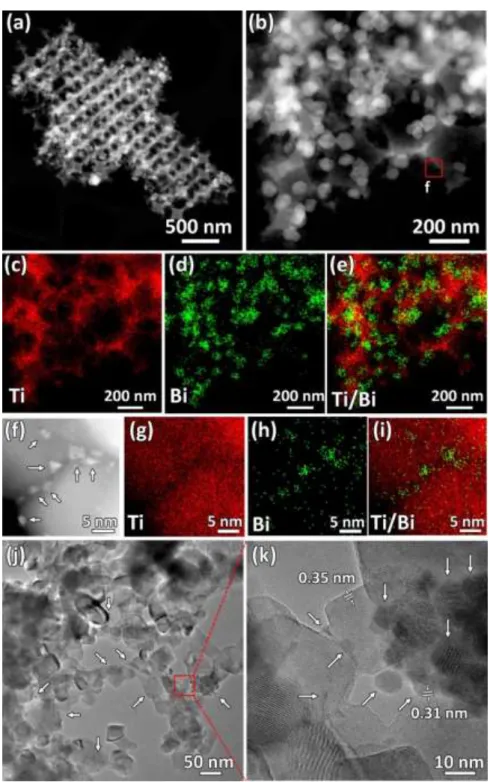
BiVO4/3DOM TiO2 nanocomposites: Effect of BiVO4 as a highly efficient visible light sensitizer for greatly enhanced visible light photocatalytic activity in the degradation of dye pollutants. The effect of the amount of BiVO4 as a visible light sensitizer on the photocatalytic activity of BiVO4/3DOM TiO2 nanocomposites was highlighted. BiVO4@3DOM TiO2 exhibits highly enhanced photocatalytic activity in visible light - The effect of the amount of BiVO4 as a visible light sensitizer is emphasized.
A series of BiVO4/3DOM TiO2 nanocomposites have been synthesized and their photocatalytic activity investigated under visible light irradiation using RhB dye as a pollutant model molecule in an aqueous solution. The effect of the amount of BiVO4 as a visible light sensitizer on the photocatalytic activity of BiVO4/3DOM TiO2 nanocomposites was highlighted. However, the photocatalytic activity decreases when the amount of BiVO4 is much higher than that of 3DOM TiO2.
The current work demonstrates that BiVO4/3DOM TiO2 is a promising heterojunction system for visible light photocatalytic applications. It is crucial to know how the amount of BiVO4 will affect the formation of the heterojunction between BiVO4 nanoparticles and 3DOM TiO2. In this work, a series of BiVO4/3DOM TiO2 nanocomposites with different compositions have been synthesized.
The effect of BiVO4 as a visible light sensitizer on the photocatalytic activity was investigated.
Photocatalytic testing
The UV-vis absorbance spectra were obtained using a UV-vis spectrophotometer (Perkin Elmer Lambda 35 UV-visible spectrometer equipped with a Labsphere for analysis in diffuse reflectance mode) in the 200-750 nm range.
Phase composition
2-Theta (Degree)a
XPS analysis
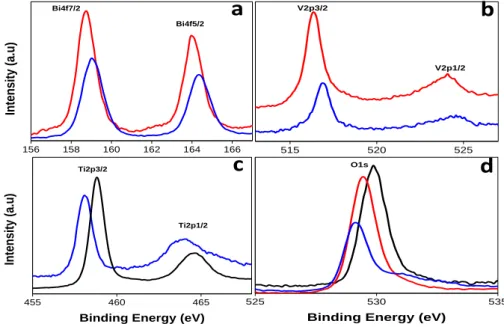
For clarity, only the results for 0.2BiVO4/3DOM TiO2 are presented and analyzed and compared with pure 3DOM TiO2 nanoparticle photocatalyst and pure BiVO4. 5 we find four dominant elements (Bi, V, Ti and O) which confirm the presence of BiVO4 and TiO2 in the sample. The primary spectrum indicates the presence of O2- ions, while additional shoulders at higher energies are attributed to surface OH- groups and/or chemisorbed H2O [58].
For the BiVO4 and TiO2. confirming that a significant interaction exists between the two coupled semiconductors. blue line) compared to pure BiVO4 nanoparticles (red line) and 3DOM TiO2 inverted opal structure (black line).
Textural properties
Furthermore, the pore size distribution calculated from the desorption branch of the isotherm for all samples, as shown by the inset curves in fig. 6, a narrow pore size distribution from 2.3 to 9 nm due to aggregation of the nanoparticles. Nitrogen adsorption–desorption isotherms and pore size distribution curves (inset) of (a) 3DOM TiO2, (b) 0.2BiVO4/3DOM TiO2, (c) 0.4BiVO4/3DOM TiO2, and (d) 0.6BiVO4/3DOM TiO2 nanocomposites photo.

Optical properties 0
Surface Area (m2/g)
Photocatalytic performance
The photocatalytic performance of the as-prepared samples was investigated in terms of degradation of RhB in an aqueous solution under visible light irradiation. In our previous work, the 3DOM TiO2 inverted opal structure, dumbbell-like BiVO4 nanoparticles, 0.04 BiVO4/3DOM TiO2 and 0.08 BiVO4/3DOM TiO2 nanocomposite photocatalysts were studied [36]. Herein, the photocatalytic activity of three new nanocomposites labeled 0.2 BiVO4/3DOM TiO2, 0.4BiVO4/3DOM TiO2 and 0.6BiVO4/3DOM TiO2 was measured under the same conditions.
10, to evaluate the variation of the photocatalytic efficiency by increasing the amount of BiVO4 nanoparticles in the nanocomposite.
Wavelenth (nm)a
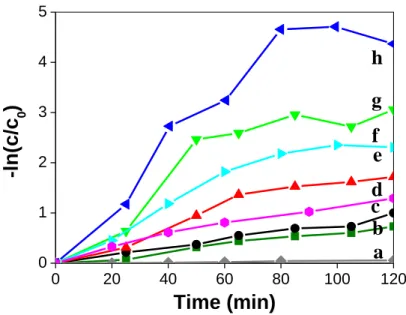
A blank experiment (curve a) in the absence of any photocatalyst shows no significant change in the RhB concentration. As can be seen, the photodegradation rate for all samples increases as the reaction time increases. The dumbbell-like BiVO4 (curve b) shows a very weak photocatalytic activity, only 22% of RhB is degraded in 120 min which may be related to the intrinsic properties of the BiVO4 samples, such as the very poor adsorption performance towards organic dye molecules and the inefficient migration of photogenerated electron-hole pairs to the surface for photocatalytic reactions.
Thus, BiVO4 nanoparticles have very low activity despite their absorption in visible light, which is related to a narrow gap energy of 2.4 eV. TiO2 has a large electron gap and absorbs only in the UV region, but the photocatalytic efficiency is higher than that of BiVO4 nanoparticles, but it is still relatively poor, only 28% is degraded in 120 minutes (curve c). The reason is probably related to the 3DOM TiO2 IO structure, which can provide a more active surface, more contact area, and increased mass transfer due to its highly accessible 3D porosity.
After the introduction of BiVO4 nanoparticles, the photocatalytic activity was greatly improved compared to the original 3DOM TiO2 inverted opal structure and pure BiVO4.
Time(min)
The photocatalytic efficiency of the coupled BiVO4/3DOM TiO2 nanocomposite increases and then decreases, reaching a maximum value as the proportion of BiVO4 increases from 0.04 to 0.6. The enhanced photocatalytic activity of 0.2BiVO4/3DOM TiO2 may originate from the interfacial transfer of electrons and holes as observed by PL and XPS. The lifetime of the charge carriers is increased and thus the recombination of electron–hole pairs can be suppressed, and the photogenerated high energy is easily transferred from BiOV4 to 3DOM TiO2 under the internal field induced by the electronic band structure.
However, the photocatalytic performance reaches a maximum for 0.2 BiVO4/3DOM TiO2; then it decreases with an increase in the amount of BiVO4 nanoparticles in the nanocomposite. Two reasons could explain the low visible light photocatalytic activity of 0.4 BiVO4/3DOM TiO2 and 0.6 BiVO4/3DOM TiO2 nanocomposites compared to 0.2 BiVO4/3DOM TiO2. The PL intensity is more important for 0.4 BiVO4/3DOM TiO2 and 0.6 BiVO4/3DOM TiO2, respectively, compared to the 0.2 BiVO4/3DOM TiO2 photocatalyst, indicating their high recombination rate.
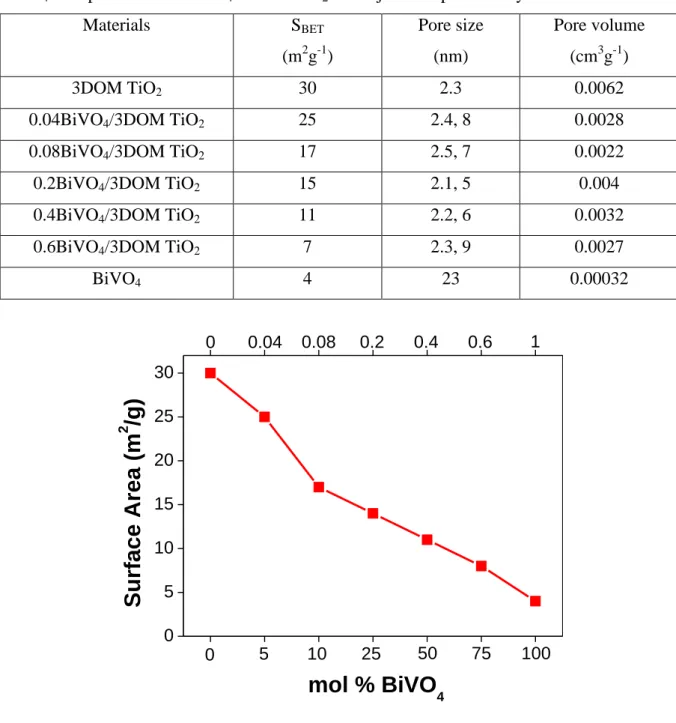
However, the interfacial loading process is limited by two factors: the low amount of 3DOM TiO2 as confirmed by XRD analysis and the decrease in surface area after increasing the amount of BiVO4 nanoparticles as shown by BET results. For the 0.4 BiVO4/3DOM TiO2 and 0.6 BiVO4/3DOM TiO2 nanocomposites, with decreasing amounts of 3DOM TiO2 compared to BiVO4 nanoparticles, the surface area decreases significantly. The adsorption performance of BiVO4/3DOM TiO2 nanocomposites becomes very poor and the diffusion of dye molecules decreases.
The kinetics of the RhB degradation via the BiVO4/3DOM TiO2 nanocomposites with different composition, pure 3DOM TiO2 inverse opal structure and BiVO4 nanoparticles are shown in figure. As can be seen, the photocatalytic efficiency of the BiVO4/3DOM TiO2 nanocomposites increases significantly with the amount of BiVO4 nanoparticles to reach a maximum of 0.2 BiVO4/3DOM TiO2. As we explained in the discussion above, the enhanced photocatalytic activity of the 0.2BiVO4/3DOM TiO2 nanocomposite is attributed to the synergy of the .
The schematic representation of energy band diagram and charge transfer process in BiVO4/3DOM TiO2 nanocomposites is given in Fig. When the BiVO4/3DOM TiO2 nanocomposite photocatalyst is irradiated using visible light (> 400 nm), electrons in the valence band (VB) of the BiVO4 nanoparticles are excited to the conduction band (CB), creating holes in the VB. BiVO4 nanoparticles in 3DOM TiO2 inverse opal structure act as a very significant sensitizer to absorb visible light and efficiently transfer high energy electrons to TiO2.
The formation of a heterojunction between BiVO4 and 3DOM TiO2 induces a more efficient separation of excess charge carriers and inhibits the recombination of charge pairs, thereby facilitating interparticle electron transfer at the BiVO4/3DOM TiO2 interfaces. This behavior can be attributed to: 1) photogenerated electrons/holes accumulating on the surface of BiVO4 nanoparticles, leading to easy recombination of photogenerated electrons/holes as the amount of BiVO4 increases, 2) low amount of 3DOM TiO2, resulting in a decrease in surface area nanocomposites and 3) poor adsorption properties of BiVO4 nanoparticles.