Executive Summary
In continuation of the measures taken in 2012 in relation to biodiversity, including "bird watching", and given that the experiments established on member farms are aimed at reducing costs, as well as adding value to the wines of this grape by increasing the hygienic and nutritional quality To improve the environment and add value to the landscape, we plan to continue developing strategies that allow members to display and present the positive qualities of grapes during visits to customers, opinion leaders and tourists. We intend to continue to take a very active role among the national wine policy makers and formulate proposals that correspond to the guidelines of hill viticulture classified as World Heritage ("Viticultura de Encosta, classificada como Património Mundial"), including the redefinition of the RDD vineyard size. With this action plan, we intend to take another step towards the realization of the established vision, i.e. to consolidate the position of ADVID as the main platform for the dissemination of knowledge/evaluation of problems between universities, research institutions, central and regional authorities and wine companies and strive to promote entrepreneurship and increase competitiveness of the wine sector.
Social Organs
We will continue to develop, in collaboration with the Porto School of Economics ("Faculdade de Economia do Porto"), a database on the costs of cultural operations, combined with other elements related to income to create the "RDD Economic Observatory" ("Observatório Económico da RDD"), a fundamental economic evaluation tool for each moment of the biological assets of the vineyard. This economic activity, the vineyard, is not only localized in mountainous regions, but also wants to maintain the conditions for a heritage classification, which entails higher costs, not only because of the techniques used for the cultivation of the vines and the sustainability of the territory, but also by spending more time and money on public authorities to obtain advice and permits to restructure the vineyard or the cellar, that is, have a series of obligations that do not bring benefits, such as zones classified as. António Manuel da Costa Lima Acciaiuoli Dória Quinta da Foz do Pinhão - Sociedade Agrícola, Lda.
Members
Objectives and Strategy
Raise the level of technical and economic expertise of the sector as a factor for the competitiveness of companies in Portugal and worldwide; ADVID's vision is to "be an aggregator unit, promote collaboration and networking of companies and other parties relevant to the development of the sector, and be recognized as a reference platform for the sustainable development of viticulture, due to its ability to transfer knowledge and determine the problems of Douro viticulture.” The targets for 2013 in this action plan are less ambitious than those for 2009 for some indicators, viz.
Operational Resources
Human resources
- Functional responsibilities
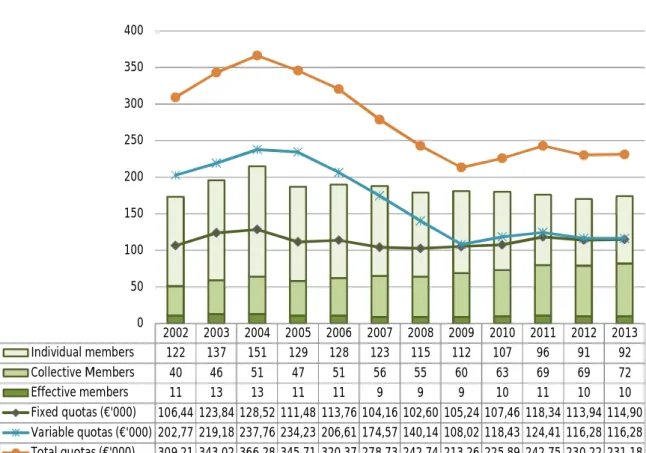
The apparently negative change in the number of members is due to a decrease in the number of individual members, which in reality corresponds to a positive evolution of the economic fabric of the region and of our members, which has moved towards more structured forms of organization, namely in corporate structures, which is easily demonstrated by the added value generated by quotas. Differences arise in the other indicators due to the current situation and the lack of financing options from the government for the Strategic Development Lines (Flagship Projects), which affects the various planned activities.
Financial resources
Material resources
Strategic lines of development (Flagship Projects)
- Climate change
- Impact of Climate Change on Viniculture in the Douro Demarcated Region
- Modelling the Evolution of RDD Wine Quality
- Short-term climate change mitigation strategies for viticulture (ClimVineSafe)
- Management of grapevine water and heat stresses
- Zonation and three-dimensional mapping of the viticultural potential using a microzoning approach
- Functional Biodiversity in Viticulture
- Biodivine (Demonstration of the functional biodiversity in vineyard landscapes)
- Ecological infrastructures in the biological protection of conservation against vineyard pests, in the RDD
- Maximising Vineyard Ecosystem Services
- Evaluation of the oenological potential of grapes
- Preservation of the genetic variability of wine grape varieties
- Sustained viticulture production
- Rationalisation of hillside vineyards
- Economic observatory
- Competency development – Training and Dissemination
Develop a cartographic model and assess the impact of climate change on the phenology of the main Douro wine grape varieties;. PhD project from the School of Engineering of the University of Porto (Faculdade de Engenharia da Universidade do Porto – FEUP); To encourage the application of cartographic materials prepared within the climate change project for the spatial analysis of the region.
Characterization of the main plant communities in the region and the identification of flowering seasons for the constituent species;. Characterization of the arthropod communities present in the plant communities and the identification of plant species that may be more interesting for increasing arthropods acting against the European vine moth;. Objectives: Establish criteria that associate measurable parameters in the grape with qualitative parameters of wine and develop tools for the objective valuation of the raw material - grapes.
Objectives: To find and maintain statistically representative patterns of genetic variability within a variety of regional indigenous varieties. Collect material for implementations in the Plasma Assisted Chemical Deposition (PECVD) conservation field in Pegões under the coordination of PORVID to protect the genetic variability of different grape varieties. Encourage applications for sustainable projects in the management area of wastewater treatment plants (Estação de Tratamento de Águas Residuais – ETAR) and life cycle and impact analyzes on viticulture in the demarcated Douro region;
Motivate the consortium and interest group to promote and monitor initiatives on the rationalization of hillside vineyards. In 2013, we will continue to collaborate within the framework of the Institutional Capacity Building Network for Promoting Employability in the Douro Region (“Rede de Capacitação Institucional para a Promoção da Empregabilidade no Douro”), aiming to meet the training and skills needs of the region detect. In 2011, an application was sent to ON2: “Continuous assessment of the Technological State of Viticulture in the Douro Demarcated Region (RDD)” (“Avaliação contínua do Estado Tecnológico da vitivinicultura da Região Demarcada do Douro (RDD)”), which to create a tool for continuous assessment of the technological state of the sector.
Communication and Dissemination
Production of knowledge support material
Knowledge acquisition
- Participation in events
- Training
Knowledge transfer
- ADVID website– www.advid.pt
- Dissemination Events
- ADVID Prize - 2013
- Dynamisation of complementary projects
Use of natural resources from vineyard ecosystems as a means of adding value to natural faunal resources. Using natural resources from vineyard ecosystems as a way to add value to natural faunal resources – Oct. As a component of the application submitted to the POPH, the realization / completion of the courses cited above in Section 6.8 is also expected in 2013.
Since 2007, the ADVID prize has been awarded to attract researchers from various scientific fields to the technical, cultural and social specificities of viticulture in the demarcated Douro region. This award recognizes an original study in any scientific field relevant to the wine industry of the Douro region. Continuing the tradition of awarding the ADVID award, in 2013 we will award a study published in 2012.
Through meetings, explanatory sessions and dissemination on the ADVID website, we aim to promote the technological and commercial development of companies by disseminating the tools available for financing, including incentives QREN, PRODER, RARRV (support scheme for the restructuring and reorientation of vineyards) and promotions in third countries where projects of interest to member companies can be presented.
Support Services for Good Agricultural Practices
Services financed by quotas
This group of services, the object of the mentioned project, are focused on improving the services provided for integrated production, specialized support for viticultural potential, the evaluation of productivity and quality characteristics of wine grape varieties grafted on different rootstocks. Members' support will be enhanced by the possibility of updating their farm identification document (identificação da exploración - iE) and parcel orthophotographic document (P3) in the Parcel Identification System (“Sistema de Identificação Parcelar”) together with ADVID technician responsible for their farm. A further strengthening of member interactions is intended in 2013 in the interpretation of the evolution of the viticultural year, which will complement the actions of technical support, namely,.
Technical support for decision-making in the framework of integrated production (MPRODI) with consulting in the office and field visit, assessment of the level of economic damage, support in the regulation of vine nutrition, soil regulation and weed control, and assessment of phytosanitary and physiological phenomena; Promotion of joint actions (plot meetings) for local/sub-regional assessments of the development of annual conditions;. Development and distribution of supporting materials for technical assistance and implementation of MPRODI (lists of approved active substances in the vineyard, publication of informative technical bulletins, production of accompanying circulars with regional information on diseases and pests).
Development of applications for agro-environmental measures ie. the single payment scheme (Regime de Pagamento Único – RUP). Development of regional estimates of harvest potential based on pollination method and integration of climatic and plant health data. Assessment of the behavior of rootstocks and wine grape varieties by analyzing data collected in several studies of grape varieties for wine x rootstock affiliation, processing and publishing existing references on the phenological, productive and qualitative behavior and contribution to the network of reference plots.
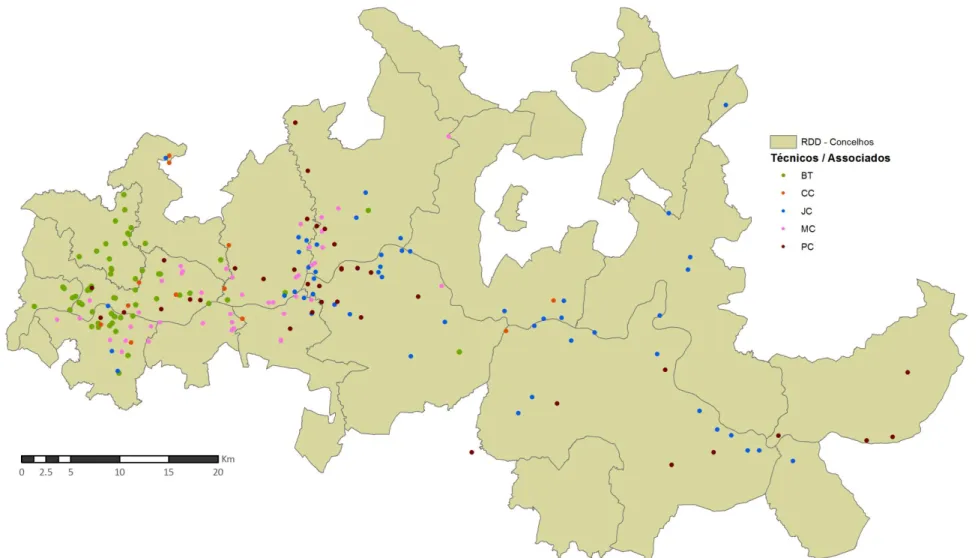
1 – Distribution of UPs subject to the application of the RPU and to respective technicians responsible in the ADVID.
Invoiced services
- Viticulture
- Oenology
Future Plans
Administrative and Accounting support
Institutional Relations
29 In order to attract new members, we will try to carry out two DEMO ADVID campaigns with companies that are not yet members. We will continue to focus on the development, together with AEVP, IVDP, IVV and AICEP VINIPORTUGAL, and on demonstrating that the work described in the action plan can and should be included in the valorization of wine and that it results in comparative / economic advantages for wines produced in RDD. We also intend to continue working with the structure of the Mission Douro ("Estrutura de Missão do Douro"), the Commission for Regional Development and Coordination - North ("Comissão de Coordenação e Desenvolvimento Regional - Norte"), the School of Hospitality and Tourism of the Douro Region (" Escola de Hotelaria e Turismo do Douro") - Lamego, Douro tourism ("Turismo Douro") and Portuguese tourism ("Turismo de Portugal"), so that the same value can be added to the landscape of the Douro wine region. and consequently lead to an increase in the number of visitors to RDD.
Given the importance of PRODER, COMPETE, IVV, IVDP, IFAP, DRAPN and COTEC for the development of the action plan, we will pay particular attention to these entities by promoting direct and permanent contacts to ensure the fulfillment of financial executions and the set targets. . We will also place particular emphasis on promoting the development of collaborations with researchers awarded the ADVID Prize and/or with their home institutions, as a way of capitalizing on the investment that this prize represents for the region. We also want to play a more active role with national wine policy makers, IVV, IFAP, DGAV, GPP, DGADR and other MAMAOT bodies in designing proposals that meet the particularities of Hillside Viticulture, classified as World Heritage.
The RDZ is a mountainous land whose main crop is grapes with increased costs compared to other vineyards, which has led to its landscape, culture, World Heritage classification and, therefore, its attractiveness to tourists. However, this economic activity, the vineyard, in addition to the mountain, has (and wants) to maintain the conditions of a World Heritage classification, which brings increased costs resulting not only from the techniques used to cultivate the vine and the territory. sustainability, but also in the increase in time and money spent by government bodies to obtain opinions and authorizations for the restructuring of vineyards or cellars. PORVID – Associação Portuguesa para a Diversidade da Videira [Portuguese Association for Grape Diversity], member of the Administration;.
CNOIV – Comissão Nacional do OIV (National Commission of the OIV), participation in several expert groups and general advisor;.
Glossary