In Chapter 5 we present a vision of the future for e-mobility in Brazil, we address perspectives on market growth and infrastructure for Horizon 2030. The mission of the National Platform for Electric Mobility (PNME) is to contribute to the implementation of practices for sustainable development of e-mobility in Brazil.

ELECTRIC VEHICLE
TECHNOLOGIES CHARACTERISTICS
As in the 1920s, one century later we are about to go through
Energy Security
The main reason for the development of energy security strategies is to protect national economies from geopolitical instability, especially the economies of those countries that import fossil fuels. In the years that followed, many countries began to integrate the energy security debate into their strategies.
Environmental Agenda
After the oil crisis of 1973 and 1979, society realized its dependence on fossil fuels as an energy source, resulting in concerns about the diversification of such sources.
The Paris Agreement , adopted at the United Nations Climate Change Conference (COP 21/UNFCCC) in Paris speaks of measures to reduce GHG emissions in order to
All as part of this technological mix to meet the world's growing demands. Given the previously mentioned objectives, car manufacturers face a continuous challenge to undergo a sustainable technological transition capable of meeting the new requirements.
Aggressive emissions targets pose challenges to the
Public Health
Country
Total Annual Premature
Related Deaths
Premature Deaths
Selected city
Ambient air pollution level by
A new ecosystem
Modernizing
Public Transportation
COUNTRY/
REGION PRO E-MOBILITY MOTIVATORS
European Union
China
By 2040, we expect 57%
On top of them, there are 184,000 fast chargers, mostly in China, mainly used by e-buses.
China also has the biggest share of e-buses, followed by
Conclusions 1.5
Urban mobility in Brazil
WHAT ARE THE DRIVERS TO E-MOBILITY IN BRAZIL?
CAN E-MOBILITY REALLY OFFER THE COUNTRY OPPORTUNITIES?
HOW HAS THIS TECHNOLOGY BEEN ADVANCING IN THE VARIOUS BRAZILIAN STATES AND CITIES?
Since motivations to drive and drive e-mobility activities are indeed a reality in Brazil, it is in such a context that Chapter 2 is placed: it presents the conditioning factors for exploring EV-related activities in the country. Having established the profile of the interfaces that justify our study of the national context in this chapter, we will take a closer look at the elements that drive e-mobility in the country.
Introduction
Brazilian Consumer Market
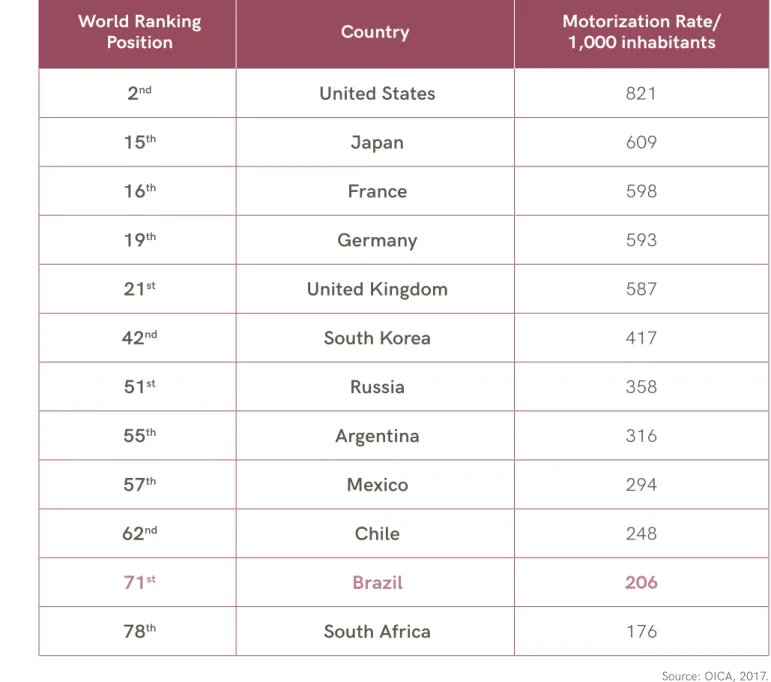
It is important to highlight that Brazil has always been one of the largest car manufacturers in the world, with its relevant consumer market standing out among the 10 largest on earth, as shown in Figure 4. In other words, the expansion of the domestic consumer market compared to the average consumption in other countries is a reasonable possibility.
Historically, the Brazilian mobility sector exerts great
Considering the socio-economic scenario before COVID-19, despite the weaknesses common to emerging markets, the Brazilian economy has always shown potential for growth and, above all, a potential consumer market to be explored through e-mobility. Nevertheless, it should be noted that the level of motorization in Brazil is relatively low compared to others.
Motivations for Brazil to
World Ranking
1,000 inhabitants
Motorization Rate is defined by the number of registered vehicles
Energy Security
The Brazilian market took a strange turn when it started using biofuels – more specifically sugar cane ethanol fuel – in its fleet. Therefore, there is a disruptive technological option that fits the Brazilian reality: the development and sale of a hybrid electric system that also runs on ethanol fuel.
Environmental Agenda
In such a system, both the productive and technological capabilities of the country can be explored, so that flexible engine technologies – running on gasoline and ethanol – can be combined with electric powertrain technologies. This is a bet on national scientific and technological knowledge, which required investment and appropriate resources to grow and which also took decades to become firmly established in Brazil, and which today still receives the help of promotional tools from the government, such as the RenovaBio program. .
To invest in electrification is one of the means to leverage
Public Health
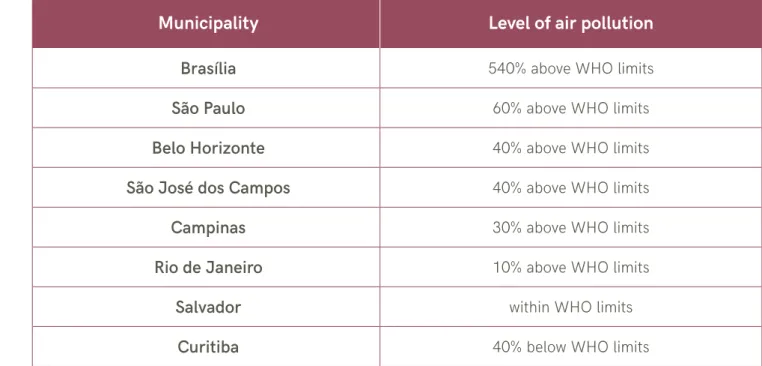
In Brazil, 85% of its estimated 210 million inhabitants live in urban areas, according to the National Household Survey. In particular, regarding the city of São Paulo, Saldiva (2019) reveals the average annual concentration of inhalable particles is 29 micrograms/m3 (which corresponds to a person smoking 4 or 5 cigarettes a.
In the P-8 phase, which will go into effect in 2025, the limit drops to 50 mg/km;
In addition to the number of preventable deaths caused by respiratory diseases, the number of population exposures to O3 (ozone) and PM2.5 (respirable particulate air pollution, also known as fine particulate matter) is increasing, especially in areas urban and regions that suffered from fires. The ministry also published that more than R$1.3 billion was spent on hospitalizations for respiratory problems in 2018 alone, and estimated that more R$14 billion was spent between 2008 and 2019.
Vehicle emissions are one of the major causes of deaths by
A new ecosystem of e-mobility innovation
Then, again, we come upon a window of opportunity to stimulate coordinated actions that promote technological skills development in the e-mobility sector. Furthermore, under the e-mobility perspective, this ecosystem is mainly composed by the energy sector, whose most important representative is the Brazilian National Electric Energy Agency (Aneel), the leading institution in the promotion of research and development projects on e-mobility compared to the latest efforts made by the public sector to stimulate such activities.
The R&D program of ANEEL
According to PINTEC, Brazil's innovation index in the production of motor vehicles, trailers and truck bodies in 2017 was 34.3% between 2015 and 2017, which is higher than the country's average industrial innovation index of 33.9%. When we only consider the automakers of cars, pickup trucks, commercial vehicles, trucks and buses, the average of the innovation index rises to 69.5%.
Public policies and government
The innovation index , according to the Brazilian
Modernizing
Another important aspect to promote e-mobility is the modernization of the Brazilian transport sector, as it is involved in the development of pilot and demonstration projects. Said policy aims to reduce emissions in the municipality, which includes reducing the use of fossil fuels in public transport.
The Brazilian e-mobility market is in its early stages of development and hybrids are still the preferred electric drive system. In this context, we can see that numbers are higher in the South and South-Eastern regions of the country.

PHEV
As for ultra-light electric vehicles (ULDV), a recent report published by the Brazilian Association of Electric Vehicles (ABVE) presented the growth in the sector. Regarding EV recharging infrastructure, the PlugShare platform estimates that there are about 500 public or private charging stations built in Brazil, mainly in the southern and southeastern regions of the country (see Figure 14).

BRAZIL
General Map View
Orange pins
Green pins
Finally, the modernization of the Brazilian transport sector is another important aspect to promote e-mobility in the national context, as it is involved in the development of pilot and demonstration projects in Brazilian cities. In contrast, when it comes to its environmental agenda and emission targets, Brazil is not as sharp as others on the international scene.
Conclusions
We have seen Brazil historically rank among the largest car manufacturers in the world, with its consumer market in the top 10 in the world. It could also be confirmed that the e-mobility market is mainly concentrated in the state of São Paulo, followed by Paraná, Rio de Janeiro and Minas Gerais.
Developing a
WHO ARE THE ACTORS IN THE UNIVERSE OF E-MOBILITY IN BRAZIL?
WHAT ACTIONS ARE THESE ACTORS PERFORMING?
WHAT ROLES AND ATTITUDES HAVE THEY TAKEN IN THIS ENVIRONMENT OF THE STATUS QUO TRANSITION PERIOD?
To better understand how the ecosystem of e-mobility works, we can adopt the perspective of the innovation system, which is based on three components that work together and cooperate towards a common goal: actors, networks and institutions. Some features of that system have been inherited from the long-established automotive sector, as far as internal combustion engines are concerned, and where innovation and tradition coexist through this new path of e-mobility.
An innovation system
Christopher Freeman (1987), Bengt-Ake Lundvall (1992)
Said system is composed of some main spheres as shown
SPHERES ROLES
- Automakers
- Components
- The Electric Power Sector
- Education and research systems
- The Government and its regulatory agencies (in the
- An environment
Companies in the electricity sector have taken strong action in favor of e-mobility in Brazil, as their main role is to provide power – power that charges and moves electric vehicles. These studies have mainly been carried out by universities and research institutes and, to a lesser extent, by private sector companies.
Start-ups
Important state actors should be recognized for this issue: the Ministry of Science, Technology and Innovation, the Ministry of Economy, the Ministry of Regional Development, the Ministry of Mining and Energy, etc. The challenge for the Brazilian governmental environment is to formulate policies in a coordinated and collaborative manner that dialogues with all sectors, and more than that, with all states and municipalities that also govern their related entities.
Sharing is another inexorable trend that puts technology
Business and Economic Interest Groups
Despite the embryonic stage of e-mobility in Brazil, it is important for private sector actors to understand public sector regulations and its organizational structure as well as their roles in this complex innovation system. Political articulation as well as investigation and understanding of the differences between Brazilian regions is something that the promotion of e-mobility in mainly urban areas of the large Brazilian municipalities can benefit from.
Entrepreneurial initiatives of actors
In a general sense, we are talking about initiatives for experimentation and knowledge generation of EV technologies, as well as initiatives for legitimizing e-mobility by society through a better understanding of how to operationalize this ecosystem. Finally, the importance of the participation of local governments, present in several of the aforementioned projects, stands out in this context.
From the 2010s onwards, some pilot and demonstration projects were initiated with the aim of solving problems related to e-mobility in Brazil. In other words, it is about using and disseminating knowledge at a level closer to society, and it is up to municipalities as well as other public and private institutions located in the municipalities that have a good understanding of the opportunities and challenges involved. can be decisive in the implementation of a demonstration project in those areas.
We have to seize this
Said projects were carried out by various actors and participants, such as traditional car manufacturers established in Brazil, new companies, car parts manufacturers, technology-based companies and start-ups, electricity suppliers, recharging infrastructure and charging station companies and interest groups that support the above activities. These are non-exhaustive examples, but they do illustrate how and to what extent the car manufacturers' actions for EVs have evolved.
Renewable energy is within
Brazilian competency, so that needs to be valued and transformed into
Setting up a real e-mobility laboratory in the metropolitan region of Campinas (investment bill for about R$ 40 million). To test the electrification of the fleet of the city of Campinas (in the state of São Paulo) and assess the costs and improvements in the quality of service and the environment.
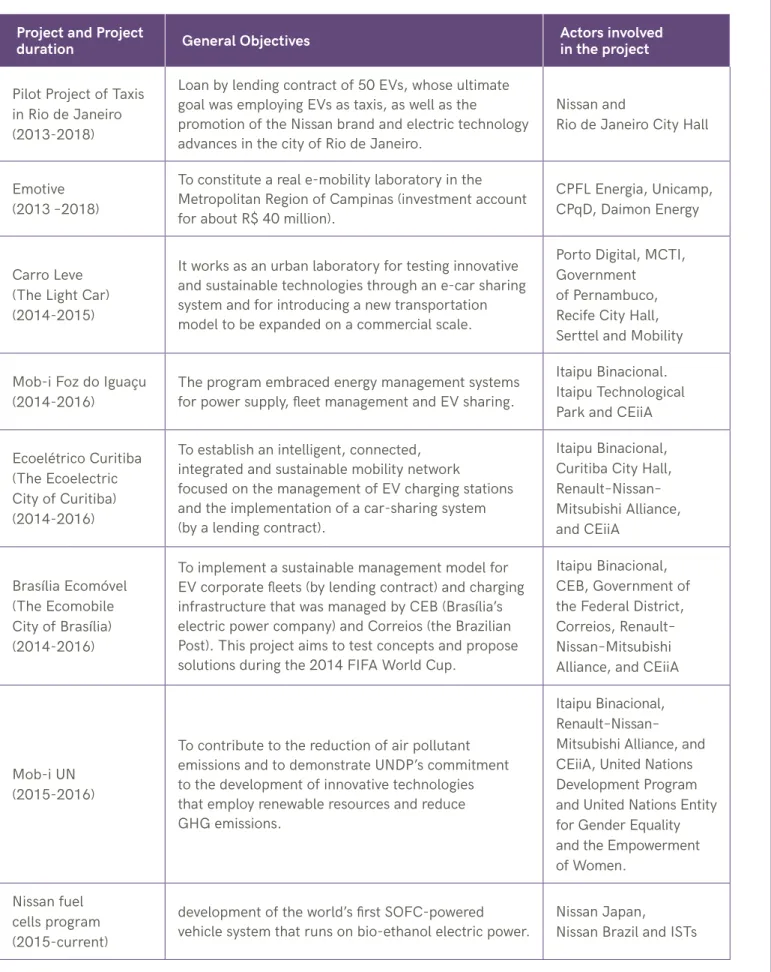
Some specific actions in the different layers suggest a scene of more daring long-term planning and objectives. A more detailed approach to these policies and programs is provided in the next section.
Spheres of government that have an impact on e-mobility in Brazil
This section aims to present and to study (see Figure 17). As for ongoing policies and programmes, Figure 18 shows how these are mapped from a temporal perspective presented in a timeline from 2010 to 2030.
NATIONAL LEVEL
Ministries Public Banks
INTERMEDIATE LEVEL
State Offices Legislative Assemblies
MUNICIPAL LEVEL
City Secretary’s Offices City Councils
Implemented policy Policy continuity over time Government policy: National level Government policy: Intermediate level Government policy: Municipal level. Decreto IPI2018 IPVA reduction • Rio de Janeiro2016 IPVA and exemption from municipal vehicle restriction • São Paulo2014 Stimulus for the use of electric vehicles • Curitiba2016 Vamo project • Fortaleza2016.

Considering EV market penetration scenarios until
Brazil will certainly be part of this trend.”
- Public policies at the national level: the federal government
- Brazil Foreign Trade Chamber (CAMEX) Resolution n. 97, dated 26 October 2015
- Brazilian National Electric Energy Agency (ANEEL) Resolution n. 819,
- The Brazilian Development Bank (BNDES) E-mobility Program
- ANEEL R&D – Call 22
- Route 2030 Program
- Public policies
It is expected that the developed projects will come to the latest stages of the innovation value chain with products and solutions to be introduced; the results of the Program can also contribute to the evaluation of the economic and technological impacts of the projects to promote their introduction to the market. Expand the global penetration of the Brazilian automotive industry through the export of vehicles and auto parts.

Public policies
São Paulo
Three other municipalities in the state of São Paulo offer the
Indaiatuba, São Bernardo do Campo e Sorocaba
Campinas
Campinas is the largest rural city in the state of São Paulo and has begun issuing bids to improve its public transportation system. Among other proposals for its new system, we highlight the creation of the so-called "Área Branca" (the white area), a non-polluting bus lane.
Curitiba
Such a process cannot be limited to actions by the federal government, but instead requires initiatives by private sector actors for the development of processes, products, demonstration projects, facility construction and other options that can help the country converge efforts which will promote actions for the development of a sustainable urban mobility model. As for the supply chain, its activities relate to infrastructure, production of vehicles and their components.
Investments in e-mobility can be noticed in the form of the
The environment for doing business and investing through private equity and venture capital funds is essential for the development of e-mobility in Brazil. Remarkable in this scenario is the supply of electric vehicles as products (business as usual), but also as services (new business development), such as sharing and rental services.
When it comes to mapped private equity and venture capital actions in Brazil (mapped non-exhaustive), in its first layer there are the investments in the supply chain and in a second layer those representing new business models. Regarding new business models, activities related to the sale of electric cars, charging services and sharing and rental services.
An environment of business, funding and promotion with private equity
In the same way, Table 9 shows the companies that stand out from the point of view of developing new "Business Models". Examples of investments involved in vehicle supply transformation and product implementation.

Manufacturing of vehicle
Assembly
Rental
Sharing
Venda de Veículos
- Project in which the partnership between Oxis Brazil and Minas Gerais Economic Development
- The partnership between EDP Brazil, the Federa- tion of Industry of the State of Espírito Santo (FIND-
- The partnership between Audi and Engie will invest R$ 10 million in the construction of 200 charging
- In 2019 Volkswagen Truck & Bus (VWCO) led the initiative of the e-Consortium, which aims to de-
- The Brazilian e-bike manufacturer Velabike has announced the construction of 100 charging sta-
The partnership between Audi and Engie will invest R$ 10 million in the construction of 200 charging R$ 10 million in the construction of 200 charging stations by 2022. Many companies are part of this partnership, such as: Siemens, which will handle infrastructure (charging stations and energy supply); CATL and Moura, which will supply battery modules; Bosch and WEG Industries, which will supply components; Semcon, which will provide engineering services; Meritor, which will supply electric axles for EVs; and Eletra, as a strategic partner.
The role of accumulators in Brazil’s commodity chain: a look into possibilities for the lithium
Suppliers of battery materials – Lithium
In addition, Sigma Mining, located in the Jequitinhonha Valley – between the towns of Araçuaí and Itinga – started a major lithium production operation in 2018, its planned production target was 220,000 tons of spodumene per year from 2020 onwards, with a lithium recovery potential of 14,000 tone. As for anodes, the Brazilian Metallurgy and Mining Company (CBMM) – based in Araxá (Minas Gerais) – is the world's largest producer of niobium.
Cell suppliers
In view of this, new actors were mobilized and assumed their role in the chain, and considering the demand for new exploration and extraction of lithium in the country, future growth is expected. In 2018, it partnered with Toshiba Corporation to replace the carbon anode with a titanium-niobium composite oxide (NTO – Niobium Titanium Oxide), while retaining the traditional cathode configuration.
Battery modules and packs suppliers
Professional training and skilled human
From 2021 on, 4 subjects designed by the Cooperation projects are part of the HEIs curricula: (1) Low-emission mobility: energy
Course /
These conclusions show that the actors are still in the process of understanding their own positions in the value chain, as well as the possibilities of action in their fields regarding the possibility of introducing electric vehicles in Brazil. In fact, these elements converge with the place that the Brazilian market occupies in the world, which was the subject of Chapter 2, and reinforce the initial stage of e-mobility in Brazil.
The impact
WHAT ARE THE IMPACTS COVID-19 BROUGHT TO E-MOBILITY AND TO ITS VARIOUS MODES OF TRANSPORTATION?
WHAT ARE THE REAL BARRIERS?
ARE THERE ANY OPPORTUNITIES?
WHAT ARE THE IMPACTS THAT COVID-19 BRINGS ON MOBILITY MOVEMENT AND ON THE DIFFERENT MODES OF TRANSPORTATION. From the context presented above, this chapter will develop its objective to present and debate the impacts of COVID-19 on the evolution of e-mobility in Brazil.
Despite being discovered at the end of 2019 in China, it was
Barriers
Public transportation
Opportunities
According to experts' views, this moment of crisis in public transport has also revealed a crisis in the current business model in which this segment is formed. By considering a possible reformulation of the acquisition approach, we can see greater investment attractiveness for this segment in the national scenario.
Commercial vehicles
Barriers
Pre-COVID-19 barriers were reinforced during the pandemic, such as the lack of credit lines for EVs for freight transportation, nor for its associated infrastructure. From an acquisition perspective, companies that were considering investing in electric trucks postponed their investments during COVID-19.
Opportunities
In the same way, the lack of sufficiently serviced routes and the variety of vehicles and their components are still a problem, which increases the challenges for the spread of commercial vehicles. Such scope can be very useful for planning new opportunities and evaluating ongoing projects in a COVID-19 scenario.
Private passenger vehicles 4.4
Premium-EVs
Flex-fuel hybrid
Barriers
As imports, its price was changed due to the depreciation of the Brazilian real against the US dollar, which also affected other categories of electric vehicles, such as heavy duty vehicles and heavy commercial vehicles. Such was the case with the FCA Jeep Renegade and Jeep Compass hybrids, whose launches have been postponed to 2021.
Opportunities
Micro-mobility: ultra light-duty vehicles 4.5
Barriers
Opportunities
In addition, losses in investments in new companies affect the category and also the expansion of the offer of these models in Brazil or even the search for new business models. This topic will be addressed in Chapter 5, which provides an insight into the vision of the future of e-mobility in Brazil.
A vision of the future
WHAT SHOULD WE EXPECT FOR THE E-MOBILITY MARKET LANDSCAPE IN BRAZIL THROUGH 2030?
HOW DO THE EFFECTS OF COVID-19 PANDEMIC IMPACT E-MOBILITY MARKET GROWTH?
WHAT ARE THE PERSPECTIVES AND FORECASTS IN THAT REGARD?
One of the biggest challenges for e-mobility in Brazil is the gap between its vision of the future and its current reality. In addition, the outline idea has the aforementioned vision of the future for the Brazilian context.
Public transportation: e-buses
Conservative Moderate Aggressive
From a conservative point of view, e-commercial vehicles are virtually absent from the national urban logistics system and road transport system. The first, represented by the conservative scenario, that there will be no significant penetration of e-commercial vehicles in the market.

Passenger Light-Duty Vehicles
Recharging infrastructure
Micro-mobility
CityCoco E-Scooter E-Bike
In short, creating projections and forecasts for the post-COVID-19 scenario in the 2020-30 time horizon is certainly a challenging task. In the face of various uncertainties, we have to take into account many factors such as stabilization of the health scenario, changes in the political agenda and exchange rate expectations to name a few.
It can be assumed that for all the modes of transportation studied in
Perspectives
WHO ARE THE ACTORS INVOLVED IN THE PROMOTION OF E-MOBILITY IN BRAZIL?
WHAT PROJECTS DO THEY SUPPORT?
HOW ARE THEY GENERATING VALUE AND OUTREACHING ACTIONS IN THE ECOSYSTEM OF ELECTRIFICATION?
The arguments used to support the data presented here are anchored in the interviews conducted with the main collectives involved in the topic of e-mobility. That is why we will present these governance initiatives, which, even under construction, have already shown concrete results and significant progress in e-mobility.
The National Platform for Electric
Mobility: A necessary orchestrator 6.2
CIVIL SOCIETY
INDUSTRY GOVERNMENT
Actors and their competencies
Currently, the committee is formed by: Ministry of Economy (ME), Ministry of Science, Technology, Innovation and Communication (MCTIC), Ministry of Regional Development (MRD), Brazilian Development Bank (BNDES) ), Energy Research Office (EPE), National Energy Agency ( ANEEL), the Brazilian Agency for Industrial Development (ABDI), the National Forum of Secretaries and Directors of Urban Mobility, the International Council on Clean Transport (ICCT), the World Resource Institute (WRI), the National Association of. The Secretariat, in turn, is responsible for the management of the platform and the organization of its activities.
Since the beginning, more than a dozen well-structured, well-planned meetings with the Platform’s members were
The steering group is responsible for the management and strategic planning of the platform, to discuss the members' requirements and topics that must be prioritized and directed towards concrete solutions. By mobilizing relevant actors, members of the WGs focus on more specific topics and work to deliver products that contribute to promoting the sector in Brazil.
Currently, the Science and Technology Commission (CST) is composed of important names in e-mobility research in Brazil, and it advises the steering committee technically to ensure the alignment of PNME's research and development efforts. Since the beginning, there have been more than a dozen well-structured, well-planned meetings with the platform's members.
Steering Committee
Next steps
ABVE's objectives also include (1) the creation of a dedicated department to support start-ups and provide a welcoming environment and (2) the creation of a department that brings together potential customers and rare earth companies, as well as metals and mining companies . EV related companies. The end point of ABVE's work is to promote the development of the National Action Plan for Electric Mobility, supported by a long-term program that promotes collaboration with various decision-makers (in local, state and federal governments). such as in branches of economic EV-related activities in Brazil.
The Brazilian Association of Electric Vehicle 6.3
Small and large companies, domestic and transnational companies, local companies and importers are all among ABVE's employees; which includes small e-bike companies as well as large power generation and electricity distribution companies, it also includes the major automotive companies and heavy vehicle manufacturers in the market. In addition, as mentioned before, ABVE wants to expand its representative participation by including urban mobility consultancy and research firms, start-ups and prospecting clients, and metal and mining EV-related companies in its workforce.
ABVE’s mission is “to foster the wide use of EVs in Brazil
ABVE joined the movement as a catalyst of demands and of collaboration and collaborative processes within and between different branches of EV-related economic activities, and thus its role is to communicate these demands to decision makers with different functions in the sector. the state – executive and legislative, to advocate for the development and use of electric vehicles (EVs) in the country. It is a priority in ABVE's mission to work towards the creation and consolidation of a federal e-mobility policy by collaborating with the National Platform for e-mobility and improving relations with the federal government.
Internally, ABVE aims to strengthen and expand its representativeness by expanding its associate base and field of work. ABVE stands out because it is the only association of its kind in Brazil that represents the electricity supply chain as a whole.
Category Scope Summary of the strategic actions
ABVE in action
As for companies, it was a period for them to introduce their products and assess the economic capillarity and market readiness for the production and distribution of various EV modes. In 2017, ABVE gradually shifted the focus of its actions to advocating the case, aiming to create regulatory support for the e-mobility business climate in Brazil.
E-mobility in Brazil: value creation and outcomes
From 2006 to 2017, ABVE focused on promoting e-mobility events and developed pioneering actions, such as the “Electric Vehicle Technology Expo” and the “EV Convoy Trips: Making Way for E-mobility”.
Some of the outcomes achieved
Creation of and access to information quality 2. Practice of legitimate advocacy
More visibility to “best practices”
Networking and business matchmaking
- ABVE’s Framework
- Collaboration and cooperation of actors
The aforementioned work is focused on the issues of public transport and tax benefits for electric vehicles, the integration of transport modes and the creation of green urban mobility zones (GUM zones). In addition, ABVE maintains relations with the British Consulate General in São Paulo and the Embassy of Germany and the Embassy of Portugal in Brasília.
EVs and Hybrids Technical Committee (EV&H-TC) and the Society of Automotive
Consequently, EV&H-TC focuses on technical projects and actions that are business bias-free or preferably work with specific technologies. Likewise, the EV&H-TC stimulates active support and commitment to e-mobility from government agencies so that ongoing projects are strengthened and the EV supply chain is broadened.
The EVs and Hybrids Technical Committee promotes actions for dissemination and sharing of scientific and technological knowledge and information on e-mobility by working on root cause solutions and systems. Evaluation of collaborative projects and actions for low-emission and efficient transport, together with industry, academia, RD&I centers and government, aimed at sustainable mobility.
Technologies within the scope of EV&H-TC
E-mobility in Brazil
EV&H-TC’s Framework
The committee is formed by a majority of participants, dedicated to promoting meetings and events aimed at the electrification of the vehicle propulsion system. As for its facilities, EV&H-TC works in two rooms at the SAE BRAZIL headquarters on Avenida Paulista in São Paulo.
6 4.3. Collaboration and cooperation of actors and network building
It has approximately 40 volunteers, including professionals from industry, research and skills development centres, academia and those working in transport companies or other sectors somehow connected to e-mobility.
Such collaborative work aims at the dissemination
The ZEBRA Partnership 6.5
In the ecosystem of e-mobility, the important role of the National Energy Agency (ANEEL) stands out. This led to the design and development (in progress) of a network structure for research and development projects, the Network of Innovations in the Electricity Sector (Rise).
ANEEL R&D – Call 22
BNDES’ Framework
The Bank's technical staff deserves attention because they master the very latest techniques (and know how to use them in products and services) and take into account the different Brazilian realities when developing the best models or arrangements of services to be successfully implemented , with an emphasis on efficient and carbon-free transport in cities. The motivations for these interfaces clearly indicate the need to promote greater collaboration in this technological area in the future.
BNDES 6.7
Therefore, BNDES has developed and promoted products and services that meet the needs of the market and has crystallized in the institution the concept of mobility with low emissions, which is understood as a strategic, priority issue.
BNDES financing compiles a wide list of products and
E-mobility in Brazil
The agreements signed with other institutions reinforce
FUNDEP in action
FUNDEP argues that e-mobility is not exclusively related to technology, but is defined in a broader context: (1) emission-free transport modes, (2) connectivity to smart cities and (3) integration between different modes, where mobility is offered as a service (MaaS – Mobility as a Service).
FUNDEP – The Research
Development Foundation 6.8
FUNDEP is a catalyst
Motivations for FUNDEP’s participation, value creation
FUNDEP believes that e-mobility will have a great impact and will produce results that cannot yet be determined and the fact that new research, developments and innovations must take place is of the foundation's interest, these are the main motivations that led the FUNDEP to the e-mobility case. In the various actions undertaken by FUNDEP, value was created by (1) evaluating the number of financed projects and their resources, (2) the number of actors involved, (3) the international relations that took place within the scope of the projects have been established. carried out and (4) active participation in events encouraging the formulation of public policies, which resulted in R$85 million to support projects of the Route 2030 point V.
FUNDEP’s Framework
FUNDEP also works with international organizations
6 8.4. Collaboration and cooperation of actors and network building
Brief analysis of the
In fact, PNME fills the gap of management structure at a strategic level that embraces the perspectives of the market, government and academia. After studying the activities undertaken by the ZEBRA project, we noticed that it is one of the most important collaborators and supporters of the electrification of public transport in cities.
How are the actions and activities regarding e-mobily
The set of outlined public policies can contribute to more intensive entrepreneurial activities taking place in the country, especially in relation to the industrial policy implemented at the end of 2018 - the Route 2030 program. In Chapter 4, which discussed the impacts of COVID-19 on the sector e-mobility, we learned that the pandemic can negatively impact planned and ongoing projects as it has affected all other industry sectors, including e-mobility. sector.
And beyond COVID-19?
In addition, the depreciation of the Brazilian real against the US dollar had a direct impact on the prices of imported goods, further hindering the adoption of e-mobility.
What types of market trends
What shall we expect
136 . in the e-mobility sector in Brazil in light of the provision of professional training courses and the participation of ISTs in several ongoing R&D projects. In fact, it is one of the roles of this type of publication, and the next editions must present the reader with an updated view of e-mobility.
1 st Workshop
MOTIVATIONAL DRIVERS
OBJECTIVES (and risks)
ACTORS AND PARTIES
2 nd Workshop
GOVERNANCE
3 rd Workshop
GOVERNANCE
INSTRUMENTS OF PUBLIC POLICY AND REGULATION
Flávia L. Consoni Tatiana Bermúdez Rodríguez
Introduction
Promoting the transition to sustainable mobility implies thinking about integrated public planning with actions to promote progress in this direction (BANISTER, 2008). In addition, e-mobility, being zero or low-emission and virtually silent, is considered a strategic technology that enables cities to transition to sustainable mobility.
Transition to sustainable mobility through e-mobility
The issue of healthy or noiseless vehicles is, in the case of electric modes of transport, another dimension to be taken into account as it provides more comfort and quality for citizens' commuting. It is about considering e-mobility as an ally to promote sustainable mobility, as it also has economic implications.
CITIZENSHIP AND HUMAN RIGHTS Sustainable mobility and e-mobility
Promoting SDGs and
- Benefits for Brazilian cities from the promotion of e-mobility
- Good health and well-being
- Affordable and clean energy
- Decent work and economic growth
- Industry, innovation and infrastructure
- Sustainable cities and communities
- Responsible consumption and production
- Actions to combat climate change
The diversity of local conditions in each region of the country has presented countless challenges as well as opportunities to achieve the SDGs of the 2030 Agenda. As we have mentioned before, e-mobility has become one of the alternatives to improve the quality of life of citizens in regarding air quality in cities and public health in general, as it contributes to the reduction of GHG emissions and local pollutants generated by transport systems. work with fossil fuels.
SDGs
Conclusions
There is no single solution to promote this transition; urban space management actions in the most diverse dimensions must be (re)thought and (re)directed. Approaching the benefits that e-mobility can provide in a broad way is also a means of getting closer to the complex UN 2030 Agenda, promoted by the Sustainable Development Goals.
Disponível em: From a public health perspective Obesity COVID-19 From an environmental perspective In contrast to fossil fuels, one cannot fail to mention biodiesel, which has been used in Brazil for years and has produced important results. In the energy matrix of transport fuels, 25% are renewable, 20% ethanol and 5% biodiesel. The Energy Transition Institute, confirms: "It would be ideal to eliminate vehicles with internal combustion engines from Brazilian urban transport". A large part (65%) of this energy is generated by hydroelectric plants; the rest through wind, solar and biomass sources. In this respect, we have an advantage over other nations whose energy power is generated, for example, by thermoelectric plants. From an innovation perspective But in terms of innovation, from strategic minerals to consumers, there are other service packages and production chains to consider, such as vehicle mechanics and maintenance services. It is an interesting chain, because new activity is emerging around, for example, the charging infrastructure, both public and private; or under concession agreements. Changes for the consumer From the economics perspective: why is e-mobility profitable for our economy? If we don't have a market, it's hard for outsiders to decide whether to invest here," he said. Indeed, there are avenues to explore in order to arrive at a more sustainable solution for the city we want to live and work in. Disponível em: http://electronicsbeliever.com/ev-charge-basic-things-and-information-you-need-to-know/. Tecnologias disruptivas de baixo carbono para setores-chave no Brasil – Painel Brasileiro de Mudanças Climáticas. Glossary VEHICLE ARCHITECTURES Mild hybrid Battery Electric Vehicles (BEVs) EV CHARGING CONNECTOR TYPES Combined Combined KEY CONCEPTS EV charging away Home charging Range anxiety Slow charging or level 1 Rapid charging Semi-fast charging EV SPECIFIC TECHNOLOGIES E-mobility general outlook 2020: drivers, market and perspectives 6 Urban mobility in Brazil: a look into the national context Developing a new ecosystem of e-mobility in Brazil The impact of COVID-19 on e-mobility in Brazil A vision of the future for e-mobility in Brazil Perspectives and the next steps for e-mobility in Brazil List of t ables List of abbreviationsOpportunities
Made in Brazil
The neighbor’s yard
The next in line
CHAdeMO plug
Tesla plug
Regenerative braking