This Capstone project was prepared and approved under the leadership of the Capstone Group Project President, Dr. In addition, we would like to thank our airlines who have invited us to participate in this exchange of knowledge and the growth of our industry. The recommendation of this research project is to implement the precheck program at 10 airports in Brazil with more than 5 million passengers per year.
The research topic was to understand the feasibility of implementing the precheck security process in Brazil's airports. Given a risk allocation of the applicants, the advance check guarantees a great advantage of waiting less than 5 minutes in line. In addition, pre-check passengers do not need to remove shoes, laptops, liquids, belts and light jackets.
Introduction
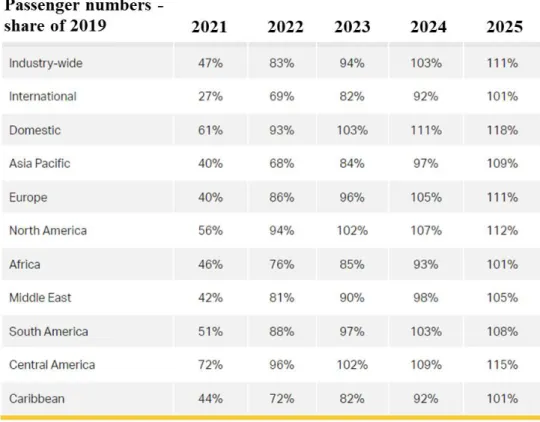
Therefore, relaxing the security requirements at the time of the X-ray will reduce the queue, giving a better score in the indicator referring to the security inspection queue. Chapter Five: Our research provides specific recommendations involving the possible use of the Pre-Check processes at Goiania airport. Also according to IATA, one of the many concerns is the security inspection and how to make it agile and safe at the same time.
According to ANAC (2017), the estimated average security inspection queue time for the largest Brazilian airports is 10 minutes at Guarulhos Airport (GRU), 28 minutes at Congonhas Airport (CGH), 15 minutes at Santos Dumont Airport (SDU), and 6 minutes at Galeão Airport (GIG) - only taking into account the peak hours of the analyzed airports. This document must meet all requirements of the national civil aviation security program, in Brazil PNAVSEC. The document also defines measures related to access control, one of the most delicate security topics.
In this sense, Article 8, point XI, of the ANAC Establishment Law (Act no. n.d.) establishes the authority of the Agency to also issue rules on security in the airport area. In this sense, one of the obligations laid down relates to the quality of service provided to the passenger.

Methodology
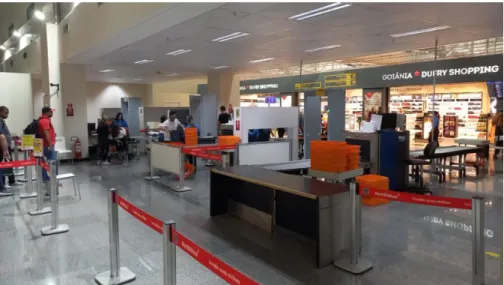
The study identified ways to synchronize security agencies' checks with the data airlines hold about passengers. The research team went to GYN Airport and measured the inspection times of passengers in the standard lane. Considering the TSA numbers, regarding the Pre-Check process, we already knew that about 95% of Pre-Check passengers wait less than 5 minutes.
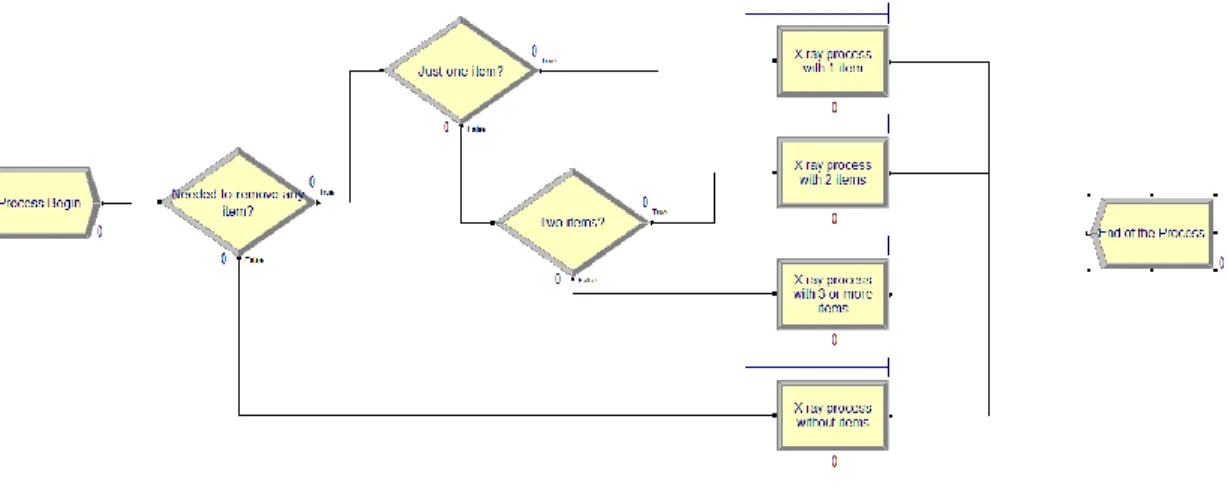
The research team gathered volunteers, and using the airport infrastructure, we simulated Pre-Check inspections using the same advantages to observe if the screening times would be the same as in the US. 59 samples of the simulated process were collected without it being necessary to validate the items by the Pre-Check. Basically, we divided the passengers into each group according to the distribution collected in the sample. The findings of the data collection, measurements and simulations gave us the necessary material to proceed with the recommendations and conclusions in the following chapters.
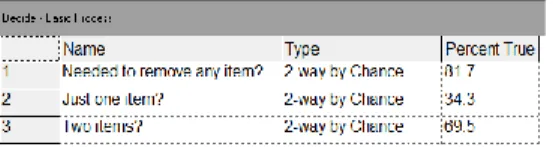
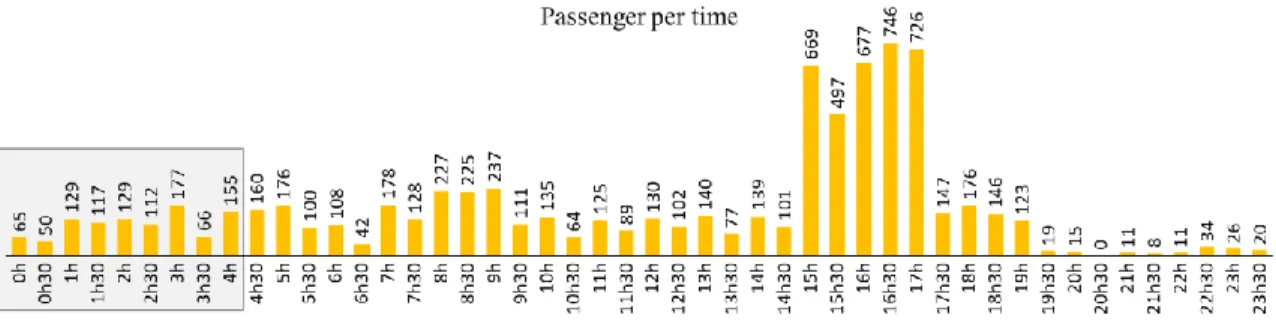
82.8% of passengers have to remove any item to undergo x-ray as shown in graph 1. In the following graphs, it can be observed that the mean and median increase with the increase in the number of items to be removed from luggage/pockets . According to the simulation results, we had 988 passengers at the beginning of the process and ended with 872 passengers, so at the end of the 4.5-hour simulation, 116 passengers remained in the queue.
The simulation results show that the average wait time on the real model is 10.8595 minutes, as shown in the report below. Another important piece of information is that the 4 x-rays are used 89.11% of the time, as can be seen in the report below. On the other hand, we have the simulation model with TSA Precheck in it.
On the simulation results, we had 981 passengers at the beginning of the process and ended with 909 passengers, leaving 72 passengers still in line at the end of the 4.5-hour simulation. From the simulation results, it is possible to see that the average waiting time is 9.1641 minutes on the simulation model - as can be seen in the report below. Another important piece of information is that the 4 x-rays are used 86.69% of the time and the exclusive TSA Pre-check is used 0.06% of the time as can be seen in the report below.
Conclusion
Conclusion: As mentioned in Chapter Two, the X-ray inspection model adopted in Brazil causes long queues, especially at peak times and is largely responsible for the need for passengers to arrive at the airport well in advance of their flights. Data Collection: Will allow law enforcement to better understand airport passengers who are part of the trusted traveler program. Conclusion: Regarding the implementation of the service proposed by this study, a registration step must occur first.
In addition, the concession contract signed by the Goiania airport manager (CCR Aeroportos) is taken into account, and ANAC provides minimum parameters for the size of the airport. As mentioned in Chapter 2, the minimum parameter for the security screening queue at Goiania Airport, specified in the Concession Agreement (citation), is 10 minutes for domestic flights and 15 minutes for international flights. Considering that one of them would be available exclusively for the TSA pre-check service, and the other exclusively for priority, and all of them would be used at peak times, an additional module would be needed at GYN to implement Pre-Check.
Conclusion: Therefore, the implementation of the pre-check TSA at Goiania airport has the potential to (i) reduce queuing time and inspection, there is no significant impact and costs increase. Therefore, it is feasible to perform the pre-check at those airports and achieve OPEX savings. Considering that the minimum staff required at each inspection module is three protection officers and the pre-screening passenger inspection is less complex, we could only use two agents, which will save R$28,000 per month, per airport.
Second conclusion: For the pre-screening registration system, the passenger must register himself and a criminal record analysis and investigation of other aspects must be done to mitigate the risk to airport security. Third conclusion: Also, the Concession Contract signed by the Goiania airport administrator (CCR Aeroportos) is respected and ANAC gives the minimum parameters for the size of the airport. As mentioned in chapter 2, the minimum parameter for security inspection at Goiania airport established in.
Considering that one of them would be available exclusively for the TSA's pre-check service and the other would be exclusively a priority, at Goiânia airport, although there was an operational benefit from the queue reduction, it would not be possible to demobilize one. of the X-rays, and it is therefore concluded that there would be no savings.
Recommendations
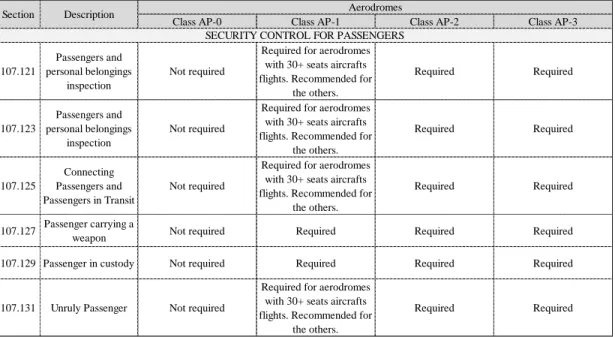
Following the example of the US, which already has TSA Precheck, the proposed system could bring more efficiency to security screening, as it would dedicate an exclusive queue to passengers in the program and also allow the Federal Police to have advance access to information and communication with airlines in case of need. As mentioned in Conclusion 3, the operational benefits in the inspection channel with the implementation of a service such as TSA pre-checking would allow greater compliance with the parameters established in the Concession Agreement for the maximum queue time, as well as reducing the cost by staff as it would be possible to provide a smaller number of inspection channels. It is recommended to implement the service at AP3 airports, i.e. only for airports that transport more than 5 mm passengers per year, taking into account the size of the airport security inspection infrastructure.
This service would only benefit larger airports classified from AP2 onwards, given that they have a larger number of passengers handled per year and larger passenger processing equipment in the screening channel. In other words, airports that have a larger amount of X-ray equipment could benefit from this service, given the possibility of eliminating some of this equipment, as there would be an operating profit in the process. In addition, another finding relates to the continuation of the study to deepen the cost savings through the implementation of the service.
In the US, TSA Precheck is a government program (FAA) and follows the same model; in Brazil it could be a federal police program. There is a limitation in the Arena student version, which is that a maximum of 150 entities can be handled in the model at a time. With the data in hand, it is interesting to conduct research in the future to bring new members to the program to increase the level of safety in the country and at the airport.
On the other hand, the operational optimization of the inspection channel would make it possible to deactivate some equipment, generating a reduction in the costs of hiring employees from external companies that provide this inspection service in the x-ray channel. This is because, here in Brazil, the company that performs the security inspection is the airport itself and, in the US, it is the Government Agency responsible for airport security (TSA). Even in the US where passengers make 3.6 trips per year, only 6.8% of travelers have a TSA pre-check.
The civil aviation market is a sector of the economy that is of relevant importance to Brazilian development, and the implementation of the service proposed in the study will certainly help in the growth of the sector and in improving user satisfaction.