Since March 2017, the cost of denied boarding has started to attract the attention of all Brazilian airlines due to the Resolution 400 of the Brazilian National Civil Aviation Agency. According to the statistical control report of the Department of Airspace Control (DECEA, 2017), they are respectively the second and the fifth busiest airports in the country. In addition, the perishability of airline tickets associated with the low financial margins of the airline industry requires increasingly aggressive overselling practices.
The results of these actions are complex situations that the ground staff of the airports face and must solve in order to provide a good experience for the customers. The length of time between the closing of the check-in window and the start of the boarding process is the interval that the airport team has to identify which passengers will be denied boarding. Reduces the impact of disruption during the short time between check-in closing and the end of the boarding process, improving the impact of punctuality.
Loyalty level Customer group program based on the amount of loyalty airline program utilization. Overbooking the fact that the company oversells seats per flight, but there are more passengers per seat at the airport who wants to board the flight. In addition, a comparison with Brazil, presenting the development in the behavior of Brazilian passengers, will follow.
Considering the European scenario, Regulation 261/2004 of the European Parliament and of the Council lays down common rules on compensation and assistance to passengers in the event of denied boarding and cancellation or long delay of flights. On the other hand, in art.23, § 1º of the same resolution 400, the rearrangement of the voluntary passengers on another flight upon acceptance of compensation will not set preterium, so in this case, if the passenger was a volunteer and accepts during the negotiation the airline is not obliged to pay the fine of R$1065.00. In this part of the process, customers must include their national ID or passport number and, prior to the boarding process, is the single guaranteed point of contact that will exist between the airline and the passenger.
By applying the principles of TOC, an analysis of the treatment flow and limitations in the surgical procedure has been identified (Sabbadini et al., 2006). It was found that the number of patients admitted to hospital for surgical procedures exceeded the capacity of doctors to attend. The result of applying TOC was a 16% increase in capacity system attendance.
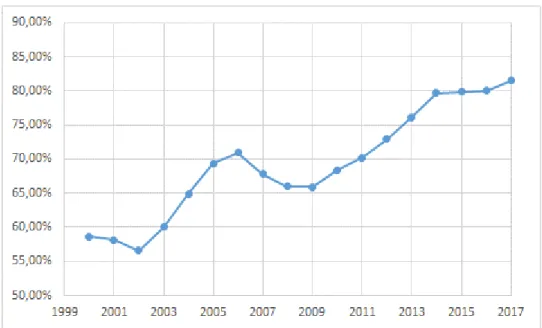
It is also noteworthy that the choice of the theory was made considering the highly complex environment, proving the effectiveness of the application of the theory. Figure 2.5 below shows the scenarios that the companies may encounter once a change is proposed: it is necessary to explore the pros and cons of the change. The literature review showed that ANAC's Resolution 400 establishes a new regulation for denied boarding in Brazil, the Brazilian aviation scenario and an evolution of the load factor.
The Theory of the Constraints was chosen as the theoretical basis and the customer journey journey was also investigated in the literature.

Methodology
We identify a policy bottleneck, namely the fine to be paid in case of involuntary denied boarding caused by a flight disruption and the lack of time to find volunteers. After finding the bottlenecks, we follow the methodology and use the Five Focus Steps to make changes to adjust the process and achieve the goals. Time: as soon as the carriers know that they must refuse boarding just before the departure time.
Technology: With new ways for passengers to check in, the number of passengers going through check-in counters is decreasing. With this new plugin, airlines can change their systems and adjust their airport procedures to improve recovery when disruptions occur, so airport agents can. To improve this new recovery process, it is important for airlines to create campaigns that encourage passengers to download and use the company's APP.
The more passengers use this channel, the easier it is for airlines to contact customers in time to change flights. In other words, companies have more guarantees that they will find volunteers. We will not develop this item further in this project, this must be done after implementation. We expect to motivate airlines to change the mindset that it is possible to have and learn more about passenger information.
The expectation is that the airlines that accept this solution will instead motivate the process change. The methodology demonstrates how to apply the Theory of Constraints to improve the airport process during disruptions and reduce the amount spent with compensation for denied boarding.
Outcomes
The goal is to provide the airline with the number of volunteers they could have by plane and give them the opportunity to optimize the process and make the individual and customized negotiation. This improves the bargaining power of the airline that actually carries out this operation in groups. The qualitative goal for the airline is Process Improvement, to be able to generate a reduction in the aircraft's ground time during disruption situations.
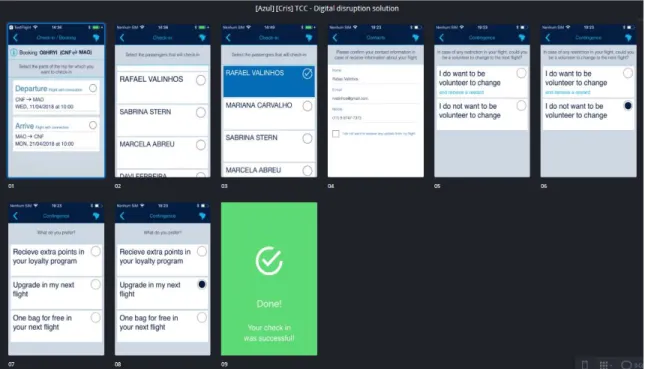
Based on these requirements, the plug-in proposes a simple stream after the check-in process with questions that will merge these two requirements, maintaining the continuity of the customer experience and providing the airline with the profile of passengers in advance. This ensures that the airline has up-to-date information and is more successful in contacting the passenger in the event of an emergency. This question gives the airline the information on how many passengers are flexible or should not be considered in a denied boarding problem.
After the passenger has checked that he/she can be a volunteer, this information goes to the airline data store and can be used at any time until the flight departs. This simple process provides the airline with the information they need to better identify potential volunteers in the event of disruption. By knowing the profile of the customer, the airline can be more assertive in approaching customers and improve the management of the operation.
This plug-in provides the airlines with the passenger information that can be used when the airline faces some flight restriction issue. The main objective of this project is to minimize the number of involuntary boarding denials, reduce the total amount of compensation used by the airlines and improve the airport process. Initiated an internal process change for the airline as soon as they have the passenger information.
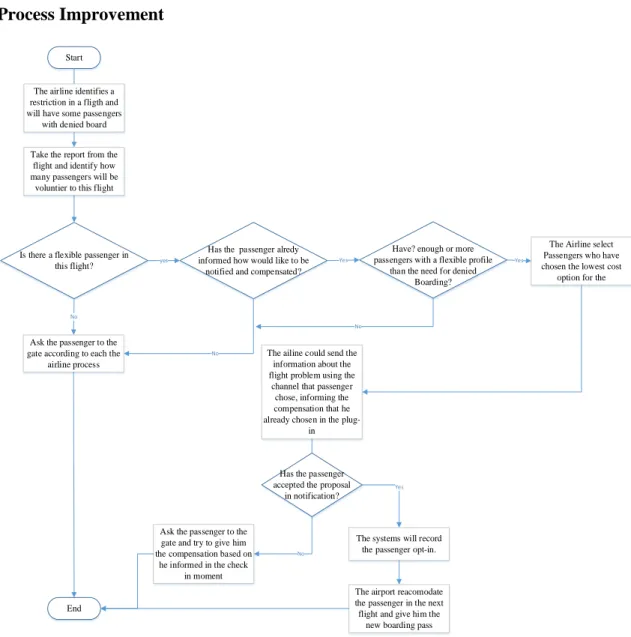
The proposed implementation plan is to embed a plug-in into the airline's mobile application, online check-in and implement the process improvement shown in the results. An important result of this project was not only the creation of a simple plugin, but also the transfer of passenger profile information to airlines. If there are passengers on the first flight who notify via the plug-in that they can transfer to another flight, the airline can transfer the passengers to a flight with low occupancy and award them compensation of their choice.
In this case, the airline increases availability on the first flight so that more seats are available on a flight with higher fares. In summary, the airline has the ability to manage the occupancy of their flights without causing problems with passengers.