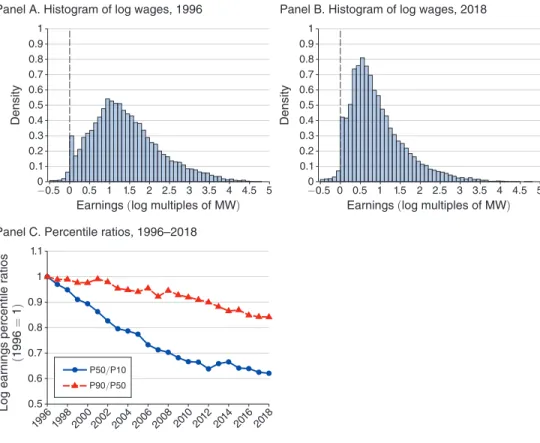
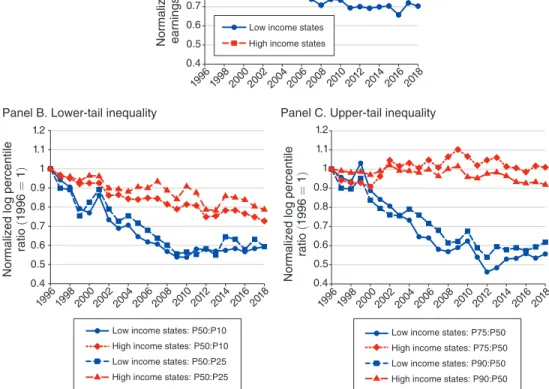
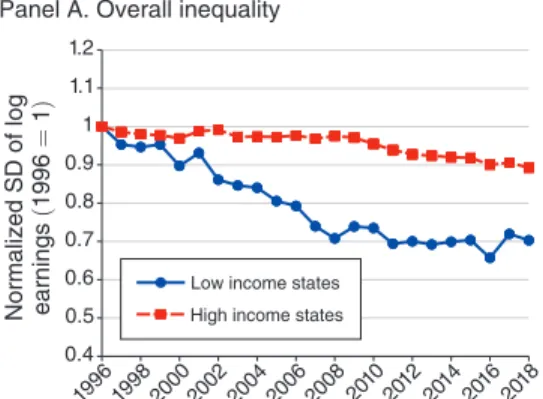
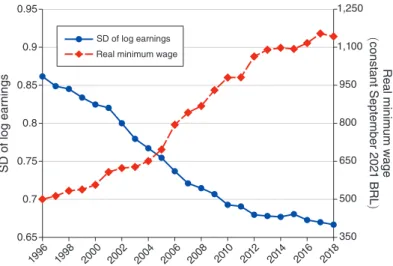
At the same time, we find little evidence of negative effects of the minimum wage on employment. The minimum wage compresses firm wage differentials and affects wages higher up in the distribution. We find robust evidence of spillover effects of the minimum wage throughout most of the wage distribution and a large negative effect on the standard deviation of wages.
At the same time, we find little effect of the minimum wage on employment, formality and other labor market outcomes. In a seminal contribution to this literature, Lee (1999) finds significant minimum wage effects in the lower half of the US wage distribution. Subsequent work by Haanwinckel (2020) also quantifies the contribution of the minimum wage towards reducing wage inequality in Brazil.
Cross-Sectional Heterogeneity and the Minimum Wage
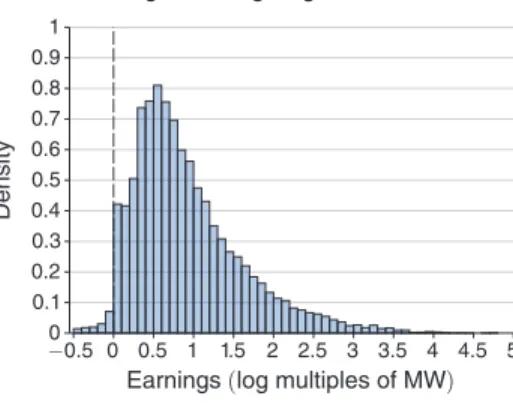
16 Online Appendix B.5 shows that the inverse relationship between effective minimum wage binding and wage inequality generalizes to the entire set of countries. Considering polynomials of order N ≥ 2 is important to capture the non-linear effects of the minimum wage as it becomes more binding. The results show a strong correlation between the minimum wage and inequality throughout the wage distribution.
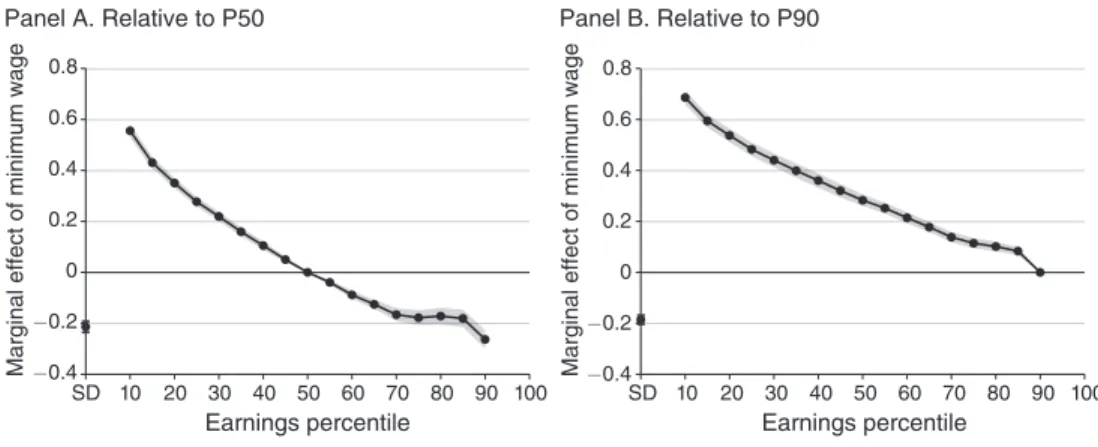
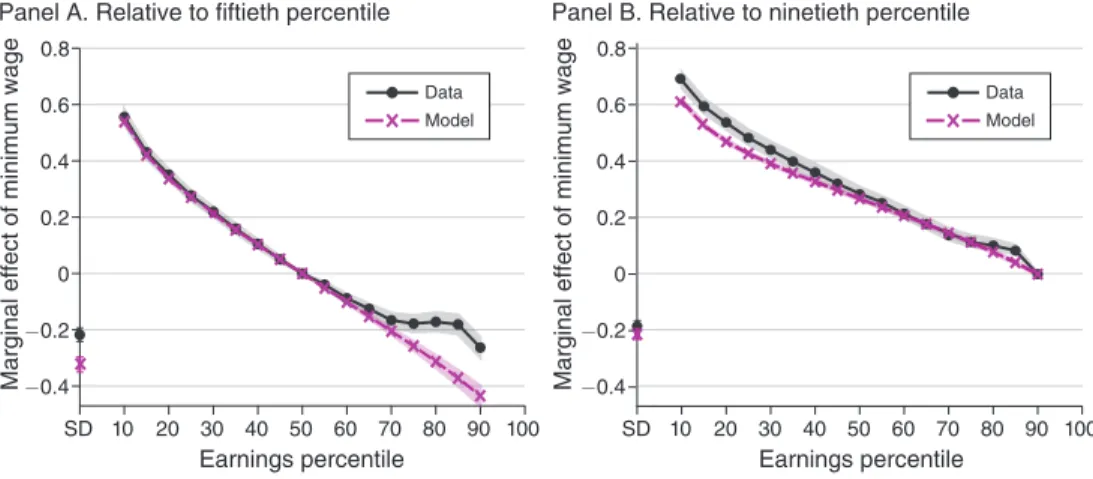
Examining these results, we estimate monotonically decreasing and statistically significant marginal effects of the minimum wage up to the ninetieth percentile. Our robust finding of an association between the minimum wage and inequality outcomes up to the 90th percentile of the wage distribution may seem surprising. 27 See also online appendix B.14 for a more detailed analysis of the relationship between the minimum wage and working hours.
Equilibrium Model of a Labor Market Subject to a Minimum Wage
Furthermore, reduced-form estimates based on cross-sectional variation only recover the relative, but not the absolute, effects of the minimum wage—a problem exacerbated if there are spillover effects through most of the wage distribution.28 Finally, concerns may remain about confounding factors, that are not controlled for in our economic analysis, such as the simultaneous rollout of social security programs and the expansion of education in Brazil. To address these issues, we develop and estimate an equilibrium model for the Brazilian labor market subject to a minimum wage. Another advantage of a structural model is that it can aggregate the effects of the minimum wage estimated based on cross-sectional variation in the data, while elucidating the mechanisms by which the minimum wage affects the labor market through counterfactual simulations.
We think of the dependence of this flow tool on ability a which reflects individual characteristics valued not only in formal employment but also in informal employment or home production. This ability parameter corresponds to both observable and unobservable worker characteristics, which online Appendix A.4 shows is important for explaining empirical wage dispersion. In particular, an employed worker of type (a,s) becomes unemployed at Poisson rate δ (a,s) , after which her search efficiency is updated according to a first-order Markov process with transition probability π(s′ | a ,s) .29 We think of this assumption as reflecting in reduced form different propensities to change employers, for example due to family relationships preventing a geographic move.30 As will become clear, it allows the model to match the modest increase in wage distribution to the minimum wage in Brazil (that said, we show in Online Appendix E.7 that our main results are not sensitive to the particular value of π(s′ | a,s)).
A job offer is an opportunity to work at a fixed rate w for the duration of employment. The worker problem and the distribution of workers along the labor scale Let U(a,s) denote the value for an unemployed worker with ability a and search efficiency s. Let W(w,a,s) be the value for a worker with ability a and search efficiency s due to employment at contract w.
An employee of type (a,s) who works at piece rate w receives external offers at rate sp(a,s) , which he accepts if the corresponding piece rate w′ satisfies w′ > w. Employed workers become unemployed at an exogenous rate δ(a,s) , in which case the worker search efficiency is updated according to the Markov process π(s′ | a,s). Companies choose per market how many vacancies they want to advertise, v ≥ 0 , and what piece rate they want to pay, w , subject to a minimum wage restriction, wa ≥ w min.
Online Appendix C defines equilibrium, which can be characterized by market as a system of two first-order ordinary differential equations in wage policy, w(z | a,s), and firms' CDF, h(z). | a, s).
Estimation
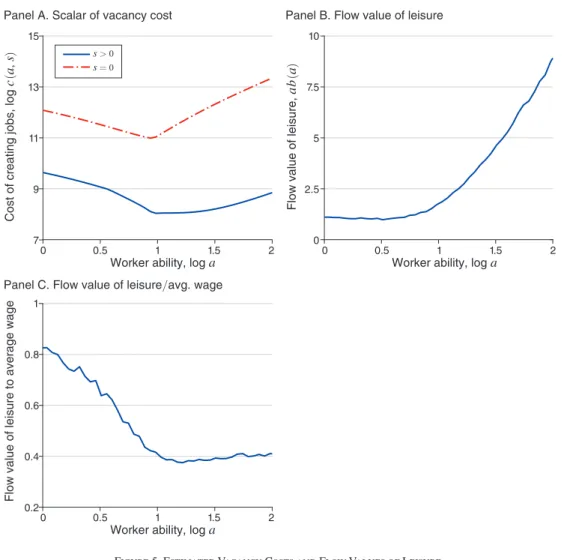
To further simplify the problem, we impose some flexible parametric constraints based on inspection of the data against the model output. The scale of the ability distribution, μ , is informed by the log ratio of the median to minimum wage. Moments for each of the then AKM worker fixed effect deciles receive a weight of wm = 1/10, resulting in a cumulative unit weight.
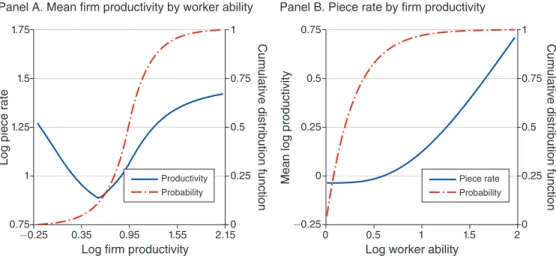
The intercept, ϕ 0 , and the slope, ϕ 1 , of the relative intensity of job search, s(a), are mapped to the EE rate by decile with the fixed effect of the AKM worker. The tail index of the firm's productivity distribution ζ = 3.503 allows the model to fit well with the variance of AKM firm's fixed effects. The estimated value of the transition rate to minimum wage jobs, π = 0.019, leads our model to a realistic jump in the wage distribution at the minimum wage.
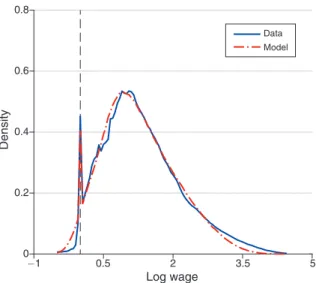
The parameters r and r1 = 1.127 capture the empirical characteristic of the fifth percentile of logarithmic wages, which increase steeply by deciles with the fixed effect of the AKM person; see Panel D of Figure D.3 in Online Appendix D.2. We now discuss the mapping between the estimated auxiliary parameters (λ, r0, r1) and the corresponding structural parameters of the model. In general, the model-generated wage distribution agrees with several important features of the empirical wage distribution.
For example, the model underpredicts the mass in the far right tail of the wage distribution. 38 Online Appendix E.7 shows that our results are robust to different parameters to better fit the properties of these data in isolation. 39 Flinn and Mullins (2018) show that the presence of wage negotiations in addition to wage posting can change the predicted spillover effects of the minimum wage.
The only exception is the reservation wage intercept, r0 , which online Appendix E.7 shows has a negligible impact on the predicted effects of the minimum wage.
The Equilibrium Effects of the Minimum Wage
Holding all other parameters constant, we compare the impact of the minimum wage increase on inequality in the model with the overall time trend during this period. The minimum wage naturally pushes up wages one-to-one at the bottom of the distribution. Although the spillover effects of the minimum wage are far-reaching, their absolute magnitude is moderately above the median.44
Within each panel, the estimated marginal effect of the minimum wage on the standard deviation of log earnings (SD on the x-axis) and on wages between the tenth and ninetieth percentiles of the wage distribution (10 to 90 on the x-axis) ) relative to some base wage p is shown. 45 Online Appendix E.2 shows the contribution of the minimum wage to changes over time in an AKM wage decomposition. Impact of the minimum wage throughout the wage distribution in the model Notes: Impact of a 57.7 log point increase in the minimum wage in the estimated model.
Panel B shows the change in enrollment wages due to the minimum wage conditional on the CDF in each year. Notes: The table shows the estimated impact of a 57.7 log point increase in the minimum wage in the model as well as the raw data. Notes: The table shows the estimated impact of a 57.7 log point increase in the minimum wage on aggregate outcomes in the simulated economy.
Panel A of Figure 11 shows the results from the response of firms' recruitment decomposition to the minimum wage based on equation (11) across productivity levels. Third, the vacancy channel captures the impact of the minimum wage w min on vacancies, V(a,s). Panel A of Figure 12 shows that a higher average worker skill, μ , significantly reduces the distributional effects of the minimum wage.
Notes: Panel A shows a decomposition of firms' recruitment response to a 57.7 log point increase in the minimum wage based on equation (11) for the market with (a = ¯a ,s > 0). United States due to the relatively higher initial minimum wage obligation in Brazil.51. Panel B shows a weaker inequality-reducing effect of the minimum wage for higher values of the productivity tail parameter ζ.
Conclusion
Panel C shows that a higher relative employment search intensity among higher skilled individuals ϕ1 strengthens the effect of the minimum wage on inequality, although the gradient is flatter than in the previous two cases. In comparison, the inequality reduction due to the minimum wage is relatively invariant to the separation rate intercept δ 0 (panel D). In addition to our parameter estimates discussed above, other reasons why we find relatively large effects of the minimum wage on inequality in Brazil may include the nature of wage setting.
In related work, Flinn and Mullins (2018) show that minimum wage spillover effects may be smaller in an economy where wages are sometimes bargained, which is likely to happen more in the United States than in Brazil. The Minimum Wage and Inequality: The Effects of Education and Technology.” Journal of Labor Economics. The Effects of the Minimum Wage on the Whole Wage Distribution: Evidence from Brazil's Formal and Informal Sectors. Unpublished.
Effects of the Minimum Wage on Labor Market Outcomes by Endogenous Search, Matching, and Contact Rates.” Econometrics. Supply, Demand, Institutions, and Firms: A Theory of Labor Market Classification and Wage Distribution. Unpublished. The impact of minimum wage distribution in the short and long term." NBER Working Paper 30294.
Estimating the Effects of the Minimum Wage in a Developing Country: A Density Discontinuity Design Approach." Journal of Applied Econometrics. Wage Inequality in the United States During the 1980s: Increasing Distribution or Declining the Minimum Wage? Quarterly Journal of Economics. The Effects of the Minimum Wage on Wages, Employment, and Prices." IZA 1135 Discussion Paper.
Aggregation Bias in Substitution Elasticities and the Minimum Wage Paradox.” International Economic Review.