MINI-REVIEW
Electrochemical Methods in Pesticides Control
E. M. Garrido,1C. Delerue-Matos,1,* J. L. F. C. Lima,2 and A. M. O. Brett3
1REQUIMTE/Instituto Superior de Engenharia do Porto, Instituto Polite´cnico do Porto, Porto, Portugal
2REQUIMTE/Departamento de Quı´mica Fı´sica, Faculdade de Farma´cia, Universidade do Porto, Porto, Portugal
3Departamento de Quı´mica, Faculdade de Cieˆncias e Tecnologia, Universidade de Coimbra, Coimbra, Portugal
ABSTRACT
The state of the art of voltammetric and amperometric methods used in the study and determination of pesticides in crops, food, phytophar- maceutical products, and environmental samples is reviewed. The main structural groups of pesticides, i.e., triazines, organophosphates, organo- chlorides, nitrocompounds, carbamates, thiocarbamates, sulfonylureas, and bipyridinium compounds are considered with some degradation products. The advantages, drawbacks, and trends in the development of
1755
DOI: 10.1081/AL-120039425 0003-2719 (Print); 1532-236X (Online)
Copyright#2004 by Marcel Dekker, Inc. www.dekker.com
*Correspondence: C. Delerue-Matos, REQUIMTE/Instituto Superior de Engenharia do Porto, Instituto Polite´cnico do Porto, 4200-485 Porto, Portugal; E-mail:
voltammetric and amperometric methods for study and determination of pesticides in these samples are discussed.
Key Words: Electrochemical method; Pesticides; Structural groups;
Voltammetric and amperometric methods.
1. INTRODUCTION
Agricultural production currently, and increasingly, depends on the use of pesticides. Pesticide is a term used in a broad sense for chemicals, synthetic, or natural, that are used for the control of insects, fungi, bacteria, weeds, nematodes, rodents, and other pests.[1]
These compounds and the products derived from them by degradation or metabolism give rise to residues that may spread through the environment and are particularly frequent contaminants in superficial and groundwaters, in soil and in agricultural and food products.
As many organic compounds used as pesticides contain electroactive groups, voltammetry can be used for their mechanistic and analytical studies.
Electrochemical techniques have been very helpful in the elucidation of processes and mechanisms of oxidation and reduction of pesticides.
Moreover, the use of electrochemical data combined with spectroscopic studies could provide important information useful to the understanding of the degradation pathways of pesticides in aqueous solutions and in this way to mimicking the environmental processes.
There is a wide range of studies concerned with analytical methods for monitoring the pesticides in environmental samples. Most applications of chemical analysis to pesticide control involve methods with high sensitivity accompanied by sufficient selectivity, precision, and accuracy. Easy sample pre-treatment and rapid analytical procedures are also desirable. When selecting the method, the cost of the instrumentation and the possibility of per- forming measurements in the field are also important factors to be considered.
Since electrochemical methods satisfy all the above criteria, they were a good choose for the analysis and control of environmental pesticides.
Unfortunately, the determination of pesticides in most samples requires their extraction into organic solvents. The well-known practical difficulties of using organic solvents in electroanalysis to determine scarcely water- soluble compounds can be overcome by working in oil – water emulsions as these are predominantly aqueous.
The principal electrochemical methods are voltammetry, amperometry, potentiometry, and conductimetry. Since electrochemical biosensors for pesticides analysis have been recently reviewed,[2,3]special emphasis will be
given to focus on the developments concerning the voltammetric and ampero- metric analyses of pesticides.
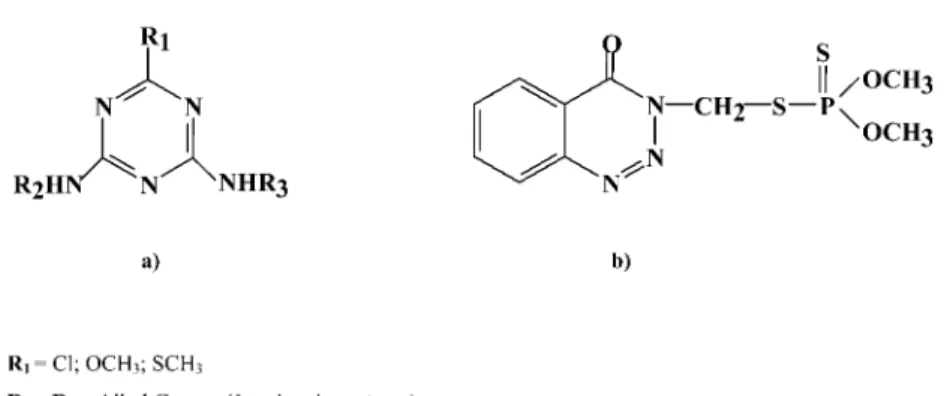
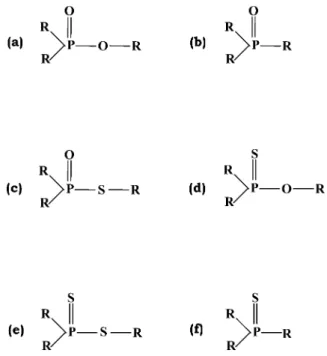
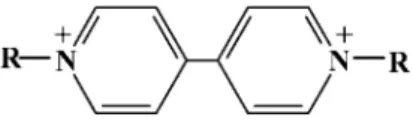
Classification of pesticides according to structure is given in Table 1. The pesticides considered in this paper are listed in Tables 2 and 3, where the applications are present.
2. ELECTROANALYTICAL METHODS FOR DETERMINATION OF PESTICIDES
In the development of electroanalytical methods for the determination of pesticides, the electrochemical detection performance is strongly influenced by the material of the working electrode. The working electrode is where the reaction of interest occurs. The selection of the working electrode depends primarily on the redox behavior of the target analytes and the back- ground current over the applied potential range.
2.1. Mercury Electrodes
For a long time mercury drop electrodes were the most popular, first in the form of the dropping mercury electrode (DME) and after in the form of static mercury drop electrode (SMDE), and the hanging mercury drop electrode (HMDE).
In the literature, there are several examples (Table 2) of the use of mercury electrodes in the study of the electrochemical behavior of pesticides and in their determination in various matrixes, for example in soil, water, and agricultural products.
Table 1. Structural groups pesticide compounds.
Class Structural group
I Organochloride
II Triazines
III Nitropesticides
IV Carbamates and thiocarbamates
V Organophosphate
VI Sulphonylureas
VII Bipyridinium pesticides
VIII Others
Table2.Alphabeticlistofpesticidecompoundsreviewed,electrode,technique,electrolyteusedindeterminationandrespectivepotential, detectionlimit,application,andreferencesrelatingtotheiranalysisinmercuryelectrode. PesticideClassElectrodeTechniqueElectrolyteEp(V)vs.SCEa orAg/AgClbDetectionlimitApplicationReferences AlachlorISMDEDPVPhosphatebuffer(pH7)21.027.0mg/LModel samples[21] AldrinIDMEDPV0.1NTetrabutylammonium bromidedissolvedina solutionwhichwas40% ethanol,20%dimethyl formamide,and40% deionizedwater
21.84bNotreportedSpikedwater[28] AmetryneIIDMEDPVPhosphoricacid0.1M(pH3)21.0dIndustrial wastec[4] HMDEAdSVNotreported21.0b0.2mg/LdRiverwaterd[65] DMEAdSVBritton-Robinsonbuffer (pH3.5)21.02a0.179mg/LSpikedriver water[71] AtrazineIIDMEDPVPhosphoricacid0.1M(pH3)20.99dIndustrial wastec[4] DMEDPVKCl/HClbuffer(pH2)20.93a 15mg/lModel samples[67] SMDEAdSVBRbuffer(pH2.5)20.83;20.94a 0.96mg/lWater samplesd[68] BenfluralinIIIHMDEAdSVBritton-Robinsonbuffer (pH10.46)with49% (V/V)methanol 20.58a 0.05mg/mLModel samplesand soil
[69] BromofenoximIIIHMDEAdSVBritton-Robinsonbuffer (pH7.6)20.33a0.98ng/LModelsamples andsoil[69]
CarbarylIVHMDEAdSVDeterminationafter nitrosationein0.10mol/L sodiumhydroxideproduct: 1,4-naphthoquinone
20.65b5mg/KgfSoild[65] HMDEfDPV0.41mg/LNaturalwater[36] HMDEfDPV20.680.47mg/KgSoil[36] HMDEfAdSV0.005mg/LNaturalwater[36] HMDEfAdSV0.007mg/KgSoil[36] CDTIIIDMEDPV0.05MSulfuricacid0.00a2.6mg/LEnvironmental water[11] ChlorothionIIIDMEDPVAcetatebuffer(pH4)20.31b1.50mg/LModel samples[70] ChlorfenvinfosVDMEDPVUniversalbuffer(pH4)20.95b0.36mg/LGrainsandsoil[17] CrotoxyphosVDMEDPVUniversalbuffer(pH4)21.12b 0.34mg/LGrainsandsoil[17] p,p0-DDTIDMEDPV0.1NTetrabutylammonium bromidedissolvedina solutionwhichwas40% ethanol,20%dimethyl formamide,and40% deionizedwater
20.63b NotreportedSpikedwater[28] o,p0-DDTIDMEDPV0.1NTetrabutylammonium bromidedissolvedina solutionwhichwas40% ethanol,20%dimethyl formamideand40% deionizedwater
20.83bNotreportedSpikedwater[28] DesmetryneIISMDEAdSVBritton-Robinsonbuffer (pH4)21.08a0.15mg/LWater samplesd[73] DichlorvosVDMEDPV20%Ethanolinasolution ofpH821.05b2.6mg/LCommercial samples[16] (continued)
Table2.Continued. PesticideClassElectrodeTechniqueElectrolyteEp(V)vs.SCEa orAg/AgClbDetectionlimitApplicationReferences DicrotophosVDMEDPVUniversalbuffer(pH4)21.05b0.30mg/LCommercial samples, grains,and soil [17] DieldrinIMMEDPV0.2%TritonX-405þ0.2% hyamine2389,0.1MBR buffer(pH6)
20.91b 0.11mg/LModel samples[22] MMEDPVEmulsionsobtainedfrom 6.0mLn-hexane–ethyl acetate(20þ1)effluent fraction.0.2%Triton X-405þ0.2%hyamine 2389,0.1MBritton- Robinsonbuffer(pH6)
20.98bNotreportedSpikedapples[24] MMEDPVEmulsionsobtainedfrom ethylacetate,0.2%Triton X-405þ0.2%hyamine 2389,0.1MBritton- Robinsonbuffer(pH6)
20.98b0.14mg/LModel samples[25] DieldrinIMMEDPV0.1NTetrabutylammonium bromidedissolvedina solutionwhichwas40% ethanol,20%dimethyl formamide,and40% deionizedwater 21.77b NotreportedSpikedwater[28]
Mixturediedrin- endosulfon(after hydrolysisof endosulfan) MMEDPVEmulsionsobtainedfrom ethylacetate,0.2%Triton X-405þ0.2%hyamine 2389,0.1MBRbuffer (pH12.0)
20.98;21.18b (respectively)NotreportedModel samples[23] Mixturediedrin- endosulfon- suphate(after hydrolysisof endosulfan- sulfate)
MMEDPVEmulsionsobtainedfrom ethylacetate,0.2%Triton X-405þ0.2%hyamine 2389,0.1MBRbuffer (pH13.0)
20.98b NotreportedModel samples[23] Mixturediedrin-a- endosulfon(after hydrolysisof endosulfan)
MMEDPVpH12inaHPO422/NaOH buffer20.98,21.18b (respectively)NotreportedSpikedapples[24] DinobutoneIIIHMDEAdSVNotreported20.46b0.6mg/LfRiverwaterd[65] DMEDPVBritton-Robinsonbuffer (pH6.1)20.24;20.46a16.5;20.5mg/LEnvironmental water[11] SMDEAdSVBritton-Robinsonbuffer (pH6.1)20.46a0.614mg/LSpikedriver water[71] DinosebIIIHMDEAdSVBR(pH5)20.21;20.36b0.36;0.11mg/LModelsamples[72] DiquatVIISMDESWVExtractedsolution neutralizedwithNaOH(to pH5.6)and0.003%gelatin
0.56b1mg/gSpiked potatoesd[33] DNOKIIIHMDEAdSVNotreported20.44b 0.1mg/Lf Riverwaterd [65] DMEDPVBritton-Robinsonbuffer (pH6.1)20.3;20.5Va 2.1;1.5mg/LEnvironmental waste[11] SMDEAdSVBritton-Robinsonbuffer (pH6.1)20.44a 0.096mg/LSpikedriver water[71] (continued)
Table2.Continued. PesticideClassElectrodeTechniqueElectrolyteEp(V)vs.SCEa orAg/AgClbDetectionlimitApplicationReferences Endosulfan-sulfateIMMEDPV0.2%TritonX-405þ0.2% hyamine2389,0.1M Britton-Robinsonbuffer (pH6.0)
20.83b0.11mg/LModel samples[22] Endosulfan-sulfateMMEDPVEmulsionsobtainedfrom ethylacetate,0.2%Triton X-405þ0.2%hyamine 2389,0.1MBritton- Robinsonbuffer(6.0)
20.900.084mg/LModel samples[25] Endosulfan-sulfateMMEDPVEmulsionsobtainedfrom 8–18mLn-hexaneacetate (20þ1)effluentfraction. 0.2%Triton X-405þ0.2%hyamine 2389,0.1MBritton- Robinsonbuffer(6.0)
20.92bNotreportedSpikedapples[24] Mixtureendosulfon- endosulfon- sulfate(after hydrolysisof endosulfan)
MMEDPVEmulsionsobtainedfrom ethylacetate,0.2%Triton X-405þ0.2%hyamine 2389,0.1MBritton- Robinsonbuffer(11.0) 21.15;20.86b (respectively)NotreportedModel samples[22]
EndrinIDMEDPV0.1NTetrabutylammonium bromidedissolvedina solutionwhichwas40% ethanol,20%dimethyl formamideand40% deionizedwater 21.73bNotreportedSpikedwater and commercial samples
[28] Fluoroglycophen- etylIIIHMDEAdSVBritton-Robinsonbuffer (pH11.6)with20% (V/V)DMF
Notreported0.55ng/mLModelsamples andsoil[69] Glifosate(after nitrosation)VDMEDPV40mLEluatesolutionadd 2mLofsulfuricacid(1:1)20.78a 35mg/LNaturalwaters[20] GuthionIIDMEDPVBritton-Robinsonbuffer(pH 4.3),in20%(v/v) MeOH/H2Omedium
20.75a19mg/LModel samples[7] SMDEDPVBritton-Robinsonbuffer (pH5.0–5.5)Notreported31mg/LSpikedriver water; spiked residential wellwater
[74] SMDEAdSVBritton-Robinsonbuffer (pH5.0–5.5)Notreported0.63mg/LSpikedriver water; spiked residential wellwater
[74] DMEAdSVNotreported20.64f 0.5(mg/L)b Riverwaterd [65] HMDEAdSVNotreported20.71f 1.5(mg/L)b Riverwaterd [65] (continued)
Table2.Continued. PesticideClassElectrodeTechniqueElectrolyteEp(V)vs.SCEa orAg/AgClbDetectionlimitApplicationReferences a-HCHIDMEDPV0.1NTetrabutylammonium bromidedissolvedina solutionwhichwas40% ethanol,20%dimethyl formamideand40% deionizedwater
21.83b NotreportedSpikedwater[28] b-HCHIDMEDPV0.1NTetrabutylammonium bromidedissolvedina solutionwhichwas40% ethanol,20%dimethyl formamideand40% deionizedwater
21.90bNotreportedSpikedwater[28] g-HCHIDMEDPV0.1NTetrabutylammonium bromidedissolvedina solutionwhichwas40% ethanol,20%dimethyl formamideand40% deionizedwater 21.23bNotreportedSpikedwater[28]
HeptachlorIMMEDPVEmulsionsobtainedfrom 20mLn-hexaneeffluent fraction.0.2%Triton X-405þ0.2%hyamine 2389,0.1MBritton- Robinsonbuffer(pH8)
20.92bNotreportedSpikedapples[24] Mixture Heptachlor– endosulfon- sulfate
MMEDPVEmulsionsobtainedfrom ethylacetate,0.2%Triton X-405þ0.2%hyamine 2389,0.1MBritton- Robinsonbuffer(pH8)
NotreportedNotreportedModel samples[25] Mixture Heptachlor– endosulfon- sulfateand dieldrin
MMEDPVEmulsionsobtainedfrom ethylacetate,0.2%Triton X-405þ0.2%hyamine 2389,0.1MBritton- Robinsonbuffer(pH8)
NotreportedNotreportedSpikedapples[24] IsomethiozinIIDMEDPVBritton-Robinsonbufferin 0.1MNaClO4atpH1.920.52b0.04mg/gSoil[66] HMDEAdsVNotreported20.56b0.9mg/LfSoild[65] MenazonVDMEDPV0.06MAceticacid/0.04M sodiumacetate20.84;21.30b0.15;0.18mg/L (respectively)Model samples[18] HydrolysisproductsDMEDPVBritton-Robinsonbuffer (pH4.3)20.44bModel samples[18] MetamitronIIDMEDPVBritton-Robinsonbuffer (pH2)20.49b 0.02mg/gSoil[75] HMDEDPVAcH/AcNa(pH4.6)20.70a 50mg/LCommercial samples[8] (continued)
Table2.Continued. PesticideClassElectrodeTechniqueElectrolyteEp(V)vs.SCEa orAg/AgClbDetectionlimitApplicationReferences HMDEAdSVAcH/AcNa(pH4.6)20.70a 0.5mg/LModel samples[8] HMDEAdSVNotreported20.45b 0.4mg/Kgf Soil[65] MethoprotryneIIHMDEAdSV0.1molL21 Perchloricacid20.87b 0.65mg/LSpiked irrigation andtap waters
[5] HMDEAdSVBritton-Robinson(pH4)21.07a0.07mg/LWatersamples[68] MonocrotophosVDMEDPV20%Ethanolinasolution ofpH221.00b2.2mg/LCommercial samples[16] ParaquatVIISMDESWVExtractedsolution neutralizedwithNaOH (topH5.6)and0.003% gelatin
20.59b1mg/gSpiked potatoes[33] HMDEAdSVNotreported20.70b1.5mg/LfWatersamples[65] Mixtureof parathionwith PCNB
IIIDMEDPVBritton-Robinsonbuffer (alkalinesolution)20.65,20.52a respectivelyNotreportedModel samples[13] Mixtureofparathion withametabolite (p-nitrophenol DMEDPVBritton-Robinsonbuffer (pH3)20.15,20.24a respectivelyNotreportedModel samples[13]
Mixtureofparathion withparaoxon (afterhydrolyze ofparaoxon)
DMEDPV0.5MSodiumhydroxideNotreportedNotreportedModel samples[13] Mixtureof parathion(I)with paraoxon(II) (afterhydrolyze ofparathion) DMEDPVHAc/Acwith50%(V/V) ofMeOH(pH8)20.74,20.48a respectively48mg/L(II)and 23mg/L(p- nitrophenol- hydrolyze product)
Model samples[14] PendimethalinIIIHMDEAdSVBritton-Robinsonbuffer buffer(pH7.42)with 49%(V/V)methanol
Notreported0.94mg/mLModel samplesand soil
[69] PhenitrothioneIIIDMEAdSVNotreported20.32b3mg/LfRiverwaterd[65] DMEDPV0.05MSulfuricacid20.085;21.00a5.4mg/LEnvironmental water[11] PhosphamidonVDMEDPV20%Ethanolina solutionofpH421.00b3.8mg/LCommercial samples[16] PrometryneIIDMEDPVKCl/HCl(pH2)20.98a15mg/LModel samples[67] HMDEAdSV0.1MHClO420.88b2.17mg/LSpikedtap water,well waterand soil
[76] SMDEAdSVBritton-Robinsonbuffer (pH4)21.02a 0.35mg/LWatersamples[68] DMEAdSVBritton-Robinsonbuffer (pH3.5)21.05a 0.951mg/LSpikedriver water[71] (continued)
Table2.Continued. PesticideClassElectrodeTechniqueElectrolyteEp(V)vs.SCEa orAg/AgClbDetectionlimitApplicationReferences SimazineIIDMEDPVPhosphoricacid0.1M(pH3)20.99aNotreportedIndustrial wastec[4] DMEDPV2.0mLEthylacetate, 0.1%sodium pentanesulfonateand 0.1MBritton-Robinson buffer(pH2.0)
20.95a44mg/LSpiked irrigation[9] DMEDPVKCl/HCl(PH2.2)20.95a15mg/LModel samples[67] HMDEAdSVNotreported20.75b0.2mg/LfRiverwaterd[65] SimetrynIIDMEAdSVNotreported21.0b0.4mg/LfRiverwatere[65] SMDEDPVBritton-Robinsonbuffer (pH5.0–5.5)Notreported21.3mg/LSpikedriver water; spiked residential wellwater
[74]
SMDEAdSVBritton-Robinsonbuffer (pH5.0–5.5)Notreported0.4mg/LSpikedriver water; spiked residential wellwater
[74] TerbutryneIIHMDEAdSV0.1MPerchloricacid20.92b 0.58mg/LSpiked[5] SMDEAdSVBritton-Robinsonbuffer (pH4)21.06a 0.36mg/LWatersamples[68] TerbutylazineIISMDEAdSVBritton-Robinsonbuffer (pH2.5)20.87;20.96a 0.12mg/LWatersamples[68] TriflurolinIIIHMDEAdSVBritton-Robinsonbuffer(pH 6.10)47%(V/V)ethanol20.57a 0.03mg/mLModel samplesand soil
[69] a ThevalueofEpvs.SCE. b ThevalueofEpvs.Ag/AgCl. c Determinationoftotals-triazines(atrazine,simazine,andametrine). d Theanalyteisevaluatedaftersolidphaseextraction. e Withderivatization. f Onlylimitofdeterminationisreported.
Table3.Alphabeticlistofpesticidecompoundsreviewed,electrode,technique,electrolyteusedindeterminationandrespectivepoten- tial,detectionlimit,application,andreferencesrelatingtotheiranalysisinsolidelectrodes. PesticideClassElectrodeTechniqueElectrolyte
Ep(V)vs. SCEaor Ag/AgClbDetection limitApplicationReferences AminocarbIVGlassycarbonelectrodeDPVAcetatebuffer(pH6.6)þ0.74a30mg/LModelsample[38] AssulamIVGlassycarbonelectrodeSWVBritton-Robinson buffer(pH1.9) þ0.89b1.63mg/LSpiked environmental samples
[77] GlassycarbonelectrodeAmperometryBritton-Robinson buffer(pH1.9)
þ1.2b2.8mg/LSpiked environmental samples
[77] BendiocarbIVModifiedcarbonpaste electrodecoveredwith aenzymaticmembrane
AmperometricPhosphatebuffer (pH7.3)
þ0.4b80mg/LModelsamples[56] BentazonVIIIGlassycarbonelectrodeSWVAcH/AcNa(pH3.4)þ0.85b2.4mg/LCommercial samples[44] GlassycarbonelectrodeAmperometryAcetatebufer (pH4.5)/NaOH þ1.10b 0.24mg/LEstuarinewaters[81] Bensulfuron-methylVIGlassycarbonelectrodeSWVBritton-Robinson buffer(pH12.1)
þ1.0b HPLC determinationCommercial samples[44] Carbaryl(after hydrolyse)IVGlassycarbonelectrodeDPVSolutionNaOH/AcH (pH3.5)þ0.56b 40mg/LCommercial samples[40] Carbaryl(after hydrolyse)GlassycarbonelectrodeAmperometrydþ0.75b0.1mg/mLVegetables[42] CarbarylGraphite–CoPC–AchE biocompositeelectrodeAmperometryPhosphatebuffer (pH7.3) þ0.25b2.2mg/LModelsamples[57]
CarbarylIVGlassycarbonelectrode coveredwitha enzymaticgrift Amperometry(pH8)þ0.25b0.20mg/LLagoonwater andKiwi fruits
[78] Graphite–epoxy–AchE biocompositeelectrodeAmperometryPhosphatebuffer (pH7.0)
þ0.70b20mg/LModelsamples[58] Platinumelectrodewith immobilized cholinesterase
AmperometryPhosphatebuffer (pH8) þ0.41bd Freeze-dried water[79] Carbaryl(after hydrolyse)GlassycarbonelectrodeAmperometryAcetatebuffer (pH5)/NaOH
þ0.81b 2.0mg/LNaturalwaters[82] Carbofuran(after hydrolysis)IVGlassycarbonelectrodeDPVSolutionNaOH/ AcOH(pH3.5)þ0.65b 27mg/LCommercial samples[40] Carbofuran(after hydrolysis)GlassycarbonelectrodeAmperometryDatanotreportedþ1.0b0.1mg/mLVegetables[42] CarbofuranGraphite–epoxy–AchE biocompositeelectrodeAmperometryPhosphatebuffer (pH7.0) þ0.70b2.2mg/LModelsamples[58] ChlorbromuronIVGlassycarbonelectrodeAmperometryAcetatebufferwith 50%ethanol(V/V)
þ1.4b0.29mg/LModelsamples[41] ChlorprophamIVGlassycarbonelectrodeAmperometryAcetatebufferwith 50%ethanol(V/V) þ1.4b0.21mg/LModelsamples[41] ChlortoluronIVGlassycarbonelectrodeAmperometryAcetatebufferwith 50%ethanol (V/V/V)
þ1.4b0.21mg/LModelsamples[41] ChloroxuronIVGlassycarbonelectrodeAmperometryAcetatebufferwith 50%ethanol(V/V) þ1.4b 0.29mg/LModelsamples[41] 2,4-DVIIIMonoclonalanti2,4-D antibodyimmobilized onthegoldelectrode
AmperometryPhosphatebuffer (pH7.3)20.3b 0.1mg/LModelsamples[80] (continued)