The third and fourth articles discussed the progress of the climate agenda in the city of Recife, Brazil. It demonstrates the factors that can decisively help cities in strengthening the climate agenda, especially in developing or less developed countries. The fourth article is a case study of climate action taken in Recife and examines the main drivers and barriers to their effective implementation in comparison with examples from the literature.
It also proves factors that can decisively help cities to strengthen the climate agenda, mainly in developing or less developed countries, providing insights to academics and policy makers on low-carbon strategies for cities.
INTRODUCTION
Research Problem and Objectives
The literature review also showed that, to date, most of the previous studies examining empirical climate governance and the drivers and barriers to climate action have been conducted in the Global North (Van der Heijden, 2019; Mi et al., 2019; Castán Broto & Bulkeley , 2013; Van der Heijden, 2019; Reckien et al., 2018; Romero-Lankao et al., 2018; Castán Broto, 2017). Brazilian cities' greenhouse gas inventories, classification of the existing gaps and understanding the drivers and barriers to climate action in Brazilian cities. The general purpose of the thesis is to analyze (I) the quality and gaps in greenhouse gas inventories and (II) the most important driving forces and barriers to strengthening the climate agenda in Brazilian cities.
To meet specific objectives 1, 2 and 3, all the most recent GHG emission inventories published by Brazilian cities that have already developed this action were used as the analysis field.
Articles Connections
To address specific objectives 4 and 5, articles 3 and 4 explore the case of Recife due to (I) the city's vulnerability to climate change and (II) the fact that the climate agenda has advanced significantly in recent years, making climate action a globally recognized city. The third paper has already been published by "Cities" (Baltar de Souza Leão et al., 2021) and has one international citation until September/2021. This is a city profile that looks at the factors that can decisively help cities to strengthen the climate agenda, especially in developing or less developed countries.
It was the first city profile published by “Cities” magazine to explore the relationship between the impacts of urban evolution in a Latin American city and the threats posed by climate change.

Method
- Article 1
- Article 2
- Articles 3 and 4
He coordinated several projects and partnerships in the city as greenhouse gas inventories; the first climate action plan; the vulnerability and risk analysis; actions to mobilize society, among other things. Leta is one of the spearheads of the city in international networks such as ICLEI and CDP. He is one of the spearheads of the city in international networks such as ICLEI and CDP.
He was actively involved in the elaboration of the city's first Climate Action Plan.

SINTHESIS OF THE LITERATURE REVIEW
Carbon Accounting Approaches and Methodologies
- Production-Based Approach X Consumption-Based Approach
- GHG Estimation Methodologies
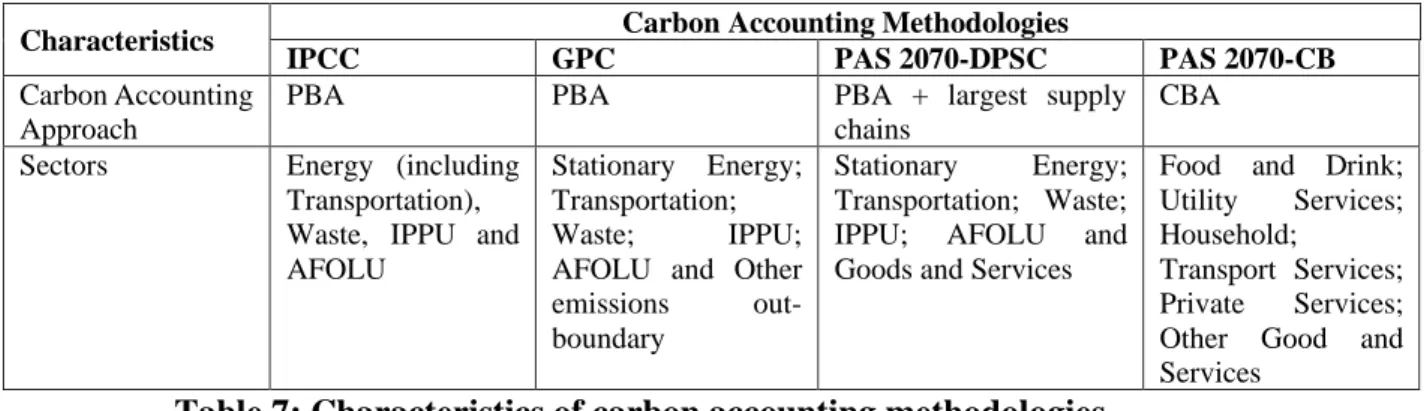
Studies found divergent results of GHG emissions inventories in New York, Paris and Shanghai (Ibrahim et al., 2012) using different approaches. Activities that take place in a city can generate greenhouse gas emissions that occur within the city limits as well as outside the city limits. PAS 2070 specifies requirements for estimating GHG emissions from a city using two different methods: (I) a direct plus supply chain (PAS 2070-DPSC) method and (II) a CBA method (PAS 2070-CB).
PAS 2070-CB covers life-cycle greenhouse gas emissions for all goods and services consumed by the city.

Climate Actions, Drivers and, Barriers to Climate Change
- Climate Actions
- Drivers and Barriers for Climate Action
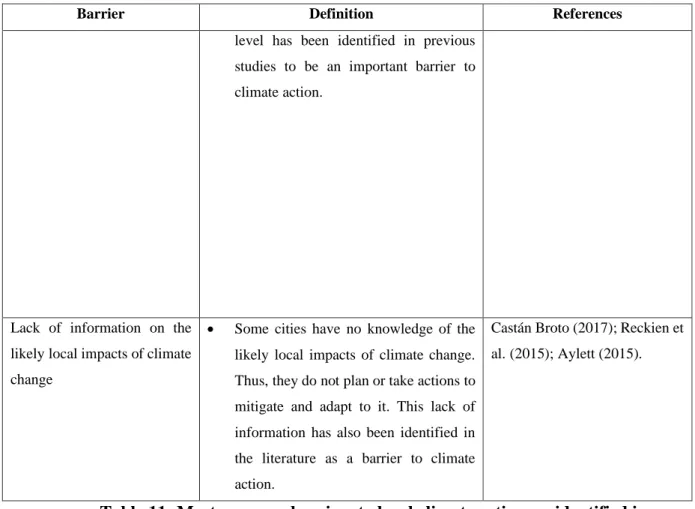
According to the literature, access to climate finance is important for urban climate management. Autonomy • The city must have the power to act and the autonomy to take urban climate action. Lack of funding • Lack of funding is considered one of the most important barriers to climate action.
This lack of information has also been identified in the literature as a barrier to climate action.

THESIS ARTICLES
Article 1: Carbon accounting approaches and reporting gaps in urban
Carbon accounting approaches and reporting gaps in urban emissions: an analysis of greenhouse gas inventories and climate action plans in Brazilian cities. The GHG reports of Brazilian cities do not properly reflect the emissions that occur as a result of the city's activities and consumption patterns. Several studies show that the approach used to calculate greenhouse gases (GHG) can significantly affect the results of the GHG inventory in cities (e.g. Sudmant et al., 2018; Andrade et al., 2018).
Thus, the accounting method shapes the provision of information and, as a result, can limit public policies to combat climate change (Harris et al., 2012). Second, the study identifies the main shortcomings of GHG inventories in terms of quality and gaps (Mi et al., 2019; Mia et al., 2019) by evaluating the inventories developed by Brazilian cities. The lack of consistent and comparable data on urban-level greenhouse gas emissions is one of the four remaining gaps in urban climate action research (Mi et al., 2019).
PAS 2070 specifies requirements for estimating a city's GHG emissions using two distinct methodologies: (I) a direct. Source: Developed by authors using GHG report data of cities 4.3 Carbon Accounting Approaches. Therefore, emissions related to their production are not accounted for in the city inventories.
Therefore, it is not feasible to assess the accuracy of the greenhouse gas results of these reports. The ABC region climate action plan was developed with integrated actions for all 7 cities. Sudmant et al., 2018; Andrade et al., 2018) discuss the impact of carbon accounting on urban greenhouse gas emissions inventories and some recent papers propose methods to improve the comprehensiveness and accuracy of urban carbon accounting.
To overcome these gaps, there are some measures that can improve the quality of greenhouse gas inventories.
Article 2: Assessing urban emissions through different methodologies: an
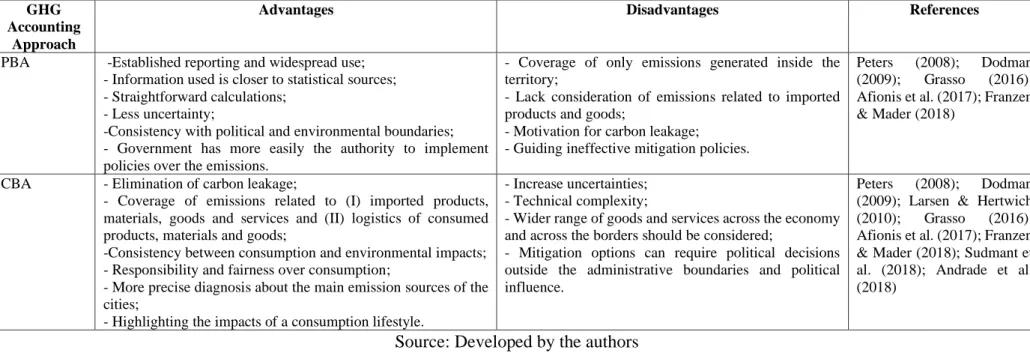
A GHG inventory is the first step towards climate action at the local level (Moran et al., 2021). Previous literature has also shown that these approaches are complementary (Sudmant et al., 2018; Andrade et al., . 2018). Advantages of using a CBA approach include: (I) the possibility to account for more emissions, (II) the ability to maintain consistency between consumption and environmental impacts; (III) the ability to eliminate carbon leakage and (IV) the ability to provide more mitigation options (Peters, 2008; Afinois et al., 2017; Andrade et al., 2018).
However, due to the lack of transparency of the input data used to calculate GHG emissions (Baltar de Souza Leão et al., 2020), the GHG results could not be reproduced. Emission sources can be overestimated or underestimated, and uncertainties must always be analyzed (Jonas et al., 2019). The consistency and comparability of urban-level GHG emissions data is one of four remaining gaps in urban climate action research, say Mi et al.
In SEEG, national emissions data are divided and distributed between states and cities in the country (De Azevedo et al., 2018). This lack of data at the local level may affect the accuracy of the results, as highlighted by Gurney et al. Greenhouse gas inventories can be expensive for a city and may require a technical team, which is not always available (Morin et al., 2021).
This would improve the consistency and comparability of city-level GHG emissions data, which is one of the four remaining gaps in the urban climate action research area, according to Mi et al. Third, it also contributes to efforts to reduce GHG inventories, as a result of uncertainties aligned with one of the literature gaps highlighted by Mi et al.

Article 3: Recife: A Climate Action Profile
Recife is the capital of the state of Pernambuco, located in the northeastern region of Brazil. In the same year, the city prepared its first inventory of greenhouse gas (GHG) emissions with 2012 as the base year and projections of emission scenarios until 2040 (Recife, 2014). In addition, as previously mentioned, urban mobility is a problem in the daily life of the city population.
Another challenge in the transport sector is the increase in emissions from air traffic, which represent more than 20% of the city's total emissions. Actively participates in the Conference of the Parties to the UNFCCC and in city events related to climate change. COMCLIMA and GECLIMA are the environments in which this multi-level governance takes place in the city of Recife.
Federal government institutions do not participate in climate debates in the city of Recife (ICLEI, 2020; Recife, 2013). Federal institutions do not participate in urban climate management, and state participation is limited (ICLEI, 2020; Recife, 2013). Being part of international networks of cities committed to combating climate change, such as ICLEI and CDP, was one of the most important drivers for strengthening climate action in the city.
Climate risk and potential impacts due to the city's development needs have been a major driver of local climate action in the city. Considering climate risk as one of the main drivers for strengthening urban climate management is thus the main theoretical implication of this paper. The industrialization of the climate agenda is fundamental to avoid interference due to changes in the political management of the city.
The continued presence of the city in the multinational networks seems fundamental to progress in capacity building, financing and cooperation with other cities.

Article 4: Drivers and barriers of climate actions in cities of the Global South
Yet there is a major gap in the environmental management literature when it comes to examining the climate actions adopted by cities in the global South, particularly in relation to understanding the. To fill this gap in literature on responses to climate change among cities in the global south, this article will present a case study of the city of Recife, in northeastern Brazil. The IPCC has identified Recife as one of the most vulnerable cities in the world to the effects of climate change.
What are the barriers or obstacles that stand in the way of advancing the climate agenda. Finally, these barriers and obstacles are similar to those experienced by cities in the global north. This paper attempts to identify the climate actions adopted by the city of Recife and the most important drivers and barriers to their effective implementation, thereby addressing the lack of climate management studies of cities in the developing world (Van der Heijden, 2019; Mi et al. , 2019; Castán Broto & Bulkeley, 2013).
Measures related to IPPU were considered in the energy sector, as these measures are generally related to energy efficiency. The AFOLU sector was considered in the Adaptation category due to its overlapping benefits with climate adaptation measures. However, in the Global Protocol for Community-Scale GHG Emissions (GPC), which is the method predominantly used by cities to calculate greenhouse gas inventories, transportation is.
Actions related to industrial processes and buildings were considered in the energy sector, as these measures are generally related to energy efficiency. The AFOLU sector was considered in the Adaptation category due to its overlapping benefits with climate adaptation measures.

FINAL CONSIDERATIONS
INTERVIEW SCRIPT