Eleven case studies supported the design of business model prototypes, built on a specific business model analytical framework. What is a business model and how it can help improve the performance of the intermodal transport service (in Chapter 2);.
1 Introduction
Objectives of HERMES Project
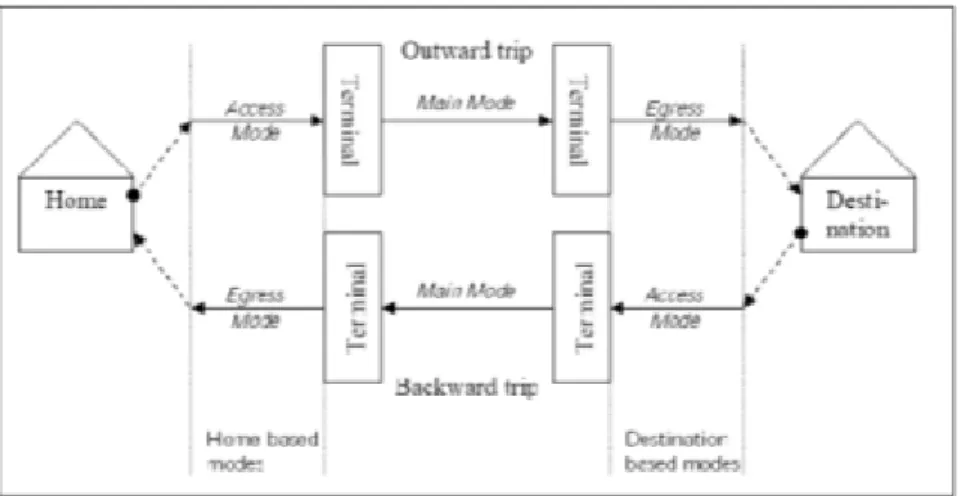
The concept under focus is the rationale that it is possible to gain a better market share in long-distance passenger transport modes (eg rail, bus or air transport) than if only the "long-distance" part of the travel would be considered by travelers for their modal choice. However, even if these services represent a small part of the mobility chain, they provide an improved fluidity throughout the door-to-door journey and, as such, have a significant impact on the public's perception of transport's attention to needs. theirs and expectations. the costs and difficulties of the local component of long-distance transport.
Structure of the Handbook
The last chapter, chapter 5, describes the general conclusions and provides important insights about developing business models in practice. The reader is also provided with real-world examples from the eleven case studies developed in the HERMES project.

2 Analytical framework for business models on intermodality
Components and working mechanisms of an intermodal transport service
- Theoretical Foundation
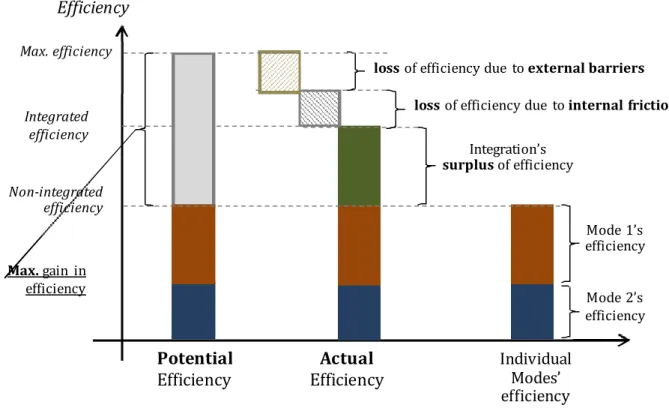
The choice of the characteristics of the transport service's profile is determined by the passengers' mobility requirements. Along each dimension, friction can occur and lead to losses in the efficiency of the transport service.
Barriers impacting the integration process and the stakeholders
- Barriers impacting the integration
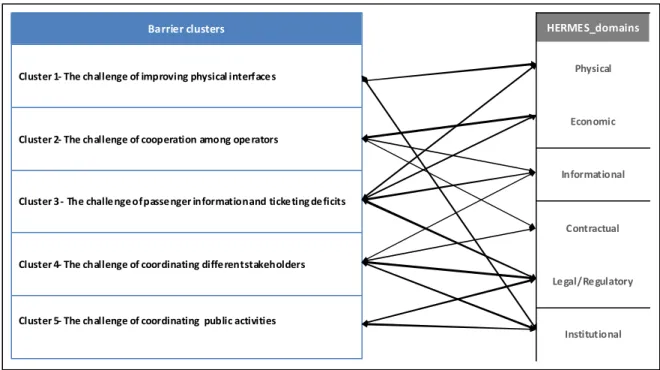
The challenge of improving physical interfaces, with reference to barriers, related to physical elements of the intermodal transport chain. The challenge of cooperation between operators, which represents barriers, related to the cooperation and coordination between operators.

The integration of public planning at different administrative levels and the homogenization of regulations are central aspects of this cluster. Fluhrer, Szimba and Siegele (2011) further analyzed the identified clusters of intermodality and barriers to interconnectivity with respect to HERMES stakeholders (carriers, terminal operators, public decision-makers and user associations).
Cluster 2 covers issues of cooperation between transport operators and is therefore related to the contractual domain. Economic and informational aspects
- Barriers impacting the stakeholders .1 Stakeholders in the Transport Sector
Planning times in the political process (eg for an airport extension) are very long. Development of a legal body which will be responsible for the intermodal chain (all intermodal agents should participate in it).
3 Business Models for Improved Intermodality
Location of the Barriers
Faro International Airport Lack of connectivity between air and ground transport services. In terms of logical barriers, examples include lack of or unclear information for passengers about transport services (routes, frequencies, fares or timetables) or terminal layout (location of piers or ticket machines).

Prototypes of Business Models
Finally, in terms of institutional barriers, a typical one was related to the inadequate management structure of the crossing point. Rent, lease and sale of facilities - Fees with parking and similar - In connection with the operation of the terminal.
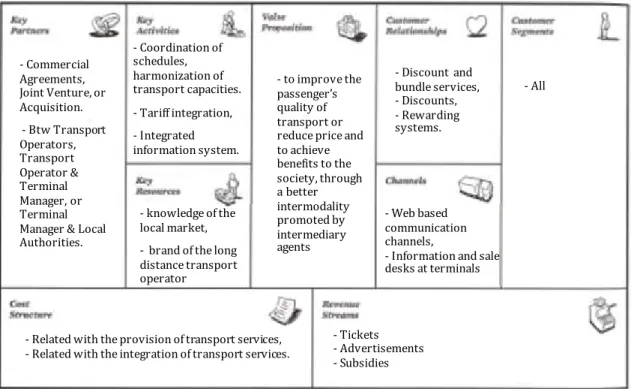
Building Blocks
- Value Proposition (VP) .1 Definition
- Customer Segments (CS) .1 Definition
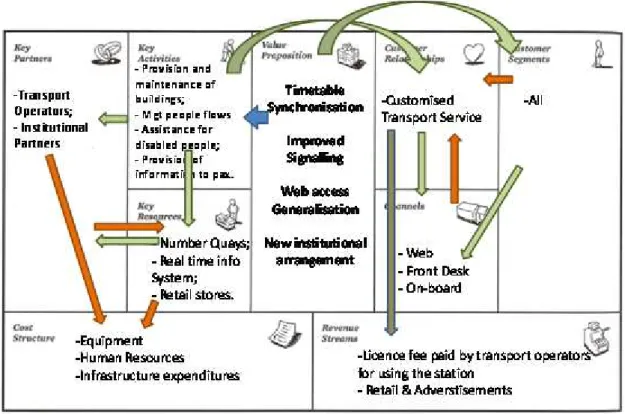
The value proposition emphasizes the need to take a holistic approach to the implementation process of transferring passengers between modes of transport. Of course, depending on the specific nature of the case, changes to the business model may be required.
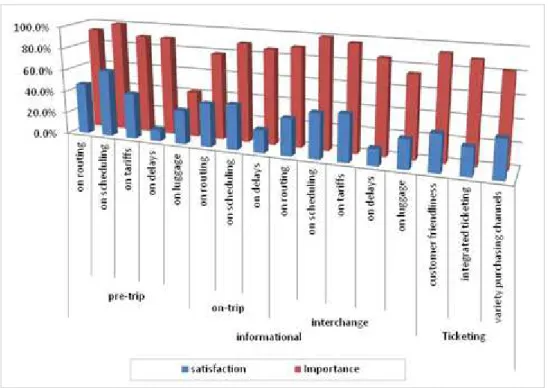
Factors influencing your trip election (%) Train travellers
Factors influencing your trip election (%) Bus travellers
There is usually one factor that appears to be by far the most important (with the exception of Gothenburg, probably due to the fact that 30% of respondents were not train users). Note that most of these passengers do not mention Ticket prices as an important factor.
Factors influencing your trip election (%) Airplane travellers
Multiple channels are used by transport providers and other stakeholders in transport services to communicate with customers. In many case studies, we note that all channels are proprietary and carrier-based.
The prototypes of business models differ in terms of the nature of the customer relationships. Prototype of Gap 1 deals with transport operators, while Prototype of Gap 2 deals with the terminal manager.
Carriers fuel the terminal's revenue streams as they pay for the use of the interchange, as shown in the Long Distance Bus Service (CS4) and Avenida de America (CS3) case studies, for example. In the Prototype of Gap 1, the main revenue streams are related to the provision of transportation services.
The first capability is related to the knowledge of the local market by the short distance transport operator. Most of these resources are already available at the site (eg offices, marketing managers).
Like the previous building block, the activities are a function of the stakeholder's positioning in the transport chain for each case study. In this case, most of the activities must be carried out by the terminal manager, although some are under the responsibility of the transport operators.
The latter case occurs when, for some reason, it is better to conclude an agreement between the carrier and the terminal operator. In this case, the partnership between carriers is established indirectly through the terminal operator.
In all case studies it can be seen that the cost structure is specific to each stakeholder. The cost structure refers to the various costs incurred in providing the service.
Conclusions
In the case of situation with gaps on the links, no significant changes for Cost Structure are expected compared to the current situation. The Key Partnerships and the Key Resources represent costs and therefore contribute to the Cost Structure of the company.
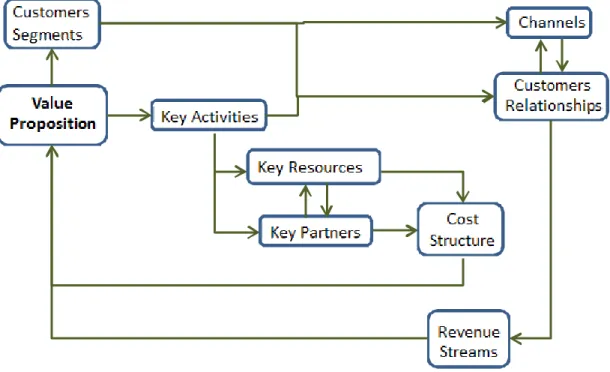
4 Deployment of Prototypes of Business Models
- Mobilize
- Understand
- Design
- Implement
- Manage
As explained, the business model must contribute to the achievement of the company's strategy and long-term vision. Designing a business model in a practical sense involves the definition of nine dimensions.

5 Conclusions on Intermodal Transport and Interconnectivity
Introduce a central (external) institutional body to coordinate and promote all agents of the system in the planning and management of transport nodes. This may indicate an agreement of the barriers that cause problems in the links and therefore the probable existence of a solution to overcome them.

6 Bibliography
Barriers to Interconnectivity and Intermodality of Passenger Transport from an Air Terminal Manager's Point of View, Presentation given at the HERMES Seminar. Barriers to Interconnectivity and Intermodality of Passenger Transport from a Policy Maker's Point of View, Presentation given at the HERMES Seminar.
7 Annex I –Segmenting passengers
They know how to locate themselves well geographically, because they create a mental image of the space in which they move (visualization). Special needs - Bulletin boards with easy-to-read messages due to the size of the inscriptions and the tables themselves.
8 Annex II – Case Studies Fact Sheets
HERMES Case Studies
The case studies were selected to provide an accurate and reliable picture of the current state of intermodality and interconnection in the European Union. The case studies cover well the realities of the Central and Western European Union, as well as the Northern and Southern Member States.
Long Distance Connection
We can summarize them in the following categories: physical barriers, logical barriers, economic barriers, contractual barriers, institutional barriers and legal and regulatory barriers.
Rail
Road
Metro &
Tram
Case Study 1 - Gothenburg Central Station .1 Brief characterisation of the Case Study
- Current Business Model
- Current Level of Quality and Missing Links
- Changes for improved Interconnectivity
Gothenburg Central Station has many transport services as well as other functions and a good overall passenger access. According to the customer survey and interviews with stakeholders, the current level of quality at Gothenburg Central Station is very high.

Case Study 2 - Arlanda International Airport .1 Brief characterisation of the Case
- Current Business Model
- Current Level of Quality and Missing Links
The current quality level at Arlanda Airport is (according to customer research) very high. The aim is to enable passengers and employees to use bus and train transportation to and from Arlanda Airport.

Case Study 3 - Avenida de America Interchange Madrid .1 Brief characterisation of the Case Study
- Current Business Model
- Current Level of Quality and Missing Links
- Changes for improved Interconnectivity
Decision makers are not well aware of the specific problems of the Exchange, and the Terminal Manager - which is very close to the users. We propose an expansion of the geographical coverage: if the operators are to increase the long-distance offer, more passengers should use the interchange.

Case Study 4 - Long distance bus services connected with high speed rail services, the case of Lerida and Zaragoza
- Brief characterisation of the Case Study
- Current Business Model Zaragoza
- Current Level of Quality and Missing Links
- Changes for improved Interconnectivity
There should be Joint parking management according to the interchange needs (space for bus parking or drop-off parking). Local transport authorities should be more involved in terminal manager and decision makers (both appointed by Adif) activities.

Case Study 5 – Extension of the Adriatic-Ionian corridor from Peloponnese to Crete
- Brief characterisation of the Case Study
- Current Business Model
- Current Level of Quality and Missing Links
- Changes for improved Interconnectivity
As a result of this "missing link", the majority of passengers use the port of Piraeus, causing significant travel deviations. The main focus of the proposed model is on the current "missing link", i.e. the inland stretch between Patras and South Peloponnese, to be integrated into the network.

Case Study 6 - Gare do Oriente Interchange, Lisbon .1 Brief characterisation of the Case Study
- Current Business Model
- Current Level of Quality and Missing Links The main problems identified along the north rail line are
- Changes for improved Interconnectivity
Poor connections to small towns from train stations in the greater Lisbon area (most connections are only available from Gare do Oriente station). The current value proposition is characterized by a good rail service on the Linha do Norte rail link with good integration into bus services from Lisbon Oriente to small towns.

Case Study 7 - Faro International Airport
- Brief characterisation of the Case Study
- Current Business Model
- Current Level of Quality and Missing Links
- Changes for improved Interconnectivity
In this sense, we can say that intermodal transport is not included in the current value proposition of the airport. By seamless we mean no (or short) waiting time at the airport and direct transport to the final destination.

Case Study 8 – Antwerp Airport
- Brief characterisation of the Case Study
- Current Business Model
- Current Level of Quality and Missing Links
- Changes for improved Interconnectivity
The airport management and the carrier CityJet work together to provide an air transport connection. For example, the bus and taxi companies commit themselves to improving their services and in return the airport management promotes public transport.

Case Study 9 – The Port of Patras
- Brief characterisation of the Case Study
- Current Business Model
- Current Level of Quality and Missing Links
- Changes for improved Interconnectivity
The description of the current Business Model of the Port of Patra is presented in the table below. The quality of port services as an exchange node in the entire intermodal passenger transport chain.

Case Study 10 – Intermodal Network of Lyon Metropolitan Area (REAL Project)
- Brief characterisation of the Case Study
- Current Business Model
- Current Level of Quality and Missing Links
Visual signs and/or staff must be used to inform the user of the Part-Dieu station. In fact, most short- and long-distance trains serve both the Part-Dieu station and the Perrache station.

Case Study 11 – Regional Airport Frankfurt-Hahn .1 Brief characterisation of the Case Study
- Current Business Model
- Current Level of Quality and Missing Links
- Changes for improved Interconnectivity
The current level of quality at Hahn Airport and especially the customers' satisfaction with space, directions, added values, friendliness of staff, waiting times, direct services, etc. 95 Mio Euro is needed for the connection of Hahn Airport to the German rail network.