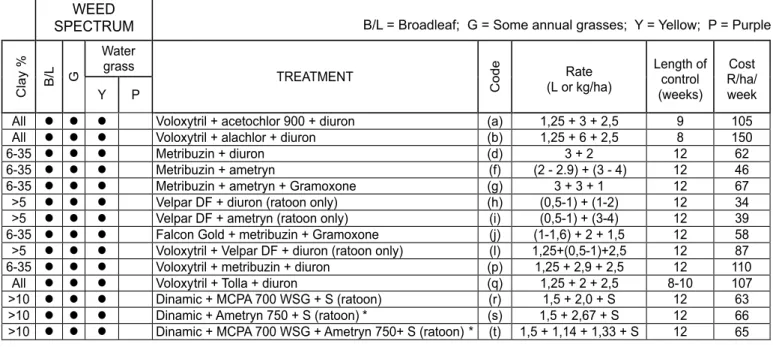
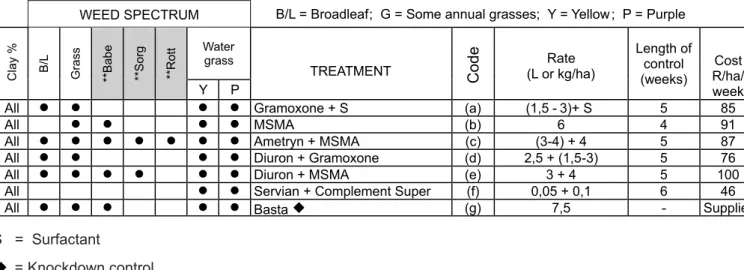
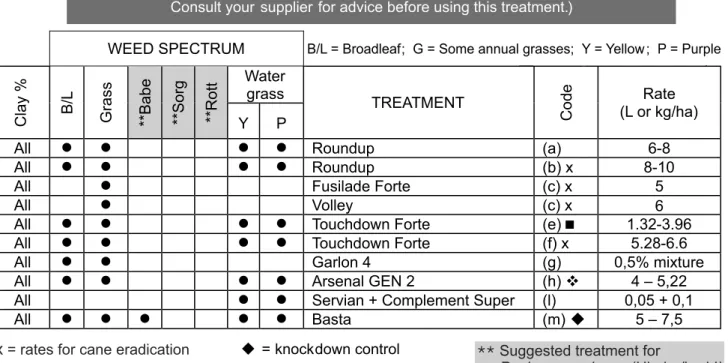
NOTE: Refer to pages 17-19 for a list of registered trade names of generic herbicides and their active ingredients. Caution: Read the label of all ingredients in tank mixes to match the registered generics. When using generics in tank mixes, the preferred recommendation is to refer to the 'L' Registration Number on any label of products registered to be mixed, and read the information under the heading 'Compatibility (Mixing and Application)'.
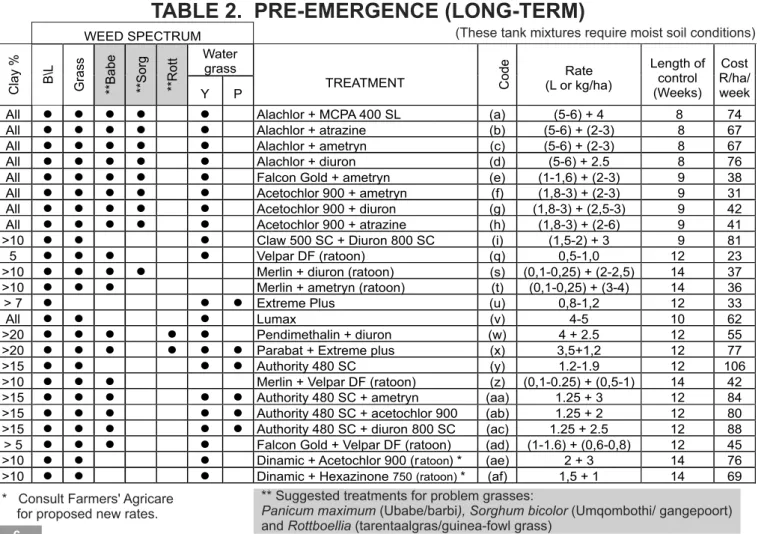
Timing The terms pre-, early-post, post and late post-emergence refer to the growth stage of the weed. PRE-TO EARLY POST-EMERGENCY (LONG TERM). These chemicals are more effective when applied to moist soil). Suggested treatments for problem grasses: Panicum maximum (Ubabe/barbi), Sorghum bicolor (Umqombothi/gangepoort) and Rottboellia (tarental grass/guinea fowl grass). These chemicals are more effective when applied to moist soil) WEED SPECTRUM.
Suggested treatments for problem grasses: Panicum maximum (Ubabe/barbi), Sorghum bicolor (Umqombothi/gangepoort) and Rottboellia (pigeon grass/pigeon grass). These chemicals are more effective when applied to a moist soil). Suggested treatments for problem grasses: Panicum maximum (Ubabe/barbi), Sorghum bicolor (Umqombothi/gangepoort) and Rottboellia (pigeon grass/pigeon grass).

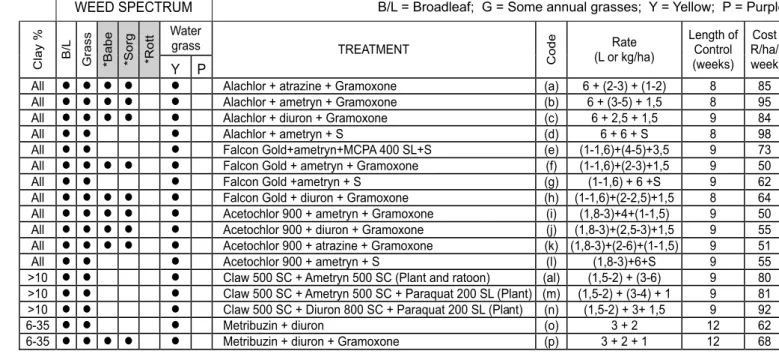
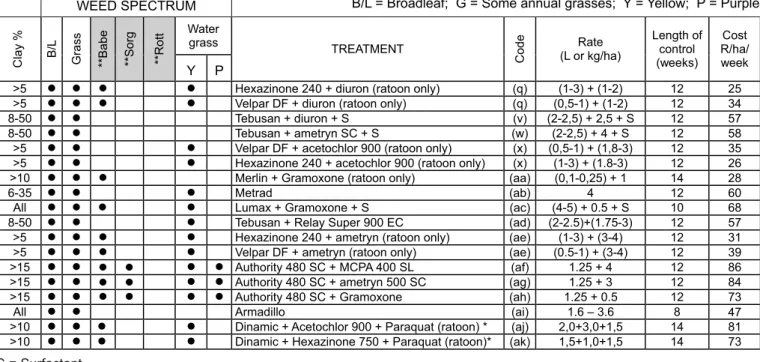
SUGGESTED CONTROL OF OTHER PROBLEM WEEDS IN SUGARCANE
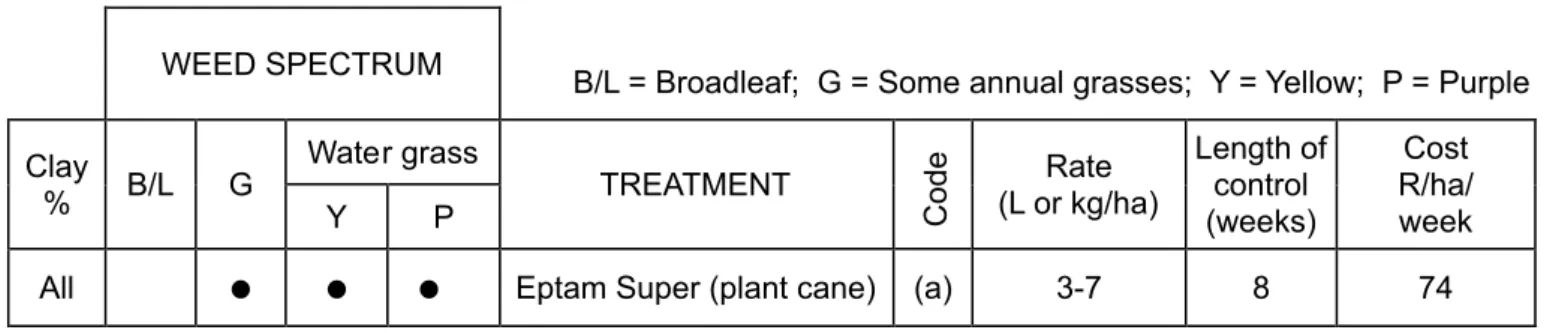
SUGGESTED CONTROL OF PROBLEM CREEPING GRASSES IN SUGARCANE
ACTIVE INGREDIENT PRICE LIST
List of herbicide trade names and their active ingredients
CHEMICAL INFORMATION
Some practical tips for mixing order (rule of thumb)
ACETOCHLOR
Apply as a full coverage spray before weed emergence and after cane cutting, up to the 2-leaf stage of cane. Occurrence up to the 2-leaf stage when applied to sugarcane has hardly any effect on sugarcane.
ACETOCHLOR + AMETRYN
ALACHLOR
AMETRYN
AMICARBAZONE
ATRAZINE
DIURON
EPTC
FLUAZIFOP-BUTYL
GLUFOSINATE AMMONIUM
GLYPHOSATE
HALOSULFURON
HEXAZINONE
HEXAZINONE + DIURON
FORMULATION TRADE NAMES FORMULATION TRADE NAMES 100 g a.i./litre (EC) : Hacker, Hatchet 240 g a.i./litre (EC) : Arsenal GEN 2 Weed control : 240 g a.i./litre Sugarcane and other grasses - non-selective. 100 g a.i./litre Control of alien plants (see SASRI information sheets 10.3 and 10.7) Variable control : Some grasses and broadleaf weeds unless in registered tank mixes. Ratoon cane and spot spray: Arsenal GEN 2 is NOT registered for application in fields with growing cane.®.
Eradication of sweat fields and cane droppings: Arsenal GEN 2 is recommended for control of creeping grass and cane droppings. Prevention of soil erosion: Where required, put in place measures to prevent soil erosion where imazapyr or glyphosate is sprayed.
IMAZAPYR
REFORMULATION TRADE NAME 200 + 200 g/litre (EC) : Voloxytril Weeds controlled : Broadleaf weeds Expected period of control : 4 to 6 weeks Absorption site : Foliage only Application time : Post-emergence adsorption and leaching.
IOXYNIL + BROMOXYNIL
ISOXAFLUTOLE
MCPA
MESOTRIONE + S-METOLACHLOR + TERBUTHYLAZINE
METAZACHLOR
METOLACHLOR
METOLACHLOR
Absorption site : Mainly through sprouting grass shoots and weed roots Application time : Pardalja. Climatic requirements: For best results, 10-15 mm of rain is required within 7-10 days after application to get the chemical into the soil. For pre-emergence control of waterweed, the chemical must be in the soil before the tubers begin to sprout.
Falcon Gold primarily controls emergent grasses, and the addition of ametryn improves control of broadleaf weeds. Use higher rates where Panicum maximum is a problem and/or for improved control of yellowwater grass. Pre- to early post-emergence herbicides such as ametryn + paraquat can be added (as indicated in Table 4 on page 8 and 9) to kill all emergent weeds.
The registered level of s-metolachlor is 35% lower than the registered level of metolachlor (based on the active substance). Post-emergence application of Falcon Gold mixed with other herbicides (especially paraquat) can cause leaf blight and stunted growth if the cane has more than 2-3 leaves per shoot.
METRIBUZIN
METRIBUZIN + CHLORIMURON-ETHYL
METRIBUZIN + DIURON
MSMA (MONOSODIUM METHANEARSENATE)
PARAQUAT
CAUTION
Highly toxic to humans
PARAQUAT + DIURON
PENDIMETHALIN
Weed control : Annual grasses and broadleaf weeds Variable control : Suppressed yellow water grass Expected control period : 8 weeks. Time of application : Pre-early post-emergence at the stage of 2-4 leaves Adsorption and leaching : Adsorbed by clay and organic matter. Persistent wet, rainy conditions following post-emergence application may reduce product efficacy.
SULCOTRIONE + ATRAZINE
SULFENTRAZONE
TEBUTHIURON
TRICLOPYR
ADDITIONAL WEED CONTROL INFORMATION
PREVENTIVE WEED CONTROL IN SUGARCANE
Where there is Cynodon dactylon in the field, the patches are marked with flags for quick and precise spot spraying each growing season. Mechanical operations such as harrowing will spread creeping grass runners, and muddy tractor tires will spread seeds. Avoid hand weeding grass edges and throwing the grass onto the field, as this spreads weeds.
Do not spread bead manure on your cane fields if your cattle have grazed on Cynodon, Digitaria and Paspalum species. A crop residue (trash) blanket spread evenly over the field suppresses weeds by preventing their germination. Keep field edges/edges, fences, roads, waterways and irrigation canals free of weeds to prevent the spread of weed seeds (eg Panicum maximum), runners (eg Cynodon dactylon) and tubers (eg Cyperus rotundus) to fields.
Plant a row of reeds along the edge of the field to prevent Cynodon suckers from drifting into the field.
HERBICIDE RESISTANCE
Herbicides with the C1, C2, C3 mode of action inhibit photosynthesis (the conversion of light into chemical energy). Herbicides with the Din mode of action inhibit the transfer of chemical energy to sugar. Herbicides with the mode of action B, G, A, H, N, K3 inhibit the synthesis of proteins or fats and thus growth and development. Herbicides with an O or K1 mode of action inhibit cell division and development through other pathways.

Guidelines to prevent or delay herbicide resistance
Risk of herbicides to human health and the environment
HERBICIDE TOXICITY
Remember that all herbicides are toxic, even Class 4, and should be used according to label precautions. Every grower should be familiar with the herbicides used and agents for accidental ingestion by operators. Water bodies - the label indicates the restriction of herbicide use within a certain distance from dams, rivers, wells.
Avoid roots - the label states that the herbicide should be used outside the root zones of neighboring plants. Animal toxicity is based on LD50 or LC50 values = the concentration of herbicide in the air, water or food that will kill 50% of the test animals. DEFINITIONS OF RISK TO HUMAN HEALTH (LABEL TAPE COLOR) AND SCORES FOR ENVIRONMENTAL RISK (OUTPOTENTIAL AND EFFECT ON ANIMALS).
Ways to minimise leaching of herbicides into groundwater
Management of creeping grasses
- Be consistent in your control efforts: Aim to reduce the extent (area covered) by the infestations
- Field verges/edges
- Cynodon in rows
- Long fallow and minimum tillage: The best opportunity to control creeping grasses is in fallow fields or when old sugarcane stools are to be eradicated prior to replanting. Glyphosate and Arsenal GEN 2 are registered to kill cane
- Application rates: Consider increasing the application rate of glyphosate to 8 L/ha for Cynodon dactylon and 10 L/ha for other creeping grasses, as the registered rates sometimes been inconsistent in the field under
It should be applied as a directed inter-row spray in small cane, knockdown control of Cynodon for 3-5 weeks. This will moderately to severely affect the cane, depending on the height of the cane, but will suppress the creeping grasses sufficiently to allow the cane to grow. Glyphosate is highly toxic to cane and is therefore only used as a canopy spray where the cane is tall with dead leaves on the lower parts of the stems.
However, the control is only temporary, as the runner from the bay is long with dead leaves on the lower parts of the stem. However, the control is only temporary, as runners from the surviving grass in the rows will spread back into the rows. Prevent entry into fields from cane edges and breaks by chemical mowing with 8-10L/ha glyphosate 360, 5L/ha Fusilade Forte Hitech or 5.22L/ha Arsenal GEN 2 near tall cane.
DO NOT use only one active ingredient as this may increase the risk of herbicide resistance. Keep border control records and ROTATE herbicides to avoid and reduce the risk of resistance to any mode of action. Integrate other control methods into the border weed program, e.g. mechanical mowing, using Melinis as a hedge to push out cynodon, or planting a cane line along the field edge to prevent drift and intrusion of runners into the field.
The best opportunity to control creeping grasses is in fallow fields or when old cane stands must be eradicated before replanting. Glyphosate and Arsenal GEN 2 are registered to kill cane stools, must be eradicated before replanting. Glyphosate and Arsenal GEN 2 are registered to kill cane and will control the grass at the same time.
Avoid fields heavily infested with Cynodon dactylon as this buries some runners very deeply, with delayed emergence allowing escape of non-residual agrochemicals such as glyphosate. Refer to page 68 for more information on applying Arsenal GEN 2. 6) Water Quality: Treat spray water if it is of poor quality. Test the water and talk to your local distributor about registered adjuvants available to overcome any salt antagonism.
Two new herbicides for creeping grass control
Water quality and herbicide performance
Check labels for water quality usage restrictions and the correct order of mixing chemicals in the sprayer tank to avoid incompatibilities. Sensitive herbicides will bind to soil and organic matter particles suspended in water and will not be available for uptake in weed foliage. Dirt can also clog nozzles, lines and filters and reduce sprayer life and overall performance.
Dust raised during the spraying operation can also result in reduced control, especially directly behind the sprayer. These herbicides will bind to the soil and organic matter particles suspended in the water and will not be available for absorption into the weed leaves. a) In general, the pH of the spray water should be slightly acidic (pH 4.5 to 6.0) for most herbicides, with exceptions such as sulfonylureas (eg Servian, Extreme Plus, Parabat Extra) and MCPA . MCPA at low pH is insoluble and may result in physical incompatibility in the spray tank.
Sulfonylureas are "less soluble" and often less effective at low pH. e) Most herbicides are sensitive to strongly alkaline spray water (pH 9 to 14). Post-emergence application is effective as long as spray water from sensitive herbicides is treated according to label directions. Post-emergence application is effective as long as the spray water is acidified according to label directions.
Negatively charged salts (anions) such as carbonates, bicarbonates, chlorides and sulfates are not normally antagonistic, but are also found in the water containing the above cations. Cations can cause some chemicals to precipitate, affect the balance of the surfactant system, affect properties such as wetting and dispersion, and render sensitive herbicides inactive by limiting their absorption by weed foliage. Other products state that NO excipients must be added, e.g. Fusilade Forte Hitech, Merlin, Terbo and certain glyphosate formulations.
Practical Solutions if Water Quality is a Concern
CALIBRATION OF A KNAPSACK SPRAYER
NOTES