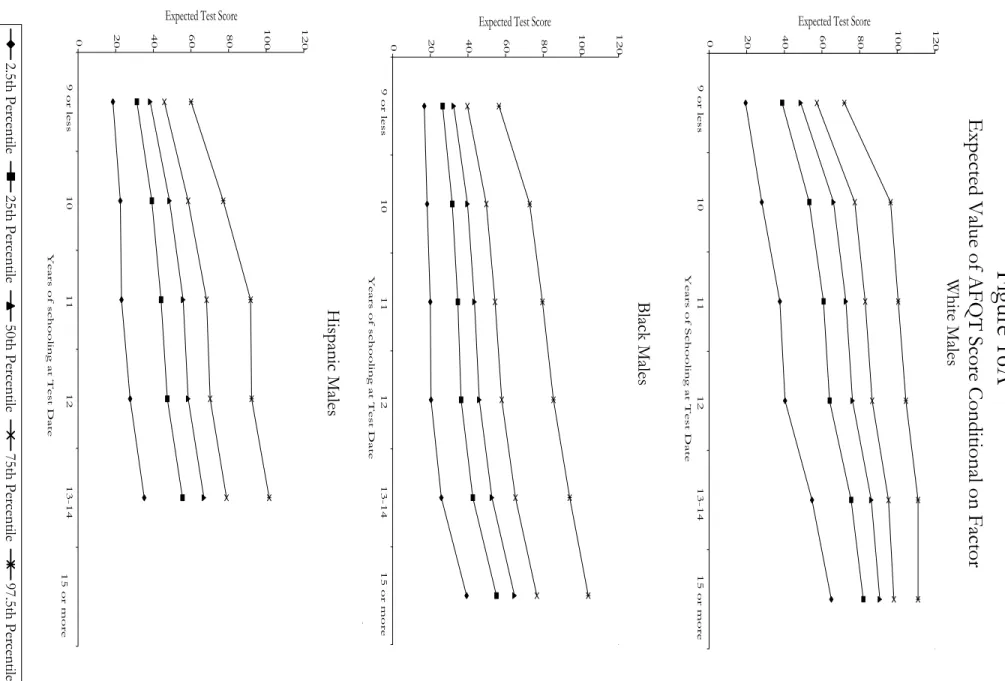
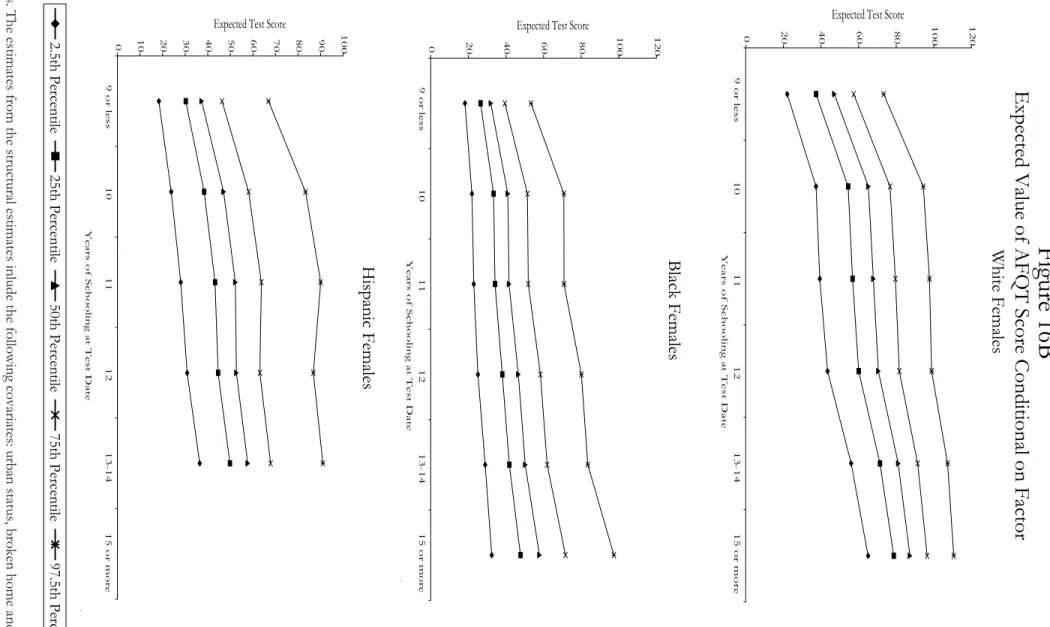
For simplicity, assume that there are two stages in the child's life cycle before reaching adulthood. The skills and capabilities acquired in one stage of the lifecycle impact the productivity of learning in the next stage.
Family Income and Enrollment in College
Many of the variables used to control for long-term family factors also predict family income in the teenage years. We discuss other studies on the timing of household income in Section 5.3.
Borrowing Constraints As Determinants of Family Investment In Chil- dren
The obvious test for the second borrowing restriction examines whether the timing of family income matters for children's performance and school attendance. They conclude that the timing of parental income within the child's life cycle is
High Rate of Return to Schooling Compared to the Return on Physical Capital
Are Rates of Return to Investment Higher for Persons From Low-Income Families?
This is clearly reflected in the higher returns for the best in vocational training and in the military AFQT studies, which we summarize below. This reversal in the pattern of returns on investment in disadvantaged individuals is a result of the skills-building technology we formalize in Part III of this article.
The Role of Ability in Returns to Schooling and in Choice of Post-School Investment
Those in the bottom 5% of the skill distribution get half the return in college of those in the top 5% of the skill distribution. We then move on to an analysis of the evidence on the effectiveness of specific policies in replenishing the environment of disadvantaged children.
Early Interventions
It is persistent over time.55 The Abecedarian program intervenes in the very early years, and IQ is known to be malleable when children are very young (see, e.g., discussion in Armor, 2003). Future Generation (FG) Earnings represents the improvement in earnings of descendants of program participants.
Intervention in the Adolescent Years
Students randomly selected to participate in the program were assigned a mentor at the beginning of ninth grade. All participants were kept in the program for four years, regardless of whether they stayed in school. As many participants were enrolled in post-secondary education at the time of the follow-up survey, it is difficult to determine the program's effect on earnings.
See Taggart, 1995 for a more detailed description of the program and an evaluation of its effects). The recent evaluation of QOP by MaxÞeld et al. 2003) found that the program did not improve grades or achievement test scores and that the effect on risky behavior was equivocal. LEAP showed increases in high school graduation or GED among randomly assigned participants who were still enrolled in school when they entered the program.
Both of these programs show positive post-program effects on earnings and employment for students who were still in school when they entered the program. However, the estimated effects were often negative for participants who had dropped out before entering the program. Although the program did not reduce national attrition rates, it did appear to delay attrition (dropout rates were lower for program participants during ninth grade but not by the end of twelfth grade).
The Effectiveness of Late Adolescent and Young Adult Remediation Programs
We then present a more formal model of skill-building technology that is a starting point for theoretical unification of a scattered literature on the effects of the treatment it presents. We ignore how parents become who they are and the decisions children make about their children. We develop a more generally consistent model in Section 8, after developing the basic framework of skill formation technology.
Another case that rationalizes the evidence is when α→ −∞ and σ = 1. 8) The available stock of cognitive skills in period 2. This phenomenon does not occur in the creation of a non-cognitive skill, provided that (1−φ1− φ2)>0. In general, the higher σ and the larger (1−φ1−φ2), the more productive the investment of I2N in the production of S2N. 75 We can show that for sufficiently low values of φ, marginal productivity no longer increases in φ.
For −∞< φ <1, the first-order conditions are necessary and sufficient with respect to the concavity of the technology with respect to I1 and I2. In the special case γ = 1+r2+r, the investment in both periods will be the same regardless of the value assumed by φ. As the degree of CES complementarity decreases, the role of the skill multiplier increases, and the higher the multiplier, the more investment needs to be concentrated at an early age.
Generational Structure and the Human Capital Production Function
It would be more efficient to give the child a mortgage that earns interest rather than investing in human capital to put the child at a certain level of income. We previously discussed the concepts of critical and sensitive periods in terms of the technical possibilities of remediation. From an economic point of view, critical and sensitive periods must be determined in terms of the costs and returns of remediation, and not only in terms of technical possibilities.
We will then integrate the technology developed in this section into a market environment where choices and credit constraints can be clearly expressed. In this section, we embed the technology (13) developed in the previous section into simple dynamic economies. These simple economies serve as starting points for discussing two conceptually different market failures: credit constraints in a deterministic economy and an imperfect market economy with labor market uncertainty, as analyzed by Cunha (2004), Cunha and Heckman (2004). and the later work of Caucutt and Lochner (2004).
In the third period of its life, the agent is a young adult (and has a child of its own). At the end of the old adult period, the agent dies and is replaced by the generation of its grandchild.
Formalizing the Problem of the Agent
Similarly, we have that the support ofη is given by the interval[ηmin, ηmax], withηmin>0. The distribution of η is given byFη. The fact that parents cannot extract resources from offspring has consequences for the proÞle of investments in human capital of the child. Consequently, gaps in skill formation emerge even in the early ages of child development, a fact consistent with the evidence presented in Part II and throughout the literature (see, e.g., the essays in Duncan and Brooks-Gunn, 1997). .
Cunha (2004) shows that for Cunha and Heckman's (2004) parameter values, a tuition subsidy causes parents to increase the amount of early investment in the child's human capital. This evidence is consistent with the strong complementarity of investments over the child's life cycle. An Equilibrium Theory of Income Distribution and Intergenerational Mobility,” Journal of Political Economy.
Early childhood intervention programs: What about the family?” in Samuel Meisels and Jack Shonkoff, eds., The Handbook of Early Childhood Interventions, New York: Cambridge University Press, pp. Empirical Estimates of the Returns to Schooling,” appears in Finis Welch and Eric Hanushek, eds., The Handbook of Education Economics, Amsterdam: Noord-Holland. Who cares about the children?: Preschool, daycare, and afterschool care,” in Finis Welch and Eric Hanushek, eds., The Handbook of Education Economics, forthcoming from Elsevier.
Home Visiting: Recent Program Evaluations - Analysis and Recommendations,” The Future of Children Gormley, William, Ted Gayer, Deborah Phillips, and Brittany Dawson. Evaluating the benefits and costs of the work unit,” Journal of Policy Analysis and Management.
LJXUH2A
YHUDJHSHUFHQWLOHUDQNRQ3,$7 0DWKVFRUHE\LQFRPHTXDUWLOH
LJXUH2B
YHUDJHSHUFHQWLOHUDQNRQ3,$7 0DWKVFRUHE\UDFH
LJXUH3A
GMXVWHGDYHUDJH3,$7 0DWKVFRUHSHUFHQWLOHVE\LQFRPHTXDUWLOH
LJXUH3B
GMXVWHGDYHUDJH3,$7 0athVFRUHSHUFHQWLOHE\UDFH
LJXUH4A
LJXUH4B
LJXUH5A
LJXUH5B
College Participation, 18 to 24 Yrs, HS Grads and GED Holders
White Males
Dependent* White Males
Dependent +LJK6FKRRO*UDGXDWHVDQG*('+ROGHUV 0DOHV$JHV
The coefficients for the regression are given in Appendix Table B-3 of Carneiro and Heckman (2003). The family background AFQT index is based on a linear combination of south, broken home, city, mother's education, father's education, and AFQT. See Table B-4 in the Appendix for the coefficients for the linear combination of the variables forming this index (Carneiro and Heckman, 2003).
Company training consists of formal employer-led training and military training excluding basic training. Specification (1) includes a constant, age, father's education, mother's education, number of siblings, southern residence at age 14, urban residence dummy at age 14, and year dummies. Return to one year of college for individuals in different percentiles of the distribution of math test scores.
There are no dropouts in the sample and the educational variable is binary (high school - university). First, we calculate the marginal treatment effect using the method of local instrumental variables as in Carneiro, Heckman, and Vytlacil (2001). Therefore, in the second step, we calculate the appropriate weight for each parameter and use this to construct a weighted average of the marginal treatment effect (see also Carneiro,2002).

YHUDJH3HUFHQWLOH6FRUH
0RWKHU·V$)47'HFLOH
LJXUH12C
LJXUH 13
FDGHPLFDQG6RFLDO%HQHILWVDW6FKRRO([LW)RU&3&3DUWLFLSDQWV
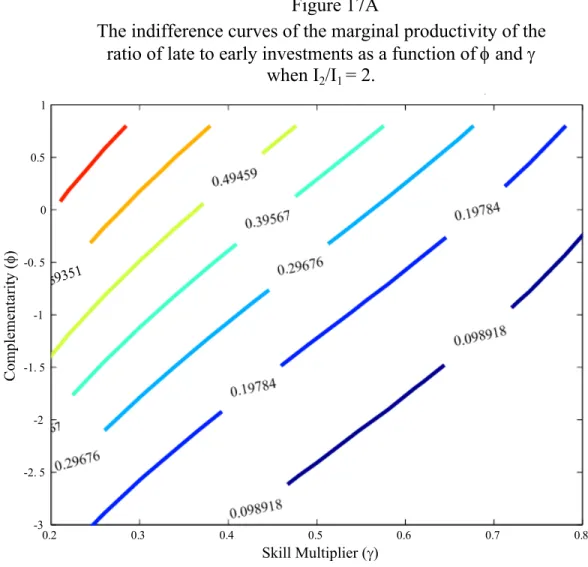
The Harlem study has higher teacher-child outcomes with 21% less repetition of class (Palmer, 1983) twice a week for ages 3-5. parental home visits for rated less aggressive. Marginal productivity indifference curves of the ratio between late and early investment as a function of φ and γ. The marginal product of the ratio of late to early investment, ω, holding early investment constant, is.
Note that for a given value of γ the value of the function tends to decrease as we increase α. 2, as a function of the skill multiplier parameterγ, for different values of the complementarity parameterφ, assuming that the interest rate rises to zero. 2 is the solution to the parent's problem of maximizing the present value of the child's wealth through investments in human capital,h,and transfers of risk-free bonds,b.To do this, parents must decide how to allocate a total of Mdollars in early and late investments in human capital, I1 and I2, respectively, and risk-free bonds.
Letq represents the present value from period “3” of the future prices of one efficiency unit of human capital: q=PT. Qrwh= This table summarizes the behavior of the ratio between optimal early and late investments according to four cases: L4 and L5 have high complementarity, but self-productivity is low; L4 and L5 have both high complementarity and high self-productivity; L4 and L5 have low complementarity and self-productivity; and L4 and L5 have low complementarity but high self-productivity. On the other hand, when L4 and L5 show a low degree of complementarity, self-productivity tends to concentrate investment throughout the period.

Generation Born
Periods