
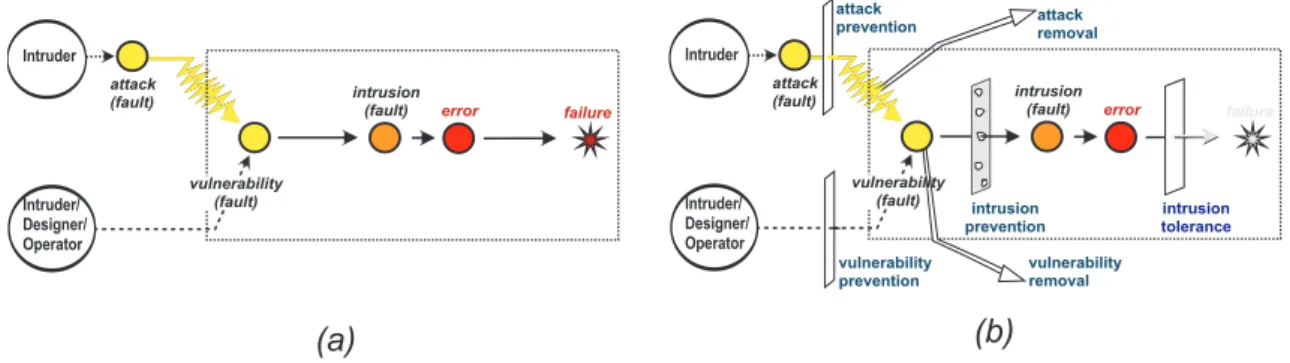
All of the aforementioned techniques predetermine what we call interference prevention, i.e., attempts to avoid the occurrence of interference errors. A key aspect of tamper-tolerant middleware is that it should lead to an automation of the resilience building process.
Middleware design strategies
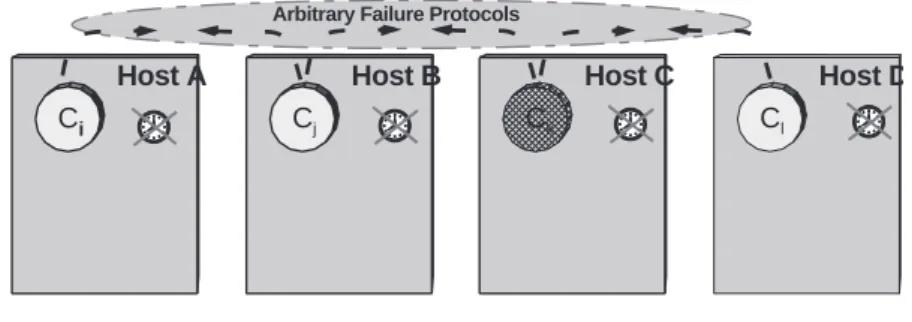
The "failover-controlled with distributed trusted components" strategy reinforces the reliability scope of local component support, making it distributed. Like the "failover-controlled with local trusted components" strategy, the impact of these components' misbehavior can be limited by implementing certain authentications with the local trusted component.
Threshold Cryptography
Quorum Systems
We implement Registerx with one of the simplest f-disseminationquorum systems, which is specific to self-verifying data, i.e. data that a malicious server cannot change unnoticed (e.g. stored values are signed by the client with its private key and the corresponding public key is known to all processes). A possible comparison is to treat f =b(n−1)/3 and quorums as any subset of inU servers of size n+2f+1e.
State Machine Replication
A good example of a primal-based SMR algorithm is BFT, the algorithm that showed that Byzantine fault tolerance can be fast, to paraphrase the name of one of the works around it [21]. A client accepts the response from the service when it receives f +1 copies of the same response from f +1 different servers, because this guarantees that at least one of the servers is correct (at most f can be wrong). First, it assigns an order number to the message and sends this number with a cryptographic hash of the request to all backups (pre-preparation phase).
A client sends a protected request with an authenticator (vector of MACs) to one of the servers. When a server receives the request from the client, it forwards the request to all other servers and provides a cryptographic hash of the request to the wormhole. If it were used to implement a data store, then it would provide atomic registers, i.e. the strongest Lamport semantics.
![Figure 7: Normal operation of BFT [21].](https://thumb-eu.123doks.com/thumbv2/123dok_br/17618648.4194451/21.892.214.682.937.1108/figure-normal-operation-of-bft.webp)
Enforcing Confidentiality
An SMR system can be said to be BQS-based if we remove the “quorums⇒asynchrony” constraint discussed in Section 3.2. Therefore, SMR cannot be implemented deterministically in asynchronous systems, although it can be implemented using randomized protocols [33] (quite effectively, as demonstrated by the RITAS project [95]). It is also important to emphasize that SMR is a generic technique that can be used to make any deterministic service intrusion tolerant.
Detection of corrupted fragments can be done with the help of MACs added to each fragment, or by reading and polling multiple fragments from different servers. The idea is to use a (k,n) erasure code to split the file into n fragments in such a way that it can be reconstructed with k fragments, but not with k−1. When a client wants to read a file, it simply requests any fragments and reconstructs the file using the fingerprints to check if the retrieved fragments have been modified.
Architectures
Moreover, in a real system, the execution part, i.e., the service software (say, DBMSs, web servers), is the major part of the system, while, in comparison, the agreement is probably a easier operation, so it can also be done on more cheap machines. The architecture can also include between the two types of servers an intrusion-tolerant privacy firewall (with (f+1)2 servers) that guarantees that malicious execution servers do not reveal confidential data. It has been used to design several intrusion-tolerant services, such as the SMR service with only 2f +1 servers of Section 3.3.2 and the Worm-IT group communication system [31].
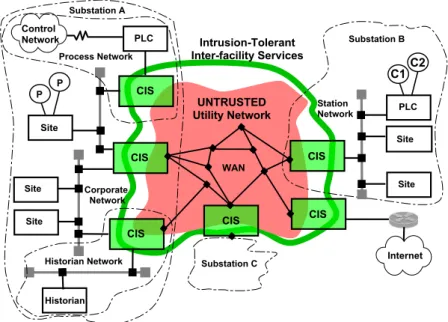
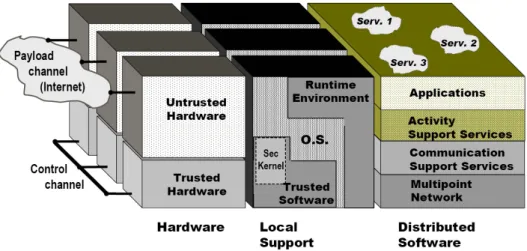
A modular and layered intrusion-tolerant middleware offers the MAFTIA architecture top-end interface for applications that implement the concept of trusted distributed components. The goal was to implement an intrusion-tolerant version of the Joint-Battlespace Infosphere (JBI), a publish-subscribe-query application for military purposes [135, 103]. Intrusion-tolerant systems can be long-lived (eg, banking systems, web transaction servers), and the continued production of attacks can lead to exhaustion of the necessary replicas.
Exhaustion-Safety
A non-exhaustion-safe system has at least one execution with a period or periods of vulnerability to exhaustion failures where resources are exhausted and correctness may be compromised. Therefore, in a fault-tolerant system, nodes are important resources, so important that it is usually assumed that a maximum number f of nodes can fail during its execution, and the system is designed to withstand until failures of joints f. In other words, this condition states that the system is exhausted when more than f nodes fail simultaneously.
Thus, by Definition 4.5, a system whose failed nodes do not recover is secure against node exhaustion if and only if each execution terminates before the time required to generate f+1 node failures. In order to build a system that is secure against node exhaustion and resistant to hacking, we would like to predict the maximum number of errors that will have to occur during any execution, call this Nf ail, so the system is designed to handle f =Nf ail errors. The most important result is the inability to build a node-exhaustion-proof and intrusion-resistant system under the asynchronous model and especially in the presence of a malicious adversary.

Proactive Resilience
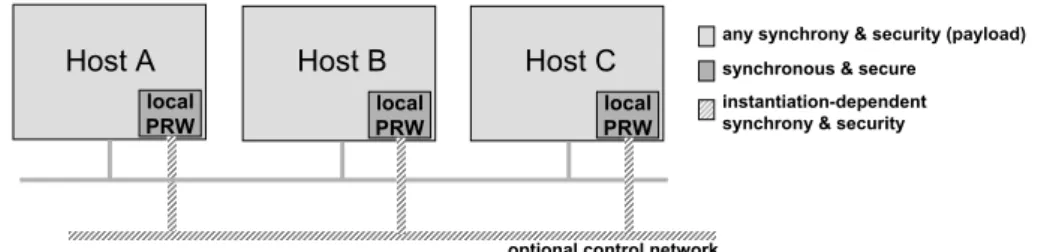
A set of practical problems of existing systems using asynchronous proactive recovery is presented in [132]. For example, if a proactive recovery procedure requires only local information, then the control network is usable. Even when the control network is required, its characteristics will depend on the specific requirements of the proactive recovery procedure.
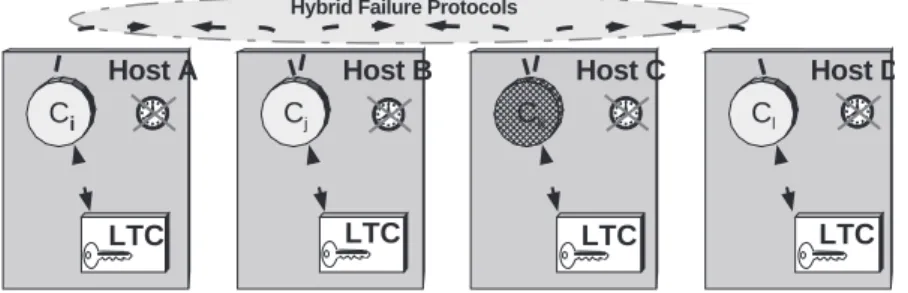
For example, these fail-safe measures can shut down the system if the periodic runtime service fails to meet its specifications. If the maximum execution time of the system is known, then you can choose a sufficiently high f - by equipping the system with enough nodes - so that exhaustion never occurs. A possible approach to solve this problem is to use the Proactive Resilience Model - upgrade the system with a PRW so that the nodes are renewed periodically and in time.
Reactive Recovery
Diversity Management
Application Scenarios
DSMW ={OS Code,SM Code,SM Status}, where OS/SM Code is the operating system/state machine code and SM status is the state machine state. With regard to this algorithm, we assume that the state of both the operating system and the local state machine is stored in volatile Random-Access Memory (RAM). We also assume that the local state machine is started automatically after each operating system boot and that the previous state is loaded from stable storage.
In Algorithm 1, line 1 stops the operating system and consequently stops the execution of the local state machine. In lines 5-6, the state machine code can be verified and recovered using similar methods as we used to verify and recover the operating system code. Alternatively, you can install the operating system and state machine code on read-only media, avoiding the execution of lines 2-5.
Proactive Resilience in numbers
To perform this task, a digest of the operating system code may initially be stored on some read-only memory, and then determining whether it is correct is simply a matter of comparing the digest of the current code with the stored one. Since the state of the local state machine may have been compromised before the rejuvenation, it may be necessary to transfer a clean state from remote replicas. This same work discusses how to implement a recovery strategy that guarantees that:. i) no more than f replicas were ever damaged; and (ii), the execution of the replicated state machine is never interrupted, that is, the replicated state machine is always available.
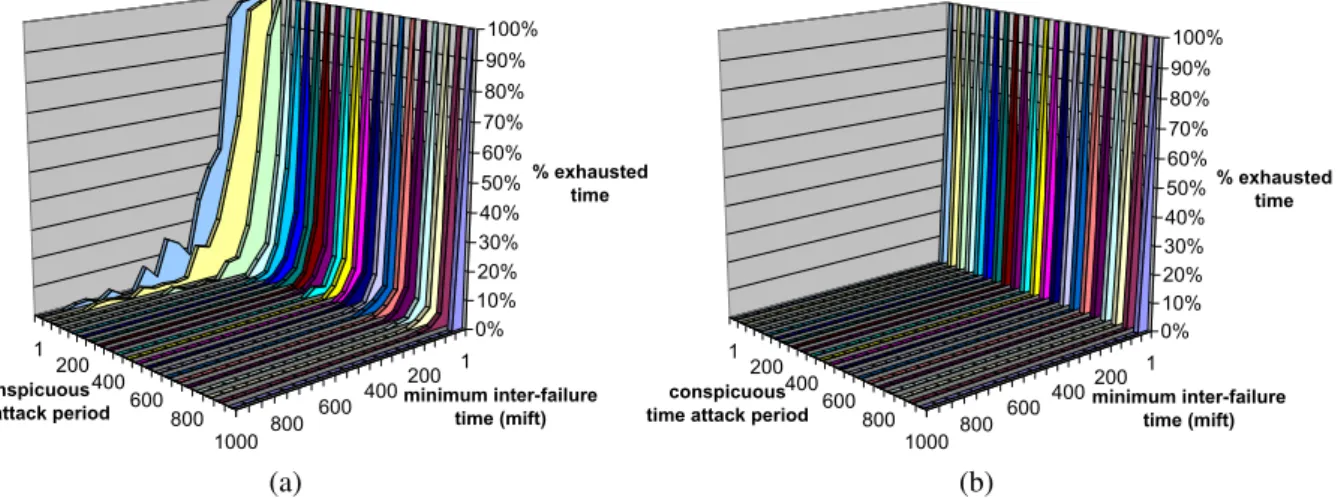
With asynchronous recovery, the percentage of time exhausted depends on how small the apparent time attack period is (Figure 13a), while proactive persistence makes the system immune to apparent time attacks (Figure 13b) and the exhaustion time is only affected by the opponent's speed of penetration. For example, internal timebase attacks hit system time references and thus programmatic detections are unreliable because they use the same time references. Neutralizing this type of attack is one of the key achievements of proactive resilience.
Trusting your assumptions
Intrusion-tolerant system designers need to have representative and realistic information about the threats and vulnerabilities their systems will experience once they are deployed. Otherwise, the implementation of the systems will be flawed because it is based on wrong assumptions (or low coverage assumptions), and as a result they will not perform as expected. It is therefore important to understand how intruders attack a system and how they proceed after an attack, in order to develop reliable and secure systems that can withstand various threats.
Attacker Profile
The analysis of this data allows, for example, a better understanding of the procedures followed after a machine compromise, and the capture of hacker tools. At the end of the 90s and beginning of the new millennium, there was an explosion in the number of projects developing systems (hardware architectures and software) whose sole purpose was to act as honeypots (see [63] for a list of available solutions) . Related to this idea, honeypots have been classified based on the level of interaction they allow [134].
Some of the results related to creating an attacker profile are summarized next. In most cases, these probes seem to select targets in a random manner, without being influenced by the operating system of the machine. An initial statistical modeling of the attack process showed that the time intervals between scans/attacks do not follow a Poisson distribution (which is the traditional assumption for failure production in hardware reliability analysis) [66].
Vulnerability Assessment
Suggested readings
Online resources
There are not many publicly available software packages that can be used to build intrusion-resistant distributed systems. It also contains a set of generic utility packages that provide useful primitives for building intrusion-resistant systems. CODEX has been implemented in C++ and is available at http://www.umiacs.umd.edu/mmarsh/CODEX/.
JITT has been implemented in Java and is available at http://www.navigators.di.fc.ul.pt/software/jitt/. It can be used to build intrusion-resistant systems that use proactive secret sharing. TTCB has been implemented in C/C++ and is available at http://www.navigators.di.fc.ul.pt/software/ttcb/.
Glossary


![Figure 8: Computers with a wormhole [32].](https://thumb-eu.123doks.com/thumbv2/123dok_br/17618648.4194451/23.892.278.622.446.644/figure-computers-with-a-wormhole.webp)
![Figure 10: DPASA/JBI architecture [103].](https://thumb-eu.123doks.com/thumbv2/123dok_br/17618648.4194451/28.892.249.656.113.534/figure-dpasa-jbi-architecture.webp)
