Fernandes, postdoctoral researcher at the Champalimaud Foundation Research Center and associate professor at the NOVA Faculty of Medicine. All the work presented in this dissertation was developed at the Department of Neuropsychiatry at the Champalimaud Research Center, Champalimaud Foundation.
Acknowledgments
Abstract
This preference was independent of the probability of delivering the reward associated with each lever. Results of the development of the two-action task led to key parameters in decision making and RL based on PI stimuli.
Resumo
- The impact of postingestive feedback on food seeking behaviour 4
- Measuring neuronal activity in response to gut signalling 10
- Viral injection, gradient refractive index (GRIN) lens implantation, and
- Dopaminergic neuron classification 27
- Two levers probabilistic instrumental task data processing and analysis 32
- Monitoring neuronal activity during intragastric infusions of different nutrients 39 1. Dopaminergic neurons of the VTA respond differently to different
- Dopaminergic neurons of SNc respond independently of macronutrient 50 4.2. Response of dorsal and lateral striatum to intragastric infusions of different
- Postingestive stimuli modulates food seeking behaviour in an instrumental two-
- Dopaminergic regions respond differently to intragastric infusions of different
- Mice in a probabilistic two-action task press more to obtain intragastric infusions
- Conclusions 80
69 Figure 7.1 Representative images of gradient refractive index (GRIN) lens tracks in the ventral tegmental area (VTA). 86 Figure 7.7 Mice weight fluctuations during a two-action instrumental task under 3 different withdrawal protocols.
List of tables
AAV AP
DLS DV
Introduction
- Feeding behaviour
- Preingestive signals and food preference
- The impact of postingestive feedback on food seeking behaviour
- Central nervous system and postingestive sensing 1. Peripheral-brain communication
- Neuronal circuits involved in feeding behaviour
- Measuring neuronal activity in response to gut signalling
- Bibliography
In addition, infusions of sucrose directly into the stomach showed a marked increase in dopamine levels in the same striatal region. The neurotransmitter most studied in the context of feeding behavior is dopamine.
Rossi MA, Stuber GD. Overlapping Brain Circuits for Homeostatic and Hedonic Feeding
Reward-related gustatory and psychometric predictors of weight loss after bariatric surgery: a multicenter gustatory and psychometric predictor of weight loss after bariatric surgery: a multicenter cohort study.
Sclafani A. Fat and sugar flavor preference and acceptance in C57BL/6J and 129 mice
Learned taste preferences induced by intragastric administration of rewarding nutrients: role of capsaicin-sensitive vagal afferent fibers. Food reward and cocaine increase extracellular dopamine in the nucleus accumbens as measured by microdialysis. Food intake recruits orosensory and post-ingestive dopaminergic circuits to influence the desire to eat in humans.
Short-term consumption of sucralose with, but not without, carbohydrate impairs neural and metabolic sensitivity to sugar in humans.
Alhadeff AL. Monitoring In Vivo Neural Activity to Understand Gut-Brain Signaling
Objectives
Preingestive stimuli include information about orosensory properties of food, while PI feedback is related to the pathways activated after food ingestion. PI signals transmit important information about food properties, such as nutrient type and the caloric content of food, to the central nervous system (CNS) through neuronal, hormonal, and humoral pathways. After food intake, PI stimuli immediately convey information regarding satiety to the homeostatic circuits of the CNS, namely several nuclei in the hypothalamus.
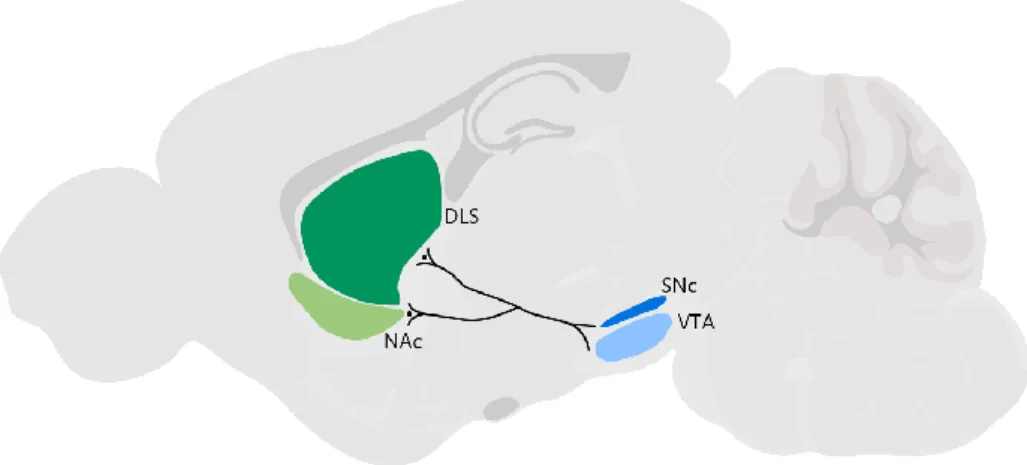
On the other hand, PI stimuli also activate non-homeostatic circuits, mostly related to the rewarding properties of food, therefore involving dopaminergic neurons. Currently, it is also known that dopamine transients in the nucleus accumbens (NAc) increase in response to PI delivery of sucrose. First, calcium imaging will be used to record neuronal dopaminergic activity in the VTA and SNc in sessions of IG delivery of various reinforcers.
However, while one action will lead to the IG infusion of sucrose, the other action will lead to an IG infusion of sucralose. The expected result is that mice will push more to obtain IG administration of sucrose, regardless of the likelihood. This project will allow to shed light on the postulated asymmetry of dopaminergic responses between the ventral and dorsal central regions according to the type of PI stimuli.
Methodology
- Experimental model
- Surgical procedures
- Gastric catheter implantation
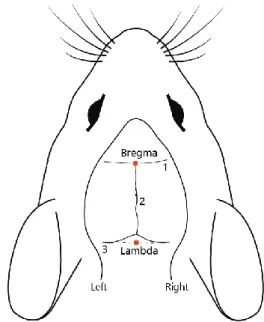
- Viral injection, gradient refractive index (GRIN) lens implantation, and baseplate fixation
- Viral injection and fibre implantation
- Calcium imaging assay
- Calcium imaging data processing and analysis
- Fibre photometry assay
- Fibre photometry data processing analysis
- Two levers probabilistic instrumental task
- Training schedule
- Two levers probabilistic instrumental task data processing and analysis
- Histology and immunohistochemistry
- Mouse perfusion and brain slice preparation
- Microscopy image acquisition
- Statistical analysis
- Bibliography
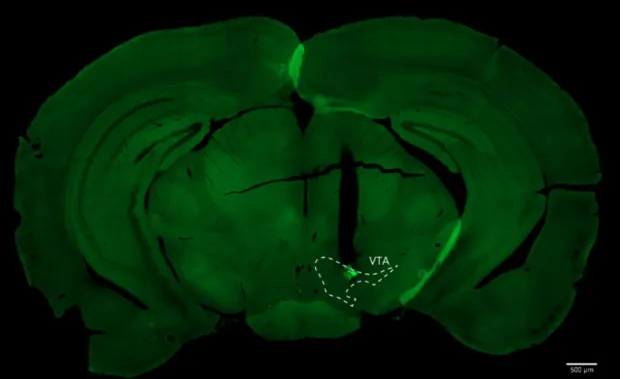
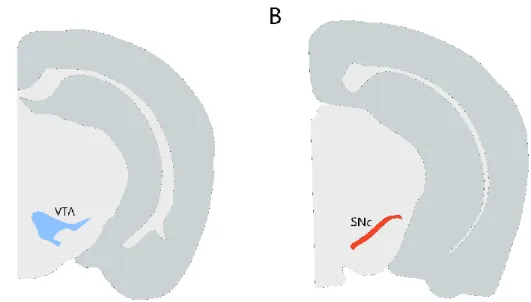
Supplementary Figure 7.1 and Supplementary Figure 7.2 show representative images of brain slices from the GRIN lens pathway in the VTA and SNc, respectively. B Representation of the SNc structure (red) for the final virus injection and lens placement coordinates. Each session began with illumination of the house light followed by a 5 min baseline period.
Finally, smooth signals were thrown in and aligned with the start of the session and start of IG enhancer infusion. Each session began with the illumination of the house light inside each box (Med Pc sound attenuating external box Med-Associates Inc and hardware platform HARP, Champalimaud Foundation) where mice were placed. Each session began with the illumination of the house light and the insertion of one or both levers.
Each session ended with the withdrawal of both levers and the displacement of the house light 13, 34. CRF criteria – the number of lever presses per session – was gradually increased and conditioned on the fulfillment of previously defined criteria. Reward delivery depended on the lever the rats pressed and the probability associated with that lever being pressed.
FP3002 Manual . 2021
Results
- Monitoring neuronal activity during intragastric infusions of different nutrients
- Dopaminergic neurons of the VTA respond differently to different macronutrients
- Dopaminergic neurons of SNc respond independently of macronutrient
- Response of dorsal and lateral striatum to intragastric infusions of different nutrients
- Postingestive stimuli modulates food seeking behaviour in an instrumental two-action probabilistic task
- Mice do not show a clear preference upon lever reversal
- Bibliography
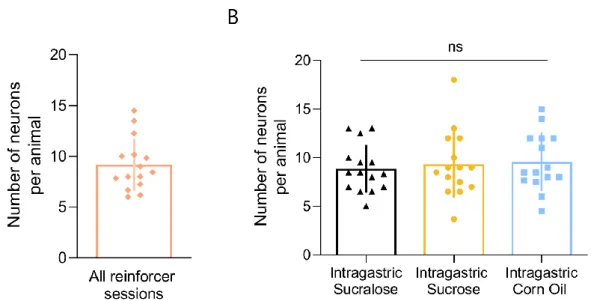
No significant difference was found in the number of recorded neurons per animal between the different reinforcement sessions (Figure 4.2 B, one-way repeated measure ANOVA ns p = 0.5). No significant difference was found in the number of neurons recorded per animal between the different reinforcement sessions (Figure 4.12 B, one-way repeated measure ANOVA ns p = 0.8). The percentage of positively modulated dopaminergic neurons in the SNc per reinforcement session was calculated as previously described (Figure 4.14 A).
The results show that the percentage of positively modulated neurons does not change significantly between reinforcer sessions (Figure 4.14 A, one-way repeated measures ANOVA ns p = 0.7). More specifically, Figure 4.15 Positively modulated SNc dopaminergic neurons during IG delivery of reinforcers for the first 300 s vs 600 s after infusion. The mean number of lever presses for the last 6 days of each deprivation protocol was plotted (Figure 4.20).
Supplementary Figure 7.5 shows the average number of lever presses per session for the 3 deprivation protocols. For Figure 4-24 A and C, the first 5 attempts (from -5 to 0) represent the time when each lever had a high probability of delivering rewards. As done before, the number of lever presses and number of blocks per session were calculated and plotted (Figure 4.25).
Comparing the number of blocks for the last day of the PP schedule (PP d18), and the last of the R schedule (R d14), confirms the previous observation (Figure 4.25 C, Paired t-test ns p = 0.3 ). Thus, preference for each lever during a transition was plotted for the last 4 sessions of R (Figure 4.27 A).

Discussion
- Dopaminergic regions respond differently to intragastric infusions of different nutrients
- Mice in a probabilistic two-action task press more to obtain intragastric infusions of a caloric solution
- Bibliography
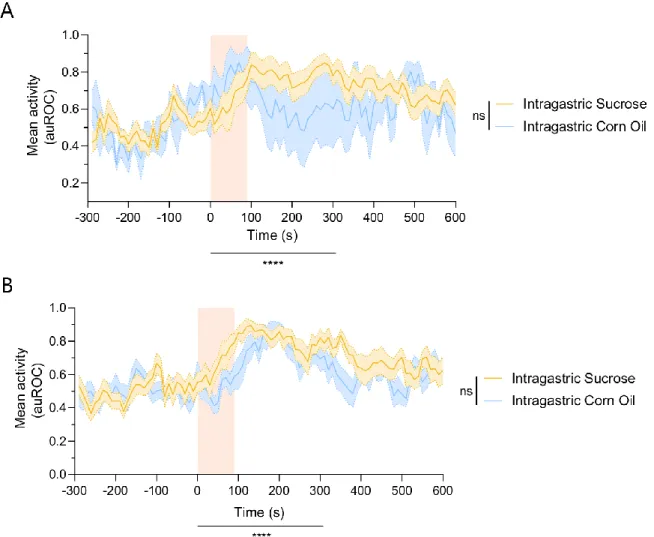
In the context of PI stimuli, there is clear evidence that the ventral striatum responds to carbohydrates, such as glucose and sucrose 2. 11 These findings led us to specifically target within the same animal dopamine dynamics in the NAc and DLS, whereas we infused isocaloric reinforcers, i.a. sucrose, corn oil and sucralose. Fiber photometry preliminary results showed that dopamine levels in the ventral striatum tend to increase in sucrose infused sessions compared to corn oil and sucralose sessions (Figure 4.18 A).
Taken together, the data obtained for ventral dopaminergic neurons and their projections in the ventral striatum suggest that these regions have a higher response pattern to carbohydrates. Fiber photometry studies in DLS appear to support the results previously observed for the SNc, as the dorsal striatal response shows no significant differences between infused enhancers (Figure 4.18 B). Although we did not observe a significant difference in the pattern of activity between reinforcers, there was always a significant percentage of neurons that responded after IG administration (average 15%).
Interestingly, the response profile for SMOF lipid in the NAc appears to be very similar to the profile for sucrose in the same area (Figure 4.19 A). We also identified a subpopulation of dopaminergic neurons that respond specifically to sucrose in the VTA and a second subpopulation of neurons that respond to the caloric content of the food ingested. It was not possible to provide more training days due to complications with the chronic gastric catheters leading to a reduction in the number of animals and to the end of the experiment.
Conclusions
In addition, the results showed that PI stimuli are able to modulate foraging behavior in a two-action probabilistic task. In sessions infused with sucrose, the percentage of positively modulated enhancer neurons is significantly higher compared to sessions infused with corn oil or sucralose. However, neuronal tracings showed that the profile of these neurons for the sucrose and corn oil session may overlap.
Cell coupling between different reinforcer sessions revealed that the percentage of neurons positively modulated by both intragastric (IG) sucrose and IG corn oil is higher compared to the percentage of IG sucrose or IG corn oil specific modulated neurons. Despite the fact that a significant proportion of dopaminergic neurons respond to both enhancers, when comparing specific sucrose neurons with specific corn oil neurons, it became clear that IG sucrose activates a greater number of neurons. These results point to the possibility that VTA dopaminergic neurons have different layers of response that are significantly higher when the reinforcer is a caloric carbohydrate.
The results show that the percentage of positively modulated neurons in this dorsal region does not differ significantly between the three reinforcers tested. The results of the two-action probability task have provided important insight into how PI stimuli may modulate food-seeking behavior. When given the choice between two levers with different associated PI stimuli, mice have a clear preference for the lever leading to the IG release of the caloric solution: sucrose.
Supplementary information
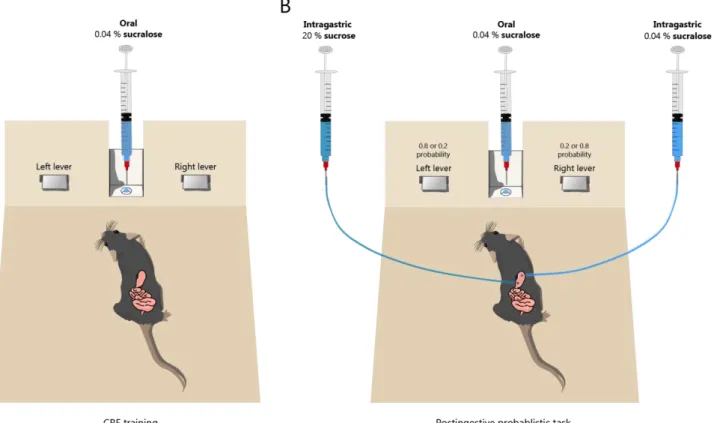
A Four groups of food-deprived C57Bl6/J mice were trained to press a lever to receive one of four oral solutions as a reward. Water-deprived mice were trained to press a lever to obtain an oral reward of a noncaloric solution—0.04% sucralose—on a CRF schedule in which each lever press led to a reward. B Number of lever presses per session in the two-action instrumental task with pre- and postingestive stimuli after three different deprivation protocols.
After lever-pressing behavior was acquired, mice were placed on a probabilistic postgestive (PP) schedule in which lever-pressing can lead to an oral reward—sucralose 0.04%—combined with an IG reward delivered directly into the stomach through an IG catheter. One lever was associated with IG delivery of a noncaloric solution—sucralose 0.04%—and the other was associated with delivery of a caloric carbohydrate solution—sucrose 20. For seven days of this protocol, the mice were submerged. deprivation protocol (indicated in blue, n =8); for the next 13 days, mice were under a water and food deprivation protocol (highlighted in orange, n = 8), and for the last 17 days, mice were under a food deprivation protocol (highlighted in yellow, n = 3).
Data are presented as mean ± standard error of the mean (SEM) Unpublished data developed by Ana Fernandes and Albino Oliveira-Maia. For the first 8 days of this protocol, rats were under a water deprivation protocol on a CRF schedule (n = 8), for the following 7 days, rats were kept on a water deprivation protocol but on a PP schedule (n highlighted in blue, n = 8). For the next 13 days, mice were under a food and water deprivation protocol (highlighted in orange, n = 8).