These equations determine the speed, angle of attack, and angle of glide slope and are expressed by the laws of incompressible aerodynamics, being appropriate for low-speed flights such as approach to the ground or initial climb after takeoff. Assuming a throttle engine and considering rotational inertia, the aircraft is maintained at a constant glide slope and a second-order nonlinear differential equation for the angle of attack is obtained. From the angle of attack it is possible to determine the speed and then push from the speed.
Topic Overview
The nonlinear coupling of these two modes for large perturbations allows broad amplitude motions and small variations of speed and angle of attack, which means that for flight on a constant glide slope it is possible to obtain a nonlinear second-order differential equation for the angle of attack and consequently determines the speed and therefore thrust. Speed, angle of attack and glide slope angle are defined by the nonlinear equations of motion for longitudinal stability and are expressed by the laws of incompressible aerodynamics and suitable for low-speed flight, such as initial climb after takeoff or approach to ground, which is the studied case forward. This makes it possible to obtain the differential equation for the angle of attack, which is solved at three levels of approximation: second-order approximation, third-order approximation and the numerical solution in time.
The first study of aircraft stability [2] considered the phugoid as a non-linear longitudinal motion of an aircraft flying at a constant angle of attack under the influence of aerodynamic forces in gravitational fields. This mode can be stable or unstable if the pitching moment coefficient decreases or increases with the angle of incidence. In steady state flight, speed, angle of attack, and glide slope angle are constant or at least two of them are determined to be constant.
These variables come from the exact nonlinear equations of motion for the force normal and tangential to the flight path and for the pitching moment that determine the longitudinal stability of an airplane. However, if only one of these three flight variables is constant, then three limited problems of longitudinal stability arise: for flight at a constant glide slope, a second-order nonlinear differential equation is obtained for the angle of attack, and the speed is determined by the angle of the attack;
Objectives
Thesis Outline
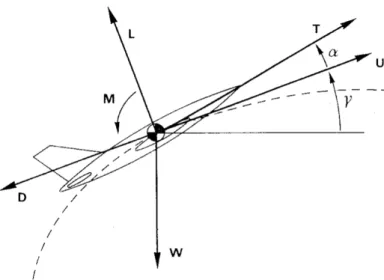
Lift, drag and pitching moment balance
Also the static stability condition of the negative slope of the pitching moment with respect to the angle of attack is made clear in (2.3b) and the drag polar in (2.3c) allows not only for lift-induced friction and drag, but also for a linear term that modifies the parabolic dependence.
Dependence on velocity, angle-of-attack and glide slope angle
The parameters (a, e0, e1, e2, b) respectively specified by (2.5b, 2.8, 2.12a) are constant, neglecting the variation of atmospheric density with height, for a limited time of flight. Also, for the same period, the variation of mass and moment of inertia with fuel consumption should be negligible.
Steady flight conditions as an equilibrium state
Three flight stability cases under one constraint
- Variable velocity and angle-of-attack along constant glide slope
- Constant angle-of-attack along a curved trajectory with variable velocity
- Constant velocity along a curved path with variable angle-of-attack
- Quadratic divergence at lowest order
- Modified short-period oscillations at second-order
- Anharmonic oscillation at third-order
The case of constant angle of attack with variable velocity and glide slope angle is an extension of the phugoid that allows for the effects of rotational inertia. The case of constant velocity along a curved path with variable angle of attack can be seen as an extension of the short period, without limitation to a constant glide slope. With the constraint of constant glide slopeγ0, the angle of attack relative to the angle of zero lift satisfies (2.5a), a second-order nonlinear ordinary differential equation that can be easily integrated, to yield a nonlinear first-order comparison:.
Introducing the dimensionless relative change of the angle of attack from the initial value: it is given as a function of time in inverse form by:. so time as a function of ψ includes the logarithm:. which correspond to the first-, second-, and third-order approximations, respectively. In the first order approximation:. the square root argument in the integrals is linear, allowing immediate integration: showing that the dimensionless relative angle of attack ψ is a quadratic function of time. Otherwise, the frequency of the angle of attack oscillations for flights limited to a constant glide slope does not coincide with the short-period frequency.
Note that the angle of attack has an oscillatory motion if (3.26) is positive, that is if αL−αM and α0−αL have the opposite sign, e.g. Especially at the third order= 3, the angle of attack is specified by a Weierstrassian elliptic function [28-30], as shown next.
Flight stability on a constant glide slope
- Angle-of-attack, velocity and thrust as a function of time
- Non-linear stability data for a large airliner
- Non-linear stability data for an interceptor aircraft
- Program overview
- Inputs and outputs
First term at r.h.s. second term at r.h.s. II) The third-order approximation (3.37), for which the dimensionless relative angle of attack is specified by a Weierstraussian elliptic function, with parameters (3.35a,3.35b) specifying the two periods;. In the second-order approximation, the angle of attack is a sinusoidal function of time (3.27), corresponding to an oscillation at a modified short-period frequency. In the third-order approximation, the angle of attack is a Weierstrassian elliptic function of time (3.37).
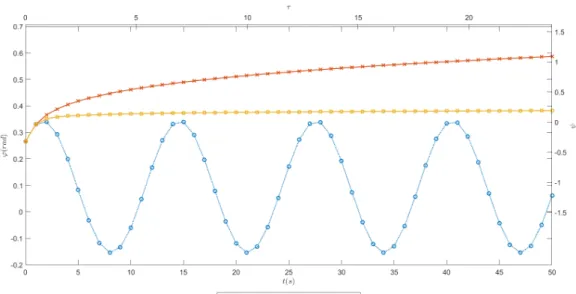
It will be shown that the third-order approximation of the angle of incidence is a monotonic function of time, as is the case for the numerical solution. Once again α0= 0.1047rad <|αL|, which causes the absence of a singularity in the velocity (2.21b) according to the second-order approximation of the angle of incidence. In order to study the behavior of the angle of incidence under a constant sliding slope angle, the numerical solution in time, the sinusoidal oscillation at the modified short period frequency and the Weierstrass elliptic function are plotted.
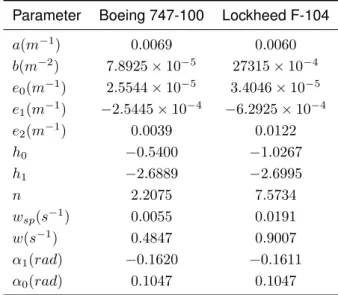
These values were then acquired by the program, which made it possible to determine the parameters from Table 4.2 and evaluate the numerical response, second-order and third-order approximation of the angle of attack. The drag coefficient at zero angle of attack is a result of CD0 = CD min+ kCLminD2.
![Figure 3.1: Boeing 747-100 [31]](https://thumb-eu.123doks.com/thumbv2/123dok_br/19768637.0/43.892.254.638.586.812/figure-3-1-boeing-747-100-31.webp)
Solution
Moderately and strong non-linearity versus linearity
In terms of speed (Figures 4.3 and 4.6), angle-of-attack fluctuations in the second-order approximation (dashed curve I in Figures 4.2 and 4.5) lead to significant variations in airspeed (dashed curve in Figures 4.3 and 4.6). The suppression of angle-of-attack oscillations in the third-order approximation (cut curve II in Figures 4.2 and 4.5) leads to a smooth variation of the speed (cut curve II in Figures 4.3 and 4.6) towards a constant asymptotic value for a long time. The numerical solution at all orders is smooth both for angle of attack (continuous curve III in Figures 4.2 and 4.5) and speed (continuous curve III in Figures 4.3 and 4.6), and the difference from the third-order approximation is less visible due to the larger scale in Figure 4.3 and 4.6 compared to figures 4.2 and 4.5.
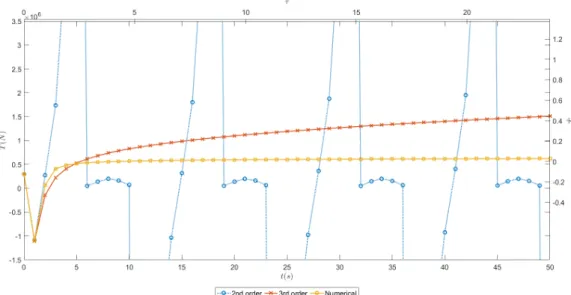
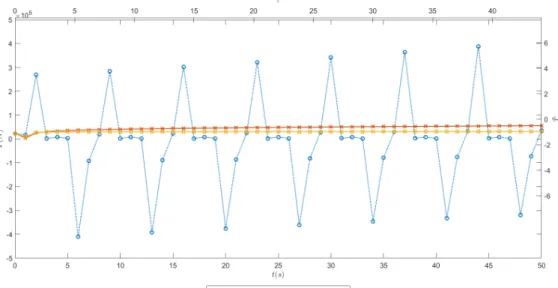
Regarding thrust as a function of time (Figures 4.4 and 4.7), significant throttle activity (dotted curve I in Figures 4.4 and 4.7) is required to maintain the aircraft on a constant glide path in the second order approach where a large angle of plane is needed. - attack oscillation (dashed line I in figures 4.2 and 4.5) and significant speed variations (dashed line I in figures 4.3 and 4.6). The third order approximation smoothes the angle of attack (oblique curve II in Figures 4.2 and 4.5), the velocity (oblique curve II in Figures 4.3 and 4.6) and also the thrust (oblique curve II in Figures 4.4 and 4.7). Although the third-order approximation is qualitatively similar to numerical theory, it is not an accurate quantitative approximation for the angle of attack (continuous curve III in Figures 4.2 and 4.5), velocity (continuous curve III in Figures 4.3 and 4.6), and thrust (continuous curve III in Figures 4.4 and 4.7), which shows that order terms higher than the third are essential to obtain accurate results, especially of asymptotic values for long periods compared to short periods.
It is also observed that the short-term negative peak in the third-order approximation (oblique line II in Figures 4.4 and 4.7) and in the numerical response (continuous curve III in Figures 4.4 and 4.7) is due to the decrease in initial velocity , since from (3.49b) a decrease in velocity will cause a decrease in thrust. This approach incorporates cubic terms in the angle of incidence and smooths the oscillations, leading to smooth profiles with constant angle of attack, velocity and thrust, asymptotic over a long time compared to the short period frequency.
Future Work
It has been demonstrated that keeping any two of these constants implies that the third is also constant, but keeping only one constant leads by elimination between the other two to nonlinear second- or third-order differential equations. The most relevant case is flight along a constant glide slope, such as approach to land or initial climb after takeoff. The obtained solutions of the nonlinear equations of motion cover large amplitude motions beyond the small amplitude oscillations of the linear short period oscillations.
A second-order analytical approximation to the exact nonlinear equations of longitudinal motion along a constant glideslope using incompressible aerodynamics leads to variations in the angle of attack at a modified short-period frequency, with associated velocity changes that require considerable throttle activity to maintain a constant glideslope. This approximation is negligible due to its quantitative difference of the quadratic approximation and the obvious wide fluctuations. It would also be interesting to determine in which order the approximation of the equation for the angle of incidence comes closest to the exact equation.
Finally, in addition to the case of a constant glide path (section 2.2.1) discussed in this thesis, this could also be considered the case of a constant angle of attack (section 2.2.2) and a constant velocity (section 2.2. 3). An approximate analysis of the nonlinear lateral motion of a slim aircraft (hp 115) at low speed.

Representation of forces and angles on an aircraft
Boeing 747-100 [31]
Lockheed F-104 [32]
For cycle in MATLAB TM
Angle-of-attack vs time for Boeing 747-100 in approach to land
Velocity vs time for Boeing 747-100 in approach to land
Thrust vs time for Boeing 747-100 in approach to land
Angle-of-attack vs time for Lockheed F-104 in approach to land
Velocity vs time for Lockheed F-104 in approach to land
Thrust vs time for Lockheed F-104 in approach to land
Lift and drag coefficient for the Boeing 747-100
Lift and drag coefficient for the Lockheed F-104
![Figure 3.2: Lockheed F-104 [32]](https://thumb-eu.123doks.com/thumbv2/123dok_br/19768637.0/44.892.254.639.104.338/figure-3-2-lockheed-f-104-32.webp)
![Table 4.1: Boeing 747-100 [25, 33] and Lockheed F-104 [1, 33] data Parameter Boeing 747-100 Lockheed F-104](https://thumb-eu.123doks.com/thumbv2/123dok_br/19768637.0/46.892.268.619.698.991/table-boeing-747-lockheed-data-parameter-boeing-lockheed.webp)