Os algoritomos cochodos foram o Double Block Zero Padding Transition Insensitive, Delay and Multiply, Dual Sideband with CBOC as BPSK e a refer ˆencia ´e um serial search com matched filter. The aim of this work is the analysis of various algorithms for the acquisition of GNSS signals considering a future implementation of the best one on the DEIMOS's GRIP receiver. Next, a complete description is made of the different methods of searching and processing the signal on the acquisition phase.
Finally, the performance of the different algorithms is analyzed with a real signal from the receiver.
Glossary
Introduction
- Motivation
- Thesis Objectives
- Thesis Contributions
- Thesis Outline
A study of the new Galileo signals, CBOC(6,1,1/11) and AltBOC(15,10) in terms of its power spectral densities (PSDs) and autocorrelation functions (ACFs). A description of the entire navigation system is made, focusing on the transmission bands, the mathematical description of the signal that reaches the receiver, and the types of modulation used. With the knowledge taken from different search strategies, a description of methods for obtaining AltBOC(15,10) is made.
In Chapter 4, there is a full description of all the innovative and traditional acquisition algorithms that were considered for this work.
GNSS Signals
- GPS Signal
- GPS Signal Overview
- GPS L1 Civil Signal
- Auto-Correlation and Random Sequences
- Modulation Types for Satellite Navigation
- Binary Phase Shift Keying (BPSK)
- Direct Sequence Spread Spectrum (DSSS)
- Binary Offset Carrier Signals (BOC)
- Galileo Navigation System
- Galileo E1 Band
- Galileo E6 Band
- Galileo E5 Band
- Galileo Modulations
- CBOC(6,1,1/11)
- AltBOC(15,10)
The second part contains orbital information called ephemeris data and allows the receiver to calculate the position of the satellite. The code can also be described as a convolution, 2.4b, this allows us to analyze the frequency content of the C/A code signal. N(#similarities−#differences) (2.7) This is an important result because the autocorrelation can be calculated simply by summing the products of the underlying +1s and -1s.
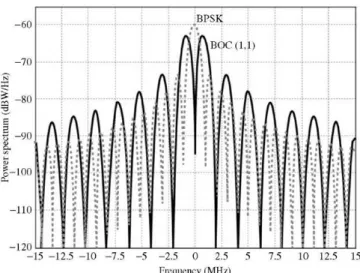
In practical terms, a 0 bit leaves the carrier unchanged and a 1 bit multiplies the carrier by -1, which is equivalent to shifting the phase of the sinusoidal signal by 180o, as shown in Figure 2.5, where Tb= 1/Rb, giving be Rb data rate in bits per second. This process, known as "de-propagation", amounts mathematically to a correlation of the transmitted PRN sequence with the PRN sequence that the receiver already knows the transmitter is using. BOC modulation is obtained by the product between the spreading code and a squared subcarrier, which is an NRZ signal, equal to the sign of the sine or cosine waveform.
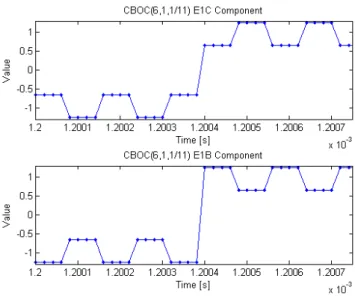
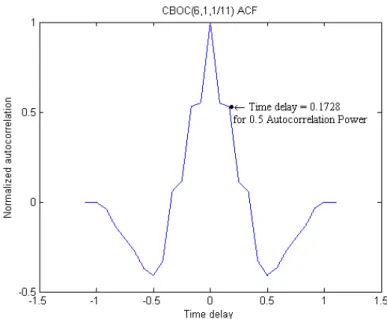
Since this is the modulation of the future, we will examine the characteristics of this modulation in more depth. The main purpose of this work is to get CBOC(6,1,1/11) signals in E1 band, but one method is to get AltBOC signal from CBOC. Therefore, this section will only contain a brief explanation of AltBOC, just enough to see why these signals take so much time and resources to acquire.
With the method proposed later, this large bandwidth will not be necessary for Doppler phase and code estimation, because the signal to be processed is only CBOC (6,1,1/11). Now that the PSD of the signal has been analyzed it is time to study the AltBOC ACF.
![Figure 2.1: GPS signals, [2]](https://thumb-eu.123doks.com/thumbv2/123dok_br/19366986.0/26.892.271.619.116.369/figure-gps-signals.webp)
GNSS Acquisition Techniques and Concepts
- Basic Concepts
- Baseband Signal Processing
- Search Space
- Detection and False Alarm Probabilities
- Search Strategies
- Serial Search
- Parallel Search
- Assisted Search
- Signal Correlation Techniques
- Matched Filter
- Sub-Carrier Demodulation Simplifications
- Detector algorithms
- Coherent Combining
- Non-coherent Combining
- Differentially Coherent Combining
- Detectors Comparison
- AltBOC(15,10) Acquisition
- Single sideband acquisition (SSB)
- Double sideband acquisition (DSB)
- Full-band independent code acquisition (FIC)
- Direct AltBOC method
- AltBOC search schemes comparison
- Hand-over from the E1
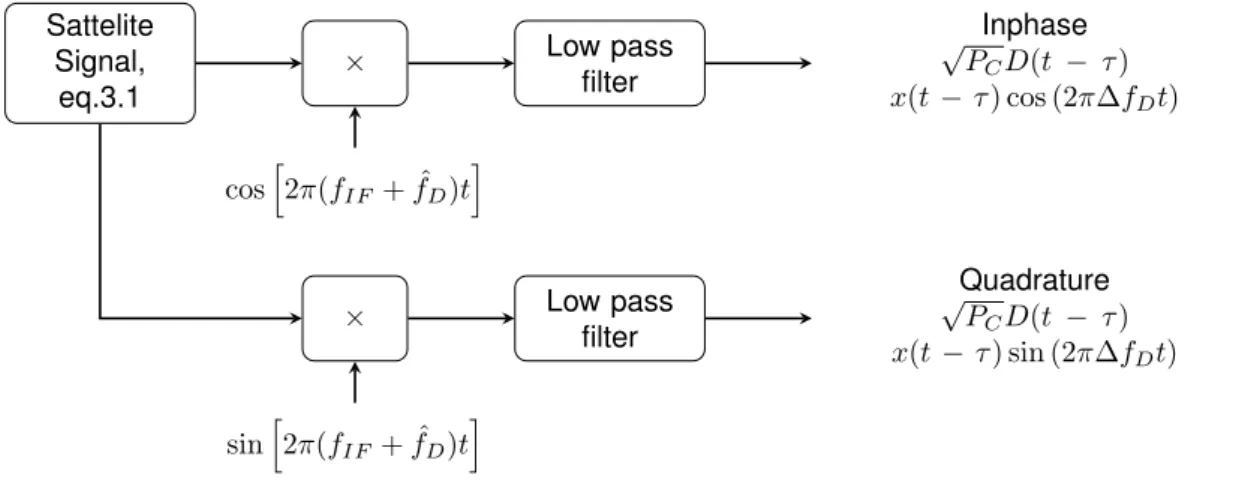
This increase in the number of pickups is mainly due to the modulation used in the Galileo signals (chapter 2). Doppler frequency, the Doppler frequency changes the size of the search grid in terms of its resolution and range. Code Phase Just like the Doppler frequency, the code phase defines the size of the search grid in terms of its resolution and range.
In the serial search strategy, each cell of the search grid must be searched. This is the most basic of the search strategies in terms of algorithmic complexity, but because of this simplicity it is also the slowest of all the buying strategies. Due to the time challenges of coherent integration other integration techniques can be used to improve the sensitivity such as non-coherent integration or coherent differential combination.
The disadvantage of this technique is the increase in terms of acquisition time due to the number of summaries made. An integer, R, of such products is added together and the squared magnitude of the result is taken as the decision statistic. With all the expressions derived in the previous sections, we are going to evaluate the sensitivity of the different detectors in terms of their probabilities of detection and false alarm.
Also, for all the methods, we assume that the secondary code phase is unknown and that the purpose of the acquisition is only to acquire the primary code. This adjustment is very important because it makes it possible to obtain the code phase delay of the E5 signal from E1.
Acquisition Algorithms Pre-selection
- Classical Acquisition (Serial Search with Matched Filter)
- Parallel Frequency Space Search
- Parallel Code Phase Search
- Double Block Zero Padding Transition Insensitive (DBZPTI)
- Dual Sideband, CBOC as BPSK
- Delay and Multiply
- Selected Algorithms
After the coherent combination of both correlators we are in the presence of the decision variable. Depending on the implementation of the Fourier transform, this method can be much faster than the range search. Also with this method the complexity increases a lot due to the many correlators needed.
The result of the multiplication undergoes an inverse Fourier transform and is converted in the time domain. The efficiency of this method depends on the implementation of the FFT and IFT, because both transformations are performed for each frequency step. One of the methods to be implemented is the Double Block Zero Padding Transition Insensitive Improved, presented in [22].
The improved one is better in terms of breaking down the peak as a function of the Doppler frequency. As illustrated in Figure 4.6, each combination of 2 blocks of the input signal is circularly correlated with each combination of blocks in the local code. Due to the zero-padding of the local code blocks, only half of this circular correlation is preserved.
The downside of this method is the loss of power when one or two bands are used instead of the entire signal and the deterioration of the properties of the correlation function. The advantage of delay and multiplication is the elimination of the Doppler frequency before correlation.

Performance Analysis
- Simulation Parameters
- Carrier-to-Noise Density Ratio
- Probabilities of False Alarm
- Integration Time and Doppler Step
- Mean Acquisition Time, MAT
- Incoming Signal
- Classical acquisition (Serial Search with Matched Filter)
- Theoretical Performance Evaluation
- Simulation Results
- Real Signals Simulation Results
- DBZPTI
- Theoretical Performance Evaluation
- Simulation Results
- Real Signals Simulation Results
- Delay and Multiply
- Delay and Multiply as a filtering method
- Simulation Results
- Real Signals Simulation Results
- Dual Sideband, CBOC as BPSK
- Theoretical Performance Evaluation
- Simulation Results
- Real signal Simulation Results
- Results Comparison
Equation 5.6a represents the noise variance at the end of the acquisition process. As can be seen from the result of Equation 5.7, it is not even fair to compare this method with classical data acquisition due to the use of FFTs. According to Equations 5.9, the detection probability of the DBZPTI method can be calculated.
This means that this method for our reference has the same performance as classical acquisition, but is many times faster. Using Figure 5.7, it can be seen that the probability of detection is very close to one, as in classical retrieval and theoretical predictions. From Equation 5.10, we have the time of the delay-and-multiply method plus the time of classical acquisition.
Using Figure 5.13, it can be seen that 50% of the time 2320 cells are scanned, which is about a 15% increase compared to C/N0= 44dBHz. But since the MAT of delay and multiplication varies with C/N0, maybe for stronger signals its MAT is worse. It is not fair to list MAT DBZPTI in Table 5.2 because they serve different purposes.
Taking into account 5.4, the size of the DBZPTI is almost twice as large. As expected, the peak magnitude of the double sideband is slightly lower than in the classical acquisition.

Conclusions
Conclusions
Of all the algorithms described, this one seems to be the most interesting of all. In chapter 5, a complete study of all algorithms has been carried out, a theoretical study has been made in terms of the average acquisition time and its detection probability for different C/N0. Tests with simulated signals were applied to all algorithms to validate the theoretical assumptions.
And finally, the use of a real signal from the DEIMOS GRIP receiver was applied to all the methods. The delay and multiplication by itself is not a good solution because of its low sensitivity, even in the presence of strong signals. The DBZPTI is by far the best method in terms of speed which is better than all the others.
The delay and multiplication as a filtering method has the same sensitivity as our reference, but the dual sideband algorithm also has a very similar sensitivity. With our simulated signals, they both present the same average acquisition time, but the delay and multiplication MAT is somewhat variable where the double sideband MAT is not; so you can say that the dual sideband method hardly outperforms the delay and multiply. Using a real signal, the acquisition time of the delay and multiply filter method was 3 minutes, while the Dual Sideband's MAT was 11 minutes.
So with this result, maybe it was worth trying the delay and multiplication on the receiver and draw some more conclusions. From all the results, one can consider the Dual Sideband method as a more stable candidate (because the MAT is constant, does not vary with the reduction of the C/N0 and the delay and multiplication is a more unpredictable candidate.
Future Work
In the above list there is an FFT based algorithm, besides that DBZPTI cannot be implemented in the DEIMOS GRIP receiver without some major changes. Due to this fact, this algorithm was "reused" as a filtering method for the classical recording. It was compared with another FFT-based method (parallel code phase search) and it is still 12 times faster.
This is only a single test and the result does not have much strength, but is still a result.
Bibliography
Analytical performance of CBOC modulated Galileo E1 signal using sine BOC(1,1) receiver for mass market applications. Proceedings of the 11th International Technical Meeting of the Satellite Division of The Institute of Navigation (ION GPS. Proceedings of the 17th International Technical Meeting of the Satellite Division of the Institute of Navigation (ION GNSS).
Appendix A
Deimos Grip
GNSS Receiver Prototype Builder
GRIP-CENTER
GRIP-MON
![Figure 2.2: GPS L1 Power Spectra, [3]](https://thumb-eu.123doks.com/thumbv2/123dok_br/19366986.0/28.892.257.615.594.869/figure-gps-l-power-spectra.webp)
![Figure 2.4: Auto-Correlation properties of the PRN that as the same length as the C/A codes (N=1023), [2]](https://thumb-eu.123doks.com/thumbv2/123dok_br/19366986.0/30.892.208.669.113.315/figure-auto-correlation-properties-prn-length-c-codes.webp)
![Figure 2.10: Galileo Frequency Plan [5].](https://thumb-eu.123doks.com/thumbv2/123dok_br/19366986.0/34.892.211.689.777.981/figure-galileo-frequency-plan.webp)

![Figure 2.13: Spectra of Galileo Signals in E5, [1]](https://thumb-eu.123doks.com/thumbv2/123dok_br/19366986.0/37.892.270.632.110.374/figure-spectra-galileo-signals-e.webp)