
This document focuses on the project management of the development and design of an energy storage system for residential applications. The financial results and business plan suggest rapid market entry with highly profitable results from the third year of commercialization of the RESS.
Introduction
The first day at the office, in Casablanca, the CEO of the company started introducing me to the team, the installations and the warehouse of the office. In the meantime, he presented me with the different functions or departments of the 9 employees of the office, he drew a diagram showing the division of the office.
State of the art of residential storage systems
- Battery
- Inverter
- Battery Management System (BMS)
- Energy Management System (EMS)
The following figure shows the characteristics of the most common types of Li-ion batteries. Assessment of parameters such as state of charge (SOC), state of health (SOH) and state of life (SOL) of the battery.

Market analysis and concept development
RESS market status and forecasts
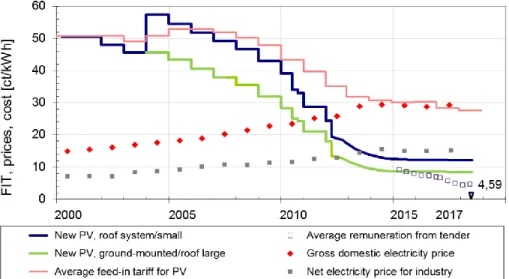
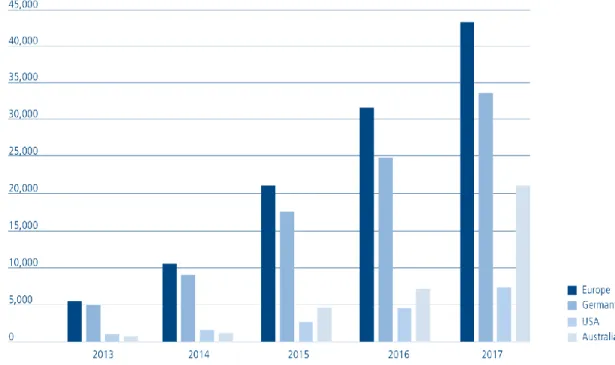
The main ones where most players are located and with the largest number of customers are the USA, Australia and Germany. As in the US, ¾ of the population expects residential batteries to be common in households in order to reduce energy bills.
Competitors analysis
- Sonnen
- LG Chem
- Senec
- SolarWatt
- Varta
- Mercedes-Benz Energy
- Tesla
They offer a modular system, ranging from 5 kWh to 15 kWh in 2.5 kWh increments, that can adapt to customer needs. As for the warranty, they offer a performance of 60% of the original capacity for the batteries after 10 years or 2500 kWh stored for each kWh capacity of the battery. The warranty they offer covers ten years for the entire system, with no restrictions on battery life, always that the unit is installed by a certified installer.
This warranty is one of the best in the current market, but it also involves some risks. Like the E3/DC, they use Panasonic NMC batteries, offering an all-in-one modular system, and coincidentally share the same market size.
![Figure 3.7. Sonnen Battery eco. [14]](https://thumb-eu.123doks.com/thumbv2/123dok_br/19768841.0/29.918.465.810.156.438/figure-3-7-sonnen-battery-eco-14.webp)
Product Development and Design
Design Thinking and Strategy Definition
Therefore, one of the main features that the battery system must have is the adaptability to meet the needs of each customer. Another problem that the customer may find when installing a battery system is the size and the weight of the entire equipment, especially when it is to be installed indoors only. Nevertheless, in view of the trend of the market, many companies have switched from LFP to the NMC technology.
The system must offer a wide range of modularities to adapt it to the needs of each customer, with all components of the installation (all-in-one) so that it can be optimized and provide a good overall performance. Major investment efforts will be made in the management of the system (BMS and EMS), providing better performance and longevity.
Battery development and design
- Preliminary definition of parameters
- Sourcing and partnership establishment
Also because larger PV installations would probably not be suitable to connect to RESS due to the input value of the inverter. In terms of battery voltage, there are mainly two options: low voltage/high capacity 48V battery or high voltage/low capacity 400V systems. Also because high voltage systems would limit system modularity for small PV array sizes.
One of the reasons is the new generations of NMC, which reduce the percentage of cobalt in the cathode. The rest of the battery parameters such as charge/discharge currents (which will determine the power), expected battery life and others will depend on what the market can offer.

Company 2
Final battery parameters definition
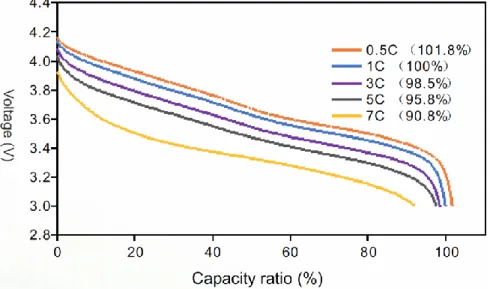
After the decision has been made to establish a partnership with Company 11, the rest of the parameters of the battery must be defined. However, the sales manager of the battery manufacturer strongly suggested to choose diesel of 17.5 Ah with a configuration of 3P14S (3 in parallel and 14 in series). Ratios of 3C or higher will not be achieved because the BMS will limit the discharge current of the battery to negligible values.
However, if 80% DOD is selected, the usable capacity of the battery decreases from 2.68 kWh to only 2.14 kWh. A 3D model is shown in Figure 4.8 and a list collecting the main parameters of the battery is shown in Table 4.9.
BMS development and design
- The search for added value
However, weak cells are not together in a battery, and it can take time and efficiency to equalize the SOC of all the different cells. According to the company's CEO, their product is unique in the world and their know-how is patented. One of the most important pieces of advice the CEO of this innovative company received as an entrepreneur is to go to market as quickly as possible.
Because of this, the protective part of the BMS will be required from the battery provider, Company 11. The specifications of the BMS must be set at an appropriate level to ensure the overall proper performance of the RESS.

Hybrid inverter development and design
- Preliminary definition of parameters
- Sourcing and partnership establishment
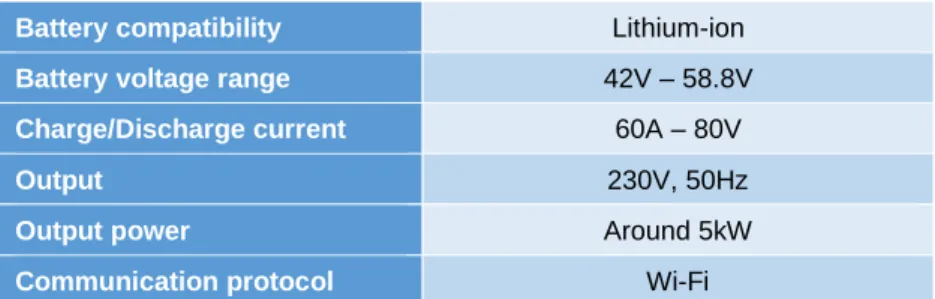
The main details of the parameters set in the BMS are shown on the next page, in Table 4.10. However, higher will also translate to more expensive, so a value between 5kW and 6kW might be best for quality/price, so for example up to 21 panels of 275Wp could be connected to the system. In the unlikely event of a PV installation that is larger than the input of the inverter, you can connect the solar inverter to those panels or arrays that the hybrid inverter cannot handle and reconnect them to the AC input so that more input can reach the battery, although in less efficient process.
The specifications of the hybrid inverters offered in their residential portfolio are shown on the next page, along with their respective prices. The predisposition and proactivity to participate in the RESS project was set at a very high level and comfortable.
EMS & future Community platform idea development and design
They even lower the initial price of their products to those shown in Table 4.12 in order to compete with Company 14. They are very good at innovation, technical design and production, but they do not implement branding, nor do they include marketing and sales in the global market. They produce after receiving orders (Built to Order) and do not keep stocks of finished products.
They don't charge any marketing commission because it's brand activities done by their client. From a marketing strategy point of view, this is very advantageous, as the company can use the product of company 14 under the Azolis brand, with its own box design.
Assembly of the RESS
With headquarters in Paris and Casablanca, their Morocco office is just a few kilometers away from Azolis. Due to the good relationship between both CEOs, of Azolis and Company 15, a free sample for testing in the prototype phase will be provided to Azolis. In future phases, the possibility of creating a Cloud Community in which customers can share their self-produced energy and become more independent will be explored.
Through blockchain process and a monthly fee, the customers will be able to share the surplus energy to serve other members who cannot generate energy due to bad conditions. For each kWh shared, the customer will receive a financial compensation above the input tariff level.
Warranty conditions definition
Aesthetical design
Overall Product Overview and Value Chain
- Value chain of the RESS
As mentioned earlier, it is almost mandatory for the company to offer the best warranty on the market as the system has one of the most advanced balancing technologies on the market and should take advantage of it. Prior to testing the RESS the intention is to offer a 12 year warranty, providing the best battery warranty on the market. Because there is no need to add external elements to the system (all-in-one), each part communicates perfectly with each other and works in line with the design of the others.
The high-tech EMS will also contribute to improving the user experience and optimizing RESS operations. Before releasing the product to the market to verify its actual performance, the RESS designed could offer a residential storage application for the first time, leading to a profitable investment for the customer.

Prototyping stage and tests
The last of the tests will consist of testing a 4-module RESS, with Company 13's BMS connected to an inverter with an EMS installed, to check the overall performance of the system and how it manages the power flow within the 4 modules. Given the inability to perform these tests because the RESS components would not arrive when expected (due to external issues from the project manager), some simulations were attempted. Unfortunately, none of them include hybrid inverters in their extensive library, nor an active balancing BMS as used in the product.
In other words, the technology used in the RESS could not be found in any of those programs. In the next section, the development of the Business Model and Business Plan to implement the battery in the market will be discussed.
Business Model
In the second segment, the customer will be asked about the possibility of removing the already installed solar inverter in exchange for improving the overall efficiency of the system (so fewer energy conversions will be required). Customer relationship is one of the points on which the company wants to focus the most. Also from possible future modifications in the modularity of the product, especially the expansion of the energy capacity.
The company's core activity is the design and integration of the RESS presented in this project. The company's key resources in this business model are redundant with key partnerships.
Business Strategy
- Milestones prior to commercialization
- Market penetration
- TAM, SAM & Target Market
- Cost structure, revenue generation and sale price of the RESS
- Financial results
- Future improvements
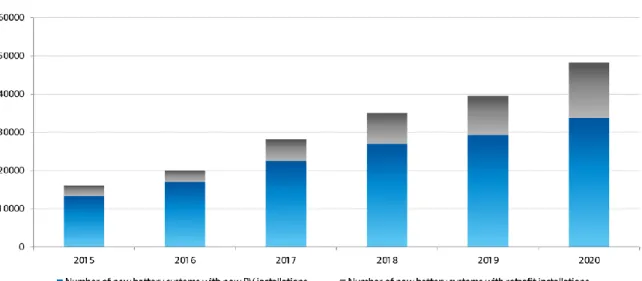
As mentioned in some sections of the thesis, the region chosen to penetrate the market for the company will be Germany. In Figure 7.2 it can be observed how the trend in the evolution of the market grows increasingly year after year. The price of the EMS is still undefined, as a free sample is provided in the prototype phase.
If those conditions are met, it will be perfect for the penetration of the product in the market. As can be deduced, the cost is always higher than the income until half of the 2nd year of commercialization.

Conclusions
As stated, RESS's product design and development have been successful, delivering a comprehensive modular product, with theoretically outstanding performance and long life, that perfectly fits the customer's needs. The exponential upward trends, good stock competition and the fast and rapid growth allowed by the market in recent years are more than enough evidence of a huge window of opportunity. There are hundreds of variables to consider, and each finding contributes to strong idea generation.
Many of the difficulties overcome are not highlighted in the document, and the author can firmly claim that this experience was very useful and useful for the development of a promising professional career. Battery Management System - a review of its use in smart grid and electric vehicles, vol.



![Figure 3.6. Market share of home energy storage systems in 2017, Germany. [12]](https://thumb-eu.123doks.com/thumbv2/123dok_br/19768841.0/28.918.161.759.279.650/figure-market-share-home-energy-storage-systems-germany.webp)
