THE GRADUATE THESIS IS SUBMITTED TO THE EVALUATION OF THE EXAMINATION COMMITTEE, APPROVED BY THE COMMISSION FOR THE GRADUATE PROGRAM IN ELECTRICAL ENGINEERING OF THE FEDERAL UNIVERSITY OF PARÁ AND IT IS ASSESSED AS APPROPRIATE FOR OBTAINING THE DOCT. If we compare the new methods with the state-of-the-art, the results showed that the former have a better damage detection efficiency in terms of false positive (in the range between 3.6 to 5.4%) and false negative (in the range between 0Ű2.6%) signs of damage, indicating their applicability for real-world SHM solutions.
Research context
For example, the answer to the severity of the damage can be done with a priori knowledge of the type of damage. In this thesis, new results-only methods are proposed for damage detection in the context of SPR for SHM.

Motivation
After extreme events, such as earthquakes and blast loads, the SHM systems can be used for condition assessment regarding the integrity of the structure. Finally, the main goal of deploying SHM systems in structures will always be to prevent catastrophic failures.
Problem
These problems highlight that, in practical SHM solutions, the accuracy of the estimated characteristics and the operational and environmental variability must be accounted for. The damage-sensitive features extracted from vibration response measurements of the Z-24 bridge were natural frequencies combining one-year health monitoring influenced by operational and environmental variability with realistic damage scenarios.

Related work
Classical methods
As an alternative, a piecewise linear relationship between the observed features can be determined by aggregating and then linear PCA is applied to each piece (YAN et al., 2005b; KULLAA, 2006). Similar to FA, this technique assumes a priori the number of factors (usually unknown) that influence damage-susceptible traits. FIGUEIREDO et al., 2011) performed a comparative study of several output-only machine learning algorithms for data normalization and damage detection on benchmark datasets.
Kernel-based methods
However, this version of KPCA again requires the specification by the user of two crucial parameters; the bandwidth of the kernel and a minimal percentage of the variance to explain the variability in the data, that is, the number of principal components retained in the high-dimensional feature space. It only ensures matching a fraction of the normal condition under operational and environmental effects.
Cluster-based methods
Justification
Objectives
Original contributions
In particular, in Appendix A, the main contribution is the adaptation of the proposed kernel-based damage detection algorithms. The main contribution is that the method is a non-parametric technique that does not require prior knowledge of the number of clusters and can identify clusters of different shapes, sizes and densities.
Organization of the thesis
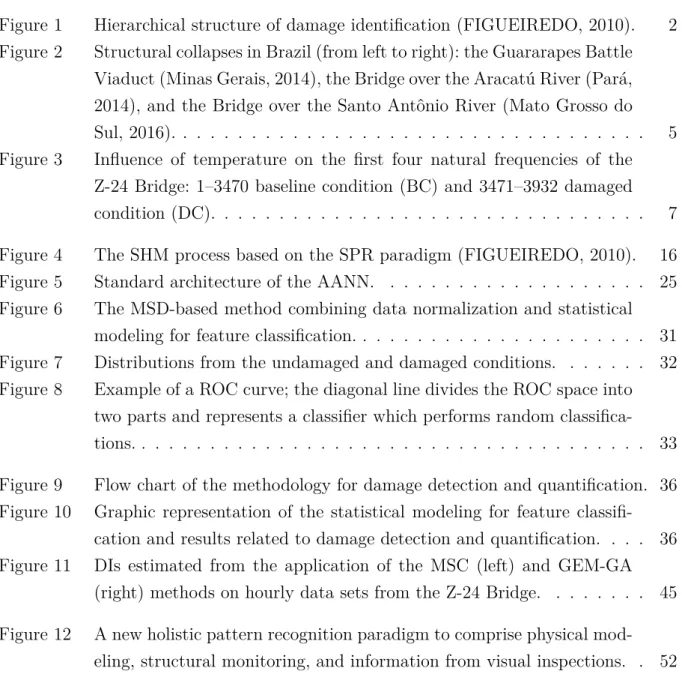
Thus, the SPR paradigm for the development of SHM systems and solutions, SPR-SHM, can be described as a four-phase process (FARRAR; DOEBLING; NIX, 2001), as shown in Figure 4. In the context of SHM In applications, the main goal of the SPR paradigm is to identify and distinguish between samples associated with an intact structure under operational and environmental influences and those associated with the same structure in a damaged condition.

Operational evaluation
This process starts with sensor measurements of the monitored structure and ends with the assessment of the actual structural condition. There is as yet no generally accepted procedure for demonstrating the return on investment in a SHM system.
Data acquisition
Feature extraction
Modal parameters
The motivation behind this approach is that the modal parameters (natural frequencies, damping ratios, mode shapes and modal scaling factors) derived from monitoring data are strongly related to the physical properties of structures (mass, damping and stiffness). The theory behind modal parameters has been discussed extensively in the literature related to operational modal analysis.
Autoregressive model
The most important dynamical system identification techniques for modal analysis are: classical and reference-based stochastic subspace identification (SSI), considering data-based and covariance-based versions (PEETERS; ROECK, 1999); SSI with variance estimation (REYNDERS; PINTELON; ROECK, 2008); classical and reference combined deterministic SSI (REYNDERS; ROECK, 2008); and the frequency response function (GUILLAUME; PINTELON; SCHOUKENS, 1992; SAMPAIO; MAIA; SILVA, 1999; . MAIA et al., 2003). Depending on the system identification method used, the estimation of the modal parameter can be performed, for example, with a peak selection strategy or a stabilization diagram (PEETERS, 2000; REYNDERS; HOUBRECHTS; ROECK, 2012).
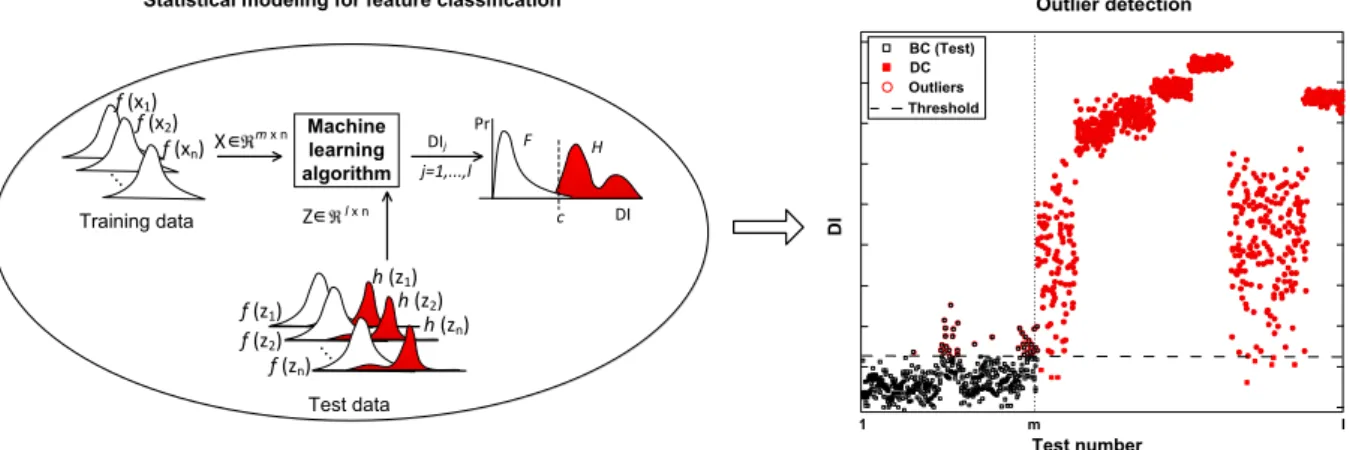
Statistical modeling for feature classification
Machine learning algorithms for data normalization
- Mahalanobis squared-distance
- Principal component analysis
- Auto-associative neural network
- Kernel principal component analysis
- Gaussian mixture models
Basically, a feature vector is the part of the residual that is uncorrelated with the unknown operational and environmental variability. Here, a DI is adopted in the form of the square root of the sum of square errors (Euclidean norm) for each residual feature vector.

Outlier detection based on central Chi-square hypothesis
If the strain vector � is related to the undamaged state, then zf ≡ ˆzf and DI(zf) ≡ 0. On the other hand, if the strain vector comes from the damaged state, the residual errors increase and DI deviates from zero, indicating an abnormal state in the monitored structure.
Performance evaluation of feature classification for damage detection 31
The training data sets must be representative of the operational and environmental variations present in the structure. Any point in the upper left triangle means that the classifier has some understanding of the classes.

Papers which compose the thesis and enhancements
- Paper A: Machine learning algorithms for damage detection: Kernel-
- Paper B: A novel unsupervised approach based on a genetic algo-
- Paper C: A Global Expectation-Maximization Approach Based on
- Paper D: A global expectation-maximization based on memetic
- Paper E: Output-only structural health monitoring based on mean
- Paper F: Agglomerative concentric hypersphere clustering applied
- Enhancements of the damage detection process
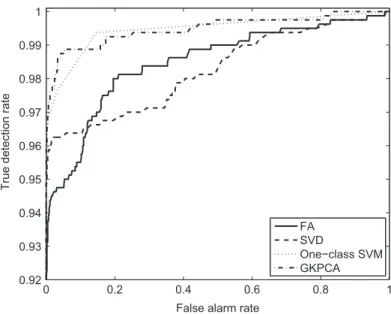
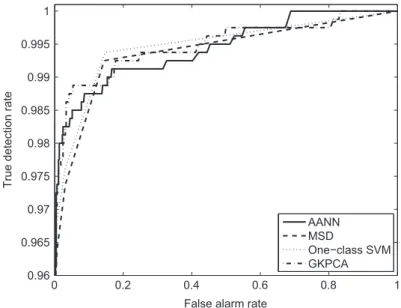
The superiority of GADBA is compared with state-of-the-art methods based on the GMM and MSD algorithms on datasets from the Z-24 (Switzerland) and Tamar (UK) bridges. The proposed approach is compared with the advanced ones, based on EM-GMM, MC-GMM, AANN and KPCA, by taking into account real datasets from the Z-24 Bridge, where several damage scenarios were performed. The superiority of GEM-PSO over the state-of-the-art methods (EM-GMM and KPCA) is attested using datasets from Z-24 and Tamar Bridges.
Similar to GEM-GA, GEM-PSO has high reproducibility in estimating the normal structural state and damage detection results, regardless of the choice of initial parameters. The superiority of the MSC technique over the alternatives (K-means, Fuzzy c-means and EM-GMM) is attested by applying a damage detection strategy implemented through the Euclidean distance using daily datasets from Z-24 Bro. In the SHM literature intrinsic to the data-based damage detection, the state-of-the-art methods have been developed without a trade-off between Type I/II errors.
Thus, a high reproducibility is achieved in the assessment of the normal condition of the structure and the results of damage detection.
Comparison between the proposed methods and discussion
Considering that all methods must misclassify 5% of the undamaged observations in the range 1–3123 (data from the training used in the test) due to the 95% threshold. This result is easily justified by the fact that the KPCA is only able to fit a fraction of the normal structural state (see subsection 1.4.2). In other words, the number of clusters estimated by both methods appears to be less than needed to handle the multimodality and heterogeneity of the current datasets.
On the other hand, by using a global optimization, the GEM-PSO and GEM-GA can handle the challenges of the monitoring data and distinguish the undamaged state with an appropriate number of groups. But some loss of information about the estimation of the normal structural state is inevitable due to the working principle of this approach. Therefore, this method should be applied when life safety issues are the primary motivations of a SHM system, i.e. the minimization of Type II errors is the reason for the monitoring;.
However, their local optimizations to generate the necessary number of clusters to handle the heterogeneity of the present hourly data appear as a limitation.

List of publications in the context of the thesis
As shown in the published papers (Appendices A to F) that make up this study, when the proposed methods are compared with those from the literature, one of the main improvements is the estimation of the normal state of a structure, without loss of information or sensitivity to the initialization procedure. , regardless of whether the structure is under linear or nonlinear variability. Thus, a high reproducibility was achieved in the assessment of normal structural condition and damage detection results. The detected clusters allow a general understanding of the sources of variability present in structures under normal operation.
However, due to the operating principle, some loss of information on the estimation of the normal structural state is expected. Among the limitations that have attracted more attention are the dependence of the proposed methods on the sensitivity of the features and the quality of the monitoring data used in the training phase. The cracks must significantly change the stiffness because the natural frequencies are naturally related to the stiffness of the structural system.
Therefore, the success of the proposed methods is highly dependent on the sensitivity of the extracted features.
Future research
First, they model the effects of the operational and environmental variability on the extracted features. However, the number of clusters in the data must be defined as input to the algorithm. The performance of the EM algorithm strongly depends on the choice of the initial parameter st=0 (where t = 0 stands for the first run).
Damage classification performance of the EM-GMM (top left), MC-GMM (middle left), and GEM-GA (bottom left) as a function of the number of executions. Box plots for the damage classification performance of the EM-GMM (top center), MC-GMM (center center), and GEM-GA (bottom center) across different runs. The section ends with a description of the damage detection strategies based on the Mahalanobis and Euclidean distances.
In the case of the Z-24 Bridge, the standard data sets are unique in meaning. MNST based on Chi-square Q-Q plot of MSD using training observations from Bridge Z-24. MNST based on Chi-square Q-Q plot of MSD using training observations from Tamar Bridge.