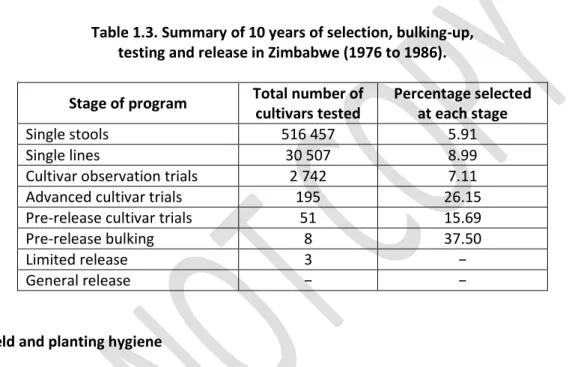
While compiling the book, team members visited Brazil, Argentina, Guatemala and India, as well as many parts of Africa. The International Finance Corporation (IFC), the private sector arm of the World Bank and active investor in the sugar industry worldwide, recognized the need for a comprehensive guide to good management practices (GMP) in the cane sugar industry.
SUGARCANE AND ITS ENVIRONMENT
- Introduction
- The changing global sugarcane landscape
- Sugar supply and demand dynamics
- Trade liberalization
- Economic development
- Biofuel and renewable energy
- Technological change
- Global warming and climate change
- Environmental issues
- The impacts of sugarcane production on the environment
- Biodiversity loss Loss of natural habitat Loss of natural habitat
- Water resource use
- Pollution of water sources
- Soil loss impacts
- Soil degradation
- Air quality impacts Impact of burning Impact of burning
- Social and community impacts
- Summary of Good Management Practices Agricultural impacts
- The soil-plant-climate continuum
- Climate Temperature Temperature
- Soils
- Physiology of the sugarcane plant
- Brief overview
- Main growth stages in sugarcane
- Plant characteristics that impact on cultivar performance
- Sugarcane cultivars
- Cultivars the key to economic sustainability
- New emerging developments
- Sugarcane taxonomy
- Centers of origin
- Hybridization
- Diseases
- Pests
- Cultivar management
- Identification
- Agronomic characteristics
- Main components of yield
- Harvesting and transport
- Milling quality characteristics (see also Section 2)
- Plant breeding and selection
- Field and planting hygiene
- Seedcane management important requirements
- Conclusions
- References
In the Tully River catchment (North Queensland) alone, the area under sugarcane and banana doubled and N/ha fertilizer use increased by 130% between 1987 and 1999, suggesting that elevated nitrate levels were due to the use higher N as well as inefficient use. of N fertilizers (Mitchell and Larsen 2000). Over the years new cultivars have resulted in the expansion of the sugar industry into areas previously considered unsuitable for sugarcane production. Sugarcane belongs to the genus Saccharum L of the tribe Andropogonae in the grass family Poaceae, which includes Sorghum and Zea.
Handbook of Standards and Guidelines for Environmental Conservation and Management in the South African Sugar Industry.
THE SOIL AND ITS ENVIRONMENT – JAN MEYER Table of Contents Table of Contents
- THE SOIL AND ITS ENVIRONMENT
- Why is knowledge of soil important?
- Origin of soils and their distribution
Gleysol' according to the World Record Base (WRB) soil classification, as it is often waterlogged during the rainy season and has a mottled, clayey subsoil (G-horizon). Important in the currently warmer and wetter regions of the world where sugar cane grows, the "last glacier".

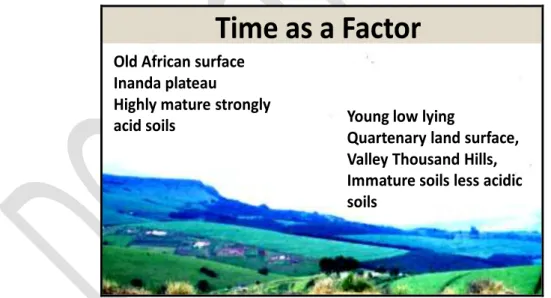
Time as a Factor
Recognizing important soil properties Soil properties Soil properties
The most effective way to understand soil and its properties is to expose the soil profile in the field. Changes in these properties between horizons can be smooth to abrupt and vary depending on the type of underlying material and the position of the profile in the landscape.
Shallow light grey Loamy sand
Box 2.3 Summary of steps to be followed in a simple profile description Step 1: Produce a fresh profile of the soil to be identified. This depth is defined as the depth of soil (excluding gravel, stones and rocks) in which about 85 to 90% of the crop's roots are found.
Yellow apedal Sandy loam subsoil
- Impact of clay content on agronomic management
- Classifying Soils
It usually occurs in the lower part of the toposequence and is also widespread in the cooler conditions of the Midlands Mistbelt in South Africa. The clay is greasy to the touch, slippery and will stick to the palm of your hand. The relative amounts of different fractions (i.e. soil textural classification) can be estimated quite accurately with training and experience.
In free-draining soils without subsurface barriers, it is assumed that 70% of the total depth is utilized by roots. Box 2.4 The 12 soil taxonomy soil types are listed in sequence, with the key being Gelisols – soils with permafrost within 2 m of the surface. It is basically a continuation of the FAO legend for the soil map of the world.
The names of the five topsoil and 20 subsoil horizons that occur regularly in the South African sugar industry and most other industries, and their relative positions in the soil profile, are. REGlC SAND: a recent deposit, usually Aeolian; little development except a darkening of the topsoil by organic matter. Box 2.5 Examples of representative shapes in each of the main ground color groups using the South African Binomial System.

Expose a profile of the soil to be identified by digging a pit, and mark off the master horizons noting whether the transition from the A to the B horizon is gradual or abrupt
In many ways, the binomial system of classifying soils is analogous to classifying plants and animals according to their generic and specific names. Soil is thus classified by first being allocated to the appropriate soil form and then to the series, so that a number of soil series belonging to the same soil form is like a family of soil. Full details of this classification system, which has been adopted by a large part of the sugarcane growing community in southern Africa, to identify, name and manage soils, are given in the publication 'Identification and Management of Soils of the South African Sugar Industry' (SASRI 1999 ).
Note the main properties of the horizons (color, texture and structure) and also likely rooting depth and quality
Identify the relevant diagnostic horizons from the soil properties captured in Step 2 using the definitions given in the bulletin
- Use of soil-specific management guidelines
- The role of soil mapping
- Choosing an appropriate classification system
- Potential benefits of soil survey maps
- Range of soil mapping options
- Soil health issues
- The new emerging view of soil health
- Yield plateau assessments
- Paired site outcomes
- Loss of organic matter
- Acidification
- Soil salinity and sodicity
- Soil compaction
- Management strategies for improving soil health
- What constitutes a healthy soil?
- Good management practices to improve soil health
- Green manuring
- Bioremedial amelioration with organic amendments
- Minimum or reduced tillage
- Managing soil acidification
- Trash Management
- Managing soil compaction
- Financial, social and environmental costs of improving soil health Financial
- Conclusions
- References
These results formed the basis of the soil-specific guidelines provided in the aforementioned bulletin. South Africa: The requirement for lime to combat aluminum toxicity in the South African industry is based on an Aluminum Saturation Index (ASI), calculated as 100 x Al/100 g clay/(Ca + Mg + K + Al /100 g clay), where all elements are expressed as cmol(+)/kg (Schroeder et al. 1995). Dumping or harvesting green cane remains one of the best options for soil carbon sequestration and carbon balance maintenance under a monoculture system.
The effect of green manures on plant parasitic nematodes in the South African sugar industry. Long-term effects of sugarcane production on soil quality in the south coast and central areas of KwaZulu-Natal. Size and activity of soil microbial biomass in the row and between rows of a sugarcane field under burning and green sugarcane harvesting.
Effect of sugarcane management systems on soil physical and chemical properties in the central plains of Thailand. The impact of lime and gypsum on sugar cane yields and soil acidity in the South African sugar industry. The impact of trashing on yield response in the South African sugar industry: a summary of results from several BT studies.

SUGARCANE CROPPING SYSTEM – PETER TURNER Table of Contents Table of Contents
- SUGARCANE CROPPING SYSTEM
- Land use planning and conservation
- Crop establishment
- References
The digital nature of the images allows a factor that differentiates between vegetation height and ground level to be applied. The level of intensity of observations has a direct impact on the accuracy of maps and results. After establishing legal, social and environmental land use rights and climate suitability in the exploratory and exploratory survey phase, semi-detailed and detailed land survey information can be used to develop the LUP.
This should be done in the dry part of the year so that the cane excrement dries out after exposure. It is used in a narrow strip (200 mm) in the old strip of culture where chemical eradication of cane has been used. Diseases may be more prevalent at certain times of the year (mosaic is a problem in some areas planted after November in South Africa).
This is due to the effect of auxins, which inhibit growth and are produced at the tip of the petiole. This means that the total inter-row distance from the middle of one row to the middle of the next row should be 1.8 m (or more). Some Postharvest Cane Management Practices in the Rainfed Areas of the Natal Sugar Belt.
WEED CONTROL - PETER TURNER Table of Contents Table of Contents
- WEED CONTROL
- Background
- The need for weed control in sugarcane
- Weeds of sugarcane
- Non-chemical weed control methods
- Chemical weed control
- Application of herbicides
- Integrated weed control
- Weed control planning
- Optimizing performance and minimizing negative impacts
- References
Soil conditions at the time of cultivation also have an impact on the effectiveness of weed control. This property of herbicides is one of the biggest advantages compared to non-chemical methods of weed control. Effective weed control for as long as 12 to 14 weeks can be achieved through a number of herbicide treatments.
It is clear that an important factor in the success of many herbicides for weed control in sugarcane is application at a young growth stage. Successful weed control can only be achieved through the integrated use of chemicals, labor and in some cases mechanical methods of weed control (Wise 1982). Recording the weed spectrum in each field on the farm will build a pattern of the most common weeds and help decide weed control and chemical selection strategy.
Regarding the social impact of weed control practices, weed control requires high numbers of unskilled labor in the absence of the use of herbicides (Wise 1982). Summary of economic, social and environmental risks and benefits from the range of weed control options. Selection of a suitable weed control program (based on weed spectrum, expected time to canopy, soil type, available herbicides for specific weeds, season, moisture regime, labor availability).
SUGARCANE NUTRITION AND FERTILIZATION - JAN MEYER Table of Contents Table of Contents
- SUGARCANE NUTRITION AND FERTILIZATION
- Introduction
In terms of crop production, adequate nutrient supply has the second largest impact on sugarcane yield after crop water requirements are met. In an age of ever-increasing economic constraints and societal pressure to preserve the integrity of the environment, there is a need to fertilize efficiently. A basic understanding of sugarcane nutrition will be of paramount importance to field managers and agronomists to ensure that a proper balance is maintained between the nutrient requirements of the crop, the capacity of the soil to supply nutrients and fertilizer management in terms of the amount, placement and timing of fertilizers without compromise with soil fertility and the other components of the environment.
This chapter discusses some principles and concepts in crop nutrition for improved nutrient management along with the roles of mineral nutrients, the amount of nutrients removed by sugarcane in relation to growth stage, symptoms of deficiency, how fertilizers. The three structural elements carbon, hydrogen and oxygen make up about 95% of the plant's fresh mass and come mainly from water and air. The remaining 5% is the mineral component, of which at least 13 elements are considered essential for good growth and to maintain the reproductive cycle of sugarcane.
The function of the element in question is specific and cannot be replaced by another element. The essential element must be incorporated directly into plant nutrition through a metabolic pathway. The remaining seven elements called trace elements or micro-nutrients that belong to the tertiary group include zinc, copper, iron, manganese, boron, chlorine and molybdenum.

- Soil factors affecting nutrient supply
- Clay minerals
- Cation exchange capacity
- Soil organic matter
- Soil pH, acidity and alkalinity
- Movement of nutrients in the soil
- Nitrogen (N)
- Importance of nitrogen
- Physiological role of nitrogen
- The Nitrogen cycle
- Nitrogen losses
- Factors affecting the nitrogen requirement of sugarcane .1 Economics
- How to adopt soil specific nitrogen recommendations .1 Main steps involved
- Nitrogen fertilizers .1 Mineral fertilizers
- Managing N fertilizer .1 Choice of nitrogen carrier
- Phosphorus (P)
- The importance of phosphorus
- Physiological role of phosphorus
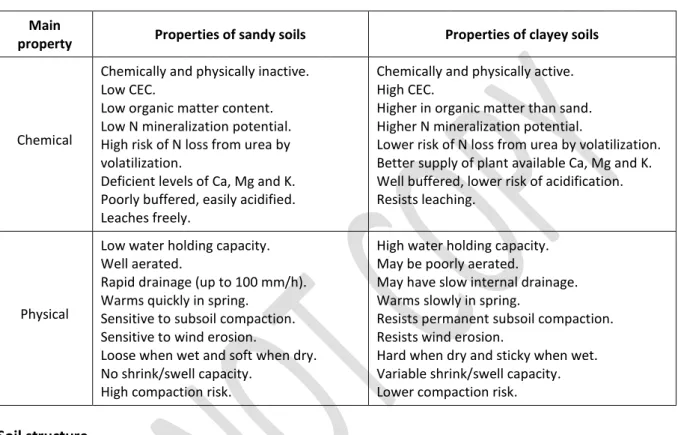
Soil texture: Is a measure of the relative proportions of sand (largest particles), silt (intermediate) and clay (smallest particles). Sand and silt particles in soil are relatively inactive, whereas clay and organic matter particles of the order of 0.0001 mm or less in diameter, known as colloids, are chemically very active. The amount of nutrients that reach the roots depends on the speed of the water flow or the consumption of the plant.
In general, only about one-third of the nitrogen applied as fertilizer to a sugarcane crop is removed by the crop in the year of application. The conversion of NH4-N to NO3-N in the soil by bacteria of the genera Nitrosomonas and. In Australia, Keating et al. 1996) found that 2 % of the borehole samples contained nitrate levels exceeding the WHO limit of 50 mg/litre.
The results also showed that the response to applied N was broadly related to the nature of the diagnostic topsoil horizon when classified according to the South African Binomial system (MacVicar et al. 1977). Sample density refers to the mass of a 100 ml of the air-dried soil in grams divided by 100. This offers a saving of between 10 to 25 % to the producer, subject to the land costs of the poultry syrup.