A multidisciplinary journal in the field of biological and health sciences has its advantages – and also disadvantages. In this way, among the author, the editor and the readers – the key elements in the production process, the dissemination and acquisition of knowledge – a fourth element arises that tends to destabilize this natural and necessary path – the indexing institutions of the journal or/and the qualifying institutions of the journal.
Environmental mycobacteria may induce recognition of auto-antigens
Circumstantial evidence using maternal and cord blood
MARINUM KANSASII TUBERCULOSIS
Tape of approx. 45 kD, seen only on the strip reacted with the mother's serum disappears after absorption with M. 3 - Group 3 - band in the region of 43 kD, seen only on the strip taken with the mother's serum disappears completely after absorption with M.

Influência da irrigação endodôntica com gel de papaína no
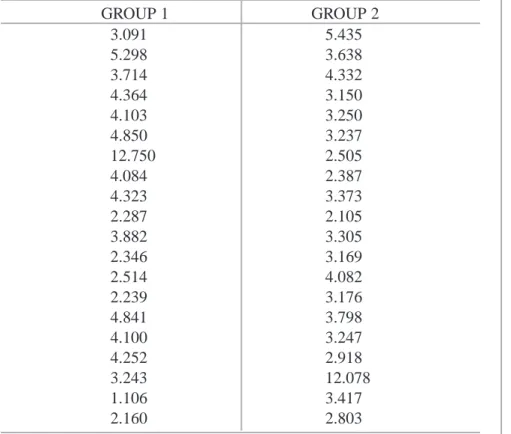
Foram utilizados 40 caninos humanos igualmente extraídos, divididos nos seguintes grupos experimentais: Grupo 1: Canais instrumentados com gel de papaína a 0,8% como enxágue. Os resultados obtidos mostraram que no grupo que utilizou a solução de hipoclorito de sódio houve menor infiltração marginal, porém sem diferença estatisticamente significativa entre os grupos (p>0,05).
Este estudo teve como objetivo avaliar, in vitro, a influência da irrigação com gel de papaína 0,8%, comparando-o com solução de hipoclorito de sódio 1%, durante o preparo biomecânico, no fechamento apical de obturações endodônticas. Foi realizada apresentação individual de cada dente, 20 irrigados com gel de papaína 0,8% (GRUPO 1) e 20 com hipoclorito de sódio 1% (GRUPO 2).

The influence of papain gel as endodontic irrigant in the
Estimation of linear boundary flow was done on a profile projector (Profile Projector, model 60, Nikon, Japan) with 20x magnification. Considering the aspect of marginal leakage, papain gel can be suggested as an irrigating agent in endodontics.
Fatores de risco da doença coronária em escolares de ensino
Este trabalho teve como objetivo abordar alguns fatores de risco para doença coronariana (DC) em alunos do ensino fundamental (5ª a 8ª série) e do ensino médio vinculados à rede pública de ensino de Bauru, SP, no ano letivo de 1995. ocorreram até os 55 anos de idade. em parentes do sexo masculino e até 55 anos em parentes do sexo feminino sugere que 54 alunos (16,0%) relataram história familiar positiva.
Nessa classificação, vale ressaltar a inclusão do sedentarismo como principal fator de risco para doença coronariana. Da amostra examinada, 38 crianças (13,0%) apresentavam algum fator de risco e dez crianças (3,4%) apresentavam dois ou mais fatores de risco. O autor sugere que os fatores de risco para DC são predominantes na infância e, neste estudo, a hipercolesterolemia é o mais comum.
Dados sobre a prevalência de fatores de risco para doença coronariana em escolares do ensino fundamental e médio da rede estadual de ensino do município de Bauru, SP são inexistentes. Considerando as especificidades do presente estudo, supõe-se que hipertensão arterial, obesidade, sedentarismo e história familiar sejam entendidos como fatores de risco para doença coronariana.

Risk factors for coronary disease in elementary and high school
In the present study, these diseases will be summarized as cardiovascular disease (CVD) and HIC will be referred to as coronary disease (CD). A risk factor is an identifiable characteristic which is associated with high expectation of the occurrence of the disease (American Heart Association, 1995). In this study, the anthropometric parameters were: body mass index (BMI) and the skinfold method.
Accumulation of more than one risk factor may exacerbate the clinical manifestation of coronary disease in adulthood. Some of these risk factors were found in the sample studied, being obesity most MAITINO.

Determinacão de catecolaminas em amostras de plasma de ratos por
A avaliação da imobilização de proteínas na superfície da fase estacionária foi realizada pela injeção de uma amostra de plasma enriquecido com catecolaminas variando em concentração de 1,0mg.mL-1 a 4,0mg.mL-1. A determinação do número de pratos teóricos (N), fator de capacidade (k), assimetria dos picos (As) e altura equivalente dos pratos teóricos (H) foi realizada por meio de um cromatograma obtido após a injeção de uma solução padrão de 2,5mg. mL contém -1 de catecolaminas. Os experimentos de separação das catecolaminas presentes nas amostras de plasma foram realizados injetando 5 réplicas para cada concentração da amostra de plasma previamente fortificada, contendo concentrações de catecolaminas de 1,0mg.mL-1 a 4,0mg.mL-1.
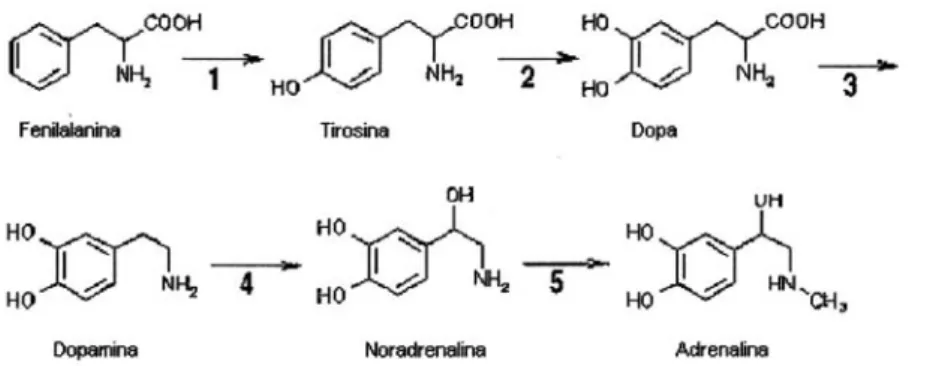
A FIGURA 2 mostra um cromatograma obtido após injeção de 10 mL de solução de 2,5 mg.mL-1 de catecolaminas (noradrenalina, adrenalina e dopamina) após otimização cromatográfica. A FIGURA 3 mostra um cromatograma obtido após injeção de 10 ml de plasma 1:100 acrescido de solução padrão de catecolaminas (4,0 mg.mL-1) após otimização cromatográfica.
Determination of catecholamines in plasma from rats by direct injection
This stationary phase allows direct injection of the biological fluid sample without any previous treatment. The determination of the number of theoretical plates (N), capacity factor (k), peak asymmetry (As) and equivalent height of the theoretical plates (H) was made in a chromatogram obtained after injection of a standard solution containing 2.5 mg.ml- 1 catecholamines. The new chromatographic column enables the separation and determination of catecholamines by direct injection of the amplified samples into CLAE.
In this regard, the linearity of the detector was determined by evaluating the relationships between concentrations from 0.625 to 5.0 mg.ml-1. Therefore, the proposed analytical method does not require the preparation of the plasma sample before its analysis, making this a simple and rapid method for the determination of catecholamines.

Síndrome de Down – Aspectos de interesse para o Cirurgião-Dentista
No entanto, pacientes com SD têm uma tendência significativa de desenvolver periodontite, que tende a aumentar com a idade (Reuland-Bosma & Van Dijk, 1986; Ulseth et al., 1991; Morinushi et al. A Gengivite ulcerativa necrosante aguda (AGUN) e bruxismo são outras anormalidades associadas com crianças com síndrome de Down (Reuland-Bosma & Van Dijk, 1986; Reuland-Bosma et al., 1988; Gabre et al. 2001).com Morinushi et al., 2001), o aumento da perda óssea em indivíduos com SD devido à progressão da doença periodontal devem ser justificados não apenas pela má higiene bucal, mas sim pelas alterações imunológicas envolvidas nesse processo.
1998) mencionam que o padrão da doença periodontal em pessoas com SD é semelhante ao da periodontite juvenil. No estudo de Gabre et al. 2001), das pessoas que perderam 6 ou mais dentes devido à doença periodontal, 44% tinham síndrome de Down.

Down´s Syndrome – Aspects of interest to dentists
The cranial wall is thin and there is a delay in the closure of the fontanel. Protrusion of the tongue and oral breathing lead to dryness and cracks in the lips. There is angular cheilitis in the labial commissures due to the difficulty in closing the lips (FIGURE 2) (Regezi & Sciubba, 2000).
In the studies by these authors, the results show a reduction in periodontal disease in individuals cared for in nursing homes. In studies, it is necessary to take into account the analysis of the total number of teeth in the oral cavity.

Implante do composto matriz orgânica de osso bovino liofilizado,
Implantação da matriz orgânica composta de osso bovino liofilizado, hidroxiapatita absorvível e agente de união em cavidade dental. O objetivo deste trabalho foi estudar microscopicamente o comportamento do implante do compósito de matriz orgânica de osso bovino liofilizado (MOOBL), hidroxiapatita absorvível (HAA) e agente ligante (AG) em alvéolos dentários de ratos. Para isso, 40 ratos (Rattus norvegicus, albinus, wistar) foram divididos em dois grupos: grupo G1, grupo controle, a cavidade foi preenchida com coágulo sanguíneo e G2, grupo experimental, foi implantado o composto MOOBL+HAA+ AG.
Os resultados permitiram concluir que: (1) houve atraso na cronologia da recuperação alveolar no grupo G2; (2) a conexão MOOBL+HAA+AG.
No presente trabalho, será avaliada a implantação de matriz orgânica de osso bovino liofilizado (MOOBL), hidroxiapatita absorvível (HAA) e ligante à base de dextrana (AG) ao nível do alvéolo dentário. Ao longo do terço cervical, próximo à parede óssea lingual, observam-se pequenas e finas trabéculas ósseas com osteoblastos em suas bordas. Ao nível do terço médio e apical, a quantidade de coágulo residual é menor, notando-se trabéculas ósseas finas ocupando maior extensão, principalmente próximo ao terço médio (FIGURA 3).
Material de implante com volume menor que o estágio anterior ao longo do terço cervical do alvéolo. O terço médio e apical do alvéolo é ocupado por trabéculas ósseas mais regulares e desenvolvidas.

Implant of organic matrix compound from frozen-dry bovine bone,
Implantation of organic matrix compound of frozen dry bovine bone, absorbable hidroxyapatite and agglutinate in the dental cavity: microscopic study in rats. The aim of this work was to study microscopically the behavior of the organic matrix compound of dry-frozen bovine bone (MOOBL), absorbable hydroxyapatite and agglutinate in rat tooth sockets. For this we used 40 rats (Rattus novegius, albinus, wistar) divided into two groups: G1, the control group, whose alveoli was filled with blood clot, and in the experimental group G2, which received the implant for the compound MOOBL+HAA. +AG.
The animals were sacrificed at the intervals of postoperative and 30 days and the samples obtained, after routine laboratory procedure, were embedded in paraffin to be cut in the microtome. The adoption of alloplastic and bone grafting, after some surgical procedures in the oral cavity, has been proposed with the aim of restoring function.
Mid-third of the tooth socket showing mild fibroblastic and capillary proliferation (arrow) close to the remnants of the periodontal ligament. Cervical third of the tooth socket with implant material and some disorganized blood clots. Mild capillary and fibroblastic proliferation is also observed in the region of the median third.
Reduced volume of implant material compared to the previous phase at the cervical third of the tooth cup. Cervical third of the dental cavity with a thick bony trabecula next to the bony wall of the tongue.

INSTRUÇÕES PARA OS AUTORES
Comunicações pessoais, trabalhos em andamento e trabalhos inéditos não devem ser incluídos na lista de referências bibliográficas, mas citados em nota de rodapé. Quando houver mais de dois autores, citar o sobrenome do primeiro, seguido da expressão, etc.
Tabelas
Ilustrações
The purpose of Journal SALUSVITA, edited by Universidade do Sagrado Coração – USC (University of the Sacred Heart), is to publish original articles, review articles and methodological works that contribute to the dissemination of knowledge in the fields of Biological and Health Sciences. SALUSVITA is published under the direction of NPU (University Publications Center) which is embodied by the Editorial Board, the Scientific Board and the Publications Desk. In case of reprinting any Brazilian or foreign newspaper, these must have the authorization of the author(s) and the editor who holds the copyright.
The first page of the text must contain the full title and omit the name of the author(s) and workplace.
SUBMISSION GUIDELINES
Tables
Illustrations