flm~a~w
INSTRUCTION BOOK
700F
·1~
ta; llff7Jc 2IH19 ~ PF.1
Explanation of Dangerous Level
A ..
~IL~ ;(l='i!'.A..!l.J!~ $ill! ill:;81
~iffi i1 .. 9Et: rr 7 til
~a<J 1!111' 1¥ 11', ill lit
~ ~ :;E*
~I i!e \0! !II 'II'
Don't ignore the warning sign and don't proceed incorrect operation.
~Jijk Or it will cause the person or the third party seriously injured or dead Dangerous during maintenance.
A
~mm~Jll:;~~iffi~rr7~~a<JI!IIl'~~il!•~•~~•~I~\O!*'~~'"";r!-'I!'.A.A~m~~~~-~~
Ignoring this warning sign and proceed incorrect operation will cause
).!!l
the person involved or the third party wounded and equipment Caution damaged during maintenance.-~~~~1.1'&~1.1'-l!i.&atJ~PF.I
Explanation of Warning Signs and Labels
& lllb f!l'fil. ill lt'i
Ifilii I&
Moving part, beware of industrial accident
1fiS-III*~ff;
A i'UU!'fil. lllt'iMi 'ill .I&
Warning Sign High voltage, beware of electric shock
A
F-\iUI'fil. lllt'i l! m•l&
High temperature, beware of burns
(S) ¥!1:
Prohibited:lll;J<I~Ull
Instruction Label
@
il!!~a<Jli~...
;j;Indication of ground wiring
I
I , ---·
i -~~ INDEX J{/PAGE
Jf{ilf.l=!f
-6:~~-Jji~!Jl
·-~~*JRN!Jl
~HU*li
iltt~~·~
ltiiMjjj.a
MM.J.a!J9~ltfl!ll m~
§BSf~:Sfll
ffiWHmmmj£
f4 51 5IB Z $1 A. JB!!
}tv•1i$
l!.JV.
fttiJJ$
tf-BEi-1.
~lbl:l::~-
tl 11= Jl t.i
IH~jl
11= =if
·1~fia i!&lllftl.
-~·
fi.flljM~llf;fjl
TO ALL USERS
GENERAL SAFETY INSTRUCTIONS IMPORTANT SAFETY INSTRUCTIONS WARNING
WARNING TAG
SAFETY ILLUSTRATION OF THE NEEDLE GUARD MOVING THE SEWING MACHINE
THE INSTALLATION POSITION SPECIFICATON
NAMES OF MAJOR PARTS INSTALLATION
HOW TO OPERATE THE NEW MACHINE LUBRICATION AND DRAINAGE
THREADING
ADJUST THREAD TENSION REPLACE THE NEEDLE
ADJUST THE STITCH LENGTH
ADJUST THE DIFFERENTIAL FEED RATIO
LIGHTENING OF THE OPERATION ENVIRONMENT CONDITIONS OF ALL OPERATORS
MAINTENANCE TOUBLESHOOTING TABLE CUT-OUT
DEMOLISTION PROCEDURE APPENDIX
1 1
3 7 8 9 9 10
11 13 14 15 15 16 17 19 19
20
21 21
22 23
31
32
33I
'---·
I
, &flm =r To ALL usERs
'--- ---
•
a.-,~t:~li~ffJHlm*~aJW~zmiii"ii:Rtf"IHIM~IIC~~-) o
·n~EM~~~~-~~~~~7M*II w•~z~~~~w~~mn~·~w~
..-1SHI·~~-~~~~ o
·~~~-~~·=·~~A~~~~-~
~~z•~~•~•n~·~~~~~*
ltfto
• Thank you very much for using our Ultra High Speed Straight Needle
Overlock/Safety Stitch Machine.
• Before operating this machine, please read this instruction book amply to understand the functions and features of this machine. This will help you to
increase the sewing efficiency and quality.
• Attention: Because this is an ultra high speed machine, please fill the lubrication oil and confirm that the motor turning direction is clockwise before turn the power on.
, --~~·111ft~ GENERAL SAFETY INSTRUCTIONS
'---
·~'
=~mm~•w·&*~~m~afi~~~~~~ft*~,--,~~-A~-~
Jl.llt
o ~ ~ J.~""F 51 Ji !JUfi
ott~~~~•wzM·=•~~fim~~
Hii~M,D- o
1. ii~Ifl:tiffi~-
Mila<J lllil W fit -T e tB i31
ffl;W o
2. ~Aifl:tlffiltliJ
~···~Mm*Z~'~tt···~~
n~*·a<J~~~ffl*~ftAo~~I~
~PJT!iRJ!II. 0 'Xfi51&*~~-tFm;~
a~
,
~fiffl •~Ill o3.
!!1it • • 1t.
it~!tllfi1li1Ui~~fiii!!~im o
CRP :
• • '
g~~-'
j.~~~Jl·)Warning!
When using this machine, basic safety precautions should always be followed to reduce the risk of fire, electric shock and personal injury, including the followings.
Read all these instructions before operating this product and save these instructions.
1. Keep work area clean
Cluttered areas and bencges invite injuries.
2. Consider work area environment Do not expose power to rain. Do not use machine tools in damp or wet locations.
Keep work area well lit.
Do not use power tools where there is risk to cause any fire or explosion.
3. Guard against electric shock Avoid body contact with earthed or grounded surfaces (e.g. Pipes, radiators, ranges refrigerators.)
4. Keep children away
Do not let visitors touch the tool or extension code.
5.
ll1itll9!1'fl
~~~~-~~~~~u~•·~~~~
~D~~m•~•ft•~·~•~•~a
~~1't~!H·
a.
~JHfj:fJHJt• ._
~~~m~~~mhlmft·~£~~~~
m••*~~••·~-~~-~~,~
llli~£~illil*f·
1
:ltl1Uillft
•~m~*~•~m~~£~~ffl#·~
~~~I~m~·~*wmm~·~~m t;~t-JM~ft~*~1!1·
B. 5HIJI!ft
z~~mmw~,M~M,••~~re#
H1; •
9.
lH !! iili< it 11.1
~~-~m·~~~OO~LZ~·-~
MB~A~~t-JI~·~~ff~~zM•
![
il!i! 00 Mil£
~M t-J •
10. ~t~mw~14
&~-•~mH~zAA·~~~6~~~
~~~~(j{J~~~~~--~ft~-~~
*#ffiE~~Q~.!L~.>.ll.I5WJ:!JB~
•
11.
-~
~7ff~~~m~~~oo~~~t-JJ:!J~z ft•ffWffl#~~re~~~m·~~~•
l3 ft M.A. II
j!;t-J
fU~•
12.
Ell
~~A il31~iJlfl ft,R
ma~~~I~J5~Eilt;~~.A.a~m~
~MHU*#·~~>I
·
1 .
.R
~!lil W" C
E"08 0!1 t-J WI II!
~!!1J
~'lil. it l!!
i:Hlllft •
5. Dress properly
Do not wear loose clothing or jewelry, they can be caught in moving parts. Wear protecting hair covering to contain long hair.
6. Do not abuse the cord
Never carry the machine by cord or yank it to disconnect it from the socket. Keep the cord away from heat, oil, and sharp edges.
7. Maintain machine with care
Follow instructions for lubrication and changing accessories.lnspect tool cord periodically. If damaged, have it repaired by an authorized service facility.
B. Disconnect machine
When not in use, before servicing and when changing accessories.
9. Avoid unintentional starting
Do not carry a plug-in tool with a finger on the switch. Ensure the power switch is off when plugging in.
1 0. Check damaged parts
Before further use of the tool, a guard or other part that is damaged should be carefully checked to determine that it will operate properly and perform its intended function.
11. Warning
The use of any accessory or attachment, otherthan those recommended in this instruction manual, may present a risk of personal injury.
12. Have your tool repaired by a qualified person
Repairs should only be carried out by qualified persons using original spare parts.
SPECIAL WARNING FOR ELECTRIC CONNECTION!
1. Incorporate this machine only with "CE"
certificate hold-to-run control device.
3.
«~~~~~·*~~~••m•~~t«!o
4. H~-,~~-~,~~--~·~M·
~~ft~~~~w~~~lli·~m~~~
taaa~.:z~~a<J~IhmH~~~il o
2. Follow the instruction manual device to install control device.
3. Always earth machine appropriately during operation.
4. Before adjustment, parts change or servicing must be sure to pull out the plug from socket to prevent the hazard of unintentionally start of machine.
·~:J;:~·llli~ IMPORTANT SAFETY INSTRUCTIONS
, __ _ _ _
- - - ---------- -------------------------------------------- - - ----~-~·~*~~R~7fim8t~W~
-~--~~~~~~~-~·5~~
~Ra<Joomm~••·~m~BHEM moom~~-·~Z~~-~~m~o
II !2ft Mf Ilt
~aJJ Cth. H '48.
~lfi fl a<J tl!!
1Jo
•tm~m•w~,
ll*7 J.j_""f*li
~~
,
=5.±.aJtf~•*~~mMfi o0
2. ~ffl*MM·~7~*00ffl~~~~
•
~!¥EllUl;Jt
f~fi
Ill~aJJ.
oIlt~~
'
il~~iirfil*fiffl~IJ.J• •
J.j_1fS~t~RJJ.1allimzMJ o0 3.
~~~t~H~~~-~~~m~~8*fi•M1fffli!Bo
&
4, -~ftjCJtllfF~·~ I PJifi~~~-~~~~RitM·tt~~PJi~~
~ftC.
"'F ll f'F :m 1'
~:ft
~a<J ' j.j_
~ WB.A.A~'fl oIlttiBillw
~il~•~n•z~~Ji.flf'F
01\7
~it'
~ir,ttiifmftel2~itllll&;o
A 7.
~"'F-~·-~IIIM·~~~~Ma& ill:
For operating safely and getting the best functions of this machine, you must operate it correctly. Please read and follow the instructions of this manual, and keep it at hand for future references. We are confident that you will enjoy this machine as much as we enjoy manufacturing it.
o
1. Instead of the following instructions, when you use this machine, please pay attention to the basic safety measures.Before using this machine, please read this manual and all related instructions. In addition, please keep this manual for future needs.
Before using this machine, please ascertain that it conforms with safety standards and regulations of your country.
L8
4. When the machine is ready for operation, all the safety equipments must be ready. Operate this machine without the specified safety devices is not allowed.This machine must be operated by a properly trained operator.
For your own safety, we suggest you wearing goggles.
Please turn off the power switch or
disconnect it for any one of the
(1)
!UtM, M)jjf\"'
~'I'~J.:.l&ll!m~tH~
,
(2)
l!!mtt, I'!IA,
M~, ~A,JJi tt }'\" ' !Ill Pi\ ' J!i>i'li !J
~• J.:.l & :It ffllllf;J !II
~21'fa!;
o(3) MIIJI feiey
o<
4 l llllllll I
fe~m .u I
1'F~!i'f l!ltA. tr
.lllleyo
( 5)
~if!lllllll €; iUIO ii ilil 11!1
;.&Jli F\" 1lii 'iitey ,
~iiiH<H!O it""
~~11: o1l.l
~D1' 11Hil liB & D21'f if! Ill z
J~.U
Jilin~.
n!I4UrJilltilt,
Siiiii.Ui!i\:SI:i~• 011 :il: ltrJ P..(
7};irl JS< n! 1!G l!IHi'i: & lit ot
oOi!i
~IIIS!iliM !i ft <P z *it .U D21'f
&
J.UUl!l!lli~:!Hi B lllll& • J.:.t
~!Jill\l!.A.R"itflo
fC'\ 12.
iiH' * i**lllJ & iUU 1'F
~>lHEi!f
\;>I
JJI11l(JII!: -T J-t
~~lo z • e!t Ell 'iF :!1: Ill a
fl9 .A. i!. «ufE & Jill# •
~ ~UJ!~1'f m
151ey •
~ :il:~t~Jwli:lli!Bilili o(98.
&
(1) When threading needle(s), adjusting thread Take-up(s), thread guide(s), and
I
or replacing bobbin(s),(2) When replacing needles, presser feet, needle plates, feed dogs, needle guards, horns, cloth guides and other parts or accessories,
(3) When repairing,
(4) When the operator leaves the working place or leaves the machine unattended.
(5) If clutch motors without brake pads are used, must wait until the motor stops completely.
If grease, oil, or any fluid contacts your skin or eyes by any chance, please wash the contacted area completely with clean water and consult a doctor. Or, swallow any fluid mistakenly, consult a doctor immediately.
Do not touch any functioning parts and devices. Always attend to whether power switch is on or o1f before operating in order to prevent anyone from getting hurts.
o
10. Qualified technicians are required for adjustment, modification, and repair. Only use assigned parts for replacement.(S}
11. Routine maintenance and service must be performed by well trained persons, or qualified technicians.1\:\
12. Maintain and check the electronic\;)I parts must be done by qualified electrician or well-trained persons. If any electronic part damaged or malfunctioned, stop the machine immediately.
tt::'\
13.1±
i!l:IIHi"li!\!!1J "i\ '* f!fo (
i§tJiilllUDll
\.Y MIY:l*IIJJ.I.iH~·I f'FilU • lllllllll
~~lllitr..I!~JI!l&,jll'f>.l;J.Illlr.!Jlit
fin
1t1< •m l!l "'
l\1i'¥ r.. lfl!! liilllft !I!> "" 7 J.:.l)J!l
1!:1< •Jtt 9f Ollli!< lit tt lllliil'i!t R llll S'l 'i!t i&l lUI i/11 81Y:l tU!i i'.1i
~.f.
:1;,;Zo
0
15.:ii\uei!I!MfllliE mlif'F litjlj!1-'Pi'lif • ll i!
~ &,'I' liJl ii!L.I:: • Ill H
lit~tt 'l!li Wi lit IY:llii Ill T llf'F "
0
16. lX/llli!l\O!IY:llltili!lilliili ' Mi S'I'II'Tli
am
~:11: 11< !l< 1± m l!l ..1:: • .!lJI iili !I!> iWl
!lllttllJi!!*I!Z!IIi~J:o
tt::'\
1 B.1iJ OJ! i'.li Iii! l!! ll H
&,!lll-fll" !Ill 'iii: :i:
~lE
\.Y lit i1ll i1! '
[li] !eyl* Ill!"' ~ IY:l 'iii: :i: Ill ii • *
~ jjj'!'
jl\llff foJ
~Hll1l
(lJOJ!
i'.lil!l!!lll!lffi~lil!ltll!llzl!f"
(1) tlll1'Ffti'.li6~~.A.ft;Z1!1~M:
~·~:I;,7J!I~'Billtzf;;;!*•Oil
o/.1
mliH!i llllt H*li z 9f li •
~'I'Jl!
1!11 lU~H *li i'l iii z * f-F "
tt::'\
13. The air hose has to be detached '-.)I from the machine and thecompressor or air supply has to be cut off before repairing and servicing the machine equipped with
pneumatic parts such as an air cylinder. Qualified technicians or well-trained persons are required for adjustment and repairs.
0
14, To ensure the best performance, periodically clean the machine is necessary.0
15. In order to operate properly and to reduce the noise, please place the machine flat and level on the ground.Avoid operating the sewing machine at a noisy surrounding.
0
16. Select a proper power plug and install it by an electrician. Please connect the power plug to a grounded receptacle.IC'\
17. This machine can only be used for~ the designed purpose. Other uses of this machine are not allowed.
I\:\
18. Any modification or conversion\::::1
made on this machine must be conformed with the safety standards and regulations. Precaution isnecessary. No responsibility will our company take for damages caused by any modification or conversion of this machine without permission.
19. Two safety warning signs are applied as warning signs:
(1) For the safety of operators and service persons, please don't open the cover of any electronic control boxes of motor or other devices and don't touch any components inside to avoid electrical shock hazards.
(2)
!0 ilii !IUJ 11 a llillll
a . M Jt'f'
OJ1± 3
!;Jlll.\li li1! •
~<~ ~
iUii;;,!!
~ :!£fti! i'i' fl •
jfg rrl!l!3!lit • J.:J.~llii~Jdo.~flo
b . ll> 7 i!! ~'Ill
I!!!
31111tt '
lil' 1!11l!8 i1
Q<!> •
~ 1'(,1 ~ ,iiUUi
il<Jfi•1JillAIIII~~·Jlll;\\'i.&
.110 li ;
I1t:9 f i!
J!!;Ill! ili:
~Ill 'f'
OJ!illllfffol~oll.·J;I,~!!J~
.A. JB'l' 1'! •
c . '!ir
~n llll
~iii!r.nll tl
;;,ii 1!113
B tt l& M <!> • li!! 'f' OJ
~1flll'(,l
~lilltt:&ti'(,J"f}J;;,I!&t~l'l'~
~9fil<P
•
PJ~!S~.A..Il.~ill·
d.
ZI!Bllili<P • !lliili;l!;l!Q ill •
ll>7i!!~Ji~OJfMiit!l;Z
ill W • !0
~lil!:iE:
~ (I{J ~ ~ffllAIII!!IIiiltl!t;tl!I
0tt9f ' '!ir
l!!l*i!I-Ttey•lifllE!Iil£iil~Jiill BIIIIM·J;J,~W~.A..Il.~
II•
e.
lil'till 'II ;;,!! :til
;t!lII iili '" • 'J "c,
~
Mn
JrMI!I! a'*' • J.:J. ~ •~..~.-~m·
f.
1.o
7l!i ~ 1!11 3 ~?& lli: !!11 ilil
~I it!lOJ
~;;: 9f • 1ir
1!11iili M til ;;,!! 3
Ill]
Jlll,llii il.& Jlll,llii
tey ' ~1111 j"
I!I!M~il£i ' PJ~W~.A..Il.~
1'*·
(2) Always keep in mind:
a. Please never operate this machine without belt cover, finger guard or any safety device to avoid physical injury.
b. Please keep your hair, fingers and cloths away from the hand wheel, V belt and motor while the machine is in
operation, as well as never put anything near these parts, to prevent the risk of injuries by tangled into them.
c. Please never put your fingers under the needle(s) or in the thread take-up cover to
prevent physical injuries when you turn on the power switch or operate the machine.
d. While the machine is in
operation, the hook rotates at a high speed. Please keep your hands away from the area of hook to prevent any potential injury to your hands.
In addition, please make sure to turn off the power of the machine while changing bobbins.
e. Be careful and do not place your fingers inside the machine when placing or lifting the machine head to avoid possible physical injuries.
f. Please turn off the power before tilting the machine head or removing the belt cover and the V belt to avoid possible accidents due to abrupt start of this machine.
I
G. ~
.19! l'f.J II ft :m:
~IfiiJ
niH~ii•IIBMB.L!:~D~·~
il!!:1'1t&~lllfil'f.J•1:i7 it~ti~~~~JNihffii
iJI ieRJ
tlit9~
' i!&illltjtlft.
j}o
h.
1:6
71¥~111-.:Zfe;rt' All!
1'•tt~~m•~•ma~fltt
fFflfto
i.
1:6 7
~~~Mtl:eX.T-W.f.FHUIffii iJI JW.:Z
RJtma9~, tt9t+J.Jif
11~
•
~HIL.I:sxt~~tiBJi og. For machines equipped servo
motors, the motors do not produce noise while the machines are at rest.
Therefore, please turn off the power of this machine to avoid possible accidents due to abrupt start of the machine.
h. Never operate the sewing machine after the ground wire is removed to avoid electrical shock hazards.
i. Please turn the power switch off before connecting or disconnecting the power plug to prevent possible accidents due to electric shock or damaged electronic components.
i M~.mall WARNING
1--- --- ---
~7~~~~•i!&•~M•·a9t•~~
~-Jft:
'l'ftl!it&iltlfttl•
MM-i~tlll~11=M
•
ilflUl5l~ltH oj.
~il il it 'fl 5 tl .:Z 1!k
II&~ttl
;Z5m n6
olt~--~~il~ll(Jl~:eX- ~)~
&:iEmo
Please confirm the followings to avoid malfunction or damage to this machine.
o
1. After installing the machine, and before the first operation, please{S)
5.clean it completely.
Clean all dust and overflowed oil during transportation.
Confirm that the voltage and the phase (single or 3 phase) of motor are set correctly.
Confirm that the power plug is correctly connected to the power supply.
Never use the machine when the local voltage type is different from the marked voltage on the nametag attached on the machine.
Confirm that the rotating direction of the machine pulley is correct.
·ti::.·
~ -~~~~~~*•~~m~z*~
am;
I ~5tHf115J.[iH~ I J,).~~~flft~f&~i1J3if.iX.:Zlt9~ 0
A
Warning:6.A
Before doing any operation or any adjustment described later in this manual, please turn the power off to prevent accidents caused by abrupt start of the sewing machine.·-----~~ ---~----·--- ----·--·--~ -·------~
•••• WARNING TAG
I I---~---~-~---A I
2.
~~mM~fl~·••~••~~m~o~•••~~~~-~~~-~a•Bm
• • 0
1. There is a warning tag attached on the sewing machine. {Fig. 1)
2. When using the sewing machine, please follow the instructions of the tag. Please contact the dealer if the tag is fallen off or fuzzy.
111/Fig. 1 3. Safety protection device (Fig. 2)
~§ll Goggles
~~~H Finger protector
.2/Fig. 2
4.~ ~7.J'f1Jh1JIRJ
0 (113)I
4~
Indicates rotating direction.(Fig. 3)~3/Fig. 3
SAFETY ILLUSTRATION OF THE NEEDLE GUARD
1---
I
*•~•z~A~~-·~•m~,~§~
jl{1==lf(l9{1=!t~i£
'
-~~JtR.K#iffP o<II
4)
This presser foot protection device is as shown as the Fig. 10. For safety of all operators, this device shall not be disassembled. (Fig. 4)
114/Fig. 4
- -
- -- --- --- --- ---
--------
-..-----
- - -- --- -
--
--
---- - ----
--
--
-..-- ----- -
-- - --- - ----
-------- --
--
.! ltjJJIIJM MOVING THE SEWING MACHINE
'~~~------~-~~---~~~-----~-------~~------------------~-------
M*JHI z ltil <1115)
1.
-~·~m~~~~M-B*R·~~jj;~J&MilfiiUI o
Moving the sewing machine (Fig.5) 1. To move the sewing machine, please
follow the figure shows. Using left hand to hold the fromt machine cover body, and right hand to hold the bottom plate to move.
1115/Fig. 5
·---------~
MIJ.a<Jii:&fil• THE INSTALLATION POSITION I
--- l
1. ~~~-~~-M~~~~,~-~~'
®SM~---~~'~ru~®~-~~
*M~.Hia<J.-TT-tiJiJT~W o
<1116)
2. BIHfM~IIl!Ui~.MC.~M~
• tto*
fiffl~~-
•
~fl*iitiXtlfFZ&. o<II
7)
1. Please do not install the sewing machine near the equipments, such as Television, Radio, or Wireless Telephone. Or these equipments will experience electronic interference. (Fig. 6)
X
1116/Fig. 6
2. The wire should insert to the AC power socket directly. If using the extension wire, this might cause malfunction. (Fig. 7)
X
lii7/Fig. 7
2. Specification
II Jill 700F
fl!\!1!!
IOJfjf.!i!.Model
Standard High Stroke
Jiitr'OJIIi!Ji
7500 spm 7500spm
Max Stitch Speed
l!li"rlf: 80?tft.DXf 82M'rf
Noise Level under 80dB under 82 dB
~
l1e
3mm 4mm
Stitch
Lengthjlfmf;jjj1
24.7mm 26.6mm
Stroke of the needle bar 11!1J'!Hiifl
Presser Foot Lift 5mm 5.5mm
11!1J'!~.:IJ
Presser Foot Pressure 5kg
~!<.
i'iliffl'
(r'JI±\jlffRjlij)Feed Dog Height (over the needle l.Omm
plate)
{tllJjlf
Needle for Use DCX27
~J'l,{$t'J/)~ iii{,·~
. J!!!f!j!
Feed Dog Transmission Eccentric, Connecting Rod
~J'!~1i:ffl'
1.8mm Teeth Width of the Feed Dog
~§w.l~ll€l!i ~Ww.l~
Stitch Adjusting Device Button Adjustment
11!1Jl.~jli[ 'lfll~~-limw.J~~
Presser Foot Device Spring Type, Knob Adjuslment Type
:tJUi!lr:IJ~ ~~m~~11~-~ft-~~~~~~t'J~~
Oil Filling Oil
tankstorage type. Automatic oil supply by felt, cotton
threadcapillary action.
@)~/)~
iiiiMll'ii
Oil Return Solution Ecoentric Pump
!till ill! jJE-fMJ!ll ill!(MOBIL# 10)
Oil for Use Provide Specific
Oil(MOBIL #10)
<!<2/Table 2
I
'---·
NAMES OF MAJOR PARTS
'--- ---
G) ~'~tli~ G) Lifting lever
<2) 1,~
®
Presser foot@~tUft @ Control box
@ji~ @Thread stand
@ )W'I' @Oil gauge window
@~· @Pulley (Hand Wheel
(j)
I
---~
0
INSTALLATION
A ~-CAUTION
~-~~-~~&~A··~~-~-o
Machine installation should only be carried out by a qualified technician.
~~R·-~B•aw•A~~fi··~·o
Contact your dealer or a qualified electrician for any electrical work that may need to be done.
llj}JM.4821JT.
~Vii1'F~~B:IRiiAJ.1J:*~.SX oThe sewing machine weighs 48kg. The installation should be carried out by two or more people.
~~-~~~,"~-~~-~~~-~~tiOO
•.
M~Wti~*WB~~o Do not connect the power cord until installation is complete. The machine may operate if the treadle is depressed by mistake, which could result in injury.•~•Bm~wg~~m•~~ft~~o·~~~~~~~~•~•••-m~
JhWif~{lo
Use both hands to hold the machine head when tilting it back or returning it to its original position. If only using one hand, the weight of the machine head may be too heavy to hold, and may cause human physical injuries.
1. •*•m~•~•••&•~M~•m~
~~~··8~-~--~~~0~~
~~m~q,M~ti~oooo•oo~~-~
1. Install the rubber cushion and the rest board in sequence as the attached table cut-out drawing and the part lists. In case of the semi-submerged type installation, the distance from the surface of the needle plate to the surface of the table is
100
mm, whereas the fully-submerged type installation is only 5 mm.100
mm' ~~5.7eit.RIJR~5 mm o2. •~w~•~~-~~~~~·~Aam
~,RIJ·~~- o
4.
~-~~~-~~~~-~~·m~~•
SIJIJ.:J.m~li~~-~M10 mm~SIIJ.~
ii:
o m11MWII~·ilil·ft«~3 o2. Install the pedal of clutch motor on the left side, and the pedal of presser foot lift on the right side.
3. Install the waste chute and the thread stand as the part lists show.
4. The turning direction of the motor is clockwise. In addition, the best tension is that the belt can be pressed inward about
10
mm by a finger. Please refer to Table 3 to see the interaction of the belt pulley and the sewing speed.-~
~itff$if;fmr~Machine Motor pulley Diameter(rnrn)
..
~60Hz 50Hz
(S.P.M)
6,000 95 115
6,500 105 125
7,000 110 135
7,500 120 145
~3/Table 3
! - - - - - - - - - -- - - ------ - - - - - ----- ---- -- ----- - - -- - - - - - - -- -- - - - - - - -- - . I
I
i fJHIIIItJOM.:ii: HOW TO OPERATE THE NEW
MACHINE
I 1----~-~-~-~-------------~--- -~~--~ ~ ----~----
tJHIBttii:VJJNJf.laJ~Wla91mii£WJ~
'it
Pleaseoperatethismachinein80%ofthe Jf.liEEM:II:iSil./120%a9il!.l•tt'zfljtJ:.
maximum speed in the first tour weeks for ffi~715dl' ::tii • .¥Aitiil11
o engagement. After four weeks, please do notoperate under the maximum speed until replacing the new lubrication oil.
~--------------
1
i BHiaZ~AiilJ!. LUBRICATION AND DRAINAGE
'--- --- --- 1. JJ)i5W.:Z.$1A.(II9)
(1) ~•**<D~~m
,
J.j~t&$6~1ifirwzm~il~jf5dla2i1Jf.IMOBIL#10~
AGIP#32W~'I'.:Z.tl5di1JDA., fl@$dl.
m~~m•~~J:.~z~~~~~•
iii.SUIM<D
o1. Fill the lubrication oil (Fig. 9)
(1) Remove the screw G), and fill it with the attached ultra high speed
lubricating oil, or choose MOBIL#1 0 or AGIP#32 or equivalent. Tighten the screw
CD
after the oillivel indicator locates between the two marking lines.(2) r»UlUIHIMf!~I*fiffl a~
' Mt±ti
• ,
J:.liltiitW1Jil5m~;~ o2. Jljf)W;ZJ!lt(ll1 0)
(1)
HfiiMCDtitRMEM •
'fil!5WM~a<J5m~~HHiiflMIHR o
(2) 1\i!E~*tiB.:ZW$
• tiMMMHiffl
fllm£1J)J!1t1Ff5W···~-Imii~
)!~-;~ 0
3. ttz~w>m
ff!m5m :
~5m(2) Please lubricate the needle bar and the upper looper shaft before starting operating a new machine or a long idling machine.
2. Drainage and refill the oil (Fig. 1 0)
(1) Loosen the screw
CD
and drain all the oil inside the oil tank. Then, tighten the screwCD
again.(2) In order to extend the term of usage, please replace the oil after the first four week, and then replace it every four months.
~ 111 0/Fig. 10
3. Needle cooling lubrication oil: SILICON OIL.
THREADING
I-- --- -- --- ---- --- --- --- --- --- --- --- --- --- --- -1
~~-~M~~~~~~-~~~9-·U
~.:Z!I.w.Ji31lelli., ~tt&$8~3Jli!l~
lift
0 (11111)Follow the procedures shown in (Fig 9) for threading. Wrong threading may cause
thread breaking, stitch skipping, puckering or unexpected sewing. (Fig. 11)
§89*111
For seam type 516 onlyI
'---·
ADJUST THREAD TENSION
'--- ---
~-~~~~m••~~~••,••,•
~~&§~KM~z~~~-~~z~M o
1.
~~ez~••~<•12)(1) M--lt&<D~tGWJi~MEXtrJI~
£ji
2.
at•~••~<ll13)(1) HM-8"1J:ft504' 514Hi '
Mf<D'
®3~:ft "'F~
'
MSJJ~503&505Ht ' ~ G)'(2)3~ftJ:~o(2) (
+
)~~11110~·1&··' (-
)~~-~~M1JiM•o
The thread tension should be adjusted properly according to the kinds and the
thickness of the materials, stitch length, and
seam width, etc. In addition, adjust the nuts case by case individually.
1. Thread tension adjusting nuts (Fig. 12) {1) The first adjusting nut
<D
controlsdouble chain stitch threads or the left aver-lock needle thread.
(2) The second adjusting nut (2) controls the seam lock needle thread.
(3) The third adjusting nut@ controls the upper looper thread.
(4) The fourth adjusting nut@ controls the lower looper thread.
(5) The fifth adjusting nut@ controls the double chain looper thread.
IJi12/Fig. 12 2. Needle thread control (Fig. 13)
(1) When the sewing type is set to 504 or 514, move the nut
<D
and (2) to the lowest point. When the sewing type is 503 or 505, move the nut<D
and® to the highest point.(2) The ( +) direction indicates to increase the needle thread length,(-) means to decrease the needle thread length.
I
3. 1;J tt!!!'*illliMI14)
c1J :ttli~nl'\11.512. !ILI::1;Jtt~~r.tc
··~®M~~~~~~mi·~Ii
~n'i\:11.503, 504, 505MJ:1;Jtt~~
ftm:• •
114®M~Illi!!~'JUim'l'•
(2) ~:;E~!If;j&@~~:
All : JB n flllllllll
81\:#l~lll CJ.';:M~n'i\:512 (3) ~:;Eill!lf;!&@~~:
tt:
DJ.'; :
1B ftO fllllilil
*iEll;:
#I~lll
C +
l:1JiOJ11.1i~iiUli~ •JiLZftl)ilid> •
I!!J13/Fig.13
3' Looper thread control (Fig. 14) (1) When the sewing type is 512, and
upper looper is on the left est side, adjust d) and® at the position as the dotted line. When the sewing type is 503,504,
or
505, and upper looper is at the lowest position, set the take-upCD
and® at the position as the continuous line.
(2) Adjust fixed thread guide@ as the followings:
Point A: for nylon stretchy thread.
Point 8: for blind hemming.
Point C: for sewing type 512.
(3) Adjust fixed thread guide@ as the followings:
Point D: for stretchy thread.
PointE: for blind hemming NOTE:
The direction(+) is for more thread in sewing seam, and the(-} direction is for less thread in sewing seam.
lii14/Fig. 14
I
'---·
I
· llatn5t REPLACE THE NEEDLE
'--- ---
1. fflf!DCX27eila];i~;Zti
o
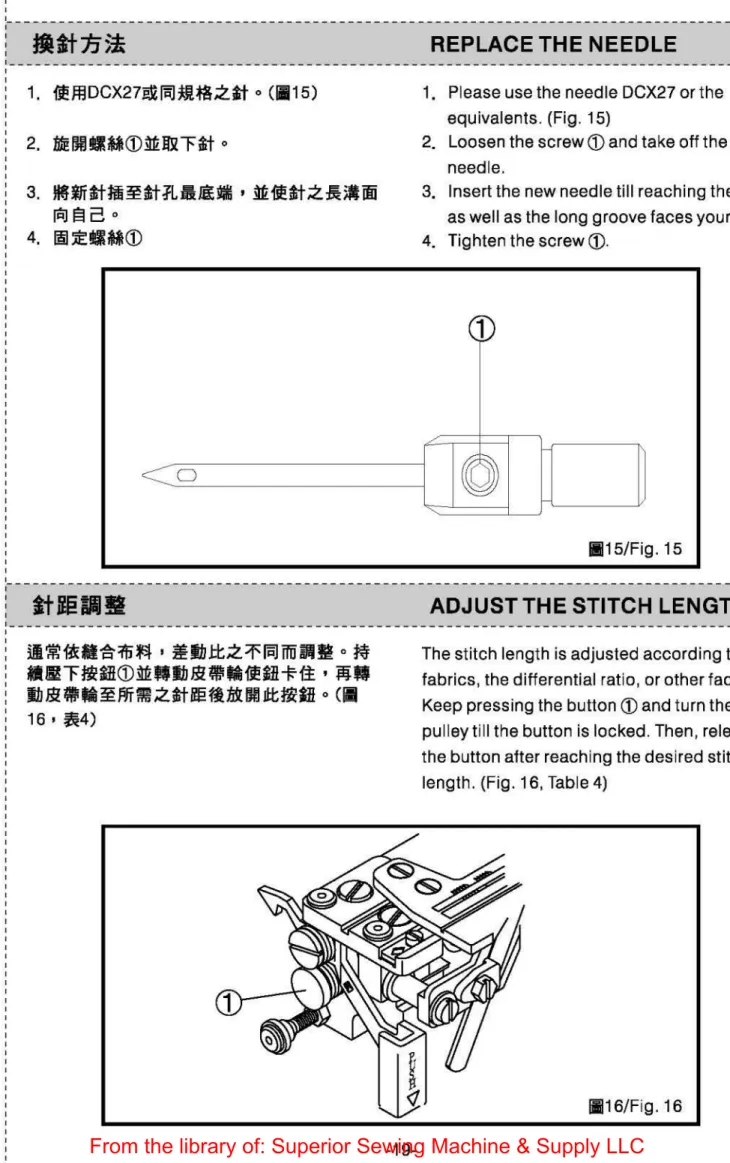
(.15) 1. Please use the needle DCX27 or the equivalents. (Fig. 15)2. tifi!ml!II**CD~Im'"fMo 2. Loosen the screw
CD
and take off the needle.3. ~~tiM¥tiRa~•·~~tiz~~oo 3. Insert the new needle till reaching the end,
JRJ~2o as well as the long groove faces your side.
4.
iJ)E!IIMCD
4. Tighten the screwCD.
1
0
1115/Fig. 15
~---·
I
ttBelll! ADJUST THE STITCH LENGTH
l_---~ -~ -~-~--------~ ~ ~------~-------~ ~ ~----
~mMM~~M·~ti~z~la.I~R~oM
•m'"'F~BCD~Mtim~MffO*~'M.
111m 1f¥nt
~ Pfim z tt BE fi nt rm Jlt tt&
oc •
16 ' fi4)
The stitch length is adjusted according to the fabrics, the differential ratio, or other factors. Keep pressing the button
CD
and turn thepulley till the button is locked. Then, release
the button after reaching the desired stitch
length. (Fig. 16, Table 4)
Max
Dif ratio Machine type Pulley scale
1
2 3 4 5 6 7
1:2 Seaming 1 1.5 2 2.5 3 3.5 3.8
1:3 Shirring 0.7
11.4 1.7 2 2.3 2.5
1:1.3 Serging 1.6 2.3 3 .1 3.9 4.7 5.4 5.9
1:4 Special 0.6 0.9 1.2 1.5 1.8 2.1
-~4/Table4
-- - - ---- -------- -- - - - ------ ---- -·- -·--------- - ------------- ---- ·--·-- - - -------- - - --- l
•11Jttll• ADJUST THE DIFFERENTIAL FEEDi
RATIO :
~~~~tt±~A~~~~~~AzM~n
tr.J
J:t~J 01.
~±~~Az~b~*~~~~~A-~~~·M•fl••~~~·&zM~fi o
2.
•~n$~~--~~•ti•~®m~•n~~~-fl~fi·&zM~~··~~
MlillE!I!I'*CD
o (.17)~:
-~-~®2~~~~tt~~~·~~
IIJJ:t~1: 1 f ~~~ISilEtt~JIJ2j.~J:Pi I R1"0011J~~~~1:
o .
1 o <e::~Jfi5)The differential feed ratio is the ratio of movements between main feed dog and differential feed dog.
1. When the movement of main feed dog is
bigger than differential feed dog, the
fabric is stretched in sewing and shirked to the contrary.
2. Loosen screw
<D
and turn the screw® in clockwise for stretching the fabric, and in reverse direction for shrinking the fabric, and then tighten the screw<D.
(Fig. 17) NOTE:When the surface of adjusting level@ be set at the scale 2 , the differential feed ratio is 1 :1, and if it is set over the scale 2, it can make the fabric stretch to the ratio 1:0. 7. (see Table 5)
II17/Fig.17
Scale 1
2 3 4 5
1:1.3 - 1:0.7 1 : 0.9 1:1.1 1:1.3
Diffe re ntial Feed ratio 1:2 1:0.7 1 :1 1:1.4 1:1.7 1:2
1 :3 1:1 1 :1.5 1 : 2 1 : 2 1 :3
1:4 1:1.1 1:1.6 1:2.3 1:2.3 1:3.3
~5/Table5
I - - - -...-- - - ---~------- - ------- - - - ------- - - ------- - - -~
,,
: afFIIiJftlaij LIGHTENING OF THE OPERATION
I
ENVIRONMENT
~ ~ ~ ~ ~ -~
- - - - ---
--~ ~ ~ ~--- -- - - - - -
~-- -
~-- - - -- -- ---
~~ ~ ~--
~ ---~-~mm-••~•~·~~~m~=I•m•
~~~~-~~a~mtt~-~~~*~ti
~M-·M·MttM·~~-;~~--~
ft*·A~--~~~ft~M·'·M~-
····~~~~~···~-~~-~
ft~~~-M~~~~~~ o ·~-~~-
18(fi~
Provide a warning that an industrial sewing unit or sewing system must always be unplugged from the local lighting of the sewing area before relamping, the marking of maximum rated input of a lamp shall be easily discernible while the lamp Is being replaced indicated on or near the lamp socket as shown on Fig. 18.
~:k51rt~· ····51 o mta~
Maximum···· ·51 0 Lum
~ 'J' 51rt ~- • • · · 430 )iff a~
Minimum··· 430 Lum
ii18/Fig. 18
,-----~---·
i flfF:f.f-j: CONDITIONS OF ALL OPERATORS
1. MS~71W1fffl~~-~~ o 1. Read and understand well the content of this instruction book.
2.
~illfH-3$rJ.Jft~~>1M*llo 2.
Know the functions of major parts and understand the notices.3.
7M3W~*IMZMJ.Io3.
Truely realize the meanings of all warning tags.4.
71WM~MH;Zji{1=1J~o 4.
Realize and be familiar with how to operate this machine.5. tl{1=~~1i~*lfliAA8.tlH
o
5. Operators have to keep well mental status.6. Operators shall wear appropiate and proper working suits.
7. Develop the familiarity of how to operate the machine if needed.
ii. MAINTENANCE I :
____________________________________________________________________________________________ j
A s±acAuTION
~ )I~JH'l=~iW I
fi+JJifj • •
0 -~Mielb~lllfti I fljj]tlltJf'F~·BA.A~11°
"'/..._1!-\_.Turn off the power switch before carrying out cleaning. The machine may operate if the treadle is pressed incautiously, which could result in injury.
!:::\
1J[]•5t)m~Jt5fblli I ~t!IZ-12~1i!IIUI2~-¥~ I J.)Jn~715mil.AIUI~~5o«szaJ:,
~\Ysliea~ o
Be sure to wear protective goggles and gloves when handling the lubricating oil and grease so that they do not get into your eyes or onto your skin, otherwise inflammation can be resulted.
!:::\
J'J5tt5m~j()dJ1"~ftm,
aftrJ~ftslmlftn±~Diil, ~5dLfiitt'J\~*1'¥1Ja9iii!n o\Y
Furthermore, do not drink or eat the oil nor the grease for they can cause vomiting and diarrhea. Keep the oil away of the reach of children.M~tl~~~~•m~·a~W-=Filfi~f'Fo
Use both hands to hold the machine head when tilting or returning it to its original
&position.
~ -~-~Jii~~-~-a9··~-~--~-~-fi~~o
If only using one hand to move the machine, the weight of the machine head may cause slipping and you may get hurt.
«1i•»
1. ~liH'A
2. ~~~•M®m~·~•m~~~® o
For keeping the machine quality and lengthening the usage term of this sewing machine, please maintain it everyday. In addition, before first use after a long idling time, please follow the following steps to maintain.
(CLEANING)
1. Raise the presser foot.
2. Remove the two screws®. and then remove the needle plate®.
3. Use a soft brush to clean dust and lints on the feed dog teeth@. (Fig. 19)
4. Install the need Ia plate® after cleaning.
1119/Fig. 19
(Periodical Maintenance Items)) (Table 6)
-f*llfi!J~
f*. JJ! §
Maintenance Cycle Maintenance Items
1. ~~~JJt.r.z.~~
1. Clean the lint on the feed dog.
mx.
2. ttit~-~~l[~~zlfltmrm o <~:lt:ff~flz.r...
-r~~~~c!1fOO) Daily 2. Check if there has enough liquid oil inside the oil pan. (The amountshould be between the red up and down paint mark of the oil level gauge.) 3. ~-3rui1'Ft:i'M~
3. Keep the machine and the operation table clean.
1.
~-~;;.·~~
l. Keep the power cords looking clean and neat.
~ 2. ~1J1'FOO~~
Weekly 2. Keep the operational panel clean
3. *:E:11${~{lf:~:S~JM!J!G;frlEif{ii~
3. Check if the power parts is loosening or still at the right position
4!=.00}3
1. J!~ftj?g;Z_~Jm~Quarterly 1. Change the liquid oil inside the oil pan 1i~ 1. *~ltl&:~:a!fz.~~m
Annually 1. Check the transmission belt to see if it is weariful or damaged
~6/Table6
TROUBLESHOOTING
A ~-CAUTION
A r±ilrrt&llt!HJilP.JzJFJ ,
D$tiiiJJ•J:t~tiw•ili,
6ftiJ~lHlM~NI1JJmlll, aM.J
~
tl*lbfF ,
~-B.A.&1i\ti oBefore processing the troubleshooting, please turn off the power switch and unplug the electronic cord. Otherwise, if touching the start switch incautiously, the sewing machine will function and will probably cause injuries happened o operators.
No. ffi.~
Problem
~~.&ilffl!'il1!
Exam and Adjustment
·!lt~~.:IJ :lfoi"fll!*)j!G~/
J \?
The tension of the needle thread is too loose or to tight?
@ilfflJJ!!!f!ltU.:!Jo
Adjust the needle thread tension
The Skipping Stitch ofNeedle Thread Choose the wrong needle?
@~J!l!C-El';;'JJ:lEII¥J:$!ltlJ!!*il~ljl1li!ijo
Select the needle
and threadnumber match the fabrics
• • !it 1' Jl!.?
Bad needle?
@~~l!i!lfo
Change a new needle
el!i!ltlJ!!tr./;;JW*iiffiZillH11lll~~?
Any
clearance between the needle and the
topof the left looper?
@IDIJ'I'Iftr.1;JW*!lffii~lli!ltZilll±O
Adjust the distance from the top of the left looper to the needle to
be±0
e~.:IJIDI!'!I!f/J~'liHmfJ'Ill?
The small spring of tension adjustment does not function?
@(1)/Ni!!l~Hmf'F!lJ~
·
~'l1¥!Jl'tL~~!!\'i o (~:@:) tl'A:I"<J!~~;Jitg:~~ 0(I) If
the small spring does not function, pull it to
bemore tightened. (Note) The brokeo thread
willhappen if pull the spring too tight.
(2)~ilffl!'ll!:fi;J!t~~Wi
'
Jl~:11i~~IDI!'II!:fi 0(2)
Ifthere is any groove existing on the tension
adjusting plate. please change a new one.e!lt~i¥1~.1J:ot~?
The tension of the needle thread is too tight?
@(l)tf'l!lt~~.:IJ ~ltilffll~ 0
(l)Loose the tension of the needle
thread
properly.No. :fl!il< * 1!!:.& iiliiJ~
Problem Exam and Ad'ustment
2.
M~ll9l'J'Wo:fl!~ (2)11'l!it~ll9W!I(A)ii'iiJ>IIHEJii!:i'iiif:!L~•
l!l::lilt~ll91;)The Skipping Stitch of Needle Thread
~m'(B)fl9!it~l!ll:t±:l:i:~:P•
3. ;b1;)!1f~ll9l'iWo
4
The Skipping Stitch of the Right Looper Thread
ti:1;JM~Il9l'J'Wo
The Skipping Stitch of Left Looper
(2)Adjust the line (A) of the needle thread to the highest position, so that the release amount of the needle thread from thread hooking will decrease.
(3)1!'l~(C)ti:@H!'b
• Wti.1.J01;JMil9tll!t.61t±:l:l: • (3)Lean the line (C) to left
alittle to increase the release
amount of the looper thread.
eki
1;1~r W:!l<
~r 1191111 'jjl::.t::*:?
The space between the
right
looper and needle is toowide?
@;b1;)MfE.Jkii.!!!.l&lf!i '
:ID.!IL!itil91111~&:·~.lmmJ'J l!l::flllE:\l!Jl<JtT1;JM • <ffol!:fl.!it •
~M• J!i!fl • 15 fl
fll1'H~1!1!>ilil'~ll9:fi 1;)~l
When the tight looper tum tight and backward, the distance to the needle has to be
0.1mm, which is using the correct right looper. (The appropriate tight looper for each type, such as single need, 2 needles, materials, and thin fabrics, are included)
e!ll'liltlf!i · :t11;JM-W:6:liltll9r.ll!il:7<:?
The distance is
toowide between the
rightand left needle when using 2 needles?
©>rn~ki1;J~~~il9ti:ki&~~.&ki1;J!ifmLT~
~&~z~~~~·r~ii'iil~tr1;JliltJ¥J~~~·
1'Eki1;Jlilt
T~lf!i •r-f:6:liltllUkililtll9TMHJ~:P•
Because the correlationship of the left/right position of theright looper while assembling and the up/down moving position of the right looper seat, adjust the movement path of the looper. When the right looper descends, d=ase the descending amount from left needle to right needle.
e;~e:t11;Jliltxxlf!i
• :t11;Jlilt
::flt1;J¥Uti:1;J!if~?The right looper
dido'!hook the left looper thread while they are crossing each other?
@~¥1f:6:1;Jlilt
• (;6:1;)lilf'cRftffilltffjl ·
'!!~IEII;f• ::ft<lolt'l
lil'ililllltf:\~7 j;Jft(}!jlf) •
Change the new left looper. (The top of the left looper
is worn. When fix and replace, the protrusion fo the
looper top shall not
beworn.
5
No.
l3i\11<
~'!'t:&iil!l~Problem
Exam and AdjustmentThe Skipping Stitch of Left Looper The wear of the right looper top?
!tit
Needle Broken
l
I Ij
/ /-
.
.
..
/ IThe Top of the Needle Damaged
~
\ i@~1'1f1;)~!liG!IIilll:O~<Rf!ffiii'.ilVoR 0
Change a new looper or use the oil stone
towear the
top.·-~1¥:1~~=1'~?
Choose the wrong needle?
@:tE:ffl:lSfNt~~:fLI¥Jliilii>!II"J
·
{]I!#Jf.l.!~~I¥J:iji'J}f-o
Use thick needle within the range that there will be no pinhole occurred on the fabric.
e.JI!!""I¥l""l!H .lit?
Bad assembling of the presser foot?
@';(~~~~~ffl:iji'j}f-~~.jlj!~~~~$*o
During assembly, make sure the needle can insert to the central point of the presser foot.
e¥&:ffl®l¥1'9:~lili1li.T~?
Wrong assembling height of the feeding teeth?
@illf~j!g:fflJ!iil'Jr!lJ!l<~
0.8mm-lmm'
[OJ~~~il'J .JI!!~ItiJ oAdjust the height of the feeding teeth
tobe around 0.8 mn to 1 mm. Meanwhile, keep the appropriate presser foot
pressure.-~~"''ll<?
Bad threading?
@~~:fUJ!iiii'i~ll'>%:/JofJ~lll!f&
•
ii-l'li~*&•
If
there is any connecting part of the thread, it needs to be dealt first. Then, rethreading.
The right looper and the needle have wrong height position?
©J:iji'j}f-:t£~~~~~~·m~m~~-~~oo~
~·~~<Rf!ffii~"''~~~~~j}f-·~~iil!l~-~~
1l1!liG:t11;)J}f-I¥Jlli!IIJ0:~·
When the needle moves close to the upper dead point,
push the needle forwards a little by finger. See whether
the
topof the needle touches the right looper or not. Then
adjust the height of the needle position or the moving
position of the right looper.
No. J31.~
Problem
jt~J;liif;J~
Exam an<f Adjustment 6. -~J-ij<iiffii~tll •m~ Jt:t:~lif'?
7
The Top of the Needle Damaged
Broken Tbread and Rough/Uneven Stitch
The
ejector plate is too close?©tll\
]lij(I(JJ<i~!t £'{(i:(Etc
1;)~(1(J~Jlffi!¥1J~l!L~:.bii!Ullff lli'f •
lltJ!ttlli~l1iftllll·
mroom~ Jtllifl!l~(I(Jill.l'j£,@lll'i'::k~
0.2mm •
The ejector plate inside must leave from the needle before the top of the left looper reaches the right side of the needle. The distance between the front ejector plate to the needle is about 0.2 mm.
·~t!li'ti.'~li!PI'W?
Incorrect needle plate assembling position?
©re~t!liNWi'ti.'~~A$*(1(}1lll~::k~~.
When assembling
the
needle plate. pullit
forwards a littleso that the space of part
Acan be larger.
-~~il'J~.fLl9.:flft?
The thread hole of the thread stand did not polish?
©!llli'J>~.fL/!flliiM7'6
·
Use emery cloth to polish the surroundings of the thread ,, hole.
// ·~(I(J~~r,;r~?
'F Choose the wrong thread?
/
©:11!~(1(]~'
~-W:'3EJ.
Change a better
thread
to balance the threads.·~(I(J~:!:Jml!'i'!!f?
Cannot adjust to the best thread tension?
©~~ft:.b1;J~(I(J~T-~~·~~~~~~~ili
'Jl.'l±:lil:¥1J:flllil(I(J*'l!'i!!ft •
Please be noted that the threads of the left/right looper should not be too loose. When adjust the position of one needle, the related changes of the threads are needed to be noticed.
A.N~~*'l!~ft1;J~*'l!~~:.b1;J~*'l!~~·
A. Pull the needle thread tightly--+the left looper is
loose~the right looper is tighter
B.N~ft~~~~:.b~~*'l!~~~~*'llili~~·
B. Poll the left looper thread tightly-+the right looper is looser--+the needle thread is looser, too.
C.
N~:.b1;)~f~~ft1;J~f*'lld~~l*'lld•
C. Poll the right looper thread tightly--+the left looper
No.
7
8
9.
m~
Problem
lfi*&W!iillil" "Hll
Broken Thread and Rough/Uneven Stitch
The Thread does not Come Out When Doing Chainstitch
~J'fliUJll~
Exam and Adjustment e1f!IJJ.~'i!il'illl~T
.l.i!.?
Incorrect adjustment of the presser foot spring?
@im!~1f!IJ'-5!i'l'i'E!leil"ffi'Z!ffll¥.rf!f:!SI
Adjust the presser foot flexibility to fit the fabric.
eW7JMtll?
The knife is worn?
@l!ftU7JD~:l!!lfl1~61t o
Sharpening the knife or changing a new one.
e£1!1tt*I!Bil"?
The differential ratio not match?
@iiiJJfi!Bi\":ffl:jSfi¥.J£11JJ21ifJfo
Adjust the dillerential feeding to match the feeding fabric.
The cam of the chainstitch looper is not appropriate?
@W!J~'I!I"R<J~lilili/Hir o
Adjust the cam
toan appropriate position.
·t.'l!~l*T
J.i!.?
Thread
tension device does not work well?
@(I )1\IIJ'!I!f~~5ilil3!'
(1
)adjust the spring strength
(2)!JmJ\';~~
(2)polishing or changing a new one
•1fll*1&5!11~3('i.H
J.i!.?
The presser foot rear spring did not assemble well?
©JmJi1iiml~l!i!~~lfl1~
•
ll!'1fll*mlli§~o·
il!zlill:;~t~:fJo
Readjust the spring or change a new one to make sure the presser foot can act smoothly and test its pressure.
Cannot Separate the Thin and Thick The eccentric is rusty?
Thread
@il'fi!.:F~~ll!I:B-il!'ii!Jl!ll3lU~llfiL.t oClean the stuck
partso the the oil can reach the cam.
eJ!ii.G,~lilili1'1!$U5!11'A'li!'il~T'M?
Inappropriate adjustment of the eccentric cam control spring?
@W!J~'!Oiz~i31'
•
{BTllJ~ oAdjust to the
propertension, but should not be too loose.
No. m:l!<
~'l't liUIIJ'!i!:
Problem
Exam and Adjustment9. f.llRIE~Offl~:fr ·~ltifilll!ilflll'iGt'iZ.71!-J}lll'iGt'i"F'i'?
Cannot Separate the
Thinand Thick Inappropriate match with the slide block of the
Thread stopper cam?
@(l)!l<JE
KP09DJ[)l't~ii'J'KP06FJ[)l't•
(!)Correct the width ofKP09D or polish the width of KP06F short.
(2)]!!jjr! KP09D/KP06F • (2)ChangeKF09D/KP06F
10.
fr!'fl '
ill~'. , i:.'lill!!!l!l!Jtl:\'l'?
Loud Noise, Strange Noise The
mainshaft is loose and has noise?
@ll'l:k'C.'J::fi<J~Jt'Z.Jill!ii~1l!f~
• mmii\111'11!: •
Clean lhe copper glue from lhe copper cover of lhe
mainshaft and readjust.
eJJian:tci1>11>JI'l?
Noise of lhe pump (scratchy?)
@!lim~:JJoll!iJJii!ll®4iill
•
~3-5
:B-Bll~llJ•
Use lhe fixture to add pressure on lhe gear of lhe pump, and keep lhe pump running 3-5 minutes.
-~~~~!liP.
The needle bar is loosening?
@ l!!!fUr r11.
~llliS ;!tl:~tfll1!ii
~zllll!Wl!!!! 'J' .
Change a new one or to polish the contacting surf act so that the clearance is smaller.
ei!.!!~
J::ti)i1MIIll!Wlz lill !E
1;1~111•
OOt~?The fixed hook of the connecting rod controlling the clearance is loosening or clashing?
@(l)~**:IJD~
(!)Add glue onto the screw ( 2 )lllf 11:11 * l,liG
{lljfil
(2)Polish the goove width wider or chamfer
(3)]!!jjr!~fo
(3)Change a new one.
e_L:r7JmftHW?
Incoorect position of the upper and the lower knife?
@i\111 '!IH7J r 7J %J !t ·
Adjust the angles of the upper and the lower knife.
No.
"-ll.~Problem II. :Of' fjgft
The Oil Does Not Splash
12.
JJ!t:'f''flj
The Knife Is Not Sharp
\ \\
. " \ \\
~
i!f liUill'l!£
Exam and Adjustment
e'lltnHl±iilll?
The oil docs not come out from the pump?
@(l).!li;~li{l!{i'I~
(2)Change a new filter
(3)m~~B9*~~~1\Ii
(3)Clean the dirt or change a new one
(4)/ll~t.l!mJmillll!ll
(4)Use the iron wire to clean thmugh the oil path.
ew;J:'f''fiJ?
The knife is not sharp?
@(I :JI'flj~]!!~1\fi
&'o
(l)Polishtior change a new one (2){i(1EJ:
TJJ!t~fii.l@'(2)Correct the angle of the upper and lower knife set
(3l!I!1\111Elifl!~~(~;l;l;jj';Wlf!/!~~)
(3)Reassemble it correctly (to assemble and adjust based on the norm)
ill!<2/Chart 2
I
~----------------------·
I
: ••. TABLE CUT-OUT
'---
1 A
·- I
~I I I II II 1 I I 1Q2Q
crrrmr::: 1 m
I. I. I.IJ.II.. l..l· j
L~~
~§ ~ ~~~~ ~ ~ ~
Bg_
~~~~ ~ ft!l A-AHli
._____---~~~
I
---1 I
DEMOLITION PROCEDURE
I1. •~w•••~~w~•~,fi-®&*
1.
When the machine needs to be eliminated m~Q~~~,~q~•••~~~~• and demolished, certain basic rules must.0
be observed to protect the environmentand public health.
2. ~~~~--~#Q~~m~~~•*• 2. ALL machine componenets must be
~M: divided according to categories as the
followings:
(1) Ji.lf~IIJf' RJfltl*ie'IJ~HlHIIP.lG~F~ (1) All sheathes, flexible hosing and
JIW,#o
plastic or non-metal components.(2)
•wwf¢: m111, !!fa,ijftAtf o
(2) Electricity components: switches, or lighting components.(3) Ma*ffl :
:S~ '~ff/RJfEPtifiDI (3) Insulation materials: rock wool, and}:to
flexible rubber strips.~)~~:··~·'·'·~~-~'
(4) Metals: ferrous metals, copper, ltf~~Hi~JIo
bronze and brass, various.3.
~~n~~~~~•RI~~-~~~~~3.
In this way, all materials can be eliminated~~~m~MM~RI~oom~~•~~~ correctly, recycled, or melted down for re-
~MfB1f.!jo use or disposed of so that they do not harm the environment.
I
~----------------------·
I