IOS Press
UFO: Unified Foundational Ontology
Giancarlo Guizzardia,b,∗, Alessander Botti Benevidesc, Claudenir M. Fonsecaa, Daniele Porellod, João Paulo A. Almeidac, and Tiago Prince Salesa
aConceptual and Cognitive Modeling Research Group, Free University of Bozen-Bolzano, Italy E-mail: [email protected]; [email protected]; [email protected]
bServices & Cybersecurity Group, University of Twente, The Netherlands
cOntology & Conceptual Modeling Research Group, Federal University of Espírito Santo, Brazil E-mail: [email protected]; [email protected]
dUniversity of Genoa, Italy Email: [email protected]
Abstract: The Unified Foundational Ontology (UFO) was developed over the last two decades by consistently putting together theories from areas such as formal ontology in philosophy, cognitive science, linguistics, and philosophical logics. It comprises a number of micro-theories addressing fundamental conceptual modeling notions, including entity types and relationship types.
The aim of this paper is to summarize the current state of UFO, presenting a formalization of the ontology, along with the analysis of a number of cases to illustrate the application of UFO and facilitate its comparison with other foundational ontologies in this special issue. (The cases originate from the First FOUST Workshop – the Foundational Stance, an international forum dedicated to Foundational Ontology research.)
Keywords: UFO, OntoUML, foundational ontology, ontological analysis, formal ontology
1. Introduction
For almost two decades now, the Unified Foundational Ontology (UFO) has been the focus of a long- term research program on ontological foundations for conceptual modeling. UFO (Guizzardi, 2005; Guiz- zardi et al., 2015b) was developed by consistently putting together theories from formal ontology in phi- losophy, cognitive science, linguistics, and philosophical logic. UFO is a four-category ontology that ad- dresses fundamental conceptual modeling notions via a set of micro-theories, including:
– a theory oftypes and taxonomic structuresthat is connected to a theory ofobject identifiers, includ- ing a formal semantics in a sortal quantified modal logic (Guizzardi et al., 2021);
– a theory ofpart-whole relations;
– a theory ofparticularized intrinsic properties, attributes and attribute value spaces(Guizzardi and Zamborlini, 2014), which includes a view on datatypes as semantic reference structures (Albu- querque and Guizzardi, 2013);
– a theory ofparticularized relational properties and relations, (Guarino and Guizzardi, 2015; Fon- seca et al., 2019), including a proposal forWeak Truthmaking (Guarino et al., 2019) connecting particularized properties to propositions;
– a theory ofroles;
– a theory ofevents(Guizzardi et al., 2013; Almeida et al., 2019; Benevides et al., 2019; Guizzardi et al., 2016), including aspects such as event mereology, temporal ordering of events, object partic- ipation in events, causation, change, and the connection between events and endurants via disposi- tions;
– a theory formulti-level modeling(Guizzardi et al., 2015a; Fonseca et al., 2021a).
*Corresponding Author: E-mail: [email protected].
1570-5838/21/$17.00 © 2021 – IOS Press and the authors. All rights reserved
This program was initially inspired by seminal work on ontological foundations for conceptual model- ing (Wand and Weber, 1989, 1990; Weber, 1997) that had employed the work of physicist and philoso- pher of science Mario Bunge (Bunge, 1977) to evaluate a number of conceptual modeling languages, in- cluding NIAM (Weber and Zhang, 1991), ER (Wand et al., 1999), UML (Evermann and Wand, 2001), and OWL (Bera and Wand, 2004). Despite the fruitfulness of the application of Bunge’s work to concep- tual modeling, it soon became clear that there was a mismatch between the purposes for which Bunge’s ontology was developed and the requirements of ontological foundations for conceptual modeling. This became manifest in the literature as the predictions made by the Bunge Wand Weber (BWW) approach found themselves in strong contrast with the intuitions and practical knowledge of modelers, as well as with some predictions unanimously shared by alternative approaches (Guizzardi et al., 2015b). For exam- ple, BWW disavowed reified relationships, a position that conflicted with modeling predictions made by other foundational theories, such as Jackendoff’s semantic structures (Veres and Hitchman, 2002; Veres and Mansson, 2005), and with evidence from practitioners (Hitchman, 2003).
It was clear from the outset that an ontological theory for conceptual modeling would have to counte- nance both individuals and types, accounting for not only substantials and their types but also accidents and their types (e.g. particularized properties, moments, qualities, modes, tropes, abstract particulars, as- pects, ways). In other words, a four-category ontology (Lowe and Lowe, 2006) was required. We needed particularized properties not only because they were of great importance in making sense of language and cognition (Parsons, 1990; Masolo et al., 2003; Davidson, 2001, Ch. 6), but because they would repeat- edly appear in the discourse of conceptual modelers. Moreover, particularized relations (relationships) and particularized intrinsic properties (e.g., often represented by the so-called weak entities) are frequently modeled as bearers of other particularized properties in the practice of conceptual modeling. In fact, as demonstrated by Guizzardi and colleagues (see Guizzardi, 2005; Guizzardi et al., 2006; Guarino and Guiz- zardi, 2015), many conceptual modeling problems can hardly be solved without considering particularized properties.
In initial papers for this project, Guizzardi and Wagner attempted to employ the General Formal On- tology (GFO) and the General Ontology Language (GOL) being developed in Leipzig, Germany, as a reference theory (Heller and Herre, 2004; Herre et al., 2004). More or less at the same time, a strong co- operation was established between them and the Laboratory for Applied Ontology (LOA – Trento, Italy), which was concurrently developing the Descriptive Ontology for Linguistic and Cognitive Engineering (DOLCE; Masolo et al., 2003). In this setting, their first attempt was to unify DOLCE and GFO to produce a reference foundational ontology for conceptual modeling, hence the name Unified Foundational Ontol- ogy (Guizzardi and Wagner, 2004). Both theories were philosophically sound, formally characterized, and based on the so-called Aristotelian Square, i.e., they were “four-category ontologies” (Lowe and Lowe, 2006).
UFO has since evolved, always focused on the requirements of the conceptual modeling discipline. In particular, ontological foundations for conceptual modeling would demand micro-theories to address its most fundamental constructs, namely, entity types and relationship types1. So, any reference theory for conceptual modeling would need a rich theory of entity (object) types and a rich theory of domain (also called material) relations. In the case of the former, we needed something in the spirit of the ontology of universals underlying the OntoClean methodology (Guarino and Welty, 2009) in order to systematize a number of notions that were pervasive in the conceptual modeling literature (e.g., types, roles, phases or states, mixins) but for which there were no precise definitions or consensus (Guizzardi, 2005). In that respect, GFO’s theory of universals still does not recognize these notions and DOLCE does not include universal as a category (DOLCE was designed as an ontology of particulars). Regarding the latter, DOLCE still does not include a theory of particularized relational properties (relational qualities) and the GFO theory of relations is subject to the so-called Bradley’s Regress (Bradley, 1893) and, hence, it can only be instantiated by infinite (logical) models. This feature renders it ill-suited for most conceptual modeling
1Hence, the name of the so-called Entity-Relationship approach that gives the name to the most important conference in conceptual modeling!
applications. Finally, there were many additional specific aspects needed for a general ontology for con- ceptual modeling that were not addressed by the existing approaches (e.g., attributes and datatypes, a rich theory of cognitively/linguistically motivated part-whole relations, higher-order types).
UFO’s evolution has also been influenced by its applications over the years. It has been employed as a basis for analyzing, reengineering, and integrating many modeling languages and standards in different domains (e.g., UML, BPMN, ArchiMate), as well as for the development of core and domain ontologies in different areas (Guizzardi et al., 2015b). For instance, it has been successfully used to provide conceptual clarification in complex domains such as risk, services, trust, law, biodiversity, design science research, among many others (a more comprehensive list is provided in Section 5).
Of all UFO’s applications, one deserves special attention, namely, the use of UFO in the design of an ontology-driven conceptual modeling language, which later came to be known as OntoUML (Guizzardi, 2005). This is a language that reflects the ontological micro-theories comprising UFO. The observation of the application of OntoUML over the years conducted by several groups in a variety of domains also amounted to a fruitful empirical source of knowledge regarding the language and its foundations2. In this paper, we incorporate the latest developments of UFO arising out of these observations (Guizzardi et al., 2021). More specifically, the fine-grained distinctions among types (differentiating types according to meta-types such asKinds,Phases,RolesandMixins) that were before only applied to substantials are now applied to endurants in general (including thusexistentially dependentendurants such as: qualities, e.g., the perceived value of the experience, the color of the apple;modes, e.g., Paul’s Dengue Fever, Matteo’s capacity of programming in Scratch; andrelators, e.g., John and Mary’s Marriage, Giovanni’s Employ- ment at the UN). These were needed to capture subtle aspects of domains such as value, service, economic exchange, and many others (Blums and Weigand, 2017; Carmo et al., 2017; Guarino and Guizzardi, 2015;
Zamborlini et al., 2017), and are also employed in some cases presented in this paper.
This paper can be consumed as an introduction to UFO, as we cover its main tenets (Section 2), its formalization (Section 3), its application to relevant illustrative domains (Section 4), and its relevance in the field of applied ontology and conceptual modeling (Section 5). Alternatively, readers interested in comparing UFO’s modeling approach with those of other foundational ontologies in this special issue may proceed directly to Section 4. As these examples are mainly represented by means of OntoUML models and all axioms in the paper are preceded by descriptions in natural language, the axioms can be largely skipped, with Section 3 serving as a reference of the axiomatization following the examples for those concerned with a more precise representation of UFO’s approach.
2. Principles and structure of UFO
The objective of UFO was, from the beginning, to provide foundations for domain analysis in concep- tual modeling, as well as for designing concrete models and modeling grammars. The idea was to develop a “Calculus of Content” aimed at supporting the ontological analysis, conceptual clarification, and seman- tic explicitation of the content embedded in representation artifacts. These, in turn, should support human users in tasks such as domain understanding, problem-solving, and meaning negotiation (Guarino et al., 2020).
As defended by the philosopher Kit Fine,“[...] the fundamental question of ontology is not ‘what is there?’ but ‘what is real?’[...] As a first stab, [...] what is real is what one must make reference to in giving a description of reality.”3. In this spirit, UFO aims at providing instruments for describing what is real, at the mesoscopic level, and as accounted for by human cognition. For this reason, not only rocks and animals are real, but so are enrollments, employments, presidential mandates, symptoms, covalent bonds, birthday parties and football matches, colors and electrical charges, organizations and constitutions, software systems and derivative contracts.
2Several dozens of these models are available athttp://purl.org/krdb-core/model-repository/.
3https://www.3-16am.co.uk/articles/metaphysical-kit
Given these objectives, UFO was constructed as a descriptive (as opposed to a revisionary) project (Strawson, 1959). This means that it is an ontology that takes into full consideration both cognitive and linguistic aspects informing its constituting categories. However, this is far from saying that reality is purely cognitively constructed. In this sense and, as put by Smith (2019),“[t]his is not to say that onto- logical items or entities—objects, properties, states of affairs, etc.—are ways of taking the world. Tables, detente, machinists, and love affairs are absolutely not merely epistemic entities... In that sense, [this view]
is stubbornly realist: all these entities are things beyond us, things in the world. [They] are not ‘ways of taking the world’, They are the world taken a certain way.”. From considering that “the world can be taken in many ways” (i.e., a pluralism of worldviews), it does not follow that anything goes, i.e., that all worldviews are equally valid or even acceptable. We should still “carve reality at its joints”, “joints”
that are supplied by concrete causal nexus of properties associated with natural and nominal kinds (Keil, 1992). There are, however, multiple ontologically viable and cognitively useful ways of doing that. The ul- timate goal of this project is, thus, providing well-founded engineering mechanisms for helping modelers to achieveintra-worldview consistency, i.e., ontological consistency when taking the world a certain way, andinter-worldview interoperability, i.e., making explicit the ontological commitments of a worldview such that different worldviews can safely interoperate.
UFO is organized in three main fragments:
– UFO-A, which is an ontology of endurants;
– UFO-B, which is an ontology of perdurants (Benevides et al., 2019);
– UFO-C, which is an ontology of social and intentional entities build on the foundations provided by the other two (de Oliveira Bringuente et al., 2011).
In this paper, we focus on the categories around UFO-A and a few categories of UFO-B, which are depicted in Figure 1. UFO is a 3D ontology having, as a fundamental distinction, the one between en- durants(e.g., Mick Jagger, the Moon, John’s headache, Mary’s marriage to Paul) andperdurants(e.g., the 2020 U.S. presidential election, the World War II, the UEFA Euro 2021 Final), as opposed to a 4D ontol- ogy in which all concrete individuals are perdurants. Endurants are individuals that exist in time with all their parts. They have essential and accidental properties and, hence, they can qualitatively change while maintaining their numerical identity (i.e., while remaining the same individual). The sorts of changes an endurant can undergo while maintaining its identity is defined by the uniqueKindit instantiates.
Perdurants4are individuals that unfold in time accumulating temporal parts. They are manifestations of dispositions and only exist in the past. As such, perdurants aremodally fragile, i.e., there is no cross-world identity between them and, hence, they cannot be in any way different than what they are (Guizzardi et al., 2016). Changes are perdurants but perdurants cannot be the subject of change. Any apparent change to a perdurant is either a variation (i.e., different temporal parts of an event having incompatible properties), or a change happening to some underlying endurant that is the focus of that event (Guizzardi et al., 2016). An endurant thenparticipates ina perdurant if that perdurant has a part that is amanifestation of adisposition inhering inthat endurant (Benevides et al., 2019).
Regarding the endurant fragment of the ontology, UFO is an ontology based of the so-calledAristotelian Square, thus, accounting for both substantial individuals (orSubstantials), i.e.,independent entities(e.g., Mick Jagger, the Free University of Bozen-Bolzano), as well as particularized properties, i.e., existen- tially dependent entitiesormoments, these last ones termed aspects, abstract particulars, or variable tropes (Moltmann, 2020). Moments are parasitic entities and can only exist byinhering inother entities.
Intrinsic momentsare existentially dependent on a single individual. These includequalities, i.e., reifi- cations of categorical properties such as color, height, weight, electrical charge. Qualities are entities that can be directly projected into certain value spaces. The latter, termedquality structures, are abstract entities delimiting the space of possible values (qualia, singular quale) for qualities of a given quality type. Quality structures can be either one-dimensional, in which case they are termedquality dimensions, or composed of multiple co-dependent dimensions (see also integral dimensions, Gärdenfors, 2004), in
4We often refer to perdurants as events, given that the latter is more easily understood by a non-philosophical audience.
Figure 1. The Taxonomy of UFO.
which case they are termedquality domains. While the former includes height and weight dimensions as examples (structures isomorphic to a subset of the positive half-line of real numbers), the later includes as examples the color spindle and the taste tetrahedron.
Intrinsic moments also includemodes. Modes can bear their own moments, including their own qual- ities, which can vary in independent ways. The category of modes includedispositions(e.g., functions, capabilities, capacities, vulnerabilities, etc.) as well as externally dependent entities (e.g., the love of John for Mary, the commitment of Paul towards Clara to meet for lunch next Friday). Externally dependent modesinhere in an entity while beingexternally dependenton another entity5. A particularly interesting type of externally dependent mode is a qua individual, which is a mode composed of other externally dependent modes that share the same bearer, the same source of external dependence, and the samefoun- dational event(Guizzardi, 2005). For instance, the sum of all commitments and claims of John towards Mary form such a complex mode that we could call John-qua-husband-of-Mary, as they all inhere in John, are externally dependent of Mary, and are founded in that particular wedding event. Likewise, arelator is a moment (i.e., an existentially dependent entity) that is an aggregation of qua individuals (Guizzardi, 2005). For instance, John and Mary’s Marriage is composed of John-qua-husband-of-Mary and Mary-qua- wife-of-John. A relator is, hence, existentially dependent on multiple individuals, namely, the bearers of its constituting qua individuals. Examples of relators include marriages, enrollments, employments, con- tracts, and presidential mandates. Externally dependent modes as well as relators serve as truthmarkers of material relations (Guarino and Guizzardi, 2015; Guarino et al., 2019), the first for one-sided relations and the second for double-sided (or multi-sided) ones (Fonseca et al., 2019).
Both substantials and moments are full-fledged endurants, being both able to bear moments, i.e., in- cluding cases involving moments of moments (e.g., the intensity of my headache, the hue of the color).
5That is, it is existentially dependent on an entity mereologically disjoint from the entity it inheres in (aka its bearer).
All endurants can have essential and accidental properties and can qualitatively change while maintaining their identity, provided they respect the principle of application provided by their respective Kinds. For example, John and Mary’s marriage can change from a marriage with full separation of assets to one with partial separation of assets. The way their marriage can change is defined by the Kind it instantiates (mar- riage). Additionally, all endurants can have parts (e.g., George’s employment to the UN is composed of a number of mutual claims and obligations).
Mereologically complex substantials are characterized by the different unity conditions that bind their parts together:
– Quantitiesare maximally-topologically-self-connected (e.g., pieces) of homeomerous amounts of matter, e.g., that puddle of water, this particular pile of sand;
– Collectivesare entities whose parts play the same role with respect to the whole, e.g., the Black Forest (as a collective of trees), a deck of cards, the Dutch-speaking group in the crowd; and – Objects(akafunctional complexes) are entities whose parts play differentiated functional roles with
respect to the whole, e.g, a human body, an organization, a computer, John’s car.
UFO is an ontology of both particulars and universals (or types), i.e., patterns of features that are re- peatable across different particulars. In fact, UFO is an ontology that also countenances high-order types, i.e., types whose instances are also types. The hierarchy of types in UFO reflects on the one hand the existing distinctions among sorts of individuals. So, we have perdurant types, substantial types, moment types, etc. On the other hand, UFO employs a number of formal meta-properties to spawn a rich typology of endurant types (Guizzardi et al., 2021).
As previously mentioned, a fundamental sort of endurant type is akind, which provides uniform prin- ciples of individuation, identity, and persistence to its instances. For example, the types person, dog, com- puter, car, headache, organization and marriage are typically considered to be kinds. Kinds apply to in- stantiating individuals in all possible situations in which these individuals exist, and hence kinds arerigid types, applying necessarily to their instances. Asortalis either a kind or a specialization of a kind, and every sortal that is not a kind specializes exactly one kind. These specializations can be either themselves rigid, in which case they are termedsubkinds(e.g., hatchback car as a subkind of car; financial organization as a subkind of organization) or they can beanti-rigid, i.e., classifying only contingently their instances.
Among the latter, we have sortals whose contingent classification conditions are intrinsic, termedPhases (e.g., teenager as a phase of person, hemorrhagic dengue fever as a phase of dengue fever, and tenured employment as a phase of employment), and we have sortals whose contingent classification conditions are relational, termedroles(e.g., employee as a role of a person in the scope of an employment relator, and husband as a role of a person in the scope of a marriage relator).
In contrast with sortals, non-sortals are types that represent common properties of individuals of multi- ple Kinds. These can be:
– categories: rigid types that define essential properties for their instances, e.g., the category ‘physical object’ describing the properties of having a mass and a spatial extension, common to things of the kinds car, person, bridge, cow, etc.;
– phase mixins: anti-rigid types that define contingent properties for their instances. Their instantiation is characterized byintrinsic contingent conditions. For example, the phase mixin ‘living animal’
may apply to instances of the kinds person, dog, and horse; the phase mixin ‘functional device’ may characterize instances of the kinds computer, watch, and espresso machine;
– role mixins: anti-rigid types that define contingent properties for their instances. Their instantiation is characterized by relational contingent conditions. Examples include ‘customer’ for the kinds person and organization, but also ‘insured legal relator’ for the kinds employment and enrollment;
– mixins: semi-rigid types that define properties that are essential to some of their instances but ac- cidental to some other instances (e.g., being a ‘music artist’ is essential to bands but accidental to people).
2.1. Summary
For the sake of comparison with other foundational ontologies within this special issue, we summarize UFO’s core positions in the list below:
I. UFO distinguishes between endurants and perdurants. Endurants are individuals that exist in time with all their parts. Perdurants are individuals that unfold in time accumulating temporal parts. An endurant can change while maintaining its identity, a perdurant cannot.
II. UFO accounts for the existence of both independent and dependent endurants. Independent en- durants are called substantials, while those that existentially depend on other individuals are dubbed moments. More precisely, a moment is said to inhere in another endurant. Perdurants are always dependent on the substantials that participate in them.
III. Perdurants are past entities in UFO and cannot genuinely change. Alleged change in a perdurant is thus either a reflection of a perdurant having temporal parts with different properties, or, a change in an endurant (e.g., a mode or relator) of which the event is a manifestation. Thus, instead of admitting those entities that Stout refers to as “processes” (Stout, 1997), we rather consider those underlying endurants as the subject of change, and track their manifestations in time.
IV. UFO accounts for (particularized) intrinsic and relational properties, which can serve as truth- makers for different types of relations and attributes. Particularized intrinsic properties that can be projected into a value space are deemed qualities, whilst those that cannot are deemed modes. Par- ticularized relational properties are called relators. The term quantity is reserved for substantials that are maximally-topologically-self-connected of homeomerous amounts of matter.
V. In UFO, roles are anti-rigid types whose instantiation occur in virtue of relational conditions. Roles that can be instantiated by individuals of a single kinds are simply termed roles, while those that can be instantiated by individuals of different kinds (thus, adhering to different identity principles) are termed roleMixins. There is no explicit definition of function in UFO.
3. The formalization of UFO in First-Order Modal Logic
In this section, we present a first-order modal theory of endurant types, in which types and their in- stances are both in the domain of quantification (i.e., first-order citizens), being connected by the instan- tiation relation (symbolized as “::”). For our purposes, the first-order modal logic QS5 plus the Barcan formula and its converse suffices (Fitting and Mendelsohn, 2012). That means that we assume a fixed domain of entities for every possible world, what is traditionally associated to apossibilisticview of the entities of the domain, i.e., the domain includes all thepossibilia. The modal operators ofnecessity(2) andpossibility(3) are used with their usual meaning.
We drop both the universal quantifier and the necessity operator in case their scope takes the full for- mula. Definitions, introduced by “def=”, “are to be viewed as extraneous conventions of notational abbrevi- ation” (Quine, 1937, p. 72). Axioms, theorems and definitions are indexed as in “(an)”, “(tn)” and “(dn),”
respectively. In a few cases when it is necessary to refer to the original formalization of UFO, we use
“(m.n)” to denote thenth axiom of themth chapter of Guizzardi (2005). Finally, this section is based on a first-order logic formalization of UFO6specified in the TPTP syntax (Sutcliffe, 2017), and submitted to multiple automated provers for consistency and satisfability checks.
6The complete first-order logic formalization of UFO in TPTP is available athttps://purl.org/ufo-formalization.
3.1. Types, individuals and instantiation
Firstly,typesare implicitly defined as those entities that are possibly instantiated (a1), whileindividuals are those necessarily not instantiated (a2). The domain of::isType∪Individual(a3) and it follows from (a1) that the codomain isType. We deal here only with first-order and second-order types (a4). Axioms (a1) and (a2) entail that entities are partitioned into individuals and types (t1), (t2).
a1 Type(x)↔3(∃y(y::x)) a2 Individual(x)↔2(¬∃y(y::x)) a3 x::y→(Type(x)∨Individual(x))
a4 ¬∃x, y, z(Type(x)∧x::y∧y::z) t1 Individual(x)∨Type(x)
t2 ¬∃x(Individual(x)∧Type(x))
We introduce thespecializationrelation between types (v) defining it in terms of necessary extensional inclusion (a5), i.e., inclusion of their instances. Proper specialization (<) is defined in the usual way (d1). By means of (a5), it follows that the specialization relation is quasi-reflexive (t3) and transitive (t4).
Whenever two types have a common instance, they must share a supertype or a subtype for this instance (a6).
a5 xvy↔Type(x)∧Type(y)∧2(∀z(z::x→z::y)) d1 x<ydef= xvy∧ ¬(yvx)
t3 xvy→(xvx∧yvy) t4 xvy∧y vz→xvz a6 ∀t1, t2, x((x::t1∧x::t2∧ ¬(t1vt2)∧ ¬(t2 vt1))→(∃t3(t1 vt3∧t2 vt3∧x::t3)∨
∃t3(t3vt1∧t3vt2∧x::t3)))
Among the individuals, there are concrete individuals (a7) and abstract individuals (a8)–(a10). Con- crete individuals are further differentiated into endurants (a11) and perdurants (a12). The classification of individuals into concrete and abstract individuals (a9), as well as the classification of concrete individuals into endurants and perdurants (a13)–(a14), are disjoint and complete.
a7 ConcreteIndividual(x)→Individual(x) a8 AbstractIndividual(x)→Individual(x)
a9 ConcreteIndividual(x)→ ¬AbstractIndividual(x) a10 Individual(x)↔ConcreteIndividual(x)∨
AbstractIndividual(x)
a11 Endurant(x)→ConcreteIndividual(x) a12 Perdurant(x)→ConcreteIndividual(x) a13 Endurant(x)→ ¬Perdurant(x)
a14 ConcreteIndividual(x)↔Endurant(x)∨
Perdurant(x)
Moreover, types are classified into types of endurants and types of perdurants (a15)–(a17), which are both disjoint (a17).
a15 EndurantType(x)→Type(x) a16 PerdurantType(x)→Type(x)
a17 EndurantType(x)→ ¬PerdurantType(x)
3.2. Some relevant type qualifications
UFO includes categories for types of endurants based on their rigidity and sortality. We implicitly definerigidityof endurant types as rigid (a18), anti-rigid (a19) and semi-rigid (a20), concluding that every endurant type is either one of the three (t5)–(t6). Also, rigid and semi-rigid types cannot specialize anti- rigid ones (t7)–(t8).
a18 Rigid(t)↔EndurantType(t)∧ ∀x(3(x::t)→2(x::t)) a19 AntiRigid(t)↔EndurantType(t)∧ ∀x(3(x::t)→3(¬x::t)) a20 SemiRigid(t)↔EndurantType(t)∧ ¬Rigid(t)∧ ¬AntiRigid(t)
t5 EndurantType(t)↔Rigid(t)∨AntiRigid(t)∨SemiRigid(t)
t6 ¬∃x((Rigid(x)∧AntiRigid(x))∨(Rigid(x)∧SemiRigid(x))∨(SemiRigid(x)∧AntiRigid(x))) t7 ¬∃x, y(Rigid(x)∧AntiRigid(y)∧xvy)
t8 ¬∃x, y(SemiRigid(x)∧AntiRigid(y)∧xvy)
On sortality, our basic assumption is that every endurant necessarily instantiates a kind (a21), and everything necessarily instantiates at most one kind (a22). We implicitly definesortalsas those endurant types whose instances necessarily instantiate the same kind (a23); while anon-sortalis an endurant type that is necessarily not a sortal (a24). As theorems, we have that: kinds are rigid (t9); kinds are necessarily disjoint (t10); a kind cannot specialize a different kind (t11); kinds are sortals (t12); sortals specialize a kind (t13); sortals cannot specialize different kinds (t14); a non-sortal cannot specialize a sortal (t15);
and non-sortals do not have direct instances, their instances are also instances of some sortal that either specializes the non-sortal, or specializes a common non-sortal supertype (t16).
a21 Endurant(x)→ ∃k(Kind(k)∧2(x::k))
a22 Kind(k)∧x::k→ ¬3(∃z(Kind(z)∧x::z∧z6=k))
a23 Sortal(t)↔EndurantType(t)∧ ∃k(Kind(k)∧2(∀x(x::t→x::k))) a24 NonSortal(t)↔EndurantType(t)∧ ¬Sortal(t)
t9 Kind(k)→Rigid(k)
t10 Kind(x)∧Kind(y)∧x6=y→2(¬∃z(z::x∧z::y)) t11 Kind(x)∧Kind(y)∧x6=y→(¬(xvy)∧ ¬(yvx)) t12 Kind(t)→Sortal(t)
t13 Sortal(x)→ ∃k(Kind(k)∧xvk)
t14 ¬∃x, y, z(Kind(y)∧Kind(z)∧y6=z∧xvy∧xvz) t15 ¬∃x, y(NonSortal(x)∧Sortal(y)∧xvy)
t16 (NonSortal(t)∧x::t)→(∃s(Sortal(s)∧svt∧x::s)∨ ∃n, s(NonSortal(n)∧Sortal(s)∧svn∧ tvn∧x::s))
Regarding the leaves of the taxonomy of endurant types according to their sortality and rigidity, kinds and subkinds are disjoint (a25), and together encompass all rigid sortals (a26). Phases and roles are disjoint (a27), and together encompass all antirigid sortals (a28). Semi-rigid sortals are those that are semi-rigid and sortal (a29). Categories are those types that are rigid and non-sortal (a30). Mixins are those types that are semirigid and non-sortal (a31). Phase-mixins and role-mixins are disjoint (a32), and together encom- pass all antirigid non-sortals (a33). LetLT be the set of the leaf categories of the aforementioned taxon- omy of endurant types {Kind,SubKind,Role,Phase,SemiRigidSortal,RoleMixin,PhaseMixin,Category, Mixin}, it follows that these leaf categories are pairwise disjoint (t17) and complete (t18).
a25 ¬∃t(Kind(t)∧SubKind(t))
a26 Kind(t)∨SubKind(t)↔Rigid(t)∧Sortal(t) a27 ¬∃t(Phase(t)∧Role(t))
a28 Phase(t)∨Role(t)↔AntiRigid(t)∧Sortal(t)
a29 SemiRigidSortal(t)↔SemiRigid(t)∧Sortal(t) a30 Category(t)↔Rigid(t)∧NonSortal(t) a31 Mixin(t)↔SemiRigid(t)∧NonSortal(t) a32 ¬∃t(PhaseMixin(t)∧RoleMixin(t)) a33 PhaseMixin(t)∨RoleMixin(t)↔AntiRigid(t)∧NonSortal(t)
t17 V
i,j∈LT,i6=j
i(t)→ ¬j(t) t18 EndurantType(x)↔ W
i∈LT
i(x)
3.3. Endurants
On the UFO taxonomy of endurants,Endurantis partitioned intoSubstantialandMoment(a34), (a35).
Additionally,Substantialis partitioned intoObject,CollectiveandQuantity(a36), (a37), (a38) and (a39).
Further,Moment is partitioned into Relator and IntrinsicMoment(a40), (a41). Finally, IntrinsicMoment is partitioned intoMode andQuality (a42), (a43). Let Le be the set of the leaf categories of endurants {Object,Collective,Quantity,Relator,Mode,Quality}, it is a theorem that these leaf categories partition Endurant(t19), (t20).
a34 Substantial(x)∨Moment(x)↔Endurant(x) a35 ¬∃x(Substantial(x)∧Moment(x))
a36 Object(x)∨Collective(x)∨Quantity(x)↔Substantial(x) a37 ¬∃x(Object(x)∧Collective(x))
a38 ¬∃x(Object(x)∧Quantity(x)) a39 ¬∃x(Collective(x)∧Quantity(x))
a40 Relator(x)∨IntrinsicMoment(x)↔Moment(x) a41 ¬∃x(Relator(x)∧IntrinsicMoment(x))
a42 Mode(x)∨Quality(x)↔IntrinsicMoment(x) a43 ¬∃x(Mode(x)∧Quality(x))
t19 V
i,j∈Le,i6=j
i(t)→ ¬j(t) t20 Endurant(x)↔ W
i∈Le
i(x)
3.4. Endurant types
We define an orthogonal taxonomy of endurant types according to the ontological nature of their instances. Let PE be the set of pairs {(EndurantType, Endurant); (PerdurantType, Perdurant);
(SubstantialType,Substantial); (MomentType,Moment)}; andPE0 be the set of pairs {(ObjectType,Ob- ject); (CollectiveType,Collective); (QuantityType, Quantity); (RelatorType, Relator); (ModeType,Mode);
(QualityType, Quality)}. We implicitly define these types in the axiom schema (a44). It follows that the types inPE0are pairwise disjoint (t21).
a44 V
(i,j)∈PE∪PE0
i(t)↔Type(t)∧2(∀x(x::t→j(x)))
t21 V
i,j∈{k|(k,_)∈PE0},i6=j
i(x)→ ¬j(x)
Kinds are also specialized according to the ontological nature of their instances. Let PK be the set of pairs {(ObjectKind, ObjectType); (CollectiveKind, CollectiveType); (QuantityKind, QuantityType);
(RelatorKind, RelatorType); (ModeKind, ModeType); (QualityKind, QualityType)}. We implicitly define these kinds in the axiom schema (a45). It is a theorem that all entities that possibly instantiate an endurant kind are endurants (t22). Moreover, every endurant instantiates one of the specific endurant kinds (a46).
It follows that every endurant sortal is a type inLES ={ObjectKind,CollectiveKind,QuantityKind,Re- latorKind,ModeKind,QualityKind,SubKind,Phase, Role,SemiRigidSortal} (t23); and that some sortals specialize specific kinds (t24).
a45 V
(i,j)∈PK
i(t)↔j(t)∧Kind(t)
t22 3(∃k((ObjectKind(k)∨CollectiveKind(k)∨QuantityKind(k)∨RelatorKind(k)∨ModeKind(k)∨ QualityKind(k))∧x::k))→Endurant(x)
a46 Endurant(x)→3(∃k((ObjectKind(k)∨CollectiveKind(k)∨QuantityKind(k)∨RelatorKind(k)∨ ModeKind(k)∨QualityKind(k))∧x::k))
t23 EndurantType(x)∧Sortal(x)→ W
i∈LES
i(x)
t24 (Sortal(t)∧(ObjectType(t)∨CollectiveType(t)∨QuantityType(t)∨RelatorType(t)∨ModeType(t)∨ QualityType(t)))↔ ∃k((ObjectKind(k)∨CollectiveKind(k)∨QuantityKind(k)∨
RelatorKind(k)∨ModeKind(k)∨QualityKind(k))∧tvk)
We have as theorems that the leaves of the taxonomy of endurant types—LET = {ObjectKind,Col- lectiveKind, QuantityKind, SubKind, RelatorKind, ModeKind, QualityKind, SemiRigidSortal, Category, Phase,Mixin,Role,PhaseMixin,RoleMixin}—are pairwise disjoint (t25); and that every endurant type is a type inLET (t26).
t25 V
i,j∈LET,i6=j
i(t)→ ¬j(t) t26 EndurantType(x)→ W
i∈LET
i(x)
3.5. Mereology
In the axioms (a47)–(a52) we formalize general extensional mereology (see Hovda, 2009). We present here the main axioms and definitions; for the purposes of the subsequent definitions, that suffices.
a47 P(x, x) (reflexivity)
a48 P(x, y)∧P(y, x)→x=y (anti-symmetry)
a49 P(x, y)∧P(y, z)→P(x, z) (transitivity)
a50 O(x, y)↔ ∃z(P(z, x)∧P(z, y)) (Overlap)
a51 ¬P(y, x)→ ∃z(P(z, y)∧ ¬O(z, x)) (Strong supplementation)
a52 PP(x, y)↔P(x, y)∧ ¬P(y, x) (Proper Part)
3.6. Composition
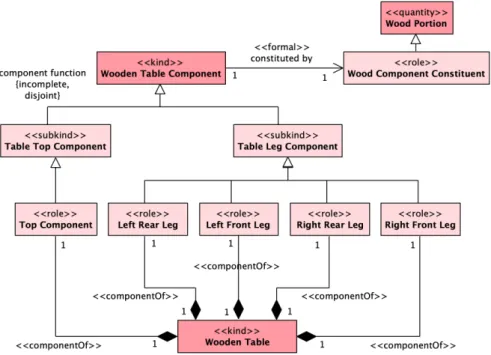
We summarize below the treatment of functional parts by Guizzardi (2005). We introduce a relation F(x, x0) between an objectx and a type x0, whose meaning is that “x functions asx0.” The relation of generic functional dependencebetween types is then defined as follows.
a53 gfd(x0, y0)↔ ∀x(x::x0∧F(x, x0)→ ∃y(¬(y=x)∧y::y0∧F(y, y0)))
We define the functional dependence between individualsxandyof typesx0 andy0 (respectively) as follows.
a54 ifd(x, x0, y, y0)↔gfd(x0, y0)∧x::x0∧y::y0∧(F(x, x0)→F(y, y0))
We can now introduce the notion ofcomponent of that we are going to use in the subsequent example.
a55 componentOf(x, x0, y, y0)↔xPPy∧ifd(x, x0, y, y0))
3.7. Constitution
We adopt here a very simple and preliminary view of constitution. First, it is a relation that holds between things of the same ontological category (a56).
a56 constitutedBy(x, y)→((Endurant(x)↔Endurant(y))∧(Perdurant(x)↔Perdurant(y)))
However, following Baker (2007), we have that constitution holds between things of different Kinds (a57). From this, we have the non-reflexivity of constitution as a theorem (t27). Notice that by instantiating different kinds, constituent and constituted obey different principles of identity, and have different modal properties (including different essential parts).7
a57 constitutedBy(x, y)∧(x::x0)∧(y::y0)∧Kind(x0)∧Kind(y0)→x0 6=y0 t27 ¬constitutedBy(x, x)
7Thomson (1998) requires the following condition to hold in constitution:“there must be at least one essential part of the constituent, and no part of the constituent is essential to the constituted”.
Any complete theory of constitution should explain why material properties of the constituent are sys- tematically related to those of the constituted. Typically, for physical endurants, the spatial location of the former are inherited by the latter8; for perdurants, the temporal properties of the former are constrained by the latter9. However, these derived relations can apply to many other properties, e.g., the weight, vol- ume, color, chemical structure of the statue are derived from the properties of the constituting clay (Baker, 2007). Now, it would be hard to defend that these derivation relations work the other way around as well (e.g., that the weight, volume, color, chemical structure of the lump of clay are derived from the properties of the constituted statue). In fact, although it is natural to conceptualizeThe Beatlesas being constituted by collective of John, Paul, George, Ringo, it is utterly unnatural to conceptualize the collective as being constituted byThe Beatles. Why is that? We believe that this is because constitution relies on a notion of grounding. This seems to also explain requirements such as the one proposed by Baker (2007) thatspecial circumstancesmust hold for the constituent to constitute the constituted (e.g., for the clay to constitute the statue, an intentional act of the sculptor is required), and that these circumstances are both necessary and sufficient.
This asymmetry is also often framed in terms of asymmetric cases of dependence (again, strongly connected to grounding). For example, every instance of statue of clay must be constituted by a particular lump of clay, but not the other way around, i.e., lumps of clay can exist without constituting statues. In other words, statues of clay aregenerically dependent on the type Lump of Clay. This can be captured with the notions of Generic Constitutional Dependence (GCD), between typesx0 andy0, as well as the type-level relation of Constitution (a59) betweenxof typex0, andyof typey0.
a58 GCD(x0, y0)↔ ∀x(x::x0)→ ∃y(y::y0)∧constitutedBy(x, y)
a59 Constitution(x, x0, y, y0)↔(x::x0)∧(y::y0)∧GCD(x0, y0)∧constitutedBy(x, y)
Now, using another example, we can have a Boxing Match being constituted by one or more punches (again, an asymmetric dependence). In this case, however, a specific Boxing Match is constituted by specific punching events, i.e., a case ofspecific dependence. This is because we are dealing here with a constitution relation between events and, as previously discussed, events are modally fragile entities and, hence, all their parts and constituents are necessary constituents (a60).
a60 ∀x, yPerdurant(x)∧constitutedBy(x, y)→2(ex(x)→constitutedBy(x, y))
In light of these notions of dependence, constitution seems to be similar to the relation of functional parthood (componentOf). ComponentOf is a material relation that also requires “special circumstances”
in order to hold. Due to the different configurations involving different types of dependence relations holding between functional parts, functional parthood is not irrestrictively transitive. In fact, transitivity only holds in certain scopes defined by these “special circumstances”. Maybe an analogous case can be made to explain why transitivity does not seem to hold for constitution irrestrictively either. For example, the human tissue that constitutes Paul McCartney does not constituteThe Beatles. Perhaps, like parthood (Guizzardi, 2005), constitution is not a single relation but a family of relations, each requiring additional axioms extending a very minimal common core.
Again, we advocate that a complete theory of constitution requires a proper theory of grounding. For this reason, we postpone proposing a complete theory for the former relation in UFO until we can fully advance a complete theory of the latter relation. In any case, to honor this strong intuition based on grounding (which is asymmetric) and asymmetric dependence, we assume here that constitution is an asymmetric relation (a61).
a61 constitutedBy(x, y)→ ¬constitutedBy(y, x)
8We do admit, however, relations of constitution between non-physical endurants. For example, a software program is consti- tuted by software code, not identical to it.
9For the case of parthood between events (Benevides et al., 2019), we have that the temporal interval framing the parts are part of the one framing the whole.Mutatis mutandis, for the case of constitution between events, we assume the same here for the relation between the temporal interval framing the constituent and the one framing the constituted.
In summary, in this rather simplified form, the general relation of constitution is taken here as a non- reflexive and asymmetric relation. Moreover, it is a relation that holds between entities of the same on- tological categories but between entities of different Kinds. Specific types of constituents and constituted entities can extend this minimal axiomatization, for example, to constraint relations between properties of physical endurants or events. A fuller theory of derivation of properties in this sense, however, waits for a fuller theory of grounding.
3.8. Existence and Existential Dependence
UFO introduces anexistence predicatedefined on any possible entity. In principle, we can view exis- tence as related to time,ex(x, t), however, as we are proposing here a single time slice formalization of UFO, we introduce in (a62) existence as a unary predicateex(x). By means of the existence predicate, we implicitly define in (a63) the relation ofexistential dependence between two entities,ed(x, y). We also implicitly define the notion of existential independence,ind(x, y), accordingly (a64).
a62 ex(x)→Thing(x)
a63 ed(x, y)↔2(ex(x)→ex(y)) a64 ind(x, y)↔ ¬ed(x, y)∧ ¬ed(y, x)
3.9. Moments and inherence
We summarize a few points of the formalization of substantials and moments of the original UFO, as they shall be required in the subsequent sections. Moments are known as variable tropes, abstract particulars, or particular qualities in the philosophical literature (Guizzardi, 2005). In UFO, moments can be viewed either as individualized properties, such as the color or the weight of an object, for the case of intrinsic moments, or a marriage or an enrollment, for the case of relational moments (relators), cf. (a40), (a41). The relation that connects moments to the object that they are about is the relation ofinherence.
Inherence is a type of existential dependence relation (a65) holding between a moment and an entity of which it depends, called itsbearer(a66).
a65 inheresIn(x, y)→ed(x, y) (6.4)
a66 inheresIn(x, y)→Moment(x)∧(Type(y)∨ConcreteIndividual(y))
(6.10) Moreover, a moment cannot inhere in two separate individuals (a67), this is the so-callednon-migration ornon-transferabilityprinciple (a67).
a67 inheresIn(x, y)∧inheresIn(x, z)→y=z (6.9)
Moments can also be involved in chains of inherence relations (d2), which are ultimately grounded on a unique entity that does not inhere in anything else. This entity that we will call here theUltimate Bearer.
(d3). Furthermore, the ultimate bearer of a moment is unique (a68).
d2 momentOf(m, x)def= inheresIn(m, x)∨ ∃y(inheresIn(m, y)∧momentOf(y, x))
d3 ultimateBearerOf(b, m)def= ¬Moment(b)∧momentOf(m, b) a68 Moment(m) → ∃!bultimateBearerOf(b, m)
Finally, in line with what was proposed originally in UFO (Guizzardi, 2005), we have the following theorems (t28)–(t30), i.e., inherence is a non-reflexive, asymmetric and anti-transitive relation.
t28 ¬inheresIn(x, x) (6.5)
t29 inheresIn(x, y)→ ¬inheresIn(y, x) (6.6)
t30 inheresIn(x, y)∧inheresIn(y, z)→ ¬inheresIn(x, z) (6.7)
3.10. Relators
We summarize below the presentation of relators by Guizzardi (2005). Recent investigations on rela- tors, relations, and their connections to perdurants (events) have been proposed by Guarino and Guiz- zardi (2015, 2016). We start by definingexternally dependent modes(a70): a modexthat is existentially dependent on an entity that is independent of the bearer ofx.
a69 externallyDependent(x, y)↔ed(x, y)∧ ∀z(inheresIn(x, z)→ind(y, z))
a70 ExternallyDependentMode(x)↔Mode(x)∧ ∃y(externallyDependent(x, y)) (6.42) Externally dependent modes indeed capture truly relational qualities. For instance, by being married to Mary, in virtue of this relation, John acquires a number of properties (i.e.modes) that depend on John’s relationship with Mary; John’s commitment towards Mary is a mode that depends on an individual that is existentially independent of the bearer of John’s commitment. The condition of existential independence excludes that an externally dependent mode may depend on individuals that are ontologically too close to the bearer of the mode. For instance, the courage of John is a mode that depends on John, who is not existentially independent of himself; for this reason, the courage of John is a mode that is not externally dependent.
Externally dependent modes (as well as relators, as we discuss later) are founded by means of a unique event (a71), (a72). E.g., John’s conjugal commitments towards Mary are founded on the event of the wedding between John and Mary. Since every externally dependent mode is founded by an unique event, we can definefoundationOf(x)by means of a definite description (d4).
a71 foundedBy(x, y)→(ExternallyDependentMode(x)∨Relator(x))∧Perdurant(y) a72 ExternallyDependentMode(x)→ ∃!y(foundedBy(x, y))
d4 foundationOf(x) =y↔foundedBy(x, y)
We can now explain what it means for an individualxto be aqua individual of another individualy: the relationquaIndividualOfholds betweenxandyiffxis the sum of all externally dependent modes ofythat share the same foundational event (a73). Moreover, an entity is aqua individualiff it is aquaIndividualOf another entity (a74). For instance, in virtue of the marriage with Mary, John is the bearer of a number of externally dependent modes related to conjugal commitments that constitute John-qua-husband-of-Mary.
For this reason, we view a qua individual as a complex externally dependent mode (a75), and so it has a unique foundation, which is the same as the foundation of its parts (a31). Finally, qua individuals are genuine individuals in the sense that they cannot be attached to two distinct particulars (a76). E.g., John qua student is the qua individual of John, not of any other person.
a73 quaIndividualOf(x, y)↔ ∀z(O(z, x)↔(ExternallyDependentMode(z)∧inheresIn(z, y)∧ foundationOf(z) =foundationOf(x)))
t31 quaIndividualOf(x, y)∧x0Px→foundationOf(x) =foundationOf(x0) a74 QuaIndividual(x)↔ ∃yquaIndividualOf(x, y)
a75 QuaIndividual(x)→ExternallyDependentMode(x) a76 quaIndividualOf(x, y)∧quaIndividualOf(x, y0)→y=y0
We assume that every relator is founded on a unique event (a77), which is also the foundation of the parts of the relator. Relators are then implicitly defined by (a79): they are sums of qua individuals that share the same foundation and are existentially dependent on each other.
a77 Relator(x)→ ∃!y(foundedBy(x, y))
a78 Relator(x)∧yPx→foundationOf(x) =foundationOf(y)
a79 Relator(x)↔ ∃y(PP(y, x))∧ ∀y, z((PP(y, x)∧PP(z, x))→(QuaIndividual(y)∧ QuaIndividual(z)∧(foundationOf(y) =foundationOf(z))∧ed(y, z)∧ed(z, y)))∧
∀y, z((PP(y, x)∧QuaIndividual(z)∧(foundationOf(y) =foundationOf(z))∧ed(y, z)∧ ed(z, y))→PP(z, x))
For example, John and Mary’s wedding is the foundation of a number of externally dependent modes of John that depend on Mary and of Mary that depend on John, the sum of which constitutes the marriage relator.
According to this view, relators bring about qua individuals. By (a79), there must exist at least two qua individuals,x0 andx00, that are part of the relator, given by the existence of a proper part in (a79) and by strong supplementation (a51). By (t32), those qua individuals are qua individuals of some other individual, y0 andy00. Thus, we establish (t32).
t32 Relator(x)→ ∃x0, x00, y0, y00(quaIndividualOf(x0, y0)∧quaIndividualOf(x00, y00))
We introduce the relation ofmediation,mediates(x, y), between a relatorxand an individualythat the relator connects in a relational statement (a80).
a80 mediates(x, y)↔Relator(x)∧Endurant(y)∧ ∃z.(quaIndividualOf(z, y)∧Pzx) t33 Relator(x)→ ∃y, z(y6=z∧mediates(x, y)∧mediates(x, z))
By axiom (a79), any relator has at least two distinct qua individuals as parts. Those qua individuals are associated to distinct individuals by (a74) and (a76), which are mediated by the relator by (a80). Thus, we infer (t33).10
Since a relator is a particular type of moment, it has to have a unique bearer, we define the bearer of the relator as the mereological sum of the individuals that the relator mediates. Moreover, a relator type is a type that applies to relators. For instance,marriageis a relator type of which the marriage between John and Mary is an instance. Relator types are defined according to schema (a44).
3.11. Characterization
Guizzardi (2005) states that a type ischaracterizedby moment types that inhere in its instances.
a81 characterization(t, m)→EndurantType(t)∧MomentType(m)∧
∀x.(x::t→ ∃y.(y::m∧inheresIn(y, x)))∧ ∀z.(z::m→ ∃!w.(w::t∧inheresIn(z, w))) In particular, for quality kinds, we have that:
a82 characterization(t, q)∧QualityType(q)→(∀x::q → ∃!y::t∧inheresIn(x, y))
3.12. Qualities and quality structures
In the following axioms, we use the standard notation from set-theory and arithmetic, i.e., membership
∈, set inclusion⊆, proper set inclusion⊂, Cartesian product×, the empty set∅, addition+, the greater or equal relation≥, and the natural number zero0, by appealing to their intuitive meaning. However, we will not commit to a specific theory.11
UFO groundsquality structuresin its taxonomy of abstract individuals, which in classified into sets and quales (a83)–(a85).
10Our theorem (t33) corresponds to axiom (6.45) in Guizzardi’s book (Guizzardi, 2005, §6.45). It is now a theorem, since we introduced a stronger definition of relators.
11A suitable set theory should be enough for expressing these notions. For instance, New Foundations with Urelements (NFU) + Infinity + Choice can represent first-order Peano arithmetic (PA) and Cartesian product. One problem here is that theories of arithmetic, like Robinson arithmetic (Q) and PA, have no finite models.
a83 Quale(x)→AbstractIndividual(x) a84 Set(x)→AbstractIndividual(x)
a85 ¬∃x(Quale(x)∧Set(x))
Aquality structureis defined as an entity associated with a uniquequality type(d5). Moreover, quality structures are non-empty sets (a86). The members of quality structures arequales, where an entity is a quale iff it is a member of a unique quality structure (a87). A quality structure is partitioned intoquality dimensionandquality domain(a88), (a89). Finally, given two quality types such that one properly special- izes the other, the sub-quality-type imposes constraints on the quality structure associated with the super- quality-type. Since quality structures are sets, the quality structure associated with the sub-quality-type must be a proper subset of the quality structure associated with the super-quality-type. For instance, given thatColoris associated withColorSpace, thenSkinColor(a subkind ofColor) is associated with a proper subset ofColorSpace. More formally, for any quality structuressands0 and quality typestandt0 such thatsis associated witht,s0 is associated witht0, andt0is a proper specialization oft, thens0is a proper subset ofs(a90).
d5 QualityStructure(x)def= ∃!t(QualityType(t)∧associatedWith(x, t)) (6.26)
a86 QualityStructure(x)→Set(x)∧x6=∅ (6.27)
a87 Quale(x)↔ ∃!y(QualityStructure(y)∧x∈y) (6.40)
a88 QualityStructure(x)↔QualityDomain(x)∨QualityDimension(x) (6.23) a89 QualityDomain(x)→ ¬QualityDimension(x)
a90 associatedWith(s, t)∧associatedWith(s0, t0)∧t0 <t→s0 ⊂s
An intrinsic moment type is a quality type iff it is associated with a unique quality structure (a91). A qualityis defined as an entity that instantiates a uniquequality kind(d6).
a91 QualityType(t)↔IntrinsicMomentType(t)∧ ∃!x(QualityStructure(x)∧associatedWith(x, t))(6.24)
d6 Quality(x)def= ∃!t(QualityKind(t)∧x::t) (6.25)
ThehasValuerelation holds from qualities to quales (a92), where hasValueis functional (a93). From (d6), we have that aqualityinstantiates a uniquequality kind, which from (a91) is associated to at least one quality structure. The axiom (a94) enforces each quale of aquality to be member of suchquality structures.
a92 hasValue(x, y)→Quality(x)∧Quale(y) (6.37)
a93 Quality(x)→ ∃!y(hasValue(x, y)) (6.39)
a94 hasValue(x, y)→ ∃t, s(x::t∧associatedWith(s, t)∧y ∈s) (6.38) UFO-A also defines what is for a quality (type) to besimpleorcomplex. Asimple qualityis a quality that bears nothing (d7). A complex quality is a quality but not a simple quality (d8). A simple quality typeis a quality type that have only simple qualities as instances (d9). Similarly, acomplex quality type is a quality type that have only complex qualities as instances (d10). Moreover, quality dimensions can only be associatedWith simple quality types, and vice versa (a95), while quality domains can only be associatedWithcomplex quality types, and vice versa (a96).
d7 SimpleQuality(x)def= Quality(x)∧ ¬∃y(inheresIn(y, x)) (6.28) d8 ComplexQuality(x)def= Quality(x)∧ ¬SimpleQuality(x) (6.29) d9 SimpleQualityType(t)def= QualityType(t)∧ ∀x(x::t→SimpleQuality(x)) (6.30) d10 ComplexQualityType(t)def= QualityType(t)∧ ∀x(x::t→ComplexQuality(x)) (6.31) a95 associatedWith(x, y)→(QualityDimension(x)↔SimpleQualityType(y)) (6.34) a96 associatedWith(x, y)→(QualityDomain(x)↔ComplexQualityType(y)) (6.35)