Thesis submitted to the examination committee of the Programa de Pós-Graduação em Engenharia Elétrica of the Universidade Federal do Pará to obtain a PhD in electrical engineering, with an emphasis on telecommunications. The development of the model was carried out in a mixed urban-river-forest trail located in the Amazon region.
Introduction
- Motivation
- General objectives
- Thesis Contributions
- Thesis Organization
This analysis will show the applicability and validation of the model proposed in this thesis. The results presented confirm the applicability of the model to the case study analyzed in this thesis.
Related Work
Related Works about Mixed Paths
In this work [29], a mixed land-ocean UHF measurement campaign was developed in the Netherlands and England. In this recent study [36], the use of the Millington correction factor for on-body propagation in the 60-GHz band was verified.
Related work about Dyadic Green's Functions
In this work [43], the author developed a method using dyadic Green's functions to solve electromagnetic wave propagation in layered media. Electric and magnetic types of dyadic Green's functions were derived in this article [45]. Using the principle of scattering superposition, dyadic Green's functions in each of several loads were constructed in general for such EM current sources located in any layer of the waveguide.
Analytical expressions for the scattering dyadic Green's function coefficients were obtained in terms of transmission matrices. In this study [47], a rigorous formulation of the dyadic Green's function for the problem of electromagnetic radiation from a point source of excitation embedded in an arbitrary layer of the circular cylindrical multilayer media was presented in terms of matrices of the cylindrical vector wave function. A complete eigenfunction expansion of the dyadic Green's functions (DGFs) for planar arbitrary multilayered anisotropic media using cylindrical vector wave functions is realized in this work [42].
In this paper [49] a dyadic Green's function for an arbitrary shaped lossy dielectric object is presented. The application of the presented Dyadic Green's function enables a detailed study of the radiation pattern and power loss of an antenna in the presence of a lossy medium. Each component of the electric field in the spectral domain forms the spectral Green's function in layered media.
Final Considerations
Efficient and accurate calculation of the dyadic Green function of the electric field in layered media (MIN HYUNG CHO and WEI CAI – 2017). In this paper concise and explicit formulas are derived for the functions of Dyadic Greens, which represent the electric and magnetic fields due to a dipole source placed in a layered medium [52]. The electric and magnetic fields in the spectral domain for half space are expressed using Fresnel reflection and transmission coefficients.
Green's function in the spatial domain is restored using Sommerfeld integrals for each component in the spectral domain. Using the Bessel identities reduces the number of Sommerfeld integrals, resulting in much simpler and more efficient formulas for numerical implementation. The author uses this approach to develop the Green function of two and three layers.
Theoretical Basis for formulation of electric field using Dyadic Green's Functions
- Introduction
- Expansion of Dyadic Green’s Functions in Eigenfunctions
- Cylindrical Waves
- Dyadic Green's functions for Free Space
- Dyadic Green's Function for N-Layers Media
- Boundary conditions for N-layers Medium
- Final Considerations
Equations (3.14) and (3.15) show that the electromagnetic fields due to an arbitrary current source are determined by the knowledge of the associated Dyadic Green's function. Therefore, it is necessary to know the solutions of the differential equations for the Green's functions given by (3.5) and (3.6). Once the expansion in the eigenfunctions of the dyadic delta function is known, the representation of the dyadic Green's function can be found.
According to Morse and Feshbach [54] the expansion of the dyadic delta function is given by. Given the symmetry of the proposed problems, cylindrical vector wave functions can be used in the expansion of Dyadic Green's functions given by (3.21). Equation (3.28) can be constructed in terms of Bessel functions of the first species, called 𝜓𝑛(1), formed by 𝐽𝑛, and 𝜓𝑛(2) or 𝜓𝑛(3) formed by 𝑁𝑛 or 𝜓𝑛(1), respectively. respectively.
The function of the electric-type Dyadic Green, 𝐺̿𝑒𝑜 (𝑅̅/𝑅′̅), which satisfies (3.5) and the Sommerfeld radiation conditions, will be used to construct the functions of the Dyadic Green for the problem of multiple dielectric layers. Using the scattering superposition method, the DGF of the electrical type, 𝐺̿𝑒(𝑝 𝑓) (𝑅̅/𝑅′̅ ), is displayed in a given “𝒑” layer, with the current source located in the layer. In [57] the explanation and full development of the calculation of the electric field produced by an electric dipole for a medium of two and three.
Dyadic Green's Functions for the Calculation of the Electric Field in Mixed Paths
- Introduction
- Electrical Dyadic Green's Function
- Dyadic Green’s function 𝑮 ̿ 𝒆𝒔
- Dyadic Green’s function 𝑮 ̿ 𝒆𝒔
- Electrical Field Calculation
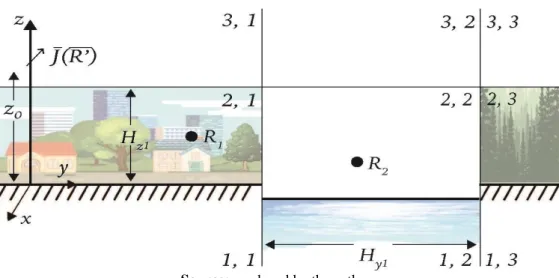
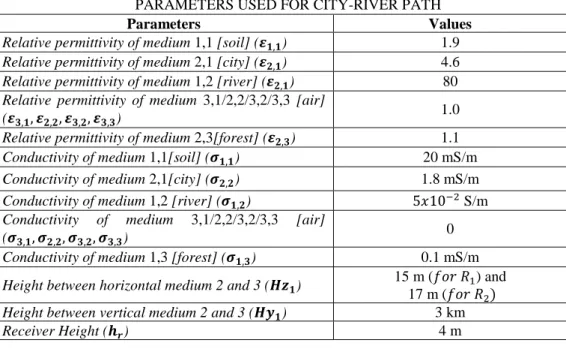
- Formulation of the Electric Field for the Mixed City-River Path
- Calculation of 𝑹 𝟏 : Receiver in the city
- Calculation of 𝑹 𝟐 : Receiver over the River
- Final Considerations
As shown in the previous chapter, the following eigenfunctions and (3.34) are found by performing the expansion of the Dyadic Green Functions. The source Tx represents a dipole (vertical, horizontal or a combination of both) and is located on the 𝑧 coordinate of the 𝑥𝑦𝑧 cartesian axis. Using the scattering superposition method, the DGF of the electric type, 𝐺̿𝑒(𝑟 𝑡) (𝑅̅/𝑅′̅ ), is in a position for receiver "𝑟 = (𝑝𝑟, 𝑞𝑟)", with the current source position located.
The notations 𝑝𝑟 and 𝑝𝑡 are the position in the horizontal layer for receiver and transmitter respectively, for the vertical layer the position of the receiver is 𝑞𝑟 and 𝑞𝑡 for the. The electric field given by (4.15) is obtained by a rigorous analysis of the eigenfunction expansion of DGF [20]. The addition of this term does not duplicate the calculation of the electric field, because the use of 𝐺̿𝑒𝑠(𝑟 𝑡)𝒗 does not add a direct field (computed only once by (4.6) if it exists, ensuring their uniqueness by 𝛿𝑡𝑟).
The forest is considered along the way because it affects the boundary condition calculations with reflected and refracted waves, although no data was collected inside the forest. In this chapter, all formulations for calculating the electric field have been developed using Dyadic Green's functions. The electric field given by (4.15) is obtained by rigorous analysis of the eigenfunction of the DGF expansion.

Measurement Campaigns
Measurements
5.1, the data was not considered because there are paths in the city and on the river. Moreover, the broadcast antenna is static in the city and has a height of 114.58 m above the ground. The receiving antenna was placed on the deck of the boat and was oriented to obtain the maximum reception power at each reception point.
In the month of March, a climate transition is observed in the region, passing from a rainy period to a dry period, and the measurements were made in the afternoon without rain. The same equipment used in the river measurements was used for field reception. The receiving antenna was placed on a vehicle at a height of 4 m above the ground and directed to obtain the maximum value of the receiving power at each measurement point.
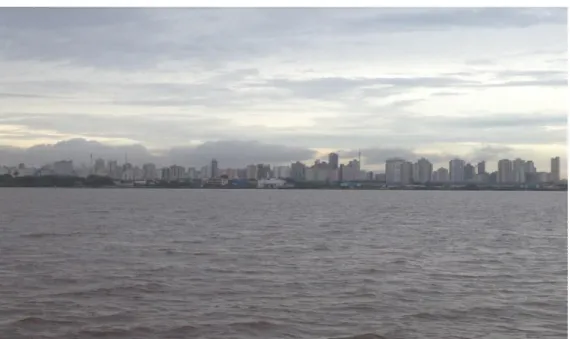
The radials in the city follow the direction of the radial in the water, as shown in Fig. Additional measurements were carried out in the city with points spread over an area of at least 2 km and a maximum distance of 20 km from the transmitter covering urban and. It is important to note that there are no large or rough waves in the river, the surface of the river is practically flat, as shown in Fig.
Measurements Uncertainties
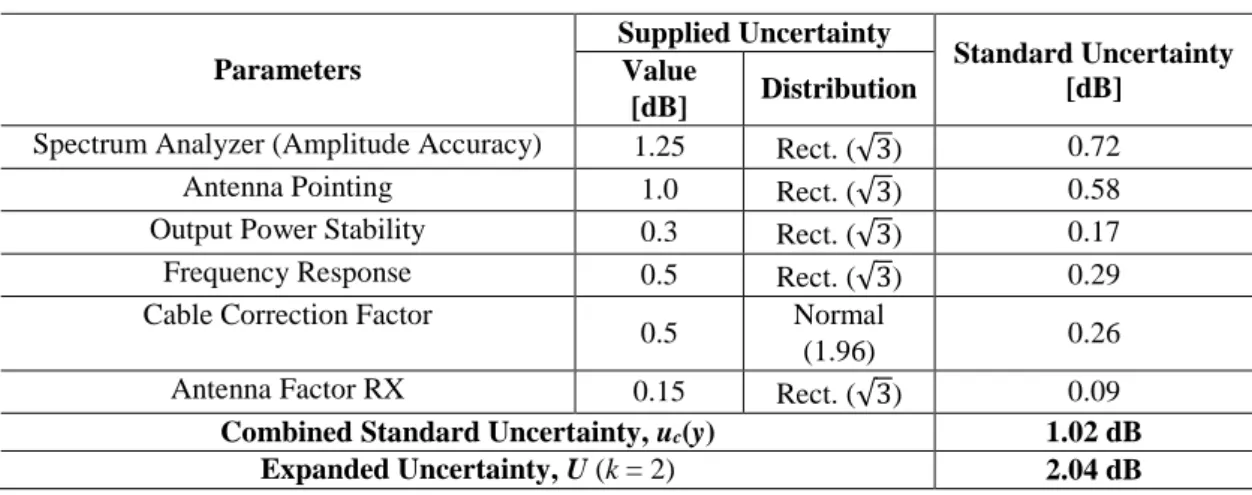
The data was collected similarly to the mixed path in this additional measurement, and the points were measured from 200 to 200 meters. It was necessary to extract the terrain profile from the transmitter to each of the mixed path measurement points to apply ITU-R Recommendation P. The transmission for the digital channel has a center frequency of 521 MHz, so the supplied uncertainty for frequency stability results in a value (10−5) that is not included in Table I.
According to the Spectrum Analyzer data sheet [59], the operating temperature range is –10 ºC to 55 ºC with a maximum relative humidity of 95%. The temperature was between 29ºC to 31ºC and the humidity was on average 70% in the period of measurements. There is no error information that includes temperature and humidity according to the data sheet of the Spectrum Analyzer, so the uncertainty of temperature and humidity measurement has not been taken into account.
Final Considerations
Results
- Preliminary Considerations
- Sensitivity of the model to parameters
- Results for a Two-Layered Medium
- Results for a Three-Layered Medium
- Results for a City-River-Forest Path
- Final Considerations
Comparison of the model using DGF for two-layer media with some models available in the literature for VHF and UHF; Comparison of the model with DGF for two-layer media with the measured data from the first measurement; Comparison of the model with DGF for three-layer media with the measured data from the first measurement for situation II and examination of the model using situation I;
When the conductivity is 5 times greater than the reference, there is a difference of 6.62 dB in the value of the electric field. Since the obtained data do not have the characteristics used in the calculation of the electric field, a graphical analysis is not performed for Situation I. Considering this case and a receiver located at a height of 25 m, the graph of the electric field using DGF for three-layer medium Situation I is presented in fig.
At a distance of 2.7 km, an increase in the electric field strength at the city-river interface is observed in the measured data above the river, known as the recovery effect, shown in the figure. Representation of the electric field in water using DGF follows the data measured after signal amplification. By using a three-layer situation I or II model for the city, we can get slightly better results in the calculation of the electric field compared to the two-layer model.

Conclusions
List of Publications
Cavalcante, "Radio-Wave Propagation Predictions in a Three-Layered Medium for VHF/UHF based on Dyadic Green's Function," presented at the 9th European Conference on Antennas and Propagation, Lisbon, Portugal, April. A Mixed Path Propagation Model Using Dyadic Green's Functions: A Case Study over the River for a City-River-Forest Path," IEEE Antennas and Wireless Propagation Letters, 2018. Oswald, "On the Computation of Electromagnetic Dyadic Green's Function in Spherically Multilayered Media,” IEEE Trans.
Giarola, “Analysis of electromagnetic wave propagation in multilayer media using dyadic Green functions,” Radio Sci., vol. Martin-Moreno, “Analytical expressions for the function of electromagnetic dyadic green in graphene and thin films”, IEEE J. 47] Zhonggui Xiang and Yilong Lu, “Electromagnetic dyadic green function in cylindrical multilayer media”, IEEE Trans.
Cavalcante, 'Radio wave propagation model for UHF band in different climatic conditions with the function of Dyadic Green', J. Cavalcante, 'Electric field prediction for VHF and UHF systems using the functions of Dyadic Green', 16th SBMO - Brazilian Symp. Cavalcante, “Radio-wave propagation forecasts in a three-layered medium for VHF/UHF based on dyadic Green’s function”, in 2015, 9th European Conference on Antennas and Propagation (EuCAP), Lisbon, 2015.