In the last two decades, the strength of the links with the central economies has been the dominant factor for most financial variables. Again, long-term interest rates in industrialized countries register high correlations with the US, particularly in In recent years, all the advanced major economies, the US, the Eurozone and Japan, have implemented extremely loose monetary policy in the aftermath of the Global Financial Crisis (GFC).
We use these shadow rates for the three advanced economies to estimate more realistic correlations between the policy interest rates of the center economies and the sample countries. The (government) term spread is the difference between the long-term interest rate (usually government bonds with a ten-year term) and the short-term policy interest rate – i.e. the slope of the yield curve. Excluding China also reduces data limitations, especially for the second step of the estimation procedure.
Moreover, China is excluded due to the specificity in which China is considered one of the major economies. We use Aizenman and Ito's (2013) crisis dummies to identify the two types of crises.
First-Step Estimations
Finally, for the changes in the REER, the movements of the center economies are crucial for both groups of countries. Interestingly, most of the developing countries seem sensitive to the REER moves of the center economies in 2010-2012. Overall, in line with Rey (2013), these figures suggest that economies, both advanced and developing, are subject to the financial conditions of the center economies.
In the next section we examine the determinants of the degree of sensitivity to the financial conditions of the center economies. It presents the share of countries for which the estimated coefficients of the center economies apply. The high percentage of countries with a ˆEURO > 0 probably reflects the debt crisis in the eurozone.
The influence of the center economies for term spread is difficult to ascertain, except that the euro area is again a dominant economy in the 2007-09 period. Overall, the degree of contribution to the adjusted R-squared of including China as one of the center economies depends on the financial variable examined.
Results of the Second-Step Estimation
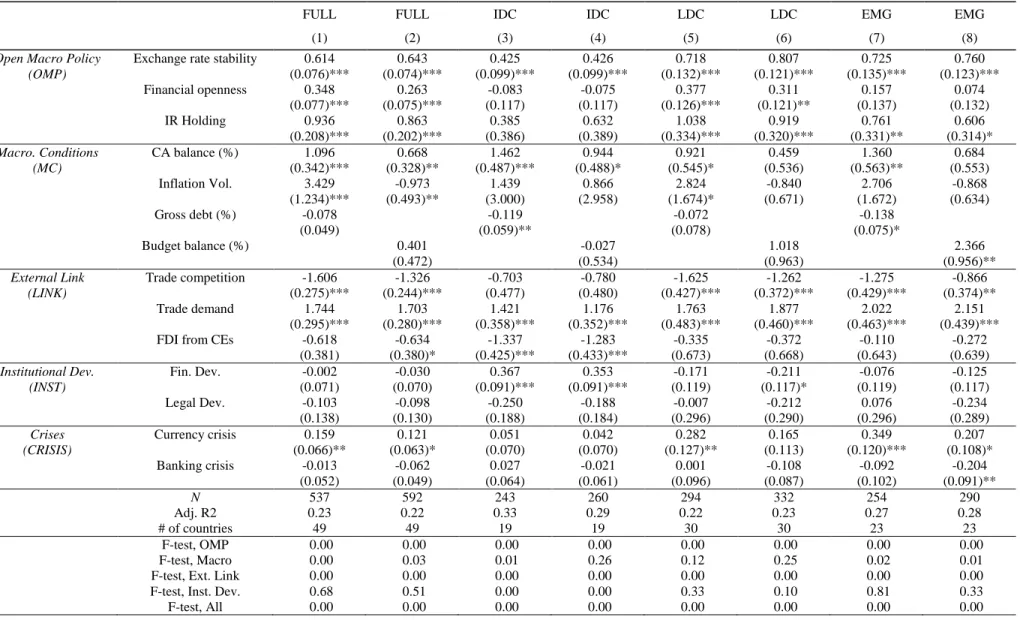
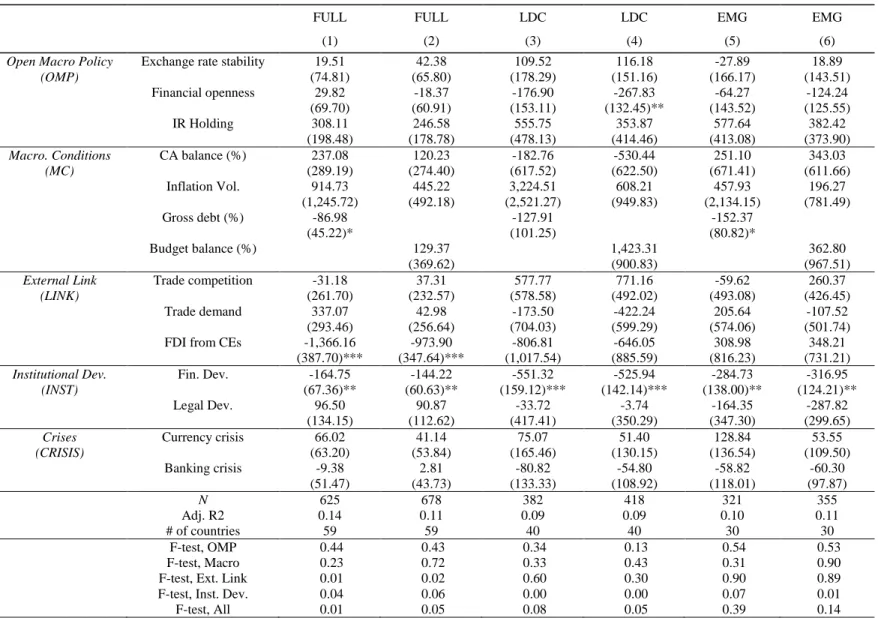
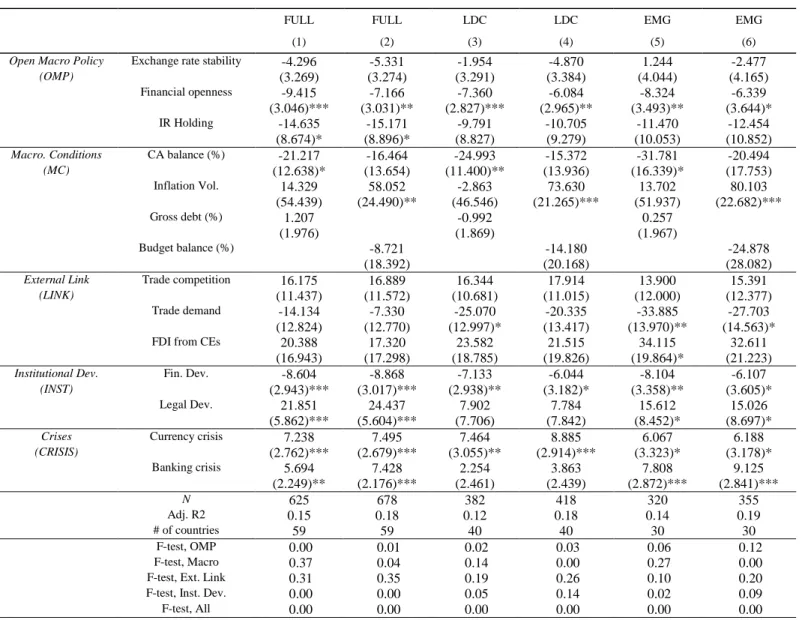
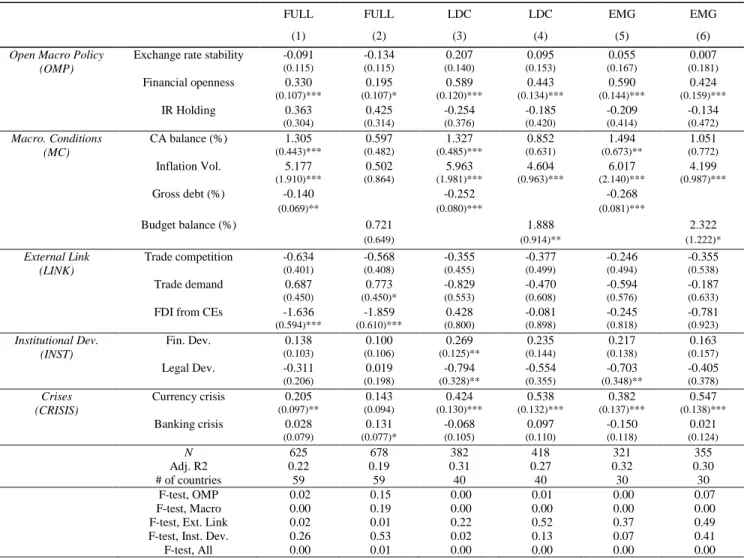
Financial openness also contributes to a higher degree of sensitivity to the interest rates of the central economies' policies. The result shows that a net exporter of capital is more sensitive to the monetary policy of central economies than an importer. A country that receives more foreign direct investment from central economies is usually more sensitive to changes in the monetary policies of central economies. 29.
Countries with more developed financial markets tend to be more sensitive to the changes in the monetary policy of the central economies. Interestingly, regardless of group, a country with a higher level of IR stock tends to be more sensitive to REER changes in the center economies. Emerging market countries with larger government debt or budget deficits tend to be less sensitive to the REER of the core economies.
Not surprisingly, countries with greater bilateral trade links with the center economies tend to be more sensitive to the REER movements of the center economies. In contrast, countries with more developed financial markets tend to be less sensitive to the REER movements of the central economies.
Robustness Checks
The negative impact of trade competition means that peripheral countries with a more competitive trade structure with that of the central economies tend to become alternative investment destinations if a shock occurs in the central economies. For example, if a shock occurs in a way that causes a real depreciation of the currencies of the central economies, such as the expected increase in output, an institutional change that would increase the level of labor rigidity and a decrease in appetite for the center. These results are consistent with the observation that greater financial development allows a country to have more flexible exchange rates.
Therefore, we conclude that our estimation results are not driven by the extreme value of the explanatory and dependent variables during financial shocks.
Further Analyses
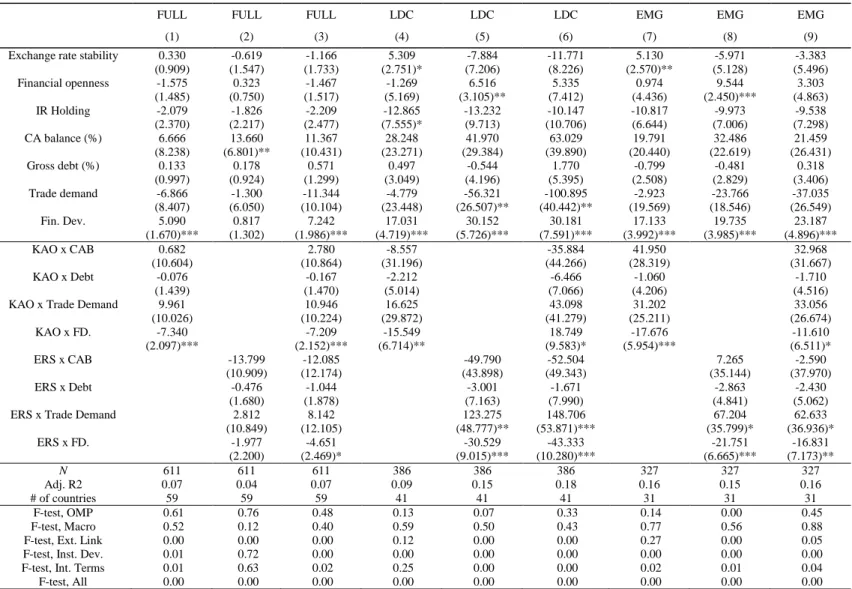
Such a positive interactive effect between import demand from central economies and greater exchange rate stability is also observed in the estimate for the stock price connectivity model (Table 3 (c)). Peripheral economies facing strong trade demand from core economies could be more sensitive to stock market movements in the core. The types of trilemma regimes could also affect connectivity to core economies through the REER.
The financial variables of the center economies that we focus on are policy interest rates, REER and EMP. The financial variables of the center economies (CE) we focus on can be correlated with the EMP of the peripheral economies. The EMP of developing countries is somewhat more vulnerable to the REER movements of the center economies.
In general, the GDP of developing countries is more exposed to the impact of the GDP of central economies. The PMM is seen as more sensitive to movements in the PMM of the core economies. Figures made using the model with China as one of the central economies give similar patterns.
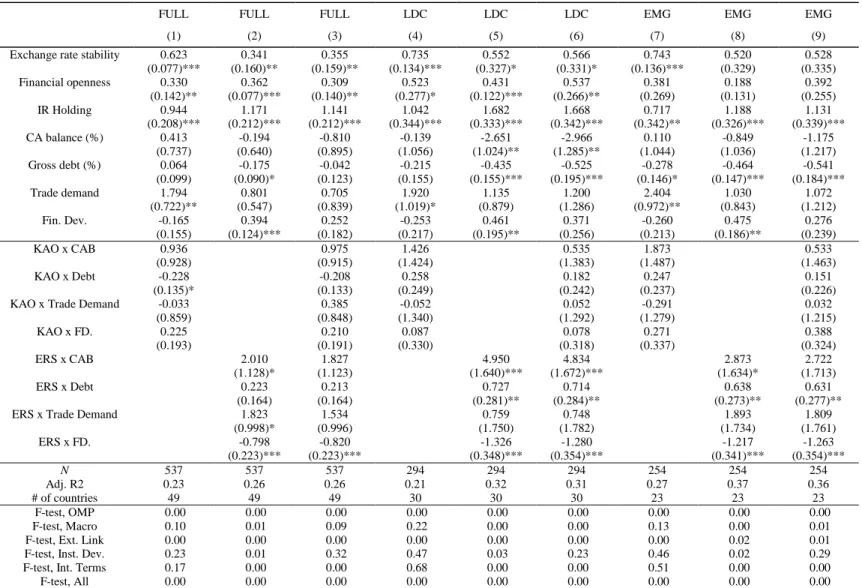
Now we repeat the estimation of the second step, but this time the dependent variable will be the estimated coefficient of the effect (ˆC) on the sample countries' EMP of the central economies' financial variables: political interest rates, REER and EMP. Interestingly, in Table 1-1 we found that a country with more developed financial markets tends to have its own policy rates that are more sensitive to those of the central economies. However, while developing countries have their economies more exposed to those of the central economies, more developed financial markets may also be able to absorb and internalize shocks from changes in the policy interest rates of the central economies.
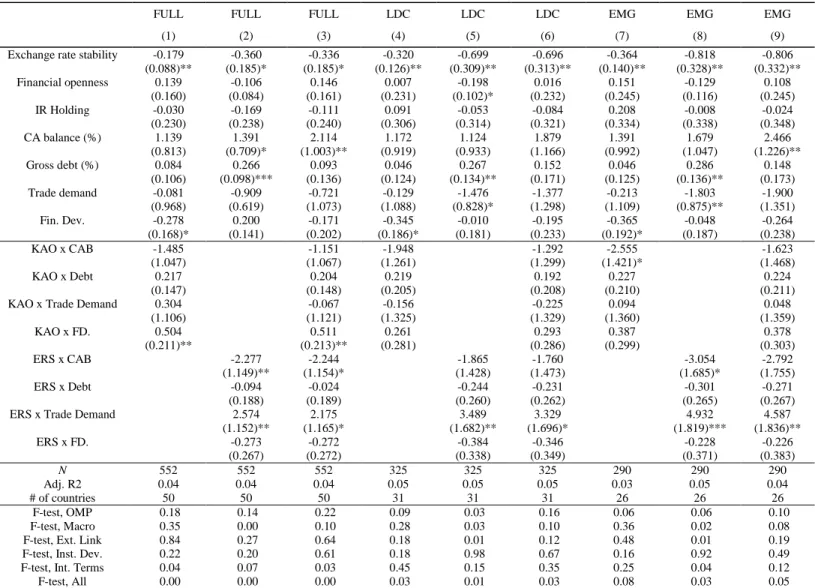
Such an insulating effect of financial development is also observed in the results for the factors affecting the relationship between the REER of the central economies and the GDP of the sample countries, as shown in Table 4-2. According to Table 6 (b), for a developing country with greater exchange rate stability or relatively closed financial openness, greater financial development may make its economy's PMI levels more sensitive. to changes in REER of central economies. Similar interactions with exchange rate stability and financial openness are also found for the impact of stronger trade ties with core economies.
Concluding Remarks
We find that for most of the financial variables we examine, linkage to the hub economies has been dominant for developing and emerging market economies over the past two decades. While China's weight in world economic output has clearly increased dramatically, including China as one of the central economies does not necessarily increase the fit in the regressions that estimate the financial variable sensitivity. Motivated by the recent "taper tantrum", we investigate whether the foreign exchange market pressure (EMP) in the peripheral economies is sensitive to the movements in the central economies' policy rates, REER and EMP.
While real appreciation of core economies could lead to higher EMP of peripheral economies, higher levels of financial development, greater financial openness, strong trade ties with medium-sized countries, and more stable inflation would help reduce the sensitivity of EMP to REER of core economies. . The impact of the interaction between the variables of open macro policy with macroeconomic and institutional conditions is also detected. For example, when a country seeks greater financial openness, exchange rate stability, or both, the accumulation of government debt can make a country's EMP more sensitive to central bank policy interest rates.
A country with a current account deficit finds its GDP more positively correlated with the GDP of core economies if it pursues greater financial openness and greater exchange rate flexibility. Asia and Financial Globalization in the Context of the Trilemma”, Journal of the Japanese and International Economies, vol. Sovereign bond spread - the difference between the long-term interest rate (usually 10-year government bonds) and the short-term policy interest rate - i.e. the slope of the yield curve, IFS.
Bank lending provided by the central economies (BLCip) - This is the ratio of the total stock of bank lending from country C to country i as a share of country i's GDP (BLCi), for which we use BIS consolidated banking statistics data. FDI provided by the center economies (FDINV iC) - It is the ratio of the total stock of foreign direct investment from country C to country i as a share of country i's GDP. Due to possible non-stationarity of the data series, we include the first difference in the FDI data series.
This index is normalized using the maximum value of the product in brackets for each country pair in the sample. Currency crisis (CURRENCY) – It is from Aizenman and Ito (2013) who use the exchange market pressure (EMP) index using the exchange rate against the base country's currency. We use two standard deviations of the PMI as a threshold to identify a currency crisis.
The weights are inversely related to each country's variances of each of the changes in the three components over the sample. 34 This variable is an aggregated version of the trade competitiveness variable in Forbes and Chinn (2004). The second estimation is performed for the estimates ˆFiC from the first stage estimation that do not include China as one of the central economies.
The second estimation is performed for the ˆFiC estimates from the first-step estimation, excluding China as one of the center economies.