Anammox bacteria were detectable only in the lower (probably anoxic) part of the biofilm with a clear upper limit, probably defined by the depth of oxygen penetration into the biofilm. In parallel with the increase in nitrite in the reactor effluent, the relative population size of ammonium-oxidizing bacteria increased from N. All groundwater samples collected at the landfill were positive for amplification of the anammox 16S rDNA fragment.
This suggests that the anammox bacteria in the rotary disc contactor were inoculated from the subsoil of the landfill.
Introduction
OHN2H4
Polymorphism methods such as RFLP have been used to study the diversity of ammonia oxidizing communities (Horz et al., 2000). The question of the diversity of nitrite-oxidizing bacteria in sewage treatment plants is intensively studied (Daims et al., 2000 and 2001). A new metabolic pathway for the oxidation of ammonium by nitrite has been postulated (van de Graaf et al., 1996).
The physiology of the organism was mainly studied on a highly enriched culture (80% anammox microorganisms) grown in a sequencing batch reactor (Strous et al., 1998).

Enrichment and characterization of an anammox bacterium from a rotating biological contactor treating ammonium-
Further studies have shown that the anammox process is carried out by an autotrophic bacterium (van de Graaf et al., 1996), which has recently been shown to belong to the order Planctomycetales (Fuerst, 1995) and has been named Candidatus Brocadia anammoxidans ( Strous et al., 1999a). This organism was also postulated to couple the oxidation of nitrite to nitrate to generate reducing equivalents for CO2 fixation (van de Graaf et al., 1997). The basic physiological aspects of the anammox process have been studied in depth mostly by a single research group in Delft (Jetten et al., 1999).
However, anammox activity has been suspected for other wastewater treatment plants with uncharacterized high ammonium losses (Helmer and Kunst 1998; Siegrist et al., 1998; Schmid et al., 2000; . Pynaert et al., 2002).
N +III O 2 -
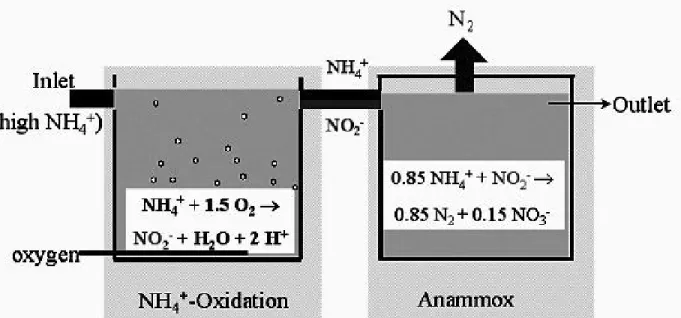
The existence of bacteria capable of catalyzing the anammox reaction (Eq. 1) was already predicted in 1977 (Broda, 1977) based on thermodynamic calculations. The advantages of the anammox process over the traditional combination of nitrification and denitrification for wastewater treatment are the lower oxygen demand, which is needed by the nitrifiers for the partial oxidation of ammonium to nitrite, and there is no need for external carbon sources because the process is autotrophic. Implementation of the anammox process as a manageable wastewater treatment technology will also require a better understanding of the range of allowable nitrite, ammonium and organic carbon loads, as well as oxygen and pH regimes.
To understand the anammox process and its importance in natural or engineered systems, it is desirable to identify and understand other anammox bacteria besides the archetype strain Candidatus B.
Composition and structure of an ammonium removing biofilm on a rotating disk contactor treating ammonium-rich
Anammox bacteria were exclusively present in the lower half of the biofilm, while CFB-type filamentous bacteria were present throughout the biofilm. Microbial community composition in Kölliken biofilms was determined using different independent approaches. The 16S rDNA sequences of the anammox bacteria Candidatus Kuenenia stuttgartiensis or any putative nitrite-oxidizing bacteria were not detected in the biofilm clone library representation analyzed.
Both newly designed probes (Daims et al., 1999) were designed to detect members of the phyla Verromicrobia and Planctomycetales. Compared to the hybridization signal intensity of the EUB mixture (set as 100%), the amount of rRNA stained with NEU was about 23% (Table 4). In contrast, no hybridized Amx820 signal was obtained in the middle and upper layers of the biofilm.
The nitrifying bacteria were found in the upper (oxic) zone where part of the ammonium is oxidized to nitrite. It may be that the high ammonium (up to 35 mM) and salt concentrations (10 g/l) in the influent of the purification system selected for ammonia-oxidizing bacteria from the N. The clone library did not provide a good representation of the abundance of different strains in the biofilm.
Structural analysis showed that aerobic nitrifiers were at the top and anammox bacteria at the bottom layer of the biofilm. Very surprisingly, the nitrifying bacteria formed close homogeneous clusters alternating in the upper (oxic) layer of the biofilm. Therefore, it appears that the activity of anammox bacteria in the biofilm is slightly limited, either by temperature, pH, ammonium, nitrite or bicarbonate.
16S rRNA-targeted oligonucleotide probes for the in situ detection of members of the phylum Cytophaga-Flavobacterium-Bacteroides.

Population analysis during start-up of nitritation reactors
In the anammox process, ammonium is oxidized anaerobically with nitrite to N2 by autotrophic bacteria (Jetten et al., 1999). The ammonia oxidizing community in the biomass of the nitritation reactors was followed quantitatively in time using quantitative fluorescence in situ hybridization (qFISH). Shown are ammonium concentrations (black triangles), nitrate (open squares), nitrite (gray circles) and total nitrogen (dashed line), as sum of ammonium, nitrate and nitrite concentrations (all in mM) all in the reactors.
The community of ammonia-oxidizing bacteria increased under all conditions, in parallel with the observed increase in nitrite concentrations in the effluent. Under conditions of pH 7.5 and at 25°C, the increase in the population of ammonia oxidizing agents was less pronounced than at 30°C (Fig. 3E and F). It may be that in the case of these two reactors the increased dilution rate or the salt composition of the sludge digester supernatant (Table 4) selects for the NEU population.
Evolution of the community composition of ammonia and nitrite oxidizers in the different reactors during operating time. This sequence clustered near cluster 6 (Purkhold et al., 2000). However, its RFLP type was not clearly visible in reactor 3A, but only in the supernatant of the sludge digester for reactor 4 (Fig. 4G). The dimensions of some tires in the M3 mark are indicated in bp to the left of each panel.
Nitrite oxidizers definitely remained active more and longer at lower temperatures (25°C) and in the reactors that worked with supernatant from the sludge digester. On the other hand, the temperature difference alone cannot explain the better survival of nitrite oxidizers in the sludge digester-operated reactors.
Molecular detection of anammox bacteria in different environments
Some studies suggested that the natural origin of anammox bacteria was the deeper saturated zone of soils (Chapter 3). Here we used polymerase chain reaction (PCR) to detect the possible presence of anammox bacteria in natural and engineered systems. The Pla46rc primer sequence is the reverse complement of its published version (Neef et al., 1998).
An aliquot of 1 µl of the purified (diluted) sample DNA was finally added to start the PCR. Because DNA from the anammox enrichment culture yielded a product of the same size and the water-only negative control yielded no product, these results suggest that anammox bacteria were present in the leachate before entering the trickling filter system and therefore must be native to the leachate. groundwater location or to the landfill material. To test the presence of anammox bacteria in wastewater treatment plants, we isolated DNA from samples from the aerated phase of the activated sludge and from the sludge digester, where anoxic conditions prevail.
In contrast, no anammox organisms were found in the activated sludge from Regensdorf, Meilen, Dübendorf and Uster and in none of the sludge digesters (Figs. 3 and 4). However, with FISH and probe Amx820 on solid sludge samples, no anammox bacteria were found in any sewage treatment plant. First, conditions in the sludge digesters were anoxic and temperatures were between 35°C and 40°C, both of which favor the proliferation of anammox bacteria.
In activated sludge ponds, sufficient ammonium and nitrite are created and anoxic conditions may exist temporarily and locally, forming niches for anammox bacteria. The detectable presence of anammox bacteria in some wastewater treatment systems is consistent with the results of others (Toh et al., 2002).

Final Discussion
Schmid et al., 2000) identified a new genus of Candidatus Kuenenia from a biofilm treatment system and named their strain Candidatus Kuenenia stuttgartiensis. This strain was closely related to ours (Egli et al., 2001) based on the 16S rDNA sequence. The oxidation of hydrazine to nitrogen gas is mediated by hydroxylamine oxidoreductase (HAO), which – interestingly – is also present in Nitrosomonas europaea (Jetten et al., 2002).
Therefore, biochemical evolutionary relationships between aerobic and anaerobic ammonium oxidizers may indeed exist, although the sequence homology based on the amino acid level is quite low (Schalk et al., 2000). They have a very unusual cell division (Lindsay et al., 2001) with a protein-rich region of the cell that may actually contain (some of) the enzymes for anaerobic ammonium oxidation (Strous et al., 2000; Lindsay et al., 2001). In previous studies (Koch et al., 2000), a mathematical model was formulated which describes the kinetics of the aerobic ammonia-oxidizing, aerobic nitrite-oxidizing and anaerobic ammonium-oxidizing microorganisms.
This model allowed a good prediction of the distribution of populations within the biofilm as well as the rate of decomposition of ammonium, nitrite and nitrate along the rotating disc of the contactor in steady state and during short-term experiments (Koch et al., 2000). Because of the slow growth rates of both aerobic and anaerobic ammonium oxidizers, both reactors could be operated as sequential batch reactors to reduce their volumetric size but maintain high activity (Strous et al., 1998). From our own data and from the literature, it should therefore be assumed that the combination of temperature (Hellinga et al., 1998), high concentrations of nitrites (Daims et al., 2001) and free ammonia, and short hydraulic retention times are successful in removing nitrite oxidants.
Based on fluorescence in situ hybridization (FISH) combined with microelectrode measurements, it has been suggested that Nitrospira-like nitrite oxidizers, which form the most abundant population of nitrite oxidizers in regular activated sludge, are adapted to concns. low nitrite and oxygen (Daims ., 2001). A successful operation of partial nitrification and anammox over long periods (up to years) has also been shown by others (Hippen et al., 2001; van Dongen et al., 2001).
Epilogue
Curriculum Vitae