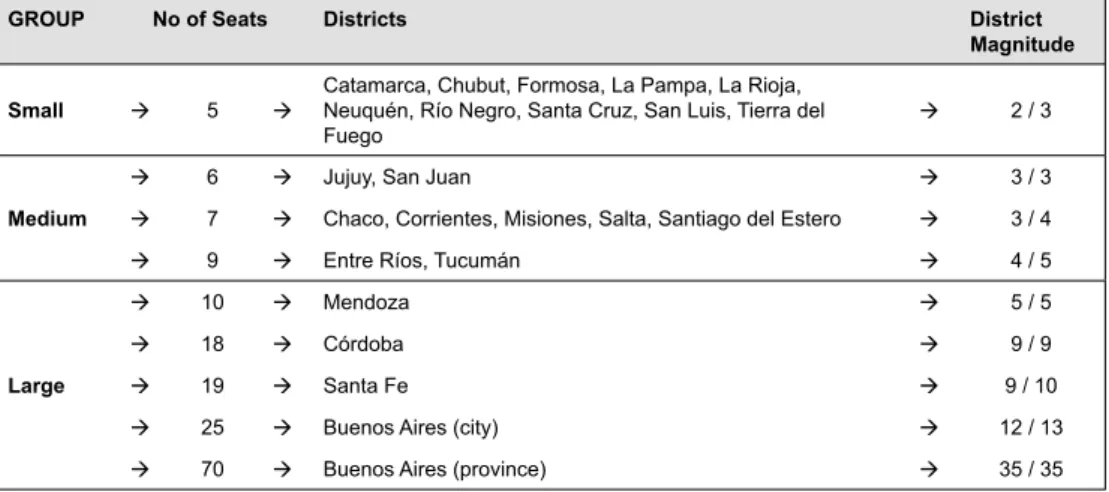
But the current paper leaves aside analysis of the two electoral arenas (national and provincial), the relationship of which has been studied elsewhere in the literature (Calvo and Escolar 2005). Next, Section 5 describes the fragmentation process and Section 6 tries to explain the causes and consequences of the transformation processes in the Argentine party system This can be argued as a natural consequence of the establishment of federal states (also applicable by analogy to those states that have advanced decentralization processes).
Aware of this fact, we propose an analysis of the institutional framework in which political parties operate (taking the party system as dependent variable and the electoral and federal system as independent variables). The return of democracy also brought back the National Constitution of 1853 (1853 NC6), so the main requirements for the election of national public officials were the same as before (see Box 1). Deschouwer identifies two dimensions of difference between parties that are typical of a multilevel system: "the presence of a party at different levels of the political system" and.
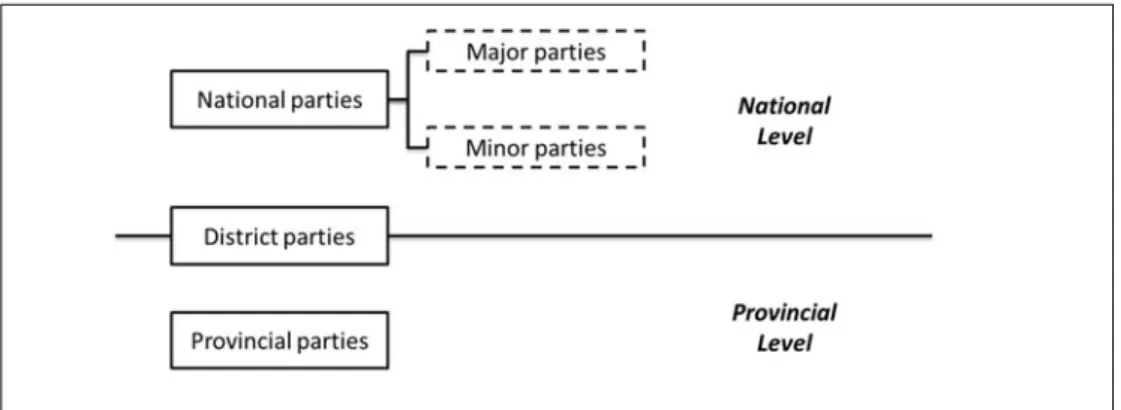
Ultimately, these ideological class divisions are largely determined by the characteristics of the constituencies in which political parties operate.13. Given these two patterns of constituency-based classification, in the universe of national political parties it is possible to find two types of parties: major parties and minor parties. Most of the time, these political parties are limited to five provinces (which is the minimum required by national law to establish a national party).
For the first time, a party other than one of the two traditional major parties (FREPASO) took second place in the presidential elections. In the recent history of the party system, there have been only two major national parties: Union Cívica Radical (UCR), founded in 1891, and Partido Justicialista (PJ), founded in 1946. The 1955 coup led to the exile of the party leader and the banning the party.
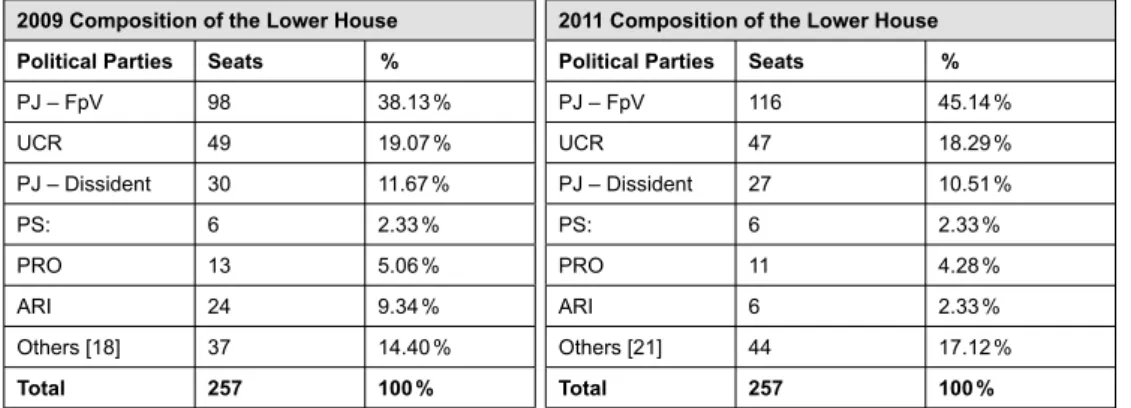
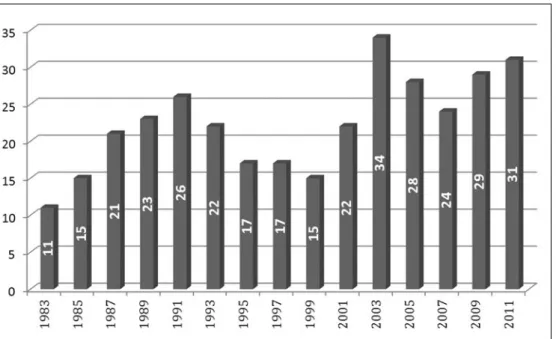
These political parties, which we have labeled small national parties, have re-emerged since the beginning of the democratization process and have gradually taken more seats in Congress. However, this "significant" number of legislators represents only 6% (equivalent to 15 deputies) and 12% (30 deputies) of the entire Chamber of Deputies. In the first case (Figure 8), the average of electoral political parties is a reminder of the level reached by the process of political fragmentation.
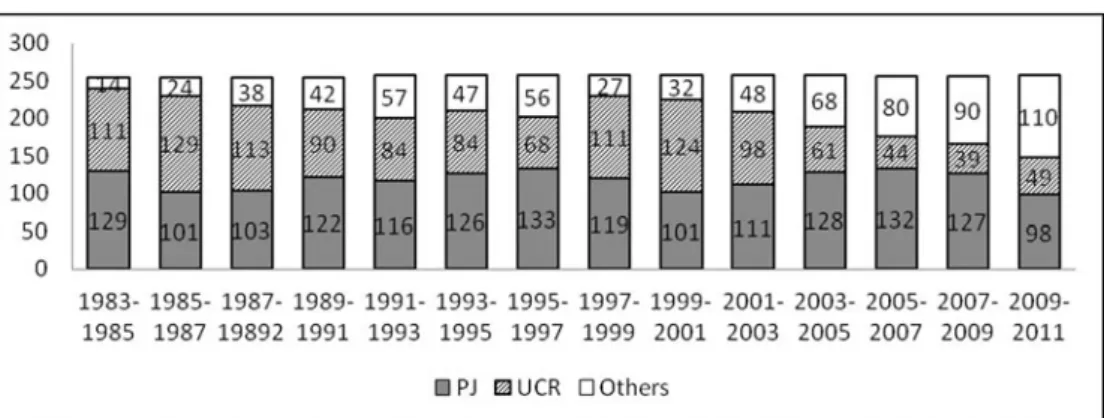
Over the last 30 years, according to the average, none of the nine provinces in the medium-sized group reached an average of 3. The evolution of the Argentine party system showed the continuous presence of a third force added to the two major parties (PJ and UCR). The number of representatives of the remaining political parties was between one and five.
The Fragmentation Process
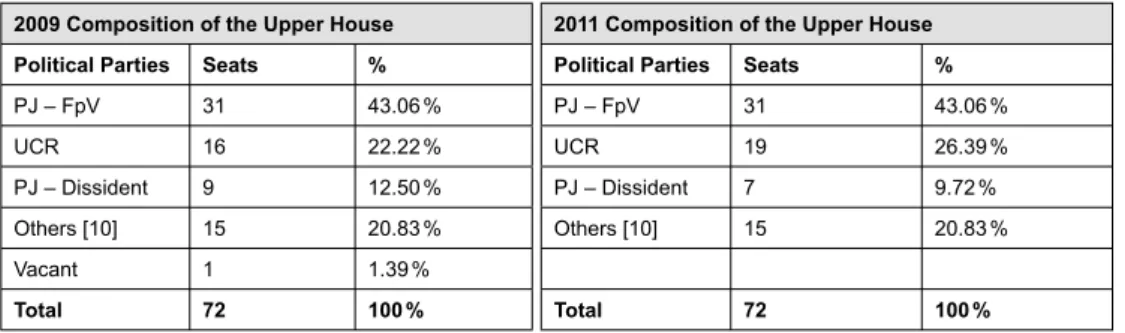
As noted above, the law regulating party organization gave sub-state units strong autonomy28; therefore the third strategy is not available to national parties in Argentina. This changes party strategies, forcing them to constantly develop new forms of vertical party cooperation. Tables 1 and 2 also show the fragmentation of the party system, with an increasing number of new political parties entering both chambers.
The fragmentation process shows the emergence of several political parties, but most with a minimal participation quota; in the upper house, these political parties are seven senators away from the party behind them and much further away from the two main parties. In this scenario, their only viable strategy is to form a parliamentary bloc with one of the two major parties.
Transformation Processes in the Argentinean Party System
Moreover, the less populated provinces are at the same time less democratic, with weak checks and balances and "excessive executive dominance" (Gervasoni 2010b: 43), translating into a low level of contestation and the dominance of local political competition. - action by the local party leaders who run the province. Underdeveloped regions in particular consider their situation in the federation as excluded from the development process that benefited other regions. This dynamic is part of the tension between center and periphery (present since the time of national independence).
Many of these provincial parties come from the group of underdeveloped provinces and have emerged mainly because of the center-periphery tension that the national leadership of the national parties has not been able to overcome in its programs. The consequences were twofold: either local branches of national parties began to increase their autonomy under the guise of more federalism (especially when the local party leader was against the national structure) or new provincial parties were founded with the specific goal. of the protection of provincial interests. These phenomena occur in the group of underdeveloped provinces: On the one hand, the most important and successful provincial parties were Movimiento Popular Neuquino (province of Neuquén), Acción Chaqueña (province of Chaco), Partido Renovador de Salta (Province of Salta) , Movement. Popular Fueguino (province of Tierra del Fuego), Partido Autonomista-Liberal (province of Corrientes - the oldest); on the other hand, the most important local branches of the PJ that have been in opposition to the national structure since the 1990s came from this group of provinces (such as San Luis, Salta, Chubut).31.
On the one hand, regarding the composition of the Senate Chamber, it reflects the "principle of legal and political equality". Based on this institutional design, the result is as follows: the "Metropolitan" provinces have 15 senators (3 senators for 5 provinces) representing 20.8% of the chamber and 142 deputies representing 55.3% of the chamber. This in turn creates leadership cadres whose normative role is to increase the power and benefits of the level of government they represent.
In short, all this translates into tensions within the party structure – which in itself can lead to fragmentation within the party – and, more generally, fragmentation of the entire party system (resulting in a multiplication of political parties).34. Currently, there are 33 national political parties plus 675 district political parties, with a total of 708 political parties recognized by national jurisdiction36 (excluding provincial political parties whose recognition depends on local/provincial legislation). Nevertheless, 83.64% of national party affiliations are concentrated in the two national political parties (72.28% of the total of national and district parties).
From this data, we can again conclude that the territorial dimension of the party system and the geographical distribution of organizational political parties are important. Only PJ and UCR have affiliate members in all provinces and together cover 83.64% of the total political affiliation of the parties.
Concluding Remarks
Partial renewal: half of the chamber every 2 years (half of the deputies from each province are re-elected). Partial renewal: half of the chamber every 2 years (half of the deputies from each province are re-elected) Provisions introduced by national legislation. In a federal system, this means that the president will act according to the needs of the nation and the governors will act according to the needs of their constituencies, needs which do not always coincide.
These consequences are in line with the intentions of the military government: “The success of this strategy [..] had an implicit condition: the internal division and fragmentation of Partido Justicialista and UCR” (San Martino de Dromi 1988: 33). . To be recognized as a "party district" a political party must demonstrate (among other requirements): (a) Its Charter, which must also prove that a number of voters exceed four per thousand (4 ‰) of the total number of voters registered in the local voter registration; Despite the presence and importance of the indigenous people in some provinces (such as Mapuches in Río Negro, Chubut and Neuquén provinces or Tobas in Chaco and Formosa provinces), they have not formed political parties to represent their interests – nor has any any existing political party claimed to represent them.
All party systems change, but Latin American party systems are, on average, much more volatile than those in the industrialized countries that have been the focus of most existing research on party systems. PRO (Propuesta Republicana) is one of the newest right-wing political parties, founded in 2005 by Mauricio Macri (businessman and former president of Atlético Boca Juniors), who was elected mayor of Buenos Aires in 2007 and re-elected in 2011. UCeDé ( Unión del Centro Democrático) was founded in 1982 by Álvaro Alsogaray (former Minister of the Economy under the administration of Frondizi and Guido (1962)) and was one of the most important parties of the so-called "new right" ("la nueva derecha" - Olmeda and Suárez Cao 2010) .
Her early political career was very successful: when she ran for president in the 2003 presidential election, ARI obtained 14.05% of the vote in a highly competitive election. But this would not guarantee their livelihood, since the Argentine political system is heavily dependent on the failure of the president, which has recently reduced the power of Congress to some extent (especially when it comes to economic resource management). This is due to the combined use of the electoral system labeled as a multi-member (or plurinominal) constituency system with closed party lists and single non-transferable vote systems where candidates for all positions (governor and legislators) are included.
Politics and Federalism: Party or Anti-Party?” The Annals of the American Academy of Political and Social Science 359, no. The Dynamic Diversity of Latin American Party Systems.” Meeting of the Latin American Studies Association, 17. Electoral system will be applied for presidential and deputy elections.” Official Bulletin of the Argentine Republic Nth June, 1983.
Chamber of Deputies The population of each province shall be represented by at least two members." Official Bulletin of the Argentine Republic No. 19,130, January 9, 1960.