‘It’s the Economy, Stupid’
Popular Support for EU Accession in the Czech Republic*
PAT LYONS**
Institute of Sociology, Academy of Sciences of the Czech Republic, Prague
Abstract: In this article, a comparison is made between economic and identity explanations of preferences toward EU membership in the Czech Republic.
This research demonstrates that economics rather than identity is a more pow- erful explanation of public opinion on accession. With regard to economic explanations of public support for integration three models are examined – a winners and losers model, an international trade liberalisation model, and a foreign direct investment model. A comparison of these three models shows that support for accession was primarily based on attitudes toward foreign di- rect investment. Moreover, contemplating employment opportunities within the EU following accession was also an important factor. Contrary to previous research the empirical evidence presented in this article suggests that being a winner or loser in the post-communist transition process was not the strong- est factor explaining popular support for membership. The results presented should not be taken to imply that instrumental rather than ideological or af- fect-based motivations determine general attitudes toward integration. On the specifi c question of vote choice in the accession referendum instrumental economic considerations were most important.
Keywords: European Union, accession, economy, identity, integration Sociologický časopis/ Czech Sociological Review, 2007, Vol. 43, No. 3: 523–560
* The CVVM survey data on which this research is based was provided by the Socio- logical Data Archive, Academy of Sciences of the Czech Republic. In undertaking this research the author gratefully acknowledges funding from the ‘Participation, Democracy and Citizenship in the Czech Republic’ project fi nanced by the Grant Agency of the Czech Republic (Grant No. 403/04/1007, 2004–2006) and ‘Legitimacy of the Political System and Inequalities: The Development of the Czech Republic in Comparative Perspective’ (Grant No. 403/06/1421). The author is grateful for the advice and suggestions of two anonymous referees.
** Direct all correspondence to: Pat Lyons, Department of Political Sociology, Institute of Sociology, Academy of Sciences of the Czech Republic, Jilská 1, 110 00 Prague 1, Czech Republic, e-mail: [email protected].
524
Introduction
Membership of the European Union (EU) was a key goal for all post-communist governments in the Czech Republic. Nonetheless, since the mid-1990s the Europe- an Union issue has been one of the key dividing lines within Czech party politics, although it has not been a central issue during general election campaigns. While public opinion in the Czech Republic was consistently supportive of the process of accession, its level of support was one of the lowest among the ten states in the May 2004 enlargement [Linden and Pohlman 2003; Taggart and Szczerbiak 2004;
Kopecký and Holsteyn 2006]. In one of the few comprehensive English-language accounts, Hanley [2004: 691] summarised popular support for accession as being based on ‘cues from longstanding positive linkages of “Europe” with democracy, market reform and Czech identity’. Moreover, this account stressed that the refer- endum campaign had little effect, as citizens had for the most part made up their mind years earlier.
Domestic and international opinion polls reveal that a key factor for those sceptical about EU membership was economic concerns and more specifi cally fears about an increase in prices and unemployment. Reservations about loss of national identity motivated only a very small minority of those polled [see Hanley 2004: 694–5]. To date there has been no systematic individual level analy- sis of preferences in the Czech accession referendum of June 2003. This article aims to make a contribution to this fi eld of research by examining what economic factors shaped attitudes toward membership prior to accession and to explore whether a citizen’s sense of identity also played some role.
Scholarly research on public support for European integration is primarily based on survey data from Western Europe that has been examined since the early 1970s. The question that has arisen with the two most recent waves of en- largement is whether these ‘West European’ models of public opinion toward the EU are applicable to a Union of twenty-seven member states. Scepticism stems from the fact that in Western Europe public opinion on integration sprung from citizens living in stable liberal democratic polities with established market econ- omies. Within post-communist states mass attitudes toward integration were grounded in polities and economies still in a process of transition where acces- sion represented a further movement of change.
Moreover, Rohrschneider and Whitefi eld [2006] argue that the current un- derstanding of public support for integration is based on elites and masses ac- cepting the merits of liberal democracy and free markets. Within Central and Eastern Europe there is still considerable resistance among political elites and substantial blocks of voters to unfettered capitalism [Večerník and Matějů 1999:
185ff]. Consequently, these scholars contend that citizens within post-communist states do not judge the EU in terms of expected economic benefi ts, but more in terms of underlying economic and political values. In sum, Rohrschneider and Whitefi eld [2006: 147] contend that in post-communist states public opinion on integration is more ideological than instrumental.
socrev2007-1.indb 524
socrev2007-1.indb 524 3.9.2007 18:41:263.9.2007 18:41:26
In this article, it will be argued that while ideological factors may be more important than instrumental ones in shaping general attitudes toward integra- tion, on the specifi c issue of accession economic considerations were most impor- tant. While there are undeniably merits in questioning the dominance and nature of economic explanations of public support for accession in Central and Eastern Europe, it is certain that economics was a primary consideration during the 2004 referendum campaigns in states such as the Czech Republic and Poland [Hanley 2004: 694; Markowski and Tucker 2005: 427, 430].
Here we will focus our attention on the Czech Republic and examine more specifi cally what were the economic and identity bases of popular support for EU membership? This raises an additional question: how do economic and identity factors shape public opinion toward the European Union? In the fi rst section, the economic bases for popular support for European integration in Western Europe will be outlined. Thereafter, there is a brief review of the literature on public opin- ion towards EU accession in 2004 within post-communist states. Here we outline three economic explanations of why the Czech public might have supported ac- cession, and we formulate a number of testable hypotheses. This is followed in the third section by a discussion of how a citizen’s sense of identity is seen by scholars to infl uence attitudes toward the integration project. In the fourth sec- tion, there is a discussion of the data and methodology used in this paper. In the penultimate section, the empirical fi ndings are presented and this is followed by some concluding remarks.
Economic explanations of citizen support for European integration in Western Europe
While economic explanations of public support for European integration have been a dominant theme, this fact should not be taken to mean that such research has adopted a consistent perspective. In fact, this literature exhibits considerable differences in terms of the level of analysis (i.e. aggregate, individual, and multi- level datasets) and the use of indicators (i.e. subjective and/or objective). Conse- quently, while economic explanations may appear simple and straightforward, the extant literature paints a more complex picture. For example, the exact effect of macro-economic variables, such as the level of unemployment and infl ation, on support for EU membership has been shown to be associated with both posi- tive and negative orientations toward integration.
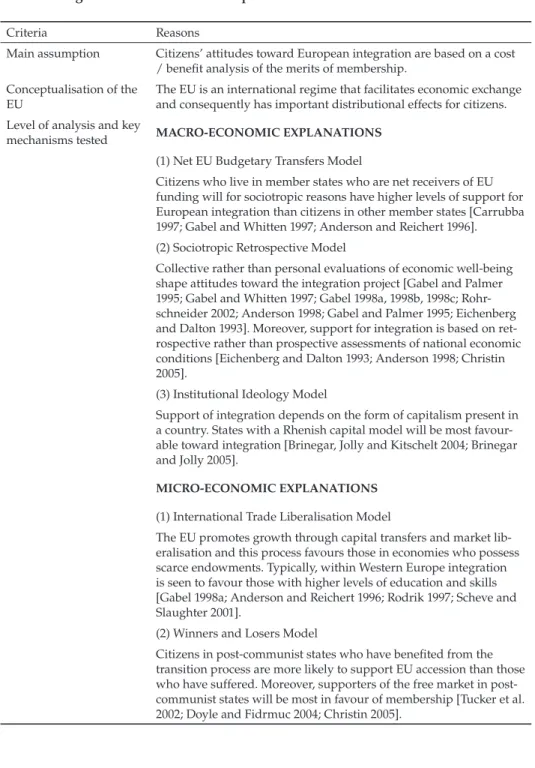
Our goal here is not to critically review the literature on economic expla- nations, but to outline the types of models tested. Table 1 summarises the two main streams within this fi eld of research and illustrates the differing levels of analysis and mechanisms underlying the key economic explanations employed.
It should be noted that the distinction between micro- and macro-level explana- tions used in this article is not absolute. In the literature on public support for European integration, use of micro- or macro-level models is often determined
526
Table 1. Summary of economic explanations of public support for European integration and EU membership
Criteria Reasons
Main assumption Citizens’ attitudes toward European integration are based on a cost / benefi t analysis of the merits of membership.
Conceptualisation of the EU
The EU is an international regime that facilitates economic exchange and consequently has important distributional effects for citizens.
Level of analysis and key
mechanisms tested MACRO-ECONOMIC EXPLANATIONS (1) Net EU Budgetary Transfers Model
Citizens who live in member states who are net receivers of EU funding will for sociotropic reasons have higher levels of support for European integration than citizens in other member states [Carrubba 1997; Gabel and Whitten 1997; Anderson and Reichert 1996].
(2) Sociotropic Retrospective Model
Collective rather than personal evaluations of economic well-being shape attitudes toward the integration project [Gabel and Palmer 1995; Gabel and Whitten 1997; Gabel 1998a, 1998b, 1998c; Rohr- schneider 2002; Anderson 1998; Gabel and Palmer 1995; Eichenberg and Dalton 1993]. Moreover, support for integration is based on ret- rospective rather than prospective assessments of national economic conditions [Eichenberg and Dalton 1993; Anderson 1998; Christin 2005].
(3) Institutional Ideology Model
Support of integration depends on the form of capitalism present in a country. States with a Rhenish capital model will be most favour- able toward integration [Brinegar, Jolly and Kitschelt 2004; Brinegar and Jolly 2005].
MICRO-ECONOMIC EXPLANATIONS
(1) International Trade Liberalisation Model
The EU promotes growth through capital transfers and market lib- eralisation and this process favours those in economies who possess scarce endowments. Typically, within Western Europe integration is seen to favour those with higher levels of education and skills [Gabel 1998a; Anderson and Reichert 1996; Rodrik 1997; Scheve and Slaughter 2001].
(2) Winners and Losers Model
Citizens in post-communist states who have benefi ted from the transition process are more likely to support EU accession than those who have suffered. Moreover, supporters of the free market in post- communist states will be most in favour of membership [Tucker et al.
2002; Doyle and Fidrmuc 2004; Christin 2005].
socrev2007-1.indb 526
socrev2007-1.indb 526 3.9.2007 18:41:273.9.2007 18:41:27
by the availability of data. In this article, the categorisation of models such as FDI as micro-level refl ects the fact that we have an individual-level survey avail- able for analysis. This is not to suggest that FDI has only individual-level effects and does not have important macro-level effects such as those associated with EU budgetary transfers. In the following two sub-sections, a brief outline will be given of these micro- and macro-economic perspectives for research on the EU-15 member states.
Macro-economic explanations
Explanations of public support based on national economies are based on the simple idea that whatever is good for the country is also of benefi t to the individ- ual. However, the factors and manner in which macro-economic factors infl uence attitudes toward European integration has never been defi nitively established.
This failure stems in part from methodological differences, where the models tested, variables used, and countries and time periods examined have varied.
Consequently, this literature has not provided systematic fi ndings. Here we will briefl y review three strands in this research.
Net EU budgetary transfers model
According to this model if a member state is a net recipient of EU funding this will improve the infrastructure and services used by citizens [Bosch and Newton 1995;
Carrubba 1997; Gabel and Whitten 1997; Anderson and Reichert 1996]. Moreover, this approach suggests that if a country changes from being a net receiver to be- ing a net contributor to the EU then popular support for integration should also change. If this is the case, ceteris paribus popular support for integration should de- cline if a country changes from being a recipient to being a contributor to the EU’s budget. Ireland represents a case where this change in fi nancial status occurred in 2007. According to the net budgetary transfers model, popular support for integra- tion in Ireland should decline after this year. The evidence from Eurobarometer data (i.e. the question of whether the country has benefi ted from EU membership)
(3) Foreign Direct Investment Model
Accession is likely to increase FDI and hence have economic re- distributional effects creating winners and losers. In capital scarce economies FDI will increase employment and training. However, increasing levels of foreign ownership may lead to greater public controversy and less support for an accession process that is associ- ated with FDI [Rohrschneider and Whitefi eld 2004].
528
reveals that there has been a decline in the perceived benefi ts of EU membership in Ireland since 1997 – a full decade before this budgetary change came into effect.
Such evidence suggests that payments from, or contributions to, the EU are not the only considerations used by citizens to assess the integration project.
Sociotropic retrospective model
Many of the economic explanations of mass support for integration emphasise that attitudes toward how the national economy has performed, rather than pro- spective individual level assessments, are the most important. In examining the relationship between macro-economic variables and support for the EU, previous research has suggested that GDP growth, infl ation, unemployment, and intra-EU trade are important. However, the evidence that national economic conditions shape public opinion on integration has not always been consistent [Eichenberg and Dalton 1993; Duch and Taylor 1997]. For example, we noted earlier that the exact effect of macro-economic variables such as level of unemployment and infl ation on support for EU membership has been shown to both increase and decrease pro-integration opinion [Anderson and Kaltenhaler 1996; Gabel 1998c].
Such problems, while stemming in part from methodological differences, prob- ably also refl ect the fact that citizens’ assessments of national economic perform- ance are infl uenced by political factors, such as key political events and length of membership [Christin and Hug 2002; Bosch and Newton 1995].
Institutional ideology model
Our fi nal explanation contends that national institutions mediate individual evalu- ations of the economic effects of European integration. In practice this means that the institutional ideology and associated preferences of a state have a signifi cant effect on transmitting the costs and benefi ts of European integration through mar- ket liberalisation. Within the EU three ideal types of capitalism may be identifi ed – liberal-market capitalism, Rhenish capitalism, and social-democratic capitalism, where the liberal-market model is often juxtaposed with the social-democratic one in terms of wealth distribution. In this respect, the prevailing argument is that the middle ground adopted by the Rhenish model helps explain which form of capi- talism is most conducive in institutional and ideological terms to mass support for integration [Brinegar, Jolly and Kitschelt 2004; Brinegar and Jolly 2005]. From a methodological perspective, it can be argued that this approach suffers from endo- geneity. This is because the states most associated with the historical development of European integration from 1957 have been adherents to the Rhenish conception of capitalism. In a sense, support for integration is explained in terms of those states that have the longest and most successful history of integration.
socrev2007-1.indb 528
socrev2007-1.indb 528 3.9.2007 18:41:273.9.2007 18:41:27
Micro-economic explanations
In the micro-economic approach, support for integration stems from benefi ts that accrue to the individual from greater mobility of capital and labour. Much of this literature is based on the effects proposed by trade liberalisation theory and more specifi cally the Heckscher-Olin model of trade. One of the mechanisms proposed to support this perspective is that integration gives higher rewards to those with greater human capital resources [Gabel 1998b; Scheve and Slaughter 2001]. This occurs via a variety of channels where integration through market liberalisation favours those sectors of the economy that have scarcities of either capital or la- bour. The key point here is that prevailing national or even regional economic conditions will give differential incentives to individuals with varying levels of age, education, and position within the labour market to support integration. In relatively rich countries, individuals who possess capital or high skills will favour greater access to markets where capital and skills are scarce. Low skill labour in such countries will fear a loss of investment and future jobs prospects, and there- fore oppose further integration. In contrast, with an abundance of cheap labour – a typical feature of less developed economies – workers will favour foreign in- vestment of capital as it brings with it more employment opportunities. However, skilled workers will fear loss of position or perhaps unemployment in a changed labour market. One consequence of the twin processes of liberalisation and inte- gration is the rolling back of the welfare state, a trend that has greater impact on those who are more likely to become unemployed. One key feature of liberalising markets is the role played by foreign direct investment (FDI). However, to date there has been little research on how attitudes toward FDI infl uence orientation toward the EU in Western Europe. This is a topic we will return to below.
Economic bases of popular support for EU membership in post-communist states
Discussions of public support for accession in post-communist states is intricate- ly bound up with attitudes toward transition toward a free market economy and support for associated liberal democratic institutions, property rights, and wide ranging changes in systems of production and social welfare. Although the goal of all transition processes has been to improve the welfare of citizens, in most post-communist states the costs of transition were often felt before the benefi ts [Rose and Haerpfer 1995: 432; Rose, Mischler and Haerpfer 1998: 200]. In this respect, citizens in post-communist states when considering the economic effects of accession were faced with contemplating what were the likely economic costs and benefi ts ensuing from EU membership for citizens. Obviously, there would be both winners and losers. In addressing this question, the growing literature on public support for European integration and accession in Central and Eastern Eu- rope has adopted a number of distinct explanations. In general these approaches represent extensions of previous research undertaken in Western Europe.
530
Macro-economic explanations in Central and Eastern Europe
There has been relatively little systematic comparative research on economic at- titudes toward European integration in Central and Eastern Europe because of data considerations. One intuitive explanation is that post-communist citizens supported accession in order to receive structural and Common Agricultural Pol- icy (CAP) funds from Brussels, i.e. a net budgetary transfer model.
Another explanation (which may be seen as a variant of the sociotropic ret- rospective model) as to why aggregated public opinion would express particular opinions toward integration is based on the idea that the countries that suffered most in the transition process would feel that they have less to lose in transferring authority and sovereignty to the EU [Sánchez-Cuenca 2000: 151; Christin 2005:
39]. In contrast, public opinion in the post-communist states where the transition process was relatively successful are expected to be more sceptical of the econom- ic benefi ts of EU membership. This is because such citizens would have more to lose. To summarise, depending on the nature of the transition process, citizens in post-communist states living in different national conditions would be expected to have different attitudes toward EU membership. Christin [2005: 43–49] has found that macro-level factors have the greatest impact on public opinion on the EU when national conditions are in ‘bad shape’.
Although the impact of institutional ideology in Western Europe is judged in terms of the type of capitalism, the evidence from post-communist states sug- gests that economic values are important. Particularly within situations of rapid political and economic change and hence high uncertainty citizens may fall back on regime ideals in assessing the benefi ts of EU membership [Rohrschneider and Whitefi eld 2006: 148]. Signifi cantly, in many post-communist states citizens still believe in socialist ideals such as an egalitarian society [Evans and Whitefi eld 1995]. For this reason, economic values may trump instrumental reasoning in shaping mass attitudes toward the EU.
Micro-economic explanations in Central and Eastern Europe
In the literature on public opinion toward integration among post-communist states at least three different micro-economic approaches have been adopted.
These models represent a distinct line of research from what came before, because of the very different circumstances underpinning the enlargements of 2004 and 2007. As our focus of interest is public opinion on accession in the Czech Republic, we will concentrate in this article on three micro-economic models. Although no direct reference is made to expectations for social improvements in this research, owing to data limitations, this is not to suggest that such considerations were unimportant. Within the Czech Republic there is considerable support for social democratic principles. For convenience, in this research, such social welfare-based expectations are subsumed under more specifi c micro-economic perspectives.
socrev2007-1.indb 530
socrev2007-1.indb 530 3.9.2007 18:41:273.9.2007 18:41:27
As this is a single country study, examination of institutional effects is im- possible, and data for macro-economic analysis are not readily available. There- fore, in this sub-section there will be a brief presentation of the three models reviewed. On this basis some hypotheses will be formulated combined with some brief description of the survey questions used to test these hypotheses. More de- tails of the data used will be given in the next section and in the appendix.
Winners and Losers Model
The fi rst micro-economic model relates specifi cally to Central and Eastern Eu- rope, where it has been argued that those who have been ‘winners’ in the free market reforms in post-communist states such as the Czech Republic will be most supportive of integration. In Tucker, Pacek and Berinsky’s [2002] ‘winners and losers’ model there are two key explanatory variables explaining support for ac- cession.
First, those who have gained from the post-communist transition are more likely to support accession than those who have lost.1 In this article, being a win- ner or loser is based on a summated rating scale of seven items. Four of the items relate to the respondents’ own subjective sense of the current economic situation of the household and how this has changed over the previous year. In addition, the respondents’ assessment of whether their household had suffi cient income and whether the household had been able to save in the last fi ve years were used as indicators. The last three items refer to objective measures of success – owning a video cassette player, owning a car, and having access to the internet (see ap- pendix for details).
The second key factor for Tucker, Pacek and Berinsky [2002] is if a respond- ent is a supporter of the free market. In the survey dataset examined here a better measure is available, where it is possible to identify citizens who have a primarily free market orientation in contrast to defi ning themselves fi rst and foremost as a social democrat, communist, environmentalist, etc. It is also possible to learn about respondents’ current feelings toward the Czech economy (on a –100 to +100 scale) and their prospective view of the Czech economy in fi ve years time (again on a –100 to +100 scale). These two ‘thermometer’ type scales are useful in detect- ing some sense of economic optimism among the public, and how this may be associated with attitudes toward accession. Using these survey questions three hypotheses regarding the winners and losers model will be tested.
1 Fidrmuc [2000] argues in a similar ‘winners’ and ‘losers’ vein that the former (entrepre- neurs, white-collar workers, and people with university education) vote for right-wing pro-reform parties, while the latter (the unemployed, retired people, blue-collar workers, and farm workers) vote for left-wing parties. This analysis shows economic performance has a strong impact on electoral choice.
532
H.1 Winners in the post-communist transition process will be more supportive of EU accession than losers.
H.2 Those citizens who have a primarily free-market orientation will be most positive about accession.
H.3 Those who feel positive about the economy at the current time and have optimistic expectations for future domestic economic performance will be supportive of accession.2
International Trade Liberalisation Model
A more general argument is that a core feature of European integration is the liberalisation of trade. According to international trade theory, liberalisation of trade is likely to have differential benefi ts for various economic interest groups.
It is only recently that attempts have been made to use international trade theory to explain individual level preferences for transnational processes [Scheve and Slaughter 2001]. According to the Heckscher-Ohlin factor proportions theory there should be strongest support for freer trade, and by implication accession to the EU, among low-skilled workers in national economies that are typifi ed as being labour abundant.
The assumption here is that in comparison to the EU the Czech economy has a greater supply of labour than capital. However, within the Czech Repub- lic there are strong regional differences, measured as relative per capita GDP. It is assumed here that this variable is highly correlated with the human capital endowments of specifi c regions.3 For this reason, it is more appropriate to treat individual preferences based on interests resulting from different human capital endowments as being mediated by the effects of the regional economy in which a respondent lives. Therefore, an interaction variable of skill by regional per cap- ita GDP was constructed. The skill level of respondents was measured in terms of both education level and occupation [Mayda and Rodrik 2001; O’Rourke and Sinnott 2002: 162–5]. However, empirical analysis indicated that the education measure yielded more robust results. In addition, the survey examined contains a subjective assessment of the willingness of Czech citizens to use the opportu-
2 Previous research supportive of this hypothesis may be found in Anderson [1998] and Rohr- schneider [2002]. For the accession member states, see Tverdova and Anderson [2004].
3 Within the Czech Republic there are signifi cant regional differences. The Prague Region in 2001 had an unemployment rate of 3.7%, and a GDP 2.18 times the national average was strongly supportive of accession. In contrast, the relatively well-urbanised Karlovy Vary Region (in the northwest of the country, on the German border and a stronghold of KSČM (Communist Party of Bohemia and Moravia)) had an unemployment rate of 10.1%
and a GDP level less than four-fi fths of the national average. It was unique in being the only region to be against accession in November 2001 [see Kostelecký and Čermák 2004].
Markowski and Tucker [2005: 17] make a similar argument with regard to the accession referendum in Poland.
socrev2007-1.indb 532
socrev2007-1.indb 532 3.9.2007 18:41:273.9.2007 18:41:27
nities of labour mobility following accession. On the basis of these trade theory considerations four hypotheses will be examined.
H.4a Low-skilled workers in poorer regions of the Czech Republic would have been most supportive of EU accession.
H.4b Medium-skilled workers in relatively rich regions would have been less supportive of accession.
H.4c High-skilled workers in relatively rich regions would have supported ac- cession.
H.5 Those workers who were most predisposed to work outside the Czech Re- public in another EU member state would be supportive of the benefi ts of mobility offered with accession.
Foreign Direct Investment Model
A key economic impact of European integration is the expected growth of foreign direct investment (FDI). Despite the importance of this facet of integration on ac- cession there has been little research on how public opinion toward FDI might shape attitudes toward accession. This is surprising because the issue of foreign ownership has been controversial in many post-communist states. Examining the link between public support for foreign ownership (a core facet of FDI), Rohrsch- neider and Whitefi eld [2004] found that support for the latter and having a posi- tive image of the EU was lower in more democratic states in Central and Eastern Europe. Moreover, higher levels of FDI at the national level were associated with lower levels of support for foreign ownership. However, national levels of FDI had no signifi cant impact on attitudes toward the EU.4 The strategy adopted here is different, as use will be made of individual-level subjective measures to assess the impact of this variable.
Our expectation is that the economic effects of integration operating through FDI will have redistributional consequences, where some groups will be ‘winners’
and others will be ‘losers’. Unfortunately, there is little theoretical work specifying which domestic interest groups should be most supportive of FDI [Frieden and Martin 2002: 128]. What international trade theory does say is that FDI results in a complex mix of costs and benefi ts. While FDI can lead to greater investment in skills and training of local labour forces much of this benefi t depends on the dif- ferential technological and productive capacities of foreign and domestic fi rms. If there is too great a differential FDI leads to greater inequality between skilled and unskilled workers [Blomström et al. 1999; Taylor and Driffi eld 2000].
4 Rohrschneider and Whitefi eld [2004: 333] report that their EU model (Table 4) should be interpreted with caution as the multi-level estimations may be infl uenced by the smaller degrees of freedom of the macro-level variables.
534
In political terms, FDI was an important issue because the Czech Republic was unique in having virtually no foreign investment between 1948 and 1989. The economic policies of the Civic Democrat (ODS) governments from 1992 to 1998 emphasised domestic rather foreign ownership. These policies were implemented through state-owned banks providing funds for domestic fi rms. However, many of these fi rms were unviable in a liberalised market. As a result, unemployment increased as many domestic companies collapsed. During this period economic policy was characterised as ‘under-regulated, under-capitalized … [leading to an]
… ineffi cient private sector dominated by politically connected insider groups’
[Hanley 2000: 4]. Nonetheless, the number of foreign businesses in the Czech Re- public increased ninefold between 1993 and 1997 [Večerník and Matějů 1999: 85].
From 1998 onwards Social Democrat (ČSSD) administrations implemented a new set of policies that strongly supported foreign direct investment through a system of incentive packages and the construction of industrial parks in areas of high unemployment. Despite these two distinct policy periods the Czech Re- public nonetheless has had one of the highest levels of net FDI infl ows in Central and Eastern Europe. According to World Bank Development Indicator data, net infl ows of FDI increased from USD 257 million in 1989 to USD 8.23 billion in 2002 – which represents a thirty-two-fold increase in fourteen years. A central question is: what effect did this have on Czech industry?
One of the few studies of the impact of FDI on domestic fi rms found (us- ing fi rm level panel data between 1994 and 2001) that foreign fi rms did ‘crowd out’ domestic Czech ones, but this was a short-term effect. However, success for foreign fi rms also increased the likelihood of success for domestic ones where increased demand for goods and services within the Czech Republic was the pri- mary basis for growth. Moreover, technology spillovers primarily aided domestic fi rms in high technology industries [Djankov and Hoekman 2000; Kosová 2006].
This evidence suggests that FDI may have had some impact on Czech public opinion and perhaps attitudes toward EU membership. In this research, support for FDI was measured using answers to fi ve different survey items relating to this issue (see appendix for details). Consequently, using this data the hypothesis to be tested may be formulated as follows.5
H.6 Czech citizens who believed that foreign direct investment (FDI) had a positive impact on the national economy would have supported EU mem- bership as facilitating this process.
5 With six items it was possible to create a summated rating scale with high internal con- sistency (inter-item correlation, Cronbach alpha = .75) and thereby a superior indicator if only a single survey question were used.
socrev2007-1.indb 534
socrev2007-1.indb 534 3.9.2007 18:41:273.9.2007 18:41:27
Identity explanations of support for integration
As the process of European integration promotes increasing economic and po- litical interdependency, one consequence of these developments is a growth in multiculturalism while the differences between European nations decline. There- fore, although membership of the EU creates economic winners and losers there is also the possibility that it will ‘provoke a sharp sense of identity loss among defenders of the nation’ [McLaren 2002: 553]. However, the relationship between national identity (which is seen to be the strongest territorial identity in most Eu- ropean states) and attitudes toward European integration is not a simple one.
In some research the association between national identity and support for the integration project is positive [Citrin and Sides 2004: 170]. This may occur because citizens have more than one sense of identity where they feel local, re- gional, national, and supranational attachments in a manner that is both inclu- sive and integrative. Thus a variety of case studies suggest that a strong sense of identity at one level reinforce a citizen’s sense of identity at other levels [Haesly 2001; Diez Medrano and Guttiérez 2001]. In contrast, other research suggests a negative relationship, because European integration is perceived to be a threat to the nation and its culture and values [McLaren 2002; Carey 2002; Christin and Trechsel 2002]. Sometimes such fears are crystallised in the association between the degree of integration and the level of immigration [Luedtke 2005].
Such scholarship demonstrates that the link between identity and attitudes toward the EU are context dependent. An infl uential stream of research suggests that how the integration issue is framed in the national context may be critical in es- tablishing positive or negative associations between national identity and support for the EU. For example, if citizens perceive national governance and democratic performance positively then there will be a positive link between sense of identity and attitudes toward the EU [Sánchez-Cuenca 2000; Rohrschneider 2002].
If we now turn our attention to the nature of national identity in the Czech Republic the survey evidence from the national identity modules of the Inter- national Social Science Project (ISSP) in 1995 and 2003 show important changes.
These data reveal that Czech national identity declined in some key areas during the late 1990s. For example, national identity was most important in 1995, while by 2003 community identity had become ascendant. In addition, popular con- ceptualisations of citizenship shifted from being legalistic to ethno-cultural. Sig- nifi cantly, such changes in key political attitudes were associated with declining satisfaction and pride in the performance of the state [Vlachová and Řeháková 2004: 17–28].
Therefore, in the Czech Republic the national context immediately prior to accession in June 2003 was one of dissatisfaction with national politics. This situa- tion resulted on the one hand in a weaker sense of national identity (and sense of patriotism) that was in turn associated with being positively pre-disposed toward the emergence of a European level of governance. Consequently, Czech citizens
536
with a weak sense of national identity were more likely to support the primacy of decisions made at the European rather than national level, even in situations of confl ict. Moreover, such citizens were most in favour of a federal Europe [Vla- chová and Řeháková 2004: 29–31].
On the basis of such empirical evidence and our brief review of the identity and integration literature, we may elaborate the following set of three hypotheses concerning the link between sense of identity and support for accession in the Czech Republic.
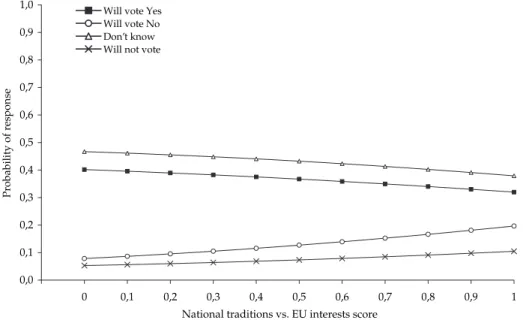
H.7a Those who feared that the EU would lead to a loss of Czech sovereignty and that party politics was based on a struggle between national traditions and European integration would have opposed accession.
H.7b Having a belief in defending national interests and feeling proud of Czech citizens would be negatively associated with voting for accession because of the perceived threat posed by aspects of integration such as loss of inde- pendence.
H.7c Citizens with a strong sense of community rather than regional or national identity would have been most opposed to EU membership because they most acutely perceived European integration to be a threat to their ethno- cultural values.
Data and methods
The analysis of public attitudes toward accession in the Czech Republic reported here relies on a mass face-to-face survey undertaken by the Public Opinion Re- search Centre (CVVM – an independent state polling agency) between October 26 and November 5 in 2001 on 1199 adults aged fi fteen years and older. In this research, only a subset of respondents aged seventeen years or older that were eligible to vote in the accession referendum of June 2003 are examined (N=1140).
Like all the main polling agencies in the Czech Republic, CVVM uses quota sampling on the basis of region (x8), size of community (x6), sex, age (x4), and ed- ucation (x4).6 Consequently, with a quota sampling methodology, non-response rate and weighting variable estimates are not available (see appendix).7 A central concern among survey researchers with data derived from quota-controlled sam- pling is that the resulting information is problematic owing to non-representative strata and non-random selection within strata [Berinsky 2006: 506–9].
6 The numbers in parentheses, e.g. (x4), refer to the number of categories used to create quota samples.
7 Two versions of this survey data exist. The fi rst is part of a pooled survey series deposit- ed at the German Social Archive in Cologne, where all variable labels and documentation are in English. The second version is available from CVVM in the Czech language only.
This dataset has a much more extensive set of variables and is the one used in this paper.
socrev2007-1.indb 536
socrev2007-1.indb 536 3.9.2007 18:41:283.9.2007 18:41:28
An analysis of the quality of survey work done by all of the main Czech polling agencies prior to the general election of 2002 found that CVVM adheres consistently to international polling industry standards. Moreover, the quality of the survey data produced by CVVM with regard to measurement validity and ac- curacy in making pre-election estimates of party support is generally superior to all the other main polling agencies within the Czech Republic. As CVVM follows standard polling practices and produced the most accurate election predictions between 2002 and 2004, this gives us confi dence in the validity and reliability of the survey data used in this research [see Kreidl and Lebeda 2003; Krejčí 2004].
Turning now to the survey question used as the dependent variable in this research, we can see from the following item wording that those interviewed were offered four response options. ‘If there were a referendum tomorrow on the Czech Republic’s accession to the European Union, would you vote for or against accession?’ The response options were: ‘for’, ‘against’, ‘would not vote’,
‘undecided’ and ‘don’t know’.
Following a similar strategy as Tucker, Pacek and Berinsky [2002] the sub- stantively similar responses of ‘undecided’ and ‘don’t know’ were combined.8 The theoretical expectation is that the individuals who responded, ‘for’, ‘against’,
‘would not vote’, or ‘undecided/don’t know’ would be different. A series of Wald and likelihood ratio tests were used to investigate and confi rm that combining any of these response options is not warranted.
As the dependent variable is unordered and nominal, a multinomial logit (MNL) modelling strategy was used to analyse the survey data [Scott-Long 1997:
151–178]. It should be noted that all the data, except the dependent variable, were rescaled (0–1) to aid interpretation. Therefore, as all measures have the same met- ric, those variables with larger coeffi cients in the same models presented have stronger effects.
However, logit regression coeffi cients are diffi cult to interpret because they are non-linear. Technically this means that while a change in the log odds ratio is constant for all levels across all variables, the value of discrete probabilities depends critically on the values of the variables. For example, the effect of being a winner in the post-communist transition process might increase the odds of supporting EU membership by a factor of ten, but the impact of an economic as- sessment is small if the odds of supporting accession were one in seven thousand.
Therefore, in order to make the presentation of our MNL regression results more transparent some of the estimates will be presented within the next section as predicted probabilities and graphically.
8 There is the temptation here to combine non-voting and uncommitted respondents.
However, care has to be taken when combining response categories. For example, Tucker, Pacek and Berinsky [2002: 561] argue that Cichowski’s [2000: 1255] strategy of combining undecided and non-voting respondents yielded misleading results.
538
Empirical results
One important implication of the research results presented here is that the EU accession campaign may have had little effect in changing the minds of voters.9 Eighteen months before the referendum poll, 44% of people supported accession while 14% were against. In the referendum of mid-June 2003, 42% of registered voters voted ‘yes’ while 12% voted ‘no’, with a turnout rate of 55%. The Novem- ber 2001 survey results are within sampling error (± 3%) of the actual referendum result.10
Taking those respondents, aged seventeen years or more (and hence eligible voters in June 2003), who were ‘undecided’ (28%), ‘would not vote’ (6%), and had no opinion (9%), it is possible to account for most of the non-voters in the refer- endum 45% (42%). The assumption here is that those voters who gave no fi rm opinions in late 2001 were most likely to abstain in the accession referendum.
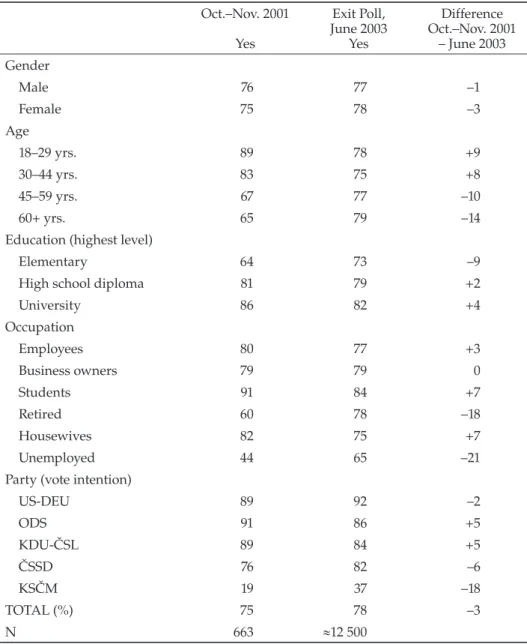
Many of the differences between the poll of late 2001 and the exit poll for the accession referendum shown in Table 2 relate to the impact of turnout. In the survey of late 2001 many more younger and middle-aged people stated that they would vote than were interviewed after voting in the exit poll. Differential turn- out on the basis of age is a well-known feature in all elections.
Furthermore, a higher turnout rate in the exit poll among those with an el- ementary education than that estimated by the poll of late 2001 is not surprising [see Rosenstone and Hansen 1993; Wolfi nger and Rosenstone 1980]. This effect is partly based on age as a higher proportion of senior citizens received only an elementary education, in addition many of this group live in rural areas with strong social networks that foster the norm that voting is a civic duty. The most interesting differences are those relating to the unemployed who appear to have been convinced between November 2001 and June 2003 to vote ‘yes’. Table 2 in- dicates that unemployed citizens’ support for accession grew by almost 48% dur- ing this period. Equally dramatic was the growth in support among voters of the Communist Party of Bohemia and Moravia (KSČM) for EU membership, which went up by almost 95%. However, these results may be more apparent than real owing to social desirability effects in survey interviews [Tourangeau, Rips and Rasinski 2000].
It is well known internationally that the number of respondents who will admit to being unemployed is often much less than those registered as being un- employed. In the Czech Republic there was an offi cial unemployment rate of 9.8%
9 Hanley [2004: 710] notes that the ‘yes’ campaign dominated the ‘no’ one. In terms of fi - nances the ‘yes’ campaign spent two hundred times more money than the ‘no’ side, which was in addition considered to be ineffective. For many, accession was considered a fait accompli prior to the referendum. The acrimonious debates during the campaign were less about accession and more concerned with the nature of integration and its impact on the Czech Republic.
10 Lebeda [2004: 219–221] shows that fi nal polls before the referendum (i.e. June 2003) were also reasonably accurate in predicting both turnout and support for accession.
socrev2007-1.indb 538
socrev2007-1.indb 538 3.9.2007 18:41:283.9.2007 18:41:28
Table 2. Comparison of the October–November 2001 survey and the exit poll results in June 2003 (%)
Oct.–Nov. 2001 Yes
Exit Poll, June 2003
Yes
Difference Oct.–Nov. 2001
– June 2003 Gender
Male 76 77 –1
Female 75 78 –3
Age
18–29 yrs. 89 78 +9
30–44 yrs. 83 75 +8
45–59 yrs. 67 77 –10
60+ yrs. 65 79 –14
Education (highest level)
Elementary 64 73 –9
High school diploma 81 79 +2
University 86 82 +4
Occupation
Employees 80 77 +3
Business owners 79 79 0
Students 91 84 +7
Retired 60 78 –18
Housewives 82 75 +7
Unemployed 44 65 –21
Party (vote intention)
US-DEU 89 92 –2
ODS 91 86 +5
KDU-ČSL 89 84 +5
ČSSD 76 82 –6
KSČM 19 37 –18
TOTAL (%) 75 78 –3
N 663 ≈12 500
Note: The difference in the column estimates relate to how much the estimates from the survey in late 2001 were over or under the results of the exit poll on 13–14 June 2003. Per- centages here refer to those who voted or stated that they would defi nitely vote ‘yes’.
540
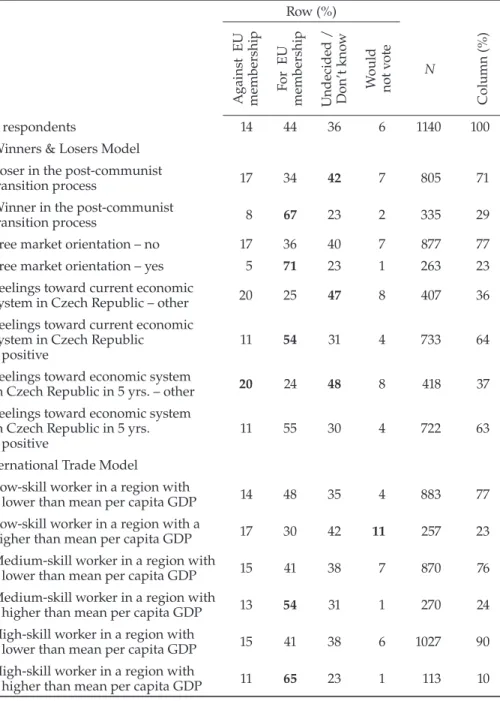
Table 3. Cross-tabulation of preferences for EU membership by attitudes toward the economy and identity (%)
Row (%)
Against EU membership For EU membership Undecided / Don’t know Would not vote
N
Column (%)
All respondents 14 44 36 6 1140 100
Winners & Losers Model Loser in the post-communist
transition process 17 34 42 7 805 71
Winner in the post-communist
transition process 8 67 23 2 335 29
Free market orientation – no 17 36 40 7 877 77
Free market orientation – yes 5 71 23 1 263 23
Feelings toward current economic
system in Czech Republic – other 20 25 47 8 407 36
Feelings toward current economic system in Czech Republic – positive
11 54 31 4 733 64
Feelings toward economic system
in Czech Republic in 5 yrs. – other 20 24 48 8 418 37
Feelings toward economic system in Czech Republic in 5 yrs.
– positive
11 55 30 4 722 63
International Trade Model
Low-skill worker in a region with
a lower than mean per capita GDP 14 48 35 4 883 77
Low-skill worker in a region with a
higher than mean per capita GDP 17 30 42 11 257 23
Medium-skill worker in a region with
a lower than mean per capita GDP 15 41 38 7 870 76
Medium-skill worker in a region with
a higher than mean per capita GDP 13 54 31 1 270 24
High-skill worker in a region with
a lower than mean per capita GDP 15 41 38 6 1027 90
High-skill worker in a region with
a higher than mean per capita GDP 11 65 23 1 113 10
socrev2007-1.indb 540
socrev2007-1.indb 540 3.9.2007 18:41:283.9.2007 18:41:28
Willing to work outside Czech Republic after accession – uncommitted
16 40 38 6 986 86
Willing to work outside Czech
Republic after accession – yes 3 70 23 5 154 14
FDI Model
Some doubts about foreign direct
investment in Czech Republic 22 25 44 8 710 62
Convinced supporter of foreign
direct investment in Czech Republic 2 74 23 1 430 38
Identity Model
EU membership will lead to a loss of
sovereignty 13 44 37 6 925 81
EU membership will not lead to
a loss of sovereignty 20 44 33 4 215 19
Believe in defending national
interests – uncommitted response 13 46 35 6 986 86
Believe in defending national
interests – yes 21 30 45 5 154 14
Very proud of Czech citizens
– uncommitted response 13 43 38 6 902 79
Very proud of Czech citizens – yes 18 48 30 4 238 21
Party politics is based on national
traditions vs. EU interests – no 14 44 37 6 1099 96
Party politics is based on national
traditions vs. EU interests – yes 27 41 27 5 41 4
Identifi es with local community – no 14 48 34 5 498 44 Identifi es with local community – yes 15 41 38 6 642 56
Identifi es with region – no 14 43 37 6 985 86
Identifi es with region – yes 14 48 35 4 155 14
Identifi es with country – no 14 42 37 6 922 81
Identifi es with country – yes 15 50 32 3 218 19
Note: Row percentages (to the left of the number of cases) represent the distribution of responses on EU accession for each variable, e.g. 34% of those who were losers in the post-communist transition process favour EU accession. Column percentages (to the right of the number of cases) refer to how much each response option constituted of the total sample, e.g. 71% felt they were losers in the post-communist transition process while 29% were winners. Numbers in bold refer to estimates that signifi cantly (p≤.05) exceed those of the total electorate, e.g. losers in the post-communist transition process were signifi cantly more likely than all voters to state they were undecided about voting in the accession referendum.
542
for December 2001, but the survey estimate was just 4%. Similarly, the attenuation effects due to social desirability were also evident for the intention to vote for the Communist Party or for feeling closest to this party – where in the survey of late 2001 it had an 11% level of support. Seven months later, in the 2002 general elec- tions, the Communist Party attracted 18.5% of the popular vote. The differences between the survey used here and the exit poll are in large part the result of well- known methodological artefacts and do not point to strong campaign effects for these specifi c groups.
Given the wide range of questions asked in the survey examined in this paper, it is a unique and invaluable instrument for estimating ‘core’ popular sup- port for accession beyond the short-term effects of a campaign – which in the Czech case may have had its greatest impact in ensuring a level of voter turnout comparable with the previous general election in 2002. While this was important in ensuring legitimacy in the decision to join the EU, it was not as crucial a consid- eration as in Poland and Slovakia, which had participation thresholds for having binding referendum results.
Before describing the results of our regression models it is instructive fi rst to examine a simple profi le of preferences for accession by attitudes toward the economy. The cross-tabulations and difference of proportions estimates present- ed in Table 3 suggest that economic attitudes were more strongly linked with opinions on accession than those related to sense of identity. Many of the patterns evident in Table 3 are consonant with our hypotheses, and we will discuss these in greater detail in the following subsections.
However, Table 3 is important, as it provides us with estimates (in the fi nal column on the right) of the frequency distributions of all variables used in the mod- els reported later in Table 4. Such data is important, as they facilitate the assessment of the signifi cance of the regression results. For example, it is important to know that seven in ten respondents felt they were losers in the post-communist transition process and that such perceptions among the majority of the electorate translated into indecision about the benefi ts of accession rather than into opposition.
Winners and Losers Model
As the fi rst column of Table 4 shows, each of the predicted effects of Tucker, Pacek and Berinsky’s [2002] model was found to be statistically signifi cant. Being a
‘winner’ in the post-communist transition (H.1) process increased the probability (p=+.48) that a respondent would state that they would support accession rather than vote ‘no’ (p=–.08) in the referendum.11 Moreover, self-identifi ed winners in the post-communist transition process in contrast to losers were much less apt
11 The probabilities reported refer to the change in probability for giving a ‘yes’ (or ‘no’,
‘don’t know’ or ‘will not vote’) response to the EU accession question across the entire range of the independent variable. For example, the probability of supporting accession
socrev2007-1.indb 542
socrev2007-1.indb 542 3.9.2007 18:41:283.9.2007 18:41:28
(p=–.39) to say ‘don’t know’ and were very unlikely (p<.001) to state that they would not vote in the referendum. Ideologically, those who identifi ed themselves as having a free market orientation (H.2) were more likely (p=.16) to be in favour of accession, indicating a strong association in citizens’ minds between the inte- gration process and market liberalisation.
A positive assessment of the national economy (H.3a) and being optimistic about the future (H.3b) were also signifi cant factors but their effects were less powerful than the other variables in the winners and losers model. Theoretically one might have expected the prospective economic measure to have had the most powerful impact, as the benefi ts of accession were a future goal. For Czech citi- zens, current and prospective assessments of the economy were moderately cor- related (r=.47), which might be the result of a question ordering or priming effect, as the two items were sequential in the survey.
International Trade Liberalisation Model
Like Gabel’s [1998b] economic interest and political preference model, the in- ternational trade liberalisation approach is based on insights derived from the Heckscher-Ohlin theory of international trade preferences. However, the explan- atory variables used are somewhat different. Gabel created an interaction vari- able using occupation and relative wages / human capital. In contrast, the trade liberalisation model implemented here focuses on the differential impact that re- gional (rather than cross-national) economic structures will have on preferences for accession.12 In addition, the model tested in this research takes into account labour mobility (i.e. migration to Prague from regions of industrial decline), a key consideration in trade theory.
Using education level as a measure of worker skill proved to be more robust than using income. The results shown in the second column of Table 4 show that skilled labour in rich regions was most strongly associated with support for acces- sion. Therefore, in line with our expectations (H.4a) low-skilled workers in richer regions tended to be against accession, though this is not a statistically signifi cant effect. In contrast, those with medium and high skills (H.4b-c) were increasingly likely to give a ‘yes’ (p=+.18 and +.25 respectively) rather than a ‘no’ response (p=–.05 and –.07 respectively).13 These results match the fi ndings of Gabel’s [1998a]
analysis of mass attitudes with EU-12 member states toward membership between increases by .48 (or 48%) across the entire range of our 8-point ‘winners-losers’ ordinal variable.
12 It should be noted that the interpretation of interaction terms in nonlinear models re- quires considerable care [see Ai and Norton 2003; Brambor, Clark and Golder 2006; and Berry, Esarey and Rubin 2007].
13 Additional tests of these interaction variables using a methodology developed by Bram- bor, Clark and Golder [2006] confi rm the results noted in Table 4. Models including all interaction variables are not reported for reasons of brevity.
544
Table 4. Multinomial logit analysis of micro-economic explanations of preferences for EU membership (will vote ‘yes’ coeffi cients) VariablesWinners & Losers Model
International Trade ModelFDI ModelEconomic ModelIdentity ModelEconomic & Identity Model Winner in the post-communist transition process (H.1)2.058***.314.452 (.510)(.573)(.588) Free market orientation (H.2)1.112***.461.398 (.324)(.392)(.399) Positive feelings toward current economic system (H.3a).723***.404.389 (.216)(.262)(.265) Positive view of economic situation in fi ve years (H.3b).703**.249.220 (.226)(.269)(.271) Low-skill * relative per capita GDP in region (H.4a)–.666–.110–.318 (.573)(.680)(.679) Medium-skill * relative per capita GDP in region (H.4b).915*.312.284 (.510)(.592)(.599) High-skill * relative per capita GDP in region (H.4c)1.332**.517.598 (.659)(.670)(.693) Willing to work outside Czech Republic after accession (H.5)3.744***2.859***2.847*** (.599)(.639)(.651) Support foreign direct investment, FDI (H.6)7.658***6.999***7.026*** (.552)(.602)(.616) EU membership: loss of sovereignty (H.7a)–.414*–.449 (.231)(.290) Party politics is based on national traditions vs. EU interests (H.7a)–.710*–1.194** (.412)(.513)
socrev2007-1.indb 544
socrev2007-1.indb 544 3.9.2007 18:41:283.9.2007 18:41:28