
(will be inserted by the editor)
A Data-Driven, Goal-Oriented Framework for Process-Focused Enterprise Re-engineering
Thai-Minh Truong · Lam-Son Lê · Elda Paja · Paolo Giorgini
Received: date / Accepted: date
Abstract Along with enterprise transformation, enterprise re-engineering is essential for maintaining the competitiveness of an enterprise. Enterprise re-engineering addresses (emergent) changes, re-organizing, outsourcing and re-aligning alike. Re-engineering itself has drawn traction in both academia and business. Most scholarly work in this area is confined to model-driven analysis, holistic frameworks for analyzing as-is/to-be enterprise models, and a few other conceptualization techniques. The practice of process redesign understandably takes the stage in re-engineering. Yet algorithmic techniques that insightfully point out how a process might be improved for proactively re-engineering process-intensive enterprise architecture are missing. Data science and business intelligence have brought a refreshingly new analysis to this mainstream problem by studying the operational history of a business process to facilitate most plausible changes. In this article, we investigate enterprise process redesign taking into account enterprise’s high-level strategy and data warehouse. More specifically, we propose an approach to reasoning about an enterprise’s strategy together with data mining rules extracted from the data warehouse of the enterprise. Our redesign algorithms suggest design-time changes to be made to its business processes, primarily by eliminating redundant tasks and re-ordering inefficiently-located tasks. We analyze the effectiveness of candidate to-be business processes with regard to business intelligence indicators. We report our work on the enterprise architecture developed for a retailer of low-cost domestic flights.
T-M. Truong, L-S. Lê ( )
Faculty of Computer Science & Engineering, Ho Chi Minh City University of Technology (VNU-HCM), Vietnam
E-mail: [email protected] E. Paja
Department of Computer Science, IT University of Copenhagen, Denmark P. Giorgini
Department of Information Engineering and Computer Science, University of Trento, Italy
Keywords Enterprise Re-engineering · Goal-oriented Modeling· Business Process Management·Data Mining·Business Intelligence·Digital Enterprise
1 Introduction and research questions
The literature of information systems has enjoyed a growing interest in enterprise re-engineering for the sake of making enterprises stay competitive and dynamic in today’s ever changing world (Laudon and Laudon, 2019).
On the one hand, a number of definitions for this term have come out (Tribolet, 2014; Alter, 2014) most of which see enterprise re-engineering as the fundamental rethinking and radical change of business processes to gain certain improvements (Ştefănescu et al., 2008). On the other hand, enterprise re-engineering addresses changes that are constantly made to enterprises (Tribolet, 2014) some of which are emergent (Alter, 2014). Industry 4.0 has emerged as a new phase in the industrial revolution that adopts what was obtained in the third revolution and enhances it with smart and autonomous systems based on changing radically the way the entire business operates and grows. Given today’s on-going industrial revolution, business processes are tightly linked to other enterprise layers and as such play a central role in enterprise engineering (Xu et al., 2018; Qu et al., 2019) and in business engineering (Winter, 2001; Österle, 2013).
Mainstream research in the realm of enterprise re-engineering is dedicated to the alignment between the enterprise’s operational level (e.g., business processes, people) and its high-level management, i.e. business strategy (Iacob et al., 2012; Hinkelmann and Pasquini, 2014; Umoh and Sampaio, 2014;
Salgado et al., 2014). The lower levels of an enterprise, i.e., its operational level and its computing and technology level combined, often handle a large volume of data that have increased significantly these days for the following two reasons. First, today’s e-business models through which enterprises may collaborate, yield a large number of transactions. Second, computing capability and storage capacity in use today keeps expanding. To this end, enterprise-wise data increasingly play a key role in today’s enterprise architecture. Data analytics would give an insight into how the enterprise in question has been operationalized of late.
In case the operationalization and the management of the enterprise diverge, the enterprise’s internals need to be re-aligned to regain its competitiveness. Alterations to the existing business model of the enterprise, including process redesign, contribute to this re-alignment. In a broader scope, the evolution and transformation of enterprise architecture together have given rise to a new line of research. Enterprise transformation concerns non-trivial fundamental changes to significantly alter an organization’s relationships with key constituencies (Rouse, 2005). Enterprise transformation might be enabled by the Internet of Things (Zimmermann et al., 2015), supported by a helpful management of enterprise architecture (Labusch et al., 2013, 2014), and enabled by an enhanced enterprise architecture framework (Donaldson
et al., 2015). The ongoing endeavor of redesigning and restructuring today’s enterprise information systems necessitates pipeline evolution (Hacks et al., 2019) and continuous re-alignment (Hinkelmann et al., 2016). A request for changes to an enterprise architecture will likely trigger a reparation process that eventually propagates changes to restore the well-formedness of the said architecture (Dam et al., 2016).
When narrowing the subject down into process re-engineering, managing changes to business processes is key to the success of a digital enterprise (Deokar and Sarnikar, 2016). The improvement of business processes could be guided using a set of pre-identified change patterns (Yousfi et al., 2016). In business management, scholarly work has confirmed that process re-engineering is evolutionary by nature (Jarvenpaa and Stoddard, 1998) and is driven by enterprise strategy (Teng et al., 1996; Kallio et al., 1999).
1.1 Research questions and design science
Despite having been investigated in many aspects, automation in enterprise re-engineering leaves a lot to be desired. Existing approaches require intensive handcraft and human expertise in the form of pattern-, product-, heuristic-based methods (Reijers, 2003; Dumas et al., 2018). To the best of our knowledge, a crisp, algorithmic suggestion to re-engineer a process-focused business is currently missing in the literature. Though business processes primarily matter in the operational level our view of process redesign is that it would be impossible without considering the big picture of the organization of an enterprise – which is heterogeneous by nature as Dietz emphasized in his work on enterprise ontology (Dietz, 2006). In the following, we elaborate our research questions. We also point out how our work fits into design science in information systems engineering.
1.1.1RQ1: How can we turn the rule-based knowledge mined thanks to enterprise data warehouse into an actionable redesign of enterprise’s business processes in order to stay tuned to changing requirements?
Business processes generate transactions as they are on the go. Enterprise data warehouses play the role of a driver for the sake of process redesign.
In enterprise ontology, data warehousing is part of what is called the D-organization (Dietz, 2006). Enterprise’s explicit knowledge up to the point in time considered for re-engineering is buried in transactional dataset, which give us evidence what process tasks need to be revised and rule-based ways of revising them. This would open the door to automatic process fine-tuning.
1.1.2RQ2: To what extent the enterprise’s business objectives blueprint the redesign of enterprise’s business processes?
Business processes of an enterprise arguably play a central role in enterprise re-engineering as they materialize enterprise’s business objectives at the
operational level. In enterprise ontology, they are at the core of what is coined the B-organization (Dietz, 2006). Over time, the operational level might unknowingly/unintentionally derail from the management level and/or diverge from what is actually happening in the enterprise. One way to make the enterprise function more effectively is to re-align them with high-level business objectives, which serve as an enabler for any attempt to redesign an existing process. In addition, since a redesign attempt could yield a multi-choice output, enterprise’s business objectives guide us to the most prominent choice among all possible alternatives.
1.1.3RQ3: How to algorithmically ground enterprise’s business objects in a formalized process redesign?
In enterprise ontology, business objects essentially capture the informational dimension of an enterprise, i.e., the I-organization (Dietz, 2006). Taking them into account when redesigning business processes would make redesign attempts more insightful. Technically speaking, they need to be grounded in our redesign algorithms in conjunction with other blocks including data mining rules and process tasks. According to artifact-centric business process (ACP), business objects play a central role in a business process model that serves as inputs to our algorithms.
1.1.4 Our research methodology with respect to design science
Design science research (Peffers et al., 2008) sheds light on how to systematically conduct research in the relatively broad field of in information systems. Concretely, (Hevner et al., 2004) offer guidelines of how to reason about the relevance, artifact, evaluation, rigor and contributions of scholar work. Our research artifact is a framework we propose for enterprise re-engineering with an emphasis on business processes to achieve desired goals thanks to data mining, Technically, we devise rigorous algorithms that suggest performance-driven changes to be made to an enterprise’s underlying business processes, which would contribute to the overall competitiveness of the enterprise in question. Blueprints for process redesign come from the analysis of data accumulated while the enterprise’s operational levels are on the go (Truong and Lê, 2016). We analyze the redesigning effectiveness of the proposed algorithms with regard to high-level indicators described at the enterprise’s strategic level. More specifically, our algorithms point out how to remove redundant tasks and resequence inefficiently-located tasks of an enterprise’s business process (Truong et al., 2017).
1.2 Paper structure
Section 2 presents the state of the art and related work, followed by a case study described in Section 3. In Section 4, we discuss our research
methodology and offer insights into our framework for process-focused enterprise re-engineering. Our implementation is given in Section 5 (see Appendix A and Appendix B for additional details). Section 6 is dedicated to the evaluation of our framework, for which an elaboration may be found in Appendix C. Section 7 concludes the paper and outlines our plausible future work.
2 State of the art and related work
In this section, we address state of the art and relevant related work in terms of goal-based business intelligence (Subsection 2.1), business process redesign (Subsection 2.2), data mining (Subsection 2.3), process mining (Subsection 2.4), intelligence-driven process re-engineering (Subsection 2.5), and strategically driven enterprise re-alignment (Subsection 2.6).
2.1 Goal-based business intelligence
Business intelligence (BI) has been a tendency of late as a tool for proposing data-driven innovative changes to an enterprise. Most of today’s research in BI is focused too much on data-oriented approaches and do little for understanding their business layer (Horkoff et al., 2014). To bridge such a gap, Horkoff et al. proposed an enterprise modeling approach named the business intelligence model that is especially focused on reasoning about situation, influences, and indicators. For reasoning and evaluating alternatives, Horkoff and Yu introduced a qualitative, interactive assessment procedure for goal models (Horkoff and Yu, 2009) based on a modeling language for the early phase in system development called i*. To support strategic decision-making, Maté et al. (Maté et al., 2015) offered a systematic analysis for business strategy, and Barone et al. (Barone et al., 2010) proposed a goal modeling language, namely Business Intelligence Model (BIM).(Paja et al., 2016; Giorgini et al., 2002) presented the applicability of goal models through analyzing and comparing the existing goal modeling and reasoning approaches.
2.2 Business process redesign
The redesign of business processes has a vast possibility in terms of decreasing times, costs, and enhancing customer satisfaction (Vanwersch et al., 2016).
Vanwersch et al. made a systematic literature review to build a general methodological framework, which specifies six key methodological decision areas (namely aim, tool, technique, actors, input, and output). There are diverse approaches to process redesign, e.g., a heuristic-based method that concentrates on various business domains (Dumas et al., 2018), several case studies using a product-based design approach to boost the performance of processes (Reijers, 2003). Automatic and semi-automatic generation of process
designs and redesigns have drawn scholars’ attention in the aforementioned field (Vanderfeesten et al., 2011). An alternative view point to this approach considers the changes and progression of business data as a key driver of business processes, e.g., data-driven process structures (Müller et al., 2008).
In this direction, Watson Research Center is one of the pioneers proposing IBM’s artifact-centric business process models (Nigam and Caswell, 2003) and data-driven process structures (Müller et al., 2008). Conceptually, in artifact-centric business process (ACP), artifacts and the process control are dually taken into account when modeling processes (Kunchala et al., 2015).
Contractually, business tasks are expressed in terms of pre-conditions (i.e., conditions that must be held for the task to be invoked) and post-conditions (i.e., conditions that will be held upon the completion of the task), which should both be grounded in the same logic used for reasoning about the state of business objects (Bhattacharya et al., 2007).
2.3 Data mining
In today’s digital and information age, data warehouse and enterprise’s transactional data give insight into activities, habits, tendencies, characteristics and the like of individuals or organizations who took part in enterprise’s business processes. Data science is becoming a powerful tool for predicting the outcome of up-coming transactions (Bordeleau et al., 2018). In the context of our work, the primary concern is to leverage data mining in order to change enterprise’ business processes in ways that the enterprise of interest becomes more competitive. As in many BI scenarios, classical mining techniques such as extracting association rules, building classification models from a transactional dataset are helpful in suggesting what process changes should be made.
2.4 Process mining
Over the last few decades, process mining has received much attention from both academia and industry. It has emerged as a crucial ingredient of initiatives on process management and process improvement. In this point of view, event logs are used to discover processes, check conformance, and analyze process performance (Dumas et al., 2018). Though promising, process mining still falls short in coping with concurrency (filtering concurrent instances may yield misleading results, e.g., diagrams with many nonexistent loops) (van der Aalst, 2020). At the present time, we do not use process mining to construct the as-is processes in our framework primarily because modeled processes have a tendency to be more abstract than the discovered process models. An abstract activity can correlate to many discovered events at different levels of granularity. In the future, when the gap between discovered and hand-made models could be bridged, process mining techniques can be employed to automatically construct as-is processes for the sake of process redesign.
2.5 Intelligence-driven process re-engineering
The rationale behind BI is bringing data-driven analysis into decision making and process engineering. Most notably, Michelberger et al. devise an approach to bridging the gap between process-related information and business processes using what they call process-oriented information logistics (Michelberger et al., 2012). By the same token, Mitschang’s group (Niedermann et al., 2010) proposed a (semi-)automated business process optimization platform based on actual execution data of the car loan process by using “best-practice”
optimization patterns. Furthermore, Wegener and Rüping (Wegener and Rüping, 2010a) discussed the integrating data mining into business processes and its evaluation in business process re-engineering context based on Business Process Modeling Notation (BPMN) and what is called cross-industry standard process for data mining. (Rupnik and Jaklič, 2009) proposed a deployment of data mining into extant business processes using a Java library for data mining. They went further in this regard advocating the reuse of effective data mining solutions in order to minimize manual coordination and adjustment in business processes (Wegener and Rüping, 2010b). At design-time, (Koliadis and Ghose, 2009) depict the problem of handling business process change based on a sophisticated scheme for annotating process models. Shahzad and Zdravkovic analyze and optimize business processes relied on a process-oriented data warehouses and goal-oriented approach (Shahzad and Zdravkovic, 2009).
2.6 Strategically driven enterprise re-alignment
In enterprise engineering, re-alignment is a term that refers to dynamic alterations done to enterprise building blocks in order to have the enterprise’s operational levels executed in accordance to the enterprise’s strategy and values. Enterprise data warehousing is notable for semantically connecting groups of enterprise building blocks that were originally devised for different purposes. Wegmann proposes a methodology of reasoning about business-IT alignment with respect to enterprise strategies (Wegmann et al., 2007).
Pombinho et al. attempt to bridge value-modeling concepts and traditional enterprise engineering (Pombinho et al., 2014). Schmidt addresses the strategic alignment of big data applications (Schmidt and Möhring, 2013). Fill et al.
enrich enterprise views by joining enterprise models and data representation (Fill and Johannsen, 2016).
Our work in enterprise re-engineering tackles the inefficiency of business processes taking into account the big picture of an enterprise architecture.
Our approach takes the rationale of BI and contributes to the discipline of business process management, in particular process improvement. Our work in enterprise re-engineering is centered around process redesign that is enabled by enterprise’s strategic goals and driven by data warehousing.
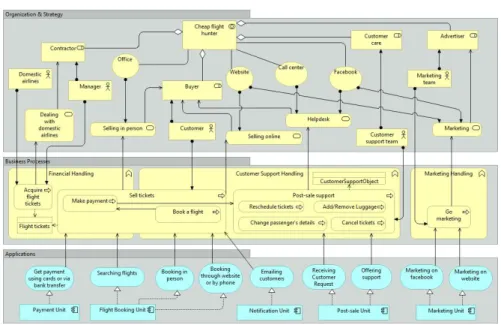
Fig. 1: The enterprise architecture of Company AD expressed in ArchiMate
3 Case study
In this section, we walk through our case study: first showing the architecture and goal models of an enterprise (Subsection 3.1), then describing its business processes (Subsection 3.2).
3.1 Case study
We describe in this subsection a real case study of a small-sized company, namely Atadi1 (nicknamed thereafter AD), that retails low-cost domestic airfare in Vietnam sourced from a number of airlines including Vietnam Airlines2, Jetstar Pacific Airlines3 and VietJet Air4. The company’s vision is to keep improving its operational levels by means of improving employee competencies, optimizing business processes and technological innovations.
The company has approximately 30 employees divided into four divisions including financial, customer support, technical, and marketing departments (Figure 1).
Company AD, a typical example of successful start-ups in Vietnam, was established on March14th, 2013 and gone live in December of the same year.
1 https://www.atadi.vn
2 http://www.vietnamairlines.com
3 http://www.jetstar.com
4 http://www.vietjetair.com
Fig. 2: Original goal model of Company AD
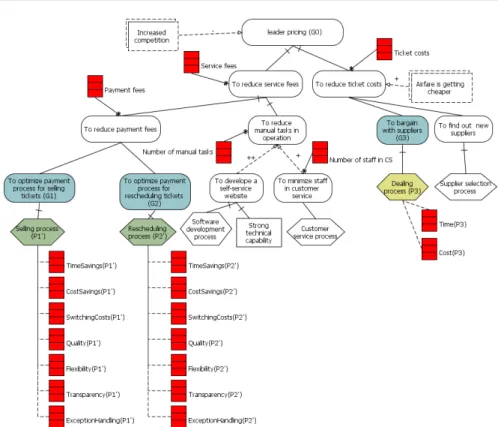
In running their business, they first faced a lot of challenges that are typical to most start-up businesses, leading to an initial strategy to establish a foothold in the domestic market of low-cost airfare (see Figure 2). After putting a lot of effort into operating and adapting to changing demand, they started to enjoy good growth5 as of 2015. AD set their next goal being leader pricing in the busy market (see Figure 3). This goal is broken down into sub goals and further into leaf goals.
For the sake of depicting their business functions, in Figure 1 we present an ArchiMate6 diagram describing the enterprise architecture of AD. Note that each business function depicted in Figure 1 comes with a fairly abstract business process that should be described in detail separately in another diagram, preferably using BPMN7.
To stay competitive, the company’s management would like to investigate if business functionsCustomer Support Handlingand Financial Handlingare aligned with their revised goals – represented in Figure 3. To do so, they attempt to redesign the processes of selling and rescheduling flight tickets separately taking into account their data warehouse. The company’s first alternative is to redesign the process of selling flight tickets; the second – the rescheduling process.
5 Until 2017, the company achieved net operating revenue of $11 millions for the same year, gross profit of more than $350 thousands. They gradually became passenger’s first choice in hunting for cheap flights
6 ArchiMate modeling languagehttp://www.archimate.nl/
7 The specification of BPMN is managed by the Object Management Group http://
www.bpmn.org/
Fig. 3: Revised goal model of Company AD
3.2 Process description
Figure 4 gives a detailed representation of business processSelling tickets
in BPMN. Company AD, its customers and the airlines providing flight tickets (under roleProvider) are each put under a pool in this BPMN diagram. For regular air tickets, the customer searches for available flights on a departure date of her choosing until she agrees on a suitable ticket and eventually books it. The customer is notified via email listing details of her reservation and payment due date. For last-minutes tickets, the system checks her e-wallet balance and asks8 her to top up if needed before opening a time-bound transaction for her to make a last-minutes booking. At some point in this process, Company AD would proceed in paying its provider. The customer receives a confirmation about her booking at the end of this process.
Figure 5 gives a detailed representation of business process Reschedule
tickets in BPMN. The customer first makes a request to reschedule her air ticket. Company AD (actually its department of customer support) then checks the availability for her newly-proposed flight reschedule and contacts
8 The process returns to regular tickets if she does not have enough e-balance.
Fig. 4: [as-is] Selling tickets in Company AD
her with reschedule fees incurred if any. Otherwise, Company AD makes a list of reschedule options checking associated fees with her again. This activity is to be repeated until the customer agrees on her rescheduled flight and the associated fees. Next, Company AD asks her to pay a surcharge, usually higher9than the confirmed reschedule fees. Company AD then proceeds with
9 Company AD has to wait for customer’s confirmation sent via email. Latency caused by any delay in making such a confirmation by the customer could result in a final charge for rescheduling her airfare that is actually higher than the reschedule fees previously confirmed by the provider. For this reason, Company AD puts a reasonable surcharge to cover this
Fig. 5: [as-is] Rescheduling tickets in Company AD
payment to its provider and determines if they need to refund the customer.
She receives a notification about the airfare reschedule (and possibly a refund) at the end of the process.
4 A framework for redesigning business processes
In this section, we walk through our enterprise re-engineering framework:
first describing an overview of the framework itself (Subsection 4.2),then presenting formal definitions part of our framework (Subsection 4.3), and finally discussing algorithms for business process re-design (Subsection 4.4).
Before going into this in-depth explanation, let us address the basis for our research methodology in line with design science in information systems research (Subsection 4.1).
4.1 Research methodology
Design science in information systems research has received increasing attention in recent years. Most notably, Hevner et al. described the performance of design science research via a concise conceptual framework and seven guidelines for conducting and evaluating good design science research
potential payment gap. The customer is entitled for a refund in case her actual reschedule fees finally go below the surcharge she paid.
(e.g., problem relevance, design as an artifact, research rigor, design evaluation, research contributions, communication of research) (Hevner et al., 2004). By the same token, Peffers et al. provided a nominal process model for doing design science research containing six steps (e.g., problem identification and motivation, design and development, evaluation), and a mental model for presenting and evaluating design science research (Peffers et al., 2008). We adopt the former because its guidelines are meant to address a whole range of aspects in information systems, and because of its relatively wide adoption (Chen et al., 2012; Peffers et al., 2008). In the following, we explain our research methodology following the guidelines we adopt.
• Problem relevance To stay competitive and dynamic, today’s digital enterprises should be able to be changed in response to evolving needs.
Majority of scholar work in process redesign is either heuristic-based or patterns-based. We target a semi-automatic, algorithmic approach taking into consideration enterprise’s data, goals, processes and business rules altogether.
• Research rigor Our work takes its root in proven basis and rigorous theories: BIM for modeling goals, ACP for modeling enterprise’s business objects and processes combined, data science for mining change-suggesting rules, and business rules for additional domain constraints. We devise (and implement) algorithms to redesign enterprise’s business processes semi-automatically (see Subsection 4.4) and then measure the performance of their output (see Section 6).
• Design as an artifact Our work in the big picture is for enterprise re-engineering with an emphasis on business processes (see Subsection 4.2).
In order to measure the performance of redesigned business processes (as-is vs to-be), we introduce a set of six indicators.
• Design evaluation We have tested and implemented a prototype of our redesign algorithms. We apply our framework to a real-life case study, and collect feedback from its stakeholders (see Section 5). Furthermore, we propose scales of measurement to facilitate the decision-making of what output processes to pick.
• Research contributionsWork presented in this paper contributes to the realm of enterprise re-engineering in the big picture and business process improvement in particular. It is quite close to process mining.
• Research communication Academically, our research targets an audience who are familiar with enterprise engineering, business process management and business intelligence. Pragmatically, the work conveys helpful information for business practitioners, managers and decision makers alike. To facilitate the understanding this work, they should have general knowledge of goal-oriented requirements engineering, business process improvement, data mining and business rules, which are recapped in the preliminaries of this paper to make it self-contained.
4.2 Overview
Market-driven changes made to an enterprise’s strategy will call for enterprise re-engineering. In our approach (see Figure 6), BIM is used to depict strategic goals and clarify the relationship between them and other enterprise’s building blocks such as processes and data. Changes made to the enterprise’s strategy serve as a trigger following which we might spot new/revised goals. Such a revised/new goal will likely be broken down into one or more sub-goals, each of which might further be decomposed until reaching leaf goals, i.e. goals that would not be further refined. Canonically, the goal in question will be fulfilled if allAND-decomposed10leaf-goals have been achieved (Gharib et al., 2018).
Fig. 6: The big picture of data-driven and goal-based enterprise re-engineering
For the sake of enterprise operation management, any newly added goal should be realized operationally by one or more processes of the said enterprise.
To this end, we should figure out whether a process needs to be newly designed or existing ones should be redesigned to achieve this new goal. Our work is dedicated to the latter case where data mining plays a central role in redesigning business processes, possibly resulting in multiple alternatives of business processes in question. Last but not least, we assess these alternatives using a set of indicators, each of which comes with a priority level.
Additionally, the workings of the business process re-engineering block in Figure 6 are clarified by Figure 7 to describe step-by-step our approach to business process redesign. In this structure, data warehousing and enterprise’s requirements both serve as inputs to our framework. Data warehousing involves pre-processing the operational data generated by business processes of the enterprise to get ready for data mining, leading to classification models (Han et al., 2011). Requirements described in the management levels of the enterprise enable us to specify non-key attributes in the data warehouse to be used as classifiers when it comes to data mining. Each resulting classification model consists of classification rules that will be assessed and chosen jointly by business analysts and data mining experts, with which they will associate several business rules refined from the enterprise’s goals.
10 Goals might logically be refined into sub-goals, thereby their satisfaction relies on that of their sub-goals. A goal might be achieved in several ways if it or its sub-goals are OR-refined (Horkoff et al., 2014).
Fig. 7: Redesigning a business process in enterprise architecture taking requirements, data warehouse and business objects as inputs.
The next stage of our approach involves redesigning a specific business process of the enterprise in question. Specifically, the classification models generated, their associated business rules and the process represented in ACP are fed into the elimination step (Algorithm 1), which yields a partially redesigned process (in ACP again) where redundant tasks are either lessened
or totally gotten rid of. Classification models that did not take effect in the elimination step will be the input of the next step – Algorithm 2. The output of this step is a final version in ACP that will be converted back to BPMN. In the end, we may have some classification models and business rules that went ineffective, i.e. they did not take effect in any step of our redesign framework.
Our choice of ACP in our re-engineering framework is justified by the fact that representing business objects in tandem with process tasks. It provides flexibility in performing processes by stating constraints as rules rather than sequence correlations (Voorberg et al., 2019). This approach is alternative to a common technique called process-centric modeling, which concentrates on activities, their sequence and just skims through data-aspects.
Unlike the process-centric counterpart, the artifact-centric paradigm aims at business objects, describing crucial physical or conceptual entities related to the business (Sousa et al., 2020).
The underlying rationale of artifact-centric business process modeling is to have a coherent representation of business processes leveraging conceptual modeling (Bhattacharya et al., 2007). As such, we formulate formal artifact-centric representation of the business process to be redesigned based on: (a) pre-conditions and post-conditions declared in the business process, (b) conceptually-represented states and attributes of business objects that matter. Note that classification rules coming out of the classification models, the artifact-centric representation of business processes and necessary business rules, are all grounded in the same representational language. All the blocks depicted in Figure 7 are visually placed into the following three diagrammatic areas: (i) building and evaluating classification models – visualized using grid pattern; (ii) redesigning business processes – diagonal pattern; (ii) formal representation of business processes – vertical pattern.
4.3 Formal definitions
In this section, we put business tasks (in terms of pre- and post-conditions) and classification rules (in terms of conditions and consequences) in a same logical system to help them understand each other. They are broken down into literals that are considered to be compared together (e.g., including or subsuming) or provide the union or intersection of them.
Let us explain our pick on the logical system to reason about. We initially considered propositional logic and then switched to first-order logic (FOL, also called predicate logic) to enjoy its existential and universal quantifiers (Ben-Ari, 2012). Coping with business rules in our process re-design necessitates second-order (or even higher-order) structures, explaining our adoption of higher-order logic (HOL) in devising re-design algorithms (Benthem et al., 2001).
In ACP models, an artifact schema is defined as M = {C1,C2, ...,Cn} (Yongchareon and Liu, 2010), whereCi∈ M(1≤i≤n)is an artifact class. An artifact classCincludes two ingredients: a set of attributesA ⊆ {a1, a2, ..., ax},
ai∈ A(1≤i≤x)(we used⊆instead of=becauseAmight be an empty set) and a set of states S ={s0, s1, ..., sy}, si ∈ S (0 ≤i≤y), where s0 denotes the initial state.
A business process P involves some scenario labels, denoted as P = {L1,L2, ....,Lm}. Each scenario labelLicontains a precise list of business tasks that define a path leading from the start point to the point being considered (Hinge et al., 2009), denoted asLi={t1, t2, ...., t`}.
We adopt the concept of pre-condition and post-condition (Yongchareon and Liu, 2010) in formally representing business tasks. From now on, we define a business task t as a 4-tuple of the following elements: pre-condition (λ), post-condition(β), service(ν)andset of involved artifacts(σ)
t < λ, β, ν, σ >,
where λ andβ are pre-condition and post-condition of the task in question, respectively;νis a service to be performed;σis a set of artifact classes involved in taskt, denoted asσ={C1,C2, ...,Cy},Ci∈ M(1≤i≤y).
However, we argue that the pre-condition and post-condition of business tasks could be described formally in terms of attribute statements of the involved artifacts. We follow the rationale of design by contract (Meyer, 1988) according to which state machine could be ignored, as opposed to what was proposed by the ACP (Yongchareon and Liu, 2010). Based on that, we modify the definitions of pre-condition and post-condition as in the following.
Definition 1 (pre-condition, post-condition)
Both the pre-condition (denoted as λ) andpost-condition (denoted as β) are defined aslogical expressions including the followingattribute propositions that are connected only by AND logical connective (∧) for the sake of simplicity.
• an attribute has been defined – denoted asdef ined(Cj.ak)
• an attribute is undefined – denoted as ¬def ined(Cj.ak)
• an attribute has been re-defined, i.e., updated/changed – denoted as redef ined(Cj.ak)
• a scalar comparison operator – denoted as f(Cj.ak, ...,Cp.aq)∈
(−∞, value], [lower, upper], [value,+∞);
where j, ..., p ∈ {1, ...,|σ|}; k ∈ {1, ...,|Cj.A|}; q ∈ {1, ...,|Cp.A|};
value, lower, upper ∈ R which is the set of real numbers; Cj, ...,Cp ∈ σ are artifact classes; Cj.ak ∈ Cj.A is an attribute of class Cj; Cp.aq ∈ Cp.A is an attribute of classCp;Cj.ak 6=Cp.aq.
Example 1 In the rescheduling process (Figure 5), the post-condition of task
Refund customer(denoted astRef undCustomer.β) is described as follows:
tRef undCustomer.β = def ined(Booking.bookingID) ∧ def ined(Booking.customerID) ∧ def ined(Booking.f lightID) ∧ def ined(Booking.staf f ID) ∧ def ined(Booking.ticketT ype) ∧ def ined(Booking.serviceClass) ∧ def ined(Booking.addOns) ∧ def ined(Booking.seatN umber) ∧ def ined(Booking.bookingT ype) ∧ def ined(Booking.bookingT ime) ∧ def ined(Booking.bookingF are) ∧ def ined(Booking.paymentT ype) ∧ def ined(Booking.paymentF are) ∧
def ined(Booking.paymentT imeF romCustomer)∧def ined(Booking.paymentT imeT oP rovider)∧
def ined(Booking.conf irmationT imeF romP rovider) ∧
def ined(Booking.ref undsT oCustomer) ∧ Booking.ref undsT oCustomer ∈ (0,+∞)∧def ined(Booking.timeT oRef und)∧¬def ined(Booking.timeT oCheckIn)∧
¬def ined(Booking.timeT oCancel) ∧ ¬def ined(Booking.timeT oReschedule) ∧
¬def ined(Booking.cancelF ees)∧def ined(Booking.timeT oSendT ickets).
A classification model includes a set of classification rules CR = {cr1, cr2, ..., crn}. Each classification modelCRis optionally associated with a set of related business rulesBR={br1, br2, ..., brm}. Both classification rules and business rules are given in the form of IF Cond THEN Consqnc, where CondandConsqncare the condition and consequence of the represented rules, respectively. From now on, we denote the classification rulecras the formula cr < Cond,Consqnc > and the business rule br as the similar form br <
Cond,Consqnc >. Similarly, the condition and consequence of business rules have the same formulas with thepre-condition andpost-condition of business tasks, respectively. However, the condition and consequence of classification rules only contain scalar comparison operators.
Definition 2 (literals)
The pre-condition, post-condition, condition and consequence, each of which is presented byX, are all broken down into a set of literals (denoted as Literals(X) = {literalX1, literal2X, ..., literalXn}), where, each literaliX has two ingredients including the variable expression (ΛXi ) and the range of this expressionrange(ΛXi )– together denoted as literaliX < ΛXi , range(ΛXi )>.
According to Definition 1, the range of the variable expression, denoted as range(ΛXi ), is given in the following form.
range(ΛXi ) =
dom(Cj.ak), ifΛXi =Cj.akandliteralXi =def ined/redef ined(Cj.ak)
∅, ifΛXi =Cj.akandliteralXi =¬def ined(Cj.ak)
(−∞, value], [lower, upper], [value,+∞);
ifΛXi =f(Cj.ak, ...,Cp.aq)
whereCj ∈σis an artifact class;j ∈ {1, ...,|σ|}; Cj.ak ∈ Cj.Ais an attribute of classCj; k∈ {1, ...,|Cj.A|}; value, lower, upper ∈R; dom(Cj.ak) is a data domain of attributeak of classCj. Note that in some cases,lowerandupper might be the same.
Example 2 In the rescheduling process (Figure 5), a set of literals of the post-condition of task Refund customer, denoted as Literals(tRef undCustomer.β), is broken down into the following literals:
Literals(tRef undCustomer.β) = {def ined(Booking.bookingID), def ined(Booking.customerID), def ined(Booking.f lightID), def ined(Booking.staf f ID), def ined(Booking.ticketT ype), def ined(Booking.serviceClass), def ined(Booking.addOns), def ined(Booking.seatN umber), def ined(Booking.bookingT ype), def ined(Booking.bookingT ime), def ined(Booking.bookingF are), def ined(Booking.paymentT ype), def ined(Booking.paymentT imeF romCustomer),
def ined(Booking.paymentF are), def ined(Booking.conf irmationT imeF romP rovider), def ined(Booking.paymentT imeT oP rovider), def ined(Booking.ref undsT oCustomer),
Booking.ref undsT oCustomer ∈ (0,+∞), def ined(Booking.timeT oRef und),
¬def ined(Booking.timeT oCheckIn), ¬def ined(Booking.timeT oCancel),
¬def ined(Booking.timeT oReschedule), ¬def ined(Booking.cancelF ees), def ined(Booking.timeT oSendT ickets)},
where,
literaltRef undCustomer.β
6 < Λ=Booking.serviceClass, range(Λ) =dom(Booking.serviceClass)>, literaltRef undCustomer.β
18 < Λ=Booking.ref undsT oCustomer, range(Λ) = (0,+∞)>, literaltRef undCustomer.β
24 < Λ=Booking.timeT oSendT ickets, range(Λ) =∅> .
Definition 3 (Operations over literals)
We state the ithelementincludesthe jthelement of a set of literals if both of them have the same variable expression and the range of the latter has to be contained by that of the former. Formally,
∀i, j ∈[1,|Literals(X)|], i6=j, literaliX < ΛXi , range(ΛXi )> ∈ Literals(X), literalXj < ΛXj , range(ΛXj )> ∈ Literals(X)
(ΛXi =ΛXj )∧(range(ΛXi )⊇range(ΛXj ))
=⇒literalXi 3literalXj . We define that Literals(A) subsumes Literals(B), formally Literals(A) c Literals(B), if every literal in Literals(B) is included by at least one literal inLiterals(A),
∀x∈ Literals(B)∃ y∈ Literals(A) (y3x) =⇒ Literals(A)cLiterals(B).
Given the ith element of a set of literals literalAi < ΛAi , range(ΛAi ) >
and the jth element of a set of literals literalBj < ΛBj, range(ΛBj) >, their aggregationis defined in the following
literalAi ∪ literaljB=
(< Λ, range(ΛAi)∪range(ΛBj)>, ifΛAi =ΛBj =Λ {< ΛAi, range(ΛAi)>, < ΛBj, range(ΛBj)>}, ifΛAi 6=ΛBj. Given the ith element of a set of literals literalAi < ΛAi , range(ΛAi ) >
and the jth element of a set of literals literalBj < ΛBj, range(ΛBj) >, their intersectionis defined below
literaliA ∩ literalBj =
(< Λ, range(ΛAi )∩range(ΛBj)>, ifΛAi =ΛBj =Λ
∅, ifΛAi 6=ΛBj.
Example 3 Given two sets of literals as follows:
Literals(A) = {< Booking.serviceClass, dom(Booking.serviceClass) >, <
Booking.bookingF are, dom(Booking.bookingF are)>},
Literals(B) = {< Booking.serviceClass, {HotF are_P lus} >, <
Booking.bookingF are, {$13.82}>},
we state thatliteral1A3 literalB1 becauseΛA1 = ΛB1 =Booking.serviceClassand dom(Booking.serviceClass)⊇ {HotF are_P lus},
and literalA2 3 literalB2 because ΛA2 = ΛB2 = Booking.bookingF are and dom(Booking.bookingF are)⊇ {$13.82}.
Formally, we say thatLiterals(A)cLiterals(B).Furthermore, we also have literalA1 ∪ literalB1 = < Booking.serviceClass, dom(Booking.serviceClass)>, literalA1 ∪ literalB2 = {< Booking.serviceClass, dom(Booking.serviceClass) >,
< Booking.bookingF are, {$13.82}>},
literalA1 ∩ literalB1 = < Booking.serviceClass, {HotF are_P lus}>, andliteralA1 ∩ literal2B=∅.
4.4 Algorithms for business process redesign
The business tasks represented in BPMN diagrams (Figure 5 and Figure 4) are defined in ACP models, formally as a tuple t < λ, β, ν, σ >
(e.g., the ACP model of rescheduling process (Figure 5) is depicted in Appendix B). To navigate back and forth in a scenario label, we define the denotationsprev∗(L, ti)andnext∗(L, ti)yielding the transitive closure of the preceding/succeeding tasks ofti in scenario labelL, respectively.
4.4.1 Eliminating redundant tasks
We devise Algorithm 1 to eliminate redundant tasks of a business process with regard to a given (data mining) classification model. We offer an outline of this algorithm before we formally present it. We assume the following primitive:
Eliminate(ti), meaning to get rid of taskti from a scenario label denoted as Lh of processP.
Step 1: We first identify a candidate task for being upgraded, into which the said classification model is integratable.
Step 2: Second, the post-condition of the upgraded task is strengthened by merging the consequences of all classification rules being integrated.
Step 3 a): Third, we figure out all redundant tasks that could to be eliminated if their post-condition is entailed by that of the upgraded task.
Step 3 b): We shrink tasks that now redundantly deliver the integrated classification model. Effectively, let’s take out the classification rules of the integrated classification model from their post-condition.
4.4.2 Re-ordering inefficiently-located tasks
We devise Algorithm 2 to first pick a process task for being upgraded, into which a classification model might be integrated. The algorithm then scans for tasks that could be re-located backward in the sense that given the
Algorithm 1: Eliminating redundant tasks
Input:a classification model
CModel=CR={cr1, cr2, ..., crn|cr <Cond,Consqnc >}; a set of tasks in a specific scenario labelLh={t1, t2, ..., tq |t < λ, β, ν, σ >}; each task in Lhmight have a set of collaborated business rules
BR(ti) ={br1ti, br2ti, ..., brmti|br <Cond,Consqnc >}
Output:tintegratedDM a task to be upgraded; a redesigned version of processP Data:business processPis a set of scenario labelsP={L1,L2, ...,Lr}
1 LetTlist←getT asks(Lh);/* gets all tasks of Lh from P. We assume that all tasks in scenario label Lh are ordered following their execution order in scenario label Lh of process P */
2 LettintegratedDM← ∅;
3 LetCON D=
n
S
t=1
Literals(crt.Cond);
4 LetCON SQN C=
n
S
t=1
Literals(crt.Consqnc);
5 foreachtaskti∈ Tlistdo
6 if
Literals(ti.β)∪
m
S
j=1
Literals(brtji.Cond)
!
∪
m
S
j=1
Literals(brtji.Consqnc)
!
cCON D
then
7 tintegratedDM←ti;
8 break;
9 end
10 end
11 if tintegratedDM6=∅then
12 Literals(tintegratedDM.β)← Literals(tintegratedDM.β)∪ CON SQN C;
13 end
14 foreachtaskti∈next∗(Tlist, tintegratedDM)do
15 if Literals(tintegratedDM.β)cLiterals(ti.β)then
16 Eliminate(ti);
17 Tlist← Tlist\ {ti};
18 else
19 if Literals(ti.β)cCON SQN Cthen
20 if Literals(ti.λ)cCON SQN Cthen
21 else
22 Changes the serviceνof taskti;
23 end
24 else
25 Literals(ti.λ)← Literals(ti.λ)∪ CON SQN C;
26 Literals(ti.β)← Literals(ti.β)∪ CON SQN C;
27 end
28 end
29 end
classification model being integrated into the upgraded task, the earlier a task being done – the better. This algorithm comes with the following primitive:
ReorderAf ter(Lh, tintegratedDM, ti), meaning to move tasktibackward to the position immediately succeeding tasktintegratedDM in a scenario label denoted asLhof processP.
Algorithm 2: Re-ordering inefficiently-located tasks
Input:a classification model
CModel=CR={cr1, cr2, ..., crn|cr <Cond,Consqnc >}; a set of tasks in a specific scenario labelLh={t1, t2, ..., tq |t < λ, β, ν, σ >}; each task in Lhmight have a set of collaborated business rules
BR(ti) ={br1ti, br2ti, ..., brmti|br <Cond,Consqnc >}
Output:tintegratedDM a task to be upgraded; a redesigned version of ProcessP Data:Business processPis a set of scenario labelsP={L1,L2, ...,Lr}
1 LetTlist←getT asks(Lh);/* gets all tasks of Lh from P. We assume that all tasks in Scenario label Lh are ordered following their execution order in scenario label Lh of process P */
2 LettintegratedDM← ∅;
3 LetCON D=
n
S
t=1
Literals(crt.Cond);
4 LetCON SQN C=
n
S
t=1
Literals(crt.Consqnc);
5 foreachtaskti∈ Tlistdo
6 if
Literals(ti.β)∪
m
S
j=1
Literals(brtji.Cond)
!
∪
m
S
j=1
Literals(brtji.Consqnc)
!
cCON D
then
7 tintegratedDM←ti;
8 break;
9 end
10 end
11 if tintegratedDM6=∅then
12 Literals(tintegratedDM.β)← Literals(tintegratedDM.β)∪ CON SQN C;
13 end
14 foreachtaskti∈next∗(Tlist, tintegratedDM)do
15 if Literals(ti.λ)bLiterals(tintegratedDM.β)then
16 ReorderAf ter(Lh,tintegratedDM,ti);
17 break;
18 else
19 if Literals(ti.β)cCON SQN Cthen
20 else
21 Literals(ti.λ)← Literals(ti.λ)∪ CON SQN C;
22 Literals(ti.β)← Literals(ti.β)∪ CON SQN C;
23 end
24 end
25 end
Step 1: In order to identify a task into which the said classification model should be integrated, we logically compare the aggregation of all conditions specified for the classification rules in the classification model to the post-condition of the task in question combined with associated business rules.
Step 2: We then strengthen the post-condition of the aforementioned task to reflect the integration of the given classification model.
Step 3: Look for a task that ought to be done earlier in the process by matching its pre-condition against the post-condition of the upgraded task.
Let’s call it the candidate task.
Step 4: Move the candidate task backward to the position immediately succeeding the upgraded task if its pre-condition is subsumed by the post-condition of the upgraded task.
5 Implementation
We have developed a proof-of-concept prototype that offers enterprise re-engineering to an organization by taking into account: (a) goal models representing the business strategies of the company; (b) gathered dataset (e.g., transactional data, survey data, partners’ operational data); (c) as-is business processes depicted in BPMN and ACP; (d) necessary business rules. We make an assumption that data mining techniques used must generate knowledge in the of conditional expressions (e.g. rule-based classification techniques), which are able to combine with other rules (e.g., business rules, business process models in ACP) in our framework. Let us revisit the case of Company AD (presented in Section 3) where the input given to our redesign framework should be (a) goal models of Company AD (see Figure 2 and Figure 3);
(b) schema and samples of the operational data provided by AD’s technical department; (c) diagrammatic representation of the as-is processes (see Figure 4 and Figure 5), and their representation in ACP (e.g., see Appendix B for the rescheduling process); (d) some business rules that matter in Company AD.
In Figure 3, we need to take into account six leaf goals, some of which were satisfied (e.g., to develop a website for self-services, to minimize staff in customer service, to find out new suppliers) in the original goal model described in Figure 2, while others are brand-new (G1, G2, G3) meaning they do not exist in the original goal model. Existing processes related to newly-created sub-goals (P10,P20) in Figure 3 are supposed to be redesigned to fulfill the emerging goals. In this end, a new process (P3) needs to be constructed to achieve GoalG3. To reach Goal “To reduce payment fees”, we have two potential options which areG1related to “Selling process” (P10) and G2 related to “Rescheduling process” (P20). Both of them will be redesigned using our framework (see Figure 7) and assessed using our set of indicators proposed in Section 6.
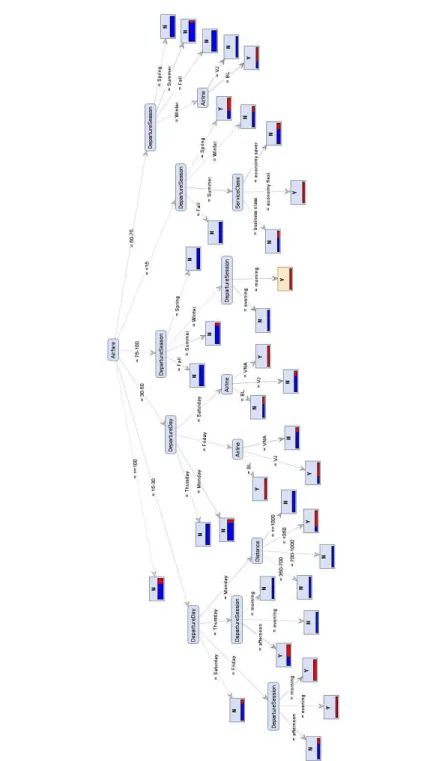
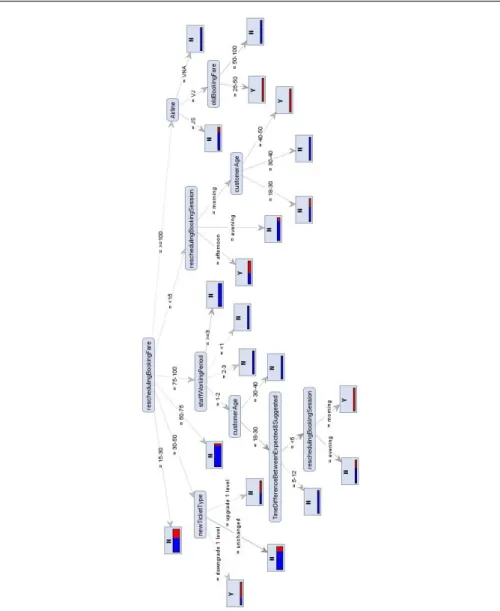
After filtering the data according to the aforementioned goals, two datasets were taken as inputs to forecast the trend of airfare and the passenger’s choices. First, real data of airfares from all domestic airlines in Vietnam were used to predict how airfare rate fluctuates (skyrockets, up, unchanged, down, plummets). The original data was formatted in json and its size is more than 16GB. We then converted it into the csv format to import to the data mining applications. Second, the customers’ decisions were recorded through capturing exchanged emails. Its meta data (e.g., name of attributes, type of data, range of attribute values) and a part of its records were extracted from the datasets
10/1/2019 Page 1
1/1
Average of AvgHour by serviceClass and flightNumber
35 40 45 50 55 60 65
serviceClass
Average of AvgHour
SBoss Promo Eco
(a) Vietjet Air
10/1/2019 Page 1
1/1
Average of AvgHour by serviceClass and flightNumber
0 50 100 150 200
serviceClass
Average of AvgHour
JHVNW_Busin…
CVNW_Business S tan…
SVNW_Economy FlexJVNW_Business Flex TPXVNW_Economy Save
QPXVNW_Economy S tandard EAP2VNW_Special Deal
Business Flex PAP4VNW_Special DealPPXVNWP_Special Deal
Economy Save Business S tandard Economy S
tandard Economy Flex LPXVNW_Economy S
tandard Special Deal GPXVNWP_Special Deal
KPXVNW_Economy S tandard RPXVNW_Economy SaveNPXVNW_Economy SaveMVNW_Economy FlexEAP1VNW_Special Deal
BF BS
EAP2VNW_Price per person
EE EF ES
GPXVNWP_Price per personLPXVNW_Price per personPAP4VNW_Price per personPPXVNWP_Price per person Price per person RPXVNW_Price per person
SF
SHVNW_Economy Flex TPXVNW_Price per person
(b) Vietnam Airlines
Fig. 8: Time difference between 2 consecutive transactions that update airfare
themselves (email logs), but the rest of its records was generated using our tool according to the said meta data.
The dataset on airfares was preprocessed thanks to filling in missing values, reducing noise, resolving data inconsistencies alike. We recognized that the airfare depends on not only the flight distance but also the departure time and and the service class. For instance, airfare on national holidays and
![Fig. 4: [as-is] Selling tickets in Company AD](https://thumb-eu.123doks.com/thumbv2/9pdforg/19324003.0/11.892.201.699.196.813/fig-as-is-selling-tickets-in-company-ad.webp)
![Fig. 5: [as-is] Rescheduling tickets in Company AD](https://thumb-eu.123doks.com/thumbv2/9pdforg/19324003.0/12.892.192.700.201.553/fig-as-is-rescheduling-tickets-in-company-ad.webp)



![Fig. 12: [to-be] Selling last-minutes tickets in Company AD](https://thumb-eu.123doks.com/thumbv2/9pdforg/19324003.0/29.892.192.700.204.518/fig-selling-minutes-tickets-company-ad.webp)
