This Thomas-Fermi magnetic functional is very similar to the one in [28], the only difference is that we consider the spin variable. The functional in [28] is recovered using the pressure summed in spinPB(ν) =PeB(ν,−1) +PeB(ν,1) in the definition of the kinetic energy density above.
Paper B: Semi-classical limit of large fermionic systems at positive
The fact that the dimension of the area of γN is N+o(N) immediately implies that kργN−ρ˜γNk1= Tr[|γN −˜γN|] =o(N). It will be needed in the proof of the convergence of the energy in Theorem B.8 below.
Preliminary observations
The last part of the lemma follows easily from standard methods in function analysis and the details will be omitted. In particular, if m0 is a minimizer of the Vlasov functional E0Vla, then the uniquess statement implies that.
Upper energy bounds
For any fixed density 0≤ρ∈L1(R3) it follows from the uniqueness statement in [16, Theorem 1.14] that for any fixed x∈R3 the measurement mρ(x, ) on R3×{±1} constructed above is the unique minimizer of the functional. Due to domain inclusions it is not difficult to see that in the sense of quadratic forms Tr[TCβN. Using the Weyl asymptotics from Corollary A.9 and Note A.10 and recalling (A.44), we arrive at the semi-classical limit.
To see this, first note for any real δ that any function in the range of γN is also in the domain of TCβN. Let 0≤ρ∈Cc(CR) be any function with R. 1) If βN → 0, then the order of density matrices γN is given by the spectral projections. The same conclusions also apply if γN is replaced by the projection γ˜N onto the N lowest eigenvectors of the operator used to define γN.
By the Stone-Weierstrass theorem we can approximate w(x−y)inL52(CR2) by a function of the form w0=Pk.
Semi-classical measures
We will use (A.65) and (A.66) to construct Landau level projections and some resolutions of the identity. Let Π(2)j denote the projection onto the jth Landau level of the operator H~−1bA⊥. Using the usual properties of the Fourier transform, we have for any function ϕ which. The next two lemmas assert some particularly nice properties of the semi-classical measure, which will prove to be of great importance later.
The first one states that the position densities of the measures are like the position densities (A.21) of the wave function ΨN. Applying this to the first component of the wave function, while holding all other variables constant, we finally get. This corresponds to the regime where the distance between the Landau bands of the Pauli operator remains bounded from below.
The proof of this lemma is a standard exercise in functional analysis using the boundedness of the sequence (m(k)f,Ψ . N)N≥k in both L1(Ωk) and L∞(Ωk), and we leave the details to the reader.
Lower energy bounds, strong fields
We now formulate de Finetti's theorem which serves as the main abstract tool in our proof of the lower bound of energy in Theorem A.5. Applying Lemma A.32 and the fact that f is well localized, it follows that (m(1)f,Ψ . N)N≥1 is tight in the position variable. We now finally have the means to give a proof of the lower bounds in Theorem A.5 in the case that βN →β ∈(0,∞].
The proof is broken down into a number of lemmas, each of which gives a lower bound for a part of the energy. Lemma A.11 bounds the kinetic energy per particle, so applying Lemma A.33 and Proposition A.38 we get for. Hence, P induces a probability measure on the set of minimizers of the magnetic Thomas-Fermi functional, completing the proof of the first part of Theorem A.6.
In this case, P induces a measure on the set of minimizers of the strong Thomas-Fermi functional, which completes the proof of Theorem A.6, except for the case when βN →0.
Lower energy bounds, weak fields
The parameter α is arbitrary for now, but we will decide on a specific choice later, see (A.101) below. At this point we have to distinguish two cases depending on how quickly the parameter βN tends to zero. If, on the other hand, βN goes to zero slowly enough so that b→ ∞, we take α=b−1 instead.
When b is unbounded, a minor complication arises from the fact that we cannot obtain rigor in the momentum variables of the semi-classical measure, due to the presence of bA(x) in the above approximation. Now combining LemmaA.11 with the fact that V is a limiting potential, it follows that the right-hand side above tends to zero uniformly in N as R tends to infinity, implying that (me(1)N ) is tight in the is position variable. Since it is independent of the spin variable by Remark A.21, the convergence of conditions (A.106) becomes.
Using Pto induce a measure on the set of minimizers of the Thomas-Fermi functional, completing the proof of Theorem A.6.
Appendix: Weyl asymptotics for the Dirichlet Pauli operator
For caseβ = 0, note that the sum in the semi-classical expression becomes a Riemann sum, i.e. in the regime where the intensity of the interaction scales as 1/N and with an effective semi-classical parameter ~ = N−1/d where d is the space dimension, we prove the convergence to the corresponding Thomas-Fermi model at positive temperature. In the limit N → ∞ we get the non-linear Thomas-Fermi problem at the same temperature T >0.
In the regime considered in this paper, a mean-field scale is coupled to a semi-classical limit. Our method to study the Fermi gas in the coupled mean-field/semi-classical limit relies on techniques previously introduced in [ 18 ]. In the next section, we introduce both the N-particle quantum Hamiltonian and the positive-temperature Thomas-Fermi theory obtained in the limit.
In Section B.4 we use this experimental condition and some known results about the free Fermi gas at positive temperature to prove our main result in the non-interacting case.
Models and main results
Similar to the T = 0 case, we can rewrite the minimum as a two-step procedure where we first choose a density ν ∈ L1(Rd,R+) with R. In the mean-field regime considered here, the spin can be considered without changing the result (in the dilute limit considered later in section B.2.2 the presence of rotation would affect the result). N is the k-particle Husing function of ΓN and m0 is the unique minimizer of the Vlasov functional in Eq. (B.5).
These are some natural semi-classical measures that can be associated with ΓN in the k-particle phase space R2dk. Example B.7 (Large atoms in a strong harmonic potential). The Hamiltonian in Eq. B.10) can describe a large atom in a strong harmonic potential. In the limit we find the positive-temperature Thomas-Fermi model for an atom in a harmonic trap, which has stimulated many works in the Physics literature.
In both cases, we have the same convergence of the approximate Gibbs states as in Theorem B.2.
Construction of trial states
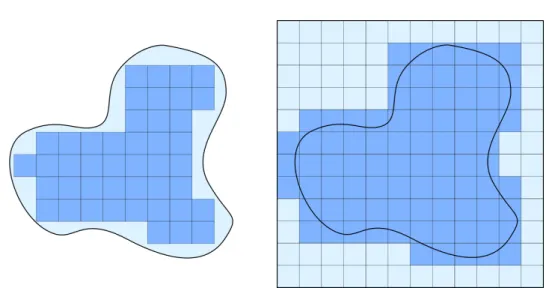
The proof consists of dividing the space into small cubes in which we take a correlated version of the reducer for the free case (correlations are only necessary for the envelopeη >1) and then the thermodynamic limit in these cubes (or equivalent the limit where the effective Planck constant before the Laplacian tends to zero). Therefore, we will only need to correct the particle number by adding O(`N)uncorrelated particles of low energy, for example outside the support of ρ0. Let us first calculate the kinetic energy of the correlated Slater determinants appearing in the definition of Γz (note that this is not an eigenfunction decomposition due to the lack of orthogonality).
The lower bound is similarly obtained by viewing Γz as a trial condition for the periodic case. Let us recall that ΓF=1 is the uncorrelated version of the experimental condition (which is equivalent to takingϕ≡1) and that we denote byρ(k)F=1 itsk particle density, fork≥1. Indeed, using the triangle inequality, the Lieb-Thirring inequality [42, 43] (the reader can refer to [18, Lem. 3.4] for the exact version of the LT inequality we use) and Young's inequality, we obtain .
Due to the correlation factor F and since it is compactly supported, we will have TrwN(x−y)Γ = 0 for sufficiently large N.
Proof of Theorem B.2 in the non-interacting case w ≡ 0
We are thus left to use the well-known semiclassical convergence (the proof of which is shown below in Proposition B.11). If we recognize the Vlasov free energy expression on the right-hand side, we refer to Theorem B.1 and immediately obtain In (B.28) we used the following well-known fact, which we prove for completeness.
In the first step, we also assume that V− ∈L∞(Rd) and then remove this assumption at the end of the proof. The inequality (B.32) is derived from the diamagnetic inequality [14], and (B.33) is obtained by the min-max characterization of the eigenvalues. The same argument applied to A and |A|2 in combination with the Hölder inequality, the Lieb-Thirring inequality and (B.37) shows that the remaining terms are over areo(~−d).
We now remove this unnecessary assumption: consider a potential V that satisfies the assumptions of statement B.11 (perhaps unbounded below).
Proof of Theorem B.2 in the general case
The low semicontinuity of the entropy term can be justified as in the proof of Lemma B.19. Integrating overx and p, we obtain on the right-hand side the von Neumann relative entropy sum of m(1)f,Γ. Weak convergence of the k-particle Husimi and the Wigner measure At this point we have proved the strong convergence of tm(1)f,Γ.
Another problem is the need to prove the existence of the limit with the perturbation again, since test conditions in the canonical ensemble are not so easy to construct. Since we are only interested in deviations in ε, the existence of the limit for the one-particle Husimi criterion will help us identify the deviation. Since we are in a semi-classical regime, the order of the operators in the trace (B.56) should not matter.
We used here our estimates (B.49) and (B.50) on the norm and trace of the non-negative operator B~.
Proof of Theorem B.1: Study of the semiclassical functional
Kinetic energy estimates for the accuracy of the time-dependent Hartree-Fock approximation with Coulomb interaction. Minimizers of functionals of the form (BB.2), where H is a one-body operator, are also called quasi-free states. Denoting :=a(uk) and a†k :=a†(uk), they become the creation and annihilation operators in this representation of Fock space.
As long as the proof lasts, for any set Λ⊆Rd we will denote by−∆ΛD the Dirichlet Laplacian onΛ, and by−∆ΛN the Neumann Laplacian onΛ. In this subsection, the existence of the thermodynamic limit of the canonical free energy is proven for general sequences of domains (ΛN) with|ΛN| → ∞ and N/|ΛN| → ρ for any density ρ > 0. With the existence of the thermodynamic limit established for the Dirichlet Laplacian, it is not difficult to generalize to the Laplacian on cubes with periodic boundary conditions.
For the proof of theorem BB.9, we follow the ideas from [2, 4], which are based on the sub-additivity of the canonical free energy. Lemma BB.14 (Properties of fCan). 3) Fix the domain Λ0 ⊆ Rd and consider sequences of the type ΛN = LNΛ0, where (LN) is a sequence of positive numbers. Due to the lower bound of the free energy from lemmaBB.11, we have for each µ∈Rand a non-negative ρ to.