DEVELOPMENT OF TOFU PRODUCTION METHOD WITH PROBIOTIC BACTERIA ADDITION
Dorota Zielińska*, Anna Kamińska, Danuta Koło yn
-Krajewska
Address(es): dr in . Dorota Zieli ska,
Warsaw University of Life Sciences – SGGW, Faculty of Human Nutrition and Consumer Sciences, Department of Catering Technology and Food Hygiene, Nowoursynowska street 159c, 02-776 Warsaw, Poland, phone number: (+48)0-225937068.
*Corresponding author: [email protected]
ABSTRACT
Keywords: tofu, soy milk, probiotic bacteria, Lactobacillus, Bifidobacterium, manufacturing
INTRODUCTION
Probiotic bacteria are defined as “live microorganisms that when administered in
adequate amounts could confer a health benefit on the host” (FAO/WHO, 2002).
Probiotic bacteria exhibit a range of health benefits such as among others: they stabilise or change microflora of the gastrointestinal tract, participate in the fermentation of saccharides that have not been digested by the body and produce such organic acids as acetic, lactic, propionic and butyric acid. Low pH also inhibits putrefaction in the lower gastrointestinal tract, a process during which ammonia and amines that are toxic to the body are formed. Moreover, they produce bacteriocins, namely substances that act antagonistically towards relative bacteria, and moreover, inhibit the growth of pathogenic strains: Escherichia,
Salmonella, Listeria, Klebsiella and Staphylococcus (Nagpal et al., 2012; Liong,
2007). Numerous studies have proven that as a result of probiotic consumption
the risk of traveller’s diarrhoea is lowered, symptoms are reduced and duration of some infective diarrhoeas caused by bacteria, parasites and viruses is shortened; moreover, it prevents from the development or relieves the course of diarrhoea after antibiotic treatment (van Niel et al., 2002). Another benefit resulting from the consumption of probiotics as part of a diet is their ability to reduce cholesterol
absorption, and as a result its blood levels are reduced (Ooi and Liong, 2010).
Probiotics affect better bioavailability and assimilation of individual nutritional components, they synthesise some vitamins, mainly of the B group, but also PP vitamin and probably K vitamin. They increase absorption of minerals and vitamins. Probiotics help digest lactose in those with poorer tolerance of this sugar. Lactic acid bacteria are a source of lactase, an enzyme that hydrolyses lactose into simple sugars, namely glucose and galactose. Hydrolysis products in this form can be absorbed by the intestinal wall without limits. As a result of fermentation diet components can be used more effectively; e.g. lactic acid
bacteria hydrolyse mono- and disaccharides, and Bifidobacterium mainly oligo-
and polysaccharides (Vasiljevic and Shah, 2008; Oelschlaeger, 2010).
Probiotic bacteria are more and more often used in industrial production of fermented foods. First of all, fermentation is used to conserve food in dairy industry, but also in meat and fruit-vegetable industries. Reasons why probiotics are used in plant-derived products include high nutritional and sensory values of
these raw materials and a long tradition of fermentation. In a vegetarian diet that has become more and more popular only plant-derived products are consumed by rule, and only such products can be a potential source of probiotics. The use of probiotics in plant-derived products is justified by economic and cultural factors as well as climatic conditions, especially in the Asian countries where there is no tradition of dairy product consumption, but where, on the other hand, fermented
vegetables, fruit and cereals, including soy, are consumed (Rivera-Espinoza and
Gallardo-Navarro, 2010; Trząskowska, 2013).
In the past the majority of traditional soy products used to be from China. With time they have been introduced into other parts of Asia and Europe. Soy products can be divided into two groups: fermented and unfermented products. Fermented soy products include tempeh, natto, shoyu, miso and sufu. On the other hand,
traditional, unfermented soy products include soy milk and tofu (Rivera
-Espinoza and Gallardo-Navarro, 2010).
Tofu is often called soy cheese. It is a high-protein unfermented product. The production process consists in the addition of a coagulant to soy milk - calcium or magnesium sulphate, calcium chloride and gluconolactone are used the most frequently. Precipitated protein is transferred to containers and pressed. Curd structure is obtained by adding calcium sulphate to milk, and magnesium sulphate is added to obtain gel structure. When gluconolactone is used for coagulation, a softer version, so called silken tofu can be obtained. High-calcium tofu contains 128 mg calcium/100g, whereas the level of this element in milk is
lower - 117 mg/100g (Obatolu, 2008; Jooyandeh, 2011).
The main reservation of consumers with regard to soy products is their taste that
is described as typical of soy - grass-like or tart, and another is that they often
cause flatulence. The purpose of soy fermentation is to remove the undesirable
beanie taste (Wang et al., 2002, 2003, 2006) which is mostly due to the presence
of n-hexanal and pentanal (Scalabrini et al., 1998), and to improve on the nutritional characteristics of soymilk. Fermentation, especially with
Bifidobacteria, also makes the proteins present more digestible and reduces the
contents of soy oligosaccharides, stacchiose, and raffinose, which can cause digestive problems (Liu,1997). Tofu is thought to be a good medium for the growth of lactic acid bacteria due to a high protein content and pH close to The aim of the study was to develop a production method for tofu with probiotic bacteria under laboratory conditions. The works included: selection of a strain and tofu production conditions, and a storage test of the manufactured product.
It was concluded that the sensory quality of tofu with the addition of different probiotic cultures did not differ significan tly (p>0.01), depending on used strains and their mixtures, and the sample quality was comparable to the commercial product. It was observed that the number of Lactobacillus bacteria in study samples was the factor determining the palatability of tofu (r= 0.75). On the other hand, the sensory quality of products was significantly affected by the production method of tofu with the addition of probiotic bacteria. It was concluded that the formation of curds from soy beverage by the addition of CaSO4, followed by inoculation with Lactobacillus casei
ŁOCK 0900 at the amount of 9.26 log CFU/g and incubation at temp. of 37C for 2h as well as for 20h are methods recommended for
production tofu with regard to sensory qualities of the final product among all tested methods. The number of lactic acid bacteria in studied tofu samples was maintained at the high level (109-1010 CFU/g), and the number of Bifidobacterium animalis ssp lactis BB-12 bacteria did not exceed 103 CFU/g, whereas the number of Lactobacillus bacteria was equal to 108-109 CFU/g. For the period of 15 days of storage of tofu with probiotic bacteria at the temperature of 4C the number of lactic acid bacteria was maintained at the constant level of approx. 109 CFU/g.
It was concluded that it is possible to produce tofu with probiotic bacteria that has acceptable sensory characteristics and a high number of lactic acid bacteria, therefore the product could be considered as a functional one.
ARTICLE INFO
Received 13. 11. 2013 Revised 27. 5. 2014 Accepted 8. 4. 2015 Published 1. 6. 2015
Regular article
neutral. During fermentation and growth of probiotic cultures a soy product
becomes a product with functional properties (Jooyandeh, 2011).
The objective of our study was to develop, under laboratory conditions, a production method for a functional product, tofu with the addition of probiotic bacteria belonging to the genera Lactobacillus and Bifidobacterium, that would have an appropriately high amount of probiotic bacteria and desired sensory qualities.
MATERIAL AND METHODS
Experiment design
Tests were divided into three stages. The aim of the first stage was to select the most appropriate strain / strain mixture for tofu production. All tofu samples were prepared in the same way, namely curd was formed as a result of the addition of
CaSO4, then selected probiotic bacteria strains (A, B, C and D) were added and incubation was performed at the temp. of 37C for 20h. Selection was performed taking into account sensory characteristics and microbiological quality of tofu samples. The second stage included selecting conditions for tofu production. One strain of probiotic bacteria was used during four methods of tofu production (1, 2, 3 and 4), and selection criteria included sensory characteristics of samples and their microbiological quality. The third stage of tests included a storage test for selected tofu samples at the temp. of 4C for 15 days. Curds were formed as a result of adding CaSO4, then Lactobacillus casei ŁOCK 0900 bacteria were added and samples were incubated at the temp. of 37C for 20h. Control tofu was prepared without probiotic bacteria, and there was no stage of incubation at elevated temperatures. Figure 1 presents a test design.
Step Methods of research
1. Selection of strain
Sensorial analysis
Microbiological analysis
pH measurement
2. Selection of manufacturing conditions
Sensorial analysis
Microbiological analysis
pH measurement
3. Storage trial (15 days at 4C) Microbiological analysis pH measurement
Figure 1 Scheme of experiment
Bacterial strains and culture conditions
Test materials included strains of probiotic bacteria: Bifidobacterium animalis ssp. lactis BB-12 (Chr. Hansen) and Lactobacillus casei ŁOCK 0900 (Motyl et al., 2009) and Lactobacillus paracasei ŁOCK 0919. The Lactobacillus strains were derived from the Collection of Pure Cultures of Industrial Microorganisms, Institute of Fermentation Technology and Microbiology at the Technical University of Łod .
Stock cultures were prepared by growing the microorganism two successive times in MRS broth (Biokar Diagnostic), each time for 24 h at 37C. Cultures prepared with this method were centrifuged, washed twice with saline, and biomass was suspended in 10 ml of soy beverage. Then 1 ml of the suspension was added per 100 g of tofu. Four inocula were prepared and used for tofu production:
A. culture mixture (1:1 rate) of Lb. paracasei ŁOCK 0919 (10.19 log CFU/g) and Bifidobacterium animalis ssp. lactis BB-12 (9.16 log CFU/g),
B. culture mixture (1:1 rate) Lb. casei ŁOCK 0900 (9.26 log CFU/g) and Bifidobacterium animalis ssp. lactis BB-12 (9.16 log CFU/g),
C. monoculture of Lb. casei ŁOCK 0900 (9.26 log CFU/g), D. monoculture of Lb. paracasei ŁOCK 0919 (10.19 log CFU/g).
Preparation of probiotic-fermented tofu
Tofu was prepared under laboratory conditions. Raw materials included soy milk coming from soy beans (Sante, Poland). Nutritional values of soy beans, according to manufacturer (Sante, Poland) declaration, per 100g was: 34.3 g protein, 17.0 g sugars, 19.6 g fat, 240 mg calcium. Soy milk was produced from soy beans according to Ng et al. (2008). Soy beans were washed and soaked for 12 hours in cold distilled water. Soaked beans were mashed and distilled water at the 1:6 (w:v) ratio was added. Mixed beans were filtrated through a sterile gauze, and as a result soy milk was obtained. This product, as well as natural soy beverage and instant soy beverage were pasteurised for 10 minutes, and then brought to the temperature of 80-85C and 0.5% calcium sulphate (CaSO4) (Sigma Aldrich) was added. The whole mixture was mildly mixed and left for 10 minutes so as protein could coagulate. Curds were pressed, formed and optionally probiotic bacteria at the average amount of 9.3 log CFU/cm3 per 100 g of tofu were added. The following four methods of tofu production were applied: 1. the addition of selected cultures of probiotic bacteria to the soy beverage
(without CaSO4) and incubation at the temp. of 37C for 22h;
2. the formation of curds with CaSO4, and then the addition of selected cultures of probiotic bacteria and incubation at the temp. of 37C for 2h, according by Ng et al. (2008);
3. the formation of curds with CaSO4, and then the addition of selected cultures of probiotic bacteria and incubation at the temp. of 37C for 20h;
4. the formation of curds with CaSO4, and then storage at the temp. of 4C for 24h (a control sample).
In order to compare the quality of products obtained commercial tofu by Solida Food (Poland) was used.
Sensorial analyses
In the tests the following methods of sensory analysis were used: an order (ranking) method and a scoring method. According to the order method a judge had to rank several randomly received samples from the best to the worst in terms of palatability. The best sample received the rank 1, and subsequent samples ranks of 2, 3, 4, etc. Whereas the scoring method used an unstructured graphic scale [0-10 conventional units – c.u.] - judges had to evaluate desirability of the smell, taste, texture and general quality on this scale. Persons participating in a sensory analysis were trained with regard to basic sensory evaluation methods. The conditions and assessment mode were determined in accordance with Meilgaard et al. (1999).
Microbial analyses
Microbiological tests were performed in accordance with (ISO:15214:1998). The number of mesophilic cells of lactic acid bacteria (LAB) was determined with a plate method using deep inoculation on the MRS medium (Biokar Diagnostic). Plates were incubated at the temp. of 30°C for 72 hours. The number of Lactobacillus cells was determined using a selective medium - Rogosa-Agar (Merck). Plates were incubated at the temp. of 37°C for 72 hours in accordance with the manufacturer’s instructions. Selective BSM Agar by Sigma Aldrich was used to determine the Bifidobacterium cells. Plates were incubated in anaerobic jar at the temp. of 37°C for 72 hours. The total number of bacteria (TVC) was determined using nutrient agar (Biokar Diagnostic). Plates were incubated at the temp. of 37°C for 48 hours.
Each time a mass of 10 g of tofu was taken aseptically from a jar, homogenized with 90 mL of sterile peptone water (Biokar Diagnostic), and decimal dilutions in sterile peptone water were prepared. Tests were performed immediately after appropriate samples had been prepared and during storage on day 0, 5, 10 and 15.
Determination of pH
Value of pH was measured in homogenates with the ELMETRON CP551 device. The result was read with the accuracy of 0.05.
Statistical analysis
RESULTS AND DISCUSSION
Selection of strain – Step 1
Tofu fermented by monocultures of Lactobacillus casei ŁOCK 0900 (C) and Lactobacillus paracasei ŁOCK 0919 (D) was evaluated slightly better with regard to taste and smell criteria, in comparison with tofu with the addition of mixed cultures of Lactobacillus casei ŁOCK 0900 and Bifidobacterium animalis ssp. lactis BB-12 (B) and Lactobacillus paracasei ŁOCK 0919 and Bifidobacterium animalis ssp. lactis BB-12 (A). However, it was concluded that there are no statistically significant differences with regard to the sensory quality between four tested tofu samples (p=0.72 and p>0.01) what can be seen in figure 2.
Figure 2 Avarage ranks values of tofu desirability fermented with different strains of probiotic bacteria (ranking method; 4- most desirable; 1- less desirable; n=25)
Explanatory notes:
A – tofu made with addition culture mixture (1:1 rate) Lb. paracasei ŁOCK 0919 and Bifidobacterium animalis ssp lactis BB-12 ; B - tofu made with addition culture mixture (1:1 rate) Lb. casei ŁOCK 0900 and Bifidobacterium animalis ssp lactis BB-12; C - tofu made with monoculture addition of Lb. casei ŁOCK 0900 ; D - tofu made with monoculture addition of Lb. paracasei ŁOCK 0919
Simultaneously, a sensory analysis with the scoring method was performed (results are not presented). Quality factors that were evaluated included: smell, taste, texture and general quality. Also in the course of this analysis there were no
statistically significant differences between individual quality factors of tofu fermented with different cultures of probiotic strains (p > 0.01).
It was concluded that desirability of individual types of tofu was evaluated between 4 and 6 c.u. on average, depending on a studied quality factor what indicated moderate approval of this product. Tofu fermented with monocultures of Lactobacillus (C and D) received slightly higher scores for taste and texture. Many studies indicate that the addition of lactic acid bacteria cultures to soy products increases the acceptability and desirability of these products. “Grass-like”, “flour-like” taste of soy that is not accepted by many consumers is masked by “acid” taste which is typical of lactic acid fermentation (Dalev et al., 2006; Kandiah and Laird, 2002; Miguel et al., 2004; Wenrich and Cason, 2004). Some authors also state that when judges have been informed of healthy properties of soy prior to a sensory analysis soy products are more accepted by them (Teh et al., 2007).
Experiments studying the survival of probiotics indicate that soymilk is a good substrate for bacteria such as the Lactobacillus and Bifidobacteria species (Rivera-Espinoza and Gallardo-Navarro, 2010).
The strains of Lactobacillus casei ŁOCK 0900 and Lactobacillus paracasei
ŁOCK 0919 used in this study were selected on the basis of results of in vitro
studies, which comprised determination of resistance to the acidity of gastric juice and to bile, adherence to epithelial cells, and antimicrobial activity. These strains showed strong antagonistic activity against positive and gram-negative pathogens (Cukrowska et al., 2009). It has been demonstrated that a mixture of three strains from the Lactobacillus genus (Lb. casei ŁOCK 0900, Lb. casei ŁOCK 0908, Lb. paracasei ŁOCK 0919) has probiotic properties consisting in modulating immune responses in children with atopic dermatitis as a result of induction of Th1 cytokine production and simultaneous inhibition of the production of proallergic interleukin-5 (Cukrowska et al., 2010). On the other hand, Bifidobacterium animalis ssp. lactis BB-12 has beneficial effects on the human health, as it stimulates the body immune system, relieves constipation, and reduces the risk of and the duration of diarrhoeas. Furthermore, it was observed that BB-12, ŁOCK 0900 and ŁOCK 0919 strains have beneficial effects in terms of treatment of atopic dermatitis in children (Chr. Hansen, 2013; Cukrowska et al., 2010). It seems that applied bacterial inocula should play their role in a milk-free product such as tofu, especially indicated for those with milk protein allergy, lactose intolerance or vegetarians.
In tofu fermented with mixed cultures (A and B) the number of lactic acid bacteria (LAB) was 3-4 log orders CFU/g higher in comparison with tofu with the addition of monocultures (C and D). The number of Bifidobacterium in the tested product did not exceed 103 CFU/g and that tofu is a good carrier of Lactobacillus casei ŁOCK 0900 and Lactobacillus paracasei ŁOCK 0919 strains, as the number of bacteria belonging to the Lactobacillus genus was >108 CFU/g in tofu (Tab 1).
Table 1 Count of lactic acid bacteria (LAB), total viable count (TVC), number of Lactobacillus, number of Bifidobacterium and pH value in tofu with addition of probiotic cultures after 20 hours of fermentation process at 37°C
Type of tofu
Count of Lactobacillus
[log CFU/g]
Count of Bifidobacterium
[log CFU/g]
Count of lactic acid bacteria LAB
[log CFU/g]
Total viable count TVC [log CFU/g]
pH value
A
Tofu with addition Lb.paracasei + Bifidobacterium
8.77 0.12 < 3 9.52 0.02 7.78 0.42 4.77 0.04
B
Tofu with addition Lb.casei + Bifidobacterium
8.99 0.06 < 3 9.77 0.02 7.28 0.40 4.79 0.08
C Tofu with addition
Lb.casei 8.94 0.08 - 9.56 0.06 7.66 0.21 5.05 0.11
D Tofu with addition
Lb.paracasei 9.10 0.08 - 9.28 0.06 8.53 0.31 5.11 0.09
Increased sensitivity to oxygen and an increased amount of metabolites such as hydrogen peroxide, ethanol and bacteriocins produced by lactic acid bacteria might have contributed to a reduced number of bifidobacteria. Similar studies were conducted by Wang et al. (2002) and have demonstrated that the growth of bifidobacteria in fermented soy beverage contributes to the increased amount of lactic acid bacteria, and this correlation depends on individual species characteristics. In our own studies we observed a strong negative correlation between the general quality and the number of lactic acid bacteria in samples (r= 0.95). An increased number of LAB also resulted in reduced pH in samples (r= 0.74). On the other hand, it was observed that the number of Lactobacillus bacteria in study samples was the factor determining the palatability of tofu (r= 0.75). High levels of LAB in the product were correlated with significantly reduced pH. However, product acidity above 4.6 pH did not inhibit the growth of saprophytic microflora what is confirmed by generally high of total viable count (TVC) (Tab 1). Similarly in the studies by Liu et al. (2006), as in our own studies, it was showed that during 6h-fermentation of soy cheese with varied
strains of Lb. rhamnosus at the temperature of 37°C pH was reduced from 5.9 to 4.7-5.2 correlated with a increase in the number of lactic acid bacteria cells.
Taking into account the results of experiments performed the strain Lb. casei ŁOCK 0900 was selected for further tests. A tofu sample (C) contained high levels of LAB after fermentation and in addition, low level of TVC. A tofu sample (C) had the highest score for palatability and the best taste and texture.
Selection of manufacturing conditions – Step 2
It was concluded that there are statistically significant differences between studied tofu samples with regard to a criterion of the sensory quality (fig. 3). 1
1.5 2 2.5 3 3.5 4
A B C D
methods of tofu production
a
v
a
ra
n
g
e
r
a
n
k
[
1
-4
Figure 3 Average values of desirability smell, taste, texture and overall quality of tofu made by different ways, compared to commercial tofu (scoring method, 10 – most desirable, 1 – less desirable, n=33)
Explanatory notes:
1-tofu made by addition Lactobacillus casei ŁOCK 0900 to the soy beverage (without CaSO4) and incubation at the temp. of 37C for 22h, 2- CaSO4,and then the addition of Lactobacillus casei ŁOCK 0900 and incubation at the temp. of 37C for 2h, 3- tofu made by addition CaSO4,and then the addition of Lactobacillus casei ŁOCK 0900 and incubation at
the temp. of 37C for 20h , 4-tofu made by addition CaSO4,and then storage at the temp. of
4C for 24h (a control sample).
Average values of evaluations of tested samples were statistically significantly different (p < 0.01), in the test conducted with the ranking method and in the other conducted with the scaling method. It was concluded that tofu (1) manufactured with probiotic bacteria cultures, without calcium sulphate, was significantly worse than other samples. Judges emphasised acid, pungent taste of tofu, and too loose texture that resembled yoghurt curds. Tofu with the addition of probiotic bacteria cultures produced with other methods was evaluated much better, comparably to control tofu (4) and commercial tofu.
The highest scores in terms of desirability of taste, smell, texture and general quality in the scaling method, and of palatability in the ranking method were given to tofu (2) produced with the addition of CaSO4, followed by the addition of probiotic bacteria cultures incubated at temp. of 37C for 2h. However, 20 hours fermented tofu (3) was also high evaluated regarding smell, texture, taste, overall quality, compared to (2) tofu (p > 0.01). The judges pointed to fresh, sour taste and pleasant smell of 20 hours fermented tofu.
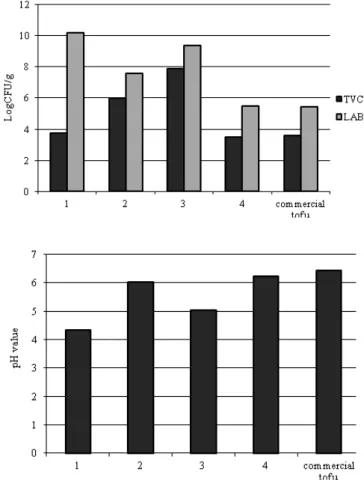
It was concluded that both commercial and control tofu (4) had similar microbiological quality (fig. 4 A and B). The total number of microorganisms and the number of lactic acid bacteria cells in both products were similar and did not exceed the value of 6 log CFU/g – for LAB and 4 log CFU/g – for TVC. Furthermore, the acidity of control and commercial products was similar and the pH value was above 6.
It was observed that the number of lactic acid bacteria was the highest in tofu incubated at the temp. of 37C for 20h (9.36 log CFU/g) and 22h (10.22 log CFU/g). Also pH of these products was significantly lower (sample 1 – pH=4.33, sample 3 – pH=5.05) in comparison with tofu incubated for 2h at the temp. of 37C (sample 2 – pH=6.02). The 2 hours fermentation time was established according to Ng et al. (2008). The authors proposed the 2 hours at 37°C incubation time to tofu production and suggested that it was an adaptation period, which ensured higher viability of probiotics during storage. The longer the fermentation time, the higher number of lactic acid bacteria cells and the lower pH were observed in tested samples.
A
B
Figure 4 Total viable count (TVC) and lactic acid bacteria count (LAB) (a) and changes of pH value (b) in tofu made by different ways, compared to commercial tofu.
Explanatory notes:
1-tofu made by addition Lactobacillus casei ŁOCK 0900 to the soy beverage (without CaSO4) and incubation at the temp. of 37C for 22h, 2- CaSO4,and then the addition of Lactobacillus casei ŁOCK 0900 and incubation at the temp. of 37C for 2h, 3- tofu made by addition CaSO4,and then the addition of Lactobacillus casei ŁOCK 0900 and incubation at
the temp. of 37C for 20h , 4-tofu made by addition CaSO4,and then storage at the temp. of
Ng et al. (2008) observed inhibition of the total number of aerobic microorganisms in tofu with probiotic bacteria (Lb. bulgaricus and Lb. fermentum) addition. In our own studies slightly different results were obtained; in the control sample there was < 4 log CFU/g cells of the total number of aerobic bacteria. Moreover, it was observed that the total number of microorganisms in tofu samples was higher when the incubation at the temp. of 37C was longer (in tofu incubated for 2h – 5.98 log CFU/g; in tofu incubated for 20h – 7.9 log CFU/g). However, in tofu incubated for 22h there were only 3.74 log CFU/g of the total number of microorganisms. It was probably associated with lowering pH of this tofu sample (1) to 4.33 what resulted in the inhibition of growth of the majority of saprophytic bacteria.
Tofu fermented for 20 hours at the temperature of 37˚C was selected for further tests. This product had desired low pH and appropriately high (>109 CFU/g) number of lactic acid bacteria - Lactobacillus casei ŁOCK 0900. It received high scores in terms of desirability of smell, taste and texture. This tofu sample was perceived as the best in terms of general quality.
Storage trial – Step 3
Many authors emphasise that tofu and other soy products are a good medium for probiotics (Liong et al., 2009; Ng et al., 2008; Donkor et al., 2007; Zielińska et al., 2008). In our studies during 15 days of storage tofu with probiotic bacteria at 4C the number of LAB was at the high level, above 109 CFU/g, whereas Liong et al. (2009) have found that the number of Lb. acidophilus FTCC 0291 in tofu during 20 days of cold storage was at the level above 106 CFU/g.
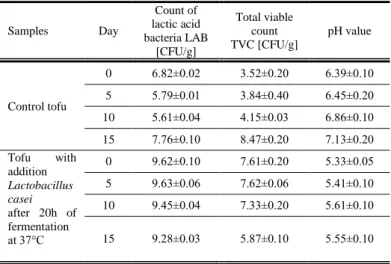
In the present study on day 15th of storage the microbiological quality of both samples statistically significantly changed. In tofu with probiotics the total viable count of bacteria (TVC) decreased by 1 log order, whereas in control tofu TVC increased by approx. 4 log orders, and the number of LAB by 2 log orders. The increase in the TVC in control tofu (r=0.80) and in tofu with the addition of Lb. casei ŁOCK 0900 (r=0.83) was present together with the increase in the LAB. Moreover, a strong positive correlation was observed between the TVC and pH in control tofu (r=0.81). On the other hand, the increase in the number of Lb. casei ŁOCK 0900 bacteria caused a decrease in pH in a sample with probiotics (r=0.85). The results of storage tests are presented in table 2.
Table 2 Changes of lactic acid bacteria count, total viable count and pH value in tofu during 15 days of storage at temp. 4°C
Samples Day
Count of lactic acid bacteria LAB [CFU/g] Total viable count TVC [CFU/g] pH value Control tofu
0 6.82±0.02 3.52±0.20 6.39±0.10
5 5.79±0.01 3.84±0.40 6.45±0.20
10 5.61±0.04 4.15±0.03 6.86±0.10
15 7.76±0.10 8.47±0.20 7.13±0.20
Tofu with addition Lactobacillus casei after 20h of fermentation at 37°C
0 9.62±0.10 7.61±0.20 5.33±0.05
5 9.63±0.06 7.62±0.06 5.41±0.10
10 9.45±0.04 7.33±0.20 5.61±0.10
15 9.28±0.03 5.87±0.10 5.55±0.10
Also Ng et al. (2008) observed that the number of Lb. bulgaricus FTCC 0411 and Lb. fermentum FTD 13 bacteria in tofu during 9 days of cold storage was at the level of 107-108 CFU/g, and the TVC decreased by 1 log order, and pH slightly changed, what confirms the results of our tests. On the other hand Liu et al. (2006) have observed slow reduction of pH and the number of probiotic bacteria cells in the soy cheese with addition of probiotic Lb. rhamnosus bacteria stored for 30 days at 10°C The most significant changes were observed between day 5 and 15 of storage, just like in our case.
When added to foods lactic acid bacteria increase microbiological safety of foods. It is associated with the fact that these bacteria produce organic acids as well as other substances with bacteriostatic properties (El-Shouny et al.2013). It was observed that during storage of tofu with the addition of Lb. casei ŁOCK 0900 the total number of microorganisms indicating the presence of coexisting microflora reduced contrary to a control sample where on day 15 there was intensive growth of microorganisms. Tofu with probiotics preserved appropriate microbiological quality for a longer period of time. It was concluded that the addition of Lactobacillus bacteria had a positive effect on tofu stability.
CONCLUSION
Soy is a valuable raw material for the production of high-protein, low-energy and functional foods. In view of its benefits it is more and more often used to produce
processed foods not only in Asia but also in Europe. Many research studies have proven that soy is a good medium for the growth of probiotic bacteria. The fermentation process that is used increases the nutritional value of soy products, and moreover, helps eliminate soy taste (“beanie taste”) that is unacceptable for many consumers. In a present studies we have developed a method to produce a new functional product based on soy.
It was concluded that tofu produced under laboratory conditions is a good medium for the growth of lactic acid bacteria the number of which maintained at the high level (109-1010 CFU/g), and especially it regards probiotic bacteria from the Lactobacillus genus (108-109 CFU/g). It was also concluded that the addition of probiotic bacteria to tofu increased palatability and general quality of studied tofu samples. We have found, that it is possible to produce tofu with probiotic bacteria that has acceptable sensory characteristics, comparable to a commercial product, and a high number of probiotic bacteria and appropriate stability, therefore the product could be considered as a functional one. Tofu with the addition of probiotic bacteria can be an alternative for vegetarians, and taking into account specific properties of bacteria that are used it may affect body immunomodulation and inhibit allergic reactions.
REFERENCES
CHR-HANSEN 2013. Bifidobacterium BB-12. Internet www.chr-hansen.com/index.php?id=2260, 20.10.2013.
CUKROWSKA B., MOTYL I., KOZÁKOVÁ H., SCHWARZER M., GÓRECKI R.K., KLEWICKA E., LI EWSKA K., LIBUDZISZ Z. 2009. Lactobacillus Strains : in vitro and in vivo Studies. Folia Microbiologica, 54, 6, 533-537. DOI 10.1007/s12223-009-0077-7
CUKROWSKA B., ROSIAK I., KLEWICKA E., MOTYL I., SCHWARZER M., LIBUDZISZ Z., KOZÁKOVÁ H. 2010. Impact of Heat-Inactivated Lactobacillus casei and Lactobacillus paracasei Strains on Cytokine Responses in Whole Blood Cell Cultures of Children with Atopic Dermatitis. Folia Microbiologica, 55, 3, 277-280. DOI 10.1007/s12223-010-0041-6
DALEV D., BIELECKA M., TROSZY SKA A., ZIAJKA S., LAMPARSKI G. 2006. Sensory quality of new probiotic beverages based on cheese whey and soy preparation. Polish Journal of Food and Nutrition Sciences, 15/56, 71-77. DONKOR O.N., NILMINI S.L.I., STOLIC P., VASILJEVIC T., SHAH N.P. 2007. Survival and activity of selected probiotic organisms in set-type yogurt during cold storage. Int Dairy J, 17, 657–665. DOI:10.1016/j.idairyj.2006.08.006 EL-SHOUNY W.,ABO-KAMARA.,RAGYS.2013.Characterization of the partially purified plantarcin SR18 produced by Lactobacillus plantarum SR18. Journal of Microbiology, Biotechnology and Food Sciences, 2 (5) 2301-2305. FAO/WHO 2002. (Food and Agricuture Organization/World Health Organization). Guidelines for the Evaluation of Probiotics in Food. Report a Joint FAO/WHO Working Group. London, Ontario, Canada. FAO/WHO, April 30 and May 1, 1-11.
ISO 15214:1998, Microbiology of food and animal feeding stuffs -- Horizontal method for the enumeration of mesophilic lactic acid bacteria Colony-count technique at 30 degrees C.
JOOYANDEH H. 2011. Soy Products as Healthy and Functional Foods. Middle-East Journal of Scientific Research, 7, 1, 71-80.
KANDIAH J., LAIRD J.B.S. 2002. Sensory attributes and acceptance of flavored soy nuts by college students. Nutrition Research 22, 405-410. DOI:10.1016/S0271-5317(02)00360-3
LIONG M.-T., EASA A. M., LIM P.-T., KANG J.-Y. 2009. Survival, growth characteristics and bioactive potential of Lactobacillus acidophilus in a soy-based cream cheese. Journal of the Science of Food and Agriculture, 89, 8, 1382-1391. DOI: 10.1002/jsfa.3598
LIONG, M.T. 2007. Probiotics: a critical review of their potential role as antihypertensives, immune modulators, hypocholesterolemics, and perimenopausal treatments. Nutrition reviews, 65(7), 316-328. DOI: http://dx.doi.org/10.1111/j.1753-4887.2007.tb00309.x 316-328
LIU D.M. Li L., YANG X.-Q., LIANG S.-Z., WANG J.-S. 2006. Survivability of L. rhamnosus in Soy Cheese, Food Technol. Biotechnol. 44 (3) 417–422. LIU K. 1997. Soybeans: chemistry technology and utilization. New York: Chapman and Hall. pp. 415–8.
MEILGAARD M., CIVILLE G.V., CARR B.T. (1999): Sensory evaluation techniques, 3rd edn. CRC Press, Boca Raton.
MIGUEL D.P., VALDEZ G., ROSSI E.A. 2004. Sensory and chemical aspects of frozen soy yogurt fermented with Enterococcus faecium and Lactobacillus jugurti. Alimentos e Nutricao Araraquara, 15, 3, 197-201.
MOTYL I., KLEWICKA E., LIBUDZISZ Z., 2009. Lactobacillus casei. Polish Patent Application No. 382760.
NAGPAL R., KUMAR A., KUMAR M., BEHARE P. V., JAIN S., YADAV H. 2012. Probiotics, their health benefits and applications for developing healthier foods: a review; FEMS Microbiology Letters, 334, 1- 15. DOI: http://dx.doi.org/10.1111/j.1574-6968.2012.02593.x 1-15
OBATOLU V.A. 2008. Effect of different coagulants on yield and quality of tofu from soymilk, Eur Food Res Technol, 226, 467-472. DOI: 10.1007/s00217-006-0558-8
OELSCHLAEGER T.A. 2010. Mechanisms of probiotic actions – a review. Int.
J. Med. Microbiol., 300, 57–62. 83. DOI:10.1016/j.ijmm.2009.08.005
OOIL.-G., LIONGM.-T. 2010. Cholesterol-Lowering Effects of Probiotics and
Prebiotics: A Review of in Vivo and in Vitro Findings. Int. J. Mol. Sci., 11,
2499-2522. DOI:10.3390/ijms11062499
RIVERA-ESPINOZA Y., GALLARDO-NAVARRO Y. 2010. Non-dairy probiotic
products. Food Microbiology, 27, 1–11. DOI:10.1016/j.fm.2008.06.008
SCALABRINI P., ROSSI M., SPETTOLI P., MATTEUZZI D. 1998. Characterization of Bifidobacterium strains for use in soymilk fermentation. International Journal of Food Microbiology, 39, 213–21. DOI:10.1016/S0168-1605(98)00005-1
TEH T., DOUGHERTY M.P., CAMIRE M.E. 2007. How Do Consumer Attitudes Influence Acceptance of a Novel Wild Blueberry–Soy Product?. Journal of Food Science, 72, 7, S516-S521. DOI: 10.1111/j.1750-3841.2007.00463.x
TRZĄSKOWSKA M. 2013. Probiotyki w produktach pochodzenia ro linnego.
ywność Nauka Technologia Jakość, 4 (89) 5-20.
van NIEL C.W., FEUDTNER C., GARRISON M.M., CHRISTAKIS D.A. 2002.
A Lactobacillus therapy for acute infectious diarrhea in children: Meta-analysis.
Pediatrics, 109, 678-684. DOI: 10.1542/peds.109.4.678
VASILJEVIC T., SHAH N.P. 2008. Probiotics – from Metchnikoff to bioactives.
Int. Dairy J., 18,714-728.DOI:10.1016/j.idairyj.2008.03.004
WANG Y.C., YU R.C., CHOU C.C. 2002. Growth and survival of bifidobacteria and lactic acid bacteria during the fermentation and storage of cultured soymilk drinks. Food Microbiology, 19, 5, 501–508. DOI:10.1006/fmic.2002.0506 WANG Y.C., YU R.C., YANG H.Y., CHOU C.C. 2003. Sugar and acid content in soymilk fermented with lactic acid bacteria alone or simultaneously with bifidobacteria. Food Microbiol. 20, 333–338. DOI:10.1016/S0740-0020(02)00125-9
WANG Y.C., YU R.C., YANG H.Y., CHOU C.C. 2006. Antioxidatives activities of soymilk fermented with lactic acid bacteria and bifidobacteria. Food Microbiol. 23, 128–135. DOI:10.1016/j.fm.2005.01.020
WENRICH T.R. and CASON K.L. 2004. Consumption and perception of soy among low-income adults. J. Nutr. Edu. Behavior, 36, 3 140-145. DOI:10.1016/S1499-4046(06)60151-6
ZIELI SKA D., KOŁO YN–KRAJEWSKA D., GORYL A. 2008. Modele
prze ywalno ci bakterii potencjalnie probiotycznych Lactobacillus casei KN291