Maejo International
Journal of Science and Technology
ISSN 1905-7873 Available online at www.mijst.mju.ac.th Full Paper
LDPC concatenated space-time block coded system in
multipath fading environment: Analysis and evaluation
Surbhi Sharma* and Rajesh Khanna
Department of Electronics and Communication Engineering, Thapar University, Patiala-147003, Punjab, India
*Corresponding author, e-mail: [email protected]
Received: 13 October 2010 / Accepted: 10 June 2011 / Published: 10 June 2011
Abstract: Irregular low-density parity-check (LDPC) codes have been found to show exceptionally good performance for single antenna systems over a wide class of channels. In this paper, the performance of LDPC codes with multiple antenna systems is investigated in flat Rayleigh and Rician fading channels for different modulation schemes. The focus of attention is mainly on the concatenation of irregular LDPC codes with complex orthogonal space-time codes. Iterative decoding is carried out with a density evolution method that sets a threshold above which the code performs well. For the proposed concatenated system, the simulation results show that the QAM technique achieves a higher coding gain of 8.8 dB and 3.2 dB over the QPSK technique in Rician (LOS) and Rayleigh (NLOS) faded environments respectively.
Keywords: LDPC, STBC, modulation techniques, multipath fading environment
________________________________________________________________________________
INTRODUCTION
Multiple antenna systems have also attracted considerable interest for providing high data rate transmission in next-generation wireless communication systems. Reliable communication over fading channels is possible by exploiting the spatial diversity with the use of multiple transmitter or/and receiver antennas. This can be achieved by using spatial multiplexing or space-time codes. For space-time coding, Alamouti [1] introduced a simple transmitting scheme for two transmitter antennas, which achieves full diversity and has a fast ML decoding at the receiver. Motivated by Alamouti’s scheme, Tarokh et al.[2] proposed a general coding scheme for any number of transmitter antennas, called orthogonal space-time block codes (OSTBC), which achieve full diversity with a fast ML decoding algorithm. In particular, the transmitted symbols can be decoded separately. Thus, the decoding complexity increases linearly rather than exponentially with the code size. There are two classes of space-time block codes from orthogonal designs. One class consists of codes from real orthogonal designs for real constellations such as pulse amplitude modulation (PAM). These codes are already well developed and have been utilised for the composition of quadratic forms. The other class consists of complex orthogonal designs for complex constellations such as quadrature amplitude modulation (QAM) and phase shift keying (PSK). Tarokh et al. [3] observed that it is not necessary for complex orthogonal designs to be square matrices since OSTBC allow non-square designs when the number of transmitter antennas (Nt) is not equal to the
number of receiver antennas (Nr). Subsequently, they introduced the definition of generalised
complex orthogonal designs and further introduced generalised complex orthogonal designs with linear processing. With these new definitions, there are space-time block codes from generalised complex orthogonal designs that can be used for any number of transmitter antennas. Research work of Su and Xia [4] presents a detailed discussion of space-time block codes from complex orthogonal designs for achieving high data rates using QAM signals in wireless communications. As space- time block codes provide substantial diversity gain and no coding gain, so there is a need for a concatenated channel coder along with a space-time coder. Among other channel codes, an LPDC code performs well near the Shannon capacity.
For single-antenna systems at the transmitter and receiver side, irregular LDPC codes [5-7] achieve better performance than other block codes for various fading channels. Kavcic et al. [8] derived a bound on Gallager codes using the density evolution method. Precisely in the additive white Gaussian noise (AWGN), reliable transmission was demonstrated [9] at low signal-to-noise ratios (SNR), and the transmission rate was extremely close to the Shannon channel limit. Extending the work to a single antenna at the transmitter and multiple receiver antennas is known as a single input multiple output (SIMO) system. Gounai and Ohtsuki [10] derived the SNR thresholds of regular/irregular LDPC codes for maximum-ratio combining (MRC), equal-gain combining (EGC) and selection combining (SC) schemes. All these combining techniques were evaluated without considering the presence of external interferers.
as channel codes in a space-time orthogonal frequency division multiplexing (OFDM) system over correlated frequency- and time-selective fading channels. The performance of faded LDPC coded signal was simulated for different modulation techniques with MIMO systems. The work of Hou et al. [13] further proves the strength of properly designed LDPC codes across quasi-static and fast fading channels in MIMO systems. Gulati and Narayanan [14] demonstrated a significant improvement in performance by using LDPC codes of quasi-regular structure in space-time wireless transmission. With a relatively small number of transmitter antennas, LDPC codes of quasi-regular construction are able to achieve higher coding gain than previously proposed space-time trellis codes, turbo codes and convolution codes in quasi-static fading channels [15]. For the MIMO system concatenated with LDPC, no work comparing the performance of different modulation schemes in line-of-sight (LOS) and non-line-of-sight (NLOS) fading environments has been reported in the literature. Hence, in this paper the performance of concatenated LDPC codes and space-time block codes (STBC) (with complex orthogonal designs) on Rayleigh and Rician fading channels with M-ary phase shifting key (MPSK) and QAM techniques using Monte Carlo simulations is determined. The perfect channel state information (CSI) is assumed to be available on the receiver side. Evaluated results obtained through computer simulations when compared with the results of Lanxun and Weizhen [16] show that there is significant improvement in bit error rate (BER) even at a very low value of SNR.
The paper is organised as follows. Concatenation of LDPC-STBC, the focus of the paper, is discussed first. Next, the iterative decoding algorithm used to decode LDPC codes is considered. In the subsequent section, the results of the proposed system in various fading channels are presented and discussed. Then the results and discussion of various fadings are presented. Finally, the conclusions drawn are provided.
CONCATENATED LDPC-STBC SYSTEM MODEL
The model considers a single-user system with Nt transmitter and Nr receiver antennas
(where Nr ≥ Nt). The main focus is the performance evaluation of different modulation schemes
using a base-band model of the system employing concatenated LDPC codes with density evolution methods and complex orthogonal space time block codes in various fading environments. The input to system is ‘K’ uncoded bits that are mapped onto the LDPC coded bits of length ‘N’ leading to ‘s’ code words, and redundancy is given by M=N-K. The code rate is r = M/N. In the present work, irregular LDPC codes are considered. An irregular LDPC code consists of a parity check matrix H having a variable number of ‘1’s per row or per column. LDPC codes are designed by an appropriate construction of the corresponding parity check matrix H of size (M * N) that is sparse in nature (the number of ’1’s are very few in comparison to the number of ‘0’s for a given row), and is given by equation (1).
]
[ T
k n *P
I
H (1)
where P is the parity sub-matrix, Ik is the identity sub-matrix of dimension (K× K) and (.)T denotes
columns of H, and the number of check nodes ‘M’ correspond to the rows of H. It is possible to associate H with a bipartite graph in one-to-one correspondence. Such a graph contains two kinds of nodes: variable node dv, (associated with a column of H) and check node dc (associated with a row
of H). The encoded message is then sent to a space-time block coder where the encoded bit stream is converted into an OSTBC code matrix ‘X’ of size (Nt x Nr) For example, an OSTBC code matrix
U of size (3 x 8) can be defined as follows [3]:
* 2 * 3 * 4 * 1 * 4 * 3 * 4 * 3 2 * 1 * 2 3 * 2 * 1 4 1 4 3 4 1 2 3 2 1 s s s s s s s s s s s s s s s s s s s s s s s s
U (2)
The ST encoder output is sent through a frequency flat channel with channel matrix Hc of size Nr x
Nt. The Hc is a complex Gaussian random matrix having independent and identically distributed
entries. The output of the channel is faded and polluted by additive white Gaussian noise, which is assumed to be independent of all receiving antenna elements. On the receiver side, the received signal is first fed to a space-time block decoder. Thus the input-output state of the concatenated LDPC-STBC system is defined as:
t C s n
H
y NrNt (3)
where y is the received vector of size (Nr x 1), s is the transmitted vector of size (Nt x1) and n is the
additive white Gaussian noise vector of size (Nr x 1). The output of the STBC decoder is fed into
the LDPC decoder, which decodes the signal using the following steps.
LDPC DECODING
The decoding algorithm of LDPC codes is first specified in the probability domain and then the results are projected in the log-likelihood ratio (LLR) domain. Decoding of the low-density parity check codes traces the following steps:
1. Compute all the reliability values input to variable node.
First, the variable-node degree distribution, λ (x), and the check-node degree distribution, ρ(x), used to update the corresponding nodes of bipartite graph are found [17]. For a given graph with l branches, with the corresponding parity check matrix having l non-zero entries, the number of variable nodes ‘N’ is given by:
dx x l i l N i i
1 0 ) ( (4)Similarly, the number of check nodes ‘M’ is given by:
2. Compute the LLR for each node by using a posteriori probability values.
To project the results in the LLR domain, let a binary random variable ‘x’ (having values in the set {0,1}) specified in the probability domain be given as
) ...ζ ,... ζ 1 x P( ) ...ζ ,... ζ 0 x P( ) ...λ ,... λ , (λ λ dv 1 dv 1 dv 2 1
where ζ is the independent observation regarding the bit. The corresponding log-likelihood ratio () is given as [18]:
) log(
(6)
3. Compute the variable node output message and transfer the message to check node.
After calculating the LLR given in equation (6), the number of variable nodes can be calculated using equation (5). The output message at a given variable node ‘v’ of degree ‘j’ that is passed to the check node ‘c’ of degree ‘i’ is the summation of initial message m0 (the sample from channel or
that corresponding to a priori information on the corresponding bit) and the input messages coming from ‘i’ check nodes connected to variable node v. (Initially the entire message coming from the check node is set to zero and after the first iteration, all messages coming at the variable node from the check node are considered independent.) Thus the jth output message of a given variable node as
shown in Figure 1 is given as
1 1 0 dv i v i vj m m
m
(7)
Figure 1. Variable node computation
The output message computed from Eq. (7) is transferred to the check node ‘c’. The jth output
message at the check node is given by Eq. (8) and the equivalent representation is shown in Figure 2 [19].
1 1 1 2 tanh t 2 dc i c i cj anh m
m (8) Variable node m0 v dv
m 1
v j
m
v
Figure 2. Check node computation
The computed check-node message form Eq. (8) is now transferred to the variable nodes.
4. Compute the final reliability value.
At the end of the decoding process each variable node computes an output reliability value as follows:
1
1 0
dv i
v i
v m m
m
(9)
In other words, the output reliability value of a code word bit is the sum of all messages directed towards the corresponding variable node.
RESULTS AND DISCUSSION
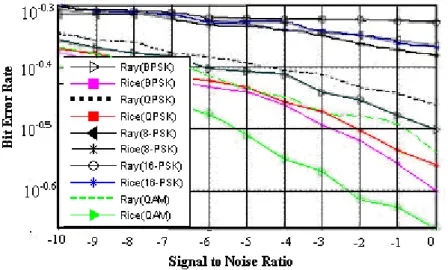
The results of the simulations have been obtained for the concatenated STBC-LDPC coding with two transmitter and three receiver antennas. In this paper we have considered transmission over Rayleigh flat fading and Rician fading channels. For Rician fading channel the Rician factors are considered as K=1 and 4. The channels are modelled as complex Gaussian distributions with a mean ‘m’ and covariance matrix R. In Rayleigh faded channels m=0, and for Rician faded channels the mean ‘m’ is the sum of the power in the line-of-sight and the local-mean scattered power. For both Rayleigh as well as Rician faded environments, R=I. The noise considered as additive is modelled as a circular symmetric complex Gaussian random variable with mean 0 and variance 1. In this paper a (180,360) irregular LDPC with a mean column weight of 3 has been employed. A frame consisting of 360 coded bits is sent from the LDPC encoder with all the bits with random values 0 and 1, which are then fed into the space-time block encoder. The results have been obtained from 1000 independent iterations of each frame, for each value of SNR varying from -10 to 20dB. Figure 3(a) shows the plot of the bit error rate (BER) for MPSK and QAM modulation schemes in Rayleigh and Rician faded environments. A more expanded view of Figure 3(a) is shown in Figure 3(b). From these figures it can be observed that for a BER of 5 x 10⁻¹, QPSK
requires an SNR of 13.8 dB and QAM requires an SNR of 3.2 dB. QAM provides 8.8 dB coding gain over QPSK in a Rayleigh faded environment.
Similarly in a Rician faded environment for the same BER, QPSK and QAM require SNR of -2 dB and -5.2 dB respectively, providing a coding gain of 3.2 dB by using QAM over QPSK. The input SNR required for various constellations of PSK and QAM modulations at a BER of 5 x 10⁻¹ is
given in Table 1.
Table 1. SNR results for different modulation techniques at BER = 5 x 10⁻¹ in NLOS and
LOS environments
Figure 3(a). BER of concatenated STBC-LDPC scheme in Rayleigh and Rician fading with different modulation schemes
Figure 3 (b). An expanded view of Figure 3(a) in which a variation is shown for the lower value of SNR
Modulation scheme SNR required in dB at BER of 5x 10⁻¹
Rayleigh fading Rician fading(K=1)
QAM -0.9 -5.2
BPSK 14 -3
QPSK 13.8 -2
8-PSK >20 14.1
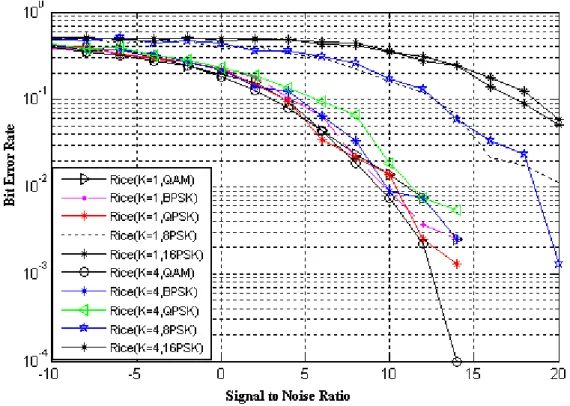
Figure 4 provides a comparison of BER for various modulation schemes in a Rician fading environment for a varying Rice factor K (K = 1 and 4). For a bit error rate of 5 x 10⁻¹, it is found
that QAM outperforms the other modulation schemes in a Rician faded environment with K=1. A more comprehensible view of Figure 4(a) is shown in Figure 4(b), where it can be observed that QAM requires nearly half the power to achieve the same bit error rate when compared with the QPSK scheme despite having the same constellation size. Table 2 shows the SNR required by various modulation techniques to achieve a BER of 5 x 10⁻¹ in a Rician faded environment. It
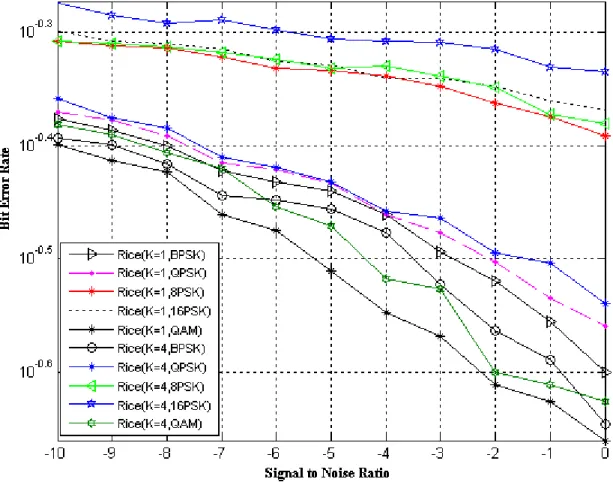
illustrates that for the same BER, the QAM technique requires minimum power and a 16-psk signal requires maximum power. Figure 5 shows a normalised view of the BER of a concatenated LDPC-STBC scheme in Rayleigh and Rician faded environments.
Figure 4 (b). A more comprehensive view of Figure 4(a) in which a variation is shown for lower values of SNR
Figure 5. Normalised BER of concatenated STBC-LDPC scheme in Rayleigh-Rician fading
Table 2. SNR results for different modulation techniques at BER =5 x 10⁻¹ in an LOS
environment
CONCLUSIONS
The bit error rate performance of concatenated irregular LDPC codes has been evaluated in flat Rayleigh and Rician faded environments. Simulation results show that the quadrature amplitude modulation (QAM) technique with LDPC codes and complex orthogonal space-time block codes is able to achieve higher coding than QPSK modulation technique in all fading environments.
ACKNOWLEDGEMENTS
The work is supported by UGC and AICTE India vide letter no. 31-1(PUN)(SR) 2008 TU and letter no. 8023/BOR/RID/RPS-105/2008-09.
REFERENCES
1. S. M. Alamouti, “A simple transmit diversity technique for wireless communications”, IEEE J. Sel. Areas Commun., 1998, 16,1451-1458.
2. V. Tarokh, N. Seshadri and A. R. Calderbank, “Space-time codes for high data rate wireless communication: Performance criterion and code construction”, IEEE Trans. Inf. Theory, 1998, 44, 744-765.
3. V. Tarokh, H. Jafarkhani and A. R. Calderbank, “Space-time block codes from orthogonal designs”, IEEE Trans. Inf. Theory, 1999, 45, 1456-1467.
4. W. Su and X.-G. Xia, “On Space-time block codes from complex orthogonal designs”, Wireless Person. Commun., 2003, 25, 1-26.
5. T. J. Richardson, M. A. Shokrollahi and R. L. Urbanke, “Design of capacity-approaching irregular low-density parity check codes”, IEEE Trans. Inf. Theory, 2001, 47, 619-637.
6. S.-Y. Chung, T. J. Richardson and R. L. Urbanke, “Analysis of sum-product decoding of low-density parity-check codes using a Gaussian approximation”, IEEE Trans. Inf. Theory, 2001, 47, 657-670.
7. O. Alamri. S. X. Ng, F. Guo, S. Zummo and L. Hanzo, “Nonbinary LDPC-coded sphere-packed transmit diversity”, IEEE Trans. Veh. Technol., 2008, 57, 3200-3205.
8. A. Kavcic, X. Ma and M. Mitzenmacher, “Binary intersymbol interference channels: Gallager codes, density evolution, and code performance bounds”. IEEE Trans. Inf. Theory, 2003, 49, 1636-1652.
Modulation scheme SNR required in dB at BER of 5 x 10⁻¹
Rician fading (K=1) Rician fading (K=4)
QAM 4.7 4.8
BPSK 6.1 6.2
QPSK 5.2 8.1
8-PSK 14 14.2
9. S.-Y. Chung, G. D. Forney Jr., T. J. Richardson and R. Urbanke, “On the design of low-density parity-check codes within 0.0045 dB of the Shannon limit”, IEEE Commun. Lett., 2001, 5, 58-60.
10. S. Gounai and T. Ohtsuki, “Performance analysis of LDPC code with spatial diversity”, Proceedings of IEEE 64th Vehicular Technology Conference, 2006, Montreal, Quebec, pp.1-5.
11. S. Sharma and R. Khanna, “Analysis of LDPC with optimum combining”, Int. J. Electron., 2009, 96, 803-811.
12. B. Lu, X. Wang and R. N. Krishna, “LDPC-based space-time coded OFDM systems over correlated fading channels performance: Analysis and receiver design”, IEEE Trans . Commun., 2002, 50, 74-88.
13. J. Hou, P. H. Siegel, L. B. Milstein and H. D. Pfister, “Capacity-approaching bandwidth-efficient coded modulation schemes based on low-density parity-check codes”, IEEE Trans. Inf. Theory, 2003, 49, 2141-2155.
14. V. Gulati and K. R. Narayanan, “Concatenated space-time codes for quasi-static fading channels: Constrained capacity and code design”, Proceedings of IEEE Global Telecommunication Conference, 2002, Taipei, Taiwan, pp.1202-1206.
15. G. Li, I. J. Fair and W. A. Krzymien “Low-density parity-check codes for space-time wireless transmission”, IEEE Trans. Wireless Commun., 2006, 5, 312-322.
16. W. Lanxun and L. Weizhen, “Quasi-orthogonal space time block codes (STBC) with full transmit rate concatenated LDPC codes”, Proceedings of the 8th International Conference on
Electronic Measurement and Instruments, 2007, Xian, China, pp.3207-3210.
17. T. K. Moon, “Error Correction Coding: Mathematical Methods and Algorithms”, Wiley-Interscience, London, 2005, pp.641-648.
18. T. Richardson and R. Urbanke, “Modern Coding Theory”, Cambridge University Press, Cambridge, 2008, pp.459-464.
19. R. Gallager, “Low-density parity-check codes”, IRE Trans. Inf. Theory, 1962, 8, 21-28.